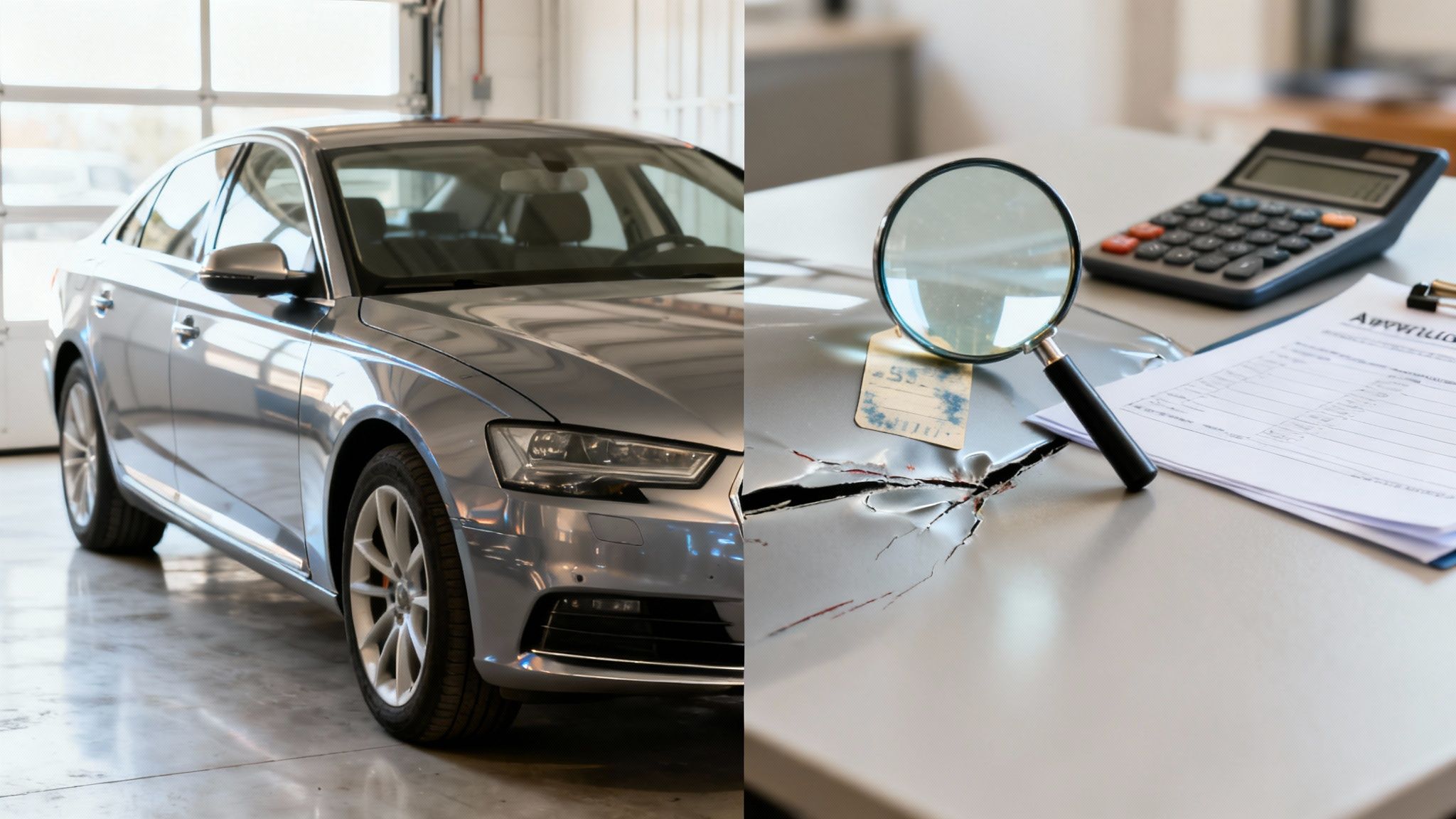
Even after perfect repairs, your car's value takes a dive after an accident. This financial hit is called Diminished Value, and it's the real-world loss in resale price your vehicle suffers simply because it now has an accident on its record. It's the hidden cost of a collision, and it's one that insurance companies often hope you won't notice.
The Hidden Financial Damage After a Collision
An accident is more than just a jarring event; it's the start of a quiet battle over your vehicle's true worth. Most people focus on the immediate stress of getting their car fixed, but the real challenge often starts after the body shop is done. Your car might look as good as new, but its value has been permanently scarred in the eyes of the market.

Think of it this way: if a collector's item is damaged and then perfectly restored, it will never fetch the same price as an identical, untouched original. The same logic applies to your car. That accident history creates a permanent stigma that savvy buyers, dealers, and vehicle history reports will flag, immediately putting you at a financial disadvantage when it's time to sell or trade it in.
The Two Major Financial Hits You Face
When you're in a collision, you're usually up against two distinct, yet equally frustrating, financial problems. Knowing what they are is the first step toward getting back what you're owed.
- Immediate Resale Value Loss: This is the big one for most people. Even if you get flawless, factory-certified repairs, the accident is now part of your car's permanent record. That history alone can slash its resale value by 10% to 30% or more, depending on the car and how bad the damage was.
- A Lowball Total Loss Settlement: If the damage is bad enough that the insurance company declares the car a total loss, you have a different fight on your hands. Insurers often rely on their preferred valuation software to come up with a settlement offer, which can easily be thousands less than what your car was actually worth moments before the crash.
This guide will walk you through both of these scenarios. We'll give you a clear roadmap for understanding, documenting, and proving the true financial loss your vehicle has suffered so you can fight for a fair outcome.
The core issue is that once a car has a crash history, it’s just not worth as much to a potential buyer. That drop in value is real, and under the right conditions, you can file a claim to recover it.
Why This Matters for Every Driver
The stakes are especially high if you own certain types of vehicles. Anyone with a newer, high-value, classic, or customized car stands to lose the most.
A fender bender on a five-year-old daily driver might cause a manageable loss. But that same minor accident on a new luxury SUV or a lovingly restored muscle car could translate into a five-figure financial hit. By understanding how to properly calculate and claim your car's diminished value, you can push back against lowball offers and recover the full, fair market value you deserve.
What Is Diminished Value, and Why Does It Matter?
When you’ve been in a car accident, the first thing on your mind is getting your vehicle fixed and back on the road. But even after the best body shop in town works its magic, your car has a permanent mark on its history. This is where Diminished Value (DV) comes into play. It's the simple, frustrating truth that your car is worth less after a collision, and understanding this concept is the key to getting a fair settlement.
Let’s use a real estate analogy. Imagine two identical houses for sale, side-by-side. One has a perfect history. The other had major foundation damage a few years ago, but it’s been expertly repaired. Which one would you pay more for? Almost everyone would choose the one without the history of problems, and they’d expect a steep discount on the other.
Diminished Value is that exact price difference, but for your car.
The Three Types of Diminished Value
The loss in your car's value isn't just one number; it actually breaks down into three distinct categories. Knowing the difference helps you understand what you can and should claim.
- Inherent Diminished Value: This is the big one and the most common type. It’s the automatic drop in market value just because your vehicle now has an accident on its record. Even with flawless repairs, that history follows the car forever, and it’s the stigma that will lower your car value after accident when you try to sell or trade it in.
- Repair-Related Diminished Value: This type of value loss happens when the repairs aren't quite right. Maybe the paint doesn't match perfectly, or the shop used cheaper aftermarket parts instead of genuine factory (OEM) ones. Any sign that the car isn't back to its pre-accident condition falls under this category.
- Immediate Diminished Value: This is the technical term for the difference in the car's value right after the crash but before any repairs have been done. It's less common in claims but helps establish the initial scope of the financial damage.
For most people, the fight is over Inherent Diminished Value. This is the guaranteed loss in market perception that exists even with perfect repairs, and it's what the at-fault driver's insurance company owes you.
Not All Cars Lose Value Equally
An accident doesn't affect every car's value the same way. The kind of car you drive is a huge factor in how much value you stand to lose. Luxury brands, high-performance models, and newer vehicles take a much bigger financial hit.
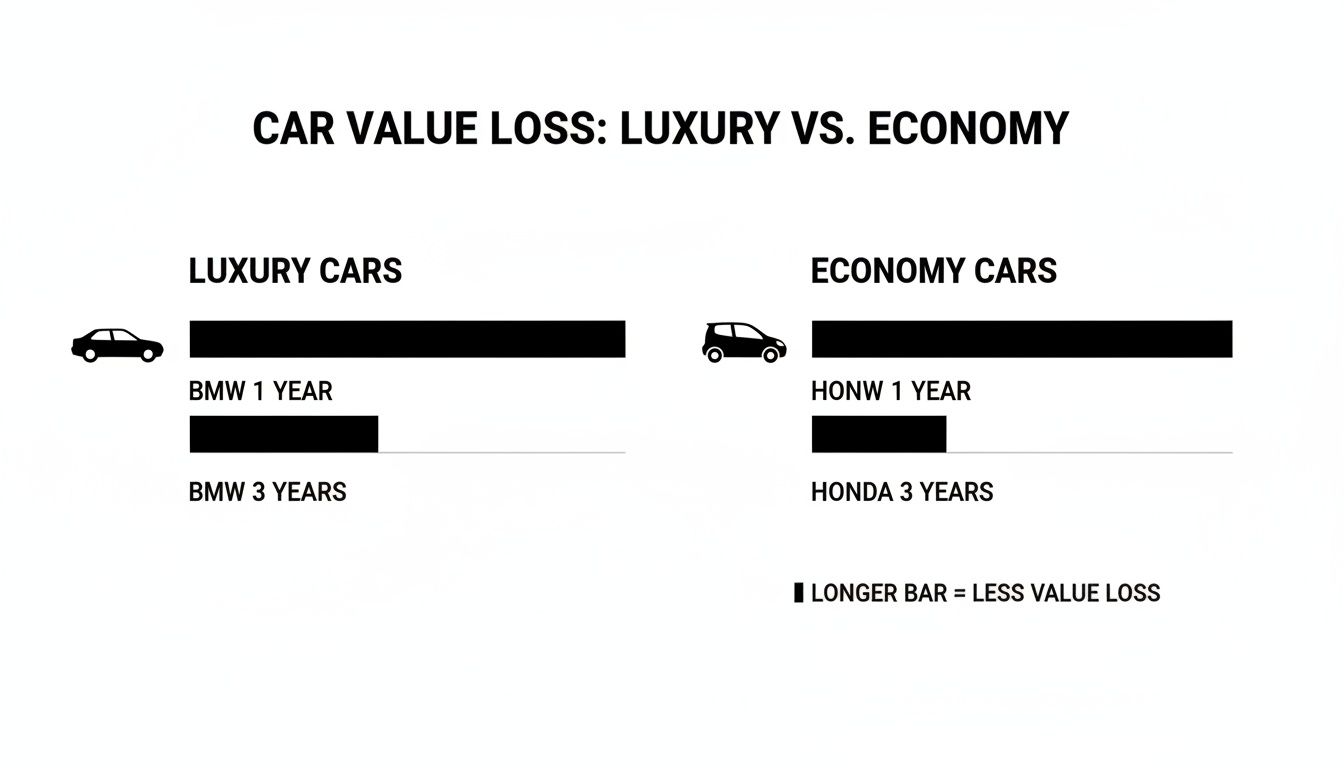
Consider a new BMW 3 Series worth $30,000 before an accident. Real-world data shows that even with minor damage and great repairs, its value can sink by 25-35%. If the accident was major, that drop could be as high as 40-50%. Why? Because potential buyers are naturally suspicious of complex, high-end cars with an accident history, fearing hard-to-spot issues with the frame or electronics. You can explore in-depth research on post-accident depreciation to see how different brands are impacted.
On the other hand, a reliable Honda Civic might only lose 10-20% of its value after a similar minor crash. The market sees it as a simpler, less expensive car to fix, which softens the blow. This is precisely why a cookie-cutter offer from an insurance company rarely covers your actual loss.
Knowing your rights and local laws is also a critical piece of the puzzle. For a comprehensive guide on filing a diminished value claim, especially for those in Oregon, this resource is a great place to start. Armed with this knowledge, you can see exactly what's at stake and understand why getting a professional appraisal is so important to prove your case.
Factors That Determine Post-Accident Value Loss
Not every accident inflicts the same financial wound on a car's value. The actual drop in your car value after an accident isn't a simple calculation; it’s a complex assessment based on several key variables that both appraisers and potential buyers will examine closely.
Understanding these factors is the first step toward building a realistic picture of your financial loss and, more importantly, a stronger claim. Two identical cars can have vastly different outcomes based on the specifics of the collision and, critically, how the aftermath is handled.
Severity of the Damage
The single biggest factor is, without a doubt, the extent and nature of the damage. A minor parking lot scrape is a world away from a collision that compromises the vehicle's core structure.
- Cosmetic Damage: We're talking about scratches, small dents, and scuffed bumpers. While they still require repair and will show up on a vehicle history report, they don’t scream "danger" to a potential buyer.
- Structural and Frame Damage: This is the big one. Any damage to the frame or unibody is a major red flag for buyers, who fear lingering alignment issues, uneven tire wear, and compromised safety. Even with perfect repairs, this kind of history can tank a car's value.
- Airbag Deployment: When airbags go off, it’s an undeniable signal of a serious impact. This event is always recorded on history reports and immediately leads buyers to assume the worst, causing a huge drop in value.
To put it into perspective, the difference in value loss between a minor cosmetic issue and frame damage can be thousands—or even tens of thousands—of dollars. The table below breaks down how this plays out across different car types.
How Accident Severity Impacts Vehicle Value
| Damage Severity | Example of Damage | Value Loss (Economy Car) | Value Loss (Luxury Car) |
|---|---|---|---|
| Minor | Minor bumper scuffs, small door ding | 5% – 10% | 10% – 15% |
| Moderate | Needs new door/fender, headlight replacement | 10% – 20% | 15% – 25% |
| Severe | Frame damage, deployed airbags | 25% – 40%+ | 30% – 50%+ |
As you can see, the hit to a luxury vehicle's value is consistently more punishing. Buyers in that market expect perfection, and an accident history is a serious blemish.
Your Vehicle's Pre-Accident Profile
The car's own identity—its age, make, model, and condition—plays a massive role in how much value it stands to lose. An older, high-mileage commuter car has already lost most of its value, so the impact of an accident is less dramatic. A brand-new luxury SUV, on the other hand, has a long way to fall.
Luxury and high-performance brands like BMW or Mercedes-Benz suffer a much steeper percentage of value loss. Why? Because buyers for these cars are paying for precision engineering and prestige, both of which are tarnished by a collision record. Someone shopping for a 10-year-old Honda Civic is far more forgiving of an accident history than a person looking for a pristine Porsche.
A low-mileage, garage-kept car in excellent condition will also lose a larger percentage of its value than an identical car with high mileage and visible wear and tear.
The core principle is simple: the more value a car has to lose, the more it will lose. A pristine reputation is a key component of a vehicle's worth, and an accident permanently damages that reputation.
The Quality of Repairs
Finally, how the vehicle is repaired has a lasting impact on its post-accident value. A top-tier repair job can soften the financial blow, while shoddy work will only make it worse.
A major point of contention here is the type of parts used. Original Equipment Manufacturer (OEM) parts are made by your car's manufacturer and guarantee a perfect fit and function. Insurers, however, often push for cheaper aftermarket parts to cut costs. To learn more about this critical difference, check out this definitive guide comparing aftermarket parts vs OEM.
The reputation of the repair shop matters, too. A detailed invoice from a manufacturer-certified body shop that lists every OEM part used provides a level of confidence that a generic receipt from a random garage simply can't match. Each of these elements helps determine the final https://totallossnw.com/what-is-actual-cash-value-of-my-car/, a critical figure in any diminished value or total loss claim.
How to Document and Prove Your Claim
It's one thing to know your car has lost a chunk of its value after a wreck. It’s another challenge entirely to prove it to an insurance company. Let’s be frank: insurers are masters at minimizing payouts. Their entire business model depends on it, and they’re betting you won’t have the right paperwork to fight back.
To win this battle, you need to build a rock-solid case with meticulous documentation. It’s about being prepared from the get-go.
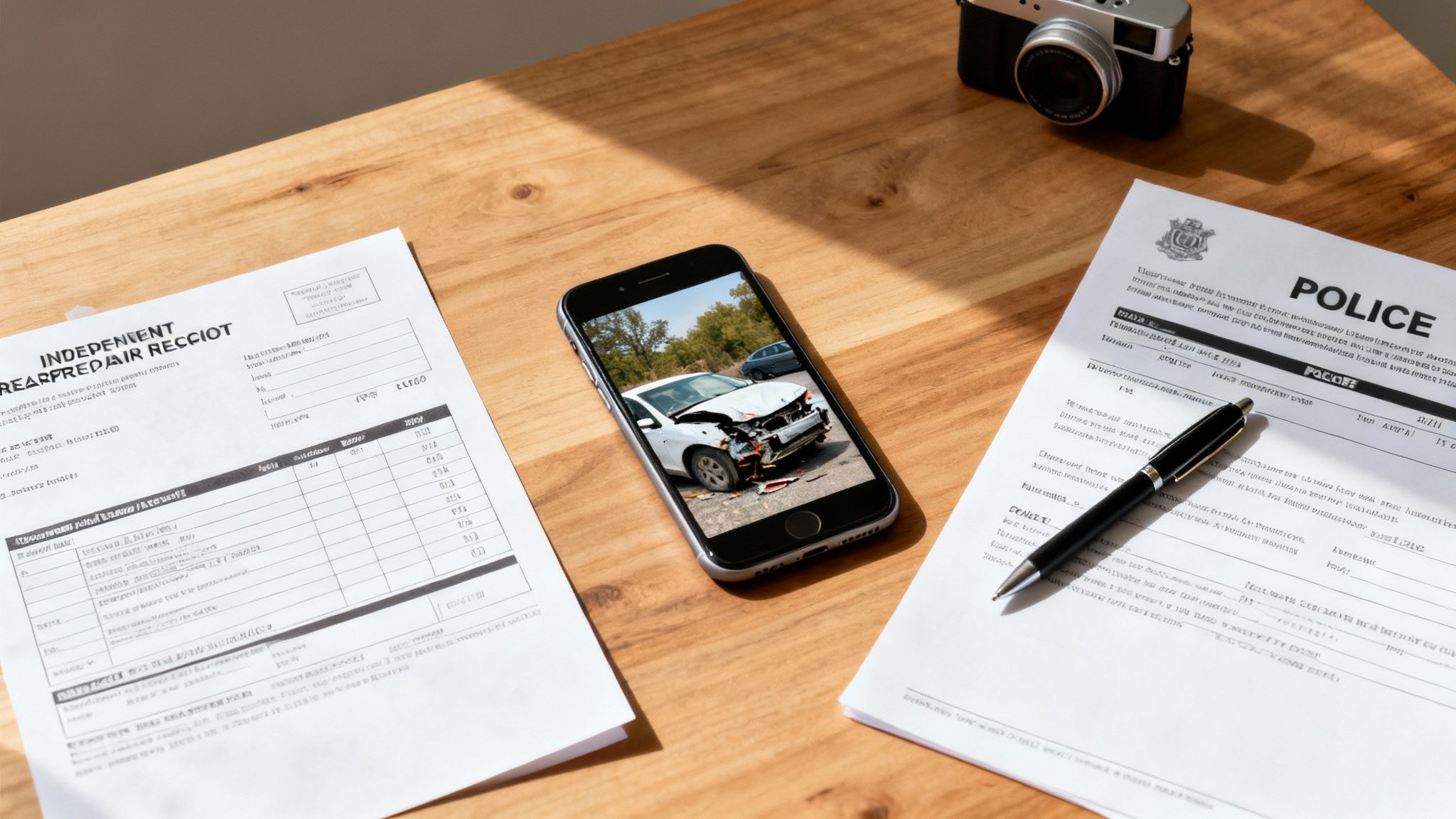
Think of yourself as a detective building a case. A vague story isn’t going to persuade anyone, especially not a seasoned insurance adjuster. You need a file—whether it’s a physical folder or a digital one on your computer—packed with irrefutable proof. This file should tell the complete story: your car's pristine condition before the crash, the extent of the damage, and the undeniable drop in market value after the repairs. This organized evidence is your single most powerful weapon.
Building Your Evidence File
Your first move is to gather every single piece of paper and every digital file related to your car and the accident. Each document adds another layer to your story, creating a complete picture of your financial loss. Don't dismiss anything as unimportant; sometimes the smallest detail can make the biggest difference.
Here’s the essential paperwork you'll need to collect:
- Pre-Accident Photos and Records: If you happen to have photos of your car before the crash, they're pure gold. They prove its condition. Maintenance records and receipts for any upgrades (like new tires or a stereo system) also work wonders to establish its pre-accident worth.
- The Official Police Report: This is your unbiased, third-party account of what happened. Crucially, it often establishes who was at fault, which is a must-have if you're filing a claim against the other driver’s insurance.
- Detailed Repair Estimates: Don’t just get one—get them all. These documents outline the initial damage assessment and the projected costs, which helps illustrate the severity of the collision.
- The Final Repair Invoice: This is a heavyweight document in your arsenal. It should list every single part that was replaced (and specify if they were OEM or aftermarket parts) and all the labor performed. It’s concrete proof of what it took to put your car back together.
This collection of documents lays the groundwork for your claim. But it's still missing the knockout punch.
The cornerstone of any successful diminished value claim is an independent, third-party appraisal report. This document transforms your claim from a mere opinion into a fact-based, market-supported argument.
The Power of an Independent Appraisal
An insurance company’s valuation of your loss is almost guaranteed to be low. Why? Because they use internal software and formulas designed to protect their bottom line, not to make you whole again. A professional appraisal report from a certified, independent expert completely dismantles their lowball offer with unbiased, real-world data.
This report is a deep dive that gives you:
- An Unbiased Pre-Accident Value: The appraiser will determine your car's true fair market value just moments before the impact, using actual market data—not the insurer's self-serving software.
- A Detailed Post-Repair Valuation: With that established, the appraiser then uses their expertise and market comparables to calculate the new, lower value of your vehicle now that it has a permanent accident history.
- A Clear Diminished Value Figure: The report wraps up with a specific dollar amount for your loss, supported by a clear, defensible methodology that the adjuster can't easily dismiss.
Hiring a certified appraiser gives you the leverage you desperately need. It forces the insurance company to stop hiding behind their internal numbers and address the real financial damage you've suffered. This third-party validation is what makes them take your claim for a lower car value after accident seriously.
Not sure if you're ready to commit to a full appraisal? A good first step is to get a rough idea of your potential claim using a professional diminished value claim calculator.
Navigating the Insurance Claim Process
Going head-to-head with an insurance company after an accident can feel like a game you’re set up to lose. The adjuster on the other end of the line is a pro whose job is to settle your claim for as little as possible. They’ve seen it all, and they know how to guide the conversation toward a quick, low offer that might look decent when you’re just trying to get back on your feet.
Here's the single most important thing to burn into your memory: the first offer is almost never the best offer. It's just a starting point, a feeler to see if you'll take the easy way out. Snapping it up is like walking away from the table with chips still on it—chips that belong to you. The insurance company is banking on you being overwhelmed and ready to put the whole ordeal behind you.
But you're not powerless. Tucked away in the fine print of your auto policy is a clause that most people don't even know exists. It's your secret weapon for turning the tables.
Your Ace in the Hole: The Appraisal Clause
This game-changer is called the Appraisal Clause. Think of it as a built-in tie-breaker. When you and the insurer are at a standstill over the value of your car—whether it’s a diminished value claim or a total loss—this clause lets you sideline their biased software and bring in the experts.
Invoking it forces the dispute into a structured, evidence-based process. Here’s how it typically unfolds:
- Step 1: You hire a certified appraiser. This is your expert, someone who will conduct a real-world, unbiased valuation of your vehicle.
- Step 2: The insurance company hires their appraiser. They'll bring in their own expert to do the same.
- Step 3: The appraisers negotiate. The two experts get together, present their data, and work to agree on a fair number.
- Step 4: An umpire makes the final call. If they can’t reach an agreement, a neutral third-party umpire is brought in to review the evidence and make a final, binding decision.
By triggering this process, you elevate the conversation from a frustrating back-and-forth with an adjuster to a formal negotiation based on cold, hard facts. It stops the insurer from simply lowballing you into submission. For a deeper dive into managing these conversations, check out our guide on how to deal with insurance adjusters.
Invoking the Appraisal Clause is the single most effective way to challenge an insurer’s lowball offer. It replaces their opinion with an evidence-based valuation from certified professionals, forcing a fair negotiation.
Knowing When to Play Your Card
Timing is everything. You don't want to jump the gun, but you can't afford to hesitate when the time is right.
The Appraisal Clause is your go-to move when you’ve presented your evidence—like a professional diminished value report—and the adjuster digs in their heels. If they refuse to negotiate or won’t move from a laughably low number, that's your cue. It sends a clear message: you’re serious, you know your rights, and you won’t be pushed around.
Whether the fight is over a few thousand dollars in diminished value or a much larger total loss settlement, the Appraisal Clause is your contractual right to get a fair shake. It’s the tool that ensures your car value after an accident is based on reality, not on the insurance company’s bottom line.
Got Questions About Your Car's Value After a Wreck? We've Got Answers.
When you're trying to get back on your feet after a car accident, the last thing you need is a confusing mess of insurance jargon and legal red tape. It's completely normal to have a ton of questions, and getting straight answers is the first step to protecting your wallet.
This section tackles the most common concerns drivers have about their car's value after a collision. Think of it as your expert-backed FAQ for getting through the process with confidence.
Can I File for Diminished Value If I Caused the Accident?
This is easily one of the most common questions, and the answer is almost always a firm "no."
As a rule, you cannot claim diminished value from your own insurance company if you were the one at fault. Your collision coverage is there to pay for repairs—that’s it. It’s not designed to compensate you for the fact that your car is now worth less on the market, even after it’s been fixed.
Diminished value is a third-party claim. That means you have to file it against the insurance of the driver who hit you. The whole idea is that the at-fault party is responsible for making you whole again, and that includes paying you for the hit your car’s resale value just took. While there might be some rare exceptions in specific states or with special insurance add-ons, you can pretty much count on needing to be the not-at-fault driver.
How Much Time Do I Have to Make a Diminished Value Claim?
Don't sit on this. Every state has a law called the statute of limitations, which is a hard deadline for filing legal claims. Miss it, and your right to get that money back is gone for good.
For property damage claims like diminished value, you typically have anywhere from two to six years from the date of the crash. This window varies widely by state, so it’s crucial to find out the exact deadline where you live and get the ball rolling long before it gets close.
The best time to start your diminished value claim is right after the repairs on your car are finished. At that point, you know exactly how bad the damage was and how well it was fixed, which gives you a solid foundation for an accurate appraisal.
Waiting too long just makes things harder. Evidence gets stale, and insurance companies will use the delay as an excuse to downplay your loss. Acting fast shows them you’re serious about getting what you're rightfully owed.
Is It Worth Hiring an Appraiser for a Minor Fender-Bender?
Whether you should hire an independent appraiser really boils down to simple math: will the money you get back be more than the cost of the appraisal report?
The answer has everything to do with what kind of car you drive.
- For newer, high-end, or luxury cars? Yes, absolutely. Even a small dent on a new Mercedes, a high-end truck, or a specialty sports car can slash thousands off its value. In these situations, paying for a professional appraisal is a no-brainer investment to get a fair payout.
- For an older car with a lot of miles? Probably not. If you're driving a 10-year-old sedan with 150,000 miles and a few dings already, its market value is already pretty low. A minor accident might only ding its value by a few hundred bucks, which likely isn't enough to justify the cost of an appraisal.
A good appraiser will usually offer a quick consultation to look at your case. They can help you figure out if a claim makes financial sense for your specific car, so you don’t end up spending good money to chase after a small return.
What If the Insurance Company Totals My Car Instead?
If the repair bill is more than your car is worth (or at least, more than a certain percentage of its value), the insurance company will declare it a total loss.
When that happens, you’re no longer fighting for diminished value. Instead, the battle shifts to getting a fair settlement for your car's Actual Cash Value (ACV)—what it was worth the moment before the accident.
The problem is, the insurance company's game is the same. They often use valuation software that spits out lowball offers, ignoring your car's great condition, recent upgrades, or the actual prices of similar cars in your area.
But you don't have to take their first offer. You are legally entitled to enough money to buy a comparable replacement vehicle. If the insurer's offer won't do that, you need to dispute it.
Your game plan for a total loss is the same as for a diminished value claim:
- Get an independent appraisal. A certified appraiser will create a detailed report establishing your car’s true market value.
- Invoke the Appraisal Clause. This powerful but often overlooked clause in your policy forces the insurance company into a formal negotiation based on evidence, not just their software.
This one-two punch ensures the final check reflects what your car was actually worth, not just a number that saves the insurance company money.
Navigating a diminished value or total loss claim takes know-how and a refusal to back down. At Total Loss Northwest, we provide certified, independent auto appraisals that hold up against insurance company pressure. If you're stuck with a lowball offer, we can invoke the Appraisal Clause on your behalf and fight for the fair settlement you deserve. Learn more and protect your vehicle's true value.