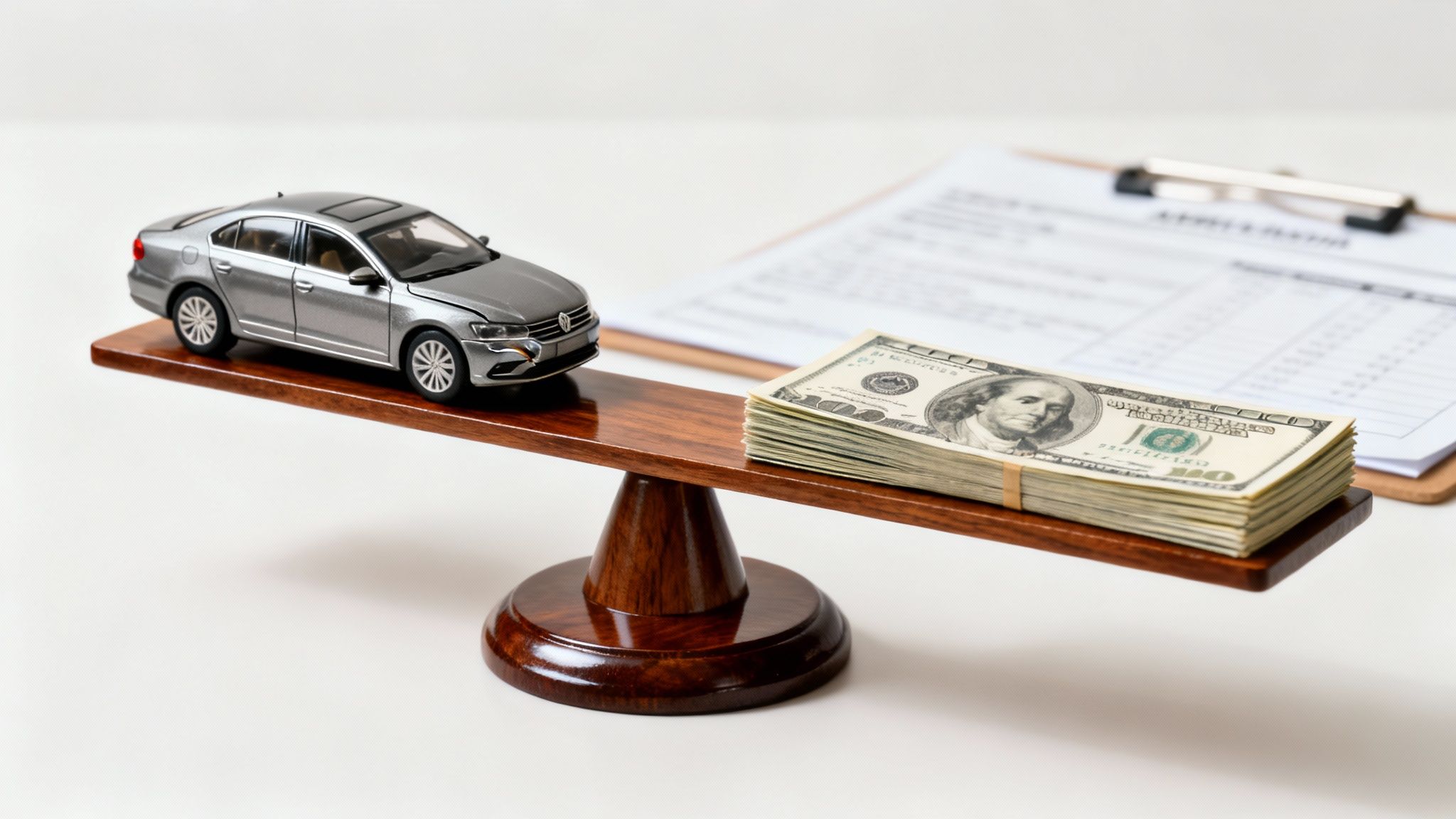
Let's be blunt: a car crash instantly tanks your vehicle's value. Even if a body shop works miracles and makes it look brand new, the accident is now a permanent part of its history. This loss, known as diminished value, can easily slice 10% to 35% off its resale price.
The hard truth is that buyers will always pay less for a car that’s been in a wreck. This guide will walk you through exactly how that value loss is calculated and, more importantly, how you can get that money back.
Why Your Car Is Worth Less After a Crash
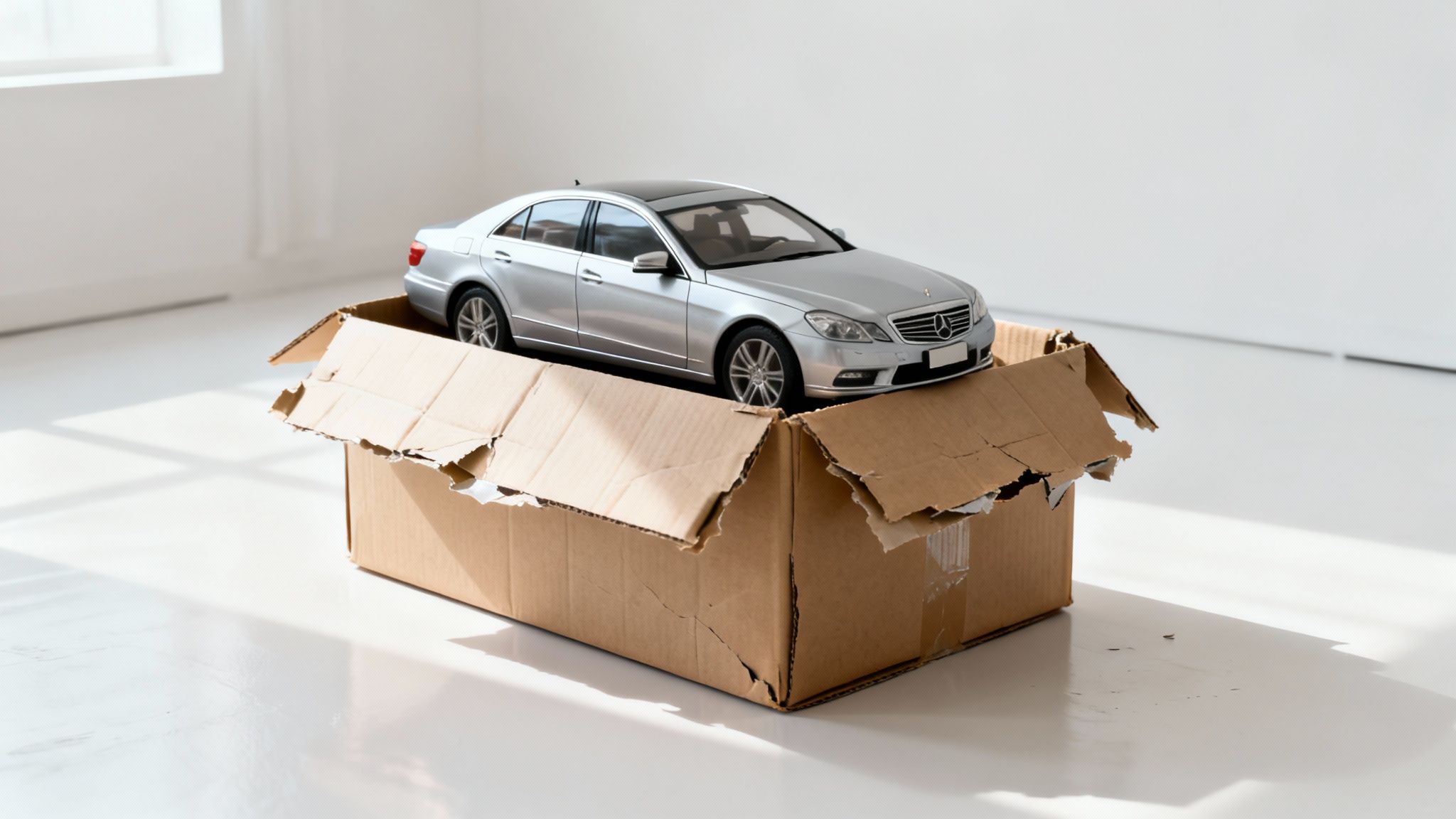
From the moment of impact, your car’s permanent record has a new, ugly entry. This isn't just about feelings; it’s a real financial hit that sticks around long after the dents are gone and the new paint has cured.
Think of it like buying a brand-new TV that comes in a bashed-up box. The TV itself might be perfect, but you'd never pay full price for it, right? You'd demand a steep discount just because the packaging is damaged. It's the exact same logic with your car. A vehicle with an accident on its record, no matter how flawless the repairs, is seen as a bigger risk and is simply less desirable to the next buyer.
The Immediate Financial Impact
The drop in value is both immediate and substantial. For a minor fender-bender, you can expect a 10% to 20% dip in value. For a more serious collision, that loss can easily climb to 30% or 35%, and sometimes even more. We're talking about hundreds, often thousands, of dollars vanishing from your car's resale value overnight. Newer cars and luxury models tend to suffer the biggest percentage drops. You can even see more data on how different car brands are affected by diminished value after an accident.
To give you a clearer picture, here’s a quick breakdown of what you can expect based on the severity of the damage.
Estimated Value Loss by Accident Severity
This table offers a general idea of how much value your car might lose. Remember, these are estimates—the actual amount depends on your specific vehicle and the details of the accident.
| Damage Severity | Typical Percentage Loss | Example on a $25,000 Car |
|---|---|---|
| Minor cosmetic damage | 5% – 10% | $1,250 – $2,500 loss |
| Moderate damage (non-structural) | 10% – 25% | $2,500 – $6,250 loss |
| Major damage (structural repairs) | 30% – 50% | $7,500 – $12,500 loss |
| Severe damage (major parts replaced) | 50%+ | $12,500+ loss |
As you can see, even a minor incident can cost you thousands when you go to sell or trade in your car.
This automatic loss is what the industry calls inherent diminished value. It happens simply because the accident is now documented forever. Grasping this concept is crucial, because if the other driver was at fault, you have a right to be compensated for this loss.
Here's something you need to know: the insurance company isn't going to bring this up. Their business model is built on paying out as little as possible. Understanding your right to a diminished value claim is the first, most important step in getting back the money you're rightfully owed.
This isn't some imaginary loss. It’s real money that you can—and should—fight to recover.
Your Hidden Financial Loss: Understanding Diminished Value
When you're trying to figure out "how much is my car worth after an accident," the most important—and often overlooked—concept is diminished value. Think of it as the silent financial hit your car takes the second an accident is stamped onto its permanent record.
Imagine two identical cars on a used car lot. Same make, model, year, and mileage. One has a squeaky-clean vehicle history report. The other has a note about a collision, even if the repairs were picture-perfect. Which one would you pay full price for? That gap in what you'd be willing to pay is its diminished value.
What Is Inherent Diminished Value?
The most common type you’ll run into is Inherent Diminished Value. This is the automatic, instant drop in your car’s market value simply because it now has a documented accident history. It has absolutely nothing to do with how good the repairs were.
Even if a master technician used original factory parts to make it look brand new, a stigma is now permanently attached to your car's VIN. Future buyers will always have that nagging doubt about hidden, long-term problems, which means they'll offer you less money than they would for a comparable car with no accident on its record. This loss isn't just a feeling; it's a real, measurable dollar amount.
The key idea is this: your car's value is hurt not just by the physical damage, but by its damaged reputation. This is a tangible financial loss, and if another driver was at fault, you are legally entitled to get that money back.
But here's the catch. The at-fault driver's insurance company isn't going to volunteer this payment. Their job is to settle the claim for as little as possible, which usually means paying for the repairs and hoping you don't know you can ask for more.
Why You Can't Afford to Ignore This Claim
If you don't file a diminished value claim, you're essentially agreeing to eat a financial loss that someone else caused. You might not feel it today, but you absolutely will when it's time to sell or trade in your car.
- Lower Trade-In Offers: The moment a dealership pulls the vehicle history report and sees an accident, their offer will drop. It's a non-negotiable part of their calculation.
- Reduced Private Sale Price: Smart private buyers will use that accident history as their biggest piece of negotiating leverage to talk you down from your asking price.
- Slower Sale: A car with a wreck on its record just takes longer to sell. Many buyers will scroll right past it, looking for an identical one with a clean history.
This isn't some abstract concept; it's a real-world hit to your wallet. For a great breakdown of how to recover this money, check out this guide on understanding a diminished value claim in Oregon. While it’s state-specific, the core principles show you the steps needed to get what you're owed. Knowing your rights is the first step toward making sure you don't end up paying for someone else's mistake.
How Insurance Companies Try to Undervalue Your Claim
When you file a diminished value claim, you're stepping onto the insurance company's home turf. And they have a well-worn playbook designed to pay out as little as possible. Their primary goal isn't to make you whole again; it's to settle your claim for the lowest possible cost to them.
They often lean on internal formulas and proprietary software that don’t really line up with what’s happening in the real-world car market. It can feel like they’re intentionally making things confusing, all leading to a lowball offer that looks official but is nowhere near fair. Knowing their tactics is your first step in fighting back.
This whole process is about one thing: your car's value taking a permanent hit after an accident, even with perfect repairs.
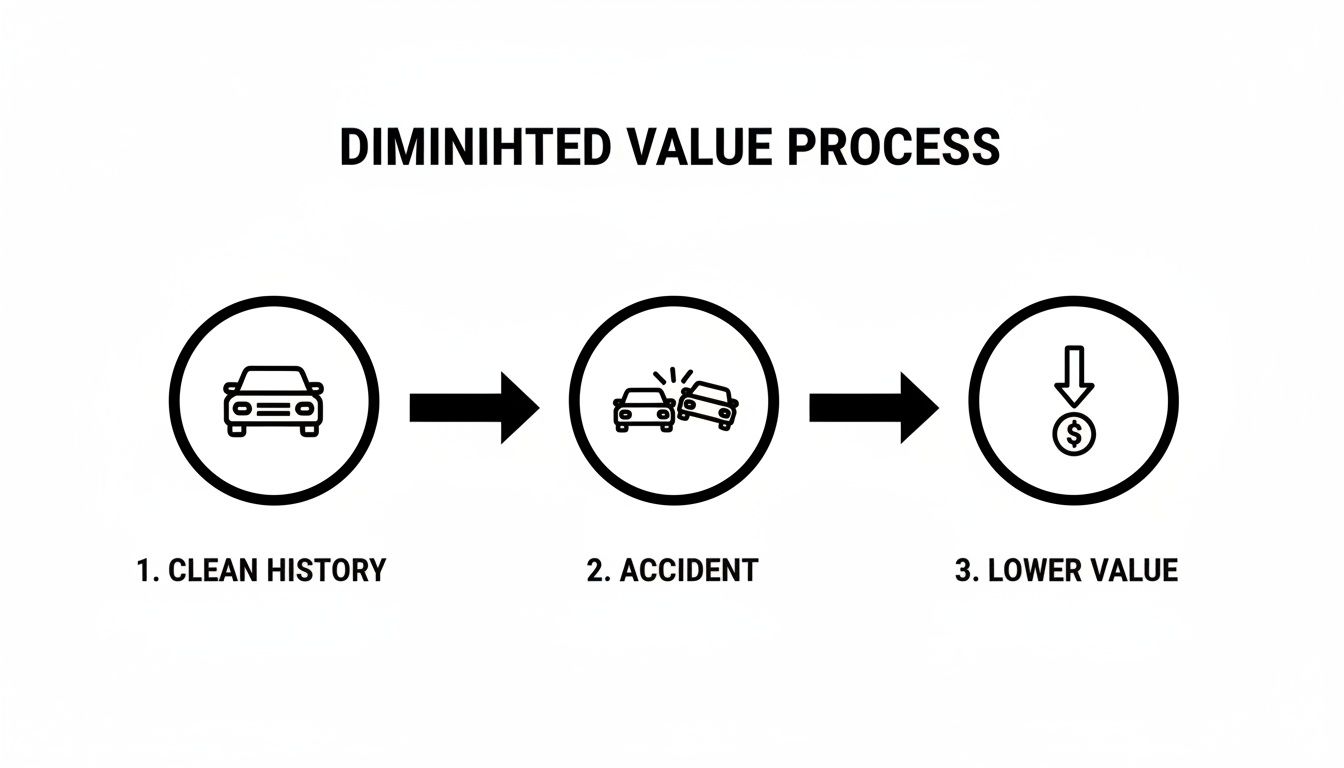
As the diagram shows, once that accident is on the record, the vehicle’s history is scarred, directly causing its market value to drop.
Exposing the Notorious "17c Formula"
One of the most common tricks up an insurer's sleeve is a calculation known as the 17c Formula. It might sound official, but it's a deeply flawed method almost guaranteed to work in their favor. This formula systematically chips away at your potential payout using a series of arbitrary caps and modifiers.
Here’s a quick look at how it breaks down your claim:
- Start with a Low Ceiling: The formula immediately caps the maximum diminished value at 10% of your car’s pre-accident value. Right off the bat, your claim is hamstrung, no matter how much value your car actually lost.
- Add a "Damage" Modifier: Next, they apply a subjective multiplier based on the damage severity. This is just another step to shrink the already-capped number.
- Factor in a "Mileage" Modifier: Finally, they hit it with another multiplier for your car’s mileage, reducing the figure even further.
This method is engineered from the ground up to produce a low number. It completely ignores what real buyers in your local market would pay for a car with an accident history. It's just an internal calculation they use to justify a rock-bottom settlement.
Let’s see it in action. Say your SUV was worth $25,000 before the accident. The 17c formula would cap the loss at $2,500 (10%). Then, they might apply a "moderate damage" multiplier of 0.50, dropping it to $1,250. After a mileage factor of 0.80, you’re left with a final offer of just $1,000. That’s a fraction of the true loss, which could easily be 20-30%.
Why Their First Offer Is Almost Always a Lowball
The number the insurance adjuster gives you isn't a fair assessment of your car’s lost value. Think of it as their opening bid in a negotiation—and it's always a low one. They are banking on the fact that you'll be too overwhelmed or uninformed to question it.
This is exactly why an independent appraisal is so crucial. You need to counter their formula-driven number with a real-world valuation. A proper appraisal doesn't rely on made-up multipliers; it uses hard data, sales of comparable vehicles, and an expert's analysis to pinpoint the true financial damage.
It's about replacing their biased calculation with undeniable proof of what your car is now worth. Understanding the real figures is everything, and a great place to start is learning what is actual cash value of my car from our in-depth guide.
What Really Drives Your Car's Loss in Value?
When you're trying to figure out how much your car is worth after a wreck, you have to understand that no two claims are ever the same. A handful of key factors all come together to determine the final diminished value, and a professional appraiser will scrutinize every single one to build your case.
It’s a lot like a home appraisal. The final price isn't just about the square footage; it's a blend of the neighborhood, the home's condition, its age, and what buyers are looking for. Your car's loss in value works the same way, relying on a specific set of details that go well beyond the cost of repairs.
Your Car's Unique Profile
Long before the accident, your car already had a unique story—a profile that directly influences how much value it can lose. An appraiser’s first step is to dig into these core details to set a baseline.
Think of these as the foundational pieces of the puzzle:
- Age and Mileage: Newer, low-mileage cars get hit the hardest. When someone buys a car that's only a year or two old, they expect it to be perfect. An accident history shatters that expectation and scares buyers away, causing a much steeper drop in value.
- Pre-Accident Condition: Was your car immaculate, or did it already have some dings, faded paint, or a few mechanical quirks? A car that was in excellent shape before the crash will have a much stronger and higher diminished value claim.
- Make, Model, and Market Buzz: This is a big one. Luxury brands like Mercedes-Benz, sports cars, and in-demand models like a Ford Bronco or Toyota Tacoma take a much bigger financial hit. Their value is wrapped up in their reputation for quality and performance, so an accident record makes buyers seriously question what they're willing to pay. That drop is far more significant than it would be for a typical family sedan.
The Story Told by the Damage
In the world of car values, not all damage is viewed the same way. The type and severity of the repairs—which are now permanently attached to your car’s vehicle history report—are probably the single most important factor.
A simple bumper replacement is one thing. But the moment words like “structural damage” or “frame damage” show up on that report, the car's value falls off a cliff. These are massive red flags for any potential buyer, who will instantly worry about future problems with alignment, safety, and reliability.
Even if the repair work is absolutely perfect, that stigma of major damage is impossible to erase. A professional appraiser will always focus heavily on whether the damage was just cosmetic or if it went deeper into the car's structure when calculating the final value loss.
If you want a rough idea of how these factors might play out for your specific vehicle, using a good car value after accident calculator can give you a solid starting point. It's a great way to get a ballpark estimate before you officially kick off the claims process.
Your Playbook for Getting a Fair Settlement
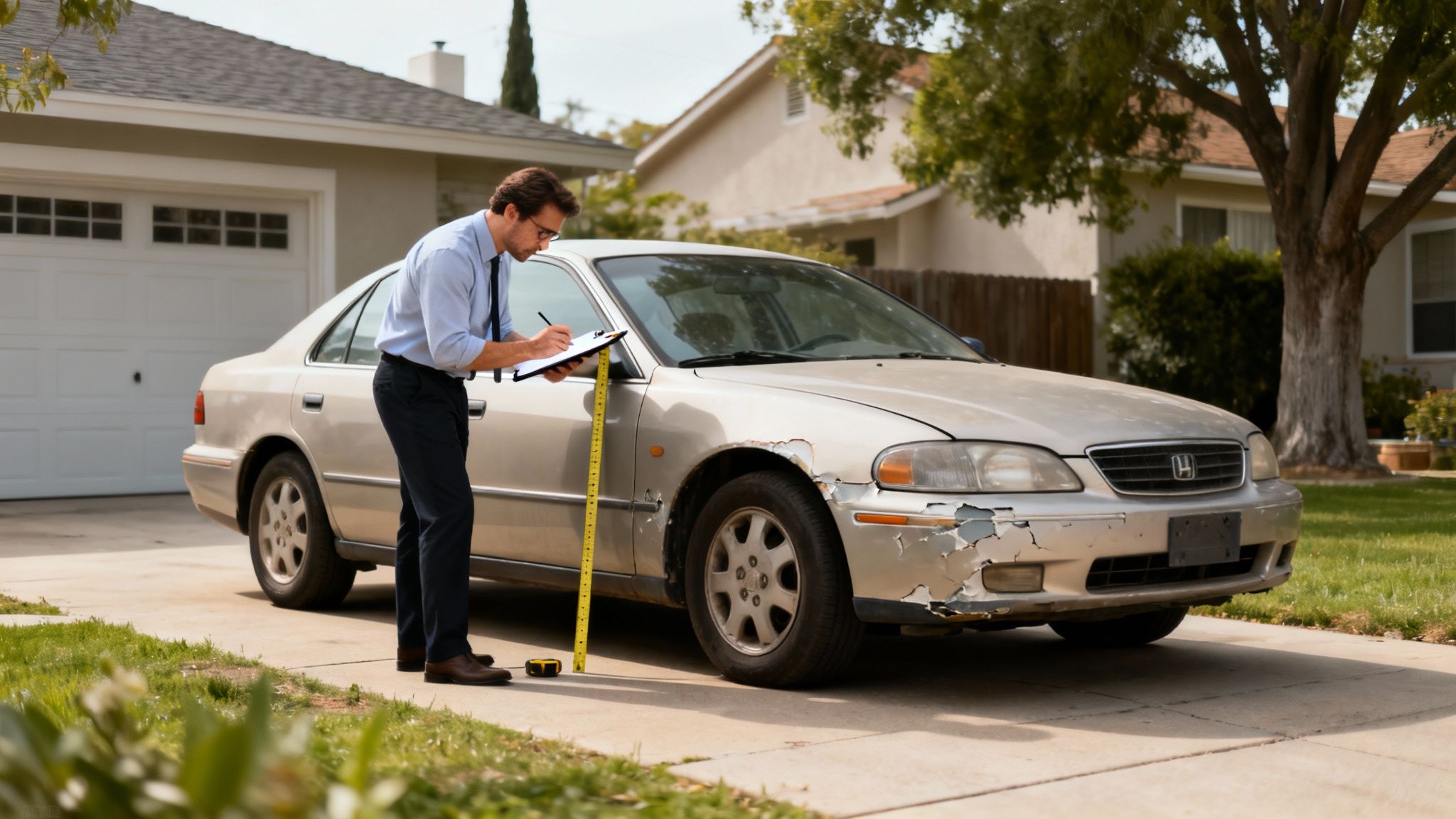
Let's be honest—after a wreck, the insurance company seems to hold all the power. They have the adjusters, the complex formulas, and a whole lot of experience pushing for the lowest possible settlement. This guide is your counter-strategy, designed to level the playing field and help you get the compensation you rightfully deserve.
If you remember only one thing from this article, make it this: you do not have to accept their first offer. Seriously. Think of their initial offer as the opening bid in a negotiation. It's almost always a lowball figure designed to close your claim quickly and for as little money as possible. Your job is to pause, gather your own evidence, and build a counter-offer based on facts.
Step 1: Get Your Own Expert—Don't Rely on Theirs
Your single best tool against a low offer is an independent, certified appraisal. The insurance adjuster works for the insurance company; their interests are not your interests. An independent appraiser, on the other hand, works for you. Their sole focus is to determine the true diminished value of your car using real-world market data, not some flawed internal formula like Rule 17c.
A professional appraiser will:
- Pinpoint Pre-Accident Value: They dig into your local market to figure out exactly what your car was worth moments before the crash.
- Scrutinize the Damage and Repairs: They'll go over the repair invoices and photos with a fine-tooth comb to understand the true severity of the damage, especially any structural work.
- Deliver a Data-Backed Report: You get a comprehensive document that clearly explains and justifies the diminished value number. This report becomes your most crucial piece of evidence.
Remember, the quality of the repair work itself is a huge factor. That’s why choosing a reputable auto body shop is so important. Excellent repairs can help your case, but they don't magically erase the diminished value caused by the accident history.
Step 2: Use the "Appraisal Clause" in Your Policy
Tucked away in the fine print of most auto insurance policies is a little-known but powerful tool called the Appraisal Clause. This clause lays out a specific process for settling disagreements over a vehicle's value. When you invoke it, you can essentially force the insurance company to treat your independent appraisal with the seriousness it deserves.
The Appraisal Clause is a game-changer. It states that if you and the insurer can't agree on the value, you each hire an appraiser. If those two still can't agree, they bring in a neutral third appraiser—an "umpire"—to make a final, binding decision. This effectively takes the decision-making power away from the insurance company's adjuster.
This simple step moves the entire negotiation out of their hands and into a forum of neutral experts. It's a formal but incredibly effective way to cut through the lowball tactics and get a final number based on fair market reality.
Step 3: Formally Submit Your Claim
With your independent appraisal report ready, it's time to formally submit your diminished value claim to the at-fault driver's insurance company. You want your demand to be professional, clear, and firmly supported by the evidence your appraiser has gathered.
Make sure your written claim includes:
- A clear, direct statement that you are filing a claim for your vehicle’s inherent diminished value.
- A complete copy of your independent appraisal report.
- All repair records and any other documentation from the body shop.
This organized, evidence-based approach sends a clear message: you know your rights, you've done your homework, and you're prepared to stand your ground for a fair settlement. It completely flips the script—instead of them telling you what your car is worth, you are showing them with undeniable expert analysis.
Decoding Your Independent Appraisal Report
When you get an independent appraisal report, it's easy to feel a bit overwhelmed. But this document is your single most important weapon in a diminished value claim. It’s a detailed, evidence-based argument that systematically dismantles the insurer's lowball offer and proves what your car is really worth now.
Think of it less as a simple price tag and more like a legal argument for your car's lost value. A good appraiser doesn't just pull a number out of thin air; they build a case, piece by piece, to show the insurance company you've done your homework and you're not backing down.
What to Expect in the Report
A professional appraisal report is a thorough document. It’s designed to be read, understood, and respected by adjusters, managers, and even lawyers if it comes to that. Here's a look at what you'll find inside.
-
Pre-Accident Valuation: First, the report will establish a rock-solid fair market value for your car the moment before the accident. This isn't based on a generic online tool but on real-world sales data for comparable vehicles in your specific local market.
-
Repair Quality Assessment: The appraiser digs into the repair work itself. They’ll review every line of the body shop invoice and often conduct a physical inspection to judge the quality and extent of the repairs. Were corners cut? Is there evidence of the damage that can't be erased?
-
Comparable Sales Analysis: This is the heart of your claim. The report will feature actual examples of similar cars—same make, model, year, and trim—that have sold recently. Crucially, it will compare ones with clean histories to ones with accident histories, creating a clear, data-driven picture of the value gap.
-
Final Value Calculation: With all the evidence laid out, the report presents the final diminished value figure. It's not just a number; it’s a conclusion supported by all the preceding analysis, with a clear explanation of how the appraiser arrived at that specific amount.
This report isn't just someone's opinion. It’s a professional analysis built to stand up to tough questions from the insurance company, giving you the solid ground you need to negotiate for what you are rightfully owed.
Once you understand the different parts of a professional vehicle appraisal, the whole process becomes much clearer. That intimidating stack of paper transforms into your personal roadmap for securing a fair settlement.
Got Questions? We've Got Answers
When you're dealing with the aftermath of an accident, a lot of questions pop up, especially around your car's value. Let's tackle some of the most common ones we hear from drivers every day.
Can I File for Diminished Value if I Caused the Wreck?
This is a big one, and the short answer is almost always no. A diminished value claim is something you file against the insurance company of the driver who was at fault.
Think of it this way: their negligence caused your car to lose value, so their policy is on the hook to make you whole. Your own collision coverage is there to pay for the physical repairs, but it won't compensate you for the hit to your car's resale price.
Is There a Deadline for Filing My Claim?
Absolutely. Every state has a legal clock ticking, known as the statute of limitations, for property damage claims. This window is often just two to three years from the day of the accident.
Don't wait. The longer you delay, the harder it can be to pull together the proof you need, and if you miss the deadline, you lose your right to file a claim forever. It’s best to get the ball rolling as soon as you can.
Does an Appraisal Make Sense for an Older Car?
It really comes down to the car's pre-accident value and what kind of "older car" we're talking about. If you have a high-mileage daily driver that was only worth a couple of thousand dollars before the crash, paying a few hundred for an appraisal probably isn't a smart financial move.
But what if it's a classic, a low-mileage enthusiast car, or just an older vehicle that was in pristine condition? In those cases, a professional appraisal is often essential. The goal is to make sure the potential payout from your claim is significantly higher than what you'll spend on the appraiser.
A quick chat with a professional can help you figure out if pursuing a claim makes financial sense for your specific car.
Don't let the insurance company dictate what your vehicle is worth. At Total Loss Northwest, we provide certified, independent appraisals to ensure you get the fair settlement you're legally owed. We fight for you. Get your free estimate and start your claim today.