So, you've been in a car accident that wasn't your fault. You went through the hassle, the repairs are done, and your car looks great. But there's a hidden cost you might not have considered: the loss in its resale value. This is where a diminished value claim comes in.
Simply put, a diminished value claim is your right to get paid for the money your car lost on the market just because it now has an accident on its record. Even with flawless repairs, that stigma sticks. You file this claim against the at-fault driver's insurance company to make up for this financial hit. The whole game is about proving the dollar difference between what your car was worth right before the crash and what it's worth now with that accident history.
What is Diminished Value, Really?
After a wreck, everyone's first thought is getting the car fixed. The at-fault insurer pays the body shop, and you get your vehicle back looking like it did before. But what they don't tell you is that your car has suffered from inherent diminished value.
This is the automatic, immediate drop in value that happens the second an accident is logged on a vehicle history report like CarFax or AutoCheck.
Put yourself in a car buyer's shoes for a minute. You're looking at two identical used trucks—same year, same mileage, same trim. One has a squeaky-clean vehicle history. The other has a record of a major rear-end collision, even though it was professionally repaired. Which one are you buying? You’d either walk away from the wrecked one or you'd expect a hefty discount to even consider it.
That discount is the diminished value. It's a real, tangible financial loss you'll face head-on the day you try to sell or trade in that vehicle.
The legal idea here is straightforward: The person who caused the accident is responsible for making you whole. Just fixing the dents and scrapes isn't enough. They also have to compensate you for the economic damage their driver caused.
How Much Money Are We Talking About?
This isn't just a few bucks. The amount you can claim depends on a lot of things: your car's age and pre-accident value, how bad the damage was, and your state's specific rules. A little parking lot scrape on a 10-year-old car won't be much, but serious frame damage on a new luxury sedan can result in a massive loss.
While the average payout nationwide is often cited around $1,500, realistic settlements usually land somewhere between 10% and 25% of the car's pre-crash value.
Let's break that down:
- A $20,000 car could see a diminished value settlement from $2,000 to $5,000.
- A $30,000 vehicle might warrant a claim of $3,000 to $7,500, or even more if the repairs were extensive.
Why You’ll Have to Fight for It
Even though this is a legitimate claim, don't expect the insurance company to write you a check with a smile. Their adjusters are trained to keep payouts as low as possible. I've seen them use the same playbook time and time again.
They might try to:
- Flat-out deny it. A common line is, "Oh, we don't pay for that in your state," which is often just not true.
- Give you a tiny offer. Many insurers use a flawed internal calculation (often called the "17c formula") that spits out a laughably low number.
- Drag their feet. The longer they wait, the more likely it is you'll get tired of the process and just drop it.
Winning this fight means knowing the specific diminished value laws in your state and building an undeniable case with solid proof. This is exactly why so many people hire an independent appraiser. A specialist can arm you with a detailed, market-driven report that dismantles the insurer's arguments and gives you the leverage you need to get the compensation you're actually owed.
Do You Even Have a Case? Checking Your Claim's Viability
Before you spend a single minute building a diminished value claim, you need to take a hard, honest look at whether you've got a shot at winning. It all comes down to one simple question: who was at fault?
If the accident was your fault, you can stop right here. Your own insurance is there to fix your car, not to compensate you for its drop in market value. The entire legal foundation for a diminished value claim is built on making the person who caused the accident—and their insurance company—pay for all the damage they caused. That includes the hit your car’s resale value takes, even after perfect repairs.
This means you’ll almost always be filing a third-party claim. You're the third party going after the at-fault driver's liability insurance.
Understanding First-Party vs. Third-Party Claims
While going after the other driver’s insurance is the standard playbook, what about filing against your own policy? This is called a first-party claim, and it’s a long shot. It really depends on your state's laws and the fine print in your insurance contract.
There was a massive case in Georgia, Mabry v. State Farm, that actually forced insurers to cover this. The court decided that when a policy promises to cover "loss," that could include the loss of value. This was a huge win for consumers and led to a $150 million payout, confirming that sometimes your own policy might pay up. But don't count on it. For the vast majority of people, the focus needs to be on the other guy's insurance.
You can dive deeper into the legal precedent and what it means for car owners by reading expert commentary on the history of diminished value claims.
Don't Ignore State Laws and Deadlines
Where you live matters. A lot. While your right to claim diminished value is recognized in 49 states, the rules and—most importantly—the deadlines are all over the map.
Every state has a statute of limitations for property damage. This is the absolute, non-negotiable deadline for filing a lawsuit. It can be as short as one year or as long as six, depending on where the accident happened. Miss it, and your claim is dead on arrival.
Don't sit on this. The longer you wait, the harder it is to prove your case. Evidence gets stale, and insurance companies get more skeptical. Acting quickly is your single biggest advantage.
This infographic breaks down the concept perfectly. A car gets in a wreck, it gets fixed, but it’s still worth less money.

The picture tells the story: repairs make a car look and drive right, but they can't erase the accident history that scares off future buyers and tanks its value.
So, once you've confirmed you weren't at fault and you’re well within your state's legal timeframe, you're clear to start building your case.
Building an Unbeatable Evidence File
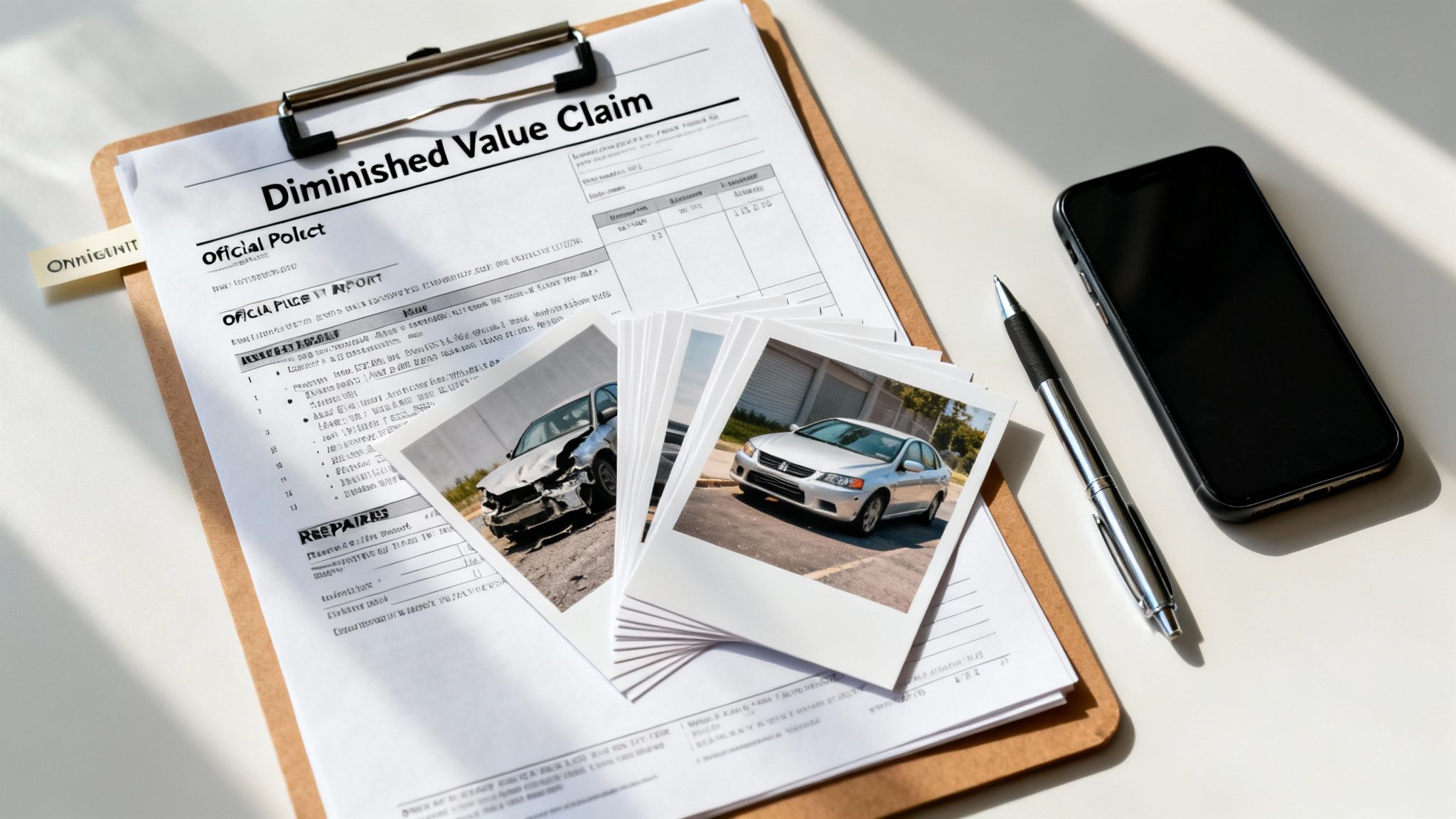
When you file a diminished value claim, you're essentially walking into a negotiation where the insurance company has the home-field advantage. Your goal is to build a case so solid, so well-documented, that they have no choice but to take you seriously.
A disorganized claim with missing paperwork is just asking for a quick denial or a frustratingly low offer. On the other hand, a professional and comprehensive evidence file signals to the adjuster that you know what you're doing. It creates a clear, undeniable story of your financial loss and makes it far easier for them to justify paying you what you’re owed.
Your Core Documentation Checklist
Think of this as the foundation of your claim. Each document here plays a crucial role in establishing fault, detailing the damage, and proving what your vehicle was worth before the collision. If you're missing any of these, you’re giving the insurer an easy opening to question your claim.
Here are the absolute must-haves for your file:
- The Official Police Report: This is your best proof of fault. It’s an impartial, third-party account that officially establishes the other driver's liability—the legal basis for your entire claim.
- Pre-Accident Photos: If you have any pictures of your car from before the crash, they're pure gold. They prove your vehicle was in great shape and help shut down any arguments about pre-existing damage.
- Detailed Repair Invoices: I'm not just talking about the final bill. You need the itemized breakdown from the body shop that lists every single part, every hour of labor, and every procedure. This document tells the true story of the collision's severity.
- Vehicle History Report: Go pull a CarFax or AutoCheck report. This is your proof that the accident is now a permanent, branded event on your vehicle’s record, which is the very definition of inherent diminished value.
A favorite tactic of insurance adjusters is to argue that because your car was repaired to "industry standards," its value is fully restored. Your evidence file is the perfect response, proving the market itself doesn't see it that way.
When you present this package upfront, you’re proactively answering the adjuster’s questions before they even ask them. It shows you’re prepared and serious about the process.
Gathering Advanced Evidence for a Stronger Case
For some cars, the basics just aren't enough. If you own a classic, a luxury model, a rare vehicle, or even just a standard car you’ve kept in mint condition, you'll need to go the extra mile to prove its superior pre-accident value. The more you can document that your vehicle was above average, the stronger your argument for a larger settlement.
Consider adding these powerful pieces to your file:
- Comprehensive Maintenance Logs: Do you have detailed records of every oil change, tire rotation, and scheduled service? This is undeniable proof of meticulous care, which directly counters the insurer's attempt to devalue your car based on its age or mileage.
- Pre-Accident Appraisals or Valuations: Did you have the car appraised for a loan or a specialty insurance policy before the accident? This is fantastic evidence of its recognized value in the market.
- Photos of the Repair Process: It can’t hurt to ask the body shop to snap a few photos during the repair. Images showing the car with panels cut off, on a frame machine, or in a state of major disassembly are incredibly powerful. They visually prove the severity of the impact in a way a final photo never could.
Ultimately, the single most powerful piece of evidence you can get is a professional appraisal that spells out your exact financial loss. An independent expert provides a detailed and defensible diminished value report that becomes the centerpiece of your demand letter. This expert analysis, backed by all your other supporting documents, creates an ironclad case that is very difficult for an adjuster to ignore.
Calculating the True Value of Your Claim

This is where you take back control. At some point after your vehicle is repaired, the at-fault driver's insurance company will probably make a settlement offer. Brace yourself, because it’s almost guaranteed to be insultingly low.
Insurance carriers have a go-to trick up their sleeve for this: a flawed, self-serving calculation they call the "17c formula". This formula has its roots in a Georgia court case and was never meant to be a universal standard, but insurers love it because it systematically minimizes what they have to pay you.
It starts by capping the maximum possible value loss at a mere 10% of your car's pre-accident value. From there, they apply arbitrary multipliers to slash that number even further based on damage severity and mileage. The whole thing is rigged to produce a tiny number that protects their profits, not to make you whole.
The Insurer's Flawed 17c Formula
The 17c formula is a numbers game stacked against you from the start. It’s a convenient way for an adjuster to plug a few numbers into a spreadsheet and spit out an "official" valuation that has almost nothing to do with what your car is actually worth now.
Here’s a quick look at how they whittle it down:
- A Low Ceiling: It starts with the baseless assumption that your car could never lose more than 10% of its value, no matter how bad the wreck.
- Damage Multiplier: It then applies a "damage modifier" based on their own subjective opinion of whether the damage was minor, moderate, or severe.
- Mileage Penalty: Finally, another deduction is made based on your vehicle's mileage, further eroding your claim.
This method completely ignores the real world, where a car with a major accident on its record can lose far more than 10% of its value instantly. To fight back effectively, it’s helpful to understand how insurance companies calculate settlements and the systems they’ve built to pay out as little as possible.
The table below shows just how different the insurer's math is from reality.
| Valuation Factor | Insurer's 17c Formula Approach | Independent Appraiser's Approach |
|---|---|---|
| Starting Value | Caps loss at 10% of NADA/KBB value. | Uses the full pre-accident Fair Market Value. |
| Damage Assessment | Applies a generic damage multiplier (e.g., 0.25 for minor). | Physically inspects repair quality and analyzes the nature of the damage. |
| Mileage Impact | Applies a generic mileage multiplier (e.g., 0.50 for 60k miles). | Considers mileage as one factor among many in market demand. |
| Market Evidence | Ignores actual market data entirely. | Analyzes real-time sales data of comparable wrecked vs. non-wrecked vehicles. |
| Final Calculation | Formula-driven, producing an artificially low number. | Evidence-based, reflecting the true monetary loss in your specific market. |
As you can see, their process is designed to minimize. The only way to get a fair shake is to use a method based on actual evidence.
The Right Way to Determine Your Loss
The only way to effectively counter the insurer's lowball offer is with a credible, market-based valuation from an unbiased expert. This is where a professional, independent auto appraisal becomes your most powerful tool.
An independent appraiser doesn't use made-up formulas. They conduct a detailed analysis of your specific vehicle and how it fits into the current local market. They essentially become your expert witness, creating a report that serves as undeniable proof of your financial loss.
A certified appraisal isn't just someone's opinion; it's a professional valuation that holds up under scrutiny. It completely changes the conversation from the insurer's fictional numbers to a defensible figure grounded in real-world facts.
A legitimate report from a certified expert is the gold standard. When you file a diminished value claim, this document is the foundation of your entire demand.
What a Credible Appraisal Report Includes
Not all appraisals are created equal. A truly solid report needs to be comprehensive and compliant with the Uniform Standards of Professional Appraisal Practice (USPAP). This is the industry benchmark that ensures the methodology is sound and the final number is defensible.
A proper report should always contain these key elements:
- Market Analysis: The appraiser digs into sales data for vehicles just like yours in your local area—comparing those with clean histories to those with accident histories to establish a clear value gap.
- Repair Quality Inspection: The expert physically inspects the repaired areas, looking for things a potential buyer would spot, like mismatched paint, poor panel gaps, or other signs of shoddy work.
- Vehicle History Review: The report will reference the CarFax or AutoCheck, cementing the accident as a permanent black mark on the vehicle’s official record.
- Final Value Conclusion: Most importantly, the appraiser provides a specific dollar amount for your diminished value, along with a detailed explanation of exactly how they arrived at that number.
This professional report puts a spotlight on the huge difference between the insurer's offer and your actual loss. It gives you the leverage to demand what you're rightfully owed and transforms your claim from a simple complaint into a formal, evidence-backed demand for payment.
Negotiating Your Settlement with Confidence

You’ve done the hard work. You’ve gathered your evidence, organized your file, and have a professional appraisal sitting in your hands. Now, you’re no longer just asking for a payout—you’re making a formal demand for what the law says you’re owed. This is where you present your case with authority and prepare for the inevitable pushback from the insurance company.
Your first official move is to draft and send a powerful demand letter. This isn't just a quick email or a note. It’s a formal document that lays out the undeniable facts, presents your evidence, and clearly states the exact amount of your claim. Think of it as the opening argument in your negotiation.
Crafting a Demand Letter That Gets Results
Your demand letter needs to be professional, concise, and absolutely impossible to ignore. It’s your chance to signal to the adjuster that you are organized, well-informed, and not going anywhere. Anything less tells them you’re an easy target for a lowball offer.
A strong demand letter must include a few key elements:
- A Clear Narrative: Briefly state the date of the accident, the claim number, and the simple fact that their insured driver was at fault.
- A List of Enclosures: Itemize every piece of evidence you’re including. This means the police report, the final repair invoices, and—most importantly—your independent appraisal report.
- The Demand Amount: State the exact dollar amount of your diminished value claim, as determined by your appraiser. Don't be vague.
- A Response Deadline: Give the insurance company a reasonable deadline to respond, usually 15 to 30 days. This creates a sense of urgency and shows you mean business.
I always recommend sending this entire package via certified mail with a return receipt requested. This gives you undeniable legal proof that the insurance company received your demand, which becomes critical if they later try to claim it got "lost in the mail."
Your goal here is to make it easier for the adjuster to approve your claim than to fight it. A professional, well-documented demand package gives them all the justification they need to process the payment and close the file.
Dealing with the Insurance Adjuster
Once your letter lands on their desk, expect a call from the claims adjuster. Remember, their primary job is to minimize the payout, and they come armed with a standard playbook of tactics. They will likely question your appraisal, try to dismiss your evidence, or insist that their own insultingly low offer is final.
The key to succeeding here is to remain calm, firm, and professional. Dealing with insurance adjusters is a game of strategy; you have to anticipate their moves without getting emotional or aggressive. Your job is to constantly steer the conversation back to the facts laid out in your professional appraisal report.
Don't let them drag you into a debate about their flawed 17c formula or other internal valuation methods. Simply reiterate that your claim is based on a USPAP-compliant appraisal performed by a certified expert—an appraisal that reflects the real-world market loss, not their internal algorithm.
The Appraisal Clause: Your Secret Weapon
What happens if the adjuster refuses to negotiate in good faith or won’t budge from a ridiculous lowball offer? It’s time to play your trump card: the Appraisal Clause.
This clause, found in virtually every auto insurance policy, is a powerful dispute-resolution tool. It allows either you or the insurer to demand that the disagreement be settled by a panel of neutral, third-party appraisers. When you invoke this clause, you effectively take the decision completely out of the adjuster's hands.
Here’s how it usually works:
- You invoke the clause in writing. You send a formal letter to the insurance company stating your intent to invoke the Appraisal Clause as outlined in their policy.
- Each side hires an appraiser. You'll use your independent appraiser, and the insurance company will hire their own.
- The appraisers select an umpire. These two appraisers then agree on a third, neutral appraiser to act as an impartial umpire.
- A decision is made. The two appraisers present their valuations. If they can’t agree, the umpire makes the final call. An agreement by any two of the three is binding.
Invoking the Appraisal Clause is a serious power move. It forces the insurer into a formal process they can't control—one that hinges on expert evaluation, not an adjuster's delay tactics. For many people I've worked with, this is the single step that finally breaks the stalemate and secures a fair settlement.
Common Questions About Diminished Value Claims
As you get into the thick of filing your diminished value claim, you're bound to have some questions. What if this happens? What if they say that? It's completely normal. The process isn't always a straight line, and insurance companies definitely have their own playbook for making things tricky.
Let’s walk through some of the most common questions and roadblocks I see people run into. My goal is to give you the clear, straightforward answers you need to handle these final hurdles like a pro.
Can I File a Claim If I Was at Fault?
This is the big one, and the answer is almost always no. Think of it this way: a diminished value claim is built on the idea of liability. You're filing a claim against the at-fault driver's property damage policy because their client is responsible for making you whole again. That doesn't just mean fixing the dents; it means compensating you for all the losses from the crash, including the hit to your car’s market value.
Your own collision coverage is there to pay for the physical repairs, plain and simple. It's not designed to cover the depreciation your car suffers after the fact. While there might be some incredibly rare exceptions buried in state-specific case law, the universal rule of thumb is you have to be the innocent party to file a successful third-party diminished value claim.
Is an Independent Appraiser Worth the Money?
This really just boils down to a cost-benefit analysis. A professional, USPAP-compliant appraisal is going to run you somewhere between $300 and $500. You have to ask yourself if that fee is a smart investment based on your potential return.
- For a minor claim: Let's say you have an older car with a lot of miles that just got some cosmetic scrapes. Your diminished value might only be a few hundred bucks. In that scenario, paying an appraiser would eat up your entire settlement, so it probably doesn't make sense.
- For a significant claim: But what if you have a newer model, a luxury vehicle, or a car that took a structural hit? Now, an appraisal isn't just a good idea—it's essential. It’s not uncommon for a professional valuation to lead to a settlement three to ten times higher than the insurer’s first insulting offer. That $300 fee suddenly looks like a brilliant move.
An appraisal isn't just about getting a number; it's about buying leverage. That report is a powerful negotiating tool. It forces the insurance company to argue against documented market facts instead of their own self-serving, black-box formulas.
What If the Insurer Ignores My Demand Letter?
First off, don't panic. And don't let their silence be their victory. If your carefully crafted demand letter is met with crickets, it’s time to escalate the pressure, step by step. In many states, an insurer's failure to respond in a timely manner can be a violation of fair claims practices.
Your first move is a follow-up. Send another copy of the demand via certified mail and make a phone call to the adjuster. You're creating a paper trail that proves they received it. If you're still getting the silent treatment, your next step is to file a formal complaint with your state's Department of Insurance. This official action often gets an immediate reaction from the insurance company.
If the claim is big enough, filing in small claims court is another fantastic way to get their attention. This is also the perfect time to formally invoke the policy’s Appraisal Clause, a power move that usually gets the claims department to sit up and take you seriously.
Does Selling My Car Hurt My Claim?
It definitely can, which is why my advice is always to settle your diminished value claim before you sell the car. If you sell it before the claim is settled, the insurer will argue that whatever you sold it for is the true post-repair value, even if you had to slash the price because of the accident history.
However, if you absolutely have to sell, that transaction can actually become powerful evidence of your loss—if you do it right. You have to document everything. Keep a log of every offer you get. Write down comments from potential buyers who walked away because of the accident report. Most importantly, save the final bill of sale. All of this can be used to show exactly how much money the collision cost you in the real-world market.
When you're going toe-to-toe with a major insurance company, having a seasoned expert in your corner can change the outcome. Total Loss Northwest specializes in certified, independent auto appraisals that arm you with the leverage needed to demand a fair settlement. We fight for the full value you're truly owed. Get a professional appraisal and secure the compensation you deserve.