Figuring out what a classic car is really worth is part art, part science. It boils down to four key areas: its physical condition, the current market trends, its unique history, and getting a solid professional assessment. A genuine valuation is so much more than a quick online search; it’s about digging deep into what makes your car special and arriving at a number that truly reflects its place in the world.
The Four Pillars of Classic Car Valuation
Think of yourself as a detective. Valuing a classic car isn’t a one-and-done task; it’s about piecing together clues from multiple sources to build a strong case for its worth. If you skip a step, you risk getting the number wrong—either undervaluing your pride and joy or pricing it so high that no one will ever bite.
Your ultimate goal is to land on a defensible figure. This is absolutely critical, especially if you're dealing with an insurance company where a number pulled out of thin air will get shot down in a heartbeat.
Core Principles of an Accurate Appraisal
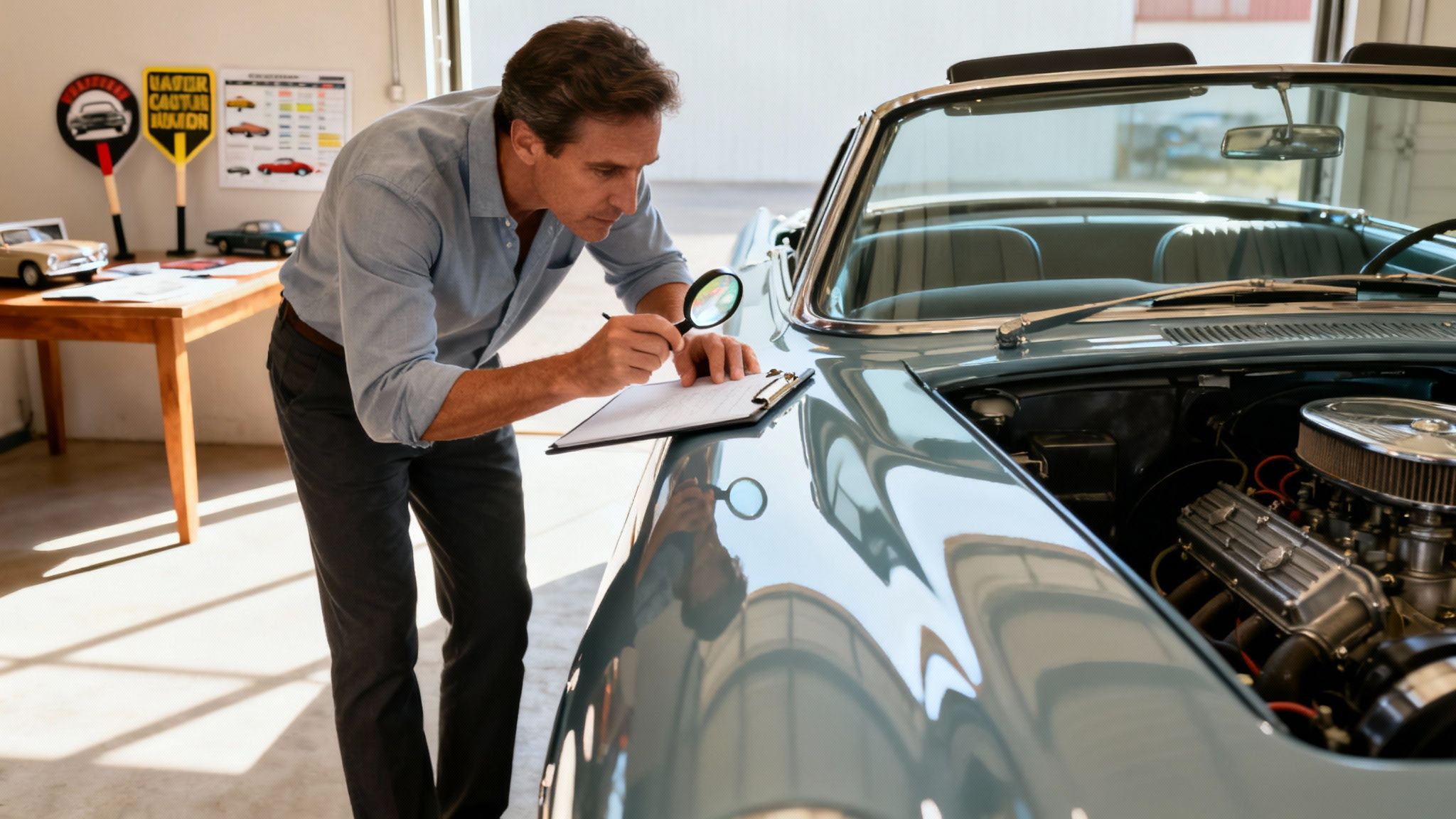
The process has to start with a hands-on, honest look at the car. You’ll need to grade everything from the paint quality and any hidden rust to the originality of the engine and the wear-and-tear on the interior. You're searching for authenticity and judging the quality of any restoration work that's been done.
If you’re thinking about making improvements, a good ultimate classic car restoration guide can be a game-changer, helping you focus on the fixes that actually add value.
After the physical inspection, you have to hit the books and research current market data. This means looking past optimistic asking prices and finding out what similar cars are actually selling for at auctions and in private sales. Understanding what is fair market value is the foundation of this step; it's all about what a real, willing buyer would pay for the car today.
A classic car’s value is ultimately decided by the market. Your job is to gather the evidence that proves where your specific vehicle fits within that market, considering its unique story and condition.
The Role of History and Expertise
This is where things get interesting. Intangible factors like rarity and provenance—the car's documented history—can send its value soaring. A vehicle with low production numbers, a rare factory options package, or a history of famous ownership is playing in a completely different league than a standard, run-of-the-mill model.
Finally, a certified appraisal pulls all of this information together into a formal, recognized document. This isn't just a piece of paper; it's essential for proper insurance coverage and for any serious, high-stakes sale.
This guide will walk you through each of these pillars, giving you the tools to confidently determine your car's true worth.
To help simplify this process, let's break down the key components that drive a classic car's final value. The table below summarizes what you need to look at and why it matters.
Core Factors in Classic Car Valuation
| Valuation Factor | What to Look For | Impact on Value |
|---|---|---|
| Overall Condition | Paint quality, rust (surface and structural), chrome, glass, interior wear, panel gaps. | High: A pristine, "Concours" level car can be worth multiples of a daily driver. |
| Mechanical Health | Engine originality, transmission performance, suspension, brakes, electrical systems. | High: A numbers-matching engine is a huge plus. A well-sorted, reliable car is always more valuable. |
| Authenticity | Correct parts, factory markings, original documentation (window sticker, build sheet). | Very High: Originality is often valued more than over-restoration. Authenticity proves its pedigree. |
| Rarity & Desirability | Production numbers, specific model/trim, color combination, factory options. | Very High: Low-production models or those with sought-after features command premium prices. |
| Provenance | Documented ownership history, racing history, celebrity ownership, maintenance records. | High: A compelling and well-documented story adds significant intangible value and collector appeal. |
| Market Comparables | Recent auction results (Hagerty, Mecum), private sale data, dealer asking prices. | High: This provides the baseline reality check for what buyers are willing to pay right now. |
Understanding these factors provides a comprehensive framework, ensuring you don't overlook a critical detail that could significantly alter your car's valuation.
Getting a Handle on Market Trends and Sales Data
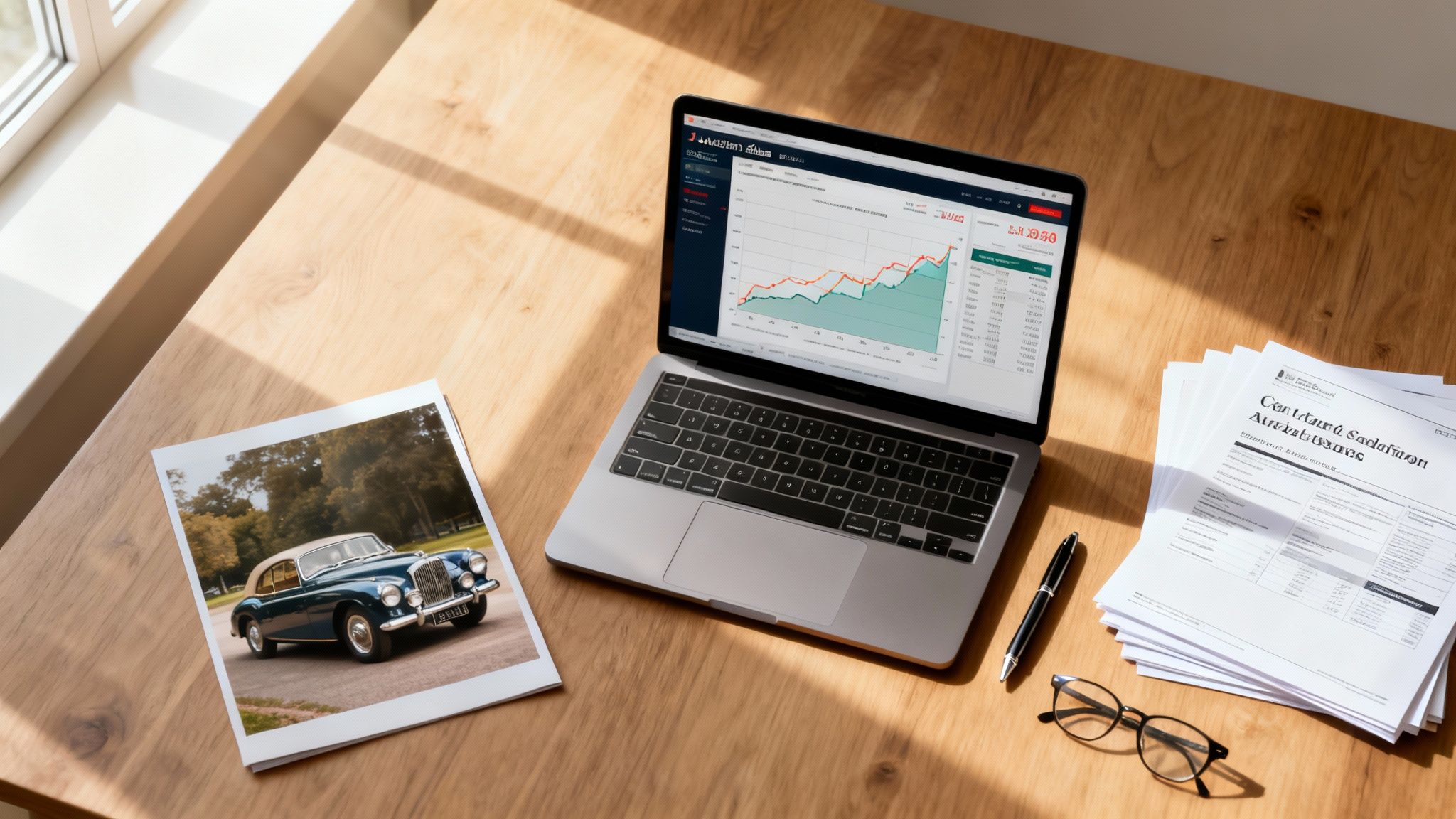
A classic car's value is never static. It's a living number, constantly pushed and pulled by collector demand, the broader economy, and even a well-timed movie feature. To really nail down what your car is worth, you have to look past the wishful thinking of online listings and get your hands on actual sales data. This isn't just an academic exercise; it's your best defense if you ever need to fight a lowball insurance offer after an accident.
When you're armed with real-world numbers, you can counter an insurer's generic, algorithm-driven valuation with a case built on solid evidence. It’s about understanding the ebbs and flows of the market, where prices can swing wildly from one year to the next.
For example, while the global collector car market saw median prices dip 10.2% from £24,750 in 2023 down to £22,223, that's far from the whole story. Some cars bucked the trend entirely. Lamborghini models, for instance, saw their mean value jump by 10%, and the incredibly rare Miura P400 SV skyrocketed 29% to over £3 million. This proves why a one-size-fits-all number just doesn't cut it. You can dive deeper into the market shifts with this 2024 classic car market analysis from wcshipping.com.
Where to Dig for Solid Sales Data
Your mission is to find "comps"—recently sold cars that are as close to yours as possible. Forget the generic online calculators; they’re a decent starting point, but the real truth lies in more specialized sources.
- Auction Results: This is the gold standard. Major players like Mecum, Barrett-Jackson, and RM Sotheby's publish the final hammer price of the cars they sell. It's not an asking price; it's what an actual buyer was willing to pay on a specific day.
- Specialty Insurers: Companies like Hagerty live and breathe this stuff. Their valuation tools are considered an industry benchmark because they track thousands of public and private sales, giving you a comprehensive view of the market.
- Online Marketplaces: Don't sleep on sites like Bring a Trailer (BaT). The transparent bidding history and final sale prices provide a real-time pulse on what specific models are fetching right now.
The interface for the Hagerty Valuation Tools is a perfect example of this in action. It allows you to see how a specific model’s value has trended over time, breaking it down by condition ratings.
How to Make Sense of the Numbers
Collecting data is one thing; understanding what it means is another. You have to look at the details. Why did that one car sell for a premium? It could have been a rare factory color, a highly sought-after option package, or a binder full of maintenance records.
Your job isn't to find the price of a model—it's to find the market value for your specific car, with its own unique history, condition, and quirks.
Always compare apples to apples. If your car is a clean, well-maintained driver (what experts call a Condition #3 car), don't base your valuation on a flawless, trailer-queen show car (Condition #1). Be honest about your car's condition, mileage, and originality, and adjust your expectations accordingly. This detailed, evidence-first approach is what turns a ballpark guess into a valuation you can take to the bank.
Get Your Hands Dirty: A Real-World Inspection
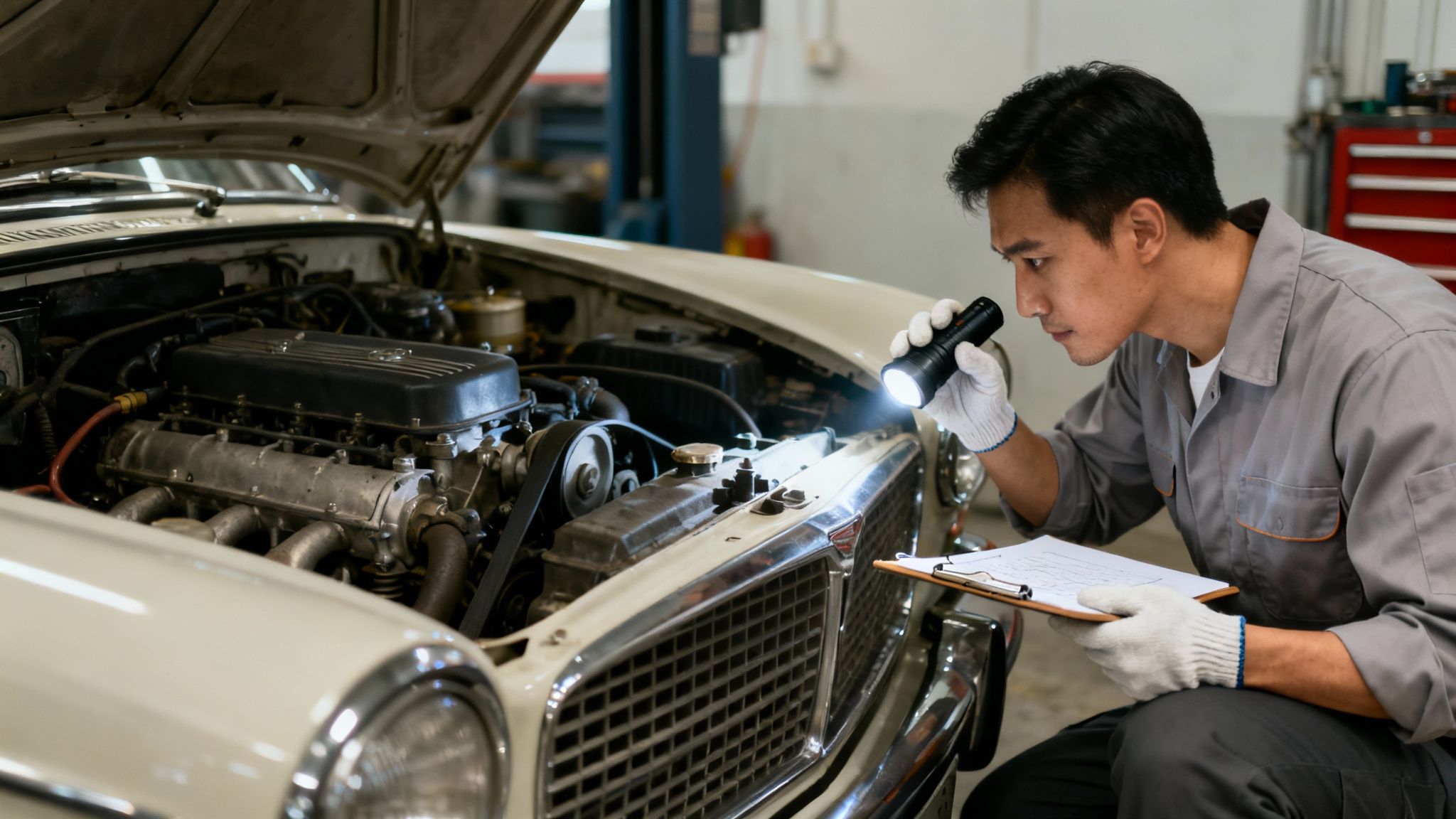
All the market data in the world gives you a ballpark figure, but the true value of a classic is found in its steel, leather, and chrome. The physical and mechanical condition is what really moves the needle, and an honest, hands-on inspection isn't just recommended—it's essential. This is where you document the car’s story, its strengths, and its flaws, gathering the evidence to justify its price.
This isn't just a quick walk-around. Think of it more like a forensic examination. Grab a good flashlight, a notepad, and your phone's camera, because you’re going to document everything. Clear photos turn a vague claim like "the interior is in good shape" into a documented fact that an appraiser or potential buyer can see for themselves.
Body and Paint: Reading the Skin
Start with the exterior, and look past the shine. Get down low and examine the panel gaps. Are they straight and consistent all the way around? Uneven gaps are often a dead giveaway of a past accident and shoddy repair work. Gently run your hand along the bottom edges of the doors and fenders; you're feeling for any bubbling under the paint, which is the classic calling card of rust trying to break through.
Paint quality is a huge piece of the puzzle. Does it have that deep, liquid look of a professional job, or can you spot imperfections like "orange peel" or fine cracking? A simple magnet is one of your best friends here. If it doesn't stick firmly to a spot, especially on a lower quarter panel, you've likely found a thick layer of body filler (Bondo) hiding who-knows-what underneath.
A car that looks perfect from ten feet away can easily hide thousands of dollars in necessary bodywork. Your job during this inspection is to uncover the truth hiding just beneath that glossy surface.
The Mechanical Heartbeat: Engine and Drivetrain
Now, let's pop the hood. What you see in the engine bay tells a story. Is it clean and tidy, or does it look like a neglected, grimy mess? The biggest question here, though, is originality. For serious collectors, nothing is more important than a "numbers-matching" car—one that still has the same engine and transmission it left the factory with. This alone can have a massive impact on value.
Find the engine block's stampings and compare them to the car’s VIN. Document any modifications you see, from an aftermarket carburetor to a modern ignition system. While some of these "day two" mods might improve how the car drives, many purists will subtract value for every part that isn't factory-correct.
Inside Story: The Interior and Authenticity
The interior is where the car’s history really comes through. You're looking for authenticity in all the little things:
- Seats and Carpets: Is the material correct for the year and model? A clean, original interior, even with a little patina, is almost always more valuable than one that's been redone with incorrect, modern materials.
- Dashboard and Gauges: Check for the dreaded dash pad crack, a common ailment for sun-baked classics. Flip the switches and see what works. Do the gauges read correctly?
- Original Touches: The little things add up. Is the original radio still in the dash? The correct steering wheel? Is the owner's manual still tucked away in the glove box? These authentic details can collectively add significant value.
Your ultimate goal here is to honestly place your car on the industry-standard condition scale. Are you looking at a flawless #1 "Concours" show-winner or a #5 parts car? This detailed, honest self-assessment builds the rock-solid foundation you need for a truly accurate valuation.
Rarity and Provenance: The Hidden Value Drivers
While a classic car's physical condition gives you a starting point for its value, the things that really move the needle are often invisible. This is where rarity and provenance—the car’s unique story and its documented history—enter the picture. These factors are what elevate a vehicle from a cool old car to a genuine piece of history, adding a level of value that standard price guides just can't capture.
Grasping these "hidden multipliers" is absolutely critical, especially if you're ever faced with a total loss claim. Insurance companies tend to lean on standard databases that completely ignore a car's unique story, which almost always results in a lowball offer. Having a detailed account of your car’s rarity and history is the ammunition you need to fight for a fair settlement.
What Makes Your Car Truly Rare?
Rarity isn't just about age. It's about how many are left on the road today. A model that was mass-produced might have specific variants that are now incredibly scarce and fetch a huge premium. You have to dig into the details to figure out what sets your particular car apart.
Here’s what I look for when determining rarity:
- Low Production Numbers: This is the most obvious one. Certain models or special editions were built in tiny numbers from the get-go. A 1969 Chevrolet Camaro is a common sight at car shows, but a ZL1 version with its all-aluminum 427 engine? They only made 69 of those, making it a different beast entirely in terms of value.
- Desirable Options and Colors: Think about how the car was ordered from the factory. A 1970 Plymouth ‘Cuda is a great muscle car, but one with the legendary Hemi engine and a "High-Impact" color like Plum Crazy is in a completely different league than a base model. The original window sticker is your best friend here.
- Survivor Status: In the world of classic cars, "original" is a magic word. An unrestored vehicle in fantastic original condition is an increasingly rare find. Many serious collectors will actually pay more for the authenticity of a true "survivor" than for a perfectly restored car. After all, it’s only original once.
The Power of a Paper Trail: Your Car's Provenance
Provenance is simply your car's verified backstory. It's the collection of documents that proves where it’s been, who owned it, and why it's special. Believe me, a thick binder of records can be worth its weight in gold because it provides concrete proof of the car’s history and authenticity.
A classic without documentation is just an old car. A classic with a complete, documented history is an investment with a verifiable pedigree.
The holy grail of provenance is confirming if your car is "numbers-matching." This term means the car still has the same engine and transmission it left the factory with. You verify this by matching the serial numbers stamped on those components to the car's vehicle identification number (VIN). For many collectors, especially in the muscle car world, this is a make-or-break detail that can easily double a car's value compared to an identical one with a replacement engine.
Start pulling together everything you have. Service records, old registration slips, photos from a restoration, even letters from previous owners all help build a compelling narrative. This complete history doesn't just add significant monetary value—it gives you the hard evidence you need to justify a higher valuation, whether you're selling or negotiating an insurance payout.
When You Need a Professional Appraisal
Doing your own homework on your classic’s value is a great start, but there are certain times when you absolutely need the firepower of a certified, professional appraisal. This isn’t about getting a second opinion. It's about getting a legally-defensible document that holds up under scrutiny, especially when the stakes are high.
Think of a professional report as your ultimate trump card. For insurance claims, legal matters, or a high-dollar sale, an expert's valuation turns your belief about the car's worth into a well-documented fact. It’s the final word, backed by real data and years of experience.
When an Expert Is Non-Negotiable
Some situations just demand the precision and authority that only a professional can provide. Relying on a guess or a generic online calculator simply won't cut it when you're facing down an insurance company or navigating a legal process.
You'll definitely want to bring in a pro for these scenarios:
- Securing Agreed-Value Insurance: A standard policy only covers "actual cash value," which can be a disaster for a classic. An agreed-value policy insures your car for a specific, predetermined amount, but insurers won’t just take your word for it—they require a certified appraisal to write the policy.
- Contesting a Total Loss Offer: If your classic is declared a total loss and the insurer's offer feels insulting, your most powerful weapon is the Appraisal Clause in your policy. Invoking this clause lets you hire your own independent appraiser to build a case and fight for a fair settlement.
- Estate Planning and Settlements: When it comes to estate planning, taxes, or divorce settlements, having a clear and undisputed value for assets is essential. A professional appraisal provides that official figure for all legal documentation, preventing headaches down the road.
This flowchart gives you a good idea of the key decision points an appraiser considers, showing why something like engine originality is such a critical piece of the puzzle.
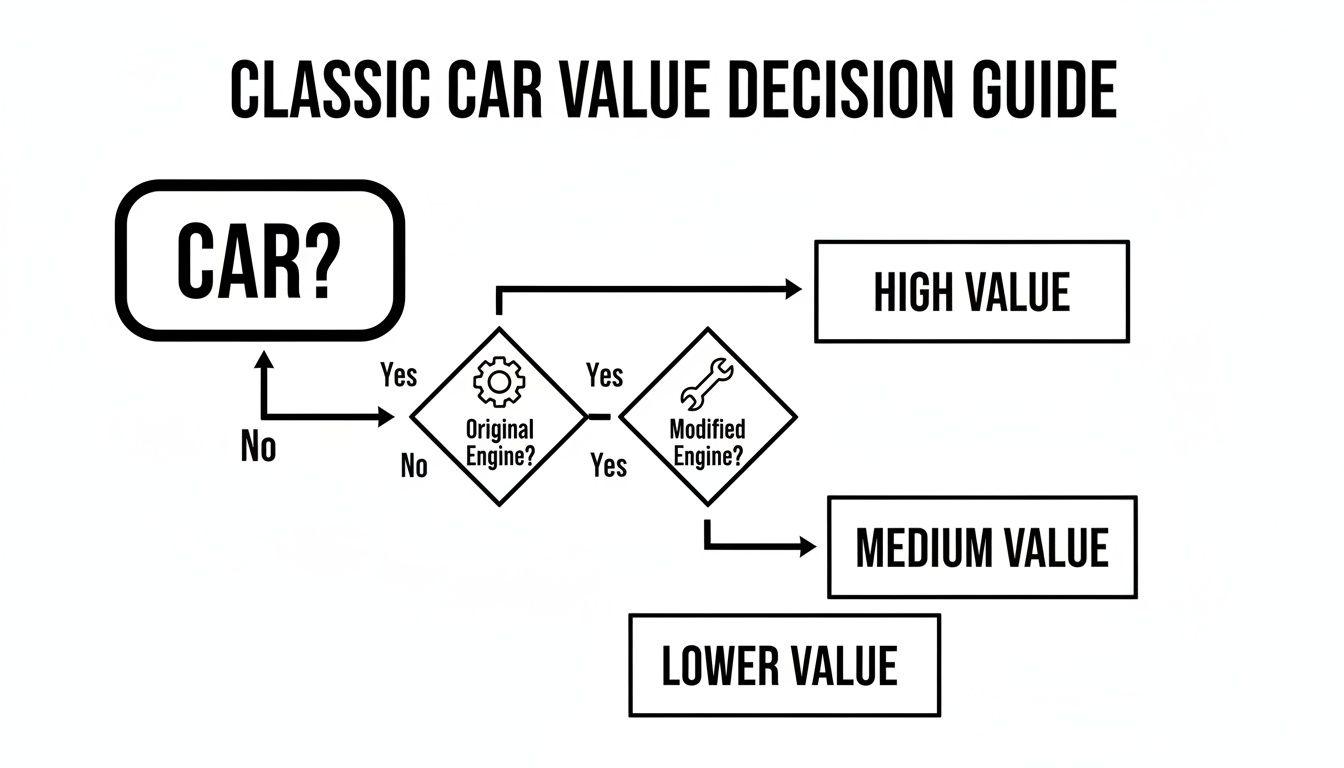
As you can see, a single detail like a non-original engine can completely change the valuation conversation, often requiring an expert's eye to determine the real-world impact on price.
The Power of a Professional Report
A real appraiser doesn't just pull a number out of thin air. They create a comprehensive report that breaks down every aspect of your car, from its mechanical condition and authenticity to its place in the current market and any unique history it might have. This detailed analysis is absolutely critical.
With the global classic car market projected to hit an incredible USD 94.13 billion by 2035, values are anything but static. This rapid growth shows just how quickly generic price guides can become obsolete.
A professional appraisal isn't an expense; it's an investment in protecting your car's true value. It ensures the final figure reflects market reality, not just an insurer's attempt to minimize their payout.
At the end of the day, that certified report is your best line of defense. To get a better sense of what goes into one, take a look at our detailed guide on what a vehicle appraisal entails: https://totallossnw.com/vehicle-appraisal/.
And if you want to understand more about the role these experts play, resources like A Guide to Professional Antique Appraisal Services can give you valuable context. This knowledge is what empowers you to get what you're rightfully owed.
Frequently Asked Questions About Valuing Classic Cars
Trying to pin down the value of a classic car can feel like navigating a minefield. Whether you're getting ready to sell or, worse, dealing with an insurance claim, the stakes are incredibly high. Let's walk through some of the most common questions I hear and get you some straight answers.
Getting this right is critical. A simple misunderstanding isn't just a mistake—it can be a costly one.
How Much Do Modifications Affect My Car's Value?
Ah, the classic double-edged sword. Some changes can definitely add value, but others can absolutely tank it. The real dividing line is whether an upgrade is period-correct and easily reversible.
Bolting on a set of vintage performance headers might catch the right buyer's eye. But cutting into the body for custom flares? That's going to turn off most purists who hunt for originality above all else.
A well-executed "resto-mod"—a classic car packed with modern performance and comforts—can command a huge price tag. But it's crucial to understand it’s no longer competing with factory-spec cars. It's in a completely different arena, being judged against other high-end custom builds.
Here’s a tough lesson many collectors learn: "improving" a classic doesn't always increase its market value. Every dollar you pour into a non-original upgrade is rarely a dollar you'll see again when it's time to sell.
Appraised Value vs. Market Value: What's the Difference?
People throw these terms around as if they're the same thing, but they're not. Not even close.
Market value is simply what a ready, willing, and able buyer would likely pay for your car on the open market right now. It's a snapshot in time, shaped by recent sales, auction results, and overall demand in the collector community.
Appraised value, on the other hand, is a formal, documented opinion of that market value, put together by a certified expert. When you're in an insurance claim or a legal dispute, a professional appraisal carries serious weight. It’s a defensible figure, backed by a detailed report and expert analysis designed to hold up under scrutiny.
What Should I Do If My Insurance Offer Seems Way Too Low?
First rule: never, ever accept the insurance company’s initial offer for your totaled classic without a fight. Your first move should be to demand a copy of their valuation report. Go through it with a fine-tooth comb.
Look for errors in:
- Condition rating
- Mileage
- Factory options
- The "comparable" vehicles they used
Insurers often pull generic models that completely miss your car's unique and valuable attributes.
Your strongest weapon here is the Appraisal Clause in your policy. Invoking it lets you hire your own independent appraiser. Their job is to build a comprehensive, evidence-based report that forces the insurance company to negotiate on a true market valuation, not their initial lowball number. This is a fundamental piece of your classic car insurance requirements and something every owner should know about.
How Accurate Are Online Valuation Tools?
Tools from sites like Hagerty or the NADA Guides are a fantastic place to start. They're great for getting a quick ballpark estimate and seeing where your car fits into the broader market.
But that’s where their utility ends.
These online estimators just can't see the full picture. They don't know your car's specific history, its precise condition, that ultra-rare factory option it has, or the unique fluctuations of your local market. For any situation that demands a truly accurate and defensible number—like setting up an agreed-value policy, settling an estate, or fighting a total loss claim—think of these tools as step one, not the final word.
If you're staring down a lowball total loss offer or just need to establish a certified value for your classic, don't leave money on the table. At Total Loss Northwest, our certified appraisers fight to get you the true, market-driven value you deserve. Visit us at https://totallossnw.com to see how we can help.