A diminished value appraisal is a professional report that shows how much your car’s market value has dropped because of an accident, even after it’s been perfectly repaired. This report is the key piece of evidence you need to prove your financial loss to the at-fault driver's insurance company. Without it, you're pretty much stuck accepting whatever lowball offer they throw at you.
What a Diminished Value Appraisal Actually Means for You

Let's try a simple analogy. Imagine you have a brand-new, expensive laptop. One day, you accidentally spill coffee all over it. You rush it to a certified repair shop, and they manage to fix it perfectly—it looks and works just like it did out of the box.
But when you decide to sell it a year later, you have to be honest and mention the repair. A smart buyer will absolutely pay less for your repaired laptop than for an identical one that's never been damaged. That price difference? That's its diminished value.
Your car is exactly the same, just on a much larger financial scale. After a wreck, your vehicle is permanently branded with a damage history. Any serious buyer will pull a Carfax or AutoCheck report and see it. This accident history creates a stigma that lowers its resale value, no matter how great the repairs look.
Bridging the Gap Between Repairs and True Recovery
The at-fault driver’s insurance company has a legal duty to "make you whole." Most people think this just means cutting a check to the body shop. The reality is, it also means paying you for this very real loss in your car’s market value.
This is precisely where a diminished value appraisal becomes your most powerful tool. It takes an abstract idea—loss of value—and turns it into a concrete dollar amount that you can claim.
An independent appraisal isn't just a number pulled from thin air. It's a carefully researched document that quantifies the exact financial hit your vehicle took, going far beyond the physical repair costs. It’s the proof you need to make the insurance company cover the full extent of your loss.
Why You Cannot Rely on the Insurer's Math
Here's a secret the insurance companies don't want you to know: they often use their own internal formulas, like the infamous "17c Formula," to calculate diminished value. These formulas are intentionally designed to keep their payouts as low as possible, using arbitrary caps and ignoring crucial factors about your specific vehicle and accident.
A professional, independent appraisal is a completely different beast. It's a detailed analysis based on:
- Real Market Data: The appraiser looks at what comparable cars—same make, model, year, and condition—are actually selling for in your local area.
- Vehicle-Specific Factors: It takes your car's mileage, pre-accident condition, trim level, and unique features into account.
- Severity of Damage: The report documents the full extent of the repairs, especially noting if there was any structural or frame damage, which is a huge red flag for buyers.
A big part of this is understanding the basics of how to calculate vehicle depreciation, because a serious accident puts that process into overdrive. At the end of the day, a diminished value appraisal is your leverage to reject an insurer's lowball offer and get the compensation you are rightfully owed.
The Three Types of Diminished Value You Must Know
When your car gets hit, the drop in its value isn't a single, straightforward number. It’s actually a multifaceted problem. To build a solid claim and get the money you're owed, you first need to pinpoint the exact kind of loss your vehicle has suffered.
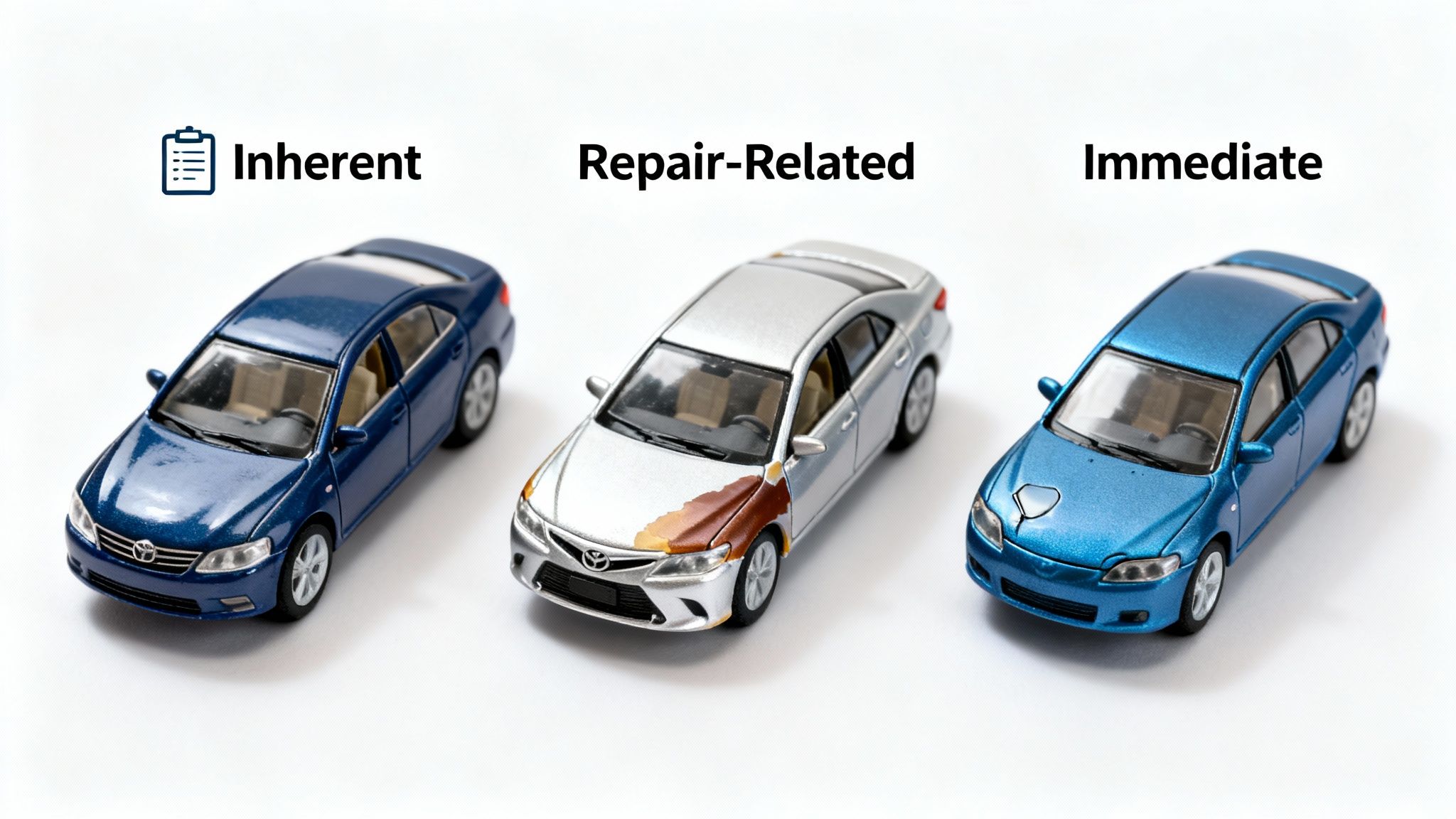
Diminished value isn’t just one thing; it breaks down into three distinct categories. While they might sound similar, each one represents a different phase of your car's post-accident life. Getting a handle on these differences is the first real step toward a successful negotiation with any insurance company.
Inherent Diminished Value
This is the big one—the most common and universally accepted type of loss. Inherent Diminished Value (IDV) is the automatic, instant drop in your car's market value simply because it now has an accident on its record. Even with perfect, top-tier repairs using all original parts, the vehicle is forever branded.
Think of it as a permanent mark on your car's resumé. The moment a potential buyer pulls a history report from a service like Carfax or AutoCheck, they’ll see the collision. Any savvy buyer will either walk away in favor of an identical car with a clean history or demand a steep discount.
This loss is "inherent" because it’s baked in, regardless of how good the repairs are. The damage to your car's reputation is just as real as the physical damage, and it directly hits the vehicle's cash value.
This is what most diminished value claims are all about. Your professional diminished value appraisal will focus heavily on calculating this specific, automatic loss in market perception, proving the financial gap between your repaired car and its undamaged counterparts.
Repair-Related Diminished Value
While inherent diminished value is based on the idea of a flawless repair, we all know that's not always how it goes down. Repair-Related Diminished Value is the additional loss in value caused by shoddy or incomplete repair work. It's like damage on top of the original damage.
This kind of loss happens when a body shop cuts corners, uses cheap parts, or simply fails to bring the vehicle back to its pre-accident condition. The evidence is often something you can see, feel, or hear.
Common signs include:
- Mismatched Paint: The new paint job doesn't quite blend with the original factory finish, looking off in certain lights.
- Inferior Parts: Aftermarket or used parts were used instead of OEM (Original Equipment Manufacturer) parts.
- Lingering Mechanical Issues: The car just doesn't drive right anymore. You might notice new rattles, alignment issues, or other flaws that weren’t there before.
- Poorly Aligned Body Panels: The gaps around the doors, hood, or trunk are uneven and unsightly.
Imagine your custom Tacoma gets sideswiped. The repairs look okay at a glance, but resale offers are shockingly low. Why? Because a closer look reveals a slightly off-color paint job and aftermarket tweaks that weren't restored properly. This is repair-related diminished value, and it can account for an additional 10-20% loss for vehicles with non-OEM parts. With repair costs spiking, this category alone averages $4,200 per mid-size truck claim. You can dig into more of this data on claim trends directly from the NAIC.
Immediate Diminished Value
The third category is a bit more technical, used mostly by appraisers and in legal contexts. Immediate Diminished Value is the difference between your vehicle’s market value right before the accident and its value immediately after the crash—before a single repair has been made.
Basically, it's what your car is worth in its wrecked, damaged state. This figure isn't something you'd typically use in a claim yourself, because once the repairs are done, your focus shifts to the inherent and repair-related losses. However, it’s a critical starting point for an appraiser to establish the total financial loss from the very moment of impact.
Knowing these three types of diminished value is what separates a weak claim from a strong one. It gives you the language to identify precisely what you've lost and to communicate it clearly. To make it even simpler, here’s a quick breakdown.
Comparing the Three Types of Diminished Value
This table breaks down the key differences between the main types of diminished value a vehicle owner might face after an accident.
| Type of Diminished Value | What It Means | Common Cause |
|---|---|---|
| Inherent | The automatic loss in value from having a documented accident history, even with perfect repairs. | The stigma of a negative Carfax or AutoCheck report. |
| Repair-Related | The additional loss in value caused by subpar or incomplete bodywork and mechanical fixes. | Use of aftermarket parts, mismatched paint, or lingering functional problems. |
| Immediate | The difference in value between the car's pre-accident condition and its damaged state right after the crash. | The physical damage sustained in the collision, before any repairs are attempted. |
By pinpointing whether your loss stems from the accident's history, the quality of the repairs, or a combination of both, you can prepare your case with confidence. This knowledge, backed by a professional appraisal, positions you for a much more effective conversation with the insurance adjuster.
Why Insurance Company Valuations Fall Short
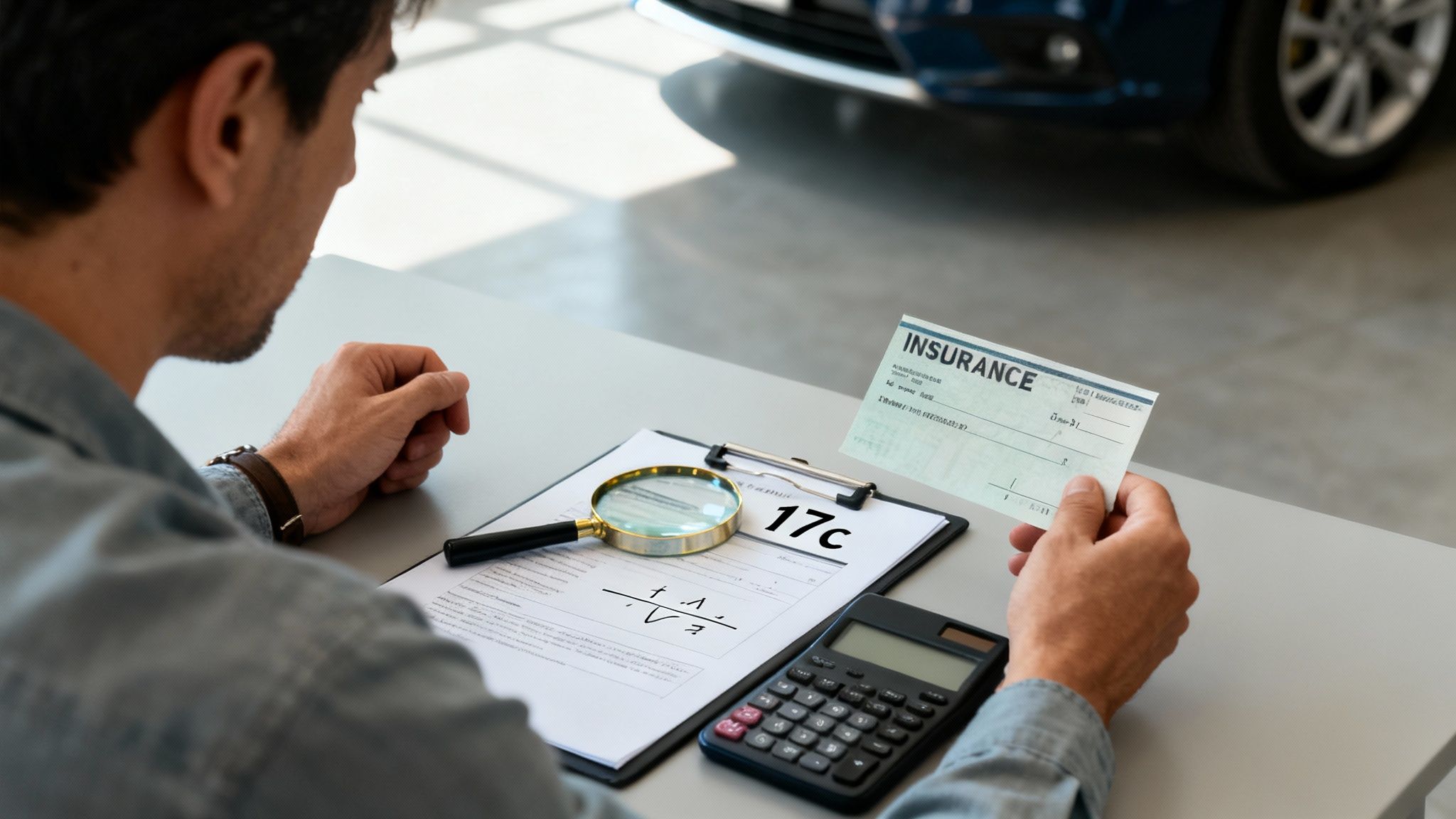
If you’ve ever gotten a settlement offer from an insurance company and thought, "That's it?"—you’re probably right. Insurance companies are for-profit businesses, and their primary goal is to protect their bottom line. It's just business.
This means they have a powerful incentive to minimize every payout, and your diminished value claim is no exception. They often do this by leaning on standardized, one-size-fits-all formulas that are designed to produce the lowest defensible number, often leaving thousands of your dollars on the table.
The Infamous 17c Formula
One of the most common tools in their playbook is the 17c Formula. This calculation came out of a Georgia court case and has been widely adopted by insurers for one simple reason: it drastically limits what they have to pay. It’s a blunt instrument used to systematically undervalue your car's true loss in value.
The formula starts by taking your car's market value and then immediately applies an arbitrary 10% cap. Right off the bat, the calculation assumes your car couldn't possibly lose more than 10% of its value, which is simply not true for accidents involving serious damage.
But it doesn't stop there. The formula then applies two more reductions:
- Damage Modifier: Your claim is reduced based on the severity of the damage. A few scratches will get a low multiplier, but severe structural damage gets a higher one—though it’s all still capped.
- Mileage Modifier: The amount is cut down even further based on your car's mileage, penalizing you for having an older vehicle or one you drive often.
The final number almost never reflects the actual market dynamics here in Oregon or Washington. It completely ignores your car's pre-accident condition, its unique features, or what real car buyers and dealers in your area think.
The Inherent Conflict of Interest
The root of the problem is a fundamental conflict of interest. The insurance adjuster making you an offer is an employee of the company that has to pay the bill. Their job is to close your claim for the least amount of money possible.
Your independent appraiser has only one duty: to determine the true, evidence-based financial loss your vehicle has suffered. An insurer's goal is to minimize that number; your appraiser's goal is to accurately calculate it. This is why a third-party valuation is so essential.
An independent appraiser, on the other hand, works for you and only you. Their report isn’t based on a self-serving formula but on a solid foundation of real-world evidence.
Evidence Versus Formulas
A professional diminished value appraisal is the complete opposite of an insurer’s lowball estimate. It’s a detailed, defensible report grounded in hard data and expert analysis, not arbitrary caps and modifiers.
An independent appraiser does the real work:
- They Analyze Local Market Data: They dig into actual sales of comparable vehicles right here in your area to figure out a precise pre-accident value.
- They Consult with Experts: They will often pick up the phone and talk to sales managers at local dealerships to get a professional opinion on how much less a car like yours, with its specific accident history, would now sell for.
- They Evaluate the Repair Quality: A good appraiser meticulously reviews the final repair invoice and inspects the car to spot any lingering flaws that could drag its value down even further.
Let’s say your reliable sedan is rear-ended in Seattle. An insurer using the 17c formula might cap your claim at 10% of its market value—maybe just $2,500 on a $25,000 car—and ignore all other evidence. But by invoking the Appraisal Clause with a certified report that uses real comps from Portland and Spokane dealers, an independent firm can often help you recover $3,000 to $10,000 more than that initial offer. You can learn more about how these claims work from the International Risk Management Institute.
At the end of the day, an insurance company’s number is designed to be just enough to make you go away. An independent appraisal is designed to make you whole.
Navigating the Diminished Value Appraisal Process
So, you need to get a diminished value appraisal. The whole idea might seem a little intimidating, but it’s actually a pretty straightforward process when you know the steps. Think of it like you're building a solid case to get your money back—each step adds another layer of proof that’s hard to ignore.
This is your roadmap. We'll walk through everything from that first phone call to submitting your final claim, turning you from a victim of circumstance into someone who's confidently in control of their vehicle's value.
Step 1: The Initial Consultation and Gathering Your Paperwork
Your first move is to call a certified, independent appraiser. This initial chat is all about figuring out if you have a strong case and what to expect next. Before you even make that call, it’s a smart move to get all your accident-related paperwork in one place.
This is your evidence-gathering phase. The more you have, the more firepower your appraiser has to build a rock-solid report.
Here’s what you’ll want to pull together:
- The Police Report: This is the official story of what happened and, most importantly, who was at fault.
- Repair Estimates: Any initial estimates from the body shop are great. They paint a picture of the expected damage.
- The Final Itemized Repair Bill: This is the big one. It’s a detailed list of every single part and every hour of labor, proving exactly how extensive the repairs were.
- Photos: Don't underestimate the power of pictures. Any you took at the scene or during the repair process are incredibly helpful.
Once you hand these over, your appraiser has the raw material they need to start digging into your diminished value appraisal.
Step 2: The Comprehensive Vehicle Inspection
With the paperwork sorted, it’s time for a hands-on look at your car. This isn't just a quick walk-around. A professional appraiser goes over the vehicle with a fine-toothed comb, looking for any lingering signs of the accident and judging the quality of the repair work.
They’ll check for things like mismatched paint, body panels that don't quite line up, or whether the shop used cheaper aftermarket parts instead of factory originals. This physical inspection is vital because it often uncovers issues you'd never spot on paper alone—flaws that directly contribute to its lost value.
Step 3: Deep-Dive Market Research
This is where a true expert really earns their stripes. Your appraiser will dig deep into your specific local market—whether that’s Portland, Seattle, or somewhere in between—to nail down your vehicle's precise, pre-accident value. We're not talking about a quick guess from some generic online tool.
The appraiser conducts real-world market analysis. They look at recent sales data for cars just like yours—same make, model, year, and mileage. Often, they’ll even call local dealership managers to get a professional take on how an accident history like yours impacts its trade-in and resale price.
This hyper-local, evidence-backed approach gives you a number that is far more accurate and defendable than any cookie-cutter formula the insurance company uses. If you're curious, you can get a rough idea of what to expect with our diminished value claim calculator before diving in.
Step 4: Putting Together the Appraisal Report
After the inspection and research are done, all the findings get compiled into a comprehensive, detailed report. This is way more than just a number on a page; it’s a multi-page document that becomes your most powerful piece of evidence.
The report carefully lays out:
- Your vehicle’s fair market value right before the accident.
- A thorough analysis of the damage and the quality of the repairs.
- Hard data from comparable vehicles sold in your area.
- The final, calculated diminished value amount, fully explained.
This professional document is written in the language insurance adjusters understand and is built to meet industry standards, giving it serious weight during negotiations.
Step 5: Submitting Your Claim and Negotiating
The final step is taking this powerful report and sending it to the at-fault driver’s insurance company with a formal demand letter. You're no longer just asking for money—you're presenting a documented, expert-backed case for it.
Suddenly, the insurance adjuster can’t fall back on their typical lowball offers. They now have to face a professional valuation rooted in actual market data. This report is the foundation of your negotiation, giving you the leverage you need to secure a settlement that fairly compensates you for the very real financial loss you've taken.
Actionable Strategies to Maximize Your Claim
Knowing what diminished value is gets you in the door, but knowing how to prove it gets you paid. The time immediately following an accident is absolutely critical. The choices you make and the records you keep will directly shape the settlement you eventually receive. It's all about being prepared, organized, and knowing how to push back.
Success here really boils down to two things: the quality of your evidence and your refusal to accept an insurer's initial lowball offer. By following these steps, you take control of the conversation and show the insurance company you’ve built a solid case for the full value you've lost.
Document Everything Meticulously
From the second the accident happens, start thinking like you're building a legal case—because, in a way, you are. Sloppy record-keeping can sink a claim before it even starts. Your diminished value appraisal is only as strong as the evidence supporting it.
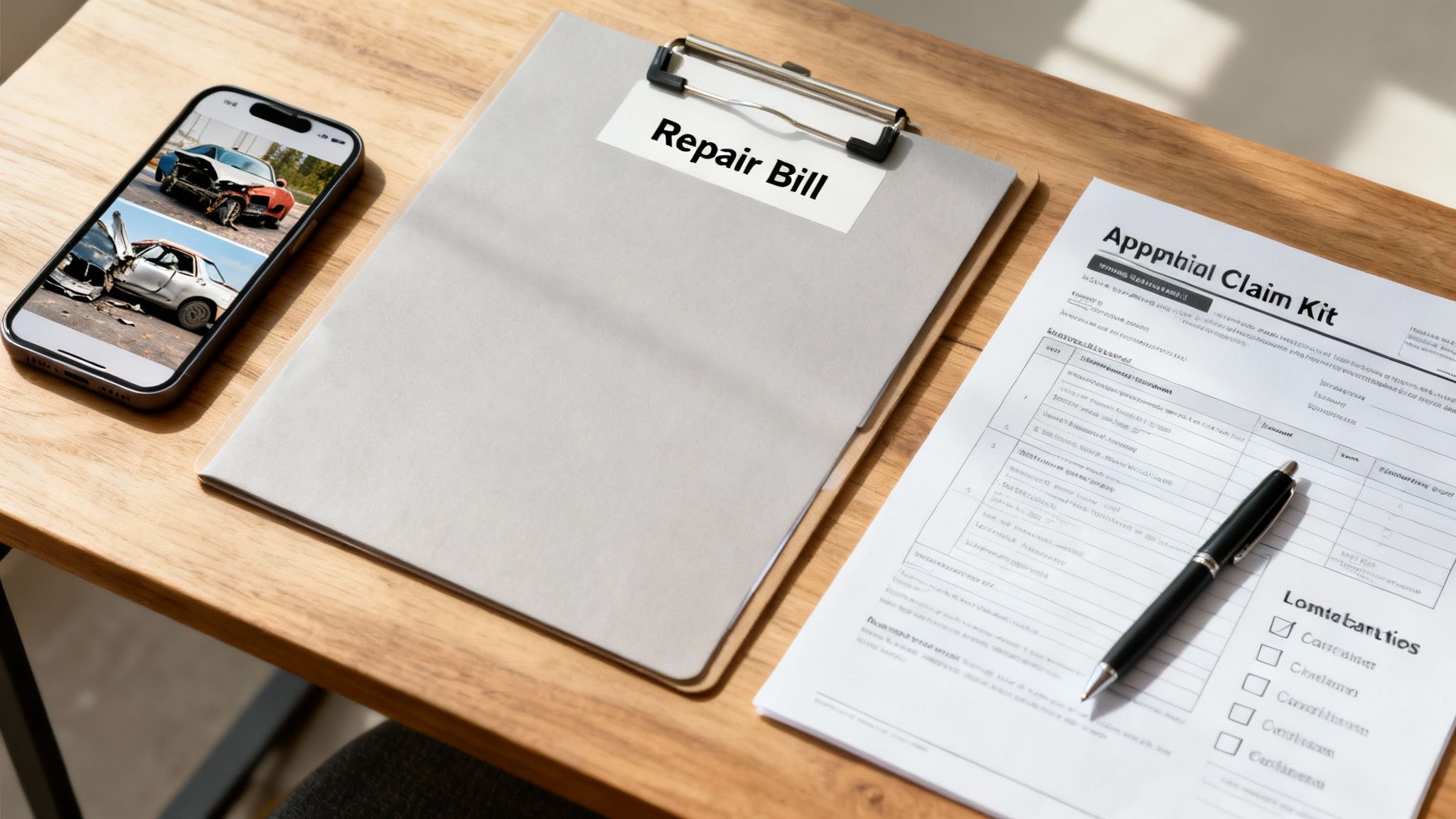
Create a dedicated folder (digital or physical) and make it the home for everything related to this incident. It needs to be your single source of truth.
- Photos and Videos: Snap pictures of everything. Get the accident scene from multiple angles, capture the damage to all vehicles involved, and don't forget to take "after" photos once the repairs are done.
- Official Reports: Always get a copy of the official police report. This is a crucial, unbiased document that often helps establish who was at fault.
- Communications: Keep a record of every single interaction. Save all emails and letters, and take notes during phone calls with the insurance adjuster, the body shop, or anyone else involved.
Perhaps the most important document of all is the final, itemized repair bill from the body shop. Think of it as your car's medical chart; it details every part that was replaced and every hour of labor spent. This is the blueprint an appraiser uses to prove just how serious the damage was.
Never Settle Prematurely
Insurance adjusters are trained to close claims quickly and cheaply. It’s common for them to send out a check right away, often with the words "full and final settlement" printed on it. If you cash that check, you've likely just accepted their offer and legally slammed the door on any future claims, including diminished value.
Crucial Warning: Do not cash a property damage check from the at-fault driver's insurance company until you are certain your diminished value claim has been resolved. Once you accept that payment, you may have forfeited your right to seek any more money for your car's lost market value.
Look at any offer with a critical eye. If it only covers the repair costs, it's an incomplete settlement. The whole point is to be "made whole," and that includes the financial hit your car's resale value has taken.
Act Promptly and Know Your Deadlines
While you shouldn't jump at a bad offer, you can't sit on your hands forever. Every state has a legal deadline for filing property damage claims, known as the "statute of limitations." The clock is ticking. For example, in Washington, you generally have three years from the date of the accident, while Oregon gives you a more generous six-year window.
The best time to file your diminished value claim is right after the repairs are finished. This timing connects the loss in value directly to the accident, without other factors like age or extra mileage muddying the waters. Looking into the diminished value appraisal cost early on will help you make a timely, smart decision.
Leverage the Appraisal Clause in the Policy
This is your secret weapon. Buried in most auto insurance policies is something called an "Appraisal Clause" or "Appraisal Provision." It's essentially a built-in process for resolving disputes when you and the insurer can't agree on the amount of a loss.
Here’s a simple breakdown of how it works:
- You hire your own certified, independent appraiser.
- The insurance company hires theirs.
- The two appraisers then negotiate directly to reach a fair settlement.
- If they can't agree, they bring in a neutral third-party appraiser (an "umpire") to make a final, binding decision.
Invoking this clause changes the entire dynamic. It forces the insurance company to argue with an expert, not just you. They have to defend their position with facts and data, not just their internal, cost-saving formulas. It's your contractual right, and it works. Independent appraisers often boost settlements by 40% or more simply by using this clause to challenge the insurer's software-generated numbers.
Your Top Diminished Value Questions, Answered
Venturing into the world of diminished value can feel like navigating a maze. It’s not something most people deal with every day, and let's be honest, insurance companies aren't exactly rushing to hand you a guidebook.
This section is designed to clear the fog. We'll give you straight, simple answers to the most common questions and worries people have when trying to get back the money they're owed.
Can I File a Diminished Value Claim if I Was at Fault?
The short answer is almost always no. A diminished value claim is a third-party liability claim, which is just a formal way of saying you file it against the insurance company of the driver who caused the accident.
Your own collision policy is there to fix the physical damage—the dents, the broken parts—and get your car drivable again. What it doesn't cover is the hit your car’s resale value takes simply because it now has an accident on its record. The legal principle is that the at-fault party's insurer has to "make you whole," and that includes paying you for this very real financial loss.
There are very few exceptions to this rule, so think of it this way: if someone else was responsible, you can pursue a claim.
Is It Worth It for an Older or High-Mileage Car?
This is a great question, and the answer is a classic "it depends." The potential for a strong diminished value claim is always highest for newer, low-mileage vehicles because, frankly, they have more value to lose.
But that doesn't mean older cars are out of the running. You might still have a very good case if your vehicle was a desirable, well-kept model that sustained significant damage. Think about a pristine 10-year-old sports car or a sought-after truck with a loyal following—these can still have a solid claim.
On the flip side, a minor fender bender on a 15-year-old commuter car with 200,000 miles probably isn't worth pursuing. A quick chat with a professional appraiser can help you do a cost-benefit analysis to see if it makes financial sense for your specific car.
How Long Do I Have to File a Claim?
Don't wait on this. Every state has a strict deadline called the statute of limitations for filing property damage claims. If you miss this window, your right to file is gone for good.
The timeline varies depending on where you are:
- In Washington, you have three years from the date of the accident.
- In Oregon, the deadline is more generous, giving you six years.
Even with these long deadlines, it's always best to file your claim right after your vehicle's repairs are finished. Waiting only complicates things. As time goes by, your car loses value from normal use and age, making it much tougher to prove exactly how much value was lost because of the accident.
What if the Insurance Company Rejects My Claim?
First off, don't panic. This is completely normal. An initial rejection or a laughably low offer is a standard move in the insurance adjuster's playbook. They're counting on you to get frustrated and just walk away.
This is the exact moment your professional diminished value appraisal becomes your secret weapon. It shifts the argument from your word against theirs to a discussion based on facts, data, and expert analysis. A detailed diminished value report shows the insurer you're serious and have the evidence to back it up.
An initial "no" from an insurance adjuster isn't the final word. It's usually just the start of the negotiation. A professional appraisal is the proof that forces them to take you seriously.
If the insurance company still won't play fair after seeing your report, your next step is to invoke the "Appraisal Clause" in the policy. This is a powerful, often-overlooked tool that kicks off a formal dispute resolution process. It basically forces their appraiser to sit down with your appraiser and hash out a binding settlement. A rock-solid report often prevents things from ever getting that far.
At Total Loss Northwest, we specialize in providing the certified, evidence-based appraisals you need to fight back against lowball offers. We handle the complex valuation process so you can focus on getting the full and fair settlement you deserve. If your vehicle has lost value after an accident, don't leave money on the table. Visit us at https://totallossnw.com to get started.