When an insurance company talks about the total loss value of your vehicle, they aren't talking about what it costs to buy a new one. They’re referring to the amount your car was worth just moments before the crash. This number, officially called the Actual Cash Value (ACV), is the foundation for your settlement. But it's vital to remember this is their opening offer—not the final word.
What Happens When Your Car Is Declared a Total Loss

Hearing an adjuster say, "your car is a total loss," is a gut-punch. It officially means the insurance company has concluded that fixing your vehicle would cost more than it's worth, or at least more than a certain percentage of its value defined by state law. This kicks off a claims process that, frankly, often leaves people feeling bewildered and underpaid.
This isn't just an unlucky break; it's happening more and more. Let's say you're driving your 2018 SUV and get rear-ended. The damage might not look catastrophic, but if the repair bill climbs past the insurer's threshold—often around 80% of the car's value—it's totaled. This scenario is far from rare. Total loss claims recently hit a record high of 22.8%, driven partly by the fact that our cars are getting older. A staggering 74% of total loss claims involve vehicles that are seven years old or more. You can find more details on this trend from Carscoops.
Understanding the Insurer's Initial Offer
Once your car is officially totaled, the insurance company will come back to you with a settlement offer based on their ACV calculation. The best way to look at this number is not as a final payment but as the opening bid in a negotiation.
The insurer's first offer is a starting point, not a conclusion. It's calculated using their own systems and data, which are designed to minimize their payout. Your job is to counter with evidence that proves your vehicle's true market worth.
This first offer almost always feels low, and there are a few key reasons why:
- Automated Valuation Systems: Insurers rely on third-party software from companies like CCC Intelligent Solutions or Mitchell that uses generalized data. These systems can easily miss local market conditions and your car’s specific features.
- Cherry-Picked Comps: The "comparable" vehicles they cite to justify their number might have higher mileage, fewer options, or be in much worse pre-accident condition than yours was.
- Their Bottom Line: At the end of the day, an insurance company is a business. Their goal is to close claims as quickly and for as little money as possible.
Understanding the gap between the insurer's lowball offer and your car's actual market value is the first, most crucial step. With the right proof and a confident approach, you can successfully push back and secure a settlement that truly covers your loss.
Here's a quick breakdown of what goes into that value calculation.
Key Factors That Determine Your Vehicle's Total Loss Value
The ACV isn't just a number pulled out of thin air. It’s a calculation based on several concrete factors that define what your car was worth on the open market right before the accident.
| Factor | What It Means for Your Settlement | Pro Tip for a Higher Value |
|---|---|---|
| Year, Make, and Model | The most basic starting point. A newer, more desirable model will always have a higher base value. | This is non-negotiable, but ensure the exact trim level is correctly identified. |
| Mileage | Lower mileage significantly increases value; high mileage decreases it. This is a major adjustment factor. | Find comparable vehicles for sale with similar (or even higher) mileage to prove market demand. |
| Overall Condition | Was your car pristine or did it have wear and tear? Adjusters rate this on a scale (e.g., poor, fair, excellent). | Provide photos, service records, and receipts to prove your car was in excellent pre-accident condition. |
| Recent Upgrades | New tires, a new sound system, or a recent major service can add value if you can prove it. | Have all receipts ready. Don't expect a dollar-for-dollar return, but these items absolutely add value. |
| Geographic Location | A 4×4 truck is worth more in Colorado than in Florida. Local market conditions matter. | Make sure the insurer's comparable vehicles are from your immediate area, not from hundreds of miles away. |
These are the core elements you’ll need to focus on when building a case for a higher settlement. Every detail matters, and good documentation is your best weapon against a low offer.
How Insurers Determine Your Vehicle's Value

If you want to successfully challenge a lowball insurance offer, you first need to peek behind the curtain. Insurance companies don’t just pull a number out of thin air; they use a specific formula and powerful software to calculate the total loss value of your vehicle.
The figure they give you is called the Actual Cash Value (ACV). It’s absolutely critical to understand what this term really means—and, more importantly, what it doesn't.
ACV is not what you originally paid for the car. It’s not the sticker price of a new one, and it has nothing to do with what you still owe on your auto loan. Instead, ACV is meant to be the fair market value of your vehicle the moment before the accident happened, factoring in all the depreciation from age, mileage, and general wear and tear.
The Role of Third-Party Valuation Software
Adjusters don't spend their days scrolling through local car listings. They lean on sophisticated, third-party valuation software from industry giants like CCC ONE or Mitchell. You need to know that these platforms are built to make the claims process faster and more efficient for the insurer, not to get you the highest possible payout.
Think of this software as a black box. It vacuums up data from all over and spits out a valuation report designed to justify the company's settlement offer. Unfortunately, this automated process has some serious flaws that almost always work in the insurance company's favor.
For starters, these systems often rely on generalized, and sometimes outdated, market data. This is a huge problem because it can completely miss the unique details of your local market. A car’s value can swing wildly from one city to another, even within the same state. A detailed guide to a https://totallossnw.com/total-loss-car-valuation/ can show you just how much these regional differences matter.
How "Comparable Vehicles" Can Be Misleading
The heart of the insurer’s valuation report is a list of so-called "comparable" vehicles, or "comps." In theory, these are cars just like yours that recently sold nearby, which the software uses to pin down a baseline value for your totaled vehicle.
This is where things really start to go sideways. The comps the software finds are often cherry-picked to justify a lower number.
Here’s what you need to look for in their report:
- Poor Matches: Are the comps a lower trim level? Do they lack options your car had, like a sunroof or a premium sound system? Is the mileage way higher than yours was?
- Questionable Condition: They might list comps in "fair" condition, but your car might have been in "excellent" shape right before the crash.
- Distant Locations: The software might pull comps from hundreds of miles away where cars are cheaper, conveniently ignoring the higher prices in your actual neighborhood.
An insurer's valuation report is not an impartial market analysis; it's a document built to support their initial offer. Scrutinizing the "comparable" vehicles they use is one of the most effective ways to begin disputing a low settlement.
This kind of selective data paints a skewed picture of your car's real worth, which is how you end up with an offer that feels way too low. While most cars are valued this way, some policies, especially for unique vehicles, work differently. You can read more about classic car insurance and agreed value policies to see how that alternative method works.
The Impact of Deductions and Adjustments
Once the software sets a baseline value using those comps, the adjuster starts making deductions. This is where a huge chunk of your settlement's value can simply vanish.
Here are the most common deductions to watch out for:
- Condition Adjustments: The insurer will subtract money for any pre-existing damage, no matter how small. Little scratches, dings, or interior wear can all be used to bring the final number down.
- Mileage Adjustments: If your car had higher-than-average mileage for its age, you can bet they will deduct a substantial amount.
- Lack of Documentation: Did you recently get new tires or a major service? Without receipts to prove it, those valuable upgrades might be completely ignored in their math.
Each one of these deductions chips away at the final total loss value. But now that you understand their formula—flawed comps minus aggressive deductions—you can see exactly where their lowball number came from. And that’s the first step to building a counter-offer based on facts.
Why the First Settlement Offer Is Almost Always Too Low
When you get that first settlement offer, it’s normal to feel a sting of disappointment. That number can feel insultingly low, but it's not a mistake. It’s a deliberate starting point in a negotiation you might not have known you were in.
Insurance companies, at their core, are for-profit businesses. Their goal is simple: collect more in premiums than they pay out in claims. Every dollar they save on your claim is a dollar that goes straight to their bottom line. It’s not personal—it's just how the business works. Understanding this is your first step toward getting what your car was actually worth.
The Problem with Automated Valuations
Adjusters don't spend hours poring over Craigslist ads to find your car's value. They plug your VIN into a third-party software system that spits out a number. These systems are fast and efficient, but they’re terrible at seeing the real story of your car.
Think about it this way: imagine two identical 2015 sedans, both with 80,000 miles. One was garage-kept, had all its maintenance records, and just got a brand-new set of tires. The other was a bit beat up, had stained seats, and was due for a brake job. A computer algorithm might see them as nearly the same, completely missing the thousands of dollars in value that your care and recent upgrades added.
Your vehicle's real-world condition, recent upgrades, and local market demand are often ignored by the generalized data used in an insurer's initial valuation. This oversight is a primary reason why the first offer is just a starting point for negotiation.
These automated reports also lag behind the market. Used car prices can swing wildly in a matter of months. An offer based on last quarter’s data might be completely out of touch with today's higher prices for similar cars in your neighborhood. This is precisely why you have to do your own homework.
Market Realities and Where You Live Matters
Location, location, location. It’s true for real estate, and it’s true for cars. The insurer's software often pulls "comparable" vehicles from a huge geographic area to find the lowest possible prices.
This ignores a simple fact: a popular SUV might sell for $2,000 more in a snowy mountain town than it does in a sunny, flat state. If the insurance company is using comps from that cheaper market, your valuation will be unfairly dragged down.
On top of that, the industry is seeing more cars declared a total loss than ever before. Why? A perfect storm of falling used car values and sky-high repair costs. According to vehicle data company Solera, over 30% of claims are now total losses because parts and labor costs are soaring. With used car prices dropping 7.25% in a single summer, it’s more critical than ever to make sure your valuation is accurate and current. For more details on this, you can read about the trend of accident cars becoming write-offs on accio.com.
Your Power to Push Back
Here's the most important thing to remember: you don’t have to take their first offer. It’s designed to be accepted by people who don’t know they have a choice. By understanding their game plan and the flaws in their process, you can take back control.
Those maintenance records you saved? The receipts for the new timing belt or tires? The photos showing your car’s pristine pre-accident condition? They aren't just memories; they're evidence. This proof shifts the conversation from them telling you a number to you negotiating for your car’s true market value.
This isn’t a secret. Legal professionals see it every day. You can find detailed advice on why you should never accept the insurance company's first offer from experts who deal with this constantly. Treat their first offer for exactly what it is: the opening bid in a negotiation.
Insurer Valuation vs. Independent Appraisal
To truly understand the gap between the insurer's number and your car's actual worth, it helps to see how their process differs from a certified, independent appraisal. The insurer’s method is built for speed and cost-savings, while an independent appraisal is built for accuracy.
| Valuation Aspect | Standard Insurance Method | Certified Independent Appraisal |
|---|---|---|
| Data Source | Large, often outdated, third-party databases (e.g., CCC, Audatex). | Real-time, local market data from multiple online and dealer sources. |
| Vehicle Condition | Uses broad categories like "average" or "good" based on an algorithm. | In-depth physical inspection (when possible) or detailed photo review. |
| Recent Upgrades | Often ignores or minimizes the value of new tires, brakes, or engine work. | Adds specific, itemized value for recent maintenance and upgrades. |
| Geographic Area | May pull "comparable" vehicles from hundreds of miles away to find lower prices. | Focuses hyper-locally on your specific Designated Market Area (DMA). |
| Goal of Valuation | To determine the lowest justifiable payout to close the claim efficiently. | To determine the highest accurate, fair market replacement value. |
Seeing the differences laid out like this makes it clear. The insurance company’s report is a starting point, but an independent appraisal is often the key to proving your car was worth more than their software suggests.
Using Your State's Rules to Your Advantage
Knowing how an insurance company calculates a total loss value is a great start. But understanding the specific rules they have to play by in your state? That’s where you really start to level the playing field.
State regulations aren't just bureaucratic fine print; they're powerful tools you can use during a total loss claim. Two rules in particular are crucial to know: the Total Loss Threshold and the Appraisal Clause. One tells you when your car is totaled, and the other gives you the power to fight back if the insurer's valuation is out of line.
Understanding the Total Loss Threshold
The Total Loss Threshold is a number set by state law that dictates when a car is officially a "total loss." It’s designed to keep unsafe, heavily damaged vehicles from being patched up and put back on the road.
This threshold is usually a percentage. For example, in a state like Washington, the line is crossed once repair costs hit 100% of the car's pre-accident value. Down in Oregon, it’s a bit different—a vehicle is totaled if the repair bill exceeds 80% of its retail market value. Knowing your state's specific number helps you see exactly why the insurance company made its call.
The Appraisal Clause: Your Secret Weapon
Buried deep in the fine print of almost every auto insurance policy is a provision most people never know exists: the Appraisal Clause, sometimes called the "Right to Appraisal." This clause is your single most powerful tool for fighting a lowball offer and getting a fair, unbiased valuation. Think of it as your contractual right to call in a neutral referee when you and the insurer can’t agree.
When you invoke this clause, you're essentially telling the insurance company that their adjuster and their valuation software are out of the game. The dispute is then handed over to impartial, certified experts.
Invoking the Appraisal Clause is the ultimate check and balance on the insurance company's power. It forces the valuation out of their internal system and into the hands of independent professionals whose only goal is to determine the vehicle's true and accurate market value.
This isn't just a friendly suggestion; it's a right written into the policy you pay for. It outlines a clear, binding process to settle the disagreement once and for all.
How Invoking the Clause Works
The process itself is pretty straightforward, but you have to follow the steps correctly. Here’s a quick breakdown of what happens when you exercise your right to appraisal:
- You Hire Your Own Appraiser: First, you’ll find and hire a certified, independent appraiser who will represent you. Their job is to build a detailed, evidence-based valuation of your vehicle.
- The Insurer Hires Their Appraiser: Your insurance company then hires its own appraiser to do the same thing from their perspective.
- The Appraisers Negotiate: The two independent appraisers get together, present their findings, and work to agree on a final value. Most of the time, they find a middle ground based on the facts.
- An Umpire Steps In (If Needed): If for some reason the two appraisers can't come to an agreement, they will jointly select a neutral third-party expert, called an umpire, who will cast the final, binding vote.
By triggering this process, you take control. You ensure the final settlement is based on real-world data and expert analysis—not just an algorithm designed to save the insurance company a few bucks. It’s how you demand the fair value you're truly owed.
How to Dispute a Low Total Loss Offer Step by Step
Getting that low settlement offer can feel like a punch to the gut. But here's the most important thing to remember: their first offer is just that—an offer. It's a starting point for a negotiation, and you absolutely have the right to push back. Let's break down exactly how you can challenge their number and fight for what your car was actually worth.
This isn't just an isolated problem; it's happening everywhere. We hear stories all the time—someone’s classic, garage-kept car gets totaled, and the insurance company acts like it was just another clunker. It’s no surprise, really. Total loss claims have skyrocketed, now making up over 30% of all auto claims in the U.S.
What’s driving this? Soaring repair costs, especially for modern electronics, mean that even minor damage can total a car. In fact, a whopping 72% of these total loss valuations are for vehicles that are seven years or older. You can dig deeper into the trends reshaping the global auto insurance market on solera.com.
Step 1: Formally Request the Valuation Report
First things first: you need to see their work. Send a formal, written request for a complete copy of the insurer's valuation report. This document is the playbook for their offer, and you can’t formulate a winning strategy without knowing how they came up with their number.
Inside that report, you’ll find the "comparable" vehicles they used to set the value, along with any adjustments they made for your car's condition. Think of it as the evidence they're using against you. Your job is to pick it apart.
Step 2: Scrutinize Their "Comparable" Vehicles
With the report in hand, it's time to put their "comps" under a microscope. This is almost always where you'll find the weak spots in their argument. The software these companies use often pulls comps that are a poor match, conveniently justifying a lower payout.
Be on the lookout for these classic red flags:
- Wrong Trim or Options: Did your car have the premium sound system, leather seats, or a sunroof that their comps are missing? Every option adds value.
- Higher Mileage: It’s a common tactic to compare your low-mileage car to vehicles with significantly more wear and tear.
- Poor Condition: They might list their comps as "average" condition. If your car was immaculate, that’s not a fair comparison.
- Distant Locations: A car sold 200 miles away in a completely different market doesn't reflect your local vehicle values.
Step 3: Compile Your Own Compelling Evidence
Now, you build your counter-offensive. Your mission is to prove your vehicle's real, pre-accident condition and value. Gather every shred of documentation you can find to paint a vivid picture of the car the insurer is trying to devalue.
Your evidence file should be airtight. Include things like:
- Maintenance Records: A thick stack of receipts for oil changes and regular service is undeniable proof of a well-cared-for vehicle.
- Receipts for Recent Upgrades: Did you just put on a new set of tires, replace the brakes, or buy a new battery? That's real money you invested.
- Photos and Videos: Pre-accident photos are golden. Show off that clean interior and scratch-free paint job.
- Original Window Sticker: If you have it, the original sticker is the ultimate proof of every single option and package your car came with from the factory.
Step 4: Find Your Own Accurate Comps
Don't just poke holes in their bad comps—go find your own good ones. Jump on sites like Autotrader, Cars.com, or local dealership websites. Your goal is to find vehicles for sale in your immediate area that are an exact match for yours.
Look for the same year, make, model, trim, and options, with similar mileage. Screenshot every single one of these listings. Nothing shuts down a lowball offer faster than showing the adjuster five examples of your exact car selling for thousands more than they're offering.
The most powerful step you can take is to remove the insurance company's biased process from the equation entirely by invoking the Appraisal Clause in your policy.
Step 5: Hire an Independent Appraiser and Invoke the Appraisal Clause
So, you’ve presented your evidence, and the insurance company still won't budge? It’s time to play your trump card. The Appraisal Clause, a provision in your own policy, is the single most effective tool for getting a fair settlement.
By hiring a certified independent appraiser, you can invoke this clause, which essentially forces the dispute to be settled by unbiased experts instead of the insurance company itself.
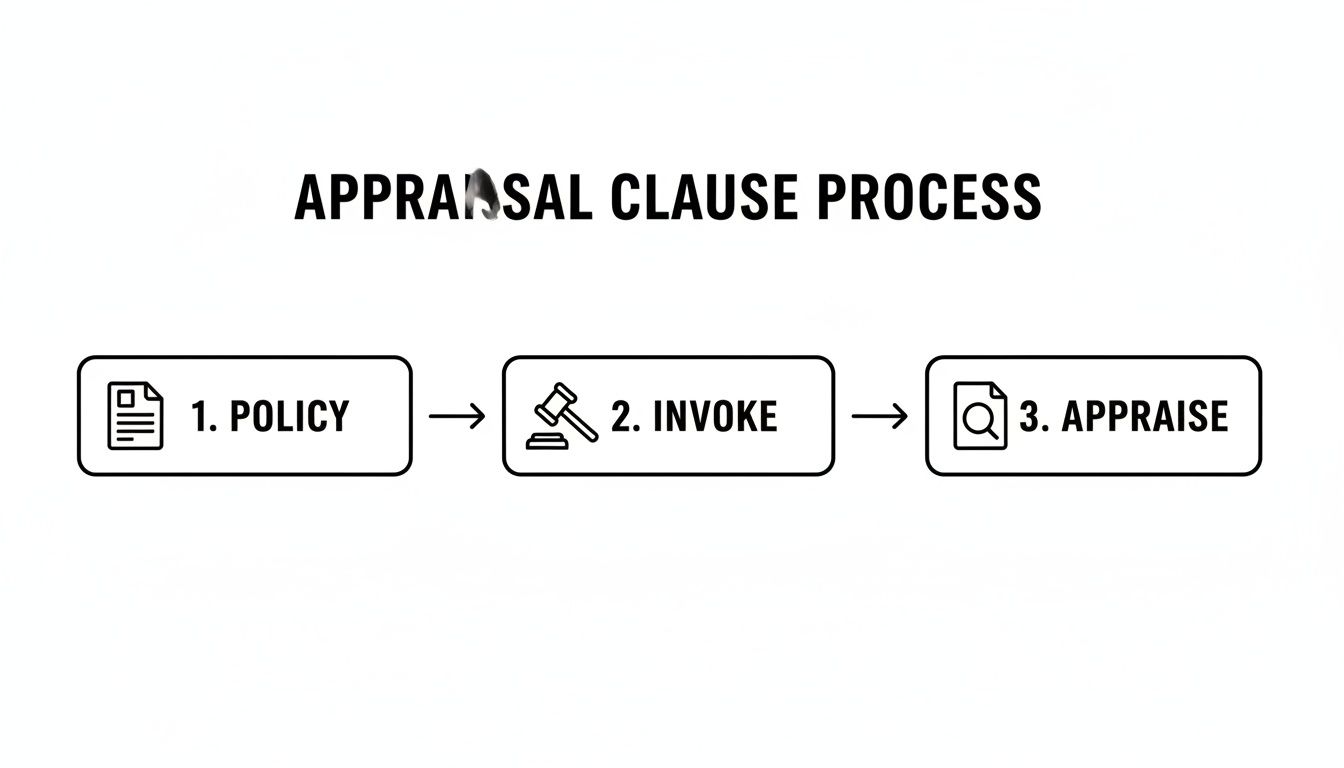
This process gives you the power to demand a fair, independent valuation when negotiations hit a wall. An expert who specializes in a professional total loss vehicle appraisal can guide you through every step, making sure the final value truly reflects what your car was worth.
Take Control of Your Total Loss Claim
Going through a total loss claim can leave you feeling completely overwhelmed. But here’s the most important thing to remember: the insurance company's first offer is just that—an offer. It's not the final number.
Think of it as the starting point for a negotiation. You actually have more power in this situation than you realize. With the right know-how and a solid game plan, you can make sure you get a fair settlement.
This guide is all about giving you that knowledge. Once you understand exactly how the total loss value of your vehicle is determined, you can poke holes in a lowball offer. More importantly, you now have a step-by-step process for fighting back effectively.
Your Path to a Fair Settlement
The goal is to stop being a passive victim of the process and start being an active participant. To do that, you need to take a few key steps right away.
- Build Your Case: Start by digging up all your maintenance records, any receipts for recent upgrades (like new tires or a stereo), and photos of your car before the accident. This is the hard evidence that proves your car’s real-world condition and value.
- Find Your Own Comps: Don't just take the insurer's word for it. Do your own homework. Look up local listings for cars that are a dead ringer for yours—same year, make, model, trim, and similar mileage. This builds a powerful argument for a higher valuation.
- Play Your Trump Card: If the adjuster won't budge, it's time to invoke the appraisal clause in your policy. This is your right, and it's the single most effective tool you have for getting an unbiased, independent valuation.
Don’t leave money on the table. The gap between the insurer's initial offer and what your car was actually worth can easily be thousands of dollars. Fighting for the compensation you deserve isn't just a good idea—it's your right.
If you’re staring at a low offer, it’s time to get to work. By preparing your evidence and knowing the rules of the game, you can turn the tables and secure a settlement that truly reflects what you lost.
Frequently Asked Questions About Total Loss Claims
Even when you think you have a handle on the total loss process, a few nagging questions always seem to pop up. Let's tackle some of the most common ones that people face, so you can move forward with a bit more clarity.
What If I Still Owe Money on My Car?
This is a tough spot to be in, and it's more common than you'd think. It's often called being "upside-down" or having negative equity on your loan.
Here’s the hard truth: the insurance company’s settlement is based on the Actual Cash Value of your car at the moment before the crash, not what you owe the bank. You are still on the hook for the rest of that loan balance. This is exactly why GAP (Guaranteed Asset Protection) insurance exists. If you have it, GAP coverage will pay off that difference, saving you from a major financial headache.
Can I Keep My Car After It's Declared a Total Loss?
Yes, in most states like Washington and Oregon, you have the option to keep your vehicle. This is called "owner-retained salvage."
If you decide to do this, the insurance company pays you the car's actual cash value minus what they would have gotten for it at a salvage auction. Just be prepared for the hurdles that come next. The state will issue a salvage title, which makes insuring and registering the car a real challenge. Plus, you’re responsible for all the repairs needed to get it safely back on the road, which often includes passing a very strict state inspection.
How Long Is This Whole Process Going to Take?
Honestly, it varies. Once an adjuster officially declares your car a total loss, it could be anywhere from a few days to a couple of weeks before you see an initial offer. The timeline really hinges on how quickly your insurer works and how fast you can get them all the required paperwork.
If you decide to challenge their offer and use the Appraisal Clause, it will definitely extend the process. While no one wants more delays, taking this step is often the only way to get a fair payout and can be well worth the extra time.
Are Appraisers Just for Fancy Classic Cars?
Not at all. This is a huge misconception. While an appraiser is absolutely critical for a one-of-a-kind vehicle, they are just as important for your everyday family car.
The automated systems insurers use can easily undervalue a common sedan by pulling the wrong comps or dinging you with unfair condition adjustments. The way an insurer figures out the actual cash value of your car is the same, no matter what you drive.
A lowball offer of $3,000 on a $20,000 family SUV is a substantial loss. An appraiser ensures your settlement reflects your vehicle’s true market value, not just an algorithm’s flawed estimate.
Bringing in a professional ensures that your car's real condition, recent repairs, and the specific demand in your local market are all factored in correctly. It's a crucial step for anyone who wants to get paid what their vehicle was actually worth.
If you've received a low settlement offer for your total loss claim, don't accept it without a fight. At Total Loss Northwest, we specialize in providing certified, independent auto appraisals that force insurance companies to pay what you're truly owed. Visit us online to take control of your claim today.