When your insurance adjuster tells you your car is a "total loss," it can feel like a final, unchangeable verdict. But it's not. In reality, this is just the beginning of a negotiation, and knowing what the term actually means is your first step toward getting a fair settlement.
Decoding the Total Loss Declaration
Simply put, your insurance company declares a car a total loss when they decide it costs more to fix than what it was worth right before the accident. This "pre-accident worth" is a critical term called Actual Cash Value (ACV).
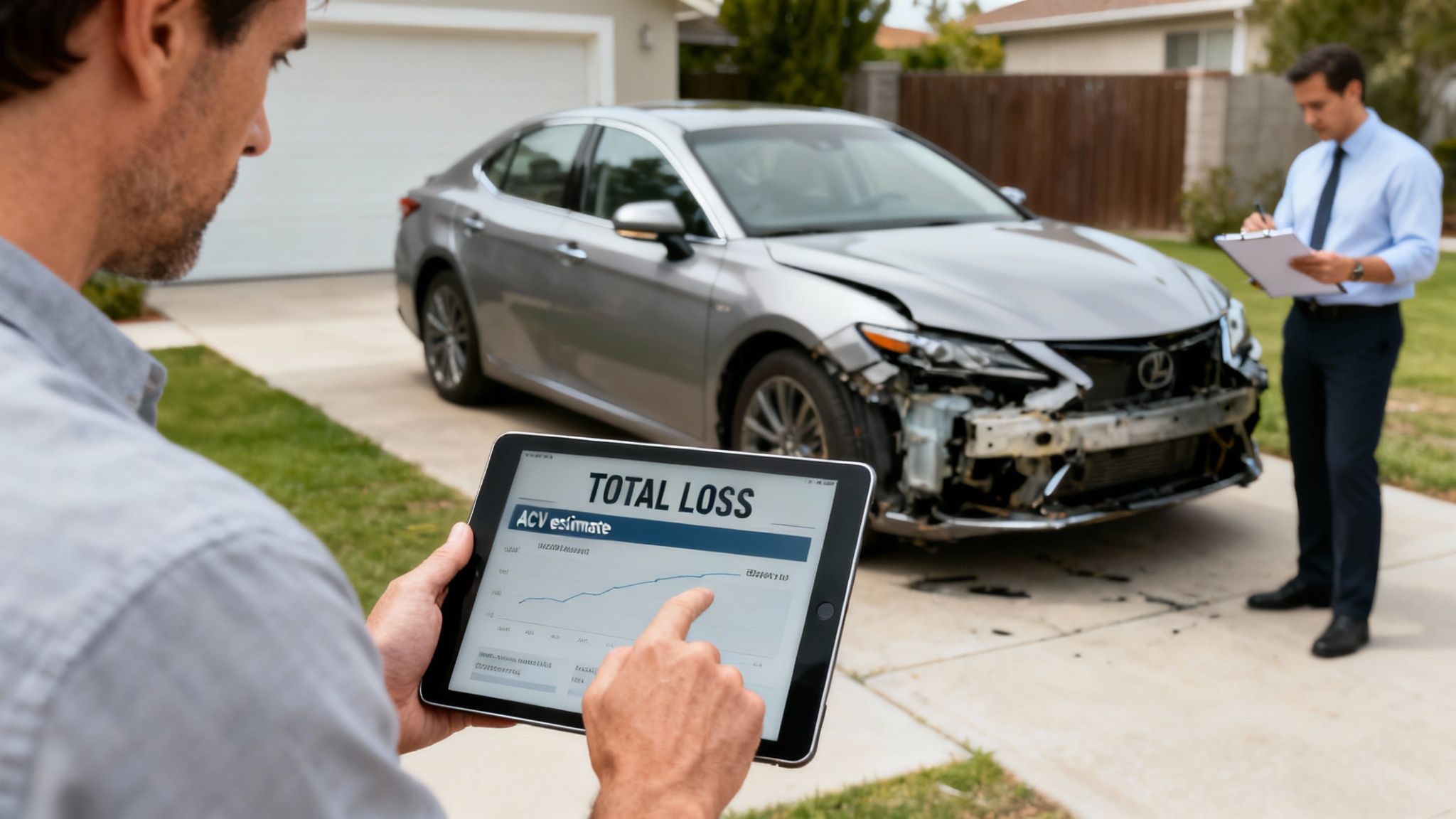
The entire decision comes down to an economic calculation. Your insurer weighs the estimated repair bill against the car's ACV. If the numbers don't make sense for them to repair it, they'll "total it out" and cut you a check instead.
Understanding the Total Loss Threshold
What many people don't realize is that the tipping point for totaling a car isn't the same everywhere. Each state sets its own Total Loss Threshold (TLT), which is a specific percentage of the car's ACV.
This threshold can range anywhere from 51% to 80%, while a few states set it as high as 100%.
For example, Alabama has a TLT of 75%. If your car was worth $10,000 before the crash, it would be declared a total loss once the repair estimates hit $7,500. This state-by-state difference is why two identical cars with the same damage could be repaired in one state but totaled in another. You can learn more about how different states handle this over on KBB.com.
Why Modern Cars Total Out So Easily
It can be shocking to hear your car is totaled when the damage doesn't look catastrophic. This is happening more and more because modern vehicles are packed with incredibly complex and expensive technology.
- Advanced Driver-Assistance Systems (ADAS): Think about the cameras, radar, and sensors in your bumpers, mirrors, and windshield. They are fragile, pricey to replace, and require expert recalibration.
- Complex Electronics: Even a minor fender bender can disrupt sensitive wiring or damage computer modules that run everything from your engine to your stereo.
- Specialized Materials: Cars today aren't just simple steel. They use a mix of aluminum, high-strength alloys, and even carbon fiber, all of which require special tools and training to repair correctly, driving labor costs through the roof.
A simple bumper repair that might have cost a few hundred dollars a decade ago can now easily run into the thousands just for sensor recalibration. This massive inflation in repair costs means cars hit their total loss threshold much more quickly.
When you understand these core pieces—the ACV, your state's specific TLT, and the high cost of modern repairs—the insurer's decision starts to make more sense. More importantly, it gives you the knowledge you need to look at their first offer with a critical eye and start building your case for what your car was really worth.
How Insurers Actually Calculate Your Car's Value
Ever wonder how an insurance company comes up with that settlement number? It's not by flipping through a Kelley Blue Book. Insurers lean on sophisticated, proprietary reports from third-party data giants. The big three you'll almost certainly run into are CCC, Mitchell, and Audatex.
These platforms are data vacuums. They suck in massive amounts of sales data from dealer lots, auctions, and private sales in your local area. The whole point is to find a handful of "comparable vehicles"—or "comps"—that are a near-perfect match for your car right before the accident.
The Make-or-Break Role of "Comps"
The selection of these comps is everything. It's the single most critical piece of the valuation puzzle. An adjuster plugs in your vehicle’s year, make, model, trim, and mileage, and the software spits out a list of similar cars that have recently sold near you.
Here's the catch: the quality of those comps can be all over the place. A common tactic, whether intentional or not, is for the system to pull cars that aren't truly comparable. Maybe they're a lower trim level, have way more miles, or are in rougher shape. A bad set of comps can instantly tank your car's value, often by thousands of dollars.
The core idea behind a total-loss settlement is simple: the payout should be enough for you to buy a similar replacement vehicle in your local market. If the insurer's comps are worse than your car was, their offer will never get you there.
Your very first move after getting their valuation report? Scrutinize every single comparable vehicle they used. I mean really dig in—check the VIN, verify the mileage, and look at the options and condition notes for each one.
How They Chip Away with Deductions and Adjustments
Once they have a baseline value from the comps, the adjuster starts making adjustments. Think of these as a series of credits and debits that account for the differences between your car and their chosen examples.
Here are the usual suspects:
- Mileage Deduction: If your car had higher mileage than the average of the comps, they'll subtract value, usually on a per-mile basis.
- Condition Deduction: This is where things get really subjective. They'll knock off money for any pre-existing dings, scratches, or interior wear. Brace yourself for some aggressive deductions here.
- Prior Damage: Had a previous fender-bender, even if it was perfectly repaired? They'll still reduce the value.
- Feature Additions: On the flip side, if your car had premium features the comps didn't—like a sunroof or a high-end tech package—they are supposed to add value.
These adjustments are often where a valuation report goes completely off the rails. It’s not uncommon to see a $700 deduction for a few minor door dings that a local shop would fix for $200.
This is why understanding what constitutes the actual cash value of your car is so crucial before you even look at their report. Armed with this knowledge, you can dissect their valuation, call out unreasonable figures, and build a strong case for a fair settlement.
Building Your Own Data-Backed Valuation
Never, ever accept the insurance company's first offer without doing your own homework. Think of their initial valuation as a starting point for a negotiation, not the final word. To get a fair settlement, you need to counter their report with cold, hard facts—your own data-backed valuation. This isn’t about arguing; it’s about presenting a case so compelling they can't ignore it.
Your mission is to become an expert on what your specific car was worth just moments before the crash. This means rolling up your sleeves and digging into your local market to find out what it would actually cost to replace it today.
Insurers typically use a third-party service to pull data on comparable vehicles. It's a standardized process, but it often misses the details that made your car unique.
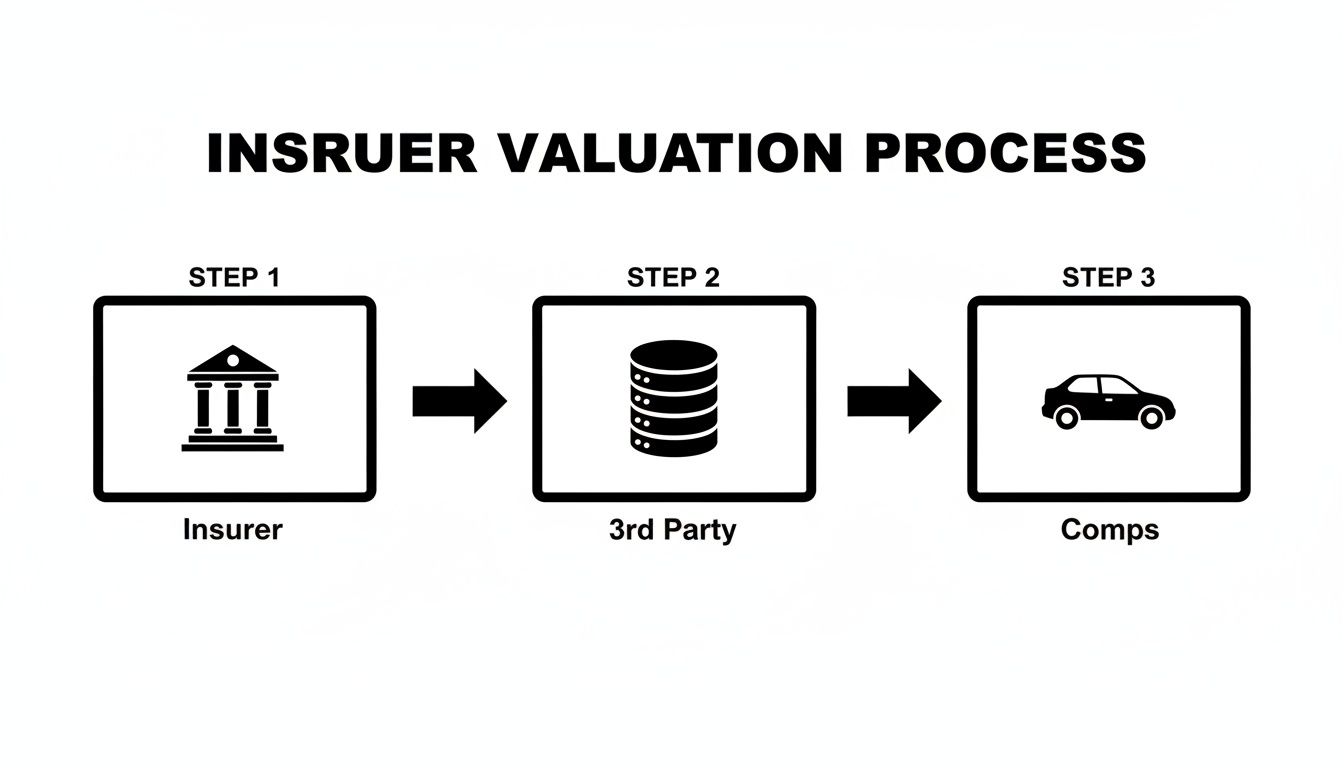
As you can see, the process relies on external data that can easily overlook key aspects of your vehicle's condition and features. Your job is to find those missing pieces and present them clearly.
Finding Truly Comparable Vehicles
The bedrock of your counter-offer is finding "comps"—cars currently for sale that are a near-perfect match for yours. Don't just grab the first few you see. You need to be meticulous.
Here’s exactly what to look for:
- Identical Year, Make, and Model: This one’s a no-brainer. It has to be the same car.
- Exact Trim Level: A base model is a world away from a fully-loaded one in terms of value. A Honda Accord EX-L is not an LX. Be precise.
- Similar Mileage: Look for comps within a 10-15% mileage range of your car.
- Geographic Proximity: Your local market matters. Stick to listings within a 50-75 mile radius.
Jump on sites like AutoTrader, Cars.com, and even Facebook Marketplace. Screenshot every single relevant listing. Make sure the screenshot captures the VIN, asking price, mileage, and all the listed options. This is your evidence locker.
Your goal is to build a portfolio of at least 3-5 strong, local comparable vehicles for sale right now. This shows the adjuster the real-world cost you're facing to replace your car.
Using Online Valuation Tools
Online tools like Kelley Blue Book (KBB) and NADAguides can provide a useful baseline, but they are not the definitive source for a total loss claim. They are a piece of the puzzle, not the whole picture. Insurers often use their own systems, so you need to understand how these public-facing tools fit into your research.
Here's a quick look at the major players and how to use them effectively.
Online Valuation Tools Comparison
| Tool (e.g., KBB, NADA) | Best Use Case | Potential Limitation |
|---|---|---|
| Kelley Blue Book (KBB) | Establishing a general retail value. Good for showing a widely recognized "book value" as a starting point. | Values can be regional averages and may not reflect the specifics of your local market or vehicle's pristine condition. |
| NADAguides | Often favored by banks and credit unions for loan values. Can be a strong, conservative data point to include. | Tends to focus more on dealer retail and may not capture private party sale nuances as effectively as other sources. |
| Edmunds | Provides "True Market Value" (TMV) based on recent transaction data. Useful for showing what people are actually paying. | TMV is based on past sales, not current listings, which is what you need to prove replacement cost today. |
These tools are valuable for adding context to your argument, but they don't replace the power of real-time, local listings. Use their reports to supplement your portfolio of comps, not as the main evidence.
Accounting for Condition and Upgrades
Now for the details. This is where you can really move the needle on your settlement. A generic online calculator won’t know about the unique things that made your car better than average, but your valuation report will.
Document everything. Did you just drop $1,200 on a set of premium Michelin tires three months ago? Find that receipt. Did your car have a factory towing package that the comps you found are missing? Write it down.
Here’s what to gather evidence for:
- Recent Maintenance: Proof of a recent timing belt replacement or other major service is solid evidence of excellent mechanical upkeep.
- New Parts: Receipts for a new battery, brakes, or tires all add tangible value.
- Premium Options: Factory upgrades like a panoramic sunroof, advanced safety features, or premium sound systems need to be highlighted and valued.
- Pristine Condition: Was your car garage-kept with flawless paint? Use high-quality photos taken before the accident to prove it.
Pull all your service records, receipts, and pre-accident photos into an organized file. Each document makes it harder for the adjuster to lowball you. This level of detail is also essential if you were trying to use a car value after accident calculator to argue for diminished value had the car been repairable. By presenting a full, documented package, you shift the conversation from their opinion to undeniable facts about your car's true market worth.
Why Online Calculators Are Only a Starting Point
When you're trying to figure out what your car is worth after an accident, the first place most of us go is an online "total loss car value calculator." It's quick, simple, and you get a number back in minutes. But that number, while helpful, is almost never the full picture. Think of it as the first chapter, not the whole story.
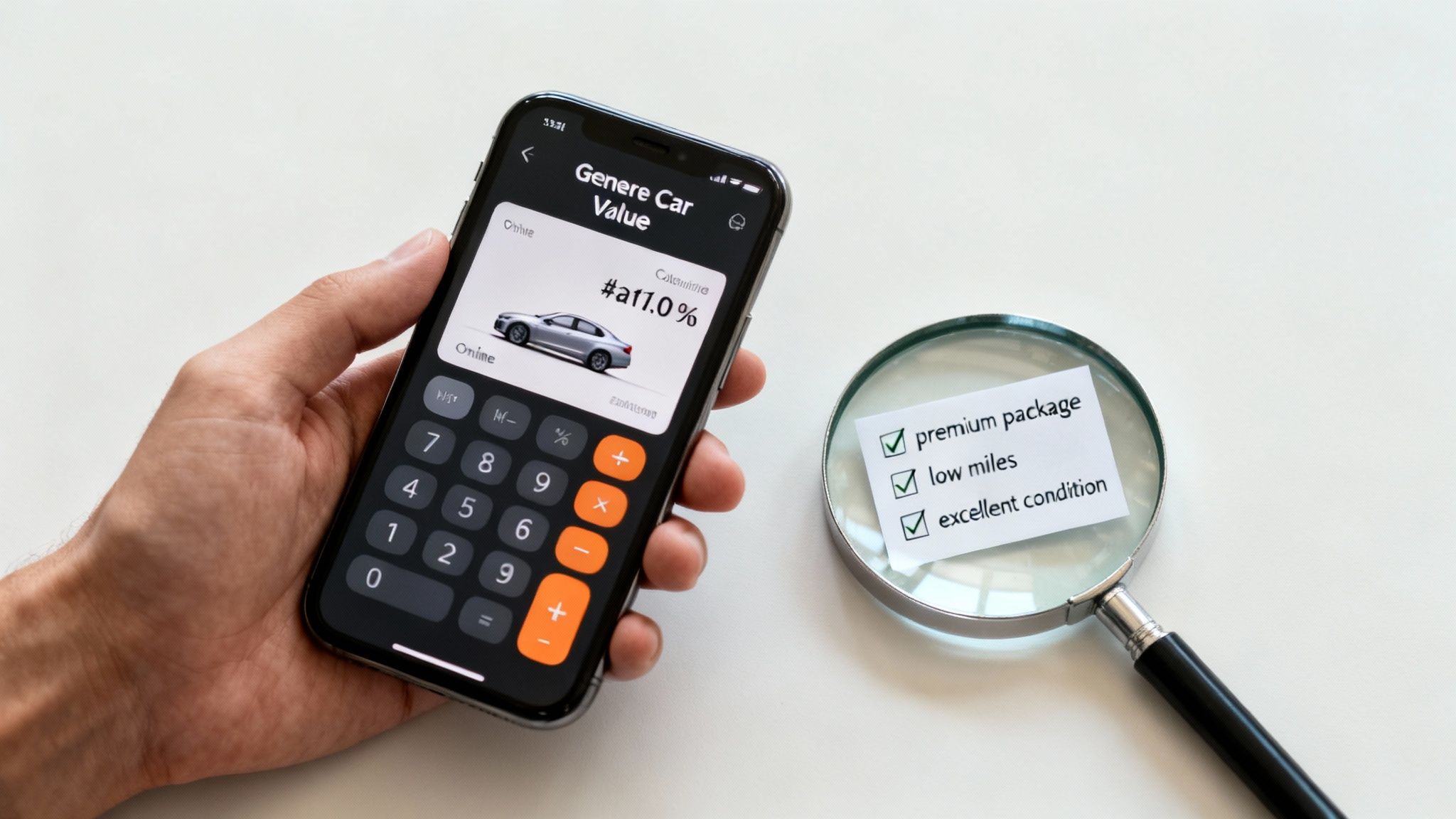
These tools are great for getting a ballpark figure. They give you a rough idea of what your vehicle might be worth by pulling from massive databases of market data. The problem is, they rely on algorithms that just can't understand the unique story of your car.
The Problem with Averages and Algorithms
An online calculator has no idea you were the kind of owner who kept the car garaged and detailed it every month. It doesn't know you just dropped $1,500 on a brand-new set of high-performance tires and premium brakes. All those little details that add real value get lost in the digital shuffle.
Put it this way: a calculator sees a 2018 Honda CR-V with 60,000 miles. It can't tell the difference between one that was driven hard and put away wet, and another that looks like it just rolled off the showroom floor. It just mashes all the unique characteristics together into a single, generic average.
This is a huge deal, especially now. The industry has seen a massive jump in total loss claims, with 22.6% of all auto insurance claims now ending this way. Modern cars are so packed with complex tech that repairs have become unbelievably expensive. You can discover more insights about total loss claims to see why getting an accurate valuation is more important than ever.
What Online Valuations Miss
The real difference between a quick online quote and a professional appraisal comes down to the details. An algorithm can't spot, document, or argue for the subtle factors that a human expert can.
Here are just a few things a typical total loss car value calculator will probably miss:
- Exceptional Condition: Immaculate paint, a spotless interior, and almost no wear-and-tear add real money to your car's value.
- Desirable Factory Options: Did you have a rare color or a sought-after performance package? That can make your specific vehicle worth more in your area.
- Recent Upgrades: Major recent investments in maintenance or new parts directly boost the car's pre-accident worth.
- Local Market Demand: A certified appraiser knows the local market inside and out—they’ll know if your exact model is a hot commodity in your city right now.
An online calculator gives you a starting hypothesis. A professional, independent appraisal provides the hard evidence you need to prove that hypothesis to your insurance company.
So, by all means, use those online tools. They arm you with some initial data and help set your expectations. Just don’t mistake them for the final word. To get a settlement that truly reflects what it will cost to replace your car, you need a detailed, human-led valuation that can stand up to the insurance company's scrutiny.
Using Your Policy's Appraisal Clause as Leverage
So you’ve hit a brick wall with your insurance adjuster. It’s a frustratingly common scenario. You’ve done your homework, presented solid research with comparable vehicles, and yet, they refuse to budge on their lowball offer. When you get to this point, it feels like you're out of options.
But you have one more card to play, and it’s a big one. Tucked away in the fine print of your auto policy is a powerful tool you probably didn't even know you had: the Appraisal Clause.
Invoking this clause completely changes the game. It takes the decision-making power away from the insurance adjuster and forces the dispute into a formal, third-party resolution process. It's your right, and it's time to use it.
How the Appraisal Clause Works
Activating the clause isn't just a suggestion; it's a formal demand. Once you do, both you and the insurance company must hire your own independent, certified appraisers. These experts don't use the same cookie-cutter software the insurer relies on. Instead, they use their professional experience and real-world market data to determine your vehicle's true Actual Cash Value.
What happens if the two appraisers can't agree on a number? They work together to select a neutral third expert, called an umpire. At that point, a final, binding decision is reached when any two of the three parties agree. This process effectively throws out the insurance company's initial, and often deeply flawed, valuation.
The Appraisal Clause is your ultimate leverage. It forces the insurance company to defend its low number against an impartial expert who works for you, not for them. This creates a level playing field where facts, not insurer tactics, determine the final payout.
When to Invoke the Clause
This isn't your first move; it's your checkmate. The right time to invoke the Appraisal Clause is when you’ve reached a genuine stalemate. You've sent them everything—local comps, receipts for that new sound system, proof of your car's pristine condition—and the adjuster is still stonewalling you.
Consider pulling this trigger in these situations:
- The Gap is Significant: Their offer isn't just a little off. We're talking a difference of $1,000-$2,000 or more from what your research shows.
- They Ignore Your Evidence: You sent them a beautifully detailed package of comps and receipts, and they just brushed it aside without a real explanation.
- The Valuation Report is Flawed: You look at their report, and the "comparable" vehicles are base models with high mileage, while yours was a top-tier trim in mint condition.
Yes, hiring a professional appraiser has a cost. But think of it as an investment. Spending a few hundred dollars to gain a few thousand in a fair settlement is a smart move. This process is one of the single most effective ways to break through the gridlock and ensure the number from a total loss car value calculator or insurer report actually reflects reality.
To get a handle on the whole process, you should learn more about the insurance appraisal clause and see just how it can empower you. By taking this step, you're no longer just having a frustrating argument—you’re initiating a structured, evidence-based proceeding where you have a real chance to win.
Answering Your Top Questions About Total Loss Value
Going through a total loss claim can be confusing, and it's natural to have a lot of questions. Let's tackle some of the most common ones that come up when your car is written off.
Can I Keep My Car if It’s a Total Loss?
Yes, you almost always can. This is called "owner retention."
If you decide to keep your car, the insurance company will calculate its actual cash value (ACV) and then subtract what they would have gotten for it at a salvage auction. You get the difference.
From there, you'll be given a salvage title. Just know that you can't legally drive the car until it's been properly repaired and passed a rigorous state inspection. Be warned, though: a salvage title seriously damages the car's future resale value and can make it tough to get full coverage insurance down the road.
Does My Loan Balance Change the Settlement Amount?
Not at all. The amount you owe on your car loan has zero impact on its actual cash value. The insurer's only job is to pay you what the car was worth the moment before the crash.
This is a tough pill for many people to swallow. If your settlement check is less than what you still owe the bank, you’re on the hook for the difference. This is exactly why GAP (Guaranteed Asset Protection) insurance exists—to cover that "gap" and prevent you from paying for a car you no longer have.
Before you get too far into the claims process, make sure you have all your insurance documents handy. Having proof of your policy, like what you’d see on a Certificate of Insurance template, is the first step.
What if the "Comps" the Insurer Used Are a Bad Match?
This happens all the time, and it's one of the biggest reasons for a lowball offer. You need to pull out your magnifying glass and go through the comparable vehicles in their valuation report. If they aren't a true apples-to-apples comparison, you have every right to push back.
Here’s what to look for when you review their comps:
- Wrong Trim Level: Did they value your top-tier Limited model against a basic, no-frills LX?
- Higher Mileage: Are the comparable cars showing 20,000 or 30,000 more miles than yours had?
- Missing Options: Did your car have a sunroof, premium sound system, or an upgraded tech package that the comps lack?
If you spot these kinds of issues, it's time to do your own homework. Start digging through local online listings to find vehicles that are a much closer match to your car's exact year, model, trim, and condition. Arm yourself with this proof and present it to the adjuster to show them why their offer is too low.
When the adjuster won't budge, you need a professional in your corner. Total Loss Northwest offers certified, independent appraisals to make sure you receive the fair and accurate settlement you deserve. Contact us today and let's get you what you're rightfully owed.