That first phone call from the insurance adjuster is more than just a check-in. It’s the opening bell for the negotiation process, and how you handle it can set the tone for your entire claim. The key is to be polite but firm, stick to the absolute basics, and never, ever agree to a recorded statement from the other driver's insurance company.
This is your chance to control the narrative right from the start.
Your First Conversation with the Insurance Adjuster

It usually happens sooner than you think. The phone rings, and a polite, professional-sounding person introduces themselves as the adjuster for the at-fault driver. It’s easy to let your guard down, but make no mistake: this is a fact-finding mission. Their goal is to gather information that can minimize their company's financial responsibility.
Every question is deliberate. Every "how are you feeling?" is loaded.
Your only job in this first call is to stay calm and give away as little information as possible. You are not obligated to recount the accident, detail your injuries, or speculate on your recovery. Saying too much now can box you in later and seriously hurt your claim.
Setting the Right Tone
When that call comes in, subtly flip the script. Before you answer any of their questions, start by asking your own. Get the adjuster’s full name, the exact name of the insurance company they work for, the claim number, and their direct phone number and email address.
This small action does two things: it shows you’re organized, and it signals that you’re taking this process seriously.
Politely let them know you’re not ready to discuss the details. A simple, confident statement works best.
"Thank you for calling. I can confirm the date and location of the incident, but I won't be providing a statement or discussing the details today. I'm still in the process of assessing my injuries and the damage. What is the best way to send you information in writing?"
This isn’t aggressive; it’s assertive. You’re establishing a clear boundary and communicating that you'll proceed on your terms, not theirs. For a deeper dive into the overall game plan, this guide on how to negotiate with insurance adjuster is an excellent resource.
The Recorded Statement Trap
You can almost guarantee the adjuster will ask for a recorded statement. They’ll frame it as a standard procedure or a routine part of the process. It is not. You should always decline this request politely but without hesitation.
Recorded statements are not designed to help you. They are a tool for the insurance company to find any inconsistencies in your story—now or in the future—or to coax you into saying something that could imply you were partially at fault.
- A simple, effective response is: "I'm not comfortable providing a recorded statement at this time."
- What to avoid: Don't feel the need to give a long explanation or apologize. A simple "no" is enough.
Keep in mind, an innocent off-the-cuff remark like, "I'm doing okay, I guess," can be twisted later to argue your injuries weren't significant. Stick to facts you know are 100% true. From here on out, try to keep your communication in writing via email. It creates a paper trail and ensures your words can't be taken out of context.
Why Their First Settlement Offer Is Just a Starting Point
When that first settlement offer from the insurance company finally arrives, it’s easy to feel a wave of relief. After all the stress and waiting, there’s a number in front of you, and it feels like the finish line is in sight. But hold on. It's critical to see that first offer for what it really is: an opening bid, not their final word.
Insurance adjusters are trained negotiators. Their job isn’t to make you whole; it’s to protect their company’s financial interests by settling claims for as little money as possible. That initial offer is a strategic move, a calculated feeler to see if you’re willing to take a low number just to get it over with.
The Lowball Strategy Is Standard Practice
That first number you see? It was almost certainly generated by valuation software that’s designed to work in the insurer's favor. These programs often compare your car to base models, vehicles in worse shape, or listings from outside your local market where prices might be lower. What they conveniently ignore are things like your recent upgrades, pristine maintenance history, and the actual, fair market value in your immediate area.
Think of it like walking onto a car lot. You’d never accept the sticker price without a conversation, and this is no different. By politely declining their first offer, you’re not being difficult—you’re simply signaling that it’s time for a real discussion to begin. This is a normal, expected step when you're learning how to negotiate with an insurance adjuster.
The adjuster’s primary goal is to close your file quickly and cheaply. They're often counting on you being exhausted, overwhelmed by the process, and ready to accept anything just to move on.
The Numbers Tell the Real Story
This isn't just an opinion; it's a documented industry tactic. Insiders and consumer reports consistently show that more than 80% of initial insurance settlement offers come in well below the claim's actual value. It's a game of numbers they play all day long.
For instance, an adjuster might open with a property damage offer of $2,000, while their internal notes show they're authorized to go as high as $7,500 once you provide counter-evidence. They handle dozens of claims every month and are trained to test your resolve. For a deeper dive into these methods, you can get more insurance negotiation strategies at pugetsoundinjurylaw.com.
The data makes it crystal clear: that first number is a test. It’s designed to see how much you know and how hard you’re willing to fight for what you’re owed. Your job is to stay calm, be professional, and show them you’ve done your homework.
Initial Offer vs Final Settlement Realities
The gap between an adjuster's first offer and the final check can be staggering. The table below gives you a real-world look at how these scenarios often play out once a claimant is prepared to negotiate with solid evidence.
| Claim Type | Typical Initial Offer | Potential Negotiated Settlement |
|---|---|---|
| Minor Rear-End Collision (Vehicle Damage Only) | $2,500 (Based on software valuation) | $5,000 (With repair estimates & comps) |
| Total Loss Claim (5-year-old Sedan) | $12,000 (Using wholesale/auction data) | $16,500 (With local retail comps & upgrades) |
| Hail Damage (Roofing) | $8,000 (Covering patch repairs only) | $18,000 (Full replacement cost justified) |
As you can see, simply accepting the first number means leaving significant money on the table. The key is understanding that their initial calculation is just one side of the story—yours is the one that matters.
Building Your Case with Compelling Evidence
An insurance adjuster’s valuation is really just an opinion. And frankly, it's an opinion heavily influenced by software designed to save the insurance company money. If you want to get what your car was actually worth, you can't just argue with them—you have to replace their opinion with cold, hard facts.
A successful negotiation is won with proof. Think of this process as building a fortress of evidence. Your job is to put together a file so thorough and clear that it leaves no room for the adjuster to lowball you. This isn't about picking a fight; it's about being meticulously prepared.
Finding True Local Comparables
The first thing the adjuster will give you is a valuation report, complete with a list of "comparable" vehicles. Take a very close look at that list. More often than not, those "comps" are anything but. I've seen them use base models to value a fully-loaded trim, pull listings from hundreds of miles away, or even use vehicles in visibly poor condition.
Your first move is to find real comps that reflect your local market. Jump onto online auto listings and start hunting like you're actually buying your car again.
- Be specific. You have to filter for your exact make, model, year, and trim package. The difference between an LX and an EX trim can be thousands of dollars.
- Keep it local. Set your search radius to 50-75 miles. This shows what it would actually cost you to replace your car today, right where you live.
- Match the mileage. Look for vehicles within about 10-15% of your car's mileage at the time of the accident.
- Document everything. Save screenshots or print PDFs of at least three to five solid examples. Make sure the asking price, VIN, mileage, and all the key features are clearly visible.
Doing this homework lets you counter their biased data with undeniable proof of your vehicle's true market value.
Pro Tip: Asking prices are good, but "sold" prices are golden. It's tougher to find this data, but if you can find out what a truly comparable car recently sold for in your area, that's an incredibly powerful piece of evidence in any negotiation.
Documenting Your Vehicle's Superior Condition
Was your car your baby? Did you keep it in immaculate condition or just drop a grand on new tires? The adjuster's software defaults to "average condition," and it's up to you to prove otherwise. If you own a classic, custom, or rare vehicle, this step is absolutely critical.
Put together a portfolio that tells the story of your car.
Include things like:
- A complete service history: Show them the stack of receipts for every oil change, tire rotation, and scheduled maintenance check-up.
- Receipts for recent big-ticket items: Did you just replace the timing belt, brakes, or the entire exhaust system? That adds real value.
- Proof of upgrades: If you added a high-end sound system, custom wheels, or performance parts, you need the receipts to prove it.
This evidence transforms the narrative from "just another used car" to "a well-maintained, above-average vehicle." A proven history of care directly adds to its market value. After an accident, it's also smart to see what your car might have lost in value even after being fixed; using a diminished value claim calculator can give you a good starting point.
The Power of an Independent Appraisal
Sometimes, even with a mountain of evidence, an adjuster just won't budge. If you feel like you've hit a brick wall, it's time to bring in a secret weapon: an independent appraisal.
An independent appraiser works for you, not the insurance company. They'll perform a detailed, hands-on inspection of your vehicle (or what's left of it) and use professional, industry-standard methods to determine its true value.
The report they produce is your ultimate trump card. It's a defensible, expert valuation that is incredibly difficult for an insurance company to dismiss. It effectively takes the negotiation off their home turf and places it on neutral, expert-backed ground.
Mastering the Art of the Counteroffer
All that homework you did? This is where it pays off. You've collected your proof, pushed back on their lowball offer, and now it's time to make your move. The key is to present your counteroffer with calm confidence, using facts—not feelings—to drive the conversation. You're about to shift the entire negotiation away from their number and onto yours.
Your mission is to make your evidence the new center of gravity for this entire discussion. Whether you're on the phone or writing an email, lead with your number. Don't just throw it out there; immediately follow it up with the proof you've gathered. It’s not about what you think your car was worth. It’s about what the local market proves it was worth.
Think of it like building a case. You need a solid foundation.
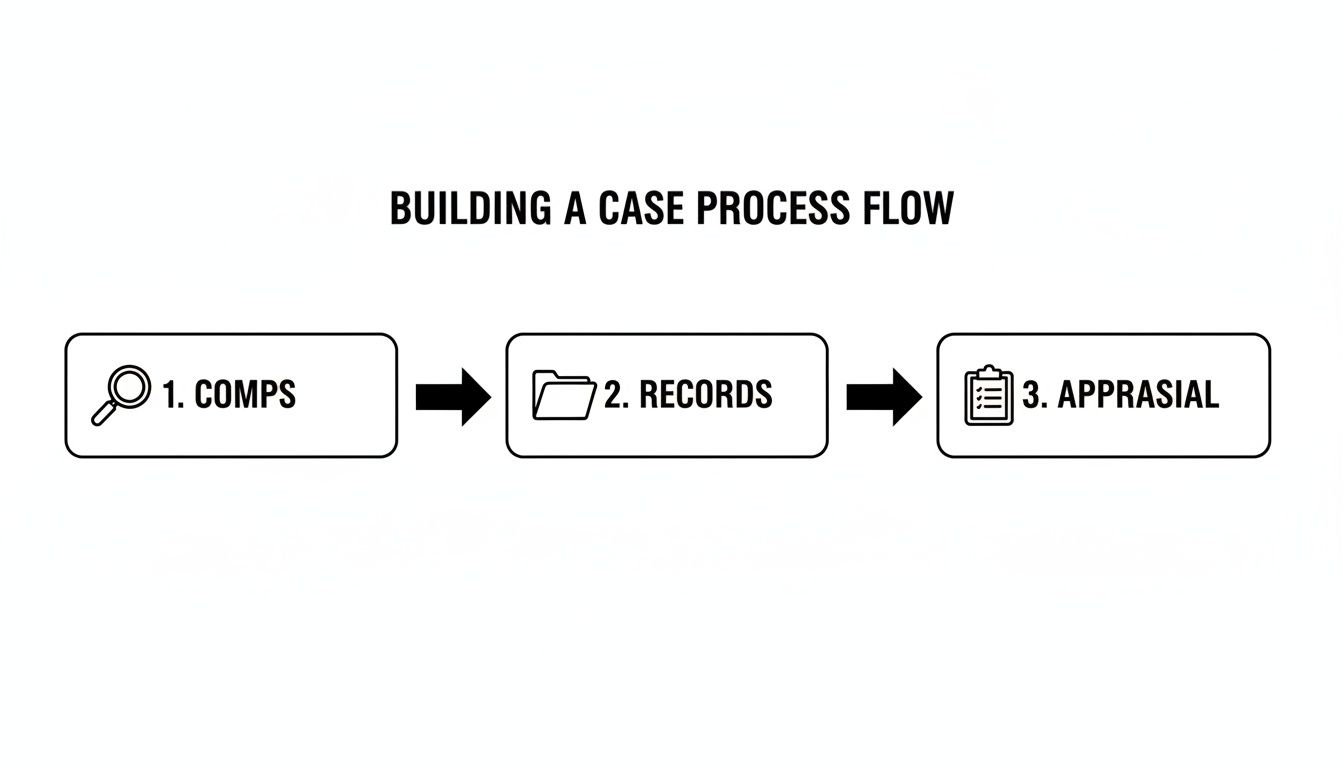
As you can see, a compelling counteroffer stands on three pillars: rock-solid local comparables, meticulous maintenance records, and, if the situation calls for it, a professional independent appraisal.
Presenting Your Number with Confidence
Kick off the conversation by stating your number clearly and directly. There's no need to beat around the bush.
For example, try something like this: "After a thorough review of the local market and considering my vehicle's excellent condition, I've determined its actual cash value is $18,500. I've already sent over the documentation that supports this, including five comparable vehicles for sale right here in the area."
Language like this immediately puts you in control. You're steering the negotiation, not just reacting to their flimsy valuation.
An adjuster's power lies in keeping you focused on their report. Your power comes from constantly pulling the conversation back to your evidence. Don't waste time arguing about their bad comps; just present yours as the more accurate, relevant, and realistic ones.
Be prepared for some classic adjuster tactics. They might try to wear you down with strategic delays or suddenly "discover" pre-existing damage that you know wasn't there. The best defense is a good offense: document every single interaction. A polite but firm paper trail is your strongest shield against these games.
Knowing When to Escalate Your Claim
So, what happens if the adjuster just digs in their heels and won't move? If you've laid out a bulletproof case and they're still stonewalling, it’s time to take it up a notch.
A great first step is sending a formal insurance demand letter. We break down exactly how to do that in our comprehensive guide on the topic.
If that doesn't get things moving, it’s time to play your trump card: the Appraisal Clause in your policy.
Invoking this clause essentially takes the decision away from the adjuster and puts it in the hands of neutral, third-party appraisers. Simply saying, "If we can't reach an agreement based on the clear market data, then I'm prepared to invoke the Appraisal Clause," can be enough to break the stalemate.
This isn't just some empty threat; it's a contractual right you're entitled to. And for the few who use it, the results are dramatic. While only about 1% of policyholders ever formally appeal a claim, those who do often see their offers double or even triple. Invoking the Appraisal Clause, specifically, can boost settlements by 30-50% on average. It pays to know your rights and be willing to stand your ground.
Knowing When to Escalate and When to Settle
You’ve laid out your evidence. You’ve made a strong counteroffer. And still, the adjuster won't budge. This is a frustratingly common part of the process. But hitting a stalemate isn't the end of the road. It just means it's time to shift gears and show the insurer you mean business.
This is the exact moment where a lot of people throw in the towel, but pushing forward is what often separates a lowball payout from a truly fair one. Your next move is to formalize everything and get ready to use the most powerful tools your policy gives you.
Creating a Formal Paper Trail
When friendly phone calls stop working, it’s time to draft a formal demand letter. This isn't just another email. It's a carefully structured document that recaps the facts, details your damages, and systematically presents the evidence supporting your vehicle's value.
Think of it as creating an official paper trail. It proves you’ve made every reasonable effort to settle the claim in good faith. More importantly, it puts the insurance company on formal notice that you’re organized, informed, and not going away. This step alone often gets your file bumped up to a supervisor, which can be all it takes to break the deadlock.
Your goal isn't to be aggressive; it's to be assertive and professional. Escalation is about methodically demonstrating that your position is backed by facts and that you’re prepared to use every tool available to you.
Invoking the Appraisal Clause
If a demand letter still doesn’t get you a fair offer, it's time to play your trump card: the Appraisal Clause. This is a provision buried in most auto insurance policies that acts as a powerful dispute resolution tool. Invoking it essentially takes the final decision out of the adjuster's hands.
Here’s how it works: you and the insurance company each hire your own independent, certified appraiser. Those two professionals then work to agree on your vehicle’s value. If they can't reach an agreement, they bring in a neutral third-party "umpire" who makes the final, binding decision. You can learn more about the insurance appraisal clause and see how it’s designed to protect you.
This tactic is incredibly effective because it completely changes the dynamic. It's no longer you against the adjuster; it’s two certified experts debating the facts. There’s a reason why 97% of all litigated insurance files settle before trial—insurers know that processes like this can lead to unpredictable outcomes they'd rather avoid.
Recognizing a Fair Offer
Of course, the best outcome is getting a fair settlement without having to go through a formal appraisal. So, how do you know when their offer is finally the right one?
A fair settlement should tick a few key boxes:
- It matches your research: The number they're offering should be right in line with the values you found for similar vehicles in your local area.
- It reflects your car’s actual condition: The offer should properly account for its excellent maintenance, low mileage, or any recent upgrades you made.
- It truly makes you whole: The final amount should be enough to go out and buy a genuinely comparable replacement vehicle in your market without paying out of pocket.
When the adjuster’s number finally lines up with these points, you can feel confident that you’ve done your job and negotiated a successful outcome.
Common Questions About Insurance Negotiations
Going head-to-head with an insurance company can feel overwhelming, and it's natural to have a lot of questions. Let's clear up some of the most common things people wonder about when they're trying to get a fair deal from an adjuster.
Getting these answers straight now will help you navigate the process with much more confidence.
Do I Have to Give the Adjuster a Recorded Statement?
This is a big one. While you have a duty to cooperate with your own insurance company, that rule doesn't apply to the other party's insurer.
You are not obligated to give a recorded statement to the at-fault driver’s adjuster. In fact, it's almost always a bad idea. Politely declining is your best move.
Why? Because those recordings are a tool for them, not you. The adjuster is trained to ask questions designed to get you to say something that can be used against you later—even a simple "I'm fine" can be twisted to downplay your injuries. Stick to the facts and provide them in writing.
A simple, professional response works best. Try saying, "I'm not comfortable providing a recorded statement right now, but I can supply the necessary information in writing." This protects your interests and keeps the claim moving.
How Do I Use My Policy's Appraisal Clause?
The Appraisal Clause is probably the most powerful tool you have in a dispute over your vehicle's value, but most people don't even know it exists. It’s written into your policy specifically for situations where you and the insurer are at a standstill.
To kick things off, you need to formally notify your insurance company in writing that you are invoking the clause.
Here's how it typically unfolds:
- You hire an appraiser. You'll need to find a certified, independent appraiser to represent your side.
- The insurer hires an appraiser. They will select their own expert to argue for their valuation.
- The two appraisers negotiate. The experts will review all the evidence and try to agree on the vehicle's actual cash value.
- An umpire steps in if needed. If the two appraisers can't reach an agreement, they select a neutral third party—an umpire—who will review everything and make a final, binding decision.
How Long Will the Negotiation Process Take?
There’s no single answer to this—it really depends. A simple claim with a reasonable adjuster might wrap up in just a few weeks.
However, it’s common for the process to take longer. If the adjuster is dragging their feet or you have to gather a lot of documentation, it could easily stretch out for a month or more.
If you end up using the Appraisal Clause, expect that to add another 30 to 60 days to the timeline. Patience is your best friend here. Adjusters know that people get frustrated and will often accept a lowball offer just to be done with the whole ordeal. For more strategies on this, you can check out these additional tips for negotiating with insurance adjusters.
At Total Loss Northwest, we handle the frustrating parts for you. As certified independent appraisers, we can invoke the Appraisal Clause on your behalf and build a case based on real-world market data, not the insurer's lowball software. If you're dealing with a total loss or diminished value claim, visit us at https://totallossnw.com to get the fair, accurate valuation you deserve.