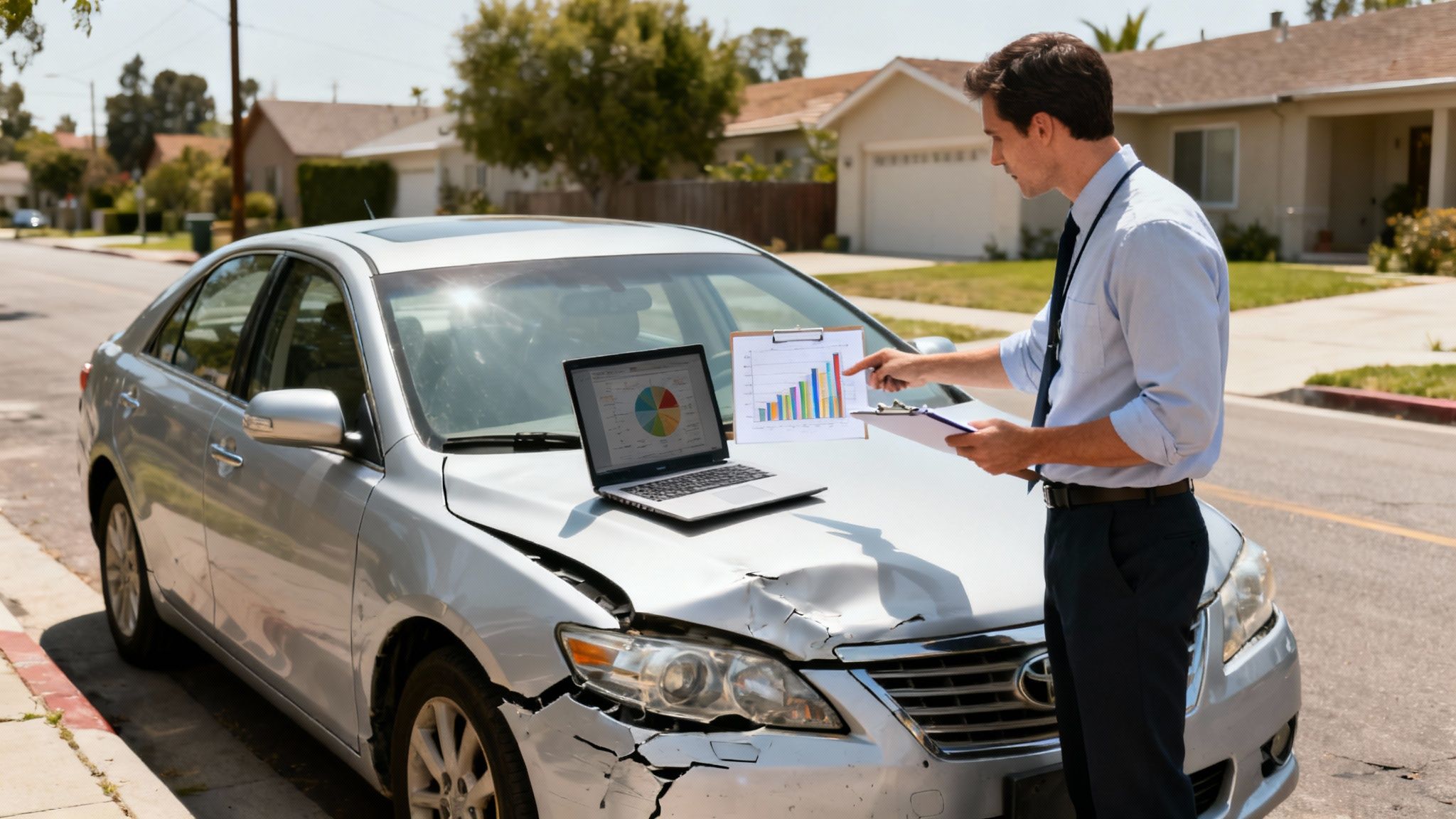
A car appraisal is, simply put, an expert's take on what your vehicle is truly worth on the open market. It's a professional, independent valuation that serves as your most powerful tool to counter the low-ball offers insurance companies often generate with their software.
When you're trying to get a fair settlement after an accident, think of it as your financial second opinion.
Understanding What a Car Appraisal Is
After a wreck, your insurance company will give you a number. That number represents their valuation of your car, whether it’s for a total loss payout or to cover its drop in value after repairs. But here’s the thing: that number is almost never calculated with your best interests in mind.
Insurance companies lean heavily on automated systems that can’t see the whole picture. These programs often miss the critical details that make your car unique—its pristine condition, recent upgrades you’ve made, or what similar cars are actually selling for right here in Oregon and Washington. A professional car appraisal cuts through all that noise.
An independent appraisal isn't just an opinion. It's a detailed, evidence-based report that establishes your vehicle’s Actual Cash Value (ACV) using real, verifiable market data—not an insurer's algorithm. It completely levels the playing field and gives you the solid proof you need to negotiate.
This becomes absolutely critical in two main situations: when your car is declared a total loss and when you're filing for diminished value. In either case, the financial stakes are high, and the insurer’s first offer is just that—a starting point. You can get a better sense of this by looking into our professional vehicle appraisal services.
Car Appraisal at a Glance
For a quick overview, this table breaks down the essentials of a post-accident car appraisal.
| Aspect | Description |
|---|---|
| What It Is | An independent, expert valuation of your vehicle's true fair market value. |
| Who Performs It | A licensed, certified, and unbiased professional appraiser. |
| When It's Needed | Primarily for total loss and diminished value insurance claims. |
This process is your best defense against accepting an unfair settlement from an insurer.
The Real-World Impact of an Appraisal
Let's say you're driving in Washington State when another car runs a red light and totals your 2022 Toyota Camry. Your insurer offers you $18,000, a figure their system spat out. You know that’s low—cars like yours were selling for closer to $25,000. This is exactly where an appraisal makes all the difference.
A professional appraiser dives into the local market, analyzing what comparable vehicles actually sold for right before the crash. Industry data shows that insurance companies can undervalue total loss claims by 20-30% when they aren't challenged, costing drivers thousands. An appraisal gives you the hard evidence to fight back and demand what you're rightfully owed.
It’s the official documentation that breaks down, point by point, why your vehicle is worth more.
- For Total Loss Claims: It proves the fair market value you need to go out and buy a truly comparable replacement vehicle.
- For Diminished Value Claims: It quantifies the money your car has permanently lost in resale value just because it now has an accident on its record.
Without that expert validation, you’re stuck arguing with the insurance adjuster with nothing but your word against their "system." An appraisal changes the entire conversation.
Total Loss vs. Diminished Value Appraisals
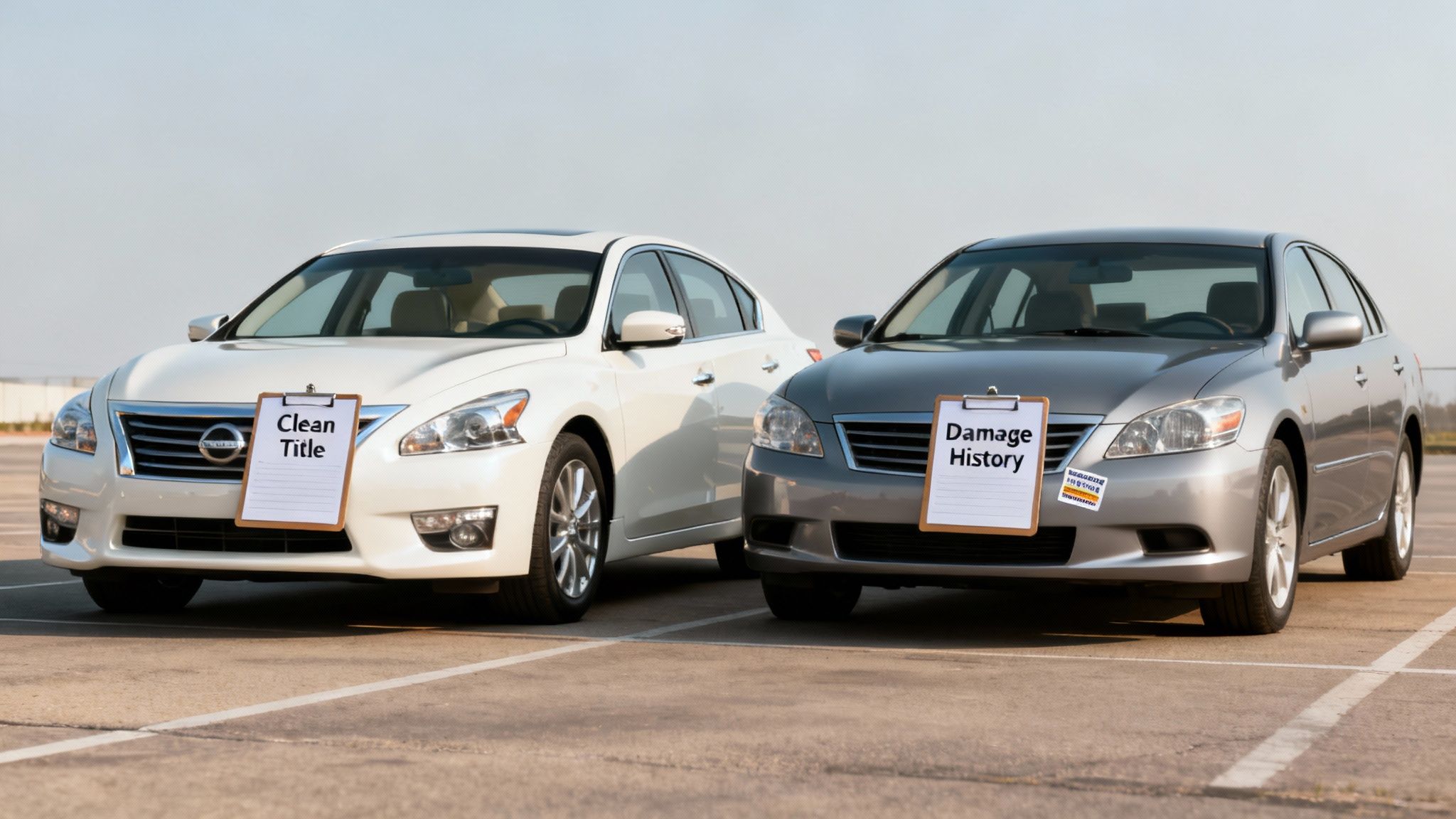
When you're dealing with the aftermath of an accident, you'll hear the term "car appraisal" thrown around a lot. But it's not a one-size-fits-all service. The right type of appraisal completely depends on what happened to your car, and figuring out which one you need is the first real step toward getting the money you're owed.
Essentially, there are two main paths your car can go down: it's either declared a total loss, or it gets repaired. Each of those scenarios demands a completely different kind of appraisal to calculate a very specific type of financial loss.
The Total Loss Appraisal: What Was Your Car Worth a Moment Before the Crash?
If your insurance company says your car is a "total loss," their job is to pay you its Actual Cash Value (ACV). That’s a fancy term for what your car was worth on the open market right before the accident happened. A total loss appraisal is the professional deep-dive that pins down that exact number.
Think of it like hitting a pause button on time. A professional appraiser ignores the crumpled metal and broken glass, focusing instead on building a rock-solid case for what a real buyer in Oregon or Washington would have paid for your car in its pre-accident state.
This is where having a human expert really matters. The insurer's first offer is usually spit out by a computer program that can’t see the whole picture. A certified appraiser, on the other hand, digs into the details that software misses:
- Your Car's Unique Condition: They document the meticulous care you put into it—from the pristine interior to the well-maintained engine.
- Recent Upgrades & Maintenance: Those new tires you just bought? That premium sound system you installed? A recent major service? These all add real value that automated systems often ignore.
- Hyper-Local Market Data: A good appraiser finds what truly comparable cars have actually sold for, right here in your area, providing hard evidence of your vehicle's true worth.
A total loss appraisal isn't about the damage at all. It’s about proving the full, fair value of the asset you just lost so you have the funds to buy a genuinely comparable replacement.
The Diminished Value Appraisal: Recouping the Loss That Repairs Can't Fix
Now, let's talk about the other scenario: your car can be fixed. Even with the best body shop in town making it look brand new, your vehicle has lost value for one simple, unavoidable reason—it now has a permanent accident history. This financial hit is called diminished value, and a diminished value appraisal is the tool you use to prove and measure it.
It's just common sense. Imagine two identical homes for sale on the same block. One is perfect. The other had a major flood last year but has since been expertly repaired. Which one are you going to pay less for?
That price gap is the home's diminished value, and the exact same principle applies to your car. The moment a CARFAX report shows a major repair, buyers will lowball you. They'll always pay less for it than they would for an identical car with a clean history.
A diminished value appraisal calculates the difference between your car's fair market value before the accident and its new, lower market value after the repairs are done. It's compensation for the stigma that is now permanently attached to your car's VIN.
This is a real, tangible loss. An appraisal for diminished value puts a number on this drop, often showing a car's worth fell from $45,000 before the crash to just $35,000 after being repaired. In fact, industry data shows that, on average, repaired vehicles only retain about 78% of their pre-accident value. Over the last five years, diminished value claims backed by an independent appraisal recovered an average of $4,200 per case.
Getting a handle on which appraisal you need is crucial. One is for getting back the full worth of a vehicle that’s gone for good, and the other is for recovering the value that was lost even after your car was put back together. You can see how this works in more detail by exploring our guide on auto appraisals for diminished value claims.
Inside a Professional Car Appraisal Report
An appraisal report isn't just a piece of paper with a number on it. Think of it as a detailed, evidence-based argument for your vehicle's true worth, built to stand up to the scrutiny of an insurance company. It's the end result of a meticulous appraisal process, turning an expert's deep-dive analysis into a powerful negotiation tool.
This report is your ammunition. It methodically dismantles an insurer's lowball offer by presenting a clear, logical case backed by hard, verifiable data. It has to be airtight, professional, and ultimately, impossible to ignore.
The Anatomy of a Credible Report
Every professional appraisal report follows a specific structure, and for good reason. It’s designed to build a defensible valuation from the ground up, leaving no room for an insurer to poke holes in the final number. Each section logically flows into the next, creating a compelling story about your car's real value before the accident.
A rock-solid report will always include these key components:
- Detailed Vehicle Specifications: This goes way beyond the basics. We're talking VIN, engine and transmission type, the specific trim level (like an EX-L vs. a base model), and every single optional feature from the factory.
- Thorough Condition Analysis: A professional appraiser documents your car’s exact pre-accident condition, either through a hands-on inspection or a detailed review of photos. This covers everything from the quality of the paint and interior cleanliness right down to the tread depth on your tires.
- Verifiable Market Data: This is the heart of the report. It contains a list of "comps"—truly comparable vehicles that have recently sold in your local area.
- A Final, Defensible Valuation: This is the bottom line, the final number backed by all the evidence that came before it.
This structure ensures the final value isn't just an opinion. It’s the logical conclusion of a transparent and repeatable process.
Finding and Analyzing Comparable Vehicles
The real muscle behind any appraisal comes from the research into comparable vehicle sales, or "comps." This is where a certified appraiser's expertise makes all the difference, and it's the single biggest contrast to an insurer's automated estimate. An appraiser isn’t just pulling up a few online ads; they are digging into databases of actual, completed sales that reflect what real people are paying for cars like yours.
It’s like valuing a house. You wouldn't base its worth on what sellers are asking for nearby homes; you’d look at what buyers actually paid. The exact same principle applies to vehicles.
A credible appraisal is built on sold vehicle data, not active listings. This grounds the valuation in real-world transaction prices from your specific geographic area, providing a true snapshot of the market your car was in.
Once a set of strong comps is found, the appraiser makes careful, line-by-line adjustments. For instance, if your car had lower mileage than a comparable sale, its value is adjusted upward. If a comp had a sunroof and yours didn't, its value is adjusted downward. This detailed adjustment process hones in on a value that is specific to your unique vehicle.
The Final Report: What an Insurer Sees
When an insurance adjuster gets a professional appraisal report, they're looking for a few specific things to see if it holds water. They want to see a clear methodology, verifiable data, and a logical conclusion. A well-built report is designed to answer all their questions before they can even ask them.
It helps to see what the insurer is used to looking at versus what a real appraisal delivers.
Insurer Valuation vs. Independent Appraisal
This table breaks down the fundamental differences between an insurance company's automated valuation and a certified independent appraisal.
| Factor | Insurance Company Valuation | Independent Appraiser Valuation |
|---|---|---|
| Data Source | Proprietary software using wholesale data & active listings | Verifiable, recent sold comparable vehicles in the local retail market |
| Condition Assessment | Generic rating (e.g., "average") with little to no detail | Detailed analysis of your specific vehicle's pre-loss condition, with photos |
| Adjustments Made | Automated, often inaccurate adjustments for mileage and options | Manual, line-by-line adjustments based on real market value differences |
| Final Value | An algorithm-generated number designed to minimize payout | A defensible Actual Cash Value (ACV) backed by market evidence |
Ultimately, a professional report completely changes the conversation. Instead of you trying to argue with a black-box computer system, the insurance company now has to argue against a documented, evidence-based valuation from a certified expert. This simple shift puts the power back in your hands.
Factors That Determine Your Car's True Value
An insurance company’s software often sees your car as just a few lines of code: year, make, model. It crunches those numbers and spits out a value. But we both know your vehicle is much more than that, and a professional car appraisal is designed to tell the full story—the nuanced, real-world story that automated systems completely miss.
An appraiser’s real job is to look past the basic data and uncover all the factors that make your specific car valuable. This human element is what makes the difference between a fair, accurate valuation and an insurer's lowball offer. It’s all about seeing the complete picture.
Beyond the Basics of Make and Model
Sure, the year, make, and model are the starting line, but they are miles from the finish. A vehicle's true value is hiding in the details, and this is exactly where those automated systems fall flat. An expert appraiser knows how to dig much deeper.
For instance, you could have two cars that are the same model, but one is a top-tier trim level loaded with thousands of dollars in factory options. Those features don't just make the car better to drive; they seriously boost its market value.
An appraiser will meticulously document and value things like:
- Specific Trim Level: Is it the base model, or is it a premium trim like a Limited, Platinum, or Touring edition?
- Optional Packages: Did it leave the factory with a tech package, a performance upgrade, or a luxury interior group?
- Desirable Features: Add-ons like a panoramic sunroof, advanced driver-assist systems, or a premium sound system all contribute real, quantifiable value.
These aren't just minor details. They can swing a vehicle’s worth by thousands of dollars.
The Power of Meticulous Maintenance and Condition
How well you’ve cared for your vehicle matters—a lot. A car with a folder full of service records and a spotless interior is in a different league than one that's been neglected. Insurance software typically just slaps a generic "average" condition rating on everything, which is a real disservice to a well-maintained vehicle.
An appraiser, on the other hand, documents the tangible proof of your care.
A clean, well-maintained vehicle with a full service history isn't just "nice to have"—it's a significant value-add. An independent appraisal quantifies this by showing how your specific car stands out from others on the market, justifying a higher valuation.
When an appraiser considers the overall condition and market appeal, investments like protective coatings come into play. Understanding the true worth of ceramic coatings can show how such additions contribute to a vehicle’s preservation and, therefore, its market value.
A proper appraisal report is built like a pyramid, starting with raw data, moving up to analysis, and culminating in a final, defensible valuation.
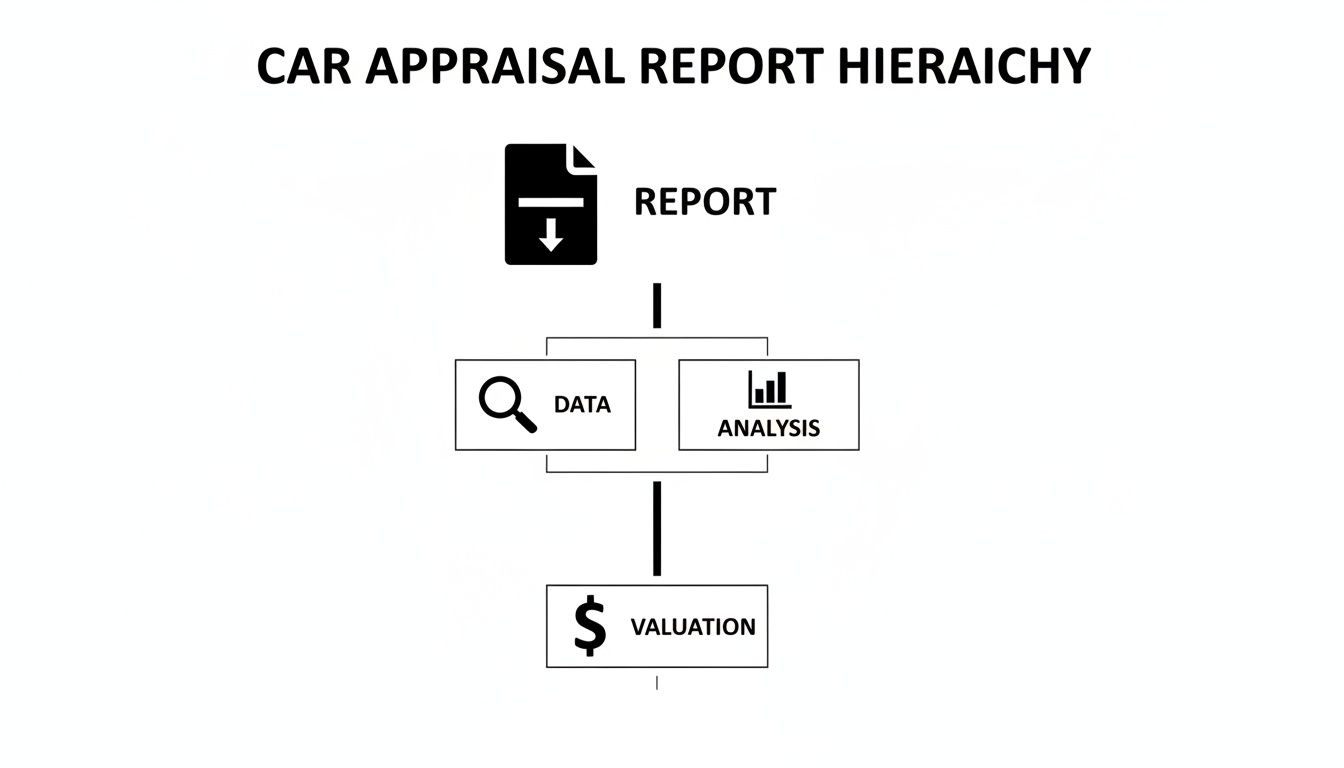
This structure ensures the final number isn't just an opinion. It’s the logical conclusion of a detailed investigation into your car’s unique qualities.
Regional Demand and Unique Vehicle Types
Where you live plays a huge role. The demand for a 4×4 truck in the rainy Pacific Northwest is a world away from its demand in a flatter, drier climate. Appraisers in Oregon and Washington get this. We use local sales data to prove your car’s value right here, right now.
This local expertise is absolutely critical for unique or modified vehicles. Imagine a pristine, custom-built sports car is totaled. The insurer’s database might spit out a value of $32,000. But a proper market appraisal, analyzing sales from enthusiast forums and specialty auctions, could easily prove its true worth is closer to $52,000.
Only certified appraisers have access to proprietary data showing that certain modified vehicles can command premiums of up to 40%. By understanding all these value drivers—from specific features and meticulous care to local market trends—you can see why an independent appraisal is the only way to get your car’s complete financial story and secure the settlement you truly deserve.
Using The Appraisal Clause To Secure A Fair Settlement
Having a solid, professional appraisal report in your hands is a huge step forward, but it's really only half the battle. The key to getting the settlement you actually deserve is knowing how to use that report to your advantage.
This is where a powerful—and surprisingly overlooked—tool comes into play: the Appraisal Clause in your auto insurance policy.
Think of the appraisal clause as your contractual right to a fair fight. It’s a provision built right into most insurance policies in states like Oregon and Washington that creates a structured, neutral process for settling disagreements over your car's value. It isn't about starting an argument; it's about activating a process you're already entitled to.
When you and your insurance company are stuck in a stalemate over your vehicle's value, this clause moves the dispute out of the frustrating loop of endless phone calls. Instead, it places it into a formal, evidence-based framework that levels the playing field and forces the insurer to take your appraiser's findings seriously.
What Is The Appraisal Clause?
The Appraisal Clause is a specific section of your policy that lays out a clear procedure for what happens when you and your insurer can't agree on the amount of a loss. The exact wording might differ slightly from one policy to another, but the core idea is almost always the same.
Essentially, it says that if there’s a dispute, both you and the insurance company will hire your own independent, competent appraisers. Those two experts then try to negotiate a settlement based on all the evidence. If they still can't agree, they select a neutral third-party "umpire" who makes the final, binding decision.
This process pulls the final decision-making power away from the insurance company and puts it in the hands of unbiased experts. It turns a subjective argument into an objective, fact-based evaluation.
By invoking this clause, you're not suing your insurance company. You're simply using the rules outlined in your own policy to make sure you get a fair and accurate payout for your total loss or diminished value claim.
How To Formally Invoke The Clause
Putting the Appraisal Clause into motion is a formal process that requires clear, deliberate action. You can't just casually mention it on a phone call. To officially trigger the process and protect your rights, you need to follow a specific procedure. Understanding your rights within the broader context of motor vehicle accident compensation can be a real game-changer here.
Here are the typical steps you'll need to take:
Send a Formal Written Notice: You must inform your insurance company in writing that you are invoking the Appraisal Clause. This letter should clearly state that you dispute their valuation and are exercising your right under the policy.
Name Your Appraiser: In that same notice, you need to identify the certified appraiser you've hired to represent your interests. This tells the insurer you’re serious and have come prepared.
Submit Your Appraisal Report: Along with the notice, you’ll provide a full copy of your independent appraisal report. This document is the foundation of your appraiser's entire position.
Once you’ve taken these steps, the ball is officially in the insurance company's court. They are now contractually required to hire their own appraiser and start the negotiation process.
You can dive deeper into how to formally start this process by reviewing the details of the insurance appraisal clause. This single move shifts the dynamic from you against the adjuster to your expert against their expert—a much more balanced fight.
How to Find a Credible and Certified Car Appraiser
Choosing the right appraiser isn't just about picking a name from a list. It’s about finding an expert who can go to bat for you. The difference between a truly experienced professional and someone just going through the motions can easily be thousands of dollars in your final settlement.
Let’s be clear: not all appraisers are created equal. You need to hire someone whose work will stand up to scrutiny from an insurance company that's actively looking for reasons to dismiss it. Think of it this way—if you were going to court, you wouldn't just hire any lawyer. You’d want a specialist with a winning record. The same exact logic applies here.
The first thing an insurance adjuster will do is try to poke holes in your appraiser’s credibility. A truly skilled appraiser builds an iron-clad report, one so well-documented and defensible that it becomes too difficult and expensive for the insurance company to fight.
Your Vetting Checklist for a Quality Appraiser
When you start looking for a professional, don’t be shy about asking tough questions. A good appraiser will be happy to show you their credentials. Their expertise is what you're paying for, so you have every right to verify it before you sign anything.
Here's a simple checklist to help you find the right person for the job:
- Look for Key Certifications: The gold standard in this field is a certification from a respected organization like the I-ACP (Independent Auto Appraiser Certification Program). This isn't just a piece of paper; it proves they've met strict ethical and professional standards.
- Verify State-Specific Experience: Make sure they know the local market. Ask them directly about their experience with claims in Oregon and Washington, as regional differences can have a huge impact on your car's value.
- Ask for Proof of Experience: A seasoned pro should have no problem discussing the types of cases they’ve handled before, especially total loss and diminished value claims. You’re listening for confidence and deep knowledge, not vague answers.
- Read Reviews and Testimonials: See what other people in your situation have said. Look for reviews that specifically mention successful negotiations or how professionally they handled interactions with insurance companies.
Following these steps ensures you're hiring a real advocate, not just a report generator.
Understanding the Cost as an Investment
Of course, you're going to wonder about the cost. Appraisals can run from a few hundred dollars up, depending on how complex your case is. But it’s critical to see this fee as an investment, not just another bill. A proper car appraisal is designed to pay for itself.
Hiring a professional appraiser is an investment in a fair outcome. Spending $400 to secure an additional $4,000 in your settlement is a 10x return—a financial decision that more than pays for itself.
A reputable appraiser will be transparent about their fees and what you get for your money. Think of it as purchasing the leverage you need to confidently reject a lowball offer and get the full amount you're actually owed. It’s about arming yourself with the proof you need to maximize your recovery.
Frequently Asked Questions About Car Appraisals
Even with the basics down, you probably still have a few questions rattling around your head about how this all works in the real world. Let's tackle some of the most common things drivers in Oregon and Washington ask when they’re staring down a lowball insurance offer.
How Much Does a Professional Car Appraisal Cost?
You can expect to pay a few hundred dollars for a professional car appraisal, with the exact amount depending on how complex your situation is. The best way to look at this cost isn't as an expense, but as an investment in getting a fair outcome.
Think about it this way: a $400 appraisal that gives you the leverage to recover an extra $4,000 from the insurance company just delivered a 10x return. A good, reputable appraiser will be upfront about their fees and explain exactly how that investment pays off in your final settlement.
Can I Get an Appraisal for My Everyday Car?
Absolutely. Appraisals aren't just for classic muscle cars or high-end European imports. Insurance companies undervalue all kinds of vehicles every single day, from a reliable Honda Civic to a workhorse Ford F-150.
If the insurer's total loss offer for your daily driver is thousands less than what similar cars are actually selling for near you, an independent appraisal is your strongest tool. It’s the hard evidence you need to prove your car's real value and claim the full amount you're owed.
An appraisal's value isn't determined by the car's price tag, but by the gap between the insurer's offer and the car's true market worth. Whether it's a family sedan or a sports car, the goal is the same: to recover what was lost.
This process gives every car owner a clear path to a fair settlement.
What Is the Appraisal Clause in My Policy?
Tucked away in the fine print of most auto insurance policies is something called the "Appraisal Clause." This is a powerful provision that spells out a formal process for settling disagreements over your car's value. It essentially gives both you and the insurer the right to hire your own independent appraiser.
If those two appraisers can’t agree on a number, they bring in a neutral third-party expert, called an umpire, who makes the final, binding decision. Most policies in Oregon and Washington have this clause, giving you a contractual right to challenge an unfair offer.
How Long Does the Appraisal Process Take?
Once an appraiser has all your documents and photos, they can typically turn around a comprehensive report in just a few business days. The negotiation part that comes next can vary.
Sometimes, the insurance company agrees to a fair settlement within a week of getting the report. Other times, a more stubborn dispute might take a little longer. But invoking the Appraisal Clause almost always speeds things up by taking the dispute out of an endless loop of phone calls and putting it into a structured, evidence-based process designed to get it solved.
At Total Loss Northwest, we specialize in providing certified, independent car appraisals that force insurance companies to pay what you're truly owed. If you're facing a total loss or diminished value claim in Oregon or Washington, don't accept a lowball offer. Visit us at https://totallossnw.com to get the expert valuation you need to secure a fair settlement.