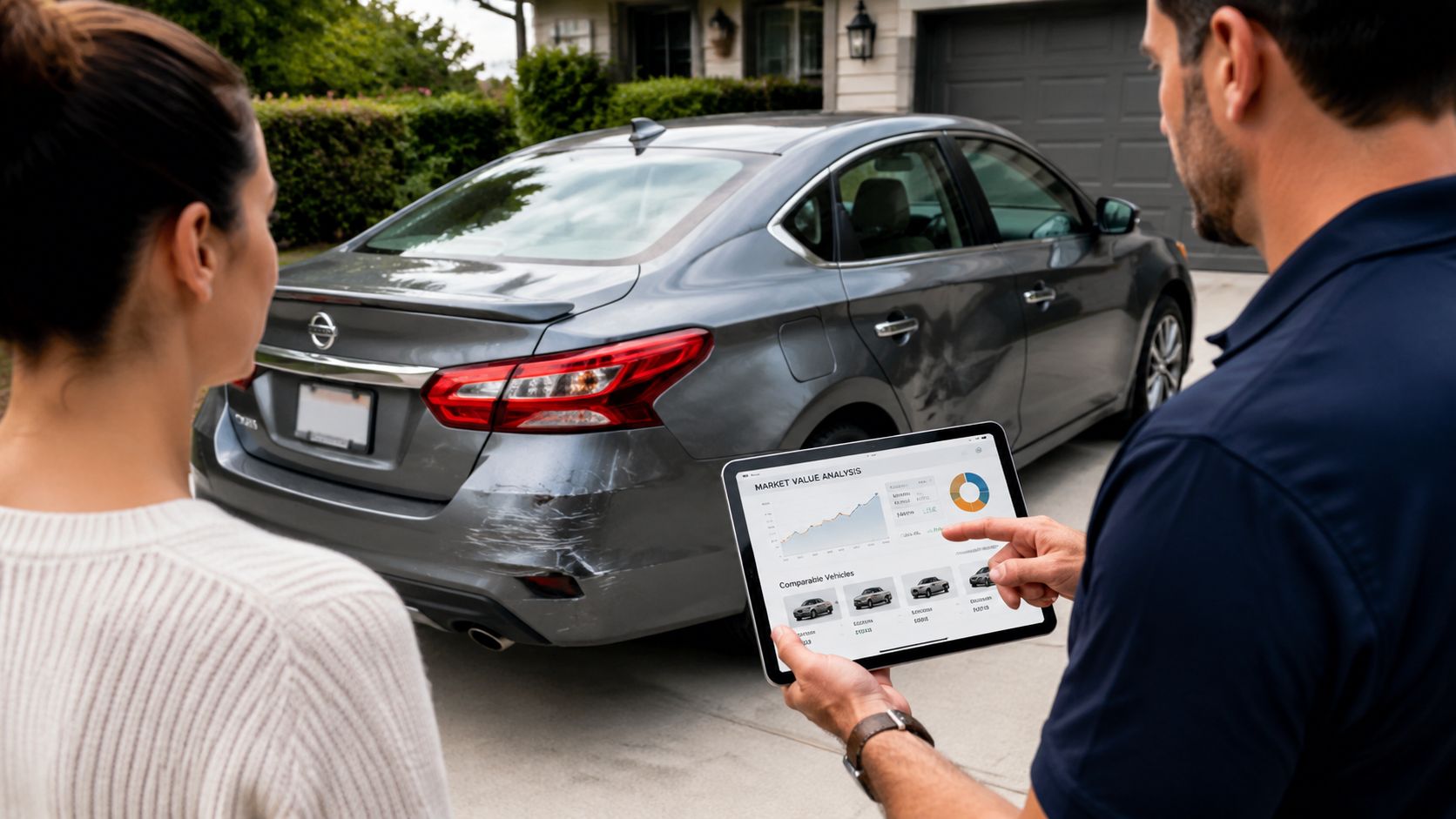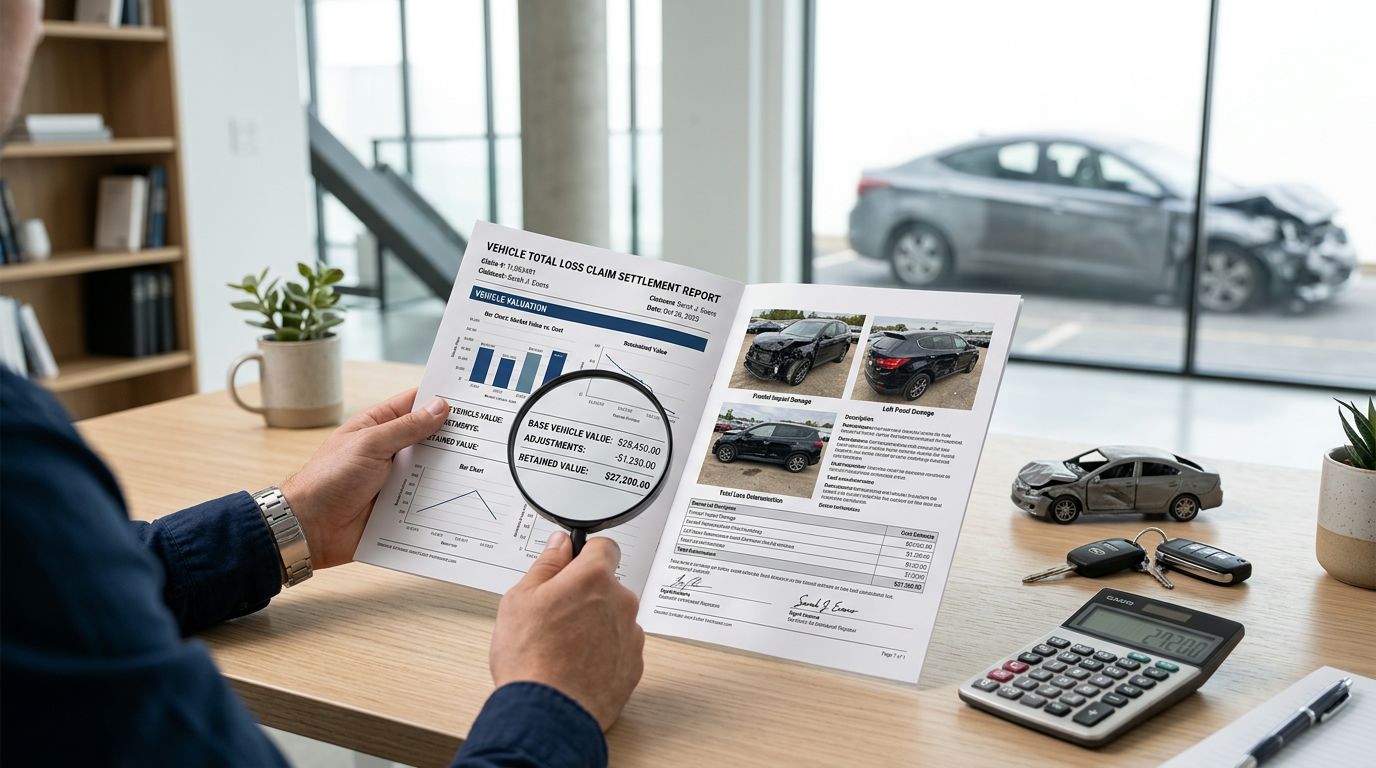
So, your car has been in an accident. The other driver was at fault, and their insurance, State Farm, has covered the repairs. Your car looks great, maybe even better than before. But here's the uncomfortable truth: your vehicle is now worth less than it was moments before the crash, and no amount of high-quality bodywork can change that.
This permanent drop in market value is known as inherent diminished value. It’s a real financial loss, and if a State Farm insured driver caused the accident, you have the right to be compensated for it.
Your Right to a Diminished Value Claim

When you're navigating the chaos after a wreck, your main goal is simple: get the car fixed. State Farm is efficient at this part. They'll work with the body shop, pay the bill for the physical damage, and once your car is shiny and repaired, they consider their job done.
But they're often banking on you not noticing the other, less obvious financial hit you’ve taken. This is the gap between your car's pre-accident value and its new, lower value after repairs. It's a loss you didn't cause, and you shouldn't have to absorb it.
The "Repaired is Restored" Myth
That accident is now a permanent part of your car’s history, logged forever on services like CarFax and AutoCheck. When it comes time to sell or trade in your vehicle, any savvy buyer—dealership or private party—will see that accident report and offer you less money. Sometimes, a lot less.
This is true even if the repairs are absolutely perfect. The market simply doesn't value a wrecked-and-repaired car the same as one with a clean history.
This is where you'll likely get your first pushback from State Farm. The adjuster might tell you that since the car was repaired to industry standards, its value is fully restored. That argument is purely to protect their own profits. Don't fall for it. Your first step is understanding the law. You can learn more about the specifics of diminished value law and how it applies to you.
Key Takeaway: Diminished value isn't about the quality of the repair work. It's about the permanent financial damage caused by the vehicle's accident history—and it's a loss you are entitled to claim.
Legal Precedent and State Farm's Position
The right to claim diminished value isn't just a negotiating tactic; it's backed by major court decisions. State Farm has been on the losing end of this argument before, and it has cost them dearly.
A landmark case in Georgia, Mabry v. State Farm, fundamentally changed the game. The court ruled that "loss" isn't just the cost of parts and labor—it also includes the inherent diminished value that remains after those perfect repairs are done. This decision ultimately cost State Farm $150 million and forced the company to establish a formal process for handling these claims. More details on this pivotal case and state-specific laws are available on teamjustice.com.
This history is important. It proves that while a State Farm adjuster might initially deny or downplay your claim, a solid, evidence-based argument stands on firm legal ground. You just have to be prepared to make your case.
Building Your Unshakeable Case Against State Farm
When you go up against State Farm for diminished value, you can't just be an upset customer. You need to think and act like you're building a legal case, piece by piece. Your first move, long before you even think about writing a demand letter, is to gather every shred of evidence you can find. A complete, organized file is your best weapon—it turns a simple complaint into a serious, credible demand they can't just brush aside.
Here's the reality: the adjuster's goal is to close your file for as little money as possible. If you send them a claim with missing paperwork or vague complaints, you're making their job easy. They'll lowball you or deny you outright. But when you present them with a file that tells a clear, undeniable story of your loss, you force them to take you seriously. You’re not just collecting documents; you're building a narrative that answers their questions before they can even ask them.
Your Evidence Checklist
Getting your paperwork in order is the bedrock of your entire claim. Each document adds another layer of proof, creating a timeline from the moment of the crash to the final bill. Don't overlook a single item on this list.
Here’s the essential evidence you need to start gathering:
- The Official Police or Accident Report: This is your unbiased, official record of what happened. It establishes who was at fault, which is the first thing State Farm will look for to confirm liability.
- Pre-Accident Photos of Your Vehicle: Hopefully, you have some photos of your car looking its best before the accident. These are gold because they set a clear "before" picture, making the "after" that much more dramatic.
- Post-Accident Photos and Videos: Go crazy with your camera before the car goes to the shop. Get shots from every possible angle, including close-ups of the damage and wider shots showing the impact areas. This is your visual proof of how bad the hit really was.
Your objective here is to make it impossible for the adjuster to minimize the collision's severity. A thick, well-organized evidence file sends a clear message: you are serious, you are prepared, and you won't be easily dismissed.
Why the Repair Invoice is Your Smoking Gun
While every document plays a part, the final, itemized repair invoice is the absolute centerpiece of your diminished value claim. Think of it as more than just a bill—it's a detailed diary of everything that was done to put your car back together.
This invoice is your proof of the accident's true severity. You need to scan it for the kind of details that make an adjuster sit up and pay attention:
- Structural or Frame Damage: If you see terms like "frame alignment," "structural repair," or work on unibody components, that's a huge deal. This is the kind of damage that scares off future buyers and is a primary driver of diminished value.
- Airbag Deployment: This is an automatic red flag on any vehicle history report and screams "major accident."
- Use of Non-OEM Parts: Did the shop use aftermarket parts? Look for codes like "A/M" (aftermarket) or "LKQ" (Like Kind and Quality, meaning used). Using non-original parts can hurt your car's value even more.
- High Labor Hours: A staggering number of labor hours is a direct indicator of a complex, difficult repair. More hours equals a more severe impact, strengthening your case for a significant value loss.
Once you’ve collected everything, get it organized. Scan all your documents and combine them into a single, professional-looking PDF. When you submit a clean, complete package like this, you immediately change the dynamic. The State Farm adjuster will see you're not just another claimant—you're a well-prepared opponent.
How to Accurately Calculate Your Diminished Value
After an accident, you can bet State Farm will calculate your diminished value using their own in-house formula. They almost always lean on a variation of the infamous "17c formula," and you need to know this method is built to protect their profits, not to make you whole. It starts with an arbitrary cap and applies vague modifiers that consistently spit out a lowball offer.
Don't feel pressured to accept their first number. The secret to a fair settlement is countering their self-serving calculation with a credible, market-based appraisal of your own. This means you have to move past the free online calculators and get a real-world analysis that reflects your car's specific situation.
Decoding State Farm's 17c Formula
The 17c formula is well-known in the appraisal industry for being heavily slanted in the insurer's favor. While State Farm keeps its exact version under wraps, the approach is predictably flawed. It starts by capping the maximum possible diminished value at 10% of your car's pre-accident value, no matter how severe the collision was.
From that already-lowered ceiling, they make more deductions:
- Damage Modifier: A subjective penalty is applied based on the "severity" of the damage, but the scale they use is designed to minimize the payout.
- Mileage Modifier: They’ll use your car's mileage to chip away even more from the claim amount.
This rigid formula completely ignores the things that actually matter in the real world, like your car's specific features, local market demand, or the nature of the repairs—especially if there was structural damage.
The 17c formula is a tool for minimizing payouts, not for accurately assessing market loss. Relying on it is like letting the person who owes you money decide how much they should pay.
The Gold Standard: A Certified Independent Appraisal
The most effective weapon in your arsenal is a detailed report from a certified, independent appraiser. Unlike a canned insurance formula, a professional appraisal is an evidence-based document built from the ground up for your vehicle and your local market. It's not a guess; it's a meticulously researched valuation.
An expert appraiser doesn't use artificial caps. Instead, they dig deep, analyzing:
- Your Specific Vehicle: They look at the exact year, make, model, trim, and pre-accident condition. A pristine, low-mileage vehicle will suffer more diminished value than an average one.
- The Repair Invoice: The appraiser will comb through the final repair bill, searching for red flags like frame damage, airbag deployment, or structural repairs—key details the 17c formula glosses over.
- Local Market Data: This is where the magic happens. The appraiser finds what comparable vehicles (same make, model, year, and condition) are actually selling for in your area.
- Dealer Interviews: They often call sales managers at local dealerships and ask them point-blank: "How much less would you offer for this car now that it has an accident history?" This gives you concrete proof of your car's lost value.
Building your case comes down to gathering the right proof: the official report, photos, and the final invoice.

This process elevates your claim from a simple request to a professional, data-backed demand that an adjuster can't easily dismiss.
As you get ready to fight for what you're owed, it helps to understand the legal foundations of your claim. Getting familiar with the different methods for Evaluating Compensation And Remedies can give you a major advantage.
The table below breaks down the fundamental differences between State Farm's approach and a true, independent appraisal.
Insurer Formula vs Independent Appraisal
| Factor | State Farm 17c Formula | Certified Independent Appraisal |
|---|---|---|
| Starting Point | Caps value loss at 10% of NADA/KBB | Based on pre-accident market value |
| Damage Assessment | Uses subjective, insurer-defined modifiers | Analyzes repair invoice for structural damage |
| Market Data | Ignores local market conditions | Researches local comparable sales data |
| Evidence | Relies on a one-size-fits-all calculation | Includes dealer quotes and real-world proof |
| Outcome | Typically a low, insurer-friendly offer | A fair, market-based valuation of your loss |
The takeaway is clear: one method is designed to serve the insurance company, and the other is designed to determine your actual financial loss.
Spending a few hundred dollars on a professional appraisal can feel like a big step, but it’s a strategic investment that often pays for itself many times over, resulting in a settlement thousands of dollars higher than State Farm’s initial offer. While online tools can give you a ballpark figure, only a certified report serves as undeniable proof. To get a rough idea, you can use a professional https://totallossnw.com/diminished-value-claim-calculator/ as a starting point.
Ultimately, you have to present State Farm with a number backed by irrefutable market evidence. An independent appraisal is the only way to do that.
Alright, let's get into the nitty-gritty of negotiating with the State Farm adjuster. This is where your hard work starts to pay off.
Negotiating Your Claim with the Insurance Adjuster
Armed with a professional appraisal and a well-organized evidence packet, you're no longer just asking for a check. You're presenting a formal, evidence-backed demand. Your first move is to draft a demand letter to the State Farm adjuster assigned to your case.
This isn't the time for a dramatic retelling of the accident. Keep it professional, concise, and straight to the point. The letter's job is simply to introduce your evidence, state exactly how much you're claiming, and kick off the negotiation on a serious, business-like footing.
Writing a Demand Letter That Gets Results
Think of your demand letter as the official start of the conversation. It should be firm but polite. You're simply laying out the facts you've gathered and stating the financial loss you've suffered because of their insured's actions.
A simple, effective structure looks like this:
- The Basics: Start with your name, the claim number, and the date of the accident.
- The Number: State the exact diminished value amount you're claiming, referencing your professional appraisal. A sentence like, "Based on the enclosed certified appraisal, my vehicle has suffered a diminished value of $4,750," is perfect.
- The Proof: Briefly list the documents you're including—your appraisal report, the final repair bill, and anything else that supports your claim. This shows the adjuster you're organized and have done your homework.
- The Deadline: Give them a clear timeframe for a response. 10 to 15 business days is standard and reasonable. It shows you're serious and expect a timely reply.
Attach your full evidence packet, especially the complete appraisal report, to the letter. I always recommend sending this as a single, combined PDF via email. It's clean, ensures they get everything at once, and gives you a digital paper trail.
How to Handle the Adjuster's Pushback
Once your demand lands on the adjuster's desk, the real negotiation begins. Expect them to push back—it's literally their job to minimize what the company pays out. They have a standard playbook of arguments they use to shut down or lowball these claims.
Knowing these tactics ahead of time gives you a huge advantage. Here’s what you’re likely to hear and how you should respond.
- “We don’t pay for diminished value.” This is their first line of defense, hoping you'll just give up. Your response should be calm and factual: "Diminished value is a recognized component of property damage in this state, and I have provided a professional appraisal that quantifies my exact financial loss."
- “The repairs made your vehicle whole again.” This classic line confuses physical condition with market value. A good counter is: "While the shop did an excellent job repairing the physical damage, the repairs could not restore the $4,750 in market value lost due to the new accident history on the vehicle's record, as my appraiser documented."
- “Your appraiser is biased and just telling you what you want to hear.” They will almost always try to discredit your evidence. Stand your ground: "The appraisal was conducted by a certified, independent expert. Their valuation is based on verifiable market data, not a proprietary insurance formula."
My Best Advice: Never get into a heated argument on the phone. After you hang up, immediately send a follow-up email summarizing the key points of the conversation. For example: "Just to confirm our call today, you stated that State Farm's position is that my claim is only worth $500. Please reply to this email to confirm this is your official offer." This creates a written record and makes it much harder for them to backtrack.
Staying Patient and Documenting Everything
Getting State Farm to agree to a fair diminished value settlement is a marathon, not a sprint. The keys to success are patience, professionalism, and persistence. Never let them see you get frustrated or emotional. Every interaction is a business transaction.
Document absolutely everything. I mean everything. Keep a simple log of every call, email, and letter. Note the date, time, who you spoke with, and a quick summary of what was discussed. This detailed record is your best friend if you need to escalate the claim later.
If you want to dive deeper into the general strategies for dealing with insurance companies, understanding the fundamentals of handling coverage disputes can provide some valuable context.
Finally, if you feel like you're hitting a brick wall and the adjuster is just stonewalling you, don't be afraid to escalate. Politely ask to speak with their direct supervisor. Sometimes, all it takes is a fresh set of eyes from someone in management to break the deadlock and get your claim moving toward a fair resolution.
Using the Appraisal Clause as Your Ultimate Leverage

So, you've presented your evidence, your appraisal is rock-solid, but the State Farm adjuster just won't budge. Their offer is still insultingly low, and it feels like you've hit a wall. This is the exact point where most people get frustrated and give up.
But you have a powerful tool that’s often overlooked, hidden right inside your insurance policy: the Appraisal Clause.
Think of this clause as your ultimate trump card when negotiations stall. It's a provision baked into most auto policies that lays out a clear process for settling disputes over the value of a loss. When you and the insurer can’t see eye-to-eye on the dollar amount, invoking this clause takes the decision out of the hands of a company adjuster and gives it to neutral experts.
Honestly, just signaling your intent to use it often shows State Farm you mean business. That move alone can be enough to bring them back to the table with a much more reasonable offer, simply because they want to avoid the formal process.
So, How Does This Appraisal Process Actually Work?
Invoking the Appraisal Clause kicks off a specific, structured method for resolving the dispute. It's not a lawsuit, but make no mistake, its outcome is binding. Knowing how it works is the key to using it to your advantage.
Here’s a breakdown of what happens:
- First, you hire your own appraiser. This is where you choose and pay for a competent, independent expert to argue your side. You need someone who truly understands vehicle valuation and the specifics of diminished value, not just any mechanic.
- Next, State Farm hires their appraiser. They will select and pay for an appraiser to represent their valuation of the loss.
- Then, the two appraisers try to reach an agreement. These two experts will get together, review all the evidence, and attempt to settle on a fair diminished value figure.
- If they can't agree, an Umpire is chosen. The two appraisers will select a neutral, third-party umpire to serve as a tie-breaker. You and State Farm typically split the cost of the umpire.
- Finally, a binding decision is made. Each appraiser makes their case to the umpire. An agreement by any two of the three—your appraiser and the umpire, or State Farm’s appraiser and the umpire—becomes the final, legally binding settlement.
This whole setup is designed to ensure the final number is based on expert analysis, not an adjuster’s goal of saving their company money.
By invoking the appraisal clause, you are essentially telling the insurer, "We disagree on the value, so let's allow impartial experts to settle it." This shifts the power dynamic from a customer-versus-corporation battle to a professional, evidence-based proceeding.
How to Formally Kick Off the Process
To get the ball rolling, you have to formally notify State Farm—in writing—that you’re invoking the Appraisal Clause. A quick phone call won't cut it. You absolutely need to send a clear, concise letter via certified mail to create a legal paper trail.
Your letter should state a few key things:
- Your full name and policy number
- The claim number for your diminished value dispute
- A direct statement that you are invoking the Appraisal Clause in your policy to resolve the disagreement
- The name and contact information of the independent appraiser you've hired to represent you
This is a non-negotiable step. It’s your official signal that you’re serious about getting a fair settlement. While it might feel a bit intimidating, this is a standard procedure for resolving insurance disagreements. For a deeper dive into how this provision works, you can read more about the power of the appraisal clause in auto insurance claims.
Once State Farm gets your letter, the clock starts for them to name their appraiser and begin. The decision reached through this process is almost always final, which is why your most critical move is choosing a highly skilled appraiser. Their ability to build and present your case will directly impact the final check you receive.
Common Questions About State Farm Diminished Value Claims
When you're trying to get a diminished value claim paid by State Farm, you're bound to run into some confusing situations. After handling countless claims, I've seen the same questions pop up over and over again. Let's get you some straight answers to the most common roadblocks so you can figure out your next move.
Can I File a Diminished Value Claim if I Was at Fault?
This is easily the question I get asked most, and the answer is almost always no.
Think of a diminished value claim as a third-party claim. You’re filing it against the insurance company of the driver who caused the accident. If State Farm is your insurer and you were the one at fault, your own collision policy isn't going to cover this. It’s designed to pay for the repairs, not the hit your car's market value takes afterward.
Now, there is one big exception: Georgia. Thanks to some specific state laws and court decisions, drivers in Georgia can actually file a first-party diminished value claim. That means you can file against your own policy even if you were at fault. For everyone else, though, your claim has to be against the at-fault driver's insurance.
How Long Do I Have to File My Claim?
You don't have forever to file. Every state has a legal deadline for property damage claims, called the statute of limitations. If you miss this window, you lose your right to claim anything, period.
These time limits are all over the map, usually somewhere between two to six years from the day of the wreck. You absolutely have to know the deadline in your state. My best advice? Start the diminished value process the moment you get your car back from the body shop. Waiting just makes things harder and brings you closer to that non-negotiable deadline.
Will State Farm Pay for My Appraisal Report?
Nope. State Farm won't reimburse you for the cost of getting an independent appraisal. They see it as your responsibility to prove your loss, and the appraisal is part of your evidence.
Don't let this stop you. Think of it as a smart investment, not just a cost. A solid, professional appraisal almost always pays for itself by getting you a settlement that’s thousands of dollars higher than what the insurance company initially offers.
If things get heated and you have to invoke the Appraisal Clause in the policy, the costs are usually split. You pay for your appraiser, State Farm pays for theirs, and you both typically share the cost of the neutral umpire.
What if the Appraisal Clause Decision Is Too Low?
Once the Appraisal Clause process is done, that's it. The number the panel comes up with is almost always final and legally binding for both you and State Farm. You can't go back and try to negotiate or appeal the amount.
This is exactly why choosing the right appraiser is so critical. It’s not just a good idea; it's the single most important decision you'll make. A truly skilled appraiser builds an ironclad case and knows how to argue for your car's real loss in value. The final, binding award will hinge entirely on the strength of the evidence and arguments they present for you.
Going through all this can feel overwhelming, but you're not on your own. At Total Loss Northwest, we specialize in providing certified, independent auto appraisals that hold up under the toughest scrutiny. We're here to make sure you get the true value you're owed. Learn more about our appraisal services.