So, you've come across a motorcycle with a "salvage title" and you're wondering what that really means. Is it a hidden gem or a money pit waiting to happen? Let's clear the air.
A salvage title is slapped on a bike after an insurance company declares it a "total loss." This usually happens after a crash, theft, or even flood damage. Essentially, the insurer has run the numbers and decided it's cheaper to pay out the owner than to foot the bill for repairs.
But here's the key takeaway: a salvage title doesn't mean the bike is totaled beyond repair. It's a financial brand, not a death sentence.
What a Salvage Title Motorcycle Really Means

Think of a motorcycle's title as its permanent record. A "clean" title means it has a spotless history with no major insurance claims. A salvage title, on the other hand, is a permanent mark indicating the bike was once written off by an insurer.
This doesn't always mean the bike was a mangled wreck. Sometimes, the damage is purely cosmetic—think scratched fairings and a bent handlebar on an older bike. For an insurance company, it's a simple business calculation. If the cost to fix it exceeds a certain point, they'll total it out, even if the frame and engine are perfectly fine.
The Total Loss Declaration
How does an insurer make this call? An adjuster will assess the bike's Actual Cash Value (ACV)—its market worth right before the incident—and compare it to the estimated repair cost.
Every state has a "total loss threshold," which is the magic number. If repair costs hit that percentage of the bike's ACV (often 75-100%), the insurer declares it a total loss and the DMV issues a salvage title.
A salvage title is the result of a business decision, plain and simple. It means the insurance company decided that paying the owner the bike's value was more economical than paying to fix it.
This process feeds a massive global market. The salvaged motorcycle industry was valued at USD 120.08 billion in 2024 and continues to grow, driven by online auctions and a strong DIY community. With projected new motorcycle sales of 507,311 units in the U.S. in 2026, accidents will inevitably create a steady supply for the salvage pipeline, especially with repair costs on the rise.
To better understand these classifications, it helps to see how they stack up against each other.
Motorcycle Title Status at a Glance
This table breaks down the most common title types you'll encounter and what they mean for you as a rider or buyer.
| Title Status | What It Means | Can It Be Legally Ridden? | Primary Use |
|---|---|---|---|
| Clean | The motorcycle has a standard, unblemished history with no major insurance write-offs. | Yes | Daily riding, resale, standard ownership. |
| Salvage | The bike was declared a total loss by an insurer. | No | Project bike, parts donor, or to be rebuilt for inspection. |
| Rebuilt | A salvage vehicle that has been repaired and passed a state-mandated inspection. | Yes, after passing inspection. | Can be ridden and sold, but with permanent diminished value. |
| Junk/Parts | The motorcycle is deemed non-repairable and can only be used for parts or scrap. | Never | Dismantling for parts or selling for scrap metal. |
As you can see, the title tells a critical story about the bike's past and its future potential.
Financial and Legal Consequences
The moment a salvage title is issued, the bike's status changes dramatically:
- It becomes illegal to ride on public roads. A motorcycle with a salvage title cannot be registered or insured. It's officially off the grid until it's properly rebuilt and inspected.
- The value tanks. A salvage brand immediately erases a huge chunk of the bike's market value. This is known as "diminished value," and it sticks with the bike forever, even after it’s repaired and gets a "Rebuilt" title.
- The owner faces a choice. They can either take the full insurance settlement and let the insurer take the bike, or they can negotiate to keep the salvage bike and receive a smaller payout.
To fully get your head around the implications, it’s worth digging into the basics of What Is a Salvage Title. This brand is a permanent part of the bike's history, affecting its value, safety, and insurability down the line. For a deeper dive, our own guide covers exactly what a salvage title means for owners and buyers: https://totallossnw.com/what-is-salvage-title/
The Journey from a Crash to a Salvage Title

Ever wondered how a bike that looks perfectly fixable ends up branded with a salvage title? It’s rarely about a catastrophic wreck. The real story is a cold, calculated business decision made by an insurance company.
Let's walk through a common scenario. A rider gets t-boned by a car that blew a red light. The bike took a hard hit, but the frame is straight and the engine wasn't touched. The owner does the right thing and files a claim against the at-fault driver's insurance. That one phone call kicks off a chain of events that can end with their beloved bike being declared a total loss.
The first step is the insurance adjuster's inspection. Their job isn't to figure out how to save your bike; it's to create an itemized list of every single part that's scratched, dented, or broken. This estimate is the first number in a purely financial equation.
The Total Loss Threshold
The adjuster's whole goal is to compare the repair estimate to the bike's Actual Cash Value (ACV)—what it was worth the moment before the crash. They aren't looking at the bike's sentimental value, just its market value. That comparison is then measured against the total loss threshold.
Think of the threshold as a financial tipping point set by state law or the insurance company's internal rules. In a state like Washington, that threshold might be 100% of the bike's ACV. But in Oregon, it's much lower, typically around 80%. The second the repair estimate crosses that percentage, the insurer can—and usually will—declare the bike a total loss.
A "total loss" doesn't mean the motorcycle is scrap metal. It simply means the cost to repair it, according to the insurer's math, has passed a specific financial limit.
So, if your motorcycle had an ACV of $10,000 in a state with an 80% threshold, any repair estimate that creeps over $8,000 triggers a total loss. The insurer cuts you a check for the ACV, takes ownership of your bike, and sends it straight to a salvage auction.
Why Seemingly Minor Damage Leads to a Total Loss
This is where most owners get blindsided. How can a few broken parts and some scrapes lead to an $8,000+ repair bill? It’s all in how the insurance company adds things up.
Their estimate is always a worst-case scenario, including:
- OEM Parts Costs: The estimate is almost always written using brand-new, factory (OEM) parts. Forget about finding a good used tank or a cheaper aftermarket fairing; the insurer's estimate uses the most expensive option.
- Labor Rates: Official shop labor rates, which can easily top $100 an hour, are factored in for every single task.
- Hidden Damage: Adjusters are trained to anticipate what they can't see. They'll often add a "supplemental" buffer for hidden problems that might pop up once a mechanic starts tearing the bike down.
Let's go back to that $10,000 bike. A new fuel tank, a set of forks, some plastic fairings, and a new exhaust pipe can easily blow past the $8,000 threshold once you add in the by-the-book labor costs. To the insurance company, your ride isn't a passion project; it's a number on a spreadsheet.
Once that "total loss" button is pushed, the insurer notifies the DMV. The state then officially brands the vehicle's record, and the clean title is gone forever. It's replaced by a salvage title motorcycle brand—a permanent red flag telling every future owner that this bike was once written off as a financial loss.
Navigating Diminished Value and Total Loss Settlements
So, the insurance company has declared your bike a total loss. This is where the real fight starts—the one for a fair settlement check. It’s not a simple transaction. It's a negotiation, and right from the get-go, you're at a major disadvantage.
Let's be clear: the insurance company’s job is to close your claim for the least amount of money possible. Their first offer is almost never their best. It's a lowball, calculated to see if you'll take it. They're counting on you being stressed, confused, and just wanting the whole ordeal to be over.
Understanding the Insurer's Lowball Offer
When an adjuster figures out your motorcycle's Actual Cash Value (ACV), they aren't looking at what a bike like yours actually sells for in the real world. Instead, they plug its details into a third-party valuation system like CCC ONE or Audatex. These programs pull data from dealer sales and auction results, which rarely reflect what a private seller could get.
The result is almost always a number that undervalues your bike. For a common, stock motorcycle, you might get shorted a few hundred dollars. But for a custom build, a rare model, or a perfectly maintained bike with premium upgrades, this flawed process can leave thousands of dollars on the table.
An insurance company's first settlement offer is a business decision meant to protect their bottom line. It is not an honest assessment of your motorcycle's true worth. Accepting it without a fight is like paying the sticker price at a car dealership.
This valuation has another devastating effect. A motorcycle branded with a salvage title loses a huge chunk of its value, a concept known as diminished value. This is the permanent, irreversible loss in market value that happens after a vehicle is in a serious wreck. Once your bike gets that total loss declaration, its future resale value tanks.
Even if the accident wasn't your fault, this is a financial hit you need to understand. You can learn more about how car and motorcycle diminished value works in our detailed guide to see just how permanently this impacts your asset.
Fighting Back with the Appraisal Clause
So, how do you counter a lowball offer? Your best weapon is a powerful but little-known tool buried in most insurance policies: the Appraisal Clause, sometimes called the "Right to Appraisal."
This clause gives you the legal right to challenge the insurance company’s valuation by hiring your own independent appraiser. It effectively takes the power out of the hands of the insurer's biased software and puts it into a more neutral, evidence-based process.
Here’s a simple breakdown of how invoking the Appraisal Clause works:
- Notify the Insurer: You send a formal letter to your insurance company stating that you are invoking the Appraisal Clause and have hired your own expert.
- Hire Your Appraiser: You find and hire a certified appraiser who specializes in total loss claims and knows motorcycles inside and out.
- Get an Expert Report: Your appraiser builds a detailed, evidence-based valuation of your bike. They look at its pre-accident condition, all your upgrades, the local market, and sales of truly comparable motorcycles.
- Negotiate or Go to an Umpire: Your appraiser presents their report to the insurer. If the two appraisers still can't agree on a value, they select a neutral "umpire" to make a final, binding decision.
This process forces the valuation out of the digital world of algorithms and back into the real world of actual market evidence.
Why an Independent Appraiser Is Your Best Advocate
An independent appraiser works for you, and only you. Their entire purpose is to determine what your motorcycle was truly worth on the open market right before it was damaged. They know exactly how to build a case that an insurance company can't ignore, documenting every custom part, every performance upgrade, and the bike's pristine condition to justify a higher settlement.
The difference in your payout can be massive. A salvage title can gut a bike's resale value by 40-60%, turning a $20,000 pride and joy into an $8,000 pile of parts overnight. For owners of high-value custom bikes or rare collector's models, this is where a professional appraiser is non-negotiable.
Here at Total Loss Northwest, we invoke the Appraisal Clause to force insurers away from their flawed software and use real-world market data instead. This regularly helps our clients in Oregon and Washington secure 20-30% more than the initial offer. Hiring an expert shifts you from being a victim in the process to an empowered negotiator with the proof you need to get paid what you're truly owed.
Buying a Salvage Title Motorcycle: High Risk, High Reward
Let’s be honest—for the right person, a salvage title motorcycle can feel like hitting the jackpot. Whether you're a skilled mechanic or just a bargain hunter with a dream bike in mind, the low price tag is incredibly tempting. But that path from a great deal to a money pit is a dangerously short one.
When you step into the salvage market, you're not just buying a motorcycle. You're buying its entire, often troubled, history. The key is knowing precisely what you're getting into and having a rock-solid plan for evaluating the machine before any money leaves your wallet. A salvage title is a huge red flag, but it doesn't always mean the bike is a total loss.
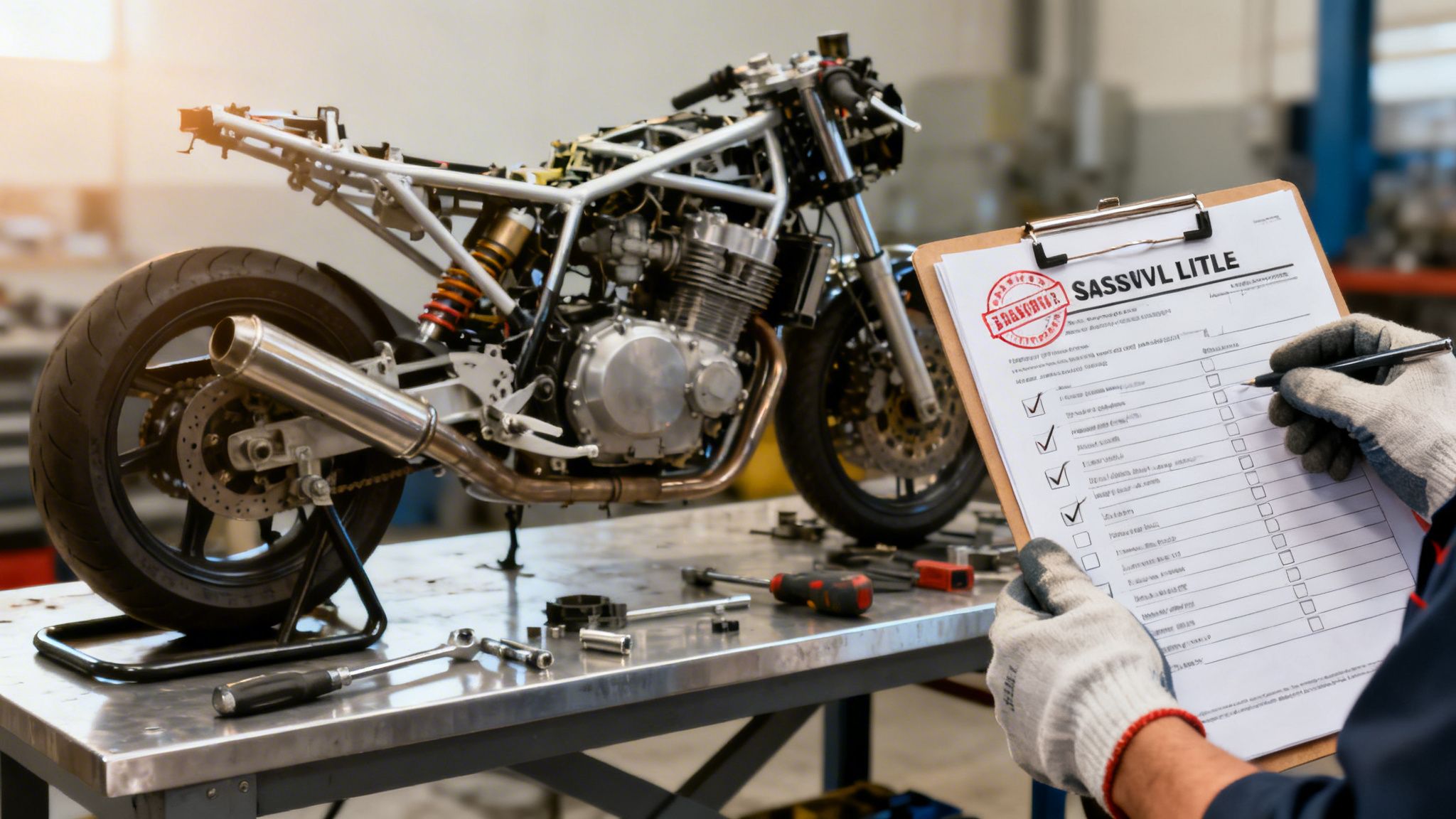
The Pre-Purchase Inspection Checklist
Before you even dream about making an offer, you need to put on your detective hat. A meticulous, hands-on inspection is your only real defense against a beautiful-looking bike that’s hiding catastrophic damage.
Your first and most important stop is the frame. Get on your hands and knees and look for any hairline cracks, especially around the welds and the steering head. Bring a straight edge with you to check for even the slightest bend or twist. A tweaked frame can make a bike unstable and dangerous, and it's a nightmare to fix properly.
Next, shift your focus to the quality of the repairs that have already been done. Is that shiny new paint job hiding a mountain of body filler? Do you see mismatched bolts or, worse, zip ties holding important parts together? These are the classic calling cards of a rushed, amateur job, hinting that bigger problems are likely hidden just out of sight.
A great deal on a salvage title motorcycle is never truly a great deal if the frame is compromised. Structural integrity is the one area where you absolutely cannot afford to make a mistake.
The market for these bikes is bigger than you might think. Online salvage auctions ballooned into a USD 10.6 billion industry in 2024, with forecasts showing it could hit USD 27.2 billion by 2030. The same research revealed that once repaired, these bikes often sell for just 35% of what a clean-title version would fetch. You can dig into the data yourself by reading this study on the growing salvaged motorcycle market.
Different Damage Types and Their Impact
Not all salvage brands are created equal. The reason the bike was written off is just as critical as the salvage title itself. Knowing the type of damage helps you gauge the real risk.
- Cosmetic Damage: This is the best-case scenario. Scratched fairings, a dented gas tank, or a broken mirror might be enough for an insurance company to total an older bike. If the frame and engine are untouched, these fixes are often straightforward and affordable.
- Structural Damage: Here's where things get dangerous. A bent frame, a cracked engine case, or a twisted swingarm can make a motorcycle fundamentally unsafe to ride, no matter how good it looks. These are expensive, expert-level repairs.
- Flood Damage: Just walk away. Water is the silent killer of motorcycles. It seeps into every electrical connector, starts corroding engine internals from the inside out, and can lead to bizarre, unpredictable failures months or even years later. A flood bike is a ticking time bomb.
Your Most Powerful Tools: A History Report and a Pro
Even if you have a good eye for detail, you simply can't see everything. That’s why two steps are absolutely non-negotiable before you buy any salvage title bike.
First, run a comprehensive vehicle history report (VHR) using the motorcycle’s VIN. This is the bike's official story. It can tell you why it was salvaged in the first place, often including photos from the insurance auction, and reveals its entire documented past.
Second, hire a professional mechanic for an inspection. Pay a trusted expert to get the bike up on a lift and give it a thorough once-over. Their trained eye can spot things you’d never notice, like hidden frame cracks or the faint, telltale signs of water intrusion. The cost of an inspection is a tiny price to pay for the peace of mind it buys you—and it could easily save you from a multi-thousand-dollar mistake.
The Path to a Rebuilt Title and Getting Back on the Road
So, you either kept your totaled bike or bought a salvage project with a vision. Great! But the work doesn't stop once the wrenches are put away. A motorcycle with a salvage title can't legally be on the road. To get it there, you'll need to go through a state-run process to get it a rebuilt title.
Think of it as the final exam for your project bike. It’s a specialized inspection and a mountain of paperwork, all designed to prove to the state that the once-wrecked motorcycle is now safe and properly repaired. Nail this, and your bike is no longer just a project—it's a street-legal machine ready to ride.
The Rebuild and Documentation Phase
Before you even think about scheduling an inspection, you need to become a master of paperwork. Every single thing you do to bring that bike back from the dead needs to be documented. This isn't just for you; it's the official proof you’ll hand over to the state inspectors.
Get a folder and start filling it. You'll need:
- "Before" Photos: Snap detailed pictures of all the damage before you start any repairs. These photos establish the bike's starting point.
- Receipts for Every Part: Whether you're using brand-new OEM parts, sourcing used ones from a donor, or adding aftermarket bits, save every single receipt. They need to show what the part is and, ideally, the VIN of the bike it came from.
- Repair Invoices: If you paid a pro to do any of the work—like straightening the frame or rebuilding the engine—get a formal invoice.
- "After" Photos: Once it's all put back together, take another set of clear photos from every angle to show off your finished work.
Treat your paperwork like you're building a case for a judge. You have to prove, beyond any doubt, that the motorcycle was restored to a safe, roadworthy condition using legally-sourced parts.
Navigating the State Inspection
With the bike rebuilt and your documentation ready, it's time for the official state inspection. This isn’t your typical annual safety checkup. This is a much more intense exam, usually handled by a special division of your state's DMV or State Patrol.
The inspector has two primary jobs:
- Safety: They will go over your repairs with a fine-toothed comb, zeroing in on critical systems like the frame, brakes, steering, and lights.
- Legitimacy: They'll match up the serial numbers on your new parts with your receipts. This is their way of making sure you didn't use any stolen components in your build.
Once you pass the inspection, you can finally apply for the rebuilt title. This usually means submitting the passed inspection report, the original salvage title, all your receipts, and paying the state fees. When everything is processed, the DMV will issue a new title that's branded as "Rebuilt," "Reconstructed," or something similar.
This whole process—from finding a bike to getting it on the road—starts with good planning.

As the chart shows, solid research and a thorough inspection are the foundation, happening long before you ever commit to a purchase.
After all that hard work, you'll want to protect your bike's fresh look. A good quality ceramic coating for motorcycles is a smart move. It adds a tough, protective layer that guards the paint and finish against the elements, keeping your revived machine looking sharp for years to come.
How to Insure Your Rebuilt Motorcycle
Alright, you did it. You poured your time, sweat, and money into a salvage project and brought it back to life with a shiny new rebuilt title. But now you need to insure it, and this is often where the real headache begins. Many riders discover that their usual insurance company suddenly gets very nervous.
Why the hesitation? To a standard insurance carrier, a rebuilt title is a giant question mark. They have no idea about the quality of the repairs. Was the frame straightened perfectly? Are there hidden electrical gremlins lurking? Because they can't quantify that risk, most mainstream insurers will either show you the door or only offer a bare-bones liability policy.
Finding the Right Coverage
This means you need to change your game plan. Your best bet is to skip the big, household-name companies you see advertised everywhere and focus on specialty insurers. These are the companies that deal with classic cars, custom builds, and other unique vehicles. Their underwriters actually know how to look at a rebuilt bike as an individual case, not just a liability.
When you reach out, you need to come prepared. Have all your paperwork organized and ready to go. This is your proof that the bike was rebuilt correctly and legally.
- The original salvage title
- Your new rebuilt title certificate
- A complete file of receipts for all parts and labor
- Photos showing the bike before, during, and after the repairs
- The official certificate from the passed state inspection
Think of this packet as the bike's resume. The more thorough and transparent you are, the better your chances of getting an underwriter to take you seriously.
An insurance underwriter sees a rebuilt title and thinks "risk." Your job is to hand them a folder full of documentation that proves the bike is a well-repaired, known quantity, not an unknown liability.
Liability vs. Comprehensive Coverage
Even with a specialty insurer, getting the coverage you want can be a negotiation. Most will start by offering a liability-only policy. This is the legal minimum, covering damage you might cause to other people or their property, but it does absolutely nothing to protect your own motorcycle.
What you really want is comprehensive and collision coverage, which protects your bike from theft, accidents, and other damage. This is the tough one. Insurers are reluctant to offer it because they don't know what the bike is actually worth. This is precisely where a professional appraisal becomes your most powerful tool. A certified appraisal report gives the insurance company a solid, defensible value for your motorcycle.
If you're curious about how these valuation methods work, our guide on agreed value vs. actual cash value policies breaks it all down.
The need for proper valuation is only growing. In the UK, for example, the salvaged vehicle market hit USD 38 million in 2024, proving that there's a huge demand for these bikes and their parts. You can read more about these trends in the global salvaged motorcycle market. That boom shows just how many rebuilt vehicles are hitting the road, but without a certified appraisal, owners are often left underinsured. With the right paperwork and an expert valuation, you can protect your investment and ride with confidence.
Frequently Asked Questions About Salvage Motorcycles
Dipping your toes into the world of salvage title motorcycles can feel confusing. Whether you're a buyer hoping to score a deal or an owner navigating an insurance claim, you’ve probably got questions. Let's clear up some of the most common ones.
Can You Legally Ride a Salvage Title Motorcycle?
Plain and simple: no. A motorcycle with a salvage title is not legal to register, insure, or ride on public roads. You can think of a salvage title as a permanent red flag in the system, marking the bike as unfit for the street in its current state.
To get it back on the road, the bike has to be fully repaired and then pass a strict state-mandated inspection. Once it clears that hurdle, it's issued a rebuilt title. Only then can you legally register and insure it again.
Is Buying a Salvage Bike a Good Idea?
This is a classic "it depends" situation. For a skilled mechanic or a serious hobbyist with a well-equipped garage, a salvage bike can be an amazing project and a path to owning a dream machine for pennies on the dollar.
But for the average rider, it’s a huge gamble. That tempting low price can hide a world of hurt, from a subtly bent frame to fried electronics that will turn your bargain into a frustrating money pit. Unless you truly know what you’re looking at or are willing to pay a pro for a detailed inspection, proceed with extreme caution. What looks like the deal of a lifetime can easily become a nightmare you can't wake up from.
Does a Rebuilt Title Affect a Motorcycle's Value?
Absolutely, and the effect is permanent. A rebuilt title will always lower a motorcycle’s resale value. Even with perfect, professional-grade repairs, the bike will never be worth as much as an identical model that has always had a clean title. That "rebuilt" brand is a permanent part of its history.
The stigma of a past total loss declaration can reduce a bike's market value by 20-40% or more. Buyers are always going to be hesitant about its past, and that caution hits you directly in the wallet when it's time to sell.
How Do You Fight a Low Insurance Settlement?
When your insurer comes back with a lowball offer, your best defense is a provision in your policy called the Appraisal Clause. This clause gives you the right to hire your own independent appraiser to challenge their valuation.
A good appraiser doesn't just plug numbers into the same software the insurance company uses. They perform a detailed assessment of your bike's actual pre-accident condition, factoring in upgrades, maintenance history, and real-world market data. This independent report gives you the leverage you need to negotiate for the fair and accurate settlement you're truly owed.
If you're facing a lowball total loss offer or dealing with diminished value on your vehicle in Washington or Oregon, don't accept less than you deserve. At Total Loss Northwest, our certified appraisers fight to get you a fair and accurate settlement. Visit us at https://totallossnw.com to learn how we can put our expertise to work for you.