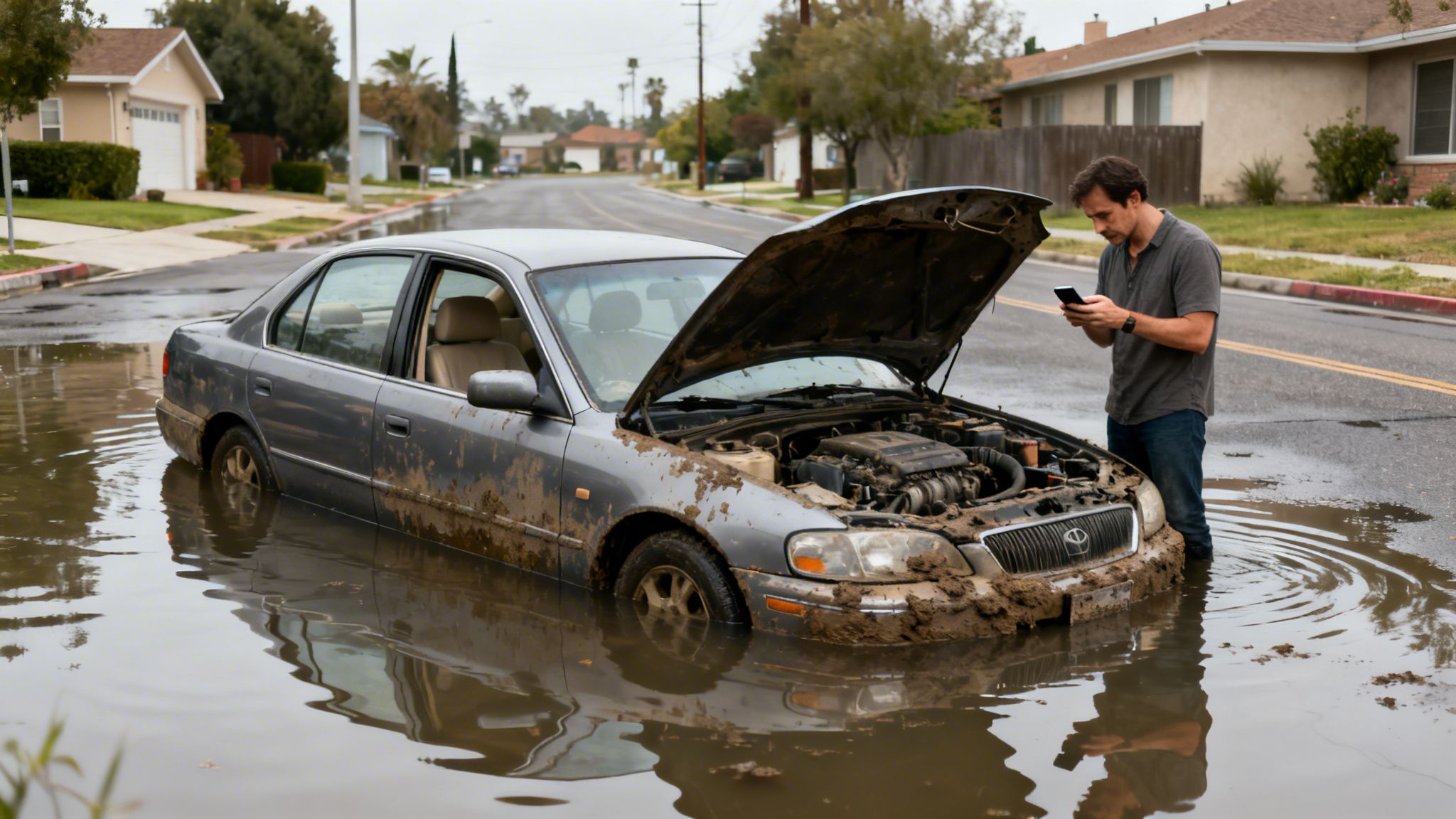
If your car was in a flood, you’re probably asking one question: is it totaled? The short answer is almost always yes.
Think of it like dropping your new laptop into a swimming pool. Even if you manage to dry it out and it turns on, you’d never fully trust it again. You know that corrosion has already started on the inside, just waiting to cause a critical failure weeks or months down the line. That’s exactly what happens to a flooded car.
Why a Flooded Car Is Almost Always a Total Loss
When an insurance adjuster looks at a flooded vehicle, they see far more than just wet carpet. They see a cascade of hidden, expensive, and often unfixable problems. This is why insurers are so quick to declare a flood-damaged car a total loss.
The decision really comes down to a straightforward financial calculation. The insurance company compares the mountain of repair estimates against your car’s Actual Cash Value (ACV)—what it was worth the moment before the water rose. If the cost to fix everything even gets close to that value, they'll total it out. It just doesn't make financial sense to do anything else.
The Hidden Costs That Sink a Flooded Car
Unlike a fender-bender where the damage is contained to one area, a flood is a systemic attack on the entire vehicle. Water doesn't just get things wet; it infiltrates every nook and cranny, starting a destructive chain reaction, especially in modern cars that are essentially computers on wheels.
The real problem isn't the visible mess. It's the insidious damage you can't see.
- The Electronic Nightmare: Modern vehicles have miles of wiring, dozens of sensors, and a network of computer modules (ECUs) controlling everything from your engine to your radio. Once submerged, these sensitive electronics begin to corrode immediately. A single wiring harness or central computer can cost thousands to replace, and a flooded car has dozens of these components at risk.
- Catastrophic Mechanical Failure: If water gets sucked into the engine’s air intake, it can cause hydrolock. This is when the engine's pistons try to compress water—which, unlike air, doesn't compress. The result is bent connecting rods, cracked pistons, and a completely destroyed engine block. There is no repairing this; the engine is toast.
- Unseen Health Hazards: Water soaks deep into seat foam, carpeting, and sound-deadening insulation under the floor. This creates the perfect breeding ground for aggressive mold and mildew. Not only does this produce a foul, musty odor that never leaves, but it also poses a serious health risk to anyone inside the car.
- Compromised Safety Systems: Critical safety components, like the sensors for your airbags and the mechanisms for your seatbelt pre-tensioners, are often located low in the vehicle’s cabin. Once they’ve been underwater, they simply can't be trusted to work in a future accident. No repair shop can guarantee their reliability, making the car fundamentally unsafe to drive.
Experts at publications like Policygenius agree: the sheer scope of damage is why these vehicles are written off. The repair bill for the engine, electronics, and interior skyrockets so quickly that it easily surpasses the car's pre-flood value.
A total loss declaration isn't a punishment—it's a practical decision based on safety and finances. It protects you from owning an unreliable, potentially unsafe car and saves the insurer from a never-ending cycle of repair claims.
In the end, the combination of mechanical, electrical, and biohazard damage makes a complete and safe restoration virtually impossible. The car's title is then permanently branded to reflect this severe history. You can learn more about this process in our guide on what a salvage title is and how it impacts a car's future. The insurer's decision is a simple acknowledgment that you can't truly fix a vehicle that has drowned.
How Insurance Companies Decide to Total a Car
When you're staring at a flooded car, the big question—"is it totaled?"—feels overwhelming. But for an insurance company, the answer isn't based on emotion or guesswork. It all comes down to a cold, hard calculation.
Insurers don't just eyeball the damage. They follow a specific formula dictated by your state's laws, comparing the cost of repairs to your car's value right before the flood. Understanding their math is the first step to making sure you're treated fairly during the claims process.
The Basic Total Loss Equation
At its core, the decision is a business one. The adjuster is simply asking: Is it more expensive to fix this car, or to pay the owner its value and sell the damaged vehicle for salvage?
This decision-making process is fairly straightforward, as the flowchart below shows.

Once water damage is confirmed, it's all about the numbers. If the repair bill gets too high relative to the car's value, the insurer will declare it a total loss.
Total Loss Threshold vs. Total Loss Formula
The exact calculation your insurer uses depends on where you live. Each state sets its own rules, which fall into two main categories.
-
Total Loss Threshold (TLT): Most states use a TLT, which is a set percentage. If the estimated cost of repairs hits a certain percentage of the car's Actual Cash Value (ACV), it must be totaled. For instance, if your state has a 75% threshold and your car was worth $20,000, any repair estimate of $15,000 or more automatically triggers a total loss.
-
Total Loss Formula (TLF): A handful of states use a slightly different calculation. The (Cost of Repairs + Salvage Value) is compared against the Actual Cash Value. If the cost to fix the car plus what the insurer can get for selling its remains is more than the car's pre-flood value, it's a goner. You can get a much more detailed breakdown by reading about the Total Loss Formula.
While these rules provide a framework, it's also helpful to know how insurers categorize the severity of damage; you can learn more about how they classify vehicles with these write off categories explained.
Forget the Dashboard Myth: You might have heard the old rule of thumb that a car is only totaled if water reaches the dashboard. That’s completely wrong for modern vehicles. Today's cars have critical electronics—airbag modules, wiring harnesses, and control units—tucked away under the seats and in the floorboards. Just a few inches of saltwater can fry these expensive systems, sending repair costs skyrocketing past the total loss point in no time.
Ultimately, whether your car is totaled comes down to the math. Knowing which rules apply in your state and what parts are driving up the repair estimate gives you a huge advantage when you get that call from the adjuster.
Telltale Signs Your Flooded Car Is a Total Loss

When an insurance adjuster walks up to a flood-damaged car, they’re looking for much more than just the high-water mark. They’re trained detectives, searching for specific clues that tell them the damage is deep, systemic, and probably not worth fixing. If you know what they’re looking for, you’ll have a much better idea of what to expect.
It’s easy to focus on the standing water on the floor mats, but the real story is told by the signs of deep infiltration. These are the clues that often seal a car’s fate as a total loss.
The Immediate Red Flags
Before you even think about putting a key in the ignition, take a careful look around your vehicle. Each of these warning signs is a strong piece of evidence that the water got into places it should never be.
- That Musty, Unshakeable Smell: This isn't just the odor of wet carpet. It’s the unmistakable stench of mold and mildew already starting to grow deep inside the seat cushions, behind the dashboard, and within the car’s insulation. This kind of biohazard is incredibly difficult and costly to remove properly.
- Foggy Headlights and Taillights: Take a close look at your light housings. Do you see condensation or water droplets trapped inside? If water managed to get past those seals, you can bet it also found its way into countless other sensitive electronic modules and connectors.
- Silt in Strange Places: Mud on the floor is one thing, but what about a fine layer of silty grit inside your glove box or center console? Pop the trunk and check under the spare tire. This fine debris is proof that dirty floodwater didn't just get in your car—it filled it.
If you’re seeing these signs, the odds are stacking up against your car. They show the flood was a major event that soaked the vehicle through and through.
Saltwater vs. Freshwater Floods
Not all floods are created equal. The type of water your car was submerged in plays a massive role in the outcome, and it's something insurers take very seriously. While no flood is good, a saltwater flood is essentially a death sentence for a modern vehicle.
Salt is brutally corrosive. When saltwater comes into contact with your car’s wiring, computer modules, and connectors, it doesn't just cause a short circuit. It begins to actively eat away at the metal, starting a chain reaction of corrosion that's almost impossible to stop. It creates a ticking time bomb of future electrical failures.
Because of this aggressive corrosion, a car submerged in saltwater or even brackish water is almost always declared an immediate total loss. The long-term reliability is so compromised that no insurer will risk covering it for future repairs.
Freshwater is less corrosive, but it’s far from harmless. As experts at Consumer Reports explain, even freshwater floods lead to pervasive mildew and can destroy critical electronics and mechanical parts. The damage is still severe and very often pushes the cost of repairs well past the total loss threshold.
Your First Steps After Discovering Flood Damage

Finding your car submerged in water is a gut-wrenching moment. Your first instinct might be to jam the key in the ignition to see if it’s salvageable. You have to fight that urge. What you do in the next few minutes can mean the difference between a massive repair bill and a catastrophic, unfixable disaster.
Above all else, do not try to start the car. Seriously. Don't even turn the key to the "on" position. If water has seeped into the engine, attempting to start it can cause hydrolock—a swift and brutal end for your engine. Water doesn't compress like air, so when the pistons try to complete their cycle, they slam into a wall of liquid. The result? Bent connecting rods, cracked pistons, or even a destroyed engine block. It’s the fastest way to guarantee your car is a total loss.
Your Immediate Action Plan
With the keys safely out of the ignition, it's time to shift gears from panicked owner to crime scene investigator. Your insurance claim will hinge on the quality of the evidence you gather right now.
- Document Absolutely Everything: Go overboard with photos and videos. Get shots from every conceivable angle, capturing the high-water marks on the outside and inside. Open the doors and document the soaked carpets, the seats, and the dashboard. Don't forget the trunk and the glove box. The more visual proof you have, the smoother your claim process will be.
- Contact Your Insurer: Get on the phone with your insurance company right away to report the flood and start a claim. This is the moment you'll find out if your policy is up to the task—flood damage is almost always handled under comprehensive coverage, not standard liability or collision.
- Perform "First Aid": If the area is safe, start the drying process immediately. Open every door, window, and the trunk to get air moving. Use old towels to mop up standing water from the floorboards and seats.
Think of this less as "fixing" the car and more as damage control. You're trying to prevent mold and mildew from taking root, which can introduce a whole new set of problems and health hazards. This simple act of mitigation shows the insurance company you're being responsible while you wait for their adjuster.
Setting Realistic Expectations
Once you've done all you can, the process is in the insurer's hands. They’ll send an adjuster to perform a detailed inspection. This is where the official "total loss" calculation happens, as they weigh the estimated repair costs against the car’s pre-flood value.
This part of the process can be stressful, so it pays to be prepared. Take some time to understand what to do when your car is declared a total loss before you even get the official word. Knowing your rights and what to expect from a settlement can give you a sense of control in a situation that feels anything but. You can't turn back the floodwaters, but a smart, proactive response is your best tool for navigating the aftermath and ensuring a fair outcome.
Navigating Your Total Loss Settlement Offer

So, the adjuster has made the call—your car is officially a total loss. Now you’re entering what is arguably the most critical part of the entire process: the settlement. This is when the insurance company presents an offer to pay you for your totaled vehicle, and your job is to make sure that number is fair.
Don’t just take the first number they give you. I've seen it a hundred times: an owner is so relieved to get an offer that they accept it without a second thought. But insurance companies often use third-party software to generate these initial valuations, and frankly, these systems can spit out lowball figures that miss the full story of your car's value.
Understanding the Settlement Offer
That number the adjuster gives you is meant to be the car’s Actual Cash Value (ACV). Think of it as a snapshot of your car’s fair market value the moment right before the floodwaters hit. It has nothing to do with what you originally paid for the car or how much you might still owe on a loan.
The initial settlement offer is exactly that—an offer. It’s the starting point for a negotiation, not a final, take-it-or-leave-it demand. You have every right to question their math and bring your own proof to the table.
Once the car is totaled, its title gets a permanent black mark. It will be re-branded with a salvage title, signaling to all future buyers that it sustained catastrophic damage. Even if someone painstakingly rebuilds it, that branded title destroys its resale value and makes it a nightmare to insure. This is why getting a fair cash settlement is so crucial; for all intents and purposes, the car’s life as a reliable vehicle is over.
The Problem with Initial Valuations
The valuation reports that insurers rely on are often flawed. They’re only as good as the data they pull from, and it’s common to see errors that conveniently lower the car’s value.
- Bad Comparisons: The report might compare your well-maintained car to "comps" (comparable vehicles for sale) that are base models, have tons of miles, or were in visibly worse shape than yours was pre-flood.
- Missing Features: Did you just put $800 worth of new tires on it? Or have a major service done? These things add real value and should be included in the final ACV calculation.
- Local Market Blind Spots: A 4×4 truck is worth a lot more in a snowy mountain town than in a sunny city. Your valuation needs to be based on comps from your immediate local market, not some statewide or national average.
Dealing with a water-damaged vehicle claim has its own unique set of challenges. Getting familiar with the general flood insurance claim process can give you a much better handle on what to expect and where things can go wrong.
Your Most Powerful Tool: The Appraisal Clause
If you look at the insurance company's offer and your gut tells you it's too low, don't just get into a shouting match with the adjuster. There’s a powerful, often-overlooked tool written right into most auto policies: the Appraisal Clause.
This clause gives you the right to hire your own state-licensed, independent appraiser to fight for a fair valuation. It effectively takes the valuation process out of the insurance company's hands and brings in an unbiased expert. Your appraiser will do their own deep dive into the market, build a case based on real-world data, and formally challenge the insurer's low offer.
It’s your ultimate leverage to make sure you get paid what you’re truly owed for your loss.
Frequently Asked Questions About Flooded Cars
When your car gets caught in a flood, your head starts spinning with questions. It's a confusing and stressful situation, and you need clear answers, fast. Let's walk through the most common questions we hear from owners dealing with a flood-damaged car.
Getting a handle on these key issues will help you understand your options and make the whole insurance claim process feel a lot less overwhelming.
Will My Insurance Cover a Flooded Car?
The short answer is yes, but only if you have the right coverage. Flood damage isn't covered by a basic liability policy. It falls under your comprehensive coverage.
Think of comprehensive as the "everything else" part of your policy—it handles non-crash events like theft, fire, falling trees, and, you guessed it, water damage. If you only have liability, which just covers damage you cause to other people, then unfortunately, the repairs or replacement for your own flooded car will be on you.
A quick heads-up: your auto policy is designed to cover the vehicle itself, not the personal belongings you had inside. For laptops, tools, or other valuables, you'll likely need to file a separate claim through your homeowner's or renter's insurance.
Can I Keep My Car If It Is Totaled?
Most of the time, yes. You can usually choose to "owner-retain" the vehicle after the insurer declares it a total loss. When you do this, the insurance company calculates your payout by taking the car's Actual Cash Value (ACV) and subtracting what they would have gotten for it at a salvage auction.
But this isn't a simple decision, and it comes with some serious baggage. Here's what you're signing up for:
- A Branded Title: The car will be given a "salvage" or "flood" title. This is a permanent brand that follows the car forever.
- Insurance Headaches: Good luck getting full coverage on a salvage vehicle. Most companies will refuse, leaving you with liability-only at best.
- Zero Resale Value: That branded title effectively kills the car's market value.
Keeping the car really only makes sense if you're a skilled mechanic who needs a parts car or you're planning a massive, personal restoration project with your eyes wide open. For everyone else, it’s almost never worth the hassle.
How Long Does a Flood Claim Take?
Honestly, it depends. If your car was swamped in an isolated event, like a burst water main, you might have your claim settled in just a couple of weeks. But if you were hit by a major hurricane or widespread flooding, you need to prepare for a much longer wait.
When a natural disaster strikes, insurance companies are completely swamped with thousands of claims at once. It just takes time for adjusters to physically get to every car. In these situations, a realistic timeline can be anywhere from a few weeks to more than a month.
Your best bet for speeding things up is to get the ball rolling immediately. File your claim the moment you can, send over clear photos and any documentation you have, and stay in regular contact with your adjuster. Being proactive is the single best thing you can do to keep your claim moving.
If the insurance company’s settlement offer seems way off the mark, don't just take it. You have every right to challenge their valuation. Total Loss Northwest provides certified, independent auto appraisals that hold insurers accountable and force them to pay what your vehicle was actually worth. Visit us at https://totallossnw.com and let an expert fight for you.