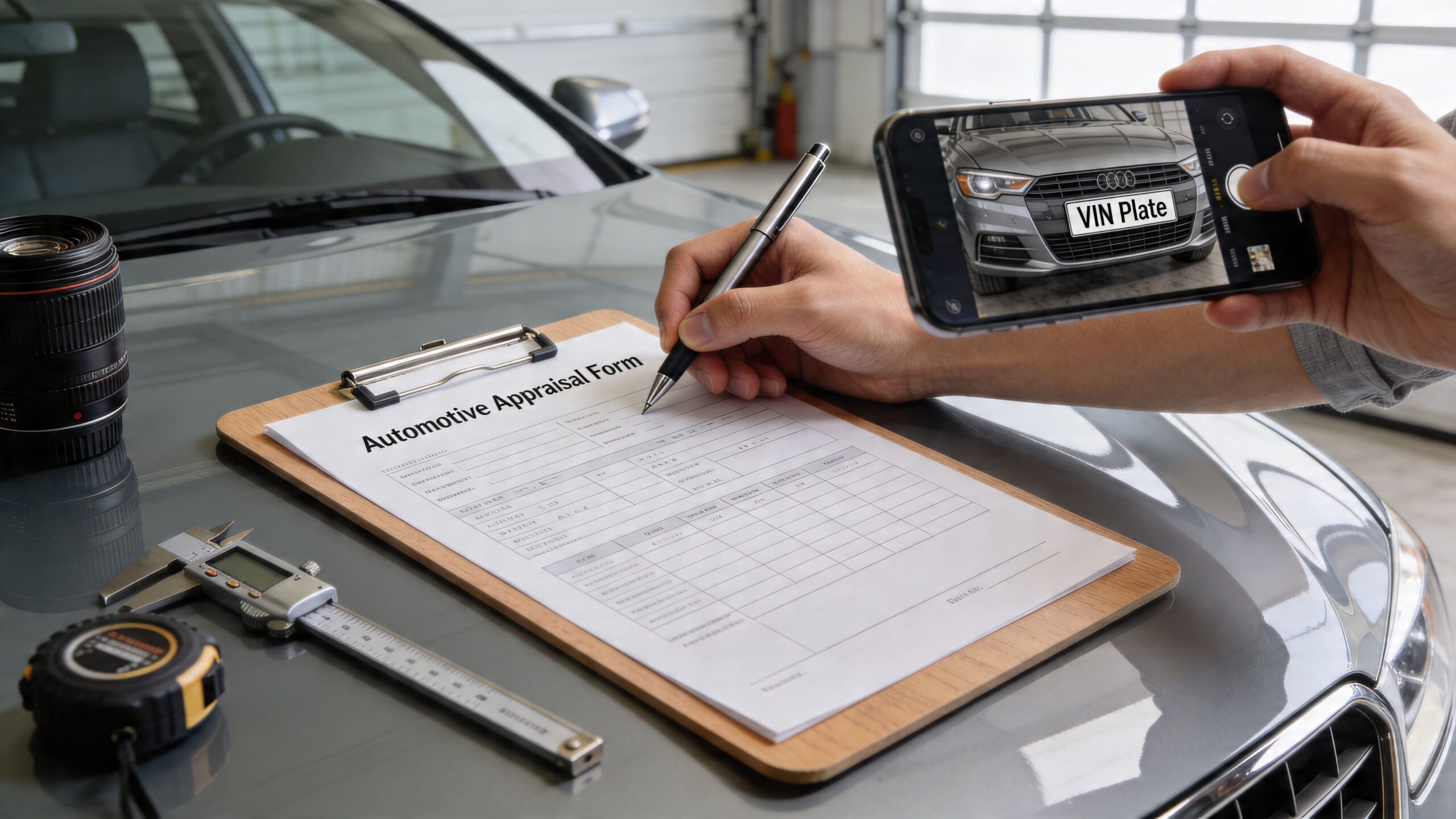
An automotive appraisal form is much more than just paperwork. Think of it as your most important tool for documenting your vehicle’s true value, especially when you're staring down a lowball settlement offer from an insurance company after an accident. It’s a structured way to prove your car's real worth, based on evidence, not the insurer's self-serving numbers.
Why a Detailed Appraisal Is Your Strongest Asset
Let's be honest—getting that first settlement offer after a car accident can feel like a gut punch. It’s almost always shockingly low, leaving you feeling powerless and wondering how you'll ever afford a comparable replacement. This is exactly where a well-documented automotive appraisal form completely changes the game. It shifts you from a defensive position to an offensive one.
Imagine this all-too-common scenario: You’re a meticulous owner, and your well-maintained SUV gets totaled by a distracted driver. The insurance company quickly comes back with an offer, but it’s thousands less than what similar vehicles are selling for in your area. This isn’t an accident; it's a core part of their business model, designed to minimize their payout on every claim.
The Financial Reality of a Lowball Offer
The gap between what an insurer offers and what your vehicle is actually worth can be massive. We see it every day. For instance, take a 2018 Toyota Corolla that was totaled here in Washington State. The insurer's initial offer was just $13,000. After a proper appraisal that accounted for its condition and local market demand, the vehicle’s fair market value was established at $18,000.
That’s a 38% difference—a $5,000 gap that the owner would have lost without pushing back. As detailed in a real-world analysis from iDrive Certified, these variances are unfortunately the norm, not the exception. This is why your appraisal form is so critical; it’s your documented argument for every single one of those dollars.
Buried deep in your auto insurance policy is a powerful tool you probably never knew you had: the Appraisal Clause. Invoking this clause gives you the right to hire your own independent appraiser to formally challenge the insurance company’s valuation. A meticulously completed appraisal form is the key that unlocks this entire process.

Comparing the Initial Offer to Fair Value
Without solid proof, you're just another claimant arguing with a multibillion-dollar company. But when you present a detailed appraisal, the conversation shifts. You’re no longer talking about their mysterious valuation software; you’re talking about concrete facts.
Here's a quick look at the financial difference a proper appraisal can make. The table below shows a typical insurer offer versus a certified appraisal for a common vehicle, a 2021 Ford F-150 XLT.
Insurer's Offer vs. Appraised Fair Market Value
| Valuation Component | Typical Insurer's Initial Offer | Certified Appraised Value |
|---|---|---|
| NADA/KBB Base Value | $32,500 (Clean Trade-In) | $36,000 (Clean Retail) |
| Condition Adjustment | -$750 (Minor Scratches) | +$1,200 (Excellent Condition) |
| Recent Maintenance | $0 (Not Considered) | +$650 (New Tires & Brakes) |
| Optional Equipment | +$500 (Missed Tonneau Cover) | +$1,500 (All Options Accounted) |
| Total Value | $32,250 | $39,350 |
The difference is stark. The insurer's process often starts from a lower baseline (trade-in vs. retail) and misses key details. A thorough appraisal backed by evidence closes that gap, ensuring you get the full amount you're owed.
When you start filling out an automotive appraisal form, you aren't just doing paperwork. You're building a powerful, evidence-based case to secure the settlement you rightfully deserve. It's the first and most important step in taking back control of your claim.
Decoding Your Appraisal Form and Building Your Case
Staring at a blank automotive appraisal form can feel overwhelming. It’s packed with industry jargon and boxes that seem designed to confuse you. But I’ve learned to see it differently—it’s not a test, it’s a guided tour of your vehicle’s true value. When you break it down piece by piece, that intimidating document becomes your most powerful tool.
Let’s walk through how to fill it out, so you can gather the right details and prove what your vehicle is actually worth. And remember, the work you do immediately after a collision can make this step much easier. Knowing what to do after a car accident from the start helps you collect the information you’ll need later.
Understanding the Key Sections of the Form
Think of an appraisal form as the story of your car. Every field is a chapter, and skipping the small details can leave money on the table. A thorough, accurate form is much harder for an insurer to dispute.
Here are the areas where you need to pay close attention:
- VIN Verification: This isn’t just a random string of characters. The Vehicle Identification Number is your car’s DNA, confirming its exact make, model, year, and every option it left the factory with. Double-check it for accuracy.
- Condition Rating: You’ll be asked to rate the interior, exterior, and mechanical state. Be honest, but don't sell yourself short. Instead of a vague "good," get specific. Try "minor wear on driver's side bolster" or "flawless dashboard, no sun fading or cracks."
- Prior Damage Disclosure: This is all about credibility. If you’ve had past repairs unrelated to the current claim, disclose them. Hiding old damage, even minor stuff, can give the adjuster a reason to doubt your entire appraisal.
- Optional Equipment and Features: This is where you can really add value. Document everything—from a factory sport package and premium audio to recent, quality-of-life upgrades like a new set of tires or a high-end battery.
Today's appraisal landscape is dynamic. In major markets like the United States, which represents 42% of global auto sales, appraisers must account for real-time market shifts. For instance, the Manheim Index tracked a massive 32% surge in used car prices between 2020 and 2023. A good appraisal reflects that reality. Simple things, like having a clean title and under 100,000 miles, can boost a car's value by as much as 12%.
Turning Jargon Into Actionable Details
Insurance companies often lean heavily on their preferred valuation software, like CCC ONE. This can be a major point of conflict for owners who feel the numbers are too low. If you're running into that roadblock, you can learn how to challenge a low CCC ONE auto valuation in our detailed guide. The key is to speak their language and counter their report with undeniable facts.
Example: Documenting a "Sport Package"
Let's say your car came with a factory "Sport Package." Simply writing that down isn't enough. You need to spell out exactly what that means to justify the added value.
- What an amateur does: "Has Sport Package."
- What you should do: "Factory Sport Package, which includes: 19-inch sport wheels, sport-tuned suspension, performance-rated summer tires (80% tread remaining), leather-wrapped sport steering wheel, and larger front brakes."
An appraisal form is your chance to be the expert on your car. The insurance adjuster has never seen your vehicle before the accident. You're the one who owned it, cared for it, and knows every single detail that makes it valuable. Your job is to document it all.
This level of detail forces the adjuster to see your car as a unique vehicle, not just another entry in their database. You’re building a detailed, factual argument for a higher valuation, making it much harder for them to defend a lowball offer. Just be sure to back up every claim with receipts and photos in your evidence package.
Building an Undeniable Evidence Package
Your filled-out appraisal form is the opening statement, but the real power lies in the proof you bring to the table. Just saying your car was in "excellent condition" won't get you very far with an insurance adjuster. You have to prove it, and you do that by building a solid package of documents and photos.
Think of yourself as building a case file for your vehicle. Every receipt, every photo, and every service record is a piece of evidence. Your goal is to create such a clear and complete picture of your car's pre-accident condition that the insurer has no room to second-guess its value.
Assembling Your Essential Documentation
Alright, let's start by rounding up all the paperwork that tells your car's life story. Insurance companies run on documentation, so a thick stack of records speaks volumes more than just your word. It's time to dig through your glove box, digital folders, and file cabinets.
Here's the evidence you'll want to gather:
- Maintenance Records: This is your knockout punch. Every oil change, tire rotation, and scheduled service invoice proves you were a responsible owner. A consistent history shows the adjuster this wasn't just a neglected vehicle; it was mechanically sound.
- Receipts for Recent Upgrades: Did you drop a grand on new premium tires last year? Or maybe you just had the brakes and rotors replaced a few months before the crash. Every dollar you recently invested needs to be documented. Collect receipts for tires, batteries, brakes—any significant part that was practically new.
- The Original Window Sticker: If you happen to have this, it's pure gold. The original Monroney sticker lists every single factory option and package, ensuring nothing valuable gets overlooked during the valuation.
- A Clean Vehicle History Report: Providing a report from a reputable source that shows a clean title with no salvage or flood history reinforces that you're starting from a high-value baseline.
I can't stress this enough: a well-documented history of care is the bedrock of a strong valuation. It proves to the adjuster that your vehicle was a genuine asset you actively maintained. This simple step can literally add thousands to your final settlement.
As you assemble these items, you're building a foundation for proving your vehicle's true worth. Let's add the visual proof next.

As the infographic above lays out, it's all about combining verified details, condition documentation, and a full list of features to create an undeniable picture of your vehicle's value.
Creating a Compelling Photographic Record
Once your paperwork is in order, it's time for your camera to do some heavy lifting. Photos are your visual evidence, shutting down any attempts by an adjuster to devalue your car by claiming "pre-existing" dings or excessive wear. My advice? Take way more photos than you think you need. You can always delete the extras later.
Focus on creating a detailed and honest visual file of the car's pre-accident state.
- The Grand Tour: Start with the exterior. Get straight-on shots of the front, back, and both sides. Then, capture all four corners from a 45-degree angle. Good lighting is your friend here, so try to do this on a clear day.
- A Look Inside: Move to the interior. Photograph the front and back seats, the dashboard, the center console, and even the headliner. You want to show the condition of the upholstery, carpets, and trim.
- The Nitty-Gritty Details: Now, get in close. Take a clear, well-lit photo of the odometer displaying the mileage. Snap a picture of the VIN plate (usually visible through the windshield or on the driver's door jamb). Don't forget all four tires to show their tread life.
- Show Off the Extras: Did your car have a premium sound system, a sunroof, custom wheels, or a built-in navigation screen? Photograph every single one. If you have aftermarket parts, get a picture of the part itself and pair it with the installation receipt.
It's critical to be honest about the difference between normal wear and tear versus prior damage. A few tiny rock chips on the hood of a car with 80,000 miles is expected. A big dent in the passenger door from a forgotten parking lot mishap is prior damage. Photograph everything so you can control the story. This evidence package will be invaluable, especially when it's time to write your formal response—you can learn more about how to craft a strong insurance demand letter in our related guide.
When you present a valuation this thoroughly supported, you make it very difficult for the insurer to push back.
Adapting Your Appraisal for Specific Claim Types
The truth is, a one-size-fits-all approach to filling out an automotive appraisal form just doesn't work. The details that win a total loss argument are often irrelevant in a diminished value claim. To get the best outcome, you have to tailor your focus.
Let’s walk through how to adapt your appraisal for three common, and often challenging, situations: a total loss, a diminished value claim, and an appraisal for a classic or custom car. Knowing where to focus your energy and what evidence to gather will make all the difference.
Focusing Your Form for a Total Loss Claim
When your car is declared a total loss, the insurance company wants to write you a check for its Actual Cash Value (ACV) and close the file. Your job is to prove their ACV offer is too low. To do that, your appraisal form has to paint a picture of a well-maintained, desirable vehicle that was worth more than their initial offer.
Your argument hinges on the car's pre-accident condition and what it would cost to replace it in your local market.
- Condition Is Everything: Get granular in the condition sections. Don't just write "good interior." Instead, try "clean, non-smoker interior with no stains, rips, or sun fading." This kind of specific language directly counters the "condition adjustments" an adjuster will use to lower your vehicle's value.
- Show Your Recent Investments: The section for recent maintenance is your secret weapon. New tires last month? A new battery and brakes six months ago? List every single upgrade and repair with dates and costs. These are real cash investments that add tangible value to your car.
- Find Your Local Comps: This isn't a field on the form, but it's critical supporting evidence. You need to find active listings for the exact same year, make, and model in your immediate area. Your appraisal form's detailed feature list should then prove your car is as good as, or better than, those comps.
Think of it this way: when fighting a total loss settlement, you're essentially selling your car to the insurance company. A detailed appraisal form is your sales brochure, highlighting every feature and service record that makes it a premium example.
By zeroing in on these details, you build a strong case that your vehicle was a top-tier example, making it tough for the insurer to justify a lowball offer based on average-condition cars.
Highlighting Inherent Loss for Diminished Value
A diminished value (DV) claim is a completely different ballgame. You aren't arguing the car is worthless; you're arguing it's worth less now, even after perfect repairs, just because it has an accident on its record. Many drivers don't realize that a repaired vehicle might only retain 70-90% of its pre-accident value. Your appraisal needs to focus on this accident stigma.
For a DV claim, the most crucial information is all about the crash itself.
- Severity of the Damage: Document how bad the initial damage was. Was there frame damage? Did the airbags deploy? Was it towed from the scene? These facts point to a serious impact, which is exactly what makes future buyers nervous.
- What Was Repaired: Be specific about the parts of the car that were fixed or replaced. A potential buyer will always be more hesitant about a car with a repaired quarter panel and door than one that just needed a new bumper cover.
- The Reality of Market Perception: The heart of any DV argument is simple: a reasonable buyer won't pay the same price for a wrecked-and-repaired car as they would for an identical one with a clean history. Your appraisal documentation needs to prove this value gap exists.
Real-World Scenario: Diminished Value on a Late-Model SUV
Picture this: your three-year-old Honda CR-V gets hit hard in the side. The body shop does a flawless repair, but now the accident is permanently on its vehicle history report. Your appraisal must show that any future buyer, especially at a dealership, will use that accident history to negotiate thousands of dollars off the price. With a DV claim, you're just recovering that future, inevitable loss now from the at-fault party's insurer.
Documenting Uniqueness for Classic and Custom Cars
Appraising a classic, collector, or heavily modified vehicle is where things get really specialized. Standard valuation tools like KBB are totally irrelevant. For these vehicles, your appraisal form must become a historical record, proving its rarity, provenance, and the quality of its unique components.
Here, the focus shifts entirely to what makes your car special and desirable to a very specific market.
The type of claim you're filing directly impacts where you should concentrate your efforts on the appraisal form. This table breaks down the primary focus for each of the main claim types.
| Claim Type | Primary Focus Area | Key Documentation to Include |
|---|---|---|
| Total Loss | Pre-accident condition and fair market replacement cost. | Recent maintenance receipts, comparable vehicle listings, original window sticker. |
| Diminished Value | The permanent loss of value due to accident history. | Repair invoice, pre-repair photos showing damage severity, expert opinion on value loss. |
| Classic/Custom | Rarity, provenance, originality, and quality of unique parts. | Build sheets, modification receipts, show awards, historical records, expert certifications. |
As you can see, the evidence you gather is just as important as the information you put on the form itself.
For a classic car, you need to document any period-correct parts, the quality of the restoration, and its ownership history. Does it have matching numbers? Do you have the original bill of sale? Details like these can add tens of thousands to its value.
For a custom truck with $20,000 in aftermarket upgrades, you can't just write "lift kit and big tires." You have to document the brand of the suspension, the model of the wheels, and provide receipts for installation labor. Each modification must be itemized with proof to be valued. For a unique vehicle, this level of detail is absolutely essential for getting a fair settlement.
Submitting Your Form and Navigating the Response
You’ve done the hard work. Your automotive appraisal form is filled out, and you have a mountain of evidence ready to prove your vehicle’s true value. Now for the crucial part: submitting it to the insurance carrier. How you package and present this information is just as important as the data itself.
Your goal is to be so professional, firm, and well-prepared that agreeing to your number becomes the adjuster's easiest path forward.
Think of this submission as a formal business proposal, not just another email. I always recommend sending your entire package via certified mail with a return receipt. This creates an undeniable paper trail, proving exactly when the insurer received your valuation. It’s a small step that adds a huge layer of professionalism and accountability that a simple email just can’t match.

If email is your only option, make it count. Request a read receipt and combine all your documents into a single, well-organized PDF. Give it a clear, professional file name (e.g., "John_Doe_Appraisal_Claim_12345.pdf") and write a brief summary in the email body.
Crafting a Firm Cover Letter
Every submission needs a cover letter. This isn't the place for emotional stories or angry rants about their first lowball offer. This is where you state your position with unshakeable confidence and set clear expectations for what comes next.
Your cover letter should be short, direct, and accomplish three key things:
- State Your Purpose: Immediately reference your claim number and state that you are submitting an independent appraisal of your vehicle's Actual Cash Value or Diminished Value.
- Declare Your Value: Put your number front and center. For example: "Based on the enclosed market research and documentation, the fair value of my vehicle is $19,500."
- Set a Deadline: Show you mean business by requesting a response within a reasonable timeframe, like 10-14 business days. This signals that you expect prompt action.
A strong cover letter frames the entire negotiation from the start. It tells the adjuster you've done your homework and aren't going to be pushed around.
Your submission package is a direct challenge to the insurance company's initial number. By presenting a case built on facts, comparable sales, and meticulous documentation, you force the adjuster to engage with your evidence instead of their own internal, often biased, reports.
Preparing for the Adjuster's Response
Once your package is sent, the ball is in their court. Expect a call. This is where your preparation truly pays off. The adjuster will likely try to find weaknesses in your report or question your comparable vehicles. Don't let it rattle you. Stay calm, be professional, and let your evidence do the talking.
For accident victims, the numbers are sobering. Even after perfect repairs, a vehicle often holds just 70-90% of its pre-accident value. Data from the Insurance Information Institute reveals that 28% of claims end up in a dispute. The good news? Using a detailed appraisal form can help resolve claims 65% faster by invoking the policy's Appraisal Clause. This is where a professional report shines, as free online tools can be off by a staggering 10-20%. If you're curious about the level of detail that goes into professional valuations, you can discover more insights about dealership appraisal consistency.
Be ready for their go-to arguments:
- "Your comparables aren't valid." You’ll calmly explain why they are, pointing to specific details like location, trim, mileage, and condition that you've already documented.
- "We don't pay extra for that option." This is when you pull out your original window sticker or build sheet and show them it was a factory-installed feature, not an aftermarket add-on.
- "That damage is just normal wear and tear." Counter this by referencing your clear, date-stamped photos showing the vehicle's pristine condition right before the incident.
Your confidence and command of the facts will set the tone. You’ve put in the work—now, stand by it. The goal is to make settling for a fair number the most logical conclusion for everyone involved.
Knowing When to Call in a Professional Appraiser
Putting together your own automotive appraisal form is a fantastic start. It proves to the insurance company that you've done your homework and you're serious about getting a fair value. But sometimes, you hit a wall, and that’s when it’s time to bring in a certified professional.
Knowing when to make that call is everything. A DIY appraisal gets the conversation started, but a report from a certified appraiser is an ironclad legal document that can quickly end a dispute in your favor.
So, when is it time to escalate? The most obvious sign is when the insurance company flat-out rejects your valuation or simply refuses to negotiate. If they won’t budge, you need more firepower.
You should also immediately consider a pro for any vehicle that's out of the ordinary. This includes:
- Classic or vintage cars
- Rare and exotic models
- Heavily customized or modified vehicles
An expert’s knowledge of these niche markets is something you just can't replicate with a few online searches. The same logic applies here as when you need to find a trustworthy mechanic for a pre-purchase inspection—you're paying for specialized expertise, and their certification and reputation are what matter most.
Understanding the Role of a Certified Appraiser
A USPAP (Uniform Standards of Professional Appraisal Practice) certified appraiser is much more than just a form-filler. Think of them as a private investigator for your car's value.
They dig deep into its condition, unique features, and the current market to produce a comprehensive report. This document carries serious weight in negotiations and is admissible in court. They essentially become your expert witness. Our deep dive into independent car appraisers explains more about their critical function.
Honestly, sometimes it just comes down to your own time and energy. If you don't have the bandwidth for a drawn-out battle with a stubborn adjuster, hiring an appraiser can be a brilliant investment. They take on the fight for you.
A professional appraisal isn't waving a white flag; it’s a strategic move to level the playing field. When an insurer sees a formal report from a certified expert, they know you have the evidence and the resolve to invoke the Appraisal Clause and fight for what you're owed.
The numbers back this up. A 2020 study found that 70% of total loss claims have disputes over value, and independent appraisals boosted payouts by 22% on average. Appraiser networks report that with an expert report in hand, negotiations succeed 85% of the time. These reports are especially vital for collector car owners needing an accurate FMV for estates or donations, where a basic online estimate just won't cut it. You can read more about how these forms help reclaim your vehicle's true worth.
A Few Common Questions About the Appraisal Process
Once you’ve submitted your appraisal form, you're in the home stretch. But this is also where some of the most common questions and sticking points tend to surface. Let's walk through what you can expect and how to handle it.
So, what happens when your appraiser and the insurance company’s appraiser just can't agree on a value? This sounds like a major roadblock, but it's a common situation with a built-in solution found right in your policy: the Appraisal Clause.
This clause allows for a neutral, third-party appraiser, called an umpire, to be brought in to settle the dispute. Each side presents its evidence, and the umpire makes the final, binding call on the points of disagreement. Keep in mind, you’ll be responsible for paying your appraiser and for half of the umpire's fee.
Is a Professional Appraisal Worth the Cost?
Hiring a certified appraiser does come with a fee, which understandably gives people pause. Is it really worth spending the money? In my experience, the answer is almost always yes.
Try to see it less as a cost and more as an investment. A detailed, expert-level report can boost your settlement by thousands, easily covering the appraiser's fee and then some. More importantly, it shows the insurer you're serious and have the evidence to back up your claim.
The cost of a professional appraisal is often dwarfed by the money it recovers. You are paying for expertise, evidence, and leverage—three things insurance companies take very seriously.
What about those free online value estimators? While they're handy for getting a rough idea of what your car might be worth, they have zero legal standing in a claim dispute. They simply can't provide the detailed, market-specific analysis and documented proof needed to challenge an insurance company's lowball offer. An official appraisal, backed by solid evidence or a certified report, is the only way to build a case that will hold up.
Don't let an insurer dictate your vehicle's worth. If you're dealing with a total loss or diminished value claim in Washington or Oregon, Total Loss Northwest can help. We provide certified, independent appraisals to ensure you get the fair settlement you deserve. Learn more about how we can fight for you.