You’re probably looking at a bike right now that checks every emotional box. Right model. Right color. Maybe the exact trim you missed when prices were higher. Then you spot the catch in the listing: salvage title.
That phrase stops a lot of buyers cold, and sometimes it should. Other times, it’s the reason a smart buyer gets a machine they couldn’t otherwise afford. The difference comes down to whether you treat the bike like a bargain or like a risk assessment.
I’ve seen both outcomes. One rider buys a lightly damaged standard bike, repairs it correctly, documents everything, and ends up with a solid machine he keeps for years. Another buys a “cheap” sportbike with sloppy plastics and a shiny repaint, then discovers the forks don’t track straight, the ABS light won’t stay off, and no insurer wants to write more than bare-bones coverage. On paper, both were deals. In practice, only one was.
Buying a salvage title motorcycle works when you stay disciplined. You need paperwork, a real inspection, a hard budget, and a realistic view of insurance and resale. If you skip any one of those, the low sticker price can fool you into paying more for less.
The Allure and Alarm Bells of a Salvage Title
A salvage bike usually shows up the same way. You search the usual marketplaces, maybe local classifieds, maybe an auction listing, and there it is: a motorcycle priced low enough to make you think you beat the system. Then you read the title status.
What that title means in practical terms is simple. An insurance company decided the motorcycle wasn’t worth repairing under its standards. That does not automatically mean the bike is junk. It does mean someone already made a financial call that the damage crossed a line.
That line is often tied to repair cost versus value. Buyers are drawn in because salvage motorcycles often sell at 20-50% discounts compared to clean title equivalents, and that affordability helped push the global salvage motorcycle market to about $120.08 billion in 2024, according to Web Bike World’s salvage vs rebuilt motorcycle guide. The catch is that insurance rates are typically 10-30% more expensive, so the cheap entry price doesn’t tell the whole story.
A lot of buyers fixate on the discount and miss the category they’re shopping in. You’re not buying a normal used motorcycle with a lower price. You’re buying a motorcycle with a branded history, extra scrutiny, and a lower ceiling on future value.
Practical rule: If the only reason the bike looks attractive is the price, walk away and keep shopping.
A salvage bike makes more sense when one of these is true:
- You know the model well: You can spot what’s normal and what’s off on that specific platform.
- You have backup transportation: The bike can sit while parts, inspections, or paperwork drag out.
- You want a project, not instant transportation: Salvage ownership rewards patience, not urgency.
- You understand title branding before you buy: If you need a quick primer, this explanation of what a salvage title means is worth reading before you make any offer.
What buyers get wrong first
Most mistakes happen before the first wrench turns. The buyer sees cosmetic damage and assumes cosmetic repair. Insurance saw enough potential cost, parts expense, labor, or hidden damage to brand it anyway.
That’s why I tell people to treat the word “salvage” as an alarm bell, not a verdict. An alarm tells you to investigate. It doesn’t tell you the whole story.
Decoding the Title and Uncovering a Bike's Past
Before you inspect the motorcycle in person, inspect the paperwork trail. A branded bike can still be a viable buy. A confused, missing, altered, or inconsistent paper trail usually isn’t.

Know the title language before you send a deposit
The title status changes what you can do with the bike.
A salvage title generally means the bike has been declared a total loss and isn’t yet cleared as road-legal. A rebuilt or restored title means someone repaired it and got it through the state’s required process. A junk, nonrepairable, or parts-only designation is different. That bike may be useful as a donor, but it may never belong back on the road.
The dangerous listings are the vague ones. “Rebuilt easy.” “Just needs inspection.” “Lost paperwork but bill of sale available.” Those phrases often hide the hardest part of the deal.
According to Auto4Export’s guide on salvage title motorcycles, the path from salvage certificate to road-legal rebuilt title is messy enough that rebuilt title applications can fail as high as 30% when paperwork is incomplete or compliance steps are missed. Even when the bike is repaired correctly, the permanent title brand typically cuts resale value by a benchmark of 30%.
A salvage bike with clean paperwork is safer than a nicer-looking bike with title confusion.
What to verify on the documents
Look at the actual title, not a blurry screenshot. The seller’s name should match the title. The VIN on the frame should match the paperwork exactly. If there’s a lender, lienholder, or any unresolved ownership question, stop there until it’s cleared.
Then ask for the rebuild file if the bike has already been repaired. The best sellers have a folder, digital or physical, that shows receipts, parts sources, before-and-after photos, and inspection documents. The worst sellers talk around it.
Check for these red flags:
- Title mismatch: Seller name, VIN, or vehicle description doesn’t line up.
- State hopping: The bike moved across states in a way that makes the branding harder to track.
- Missing repair receipts: No proof of what parts were used or who did the work.
- Gaps in ownership: Nobody can clearly explain who owned it and when.
- Vague damage story: “Minor laydown” with no documentation usually means you’re guessing.
Run the VIN like a skeptic
A VIN lookup isn’t a formality. It’s where you catch the stories that don’t survive contact with records.
Use a VIN history service that pulls title and loss history, and check what your DMV or motor vehicle department can confirm. You’re looking for consistency across records, not just one clean-looking report. If one record says theft recovery and another shows flood exposure, you need both facts before money changes hands.
When you review the history, focus on damage type more than marketing language. Theft recovery can be manageable. Cosmetic crash damage can be manageable. Flood and fire deserve much more caution because they can create problems that keep surfacing long after the bodywork looks acceptable.
Read for patterns, not single events
One prior event doesn’t always kill the deal. Patterns do.
A bike that shows a branded title, then a transfer, then another transfer, with weak repair documentation and a generic sales pitch is often harder to trust than a bike with one clear incident and thorough repair records. If the report and the seller’s story don’t tell the same timeline, trust the discrepancy.
Here’s the standard I’d use before setting an in-person appointment:
- Confirm the title type and whether it can legally return to the road.
- Match every VIN appearance across title, frame, engine tags if applicable, and sale documents.
- Review damage history for crash, theft, flood, or fire indicators.
- Ask for repair records before visiting so you don’t waste a trip on a bike with no paper trail.
- Call your local DMV or equivalent office if the title language is unclear.
If the seller gets impatient when you ask for this information, that’s information too.
The Hands-On Inspection Your Wallet Depends On
Paperwork can keep you from buying a legal problem. Inspection keeps you from buying a mechanical one. This is the stage where a “great deal” often falls apart.

If you take only one piece of advice from this article, take this one: pay for an independent pre-purchase inspection unless you already have the skill and tools to evaluate the bike at a high level. That’s not caution for caution’s sake. It’s because RideSafely’s salvage motorcycle buying guide notes that 25-35% of salvage bikes fail their official rebuilt inspection due to subframe cracks or ABS faults missed by the buyer, and flood-damaged bikes see electrical failure within the first year at a 50% rate.
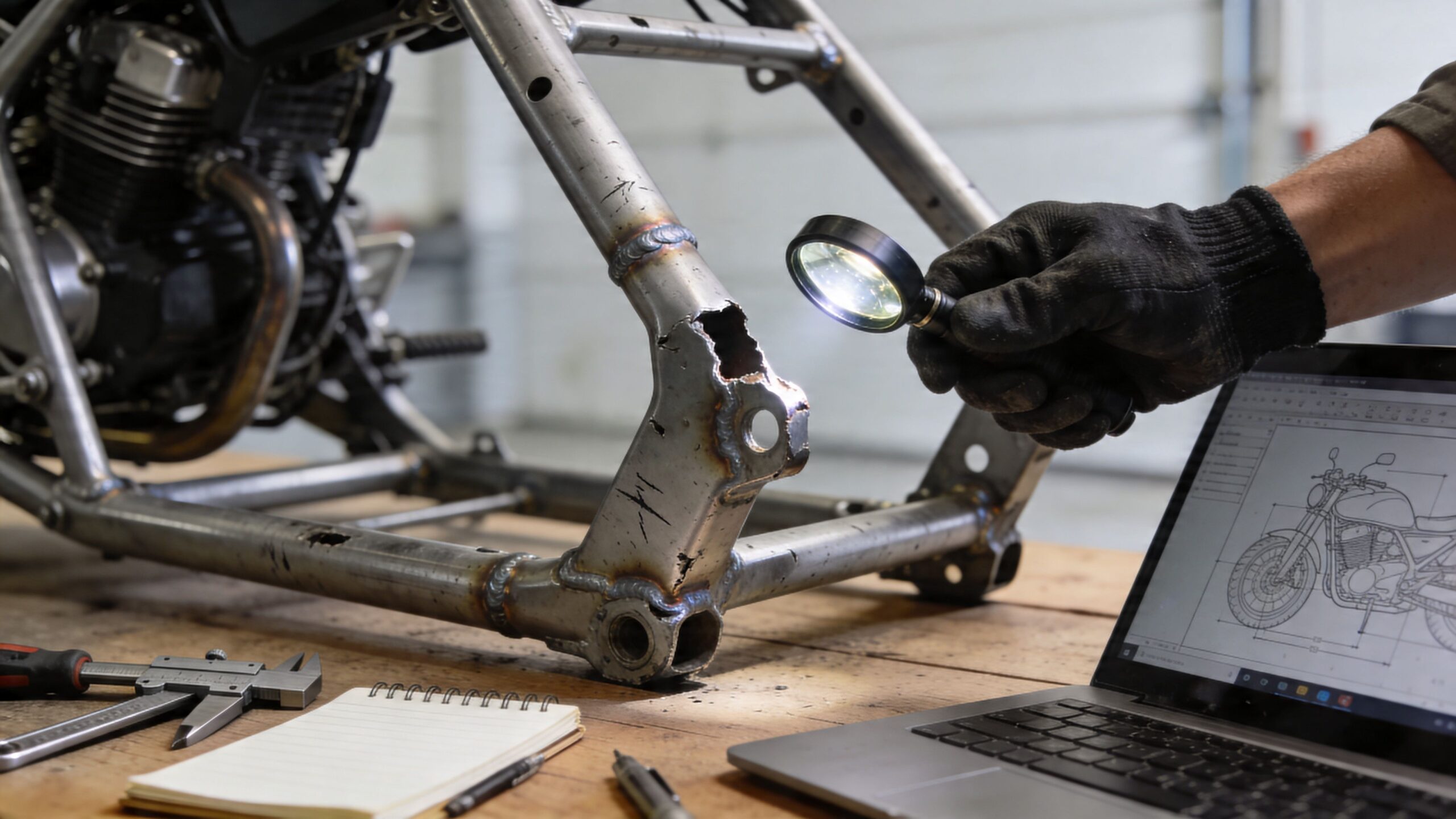
Start with the frame
The frame decides whether the bike is a project or a trap. Fairings, headlights, levers, tanks, and body panels are all replaceable. A bent or poorly repaired frame changes the entire equation.
Stand in front of the bike and sight down it. Check whether the bars, fork tubes, wheel, and tank centerline look aligned. Look for ripples in paint around welds, fresh coating in isolated areas, grind marks, or uneven finish where somebody may have repaired or hidden impact damage.
Pay close attention to:
- Steering head area: Cracks, buckling, or fresh paint here deserve immediate suspicion.
- Subframe mounts: Misalignment often shows up around bolt holes or tabs.
- Swingarm pivot area: Distortion here can ruin handling.
- Footpeg brackets and engine mounts: These often tell the truth about impact direction.
A salvage motorcycle can wear replacement plastics and still have geometry that never comes back.
Forks, triples, wheels, and tracking
Front-end damage is common and expensive. Even if the bike rolls straight across a parking lot, that doesn’t prove the front end is healthy.
Check the fork tubes for pitting, leaks, and signs of a twist in the triples. Look at axle pinch bolts and caliper mounts for tool marks from rushed assembly. Spin the front wheel and watch for wobble. Then inspect the rear wheel the same way.
If you can test ride, pay attention to whether the bars sit centered when the bike tracks straight. If it wants to drift, if the bars are cocked, or if it resists turning one direction more than the other, start looking harder for frame or suspension problems.
Engine health is more than “it starts”
A cold start tells you more than a warm seller-prepped bike. If the engine is already hot when you arrive, ask why.
Listen for top-end clatter, bottom-end knock, timing chain noise, and uneven idle. Watch the exhaust on startup and throttle blips. Check for leaks around covers, cases, and seals. Remove the oil fill cap if practical and inspect for contamination or neglect.
If the bike is serious enough to consider buying, run a compression test or have your mechanic do it. That one step can save you from inheriting a damaged top end hidden behind a smooth sales pitch.
Here’s a useful walk-through on what experienced buyers watch during damage assessment and rebuild evaluation:
Electrical problems don’t stay small
Electrical faults are where salvage bikes drain patience and money. On flood-exposed or theft-recovery bikes, I look at the harness before I admire anything cosmetic.
Pull the seat. Open connectors you can access. Look for green corrosion, brittle insulation, taped splices, household connectors, mismatched wire colors, or aftermarket alarm remnants. Check every switch, every light, the horn, dash functions, ABS warning behavior, charging output, and fan cycling.
If the seller says, “It only needs a small electrical fix,” assume that diagnosis has not been finished.
Flood damage is especially nasty because a bike can run today and still have corrosion advancing inside connectors and modules. When I see evidence of water intrusion, I don’t price the bike as repaired. I price it as uncertain.
Brake and suspension honesty test
Bad salvage repairs often reveal themselves in the safety systems. Calipers should mount squarely. Rotors should not pulse or show obvious heat damage. Brake lines should route cleanly and match the bike’s hardware. A patched line, a bent bracket, or a crushed reservoir tells you somebody was trying to get the bike assembled, not restored properly.
Suspension should move smoothly through the stroke without binding or odd noises. Look for leaks at the shock, damaged linkage hardware, and witness marks from bottoming or side impact.
The checklist I’d use in the driveway
| System | Check | Pass/Fail | Notes (Look for…) |
|---|---|---|---|
| Frame | Sight alignment and inspect weld zones | Cracks, ripples, fresh paint, grind marks | |
| Steering head | Check for distortion and straightness | Buckling, uneven gaps, impact signs | |
| Front suspension | Inspect forks, triples, seals | Twisted tubes, leaks, clamp damage | |
| Wheels and tires | Spin both wheels and inspect rims | Wobble, flat spots, sidewall damage | |
| Brakes | Test lever feel and inspect hardware | Pulsation, leaks, bent brackets, warning lights | |
| Engine | Cold start, idle, listen, inspect for leaks | Smoke, knock, seepage, hard starting | |
| Drivetrain | Check chain, sprockets, clutch action | Tight spots, abnormal wear, rough engagement | |
| Electrical | Test all functions and visible wiring | Corrosion, splices, intermittent faults | |
| Cooling system | Inspect radiator, hoses, fan operation | Bent core, seepage, overheating signs | |
| Controls and body | Verify levers, pegs, bars, locks, plastics | Mismatched parts, poor fit, hidden impact clues | |
| Paperwork support | Match visible repairs to receipts | Missing documentation, unexplained replacements |
What works and what doesn’t
What works is buying damage you can understand. Cosmetic rash. Bolt-on parts. A clear theft recovery with complete paperwork. A bike repaired by someone who kept receipts and didn’t hide the work.
What doesn’t work is optimism. Fresh paint over questionable welds. Electrical mysteries. Missing ABS function. Frame stories that require trust instead of evidence.
A salvage bike can forgive ugly. It rarely forgives hidden structure or wiring problems.
Calculating the True Cost of a Bargain Bike
A salvage motorcycle becomes expensive when the buyer stops at the purchase price. The right way to evaluate one is the same way an appraiser or careful rebuilder would: figure out the value ceiling first, then see whether your total investment stays comfortably below it.

Use an all-in cost formula
Start with a simple formula:
Purchase price + repair parts + labor + inspection and title fees + insurance reality + resale discount = true project cost
Most buyers stop after the first three items. That’s how they overpay.
The long view matters. According to RideSafely’s breakdown of things to consider when buying a salvage motorcycle, the long-term total cost of ownership for a salvage motorcycle can exceed a clean-title bike by 25% over 5 years. The reasons cited include a permanent 20-40% drop in resale value, 10-30% higher insurance premiums, and an 18% increase in rebuild parts costs.
That changes the way you should evaluate every “deal.” Saving money at purchase doesn’t help if the bike keeps the savings back through insurance, parts, and a lower resale ceiling.
Diminished value is the number many buyers skip
Even a correctly repaired motorcycle with a rebuilt title does not become the same asset as a clean-title equivalent. Buyers, insurers, and future shoppers treat it differently.
That’s why I tell people to calculate the bike backward. Start with what a comparable clean-title motorcycle sells for in your market. Then apply a realistic discount for the branded history and current condition. That gives you a rough ceiling for what the finished bike is worth to the next buyer, not just to you.
Appraiser’s view: The best time to think about diminished value is before you buy, not when you try to sell.
If you want a better framework for that process, this guide on how to calculate fair market value is useful because it forces you to think in comparable sales and market value, not wishful math.
Build your budget from quotes, not guesses
Get actual parts pricing before you commit. Price OEM parts where safety or fit matters. Price used parts carefully if you’re trying to control cost. Ask local shops for labor estimates if you won’t do the work yourself.
Then add a buffer for what the first inspection missed. Salvage projects almost always reveal something after disassembly. Maybe it’s a bracket. Maybe it’s a sensor. Maybe it’s a wiring problem hidden under the airbox. The point is not to invent a number. The point is to stop pretending the visible damage is the whole job.
A practical budgeting method looks like this:
- Start with a clean-title comparison: Find what the same year and model bring in normal condition locally.
- Subtract for branded title reality: The bike’s history lowers what the market will pay later.
- List every known repair item: Plastics, lights, controls, fork work, tires, battery, fluids, hardware.
- Include the paperwork side: Title conversion, inspection requirements, and any state compliance costs.
- Realistically price your time: If your weekends matter, labor isn’t free just because you’re the one doing it.
When the math still works
A salvage deal can still make sense. The best candidates usually have understandable damage, available parts, and an owner who plans to keep the bike rather than flip it. If you’re buying a rare model you specifically want to ride and maintain long term, the lower resale ceiling matters less than it would for a short-term owner.
Where buyers get hurt is when they pay too much up front because they mentally compare the bike to a clean-title bike. You can’t do that. You’re buying into a lower value category with more friction built in.
If the finished bike leaves you with thin margin, difficult insurance, and no room for surprises, it wasn’t a bargain. It was just cheap at the beginning.
Navigating Insurance Registration and Price Negotiation
Many salvage deals often cease to be enjoyable. A motorcycle can look sorted in your garage and still create problems at the DMV counter or with an insurance underwriter.

Insurance is the hurdle buyers underestimate
A lot of guides mention insurance almost as an afterthought. That’s backwards. Insurance should be part of your pre-purchase screening, not a surprise after money changes hands.
As noted in this discussion of rebuilt-title motorcycle insurance and appraisal clause strategy, many standard carriers refuse to offer broad or collision coverage on rebuilt title motorcycles, and liability-only premiums can be 10-30% higher. That matters because it changes both your monthly cost and your risk exposure if the bike is stolen, damaged again, or disputed in a claim.
Before you buy, call insurers with the VIN and ask specific questions:
- Will you insure a rebuilt-title motorcycle at all
- Is coverage liability-only or can you get broader protection
- What documentation do you need before binding
- How do you value the bike in a total loss situation
- Does the company recognize appraisal or dispute processes if value is contested
For a broad overview of the policy choices and coverage terms that affect motorcycle owners, this complete guide to motorcycle insurance is a useful reference. It helps buyers understand what they’re shopping for before they start comparing carriers.
If you can’t get acceptable insurance on acceptable terms, the deal is wrong no matter how nice the bike looks.
Registration and rebuilt title paperwork
Every state handles branded titles a little differently, but the pattern is familiar. You need the salvage certificate or title, proof of ownership, repair documentation, receipts, and any required inspection paperwork before the bike can move into rebuilt status.
The buyer who struggles here is usually the one who bought the motorcycle without the seller’s full paper trail. If the receipts are incomplete, the VIN documentation is weak, or the state sees signs of noncompliance, you can spend a lot of time trying to fix a problem that started before you ever owned the bike.
The smart move is to call your DMV or licensing office before purchase and ask for the exact rebuilt-title checklist for your state. Then compare that list to what the seller can provide.
Negotiate from evidence, not enthusiasm
The strongest negotiating tool on a salvage bike isn’t attitude. It’s documentation.
Bring the VIN history. Bring your inspection findings. Bring parts quotes. Bring the list of registration requirements and any missing documents. If the bike has unresolved insurance limitations, factor that into your offer too. A salvage seller doesn’t have a clean-title asset, and the price needs to reflect that.
A good negotiation position sounds like this: the frame checks out, but the bike needs front-end parts, brake work, and documentation cleanup, and the rebuilt title path still has uncertainty. That’s objective. It’s hard to argue with objective.
Use these pressure points:
- Missing records: No receipts or incomplete rebuild documents lower confidence and price.
- Inspection findings: Electrical faults, ABS issues, or alignment concerns are costly bargaining points.
- Coverage limitations: If insurers restrict the bike, market demand shrinks.
- Resale friction: Future buyers will ask the same hard questions you’re asking now.
Why an appraisal matters before and after the purchase
Independent appraisal work isn’t just for an insurance dispute after the fact. It can help before the purchase too, because it gives you a grounded view of market value, not the seller’s opinion of value.
That matters twice. First, it helps you avoid overpaying for a bike with a limited value ceiling. Second, if there’s a later disagreement with an insurer over what the motorcycle is worth, an independent report gives you something stronger than screenshots and guesswork. When value is contested, understanding the process of how to negotiate with an insurance adjuster can make the difference between accepting a low number and pushing back with support.
The mistake is waiting until a claim happens to think about valuation. Salvage ownership gets easier when the numbers are realistic from the start.
The Final Verdict Is It Worth the Risk
Buying a salvage title motorcycle can be smart. It can also be expensive in a way that doesn’t show up until months later. The right answer depends less on the bike and more on the buyer.
The best candidate for a salvage project is someone with mechanical judgment, patience, and transportation that doesn’t depend on this bike being ready next week. This buyer can read a title, inspect a machine critically, chase paperwork, source parts without panic, and live with the fact that the motorcycle will always carry branded history. For that person, a salvage bike can be a practical way to own a model that would otherwise be out of reach.
The wrong candidate is the buyer who needs a turnkey commuter, has no appetite for insurance friction, or is stretching every dollar just to get into ownership. That buyer doesn’t need a project. That buyer needs reliability, easy registration, straightforward coverage, and clean resale prospects later.
Here’s the simplest way to frame it:
- Proceed if: you want a project, can verify the bike’s history, can inspect it properly, and plan around insurance and lower resale.
- Walk away if: you need certainty, don’t have strong documentation, or feel pressure to make the math work.
You are not buying a discounted clean-title motorcycle. You are buying a repaired risk with a permanent story attached to it.
That doesn’t make it bad. It makes it specific. If you respect that reality, buying a salvage title motorcycle can work. If you ignore it, the bike will teach you the lesson later, and usually at the most expensive moment possible.
If you’re dealing with a total loss valuation, diminished value dispute, or you want an independent number before committing to a branded-title vehicle, Total Loss Northwest provides certified appraisals that help owners challenge low valuations with real market-based support. For riders in Oregon, Washington, and beyond, that kind of appraisal can bring clarity before you buy and an advantage if an insurance company later tries to set the number for you.