Your door closes, but the lock doesn’t respond. The key fob does nothing. Maybe the outer skin of the door was hit in a parking lot or crushed in a not-at-fault collision. Maybe the shop says the lock “just needs an actuator,” while the insurance estimate barely mentions it.
That’s where people get burned.
A vehicle door lock replacement isn’t just a small mechanical fix. On modern vehicles, it affects security, electronics, repair quality, and post-accident value. If the lock damage came from a crash or break-in, the paper trail matters almost as much as the repair itself. Buyers notice. Appraisers notice. Insurers notice too, even when they pretend it’s a minor line item.
I’ll give you the same advice I give clients. Diagnose the failure correctly. Don’t guess on repair strategy. Don’t treat DIY risk lightly. And if insurance is involved, document everything like you expect a dispute, because you probably should.
Assessing the Damage and Diagnosing the Lock Failure
Start with the obvious question. Why did the lock fail? In real-world claims, I see three causes over and over: mechanical wear, electrical failure, and collision damage. If you don’t separate those causes early, you can waste money on the wrong part and create a messy record for insurance.

Start with the key fob test
The cleanest first test is simple. Try the key fob. Then try the physical key.
If the key fob fails to release the door but the physical key works, that points to actuator failure, not a basic lock cylinder problem, based on the actuator testing guidance shown in this door lock diagnostic walkthrough. That matters because an actuator issue pushes you toward electrical diagnosis and likely replacement, not guessing with lubricants or random parts.
If both the fob and the key struggle, stop calling it “just the actuator.” You may be dealing with collision distortion, internal mechanical damage, rod misalignment, or a damaged latch assembly.
Practical rule: If one method works and the other doesn’t, isolate the system before you buy parts. Parts-swapping is not diagnosis.
Separate the three failure types
Use this framework.
Mechanical wear
The lock cylinder turns poorly, feels rough, or binds inconsistently. The handle may feel normal, but the lock doesn’t move cleanly. Mechanical issues often show up in older hardware or after contamination inside the door.Electrical failure
The remote command doesn’t trigger the lock, or the actuator sounds weak, delayed, or silent. Scan-tool testing is helpful in these situations. Technicians can use bidirectional controls to command the lock electronically and see whether the actuator responds.Collision damage
This one gets missed constantly. If the door took an impact, the lock may fail because the shell, latch position, mounting points, or control rods shifted. Replacing the actuator alone won’t fix bent geometry.
What to check before authorizing work
Don’t hand the car over with a vague complaint like “door lock broken.” Give the shop a symptom list.
- Remote behavior: Does the key fob fail on one door only, or all doors?
- Physical key operation: Does the key turn fully, partially, or not at all?
- Door alignment: Does the door close flush, or does it need extra force?
- Handle response: Does the inside or outside handle feel loose, stiff, or disconnected?
- Window and switch behavior: Any dead switch functions in the same door can suggest broader wiring or intrusion damage.
If the vehicle was recently in a collision, say that immediately. The repair context changes the diagnosis. A bent door edge or crushed inner structure can mimic a bad lock motor.
Don’t ignore hidden damage behind the panel
A lot of lock problems are invisible until the trim panel comes off. That’s one reason quick estimates are often wrong. A proper inspection may reveal damaged rods, broken clips, moisture intrusion, or a shifted latch mounting point.
If you want a plain-language overview of how shops isolate electrical faults before replacing components, this guide on expert auto diagnostic services is useful background. It’s not a substitute for a collision-aware inspection, but it shows why “scan it and verify it” beats guessing.
A lock that failed after impact should be treated as collision-related until a technician proves otherwise.
Protect yourself from the first insurance mistake
The first insurance mistake is labeling the issue too narrowly. If the estimate says “replace lock actuator” but the door sustained impact damage, that wording may understate the scope and suppress later value arguments. You need records that connect the failed lock to the accident event.
Right after the incident, preserve the timeline. Save photos, note exactly when the lock stopped functioning, and keep your first repair conversations. If you’re still in the early post-crash stage, follow a documented process like these steps to take after a car accident so the lock damage doesn’t get brushed aside as unrelated wear.
A correct diagnosis does two jobs. It gets the repair right. It also establishes whether the lock failure belongs in a diminished value or total loss dispute. That second part is where people either maintain their advantage or lose it.
Repair Rekey or Full Replacement A Decision Framework
Once you know what failed, you have three possible paths. Repair, rekey, or full replacement. Most owners choose too fast. They hear the cheapest option first and assume it’s the smartest one. It often isn’t.
The right decision comes from matching the failure type to the long-term consequence. Security hardware is not where you should chase false savings.

When a repair makes sense
A repair works when the problem is limited, verified, and not tied to crash distortion or internal actuator failure. That usually means a minor mechanical issue, a loose linkage, or a fixable attachment problem inside the door.
Repair has two real advantages. It can preserve original hardware, and it avoids replacing a larger assembly than necessary. For some vehicles, especially ones where originality matters, that’s worth protecting.
But repair only makes sense if the technician can explain exactly what failed and why the fix restores full function. “We adjusted it and it seems okay now” is not a strategy. That’s a comeback waiting to happen.
When rekeying is the smart move
Rekeying has a narrow lane. It’s useful when the lock body is still sound, but you need the internal tumblers changed to match a different key. That often comes up after key loss, ownership changes, or a security concern that doesn’t involve structural lock damage.
Rekeying is not the answer for a dead actuator, impact-damaged latch, or electronically integrated assembly. If the lock issue started after a wreck, rekeying usually doesn’t address the problem.
Use rekeying when the hardware is healthy and the goal is key control. Don’t use it to avoid replacing a compromised assembly.
When replacement is the only defensible choice
Some situations demand full replacement.
- Actuator failure: If testing confirmed the electronic actuator isn’t responding, replacement is usually the proper fix.
- Collision-related deformation: If the door or latch geometry shifted, damaged parts need to be replaced and aligned.
- Break-in damage: If someone attacked the lock, the assembly may be compromised even if it still partly works.
- Security mismatch: If the repair would leave non-matching or visibly altered hardware, value retention suffers.
Here’s the larger market context. The global automobile door locks market was valued at USD 7.5 billion in 2023 and is forecasted to reach USD 10.5 billion by 2032, reflecting the growing complexity of integrated lock systems, according to Future Market Insights on the automobile door locks market. That complexity is exactly why low-detail insurance estimates often miss what a proper replacement entails.
If a modern lock assembly is tied to electronics, sensors, or latch components, a “small lock repair” can be a fiction on paper.
A lot of adjusters still write lock damage like it’s a simple cylinder swap from decades ago. That’s outdated thinking. Modern lock hardware is part security device, part electronic subsystem.
A visual walk-through can help if you want to compare the service paths in plain terms:
Use value retention as the tie-breaker
If you’re stuck between “repair it if possible” and “replace it correctly,” use this test: Which option leaves the cleanest repair history and the fewest buyer objections later?
That question matters because post-accident buyers don’t inspect your invoice with charity. They look for signs of shortcuts, non-matching parts, and security-related repairs. If one route leaves the vehicle easier to question, that route can cost you later.
A repaired lock with vague documentation can be harder to defend than a documented replacement with proper parts and calibration. That’s especially true if you’re already dealing with accident stigma. If you want to understand how repaired components can affect your vehicle’s market standing after a crash, this overview of car value after a wreck gives useful claim context.
A blunt decision matrix
Use this standard:
| Choice | Best use case | Bad use case | My recommendation |
|---|---|---|---|
| Repair | Minor verified issue, no structural damage, no security compromise | Collision distortion, unknown fault, recurring failure | Approve only with a precise diagnosis |
| Rekey | Lost keys or controlled security update with healthy lock hardware | Electronic failure, impact damage, break-in damage | Fine for key control, not for crash damage |
| Replace | Confirmed actuator failure, compromised assembly, crash-related damage | Tiny fixable issue with proven intact hardware | Choose this when reliability and claim defense matter |
If this repair touches an accident file, lean toward the option you can prove, document, and defend. Cheap ambiguity is expensive later.
The Two Paths DIY Replacement vs Hiring a Professional
People often talk themselves into trouble when they watch one video, buy a trim tool kit, and assume vehicle door lock replacement is a clean Saturday job. Sometimes it is. A lot of times it isn’t.
DIY can work if you’re careful, mechanically competent, and working on a straightforward vehicle. But once the repair intersects with collision damage, insurance, electronics, or resale value, the margin for error shrinks fast.
Why DIY looks cheaper than it is
The first trap is the door panel. That’s where beginners do damage before they even touch the lock.
The panel is typically held by 6 to 10 push pins, and improper force can permanently break the mounting tabs, according to the iFixit actuator replacement guide. The same guide notes this is the most intimidating step and a common source of secondary damage. That means your “simple lock fix” can become an interior trim repair.
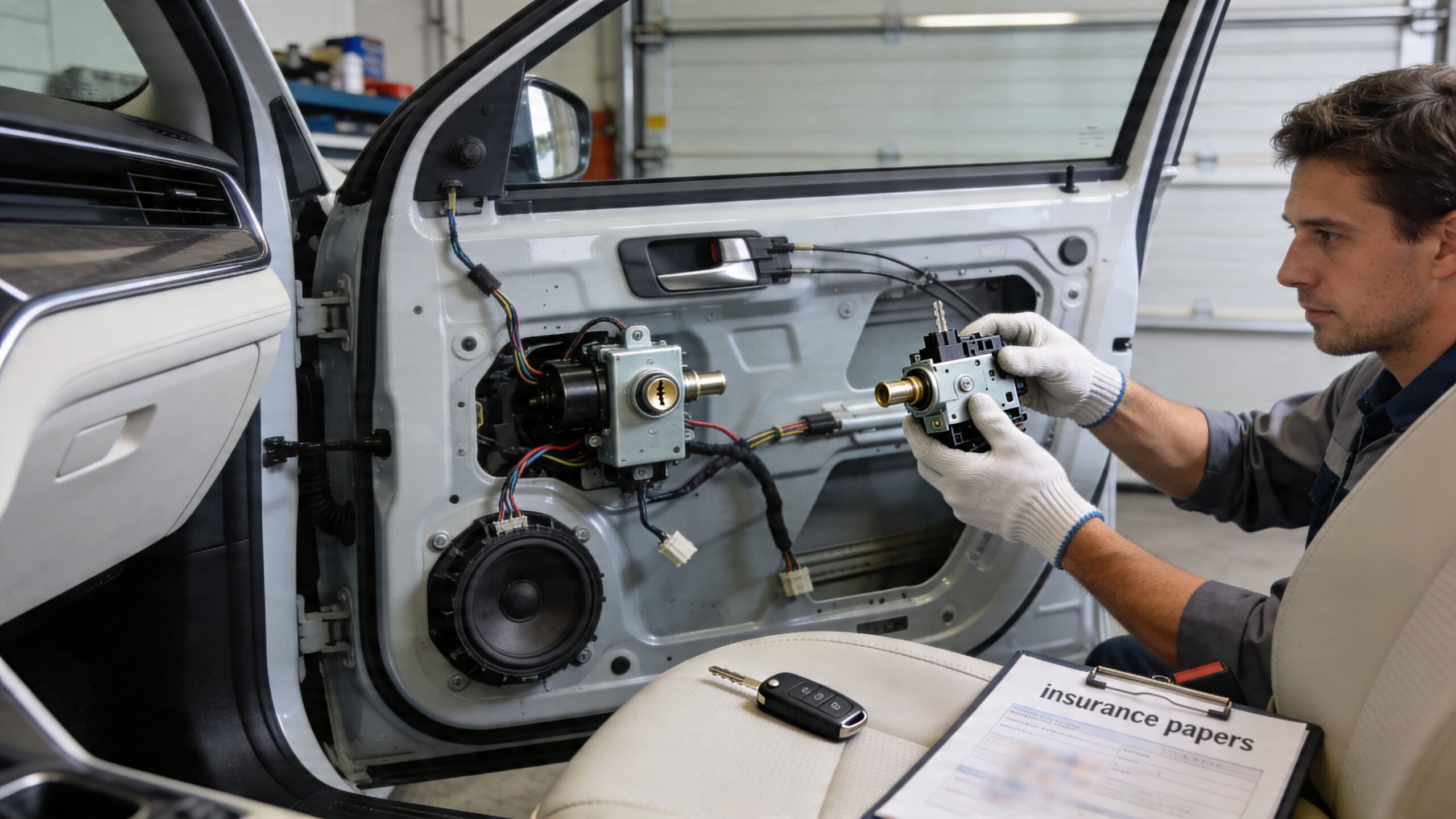
The second trap is access. Many actuators are riveted in place, not just bolted. Removing them can require careful drilling, controlled tool use, and patience. If you rush, you can damage the door shell, wiring, vapor barrier, or linkage clips.
The repair itself is rarely what hurts DIY owners most. It’s the extra damage they create getting to the part.
Where professional service earns its keep
A qualified locksmith or body shop doesn’t just install a part. They inspect the latch, linkage, mounting points, electrical response, and final operation before reassembly. That’s what you’re paying for.
A professional is also less likely to leave you with a half-fixed door. I’ve seen DIY jobs where the lock works but the window switch doesn’t, or the inside handle binds, or the panel never sits flush again. Those details matter if you later need to defend repair quality in a claim.
Side-by-side comparison
| Factor | DIY Replacement | Professional Service (Locksmith/Body Shop) |
|---|---|---|
| Initial cost | Lower out-of-pocket if nothing goes wrong | Higher upfront labor cost |
| Tool requirements | You need trim tools, screwdrivers, drill bits, and safe panel removal technique | Shop already has the tools and experience |
| Risk of panel damage | High if you force clips or tabs incorrectly | Lower because removal is routine |
| Electrical diagnosis | Limited unless you have scan capability and know how to use it | Better verification before parts are installed |
| Collision-related complications | Easy to miss bent structure or rod misalignment | More likely to catch related damage |
| Documentation quality | Weak unless you build your own paper trail carefully | Better if the invoice is itemized and detailed |
| Comeback risk | You own the mistakes | Shop may stand behind the work |
When DIY is reasonable
DIY is reasonable if all of these are true:
- You’ve confirmed the fault: You aren’t guessing between actuator, cylinder, and collision damage.
- The door wasn’t structurally hit: There’s no sign of bent sheet metal, latch shift, or misalignment.
- You can document the job: You’re willing to photograph disassembly, parts, and final function.
- You accept the risk: If clips break or reassembly goes sideways, you can solve it.
If any of those conditions fail, stop acting like labor is the only cost.
When I’d tell you to hire a pro
I’d push you toward a professional if the vehicle is newer, higher value, collector-grade, recently crashed, or tied to an insurance dispute. The reason is simple. The repair has to be technically correct and provable.
You also want a clean invoice and a shop statement that links the lock replacement to the collision event when appropriate. That paperwork can matter more than the labor charge you were trying to save.
The real decision
DIY saves money only when the repair stays small. Professional service costs more at the start, but it often lowers the risk of hidden damage, poor fitment, weak documentation, and claim problems.
For a purely personal beater with no insurance dispute, DIY might be fine. For an accident vehicle where value is already under pressure, I’d rather see a properly documented professional repair than a cheap job with no proof and questionable fit.
Documenting Door Lock Replacement for Insurance Claims
This is the part most owners underestimate. They repair the door lock, file the invoice, and assume the insurance company will treat it fairly. That’s not how this works.
If the lock was damaged in a collision, documentation is part of the claim, not an administrative afterthought. If you don’t build the file correctly, you make it easier for the insurer to call the repair minor, unrelated, or fully resolved without any effect on value.

Why the paperwork matters so much
Security-related repairs carry buyer stigma. People worry about hidden structural issues, poor fitment, and mismatched parts. That buyer reaction shows up in valuation.
According to the diminished value figures summarized in this discussion of post-accident lock-related value loss, vehicles with repaired security components like door locks can lose 10% to 25% of market value after an accident, and National Auto Auction Association data from 2025 showed mid-range sedans with such repairs received bids 15% lower on average. If you’re in Oregon or Washington, that’s exactly why weak documentation gives the insurer an advantage.
What you need to collect
Don’t settle for “door lock replaced” on a generic invoice. Build the record like you expect a challenge.
Photos that actually help
Take photos in three phases:
- Before repair: Capture the damaged door edge, latch area, outer panel, inner trim, and any visible deformation. Include shots showing the lock won’t respond if that can be demonstrated safely.
- During repair: Photograph the removed panel, damaged actuator or latch, broken clips, bent rods, or impact marks inside the door.
- After repair: Show proper panel fit, lock operation, door closure, and alignment.
The best photos don’t just show the part. They show context. You want to connect the failed lock to the accident damage.
The invoice must be itemized
Push for detail. The invoice should identify the components replaced, labor performed, and any programming, diagnosis, alignment, or reassembly tasks. If the door took a hit, the paperwork should reflect related correction work, not just the final part name.
If a shop gives you a vague receipt, ask them to revise it. “Customer states lock not working, replaced actuator” is weak. It doesn’t explain cause, scope, or supporting operations.
Claim file rule: If the invoice is vague, the insurer will interpret it in the cheapest way possible.
Parts language matters
Ask whether the repair used OEM, OEM-equivalent, recycled, or aftermarket components. That distinction matters for value and for later appraisal work. On collector, luxury, or newer vehicles, non-matching or questionable lock hardware can trigger credibility problems with buyers and appraisers.
You don’t need to exaggerate that point. You just need the truth in writing.
Build a file the insurer can’t shrug off
Use a simple folder structure, digital or paper:
- Accident evidence: Crash photos, claim number, body damage images
- Diagnostic evidence: Shop notes, scan results if provided, symptom timeline
- Repair evidence: Itemized invoice, parts listing, work order, photos
- Post-repair proof: Final operation videos, alignment photos, written confirmation if available
If you’re managing a lot of claim paperwork, a workflow overview like this article on automated claims processing can help you think about organizing records cleanly and consistently. The point isn’t automation for its own sake. It’s reducing missing documents and sloppy files.
Don’t let the insurer isolate the lock from the loss
Insurers like to slice repairs into tiny parts and argue each one had no meaningful value impact. That’s the wrong frame. A door lock replacement after a collision is part of the vehicle’s accident history, repair history, and market perception.
That means your demand should connect the dots:
- The accident damaged the door and lock system.
- The repair required more than cosmetic correction.
- The vehicle now carries a repair history involving a security-related component.
- Market perception and settlement value are affected.
If you’re putting the argument in writing, this guide to an insurance demand letter is useful for structuring the documentation and claim narrative.
The mistake that costs owners the most
The biggest mistake isn’t failing to fix the lock. It’s fixing it without creating evidence.
A proper claim file shows causation, scope, repair quality, and parts used. Without that, you’re asking the insurer to value your loss based on goodwill. That’s not how they operate. They operate off paperwork. So should you.
If you want an advantage in a diminished value dispute or total loss negotiation, the lock replacement must be documented as a meaningful repair event, not a forgettable line item.
Finalizing the Job Key Programming and System Checks
A lot of owners think the job ends when the new hardware clicks into place. On older vehicles, maybe. On modern vehicles, not usually.
Electronic lock systems now sit inside a larger network of modules, remotes, and security controls. That’s part of why this repair keeps getting underestimated. The global automotive door lock motors market was valued at US$ 3.4 billion in 2024 and is projected to reach US$ 5.2 billion by 2035, reflecting how integrated these components have become, according to Transparency Market Research on automotive door lock motors.
What must be checked before the door gets closed up
A proper finish includes system verification, not just physical installation.
Functional checks
At minimum, confirm these items before calling the repair done:
- Remote lock response: The key fob should lock and open the repaired door reliably.
- Physical key operation: The mechanical key should still operate smoothly if the vehicle uses one.
- Inside and outside handle function: Both should release correctly without binding.
- Window and switch function: The repaired door should not lose unrelated electrical function after reassembly.
- Door closure and latch feel: The door should shut cleanly and latch consistently.
If any of those fail, the repair is incomplete. Reattach the panel only after the door passes those checks.
Why programming may be required
On newer vehicles, replacing the actuator or lock-related assembly can require module recognition, key fob syncing, or other electronic setup. This isn’t dealer drama. It’s part of the system design.
A lock motor can be physically installed and still not communicate properly with the rest of the vehicle. That leaves you with a car that looks repaired but behaves unpredictably. From a security standpoint, that’s unacceptable. From an insurance standpoint, that programming labor belongs in the repair cost.
A mechanical fix without system confirmation is only half a repair.
What to ask the shop
Don’t ask, “Is it done?” Ask better questions.
- Was any programming or initialization required?
- Were all lock and handle functions tested before final reassembly?
- Did the repair affect the alarm, remote entry, or window controls?
- Is that testing shown on the final invoice or work order?
Those answers help you verify quality, and they help your documentation if the insurer later disputes the full scope of the repair.
Frequently Asked Questions About Vehicle Door Locks
If my key fob stopped working but the physical key still works, what’s the most likely issue
That points strongly to actuator failure, not a basic mechanical cylinder problem. Don’t start by replacing the key or forcing the lock. Get the actuator circuit and response tested, especially if the problem affects only one door.
Should I repair, rekey, or replace a lock after a collision
After a collision, replacement is often the cleanest option if the assembly, actuator, or latch area was compromised. Rekeying is for key-control issues, not crash damage. Repair only makes sense when the fault is narrow, verified, and unrelated to structural distortion.
Do I need to replace every door lock if only one failed
No. Replace what’s damaged or proven faulty. But you do need to make sure the repaired door still works correctly with the rest of the vehicle’s locking system. If key matching or system programming is involved, that needs to be handled correctly.
Is DIY vehicle door lock replacement worth it
Sometimes, but only when the diagnosis is solid and the vehicle isn’t wrapped up in collision damage or a claim dispute. If you break panel tabs, misroute rods, or leave the electronics half-functional, the “savings” disappear fast.
Why does a replaced door lock affect vehicle value
Because buyers treat security-component repairs as meaningful. They wonder whether the door was hit harder than disclosed, whether the replacement parts match properly, and whether the repair was done cleanly. In an accident case, that’s exactly why documentation matters.
What matters most for a diminished value or total loss dispute
Clear photos, a symptom timeline, a detailed invoice, and written identification of parts and related operations. If the file is thin, the insurer has room to minimize the repair. If the file is strong, you’ve got something an appraiser can work with.
If your insurer is downplaying collision-related lock damage, lowballing a total loss offer, or ignoring diminished value after repairs, get an independent appraisal from Total Loss Northwest. They handle diminished value and total loss appraisals for drivers in Oregon and Washington and can invoke the Appraisal Clause to challenge biased insurance valuations with real market-based evidence.