Your key goes in, but it won’t turn. Or the fob clicks and nothing happens on the driver’s door while the other doors respond. Sometimes it starts after a crash repair, when the door looks fine from the outside but the lock feels rough, loose, or inconsistent. That’s usually the moment people ask the wrong first question.
They ask, “How do I change locks on car door?” The better question is, “What failed, and what happens if I fix only the obvious part?”
A bad door lock isn’t just an annoyance. It can leave the car easier to steal, make a recent repair look incomplete, and create a valuation problem if the vehicle was in an accident. I see this missed often. Owners focus on getting the door to open again. Insurers focus on visible damage. The lock, latch, cylinder, actuator, and keying issue sits in the middle and gets treated like a small line item when it can affect both security and value.
You usually have two paths. One is a mechanical DIY repair, which can work well on the right vehicle with the right diagnosis. The other is bringing in a locksmith, dealer, or collision professional when the lock problem is tied to electronics, crash damage, or claim documentation. The smart move depends on what failed, not on what feels cheapest in the moment.
Why Your Car Door Lock Needs Attention
The most common real-world scenario isn’t dramatic. It’s a normal weekday problem that starts small. The key feels gritty. The driver door needs a second try. Then one day the lock won’t rotate, the handle feels wrong, or the door stays locked after body work.
If the car was recently hit on the side, this gets more serious fast. A lock can be physically damaged even when the sheet metal is only lightly repaired. The cylinder may bind. The linkage may be slightly out of position. The latch can still “work” while the security of the door is no longer what it should be.
What owners usually notice first
Common complaints include one of these:
- The key won’t turn smoothly: That points toward a worn or seized mechanical cylinder, contamination, or damage inside the lock assembly.
- The remote works on other doors, not this one: That often suggests a door-specific actuator, linkage, or wiring issue rather than a dead fob.
- The lock worked before an accident: That raises the odds of misalignment, internal door damage, or a repair that addressed cosmetics but not function.
- The new part “sort of” works: That usually means the wrong cylinder, poor rod adjustment, or a reassembly problem.
Practical rule: If the lock problem started after collision work, treat it as both a repair issue and a claim issue.
There’s also a security angle owners tend to underestimate. If the door can be opened inconsistently, if the cylinder spins oddly, or if the latch doesn’t fully engage, the vehicle is telling you the repair isn’t finished.
The two decisions that matter
You don’t need to decide everything at once. You need to decide two things correctly.
First, is this a mechanical cylinder problem or an electronic access problem? Those are different jobs, with different tools and different failure patterns.
Second, is the issue isolated to the lock, or is it part of a larger post-accident condition that should be documented before anyone starts swapping parts? That distinction matters if you later need to show that the car’s condition, security, or repair quality affected value.
A basic lock replacement can be straightforward. A lock issue wrapped into collision damage is not. Once insurance enters the picture, a cheap partial fix can cost more than a proper documented repair because it leaves you with a car that functions poorly and appraises worse.
Diagnosing the Lock Problem Accurately
Before you remove a single screw from the door panel, narrow the failure down. Too many people tear into the door and replace the cylinder when the problem is really the actuator, the fob, or a damaged linkage.

Start with the simplest question
Ask this first. Does the key physically turn in the affected door?
If the answer is no, or it turns only with force, the mechanical cylinder becomes the prime suspect. That usually means wear inside the wafer lock, contamination, corrosion, or impact-related distortion.
If the key turns normally but the lock fails to engage or disengage the door, the cylinder may be okay and the problem may be deeper in the linkage or latch.
Compare manual function with electronic function
The next check is basic but valuable.
- If the key works but the fob doesn’t: Look at the door actuator, electronic controls, or key programming.
- If the fob works on some doors but not one door: Focus on that door’s actuator, wiring, connector, or internal rod connection.
- If neither the key nor the fob works on that one door: You may have both a mechanical issue and a linkage or latch problem.
- If all doors fail electronically at once: That points away from the cylinder and toward the vehicle’s access system.
This comparison saves time because it separates the metal parts from the electronic ones.
Watch for post-accident clues
A lock problem after a collision often leaves a trail. The outside handle may feel different. The weatherstrip may sit slightly off. The interior panel may have been removed before. Fasteners may show tool marks. None of that proves a bad repair, but it tells you the door has already been opened up, adjusted, or rebuilt.
A lock that fails right after body work should be treated as a symptom, not an isolated inconvenience.
Also check whether the problem is limited to one operation. Some doors will disengage but not lock. Some will open from inside but not outside. Some will respond to the remote but not the key. Those patterns matter because they help identify whether the cylinder, the linkage, or the electronic actuator is the actual failure point.
A quick diagnosis framework
Use this as a practical decision tree:
| Symptom | Likely direction |
|---|---|
| Key won’t turn | Mechanical cylinder or physical damage |
| Key turns, no lock movement | Rod linkage, clip, or latch issue |
| Remote fails on one door only | Door actuator or door-specific wiring issue |
| Remote fails everywhere | Fob, programming, or broader electronic fault |
| Problem started after side impact or door repair | Misalignment, hidden damage, or incomplete repair |
If you land on a mechanical cylinder diagnosis, a DIY repair may be realistic. If the evidence points to electronic access, crash-related distortion, or mixed symptoms, stop before you create extra labor by replacing the wrong part.
A DIY Guide to Mechanical Lock Replacement
This section is only for a mechanical lock cylinder. If your vehicle’s problem is mainly electronic, skip the temptation to force a mechanical fix into an electronic problem.
The reason a cylinder job is manageable is that the process is predictable. According to this mechanical lock cylinder replacement guide, the normal sequence is to remove the interior door panel, disconnect rod linkages, extract the old cylinder by releasing a retaining clip, install an OEM-matched replacement, allow 2-3mm play in the rods, and test the lock 10-20 times before reassembly. That same guide notes 10-15 minutes just to remove the panel, 45-90 minutes total for the job, 40% of DIY failures from linkage misalignment, seized parts in 25% of vehicles over 5 years, 15% failure rates with some aftermarket cylinders, and DIY success around 65-75% for experienced users.

Phase one getting access cleanly
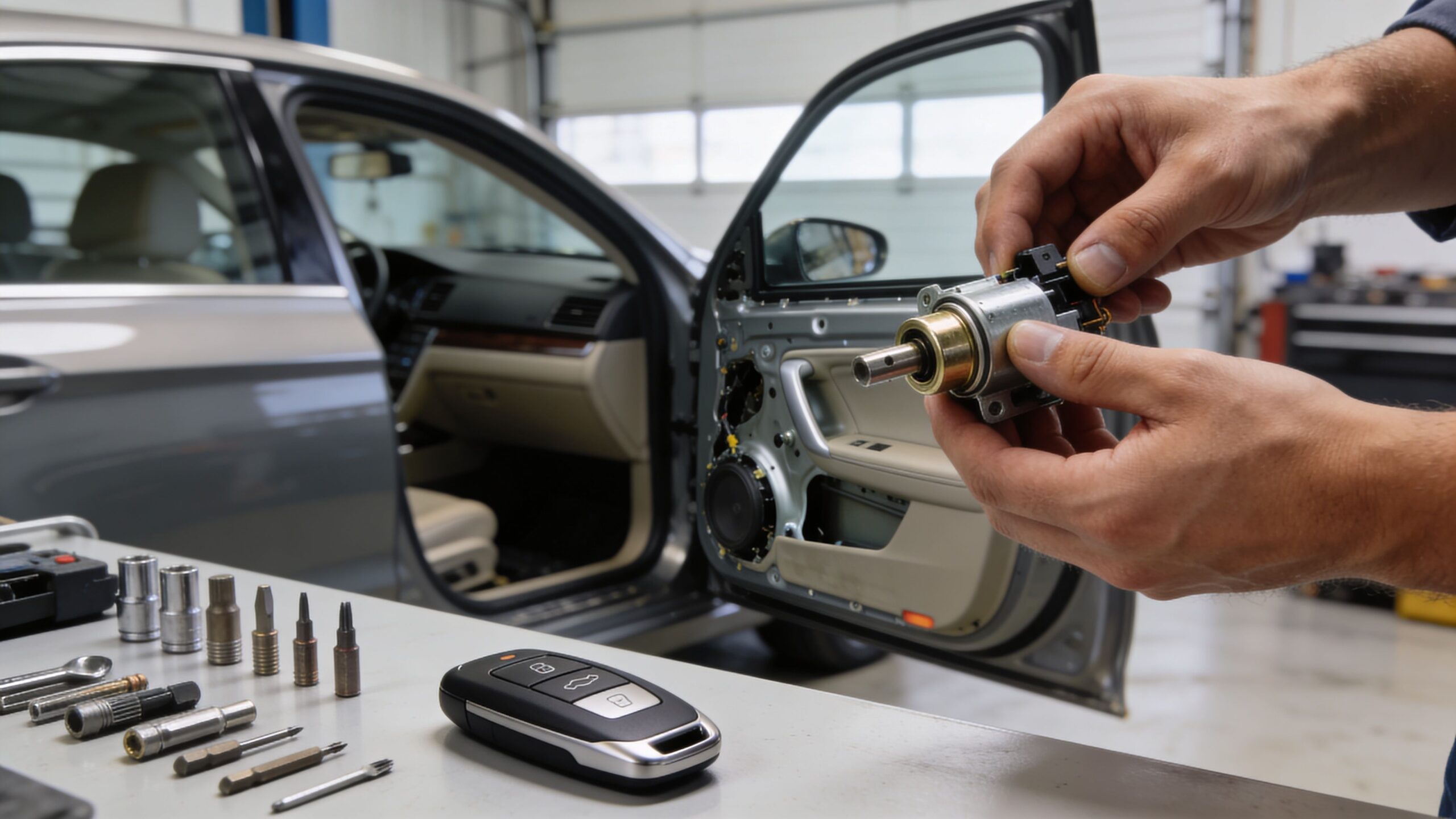
Your first task is getting the inner door panel off without creating new damage. Use trim tools, plus the correct Torx or Phillips driver for the fasteners your vehicle uses. Work slowly around clips and hidden screws.
If the car has power locks or switches in the panel, disconnect the electrical connectors as you go. Don’t yank the panel free and hope the wiring has enough slack. That’s how simple lock work turns into an electrical repair.
A good habit is to mark rod positions before disconnecting them. Painter’s tape works well. A quick phone photo works too. That one step prevents a lot of reassembly guessing.
Phase two disconnecting linkages without losing the setup
Inside the door, you’ll usually see rods connecting the exterior handle, interior handle, and lock mechanism. These rods matter as much as the cylinder itself.
If you disconnect them carelessly and reinstall them under tension, the new cylinder can feel wrong even when it’s the correct part. That’s why rod geometry matters. A lock that binds after replacement often isn’t a bad cylinder. It’s a bad linkage setup.
Reassembly is where most “new part still doesn’t work” complaints start.
If clips are brittle or questionable, inspect them closely before reusing them. You want the rods seated securely and moving freely.
Here’s a useful support reference for claim-related repair documentation while you’re assessing the bigger picture: vehicle value and claims resources.
Phase three removing the old cylinder
Most cylinders are held by a retaining clip or pin. Once the clip is released, the cylinder slides out. Sometimes it comes easily. Sometimes age and contamination fight you the whole way.
If the cylinder is seized, light penetrating lubricant can help. Don’t force it with random prying that bends the mounting area. A bent bracket or distorted sheet metal can make the new lock feel defective.
This walkthrough can help if you want a visual before you start taking the door apart:
Phase four installing the replacement correctly
Match the replacement cylinder to the vehicle properly. OEM-matched parts are the safer move because fit and keying errors create headaches quickly. Aftermarket parts can work, but when they don’t, you lose time inside the door twice.
When you reconnect the rods, keep that 2-3mm play in mind from the referenced guide. You want free movement, not preload. Then test the lock with the panel still off. Run the key through repeated lock and open cycles before sealing everything back up.
- Check smooth rotation: The key should turn cleanly without needing extra hand pressure.
- Verify full travel: The lock must reach full lock and full release, not just “almost.”
- Test both handles: Make sure outside and inside handle operation still behaves normally.
- Confirm electronics if equipped: If you unplugged connectors, make sure power lock function still matches the mechanical function.
What usually goes wrong
DIY jobs fail for familiar reasons, not mysterious ones.
- Wrong diagnosis: The cylinder gets replaced when the actuator or latch was the issue.
- Rod misalignment: This is a major failure point in the source data and it shows up as stiff, partial, or inconsistent operation.
- Bad part choice: A cylinder that isn’t properly matched can waste the whole job.
- Testing too late: If you put the panel back on before cycling the lock repeatedly, you may have to undo everything.
Mechanical lock replacement can be satisfying and cost-effective when the diagnosis is right. It goes badly when owners rush through the door setup and assume the cylinder is the whole system.
Handling Modern Electronic and Keyless Systems
Newer vehicles blur the line between “door lock” and “access system.” The visible key slot may be only one part of the chain. The actual failure can sit in the actuator, body control logic, wiring, or the fob itself.

Mechanical lock versus electronic access
A traditional cylinder job is mainly about fit, rods, clips, and smooth movement. An electronic lock complaint is different. You may have a perfectly healthy cylinder and still have a door that won’t respond because the actuator motor is weak, a connector is damaged, or the system lost synchronization.
That difference changes the repair approach.
| Mechanical cylinder issue | Electronic access issue |
|---|---|
| Diagnosed with key feel and physical movement | Diagnosed by comparing door responses and system behavior |
| Fixed with panel removal and cylinder replacement | Often requires scan tools, programming checks, and electrical testing |
| Usually localized to one physical component | Can involve the fob, actuator, module, or networked controls |
| More feasible for careful DIY work | More likely to need a specialist |
Signs you’re not dealing with a simple lock barrel
If the other doors respond but one door doesn’t, that points toward a component inside that door. If the spare key behaves the same way, that points away from a dead fob battery as the only cause. If the lock issue appeared after trim, dash, or side panel work, wiring damage becomes more plausible.
People get trapped by continuously replacing visible parts, believing the failure is a lock issue. In reality, the lock is only the last moving piece in a longer electronic path.
On a modern vehicle, the lock cylinder might be fine while the access system is failing upstream.
Why specialist work often makes more sense
Electronic lock complaints need a different kind of confidence. You need to know whether the command is being sent, whether the actuator is receiving it, and whether the module recognizes the key or fob correctly. Basic hand tools won’t answer those questions.
That’s also why car owners looking at broader connected access features should understand how access is evolving beyond simple locking and opening hardware. A good overview is Nimbio's solutions for in-car access, which helps frame how modern vehicles increasingly tie physical access to software and integrated systems.
If your lock problem involves a push-button start system, proximity entry, memory settings, or body control module behavior, this usually stops being a garage-floor job. A locksmith with automotive programming capability or a dealer-level diagnostic process is often the cleaner route.
Costs Insurance and Your Vehicle's Value
A door lock repair looks small on paper. In an insurance file, that’s exactly why it gets overlooked. But if the lock was damaged in a crash, or if the post-repair condition leaves the car less secure, it can affect more than convenience.
According to the verified claim data tied to this topic, a compromised door lock increases theft vulnerability by up to 30%, and in Washington and Oregon, post-accident theft rates rose 15% in 2025. The same source states that insurers often undervalue lock-related repairs in diminished value claims, and that invoking the Appraisal Clause is a key strategy in disputes over low valuations, as noted in this post-accident lock and appraisal discussion.
Why insurers miss this item
Adjusters tend to focus on visible body damage, paint, and major parts. If the door shuts and the estimate includes some repair time, the file may move on. But a damaged or poorly repaired lock changes the vehicle in two ways.
First, it changes security. That matters to owners right away.
Second, it changes condition. That matters in diminished value and total loss discussions because a vehicle with unresolved access or security issues isn’t equivalent to one repaired to proper pre-loss condition.
Cost comparison for the repair path
The prompt requires a comparison table. Since no verified cost figures are provided for the requested 2026 estimates table, the comparison below stays qualitative rather than inventing numbers.
| Repair Type | DIY Parts Cost | Professional (Locksmith) Cost | Professional (Dealer) Cost |
|---|---|---|---|
| Mechanical cylinder replacement | Usually lowest upfront, but varies by part quality and keying needs | Higher than DIY, includes labor and fitment experience | Often the highest path, especially if OEM parts and vehicle-specific procedures are involved |
| Actuator or electronic lock repair | Hard to predict without diagnosis | Often more efficient if the locksmith handles automotive electronics | Common choice when programming or module-level diagnosis is required |
| Post-accident lock correction | May look cheap at first but can miss hidden damage | Better for function testing and security restoration | Often best when repair records, OEM fit, and system integration matter |
For a broader look at claim categories that sometimes overlap with lock damage, this overview of comprehensive insurance coverage and what it means helps separate theft-related issues from collision-related ones.
What to document before accepting a settlement
If the lock issue is connected to an accident, document the condition before it disappears into a generic repair invoice.
- Record the symptoms clearly: Note whether the key binds, whether one door fails electronically, and whether the problem started after the collision.
- Keep repair invoices specific: The invoice should identify the lock, actuator, cylinder, latch, or door components repaired.
- Photograph the door condition: Exterior alignment, latch behavior, and visible hardware condition all help show this wasn’t a minor annoyance.
- Flag security concerns: If the vehicle can’t be secured properly, that should not be treated as cosmetic.
A lock problem after an accident isn’t a side note. It can support the argument that the car wasn’t restored fully, that the repair scope was incomplete, or that the insurer’s valuation missed a meaningful defect.
Making the Final Call Locksmith or DIY
The right answer usually becomes clear once the diagnosis is honest.
If you have an older vehicle, a confirmed mechanical cylinder failure, good access to trim tools, and patience with linkages, DIY can make sense. If the problem showed up after collision work, involves electronics, affects only one door intermittently, or creates a dispute about repair quality or value, the better move is usually professional help.
There’s a useful way to think about this from probability, not pride. The Monty Hall problem shows that switching from your initial choice raises the odds of winning from 1/3 to 2/3, with simulations showing about 67% wins for switching versus 33% for staying, as explained in this Monty Hall analysis. For car owners, the lesson is simple. Your first instinct might be to stick with the cheapest option, the first insurance number, or the do-it-yourself route. But once new information appears, such as hidden complexity, crash involvement, or security risk, switching strategies is often the smarter move.
That same mindset matters when you’re dealing with the claim itself. If the insurer is minimizing the repair or brushing off the value issue, learn how to deal with insurance adjusters after a vehicle claim.
The best repair choice isn’t the one that feels simplest at the start. It’s the one that still looks right after the door is reassembled, the car is secure, and the claim is settled.
A door lock can be a small mechanical job. It can also be evidence that a vehicle wasn’t fully restored after a loss. Treat it with the weight it deserves.
If your vehicle was damaged in an accident and the insurer is overlooking security issues, repair quality, diminished value, or a low total loss figure, Total Loss Northwest can help. They specialize in independent diminished value and total loss appraisals for Oregon and Washington owners, and they use the Appraisal Clause to challenge biased insurance valuations with real market-based evidence.