The call usually goes the same way. The adjuster is polite, the number sounds official, and the conclusion lands like a brick: your car is a total loss. Then they give you a settlement figure that doesn't come close to what it would cost to replace the vehicle you owned.
That's when many policyholders make the same mistake. They assume the insurer already did the hard math, that the number must be objective, and that fighting it will be slow, expensive, or pointless.
It isn't.
A total loss vehicle appraisal exists for exactly this situation. If the insurer's offer ignores condition, options, maintenance, local demand, or recent work, you can challenge it. More important, you may have a built-in tool inside your own policy to force a proper valuation process: the Appraisal Clause.
If you just got a low offer, treat it as an opening position, not the last word. What matters now is moving quickly, preserving your documentation, and shifting the discussion away from insurance software and onto real market evidence.
That Sinking Feeling The Total Loss Phone Call
You've been dealing with the accident, the rental, the body shop updates, and the basic hassle of not having your normal routine. Then the adjuster calls and says the vehicle is totaled.
At first, some drivers feel relief. No more waiting on repairs. No more wondering whether the car will ever drive the same. Then the settlement number arrives, and the relief disappears.
Maybe your truck had meticulous service records. Maybe your SUV had a rare trim package, new tires, or factory options that buyers in your area pay for. Maybe you spent money keeping the car clean, sorted, and mechanically strong. The insurer's number often acts like none of that mattered.
Most low offers have the same problem. They value a database version of your vehicle, not the one sitting in your driveway before the crash.
That's why this part of the claim feels personal. You're not arguing over abstract numbers. You're trying to replace a real vehicle in a real market, and the first offer often falls short of that reality.
The good news is that a total loss decision and a low valuation are two different issues. Your insurer may be right that the vehicle qualifies as a total loss. They may still be wrong about what it was worth one minute before impact.
That distinction matters. If you understand it, you stop arguing emotionally and start pushing on the right pressure point: value.
Decoding Actual Cash Value and Insurer Calculations
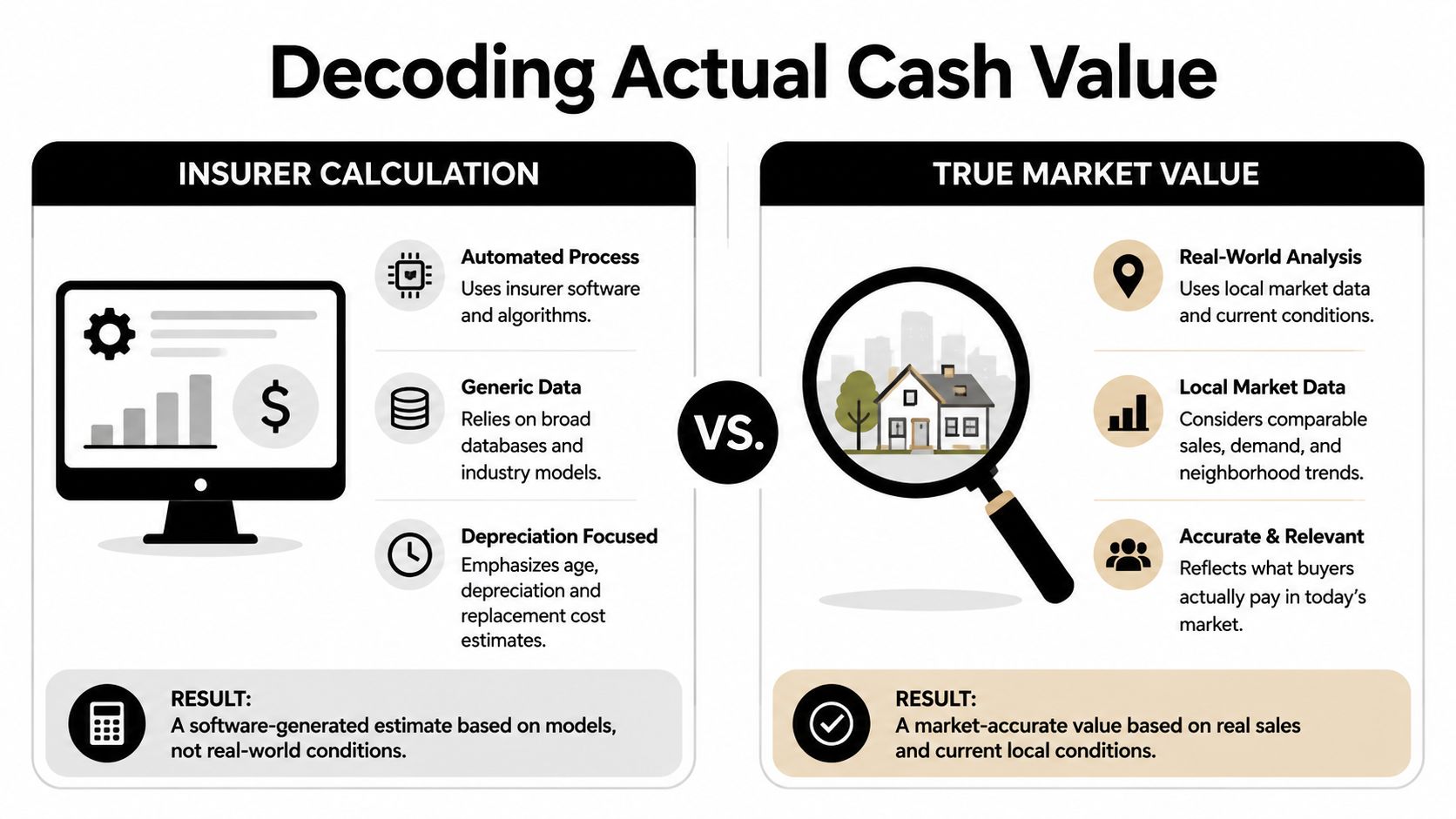
Actual Cash Value, or ACV, is the figure the insurer uses to decide what your vehicle was worth before the loss. In theory, that sounds straightforward. In practice, ACV disputes happen because the insurer's process often starts with broad software inputs and ends with a number that looks precise but misses the actual market.
Why insurer software misses the mark
Programs such as CCC ONE and Mitchell can organize data fast. That's useful for processing claims at scale. It's not the same as building a fair value for your specific car.
Take two vehicles with the same year, make, model, and mileage. One was garage-kept, dealer-serviced, and loaded with desirable options. The other was an average commuter with cosmetic wear, uneven maintenance, and no meaningful extras. A formula-heavy report can pull those vehicles too close together.
A professional appraiser looks where the software doesn't. Condition. service history. option packages. local demand. recent maintenance. visible care. These are exactly the kinds of factors that independent appraisers can document when generic formulas leave value on the table, as explained in this breakdown of how to calculate fair market value.
What changed in the market
The valuation problem gets worse when the market moves faster than templates do. A discussion of 2025 market trends and total loss appraisals notes that rising new and used vehicle prices have pushed up the actual cash values used in total loss determinations, while modern vehicles with ADAS features and sensor arrays have made repair estimates much more expensive. Even minor hits can trigger surprisingly high repair costs when cameras, calibration, and sensor hardware are involved.
That creates an odd result. Some vehicles are totaled quickly because repairs got expensive fast, yet the settlement offer still doesn't reflect what that vehicle would cost to replace in your market.
Insurer number versus market-based appraisal
| Issue | Insurer calculation | Independent appraisal |
|---|---|---|
| Core input | Software-driven valuation | Real market analysis |
| Vehicle details | Often limited to broad categories | Can include maintenance, options, paint, condition, and unique features |
| Market scope | Generalized comparable data | Local and vehicle-specific comparable research |
| Dispute strength | Internal estimate | Documented report built for negotiation or appraisal process |
If your offer feels low, don't focus on whether the adjuster sounded confident. Focus on whether the valuation reflects your actual vehicle.
Your Secret Weapon The Appraisal Clause
The strongest move in a lowball total loss case usually isn't arguing harder with the adjuster. It's invoking the Appraisal Clause in your policy.
That clause is a contractual mechanism for resolving disputes over value. In plain English, if you and the insurer disagree on what the vehicle was worth, each side can have an appraiser involved instead of leaving the outcome entirely inside the carrier's software and internal process.
Why you probably haven't heard much about it
A report on policyholder awareness found that only 4 out of 38 surveyed policyholders were informed by their carrier about the appraisal clause option, while 34 said their carriers didn't educate them about the process. The same report said appraisal awards averaged $3,889.27 higher for total loss claims, a 26% increase. You can review that finding in this Repairer Driven News coverage of the Texas Watch study.
That doesn't mean every appraisal will produce the same result. It does mean a lot of drivers never get told they have a formal way to dispute value.
What invoking the clause actually does
The Appraisal Clause changes the frame of the dispute.
Instead of trying to persuade the insurer to “be reasonable,” you're exercising a right written into the policy. That matters because claims conversations often stall when the adjuster keeps repeating the same report. Once the clause is invoked, the claim moves into a valuation process that is harder to brush aside.
A practical overview of the insurance appraisal clause process can help you see how the language works and what to expect from the steps that follow.
Practical rule: If the insurer says, “That's the market value,” ask whether your policy contains an appraisal clause and whether you may invoke it for a valuation dispute.
What does not work well
These approaches usually waste time:
- Sending random listings only: A few screenshots from online ads can support your position, but they rarely replace a full appraisal.
- Arguing only from emotion: “I loved that car” is understandable. It doesn't move a valuation file.
- Accepting the first revised offer too quickly: Some carriers will make a small increase and hope you stop there.
The Appraisal Clause isn't aggressive. It's procedural. That's exactly why it works.
How to Get a Total Loss Vehicle Appraisal Checklist
The carrier says your car is worth thousands less than what it would cost to replace. At that point, anger is normal. What helps is a file, a timeline, and a plan to force the value dispute into the appraisal process if the offer stays low.
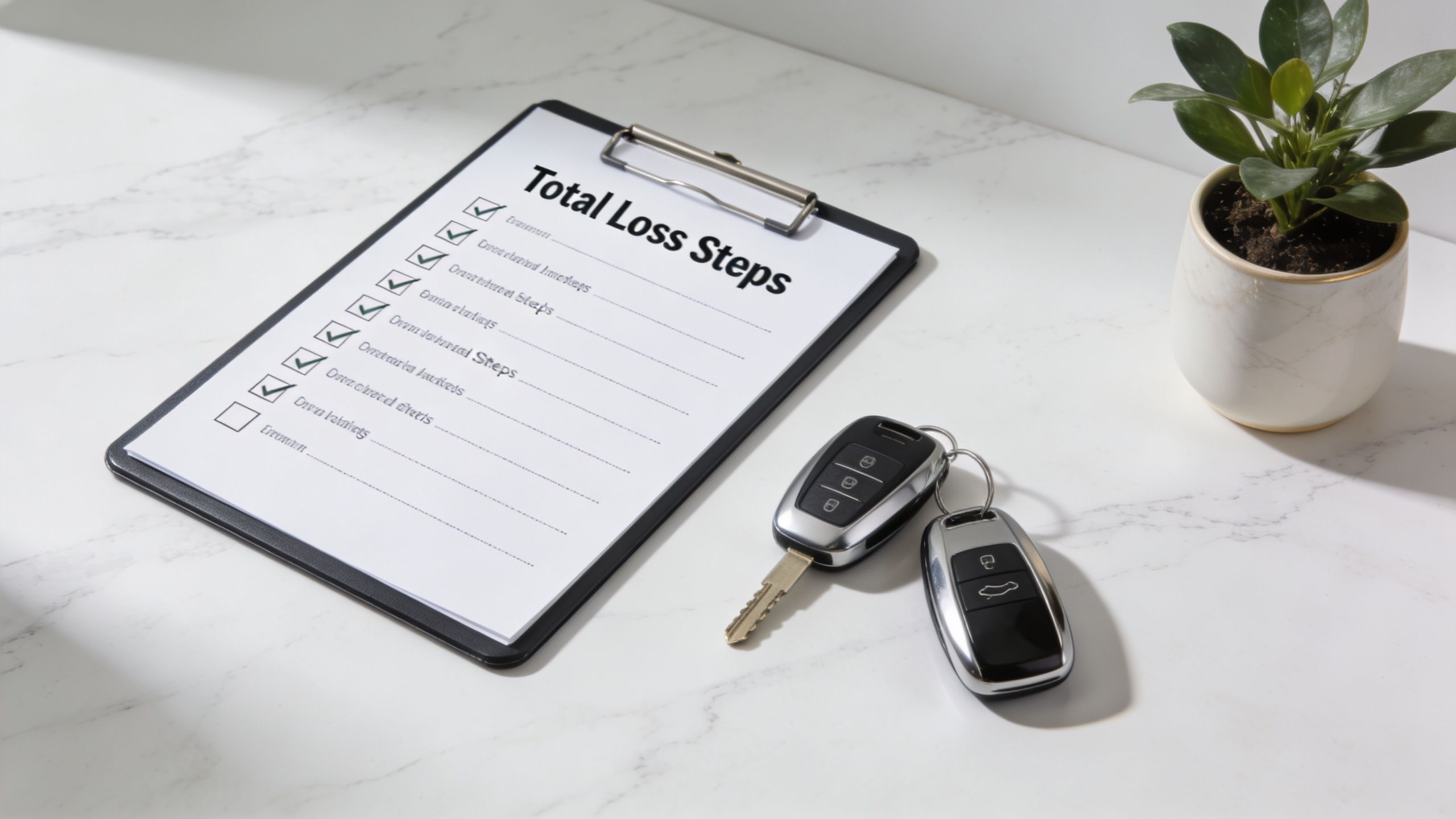
Step one gather the file before the insurer defines the story
Total loss cases turn on documentation. If the insurer's report is built from bad trim data, weak comparables, or missing option information, that low number can start to look official unless you answer it with records.
Pull everything into one folder, digital or paper:
- Claim documents: The valuation report, total loss notice, estimate, and every settlement offer
- Vehicle records: Maintenance history, repair invoices, tire receipts, battery records, and major recent service
- Ownership details: Title, registration, loan or lease payoff information, and purchase paperwork if you still have it
- Photos: Pre-loss photos of the exterior, interior, wheels, bed, cargo area, dash, and any notable features
- Factory equipment evidence: Window sticker, build sheet, dealer invoice, or screenshots showing trim and packages
Independent appraisers can use maintenance history, option packages, and condition evidence that carrier valuation systems often miss, as discussed in this explanation of calculating a total loss vehicle value.
Step two audit the insurer valuation line by line
Read the report like someone checking an estimate that will cost real money, because that is exactly what it is.
Look for wrong trim, missing options, mileage errors, poor condition adjustments, or comparables pulled from a market you would never shop in. I have seen a single trim mistake drag a claim down fast. A missing technology package or premium wheel package can do the same.
Use this review table:
| What to check | Why it matters |
|---|---|
| Trim and package accuracy | Wrong trim can reduce the value immediately |
| Mileage | Entry errors change the baseline |
| Comparable vehicles | Weak comps often have fewer options or worse condition |
| Condition adjustments | Clean, well-kept vehicles are often graded too low |
| Recent work | New tires, major service, and documented upkeep can support a higher value |
Mark every error. Save screenshots. If you end up invoking the appraisal clause, those details help your appraiser build a cleaner, harder-to-dismiss report.
Step three hire an appraiser who handles total loss disputes, not just vehicle values
A total loss appraisal is not the same as a casual market opinion. You want someone who understands insurer reports, policy language, comparable selection, and how a value dispute gets resolved when the carrier will not fix its own number.
Ask direct questions before you hire anyone:
- Have you handled total loss disputes with insurers before?
- Do you work on ordinary daily drivers, not just collector or exotic vehicles?
- What records do you need from me before you start?
- Will your report explain the comparable selection and adjustments clearly?
- Have you worked in appraisal clause cases in my state?
- Are you prepared to defend your value if the insurer pushes back?
One option in Oregon and Washington is Total Loss Northwest, which provides independent total loss and diminished value appraisals and can invoke the appraisal clause on a client's behalf.
Step four invoke the appraisal clause in writing if the number is still wrong
This is the pressure point.
If your policy includes an appraisal clause, use it. Stop treating the dispute like a request for the adjuster to reconsider and start treating it like a contractual right. That changes the file. It also tells the insurer you are prepared to move the claim out of the usual back-and-forth and into a formal valuation process.
Keep the notice short and professional:
- Identify the claim: Include claim number, vehicle, and date of loss
- State the dispute: Say you disagree with the carrier's valuation
- Invoke the clause: Refer to the appraisal provision in your policy
- Name your appraiser if ready: If not, say you will provide that information promptly
- Request confirmation: Ask for written confirmation of receipt and next steps
Put every important claim communication in writing. Phone calls get summarized by someone else. Emails create a record you can use.
Step five give your appraiser evidence the carrier did not use well
Good appraisers do not manufacture value. They document it.
That means your job is to supply proof of condition, equipment, upkeep, and local market support. The stronger the file, the harder it is for the insurer to hide behind a generic report.
Useful support often includes:
- Service history with dates and invoices
- Records of upgrades or factory options
- Photos showing condition before the loss
- Local comparable listings
- Evidence of stronger regional demand for your model
This matters even more for enthusiast vehicles, modified trucks, specialty trims, and older vehicles in unusually clean condition. Broad valuation software tends to flatten those differences.
Here's a useful walkthrough if you want to understand the process visually before moving forward:
Step six know what a usable appraisal report looks like
A report should do more than announce a higher number. It should show how the appraiser got there and why the insurer's figure falls short.
Look for these elements:
- Vehicle identification and equipment detail
- Condition analysis
- Comparable market vehicles
- Adjustments tied to real differences
- A clear valuation conclusion
- Language that works in negotiation or formal dispute resolution
If the report reads like marketing copy, it will not help much. If it reads like evidence, it can move the claim.
A strong appraisal report gives the insurer a valuation they must answer with facts, not boilerplate.
Step seven avoid mistakes that weaken your position
A lot of owners lose value before the dispute ever gets traction.
These are the common errors:
- Signing too early: Once you release the claim, reopening value issues gets much harder
- Throwing away records: Missing service and option documentation weakens the appraisal
- Waiting too long to object: Delay can make the carrier treat the file as effectively resolved
- Mixing repair complaints into a total loss dispute: Stay focused on pre-loss market value
Treat this checklist like a claims tool, not paperwork for paperwork's sake. If the offer is low and the policy gives you an appraisal clause, your goal is to document the vehicle, expose the bad assumptions, and use the clause before the insurer turns a weak number into a finished settlement.
Key Rules for Oregon and Washington Drivers
Where you live changes the total loss analysis. That's not a detail. It can shape whether the insurer totals the vehicle at all and how the claim is handled.
Oregon uses a threshold approach
A review of state total loss thresholds explains that Oregon uses an 80% threshold, or if costs plus salvage value exceed ACV, while Washington uses a Total Loss Formula where repair cost plus salvage value must exceed ACV. The same source notes that Texas requires repairs to reach 100% of ACV, while Florida uses 80%.
That means the same damaged car can be treated differently depending on the state.
In Oregon, a lower threshold means some vehicles will be declared total losses sooner than they would be in states with a higher trigger. For owners, that can be good or bad depending on the condition of the vehicle, the likely quality of repairs, and the fairness of the valuation.
Washington uses the formula differently
Washington drivers need to pay attention to the formula, not just a percentage shorthand.
If repair cost plus salvage value exceeds actual cash value, the vehicle meets the formula for a total loss. That method can produce different outcomes than a simple threshold state because salvage value becomes part of the equation.
| State | Rule type | Why it matters |
|---|---|---|
| Oregon | 80% threshold or costs plus salvage value exceed ACV | Vehicles may total earlier than in higher-threshold states |
| Washington | Total Loss Formula | Salvage value becomes a key part of the calculation |
| Texas | 100% threshold | Vehicles may remain repairable longer |
| Florida | 80% threshold | Similar threshold pressure to Oregon |
What this means for your valuation fight
The total loss rule tells you when the car may be declared totaled. It does not tell you whether the insurer's ACV number is fair.
That's the mistake many drivers make. They hear “the state says it's totaled” and assume the settlement amount must also be correct. Those are separate questions.
For Oregon and Washington drivers, that separation is where a total loss vehicle appraisal becomes most useful. Once the insurer has decided the car is a total loss, your job is to challenge bad valuation, not re-argue the label.
Negotiating a Higher Settlement and Claiming Diminished Value
Once the independent appraisal is complete, the conversation changes. You're no longer saying the offer feels wrong. You're presenting a documented value position.
Use the report as evidence, not decoration
Send the report to the insurer and ask for a written response. Be specific. Identify the valuation conclusion and ask the adjuster to explain whether the carrier will revise its offer or proceed under the appraisal process already invoked.
That forces a cleaner exchange. The insurer now has to deal with methodology, comparables, condition, and market evidence.

A short negotiation sequence often works best:
- First message: Submit the appraisal and request a revised settlement.
- Second message: If the response is weak, point to specific errors in the insurer's report.
- Third message: Ask for a deadline on the carrier's position and next procedural step.
Keep your tone flat and professional. Strong files beat dramatic emails.
Specialty vehicles need more support
Standard valuation software struggles with vehicles that have active enthusiast demand or region-specific pricing. A review of specialty vehicle total loss appraisal issues notes that Ford Mustang, Dodge Challenger, and Subaru WRX hover around 14% total loss rates, and that standard valuation systems like CCC ONE and Mitchell can miss niche demand and regional pricing variations that an independent appraiser can document.
That problem shows up constantly with:
- Performance trims
- Collector vehicles
- Modified trucks
- Older vehicles in unusually clean condition
- Models with local buyer demand
If your car falls into one of those categories, generic comps can wreck the settlement.
Don't confuse total loss with diminished value
If the vehicle is repaired instead of totaled, a different claim may come into play: diminished value. That is the loss in market value caused by accident history after repairs are finished. It is separate from a total loss valuation issue.
If you're dealing with a repairable vehicle, this overview of automobile diminished value is a useful starting point for understanding how the claim differs from a total loss dispute.
For claims that also involve bodily injury, medical treatment, or broader accident damages, it can help to estimate the non-vehicle side separately. A tool like this AI personal injury settlement calculator can help organize that part of the claim while you handle the vehicle valuation on its own track.
The cleanest claims strategy is to separate each bucket of loss. Total loss value is one issue. Diminished value is another. Injury damages are another.
That keeps the insurer from blending everything together and obscuring your advantage.
Common Questions About Vehicle Appraisals
Is it worth paying for an appraisal if my car isn't high-end
Often, yes. The issue isn't whether the car was expensive when new. The issue is whether the insurer undervalued it. Daily drivers with excellent maintenance, rare options, unusually clean condition, or strong local demand can still be underpaid.
What happens if my appraiser and the insurer's appraiser can't agree
That depends on the policy language and appraisal process being used. In many appraisal clause disputes, there is a further step to resolve disagreement. The key point is this: once you enter the process properly, the value dispute no longer sits only inside the insurer's original report.
Can I get an appraisal after I already accepted the offer
Usually, your bargaining power drops sharply after you sign a release or formally accept payment as full settlement. If you haven't signed anything, act now. If you have signed, have someone review the paperwork before assuming the issue is closed.
Do I need maintenance records if the car looked clean
Yes. Clean appearance helps, but records prove care. Oil service, tires, brakes, scheduled maintenance, and recent repairs all help support pre-loss condition.
Should I send online listings to the insurer myself
You can, but don't rely on that alone. Listings are supporting material. A real total loss vehicle appraisal ties those market examples to your exact vehicle and explains the adjustments.
What if the insurer keeps saying their software is standard
Standard does not mean accurate for your vehicle. It means they use it often. If the result ignores real market facts, you challenge the valuation through documentation and, where available, the appraisal clause.
If you've been hit with a low total loss offer in Oregon or Washington, Total Loss Northwest provides independent appraisals for total loss and diminished value claims and can help invoke the Appraisal Clause when valuation is disputed. If the insurer's number doesn't reflect your vehicle's real pre-loss market value, getting a professional review is the fastest way to find out whether you should push back.