You open the claim, send photos, maybe upload the repair estimate, and then the insurance company sends back a number that doesn't even come close to what your vehicle was worth. That's where most drivers get stuck. They assume the adjuster's number is the number.
It isn't.
An accident settlement letter is how you stop reacting and start framing the claim yourself. For injury claims, that means documenting treatment, lost income, and pain and suffering. For vehicle owners, it also means something many legal blogs barely touch: forcing a real conversation about total loss value and diminished value instead of letting CCC One, Mitchell, or another insurer-selected system define your loss.
If you're dealing with a low total loss offer, a repaired car that now carries an accident history, or a custom or collector vehicle that the carrier treated like a basic commuter, the letter matters more than is widely recognized. It's the document that puts your evidence, your valuation, and your demand in one place, on your timeline.
What Is an Accident Settlement Letter and Why It Matters
Your car is declared a total loss on Monday. By Friday, the adjuster has sent a valuation report that skips options, uses weak comparables, and prices your vehicle like the base trim. If you answer with a short email saying the offer feels low, you stay on the insurer's ground. An accident settlement letter changes that. It puts your facts, your documentation, and your number into the claim file in a form the carrier has to address.
For injury claims, the letter usually covers treatment, medical bills, wage loss, and how the crash affected daily life. If you want a useful primer on the broader opening moves in personal injury claims, Bell Law gives a solid overview of how demand letters function in injury cases.

Vehicle owners need to treat the letter differently. The real fight is often not liability. It is value.
On the property damage side, insurers like standardized systems because standardized systems close files fast. That does not mean the number is accurate. Total loss reports can miss trim level, factory packages, mileage adjustments, prior condition, recent mechanical work, regional pricing, and local dealer reality. Diminished value claims get brushed aside with the same stock answer: the car was repaired, so the loss is over. Anyone who has watched a clean-history vehicle compete against one with an accident record knows that is not how the market works.
A strong settlement letter puts the adjuster on notice that valuation is disputed and supported. It also sets up your next move if the carrier refuses to correct the number. For first-party total loss disputes, that next move may be the Appraisal Clause in your policy. Many drivers never hear about it until late in the claim, and many legal articles barely mention it. They should. In the right case, appraisal is one of the few practical ways to break a bad insurer valuation without filing suit.
Two vehicle claim types usually call for different proof and a different ask:
| Claim type | What you're asking for | Common insurer move | What your letter should do |
|---|---|---|---|
| Total loss claim | Fair actual cash value for the vehicle before the crash | Treat the insurer's valuation report as settled | Attack the comparables, condition rating, options, and valuation method |
| Diminished value claim | Payment for the vehicle's lost resale value after repair | Argue that proper repairs ended the loss | Show market resistance to accident-history vehicles with support for the reduced value |
The letter also changes how the file is handled internally. Adjusters see the difference between a complaint and a documented dispute. A complaint says, “I want more.” A documented dispute shows why the report is wrong, what evidence fixes it, and what process comes next if the carrier stalls.
That early paper trail often decides the outcome. Claims managers, supervisors, appraisal reviewers, and defense counsel all read what gets put in the file. If your position is clear from the start, you have a better shot at getting paid on actual vehicle value instead of spending weeks arguing over a computer-generated number.
Assembling the Core Components of Your Demand Letter
A demand letter works best when it reads like a file review, not a complaint. Adjusters are trained to discount broad statements and focus on what they can document, defend, and enter into the claim notes. If you want movement on a low total loss offer or a brushed-off diminished value claim, build the letter around proof that forces a valuation response.
Start with the claim identifiers and make them impossible to miss. Put your full contact information, claim number, policy number if it is a first-party claim, date of loss, location of the crash, the vehicles involved, and a short liability summary near the top. For vehicle claims, include the year, make, model, trim, VIN, mileage, factory packages, and any upgrades that affect market value. Those details are not filler. They give the adjuster fewer excuses to use the wrong vehicle profile or ignore equipment that should raise the number.
If injury damages are part of the claim, separate them clearly from the vehicle dispute. List providers, treatment dates, diagnosis summaries, bills paid, and out-of-pocket losses in their own section. If you are sorting medical bills under first-party coverage, review Personal Injury Protection details before assigning charges to PIP or the liability portion of the claim.
Organization matters more than people expect.
A good package has an index, labeled exhibits, page numbers, and a short explanation of what each attachment proves. That sounds basic, but it changes the adjuster's job. Instead of hunting through loose PDFs, the carrier has a clean record that can be shown to a supervisor, a valuation vendor, or an appraisal reviewer.
Attach the documents that support your position, not every paper you happen to have:
- Police report or incident report: If one exists, include it.
- Photos: Scene photos, all damage angles, interior damage, wheel and suspension impact, warning lights, airbag deployment, and specialty equipment.
- Repair estimate or insurer valuation report: Include the report you are disputing.
- Vehicle value support: Comparable listings, dealer quotes, maintenance records, service receipts, prior appraisals, and upgrade documentation.
- Medical records and bills: Only if bodily injury is part of the claim.
- Income loss proof: Employer verification, pay stubs, invoices, or tax records where relevant.
- Witness statements: Use them if they support fault or the severity of impact.
For property damage, the vehicle file should stand on its own. Weak letters usually lose money at this stage. The driver argues that the offer feels low, but never shows exactly why the carrier's number is wrong.
For a total loss claim, include evidence that supports pre-loss market value. That usually means trim-correct comparable vehicles, proof of condition, service history, tire age, recent mechanical work, photos taken before the crash if available, and documentation of features the insurer missed. If you need a framework for building that valuation support, use this guide on how to calculate fair market value after a total loss.
For a diminished value claim, the packet needs a different kind of proof. Include the repair invoice, paint and parts details, severity of damage, whether structural panels were affected, and any market evidence showing that buyers discount an accident-history vehicle even after proper repairs. High-line vehicles, newer vehicles, and very clean vehicles usually need more careful support because adjusters often treat them like ordinary used cars.
One practical point gets missed in a lot of legal blogs. If the claim may end up in appraisal, assemble your exhibits now as if a neutral umpire will read them later. That means clean comparable data, a written explanation of disputed condition ratings, and a precise statement of the amount in dispute. A sloppy demand package does not become stronger when appraisal starts.
Leave out anything that weakens your credibility:
- Emotion-heavy arguments with no support
- Unsorted attachments
- A demand amount with no calculation behind it
- Vehicle claims with no market evidence
- Long narratives that never identify the valuation errors
The strongest demand letters make the adjuster deal with specifics. They show the wrong trim, the bad comparable, the missed option, the unsupported condition downgrade, or the resale penalty after repairs. That is the kind of letter that gets a supervisor's attention and gives you a better position if the carrier still refuses to pay fair vehicle value.
Calculating Your Vehicle's True Value After an Accident
Insurers often talk about value as if their report is neutral. It isn't always. The software may produce a number, but the quality of that number depends on the inputs, the comps selected, and whether anyone corrected obvious mistakes.
If you want a fair settlement, you need your own valuation logic.
Total loss value isn't just a database printout
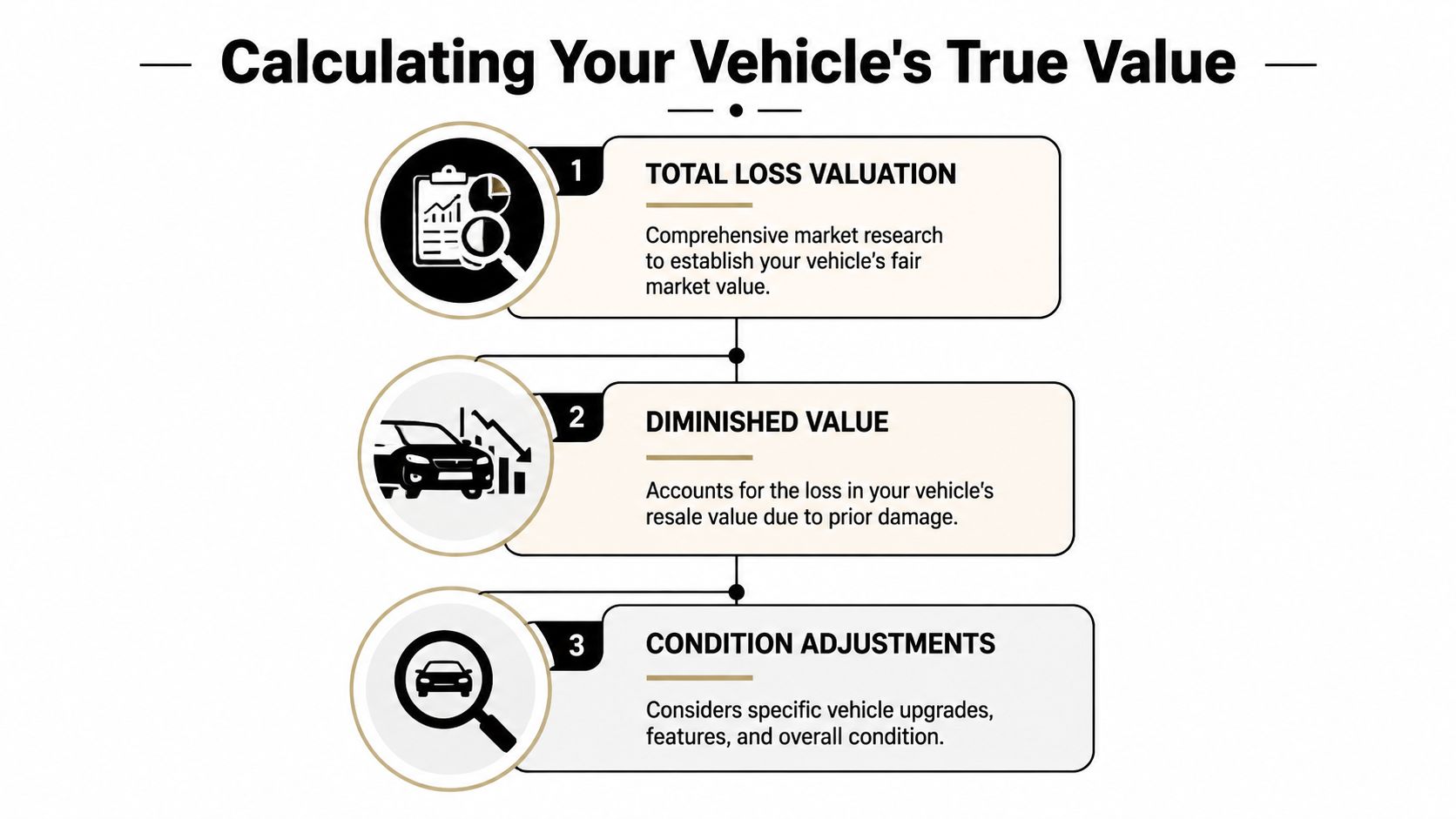
A fair total loss number starts with actual market value before the crash. That means asking what someone in your market would have had to pay for a comparable vehicle in similar condition, with similar mileage and equipment.
Adjusters often rely on valuation systems that may miss details such as:
- Trim and package differences
- Recent maintenance
- Aftermarket upgrades with real market impact
- Unusually strong cosmetic or mechanical condition
- Regional pricing differences
- Bad comparable selections
If the insurer used weak comps, challenge them line by line. If they used vehicles with higher mileage, lower trim, prior damage, or different equipment, say so plainly. If you need a practical framework for that process, this guide on how to calculate fair market value is useful for checking whether the carrier's report matches real market conditions.
A simple comparison format works well:
| Valuation issue | Insurer position | Better approach |
|---|---|---|
| Comparable vehicles | Broad or mismatched listings | Local and trim-correct comps |
| Condition | Generic average condition | Photo-backed condition assessment |
| Options and upgrades | Ignored or underweighted | Documented receipts and feature list |
| Mileage | Formulaic adjustment | Market-sensitive mileage analysis |
Diminished value is real even after good repairs
A repaired vehicle can still be worth less because buyers see accident history and either walk away or demand a discount. That's the heart of a diminished value claim.
According to a 2025 IIHS study of 50,000 claims, U.S. post-accident resale values dropped 25% to 40% for repaired vehicles, as noted by IIHS vehicle safety information. For owners in markets with newer, tech-heavy vehicles, that resale penalty can hit hard.
One reason it matters is buyer behavior. If you've ever looked at a used vehicle report before making an offer, you already know an accident record changes how people price risk. Resources on evaluating car accident history help show how that history affects both value and buyer confidence.
A repaired bumper isn't the same thing as a clean history. The market treats those differently.
Use formulas carefully
Some carriers and appraisers reference the 17c formula as a starting point for diminished value. It can help structure the discussion, but it shouldn't be treated as the final answer in every case. The formula can understate loss on desirable vehicles, late-model vehicles, or vehicles with damage histories that buyers care about more than a spreadsheet does.
Use formulas as a baseline. Use real market evidence to refine the result.
For total loss and DV disputes, I trust a method in this order:
- Real comparable market sales or listings
- Vehicle-specific condition evidence
- Repair severity and accident history impact
- An independent appraisal when the gap is significant
That's how you move from “the insurer offered a number” to “here's why that number doesn't reflect the market.”
How to Draft a Letter That Commands a Fair Response
A strong accident settlement letter doesn't sound angry. It sounds prepared.
That's a difference adjusters notice fast. A hostile letter invites the carrier to slow the file down and wait for you to lose momentum. A firm, documented letter tells them there's work behind the demand.

Use a clean structure
Keep the letter in a sequence the adjuster can follow without hunting for context.
A practical layout looks like this:
- Claim identification
- Accident summary and liability
- Injury summary, if applicable
- Vehicle damage summary
- Valuation dispute or diminished value analysis
- Itemized damages
- Specific demand
- Deadline for response
- List of attachments
Per the Insurance Research Council, claimants who submit detailed, structured demand letters recover 3.5 times more on average in total loss cases than those who don't, according to this summary at WK Firm. That's why format matters. Bullet points and bolded totals make it harder for an adjuster to shrug off the file.
Strong language versus weak language
Here's the tone you want.
I am seeking payment based on the documented pre-loss market value of my vehicle, supported by the attached comparable vehicles, maintenance records, and condition evidence.
That works because it's factual and specific.
Compare that with a weaker version:
I feel like your offer is unfair and way too low, and I need you to increase it as soon as possible.
The second sentence may be true. It doesn't help much.
Another useful example for a repaired vehicle:
The attached repair documentation shows the vehicle was repaired, but the accident history remains part of the vehicle's market record. For that reason, I am demanding compensation for diminished value in addition to repair-related losses.
Two claim-specific drafting angles
A first-party total loss letter against your own insurer should focus on policy rights, valuation defects, and supporting market evidence.
A third-party diminished value letter against the at-fault driver's carrier should focus on liability, repair history, and post-repair market stigma.
Use short sections, bold totals, and exhibit labels such as Exhibit A, Exhibit B, and Exhibit C. That makes calls with the adjuster easier because you can point to a specific item without re-arguing the whole file.
A short visual explanation can help if you're unsure how demand packages are usually presented:
A sample demand paragraph
You don't need legal drama. You need clarity.
Based on the enclosed documentation, I demand payment for the full value of my losses as stated in this package. Your valuation does not reflect the vehicle's actual pre-loss market value and does not account for the documented condition, equipment, and comparable vehicles attached. Please respond in writing by the stated deadline.
That language does three things. It states the dispute, grounds it in evidence, and asks for a written response.
Sending Your Letter and Handling the Insurance Adjuster
Once the letter is finished, the next mistake is sending it casually and then hoping the adjuster handles it fairly. Treat delivery as part of the claim strategy.
Send the package by certified mail, and keep a complete copy for yourself. If the insurer also accepts electronic delivery through a portal or email, upload it there too, but keep the certified mail record. You want proof of what you sent and when they received it.

What to do after it lands on the adjuster's desk
Three responses are common.
| Adjuster response | What it usually means | Best move |
|---|---|---|
| Silence | They're delaying or waiting for you to blink | Follow up in writing and reference your deadline |
| Request for more documents | They may be testing the file or filling a real gap | Provide only what's relevant, in writing |
| Low counteroffer | They want to anchor the negotiation low | Answer with analysis, not outrage |
If the carrier calls and wants a recorded statement after your demand is already documented, slow the conversation down. Keep the focus on the written record. Recorded statements can create unnecessary side issues, especially in valuation disputes where the actual dispute involves market data, condition, and policy language.
Keep negotiation on paper when you can. Paper preserves the facts. Phone calls often preserve the insurer's version of them.
Use direct scripts
When the adjuster says the offer is final, respond without drama.
Thank you. I disagree with the valuation for the reasons outlined in my demand package. Please identify in writing which comparable vehicles or condition adjustments support your number.
If the offer is still not acceptable in a total loss case, your next written response should get more specific. As one legal guide puts it, your letter should clearly state: “I am formally disputing the Actual Cash Value offer. Per Section X of my policy, I demand an independent appraisal to resolve this dispute.”
If you need a practical negotiation framework before you escalate, this guide on how to negotiate with an insurance adjuster can help you keep the conversation focused on evidence instead of pressure tactics.
Don't let the file drift
Set a response deadline in the original demand and enforce it. Then follow up in writing if the insurer misses it. Short, professional follow-ups work best.
Use a simple sequence:
- First follow-up: Confirm receipt and ask for written position.
- Second follow-up: Re-state the unresolved valuation points.
- Third follow-up: State that, absent a fair revision, you'll move to appraisal if the policy allows it.
That progression shows patience, organization, and resolve. It also builds the record you'll need if the dispute moves beyond desk-level negotiation.
When and How to Invoke Your Policy's Appraisal Clause
Most drivers have never heard of the Appraisal Clause until they're already frustrated. That's a problem, because it's often the cleanest way to break a deadlock over vehicle value.
The clause usually appears in the policy language for first-party property disputes. In plain English, it allows you and the insurer to each hire an appraiser. If those appraisers can't agree, a neutral umpire resolves the remaining difference. That shifts the dispute away from the insurer's internal valuation process and into a more evidence-driven setting.
When appraisal makes sense
Appraisal is usually worth considering when the fight is about value, not about whether the loss happened.
That includes situations such as:
- The total loss offer ignores real market comps
- The insurer undervalues options, condition, or upgrades
- The carrier refuses to account for meaningful diminished value
- Negotiation has stalled and the same talking points keep repeating
Accepting the insurer's initial total loss offer without verification is a common mistake. Department of Justice statistics show unappraised claims are undervalued by 20% to 40%, and invoking the Appraisal Clause is a strong counter because 85% of umpire decisions favor the insured's position, according to NAIC reports summarized in this analysis at Call JMB.
How to invoke it properly
The trigger usually isn't complicated. It just needs to be clear.
Your letter should identify the disputed issue, cite the policy provision, and demand appraisal in writing. If you want a practical reference for the policy process itself, this overview of the insurance appraisal clause is a helpful starting point.
A concise appraisal demand should include:
- The claim and policy identifiers
- A statement that you dispute the insurer's valuation
- A demand for appraisal under the applicable policy section
- Your chosen appraiser's information, if you have it
- A request that the insurer name its appraiser within a reasonable time
Appraisal is most effective when your file is already organized. It is not a substitute for evidence. It is the process that gives your evidence more weight.
Why this move changes leverage
Insurers are comfortable when the argument stays inside their own worksheet. They're less comfortable when they have to defend their number against a documented independent valuation.
That's especially true for unusual vehicles, strong-condition vehicles, custom builds, and claims where the insurer's comps don't survive close review. A certified independent appraiser can document real market support, option adjustments, condition factors, and accident-related value loss in a way the claim file can't easily ignore. One example is Total Loss Northwest, which prepares independent appraisals and helps policyholders invoke appraisal in vehicle value disputes.
If your claim has reached the point where the adjuster keeps repeating the same low number, don't keep writing longer emails to the same desk. Move the dispute into the process your policy already gives you.
If you're stuck on a low total loss offer or need support proving diminished value, Total Loss Northwest provides independent auto appraisals for drivers in Oregon and Washington and diminished value support nationwide. A solid appraisal and a properly written accident settlement letter can turn a vague dispute into a documented valuation case.