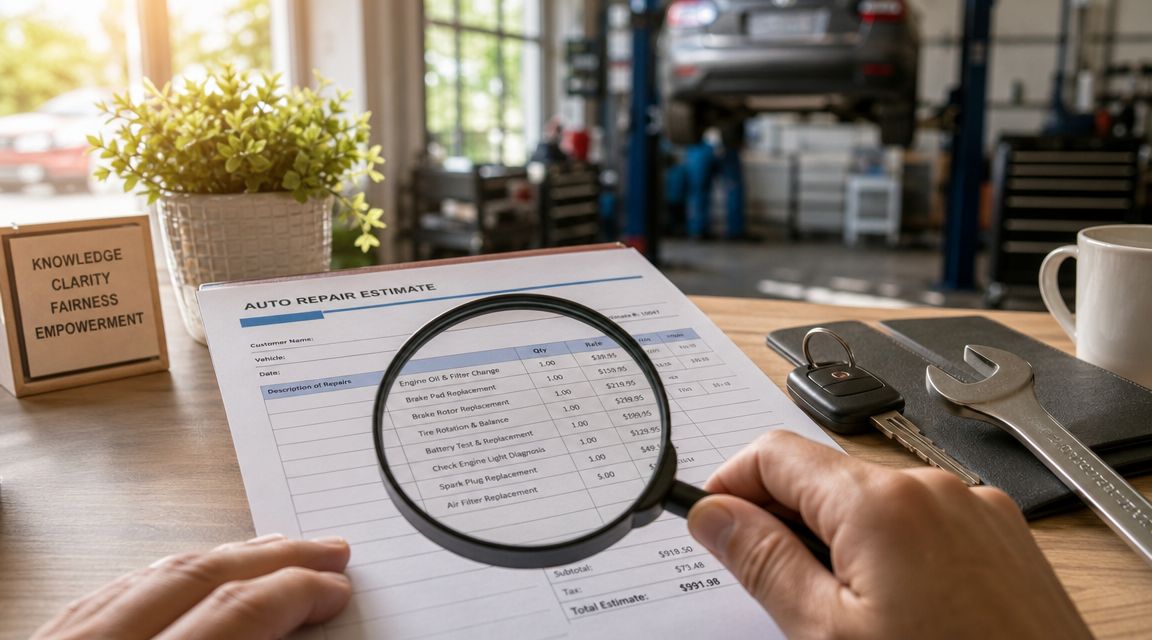
You've got the estimate in your hand, and it already feels wrong. The insurance company sent a sheet full of line items, abbreviations, and clipped labor notes, and the total looks far below what any decent repair shop has hinted the damage will cost. That gut reaction is often correct.
After a crash, the estimate becomes the center of the fight. It decides whether your car gets repaired correctly, whether you get pushed into paying out of pocket, whether the insurer avoids calling the vehicle a total loss, and whether you recover the value your car lost after the accident. If you treat that document like paperwork, the insurance company controls the process. If you treat it like evidence, you gain an advantage.
A lot of drivers make the same mistake. They assume the insurer's estimate is neutral. It isn't. It's an opening position. Sometimes it's incomplete because the car hasn't been disassembled yet. Sometimes it's thin because key operations were omitted. Sometimes it's low because keeping the repair number down helps the carrier avoid a larger payout. Different reason, same result. You get handed a number that serves their interests first.
I've seen this pattern over and over. A driver gets rear-ended. The bumper looks bad, but not catastrophic. The insurer writes a quick estimate off photos. Then a proper shop removes the bumper cover and finds impact absorber damage, bracket damage, sensor issues, and refinishing steps that never appeared on the insurer sheet. Suddenly, the “reasonable” insurance estimate looks like what it was all along: an incomplete starting point.
Your Guide to Navigating Post-Accident Estimates
The first thing to understand is simple. Repair shop estimates are not just repair paperwork. They are claim strategy documents. If you use them correctly, they help you challenge a low repair offer, expose missing operations, support a total loss argument, and preserve evidence for diminished value.
That matters because the three players in this process do not want the same thing. You want your vehicle restored properly and your financial loss covered. The repair shop wants enough approved work to complete a safe repair. The insurance company wants to close the claim for as little as possible. Once you see that power dynamic clearly, the rest of the process makes more sense.
Practical rule: Never assume the first estimate tells the whole story. It usually tells you who wrote it and what they were trying to accomplish.
A body shop estimate can work in your favor when it's detailed, photo-supported, and written by people who know how to identify what estimating systems miss. A weak estimate does the opposite. It gives the insurer room to say the damage is minor, the work is routine, and your dispute has no substance.
What's actually at stake
If the estimate is too low, one of three things usually happens:
- The repair gets watered down. Cheaper parts, skipped procedures, or inadequate refinishing steps become “good enough.”
- The shop submits supplements later. That's normal in many claims, but it can also drag out approvals and leave you stuck while the insurer argues over every added line.
- The numbers expose a bigger issue. A proper estimate may show the vehicle should be evaluated as a potential total loss instead of pushed through a repair path that makes no economic sense.
Your job is not to become a collision estimator overnight. Your job is to learn enough to recognize when the insurer's document is incomplete, when the shop's document is stronger, and when the estimate should be used strategically instead of accepted as fact.
How to Read a Repair Shop Estimate
A good estimate reads like a repair recipe. Every ingredient and every step matters. If one line item is missing, the final product changes.
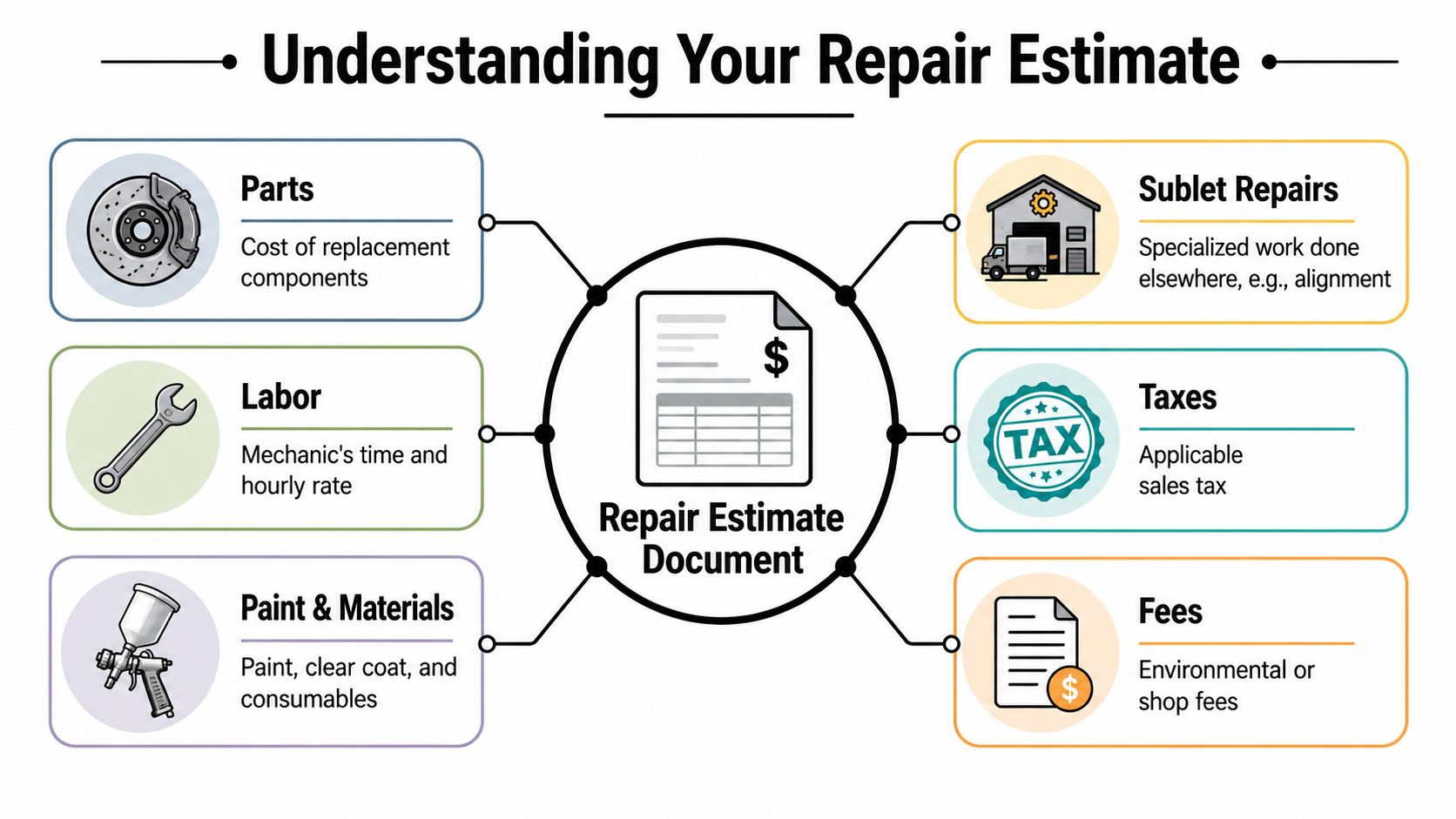
At minimum, you should expect to see parts, labor, paint or materials, taxes, possible sublet work, and fees. If the estimate is vague, rounded off, or built from broad lump sums, you should slow down and ask questions. Collision repair is not one task. It's a chain of operations.
The line items that matter most
Here's the short version of what you're looking at:
| Category | What it means | Why it matters |
|---|---|---|
| Parts | Replacement components for damaged areas | The part type affects fit, finish, safety, and value |
| Labor | Time billed for body, paint, structural, mechanical, or related work | Labor is often where estimates differ sharply |
| Paint and materials | Coatings, clear coat, masking items, and consumables | Refinishing steps are commonly underwritten |
| Sublet repairs | Work sent elsewhere, such as alignment or specialized services | These costs often appear later if omitted early |
| Taxes and fees | Sales tax and shop-related charges | Small on their own, but still part of the real bill |
Labor deserves special attention. The U.S. Bureau of Labor Statistics reported that automotive body and related repairers had a mean hourly wage of $26.89 in May 2023, with a mean annual wage of $55,940, and with much higher annual mean wages in markets such as San Jose at $70,680 and San Francisco at $68,320. That's a useful benchmark because local labor economics help explain why repair shop estimates vary so much by region, even when the damage looks similar. The same federal data also lists 111,200 jobs in this occupation, which shows collision estimating sits inside a large labor market, not a niche trade. You can review that wage table from the U.S. Bureau of Labor Statistics.
Parts are not all equal
A line that says “replace bumper cover” tells you almost nothing by itself. You need to know what kind of part the estimate uses.
- OEM parts are made for the vehicle's original specifications.
- Aftermarket parts are made by a different manufacturer.
- Reconditioned or recycled parts may be acceptable in some situations, but they need scrutiny on newer, high-value, or safety-sensitive repairs.
If you've ever compared appliance or specialty vehicle replacement costs, you already know the listed price rarely tells the whole story. A practical example is this guide to understanding RV fridge replacement prices, where the final cost depends on the unit, labor, installation complexity, and surrounding components. Collision repairs work the same way. The visible part is only one piece of the total.
Read for missing steps, not just totals
Don't stare only at the bottom number. Scan for operations that should logically appear.
Ask questions like these:
- Was the damaged area disassembled enough to inspect hidden damage?
- Does the estimate include refinish-related work, not just part replacement?
- Are mechanical, structural, or diagnostic steps separated clearly?
- If sensors or electronics sit near the impact area, where are those procedures listed?
A clean-looking estimate can still be incomplete. The danger is in the missing lines, not the neat formatting.
When you can read the document line by line, you stop reacting to the insurer's total and start evaluating whether the plan repairs the car.
Why Your Insurer's Estimate Is Always Lower
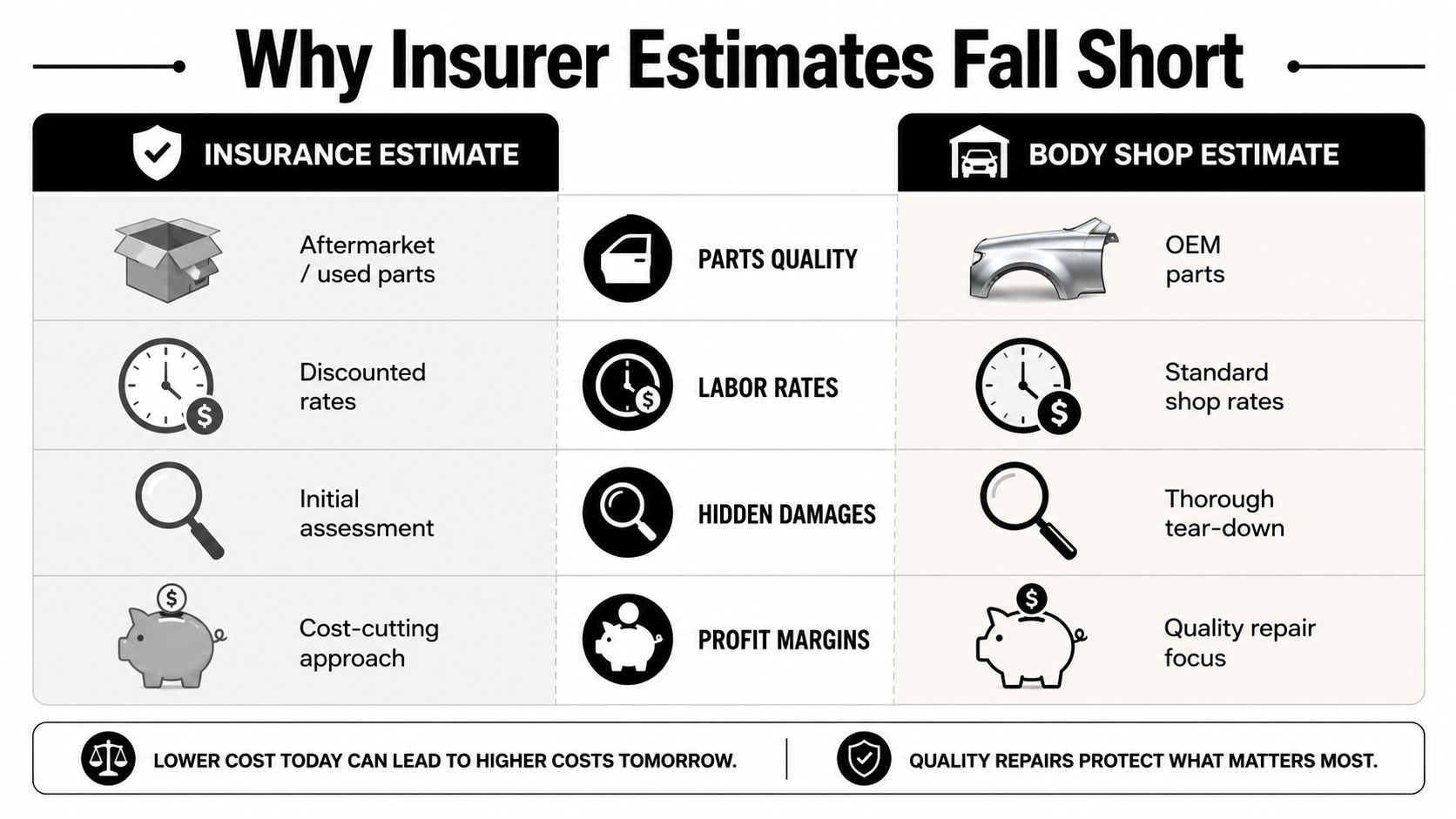
Insurance estimates are lower because the insurer and the repair shop are solving different problems. The shop has to return the vehicle to proper condition. The insurer is trying to control claim cost.
That doesn't mean every adjuster acts in bad faith. It means the system is built around cost containment. If a lower number gets the claim moving, that lower number often appears first.
What gets cut first
The usual gaps show up in familiar places:
| Issue | Insurance estimate | Strong shop estimate |
|---|---|---|
| Parts choice | More likely to favor lower-cost alternatives | More likely to specify what the repair actually requires |
| Labor allowances | Tighter time assumptions | Adjusted for the real work involved |
| Damage scope | Based on visible damage only | Expanded after inspection and teardown |
| Repair operations | May omit necessary supporting procedures | Adds them line by line |
Modern estimating systems like CCC, Mitchell, and Audatex are useful tools, but they don't automatically include every required operation. Shops have to manually add items such as paint blending, ADAS calibration, OEM procedure research, and sublet work where needed. According to Rome Technologies' explanation of body shop estimate writing, those omitted operations are a primary cause of low initial insurance estimates.
The insurer's first number is a negotiation position
That's the part most drivers miss. The insurer's estimate is often presented like a conclusion, but functionally it behaves like an opening offer. If you accept it without challenge, you're telling the carrier that the visible damage sheet is enough to define the whole loss.
For repair claims, that hurts you because the vehicle often hasn't been fully evaluated. For total loss disputes, it can hurt even more. A low repair estimate can keep the claim below the point where the insurer has to seriously confront whether the vehicle should be treated as uneconomical to repair. If you're dealing with that kind of valuation fight, it helps to understand how carriers approach actual cash value in auto insurance claims.
Why body shop estimates usually climb
A reputable shop doesn't inflate the claim by default. It sees more once the car comes apart. That's especially true when the impact area includes sensors, reinforcement components, mounting points, adjacent panels, or structural members that aren't visible in a photo estimate.
Use this rule. If the insurer inspected by photos and the shop inspected in person, trust the more complete inspection. If the shop performed disassembly and the insurer didn't, the shop's estimate usually carries more weight because it's based on better information.
How to Collect and Document Competing Estimates
You do not need five estimates. You need one strong one.
Most drivers waste time collecting multiple weak quotes, often from shops that write to please insurers instead of documenting the full repair. That creates noise, not a stronger position. A detailed estimate from a credible shop with photos, notes, and willingness to supplement is far more useful.
Pick the right shop first
Start with the shop, not the carrier's referral list. Direct repair program shops can do competent work, but remember who sends them volume. If the shop's business depends heavily on insurer relationships, you should at least ask whether they will document every required operation and challenge omissions.
Look for a shop that does these things well:
- Performs a thorough in-person inspection instead of relying only on photos.
- Documents damage with clear images before and during teardown.
- Writes line-by-line estimates instead of broad summaries.
- Explains part types and procedures in plain English.
- Supports supplements aggressively when hidden damage appears.
Build a claim file like you expect an argument
Create one folder for everything tied to the loss. Keep the insurer estimate, the shop estimate, all photos, every email, every text, towing records, rental paperwork, and notes from every phone call. If the carrier changes its position later, you want a paper trail.
Use a simple documentation routine:
- Photograph the vehicle before repairs begin. Wide shots and close-ups.
- Ask the shop for teardown photos. Hidden damage changes claim value.
- Save each revised estimate. Don't overwrite the earlier versions.
- Confirm conversations in writing. Email beats memory.
- Track approvals and delays. Timing often matters when costs change.
PartsTech's 2025 industry report states that repair orders authorized digitally in 2024 had an average value 50% higher than those without digital authorization, based on Tekmetric data. That matters because it shows how much repair cost can increase as work is documented, approved, and expanded after hidden damage is found. The report is available in the PartsTech 2025 U.S. industry report.
Your leverage grows when the file gets better. Photos, supplements, and written approvals turn “I think this estimate is low” into “Here is what you missed.”
Don't argue from suspicion alone. Argue from documentation.
Spotting Red Flags That Point to a Total Loss
Some vehicles should not be repaired just because an insurer wants to keep the claim on the repair side. A low initial estimate can hide that reality for a while, but once a proper shop documents the actual damage, the economics change.
Repair shop estimates evolve beyond simple repair plans, demonstrating that the vehicle may be financially impractical to fix.
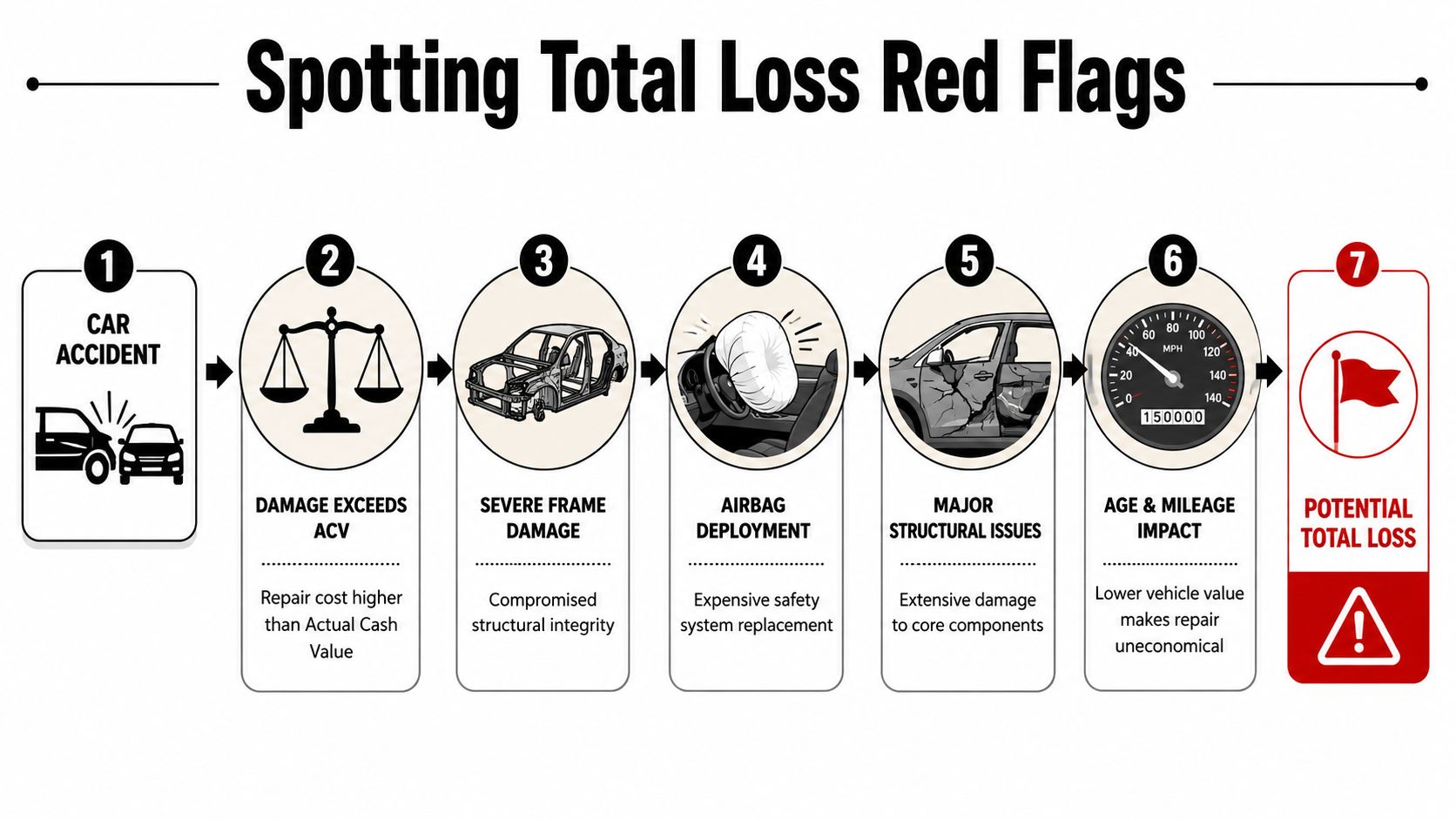
Signs the repair path may be the wrong path
Watch for these red flags:
- Structural involvement: Frame or major structural damage raises complexity fast.
- Airbag or safety system issues: These repairs rarely stay simple.
- Multiple adjacent damaged systems: Body, suspension, electronics, and alignment together are a serious warning sign.
- Late-model technology near the impact area: Sensors, cameras, and calibration needs can change the math.
- High-value or specialized vehicles: OEM constraints and post-repair market stigma matter more.
The key point is this. A visible-damage estimate often understates a serious loss. An auto repair estimate is only a technical forecast based on what can be seen initially, and the final bill can increase when teardown reveals hidden structural, electrical, or alignment damage. That explanation is laid out clearly in this overview of how auto repair estimates work.
Use the estimate to challenge the repair decision
If your insurer keeps pushing repair while the shop keeps finding more damage, stop treating those supplements like routine paperwork. Add them up. Read them against the type of vehicle you own, its pre-loss condition, and the likely post-repair market reaction.
Ask direct questions:
| Question | Why it matters |
|---|---|
| What hidden damage has teardown confirmed? | It shows whether the original estimate was materially incomplete |
| What procedures are still pending? | Unapproved operations can push the vehicle further toward uneconomical repair |
| Are OEM procedures or calibrations still unresolved? | Missing technical steps often mean the estimate remains understated |
If the estimate keeps rising and the carrier keeps resisting the implications, you may not have a repair dispute anymore. You may have a total loss valuation dispute.
That distinction matters. Once the actual repair scope is documented, you can challenge the insurer's effort to keep the claim artificially below the point where a total loss decision becomes harder for them to avoid.
Disputing a Low Valuation and Invoking Appraisal
When the insurer won't move, stop repeating yourself to the adjuster and start using the tools built into the policy.
The most overlooked one is the appraisal clause. In many auto policies, that clause gives you a formal process to dispute value. It is one of the few mechanisms that can force a valuation disagreement out of the insurer's internal loop and into a structured dispute between appraisers.

Why appraisal matters in estimate disputes
There's a major guidance gap for drivers dealing with total loss or high-value vehicle disputes. Mainstream insurer materials usually explain the basic claims process, but they don't deal with the hard questions involving appraised market value, calibration costs, or post-repair value loss. That gap leaves owners of newer, specialized, and more complex vehicles at a disadvantage, which you can see in standard consumer-facing claims guidance such as State Farm's auto repair services page.
That gap exists because appraisal changes the balance of power. Once value is disputed formally, the insurer can't rely as comfortably on its own internal number as the final word.
What to do when you hit a wall
If your claim is stuck, take these steps:
- Read the policy language. Find the appraisal clause and the conditions for invoking it.
- Tie your dispute to evidence. Use the repair shop estimate, supplements, photos, market comparables if available, and any signs of omitted repair operations.
- State the disagreement clearly. Don't send an emotional complaint. Send a written value dispute.
- Hire an independent appraiser if needed. Some firms focus specifically on total loss and diminished value work. One option in this space is insurance appraisal clause support, which is designed for valuation disputes rather than routine repairs.
- Stop letting the insurer frame the issue as closed. Once appraisal is invoked properly, the dispute becomes procedural, not just conversational.
Here's a useful overview of how the process can work in practice:
Don't wait for permission to challenge the number
Drivers often think invoking appraisal is aggressive. It isn't. It's contractual. If the carrier offers a valuation that doesn't reflect the actual loss, you're allowed to challenge it.
What you should not do is keep sending the same estimate back and hoping the next adjuster reads it differently. That usually goes nowhere. You need a process that changes who evaluates the number and how that number gets defended.
Securing Your Final Payout with a Diminished Value Claim
Even if the repair is done correctly, your car may still be worth less because it now carries an accident history. That loss is called diminished value, and many drivers leave it on the table because they think the repair payment ended the matter. It didn't.
The repair shop estimate you fought for is also part of your diminished value evidence. It helps show the severity of the damage, the parts involved, the systems affected, and the scale of the repair. A superficial estimate weakens that claim. A detailed estimate strengthens it.
Why the estimate still matters after repairs
Buyers don't evaluate a repaired vehicle the way they evaluate one with a clean history. That's even more obvious with newer, premium, collector, or customized vehicles. The stronger your repair documentation, the easier it is to explain why the market would discount the vehicle after the loss.
For readers who want a broader view of how independent vehicle experts fit into these disputes, this article on kim jest rzeczoznawca samochodowy gives a useful outside perspective on what an automotive appraiser does.
Don't stop at the repair check
A fair claim resolution may include:
- Repair cost coverage for the actual loss documented by the shop
- Total loss challenge support if repairs no longer make sense
- Diminished value recovery when the vehicle is worth less after the accident
If you're pursuing that final piece, this guide to automobile diminished value claims is the next logical step. The insurer's job is to close the file. Your job is to make sure the file reflects the full loss.
If you're dealing with a low repair estimate, a total loss dispute, or a diminished value claim, Total Loss Northwest provides independent auto appraisals for Oregon and Washington total loss cases and diminished value support in all 50 states. If the insurance company's numbers don't match the actual damage or the actual market value, get the claim reviewed before you accept the payout.