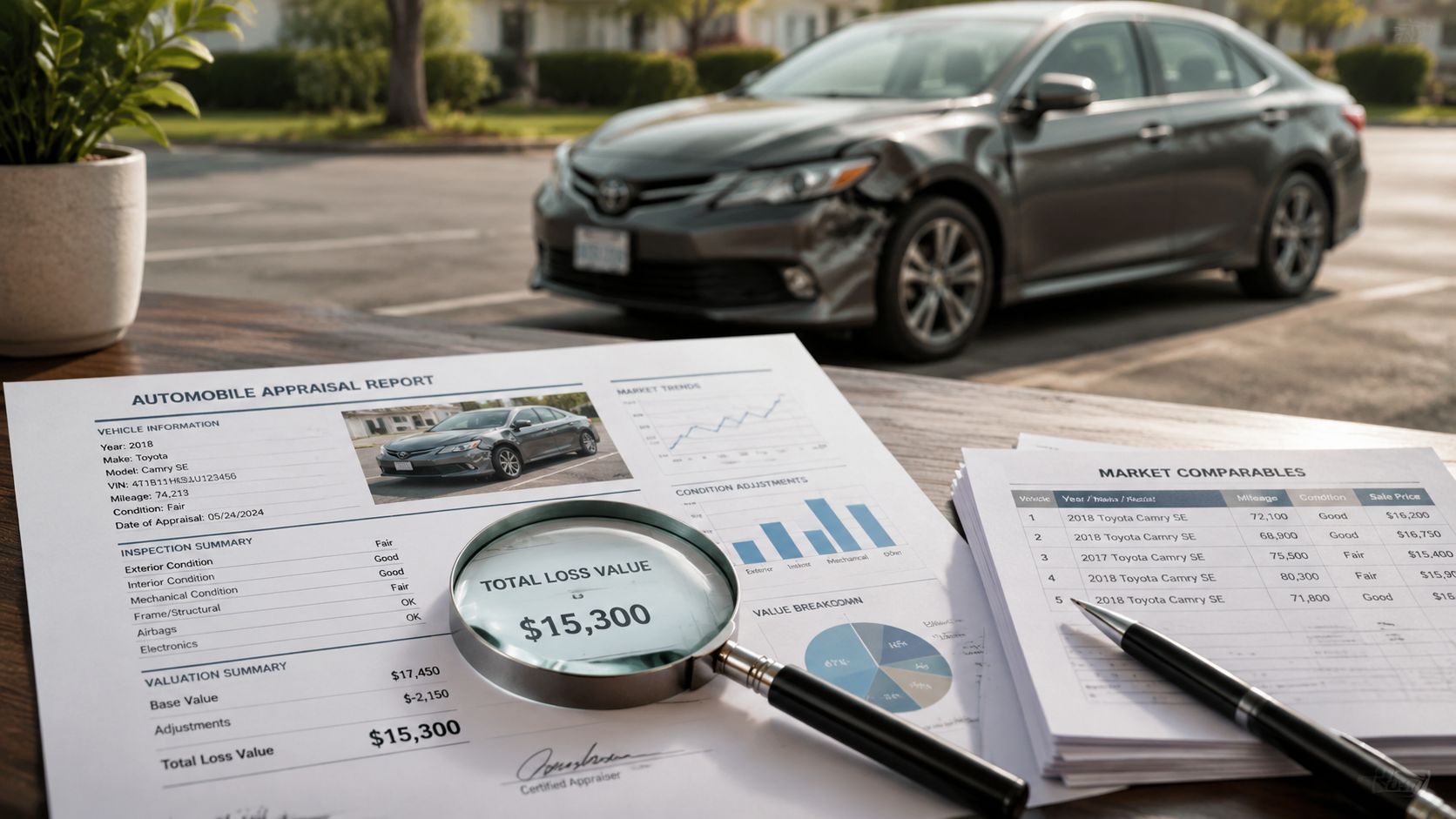
You've got a damaged car, an insurance adjuster moving fast, and a settlement number that feels wrong. That's where most drivers get cornered. The insurer presents the offer like a finished calculation, when in reality it's just their opening position based on software, assumptions, and whatever data made it into the file.
Good Totaled Car Value Help starts with one mindset shift. You are not arguing about feelings. You are challenging a valuation process. That matters because negotiation alone is weak. Procedure is stronger. If your policy includes an appraisal clause, you may have a contractual path to force a re-evaluation instead of begging for one.
Decoding the Insurer's Total Loss Offer
A vehicle is usually declared a total loss when repair costs reach about 70% to 75% of its actual cash value, although the exact threshold depends on the insurer and state rules. A car with an ACV of $15,000 may be totaled once repairs and related loss costs rise above roughly $10,500 to $11,250, as explained in this overview of how total loss thresholds work.

That threshold is only part of the fight. The bigger issue is the number underneath it: Actual Cash Value, or ACV. Insurers usually tie the settlement to the vehicle's pre-loss market value, not what you paid, not what you owe, and not what it would cost to replace it with something newer. If the ACV is set too low, everything downstream gets worse.
What the insurer is usually doing
Most carriers use valuation software and a report built around comparable vehicles. In theory, that sounds fair. In practice, the report often includes weak comparables, shallow condition grading, and missing equipment details.
Here are the first places I tell people to look:
- Vehicle identity errors: Wrong trim level, missing packages, omitted factory options, or mileage that doesn't match your records.
- Bad comparable choices: Listings from the wrong market, vehicles with different equipment, or comparables that were never equivalent to yours.
- Condition downgrades: Interior, paint, tires, or service history marked lower than the car deserved before the loss.
- Feature omissions: Premium audio, towing package, driver-assist package, upgraded wheels, or other options left out.
Practical rule: If the report has one obvious mistake, assume there may be several smaller ones pushing the value down.
The insurer's first offer often feels final because it arrives in a polished format. Don't let the formatting fool you. A valuation report is only as good as its inputs.
Red flags that should slow you down
If you're reviewing a total loss offer, stop before you sign anything if you see any of these problems:
| Red flag | Why it matters |
|---|---|
| Wrong trim or drivetrain | It can materially distort market value |
| Missing options | You don't get paid for equipment the report ignores |
| Generic condition notes | Broad assumptions often underrate well-kept cars |
| Thin local market support | ACV should reflect your real market, not a lazy substitute |
If your loss came from theft, hail, falling objects, flood, or another non-collision event, it also helps to understand what is covered under comprehensive auto insurance, because coverage type can affect how the claim is handled even when the value dispute looks the same.
One more point matters here. A total loss decision and a fair valuation are not the same thing. The carrier may be right that the car is totaled and wrong about what it was worth. If you want to understand the math carriers use to decide whether repair costs tip into total loss territory, this breakdown of the total loss formula is useful.
Building Your Counter-Offer with Market Evidence
Once you know the report can be wrong, the next move is simple. Build your own file. Not a rant. Not a long email about how much you loved the car. A market-backed package that shows why their number misses the mark.
What belongs in your evidence folder
Start with documents that pin down exactly what the vehicle was before the loss:
- Ownership and identity records: Registration, VIN confirmation, trim level, and any factory package documentation.
- Service history: Recent maintenance invoices, major repair receipts, tire purchases, brake work, battery replacement, and dealership records.
- Pre-loss photos: Exterior, interior, odometer, wheels, seats, cargo area, and any especially clean or upgraded areas.
- Comparable listings: Local dealer and private-party listings for the same year, make, model, trim, and similar mileage.
- Option proof: Window sticker, build sheet, original purchase documents, or manufacturer records if you have them.
I'd rather have ten clean, relevant documents than a giant pile of random paperwork. Relevance wins.
The aftermarket parts trap
Modified vehicles get undervalued all the time because the software often treats them like standard cars with depreciation, not cars with market-supported upgrades. According to the verified NAIC-based guidance provided for this article, over 60% of claim denials for modifications stem from a lack of documented appraisals proving installation cost and market demand, and insurers' systems often default to pre-modification value unless an independent appraisal is invoked.
That means custom work needs its own proof stack.
Focus on these categories:
- Performance parts: Intake, exhaust, tuning support, suspension upgrades, wheels, tires.
- Truck and off-road additions: Lift kits, racks, bumpers, winches, lighting, bed systems.
- Appearance work: Wraps, body components, premium paint correction, ceramic coating when it's documented.
- Audio and tech upgrades: Head units, amps, speakers, cameras, integrated electronics.
If you can't prove what was installed, when it was installed, and why buyers in your market would pay for it, the insurer will usually treat it as invisible.
How to frame your counter-offer
Don't send a vague message saying the number feels low. Send a structured rebuttal:
- Identify each factual error in the insurer's report.
- Attach proof for each correction.
- Present your comparable vehicles and explain why they're closer matches.
- Add documentation for upgrades and condition.
- State the value range your evidence supports.
A good counter-offer reads like a file review, not a complaint letter.
For readers who want a practical reference point while assembling those comps, this guide on how to calculate fair market value can help you organize the logic behind your number.
How to Invoke the Appraisal Clause in Your Policy
Negotiation has limits. The adjuster can keep saying they'll “review” your evidence while the clock runs. The appraisal clause changes the power dynamic because it's a contractual mechanism, not a request for a favor.
The urgency is real. The verified industry analysis provided for this article states that 45% of consumers accept initial ACV offers because they don't know the appraisal clause must be invoked, often within 30 days of the denial, to force a third-party umpire and override the insurer's valuation.
Why this works better than haggling
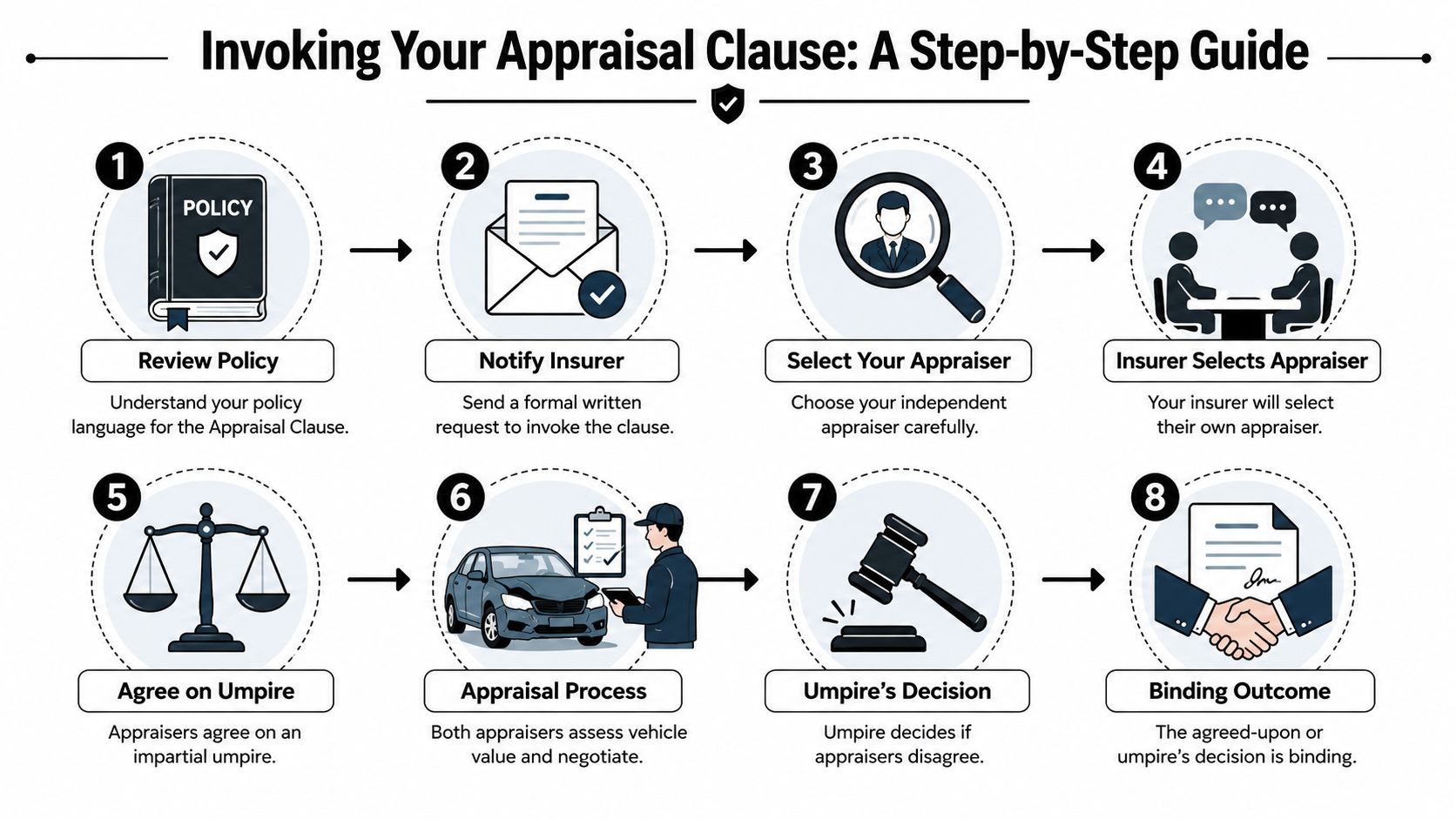
When you stay in ordinary back-and-forth negotiation, the insurer controls the lane. They decide when to respond, what to reconsider, and whether their own software gets the final word. Once appraisal is properly invoked under the policy language, the dispute shifts into a defined process.
That's the advantage most guides leave out.
How to do it properly
Pull your full policy, not the summary page. Search for “appraisal” and read the clause word for word. Some policies describe how each side selects an appraiser and how an umpire is chosen if the appraisers disagree.
Then act in writing.
Use a short, direct notice that includes:
- Claim details: Your claim number, date of loss, vehicle identification, and adjuster name.
- Clear invocation language: State that you dispute the insurer's valuation and are formally invoking the appraisal clause under the policy.
- Request for response: Ask the carrier to confirm receipt and identify its appraiser according to the policy terms.
- Reservation of rights: State that you do not accept the current ACV offer.
Here's the tone to use:
I dispute the insurer's actual cash value determination for my totaled vehicle and hereby invoke the appraisal provision in the policy. Please confirm your designated appraiser in writing and provide any next procedural steps required under the policy language.
Oregon and Washington practical note
For Oregon and Washington claims, timing and wording matter. Delay is one of the insurer's best tools. If you think the offer is low, don't spend weeks arguing informally before checking the clause. Preserve your rights first. You can always continue discussions after the clause is invoked. You may not be able to recover the deadline after it passes.
Common mistakes I see:
- Waiting for “one more revised offer”
- Making the request by phone only
- Sending an emotional dispute letter without formally invoking the clause
- Hiring someone who gives a price opinion but not a defensible appraisal report
Working With a Certified Independent Appraiser
Once appraisal is triggered, your appraiser becomes the backbone of the case. Many people err when they rely on a consumer pricing site, a dealer opinion, or a short letter with a number on it. That won't carry much weight in a formal appraisal process.
A defensible total loss appraisal should read like a valuation record built for scrutiny. It should show what the vehicle was, what the market looked like, what data was considered, and why the final number is supported.
What separates a real appraisal from an online estimate
CCC Information Services reported that vehicles seven years or older made up nearly 45% of all repairable claims in Q4 2024, and valuations for vehicles in that age group represented almost 72% of valuations across all loss categories, according to its Q4 2024 Crash Course report. Older vehicles often have more condition variation, equipment differences, and ownership history issues than software can capture cleanly.
That's exactly why a serious appraisal matters.
A credible appraiser should evaluate items like these:
| Appraisal component | Why it matters |
|---|---|
| Pre-loss condition review | Condition can change value materially |
| Local comparable analysis | Market value should reflect your actual buying area |
| Mileage adjustment logic | Not all same-model vehicles trade at the same level |
| Options and package verification | Missing equipment means missing value |
| Modification documentation | Custom work needs support, not assumptions |
| Final narrative conclusion | The report must explain the number, not just state it |
What I look for in a strong report
I want to see source material that can be defended. I want clean comparable selection. I want adjustments explained in plain language. And I want the report to hold up if the other side pushes back.
That usually means the appraiser has done more than pull listings. They've reviewed trim, condition, market placement, and the reasons one comp belongs while another doesn't.
If you're comparing providers, ask whether they produce a report suitable for formal appraisal clause disputes, not just informal negotiation. One example of that type of service is an independent car appraiser who works specifically on total loss valuation disputes.
A short explainer can also help you understand what happens after the paperwork starts moving:
A good appraiser doesn't tell a bigger story. They tell a better-supported one.
Final Negotiations and Escalation Paths
After your appraisal report is ready, the tone should stay firm and dry. Don't oversell it. Present it like evidence entering the file.
How to present the report to the adjuster
Use a short cover email or letter. Attach the report. Then state what you want.
A clean version sounds like this:
Please add the attached independent appraisal to the claim file. It addresses errors in the original valuation and provides a supported market value analysis. I'm requesting that the claim be updated based on this evidence and that you confirm next steps in writing.
That keeps the discussion on record and avoids side arguments.
If the insurer responds with broad language like “our vendor already accounted for market conditions,” bring the conversation back to specifics. Ask which comparables they stand by. Ask whether they dispute the mileage, trim, options, condition, or modification documentation. Push them onto identifiable points.
What usually works and what usually doesn't
The table below reflects the difference between productive pressure and wasted motion:
| Approach | Result |
|---|---|
| Pointing out exact valuation errors | Moves the file toward re-review |
| Supplying better local comparables | Gives the adjuster something concrete to escalate |
| Invoking the appraisal clause | Forces a procedural response |
| Repeating that the offer is unfair | Rarely changes anything |
| Threatening without documentation | Often gets ignored |
| Long emotional explanations | Adds heat, not leverage |
If the insurer still resists
At that point, escalation depends on where the dispute sits.
- If appraisal is underway: Stay inside that process. Make sure deadlines, appraiser selection, and umpire steps are documented.
- If the carrier won't engage properly: Ask for a supervisor review and confirm every communication in writing.
- If there are larger legal issues: Bad faith concerns, liability disputes, injury claims, or serious delay may justify legal advice.
For readers dealing with the legal side of a crash along with the vehicle valuation dispute, a practical outside reference is this page on Austin car accident attorneys. Not every total loss case needs a lawyer, but some absolutely do.
One caution. Don't mix tracks carelessly. If you've triggered a contractual appraisal path, use it intentionally. Randomly bouncing between adjusters, complaints, and legal threats can muddy the record unless there's a clear reason for each move.
Your Total Loss Claim Checklist and Next Steps
When people feel stuck in a total loss claim, it's usually because the process looks bigger than it is. Break it into tasks and it becomes manageable.
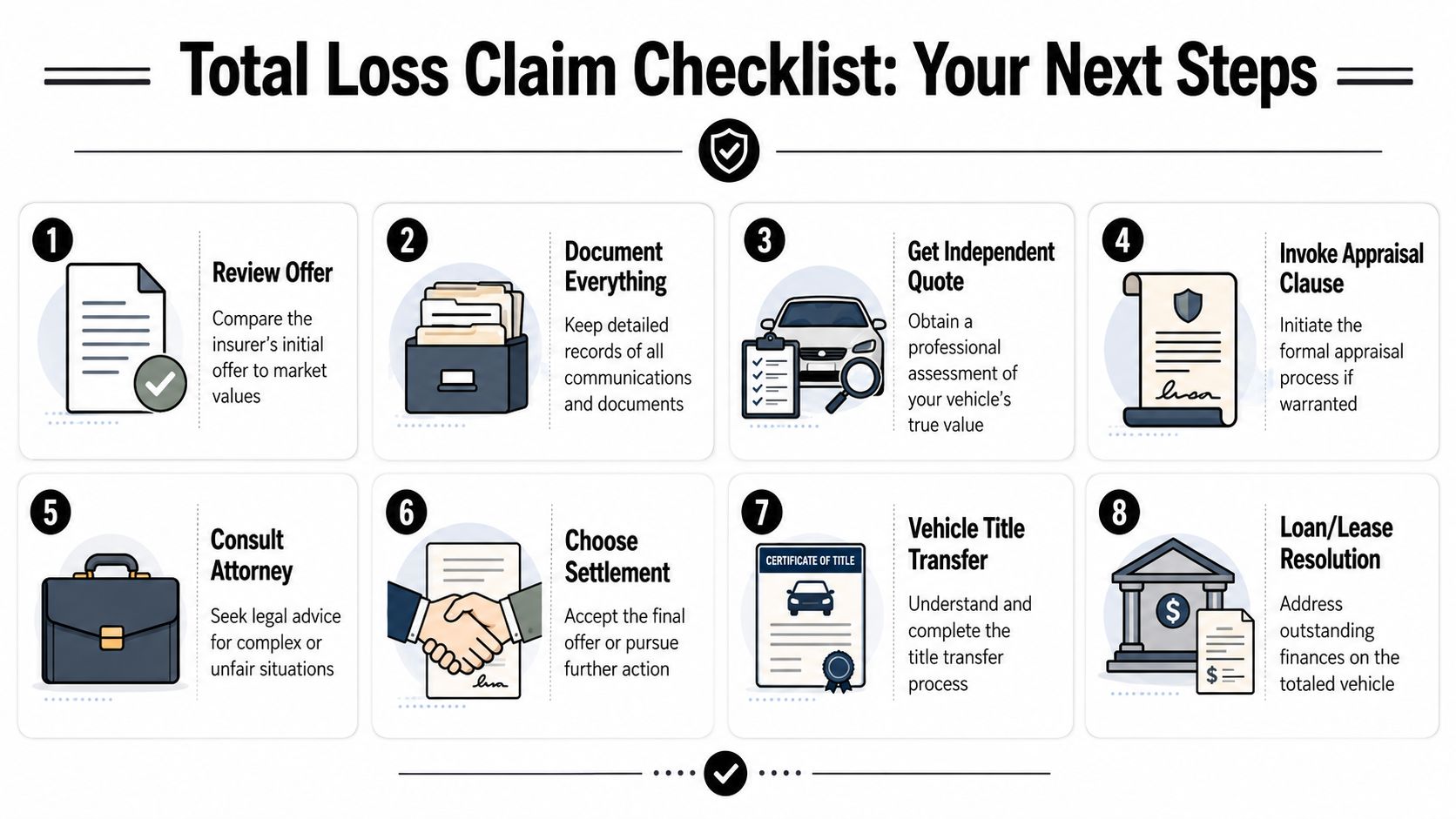
Use this checklist:
- Review the valuation report: Confirm trim, mileage, options, condition, and comparable vehicles.
- Collect your proof: Gather photos, maintenance records, receipts, build sheets, and loan or title documents.
- Document upgrades carefully: Save invoices, installation records, and anything showing market relevance for custom work.
- Build your own comparable set: Use local listings that match your vehicle.
- Decide early whether negotiation is enough: If the insurer keeps circling, check the policy for the appraisal clause.
- Send written communications only: Phone calls are fine for logistics. Important disputes belong in writing.
- Hire the right appraiser if needed: Use someone who prepares a formal, supportable total loss valuation.
- Stay organized until the claim closes: Keep every letter, email, report, and deadline in one folder.
The next best move is usually the simplest one. Pull the insurer's valuation report and mark every factual error you can prove. That single step will tell you whether you're dealing with a minor correction or a real valuation fight.
If you're facing a low total loss offer in Oregon or Washington and need a formal appraisal-backed path instead of more adjuster back-and-forth, Total Loss Northwest provides certified independent appraisals for total loss disputes and appraisal clause matters.