Your car is gone. The tow yard confirms it, the insurer calls it a total loss, and for one brief moment you feel some relief because you bought gap insurance.
Then the numbers arrive.
Your auto insurer offers an Actual Cash Value settlement that feels low. Your lender still wants the loan paid in full. Your gap carrier asks for paperwork, then starts subtracting items you assumed were covered. By the time you read the fine print, you realize gap insurance doesn't erase every dollar tied to the vehicle. It only pays under narrow conditions, and only after the primary insurance claim is handled first.
That surprise is where most drivers get hurt. They focus on having gap coverage, but not on what gap insurance does not cover. As an appraiser, I've seen that misunderstanding create a second financial hit right after the crash itself. The driver thinks the product failed, when in many cases the bigger problem is that the total loss valuation was too low from the start.
The Shocking Reality of a Total Loss Settlement
A common version of this happens fast. You financed a newer vehicle. Maybe you had a long loan term, maybe you traded in a car that was already underwater, maybe the dealer rolled extra products into the contract. Then an accident happens, the vehicle is totaled, and you assume gap insurance will clean up whatever your regular insurer doesn't pay.
It rarely feels that simple once the paperwork lands.
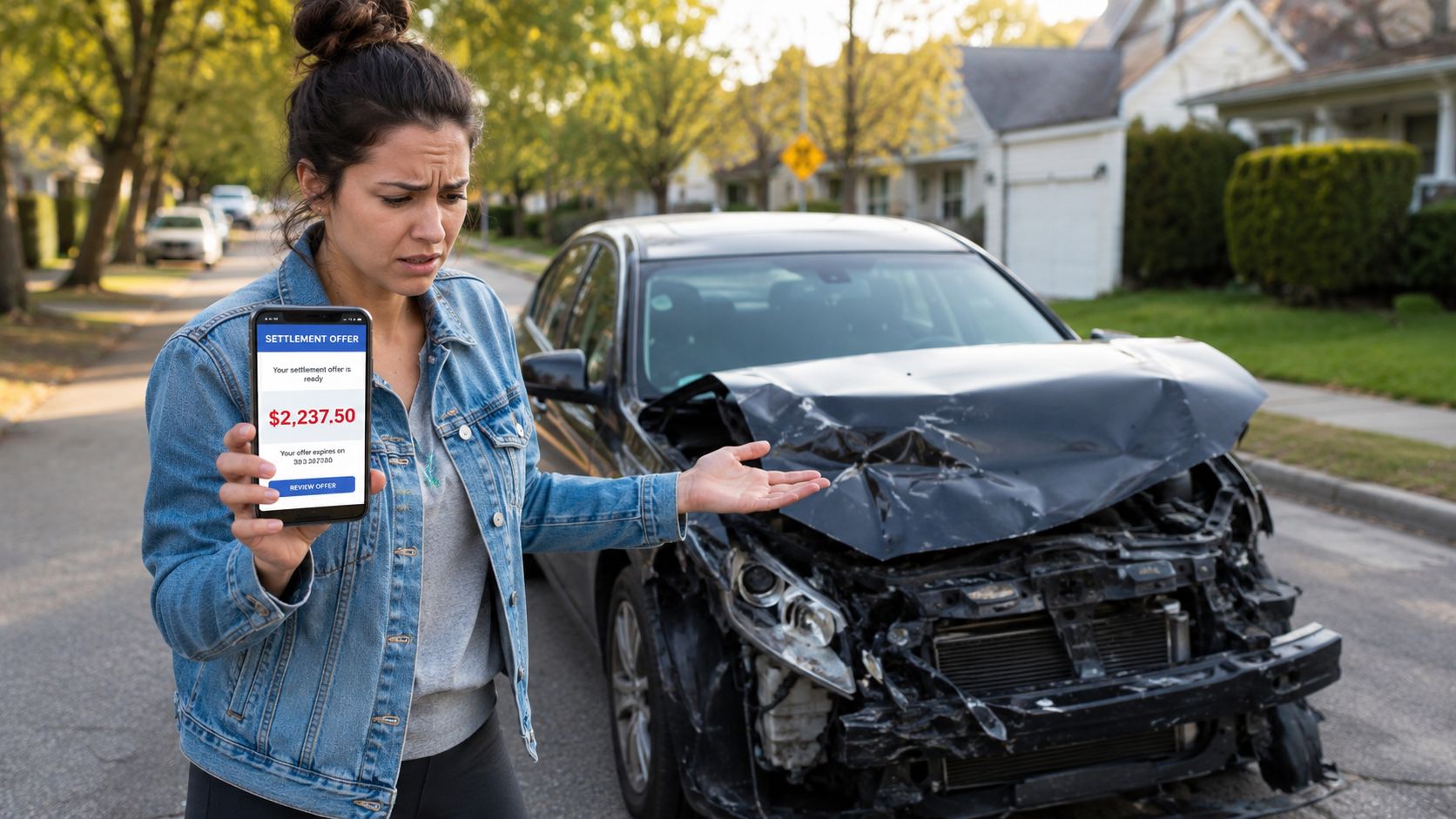
The first shock is often the Actual Cash Value, or ACV. That's the number your primary insurer uses to settle the total loss. If that number comes in lower than expected, the loan payoff and the insurance settlement can be farther apart than you thought. Drivers often assume gap insurance fills every inch of that distance. It doesn't.
Where the surprise usually starts
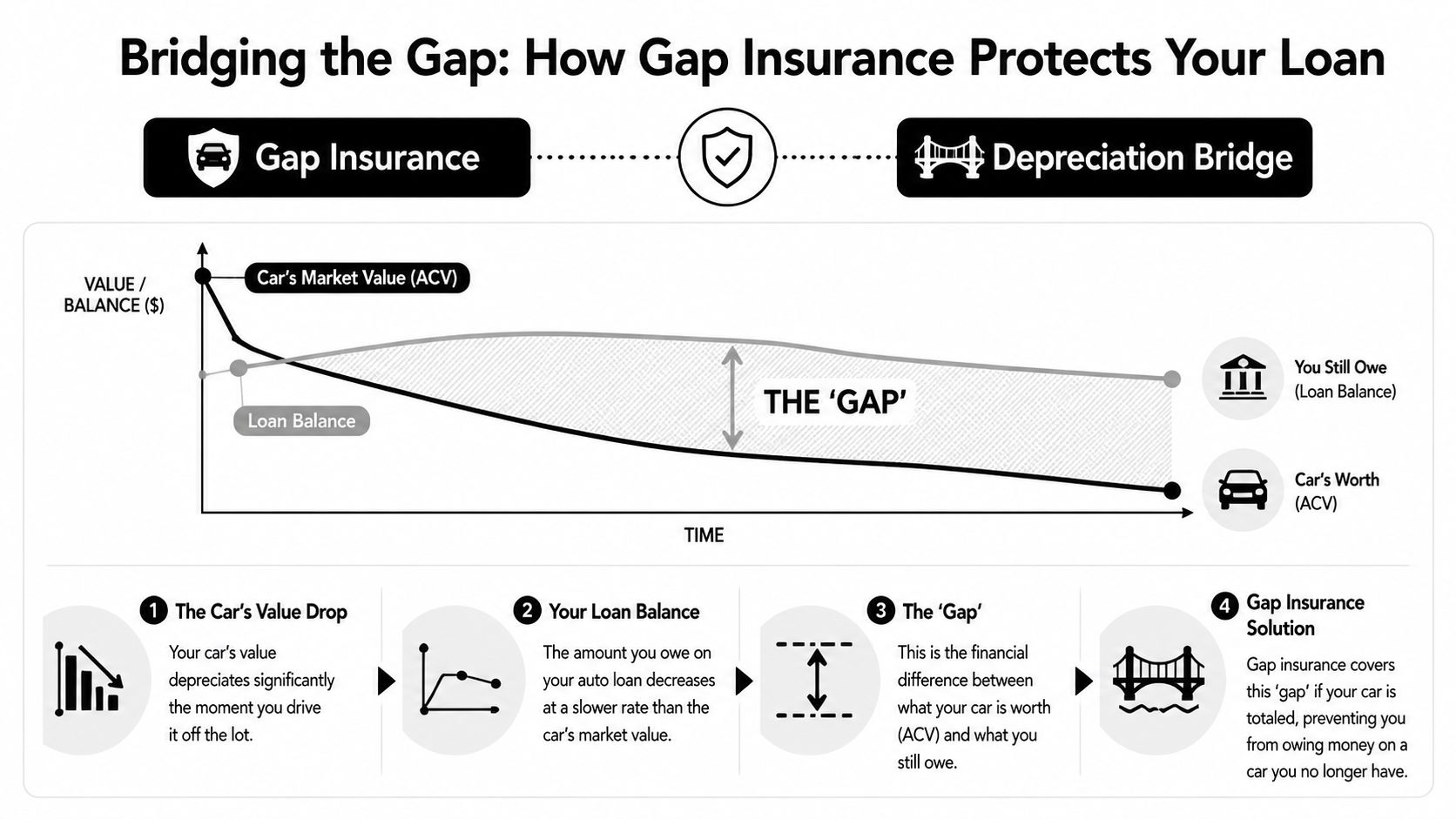
Gap insurance is built for one narrow problem: depreciation on the current vehicle after a covered total loss. It isn't a broad debt cleanup policy. It doesn't function like a refund for every item inside your loan.
That distinction matters because many auto loans carry more than the vehicle's value. They may include old debt from a trade-in, late charges, add-on products, or a deductible that still belongs to the driver. If any of those are part of your remaining balance, they can survive the total loss even though the car doesn't.
Practical rule: If you still owe money after a total loss, don't assume gap failed before you compare your loan documents, your insurer's valuation report, and the gap contract line by line.
The hard truth is this: a lot of frustration blamed on gap insurance starts with a bad ACV number. If the primary settlement is low, every calculation after that gets worse for the driver. That's why understanding exclusions isn't enough. You also need to know where to push back.
How Gap Insurance Is Supposed to Work
A driver totals a recently financed car, opens the settlement letter, and sees two very different numbers. The auto insurer pays the vehicle's Actual Cash Value. The lender wants the remaining payoff. Gap insurance is meant to address that narrow gap, but only after the underlying total loss claim is handled correctly.
The trigger has to happen first
Gap coverage applies after a covered total loss under the primary auto policy. The regular insurer values the vehicle, issues the ACV settlement, and the lender confirms the payoff amount. Only then does the gap carrier review whether any remaining balance qualifies under the contract.
That order matters because gap is secondary coverage. It does not replace collision insurance or other physical damage protection, and it does not rescue a claim that the primary carrier denied for a lapse, excluded use, or other coverage problem. If the vehicle is repairable rather than totaled, gap never enters the picture.
The simple version of the calculation
In practice, the claim usually works like this:
- Your primary insurer determines the vehicle's ACV
- Your lender provides the loan payoff
- Gap compares those two numbers
- The contract removes ineligible charges
- The carrier pays up to any policy limit
For a straightforward explanation of that core function, see this guide on what gap insurance covers.
A clean file produces the best result. The vehicle is a total loss. The auto policy pays properly. The loan balance reflects the current car, not extra debt carried into the deal. In that situation, gap often does what drivers expected when they bought it.
Why the result can still disappoint
The weak point is usually the ACV, not the idea of gap coverage itself.
If the primary insurer values the car too low, the shortfall gets larger before the gap company reviews a single line item. I see this often in Oregon and Washington. A settlement starts with an undervalued comparable set, the lender payoff stays fixed, and the driver assumes gap will absorb the difference. Sometimes it will not, especially once exclusions and caps are applied.
Some policies also limit how much they will pay, and many contracts only cover the portion of the deficiency tied to depreciation on the current vehicle. That leaves drivers exposed if the file includes rolled-over debt, add-ons, late fees, or a deductible the contract does not absorb.
Gap works best when the ACV is accurate, the loan is clean, and the remaining balance comes from depreciation rather than extra charges.
That is why the practical move in Oregon and Washington is not just reading the gap contract. It is checking whether the ACV was fair in the first place. If it was not, the Appraisal Clause may be the tool that fixes the root number before the gap shortfall calc hardens into a smaller payout.
The Fine Print What Gap Insurance Does Not Cover
A driver totals a recently financed car, sees "GAP" on the paperwork, and assumes the loan will disappear. Then the payoff statement arrives, and several charges are still sitting there. That result usually comes from the contract language, not a claims mistake.
Gap covers a narrow deficiency after a covered total loss. It does not wipe out every dollar tied to the loan or lease. In Oregon and Washington, I tell clients to read the exclusions with one question in mind: is the remaining balance coming from the car's depreciation, or from something the contract never agreed to pay?
Partial losses and repairable damage
Gap does not apply to repairable claims.
If the carrier decides the vehicle can be fixed, the claim stays under collision or the relevant physical damage coverage. A large repair estimate does not turn a partial loss into a gap claim. The same rule matters in theft files. A stolen vehicle that is never recovered may become a total loss. A recovered vehicle with repairable damage usually does not.
Rolled-over negative equity from an old loan
This is one of the biggest shortfalls I see at delivery and one of the least understood after a total loss. A buyer trades in a vehicle with debt still attached, the unpaid balance gets folded into the next loan, and gap often excludes that carried-over amount.
The Consumer Financial Protection Bureau states that 28% of new auto loans in 2024 included negative equity from a prior vehicle in its guidance on gap insurance and vehicle financing. That matters because a substantial share of borrowers start the new loan already owing more than the current vehicle is worth for reasons that have nothing to do with this car's depreciation.
In practice, that means a total loss can leave two separate problems on the table. One is the shortfall created by market value. The other is old debt embedded in the payoff. Gap may address the first and leave the second untouched.
Late payments, skipped payments, and delinquency charges
Gap usually does not clean up a troubled account.
Past-due installments, late fees, collection charges, and other delinquent amounts are commonly excluded or deducted from the benefit. The policy is written to address the covered deficiency after the primary insurer pays. It is not written to bring the loan current.
That distinction matters more than drivers expect. A borrower can have valid gap coverage and still owe money after a total loss because part of the payoff balance came from missed payments rather than the vehicle's value loss.
Deductibles are often conditional, not automatic
Some contracts offer deductible assistance. Many drivers hear that as a blanket promise. It is not.
Whether the deductible is reimbursed usually depends on the policy formula producing a payable gap benefit first. If the numbers do not create a covered deficiency, the deductible reimbursement often disappears too. The fine print controls the result.
Add-ons, extras, and charges that are not the vehicle itself
Gap commonly excludes amounts that are attached to the financing but not part of the current vehicle's depreciating value. Depending on the contract, that can include extended warranties, service contracts, credit insurance, aftermarket accessories, lease penalties, excess mileage charges, and prior past-due insurance premiums.
| Covered by Gap Insurance | NOT Covered by Gap Insurance |
|---|---|
| The qualifying difference between ACV and the covered loan or lease balance after a total loss | Rolled-over negative equity from a prior vehicle |
| Depreciation-based shortfall tied to the current financed vehicle | Late payments, delinquent balances, and lease penalties |
| A covered total loss after the primary insurer pays first | Excess mileage charges, past-due premiums, and similar fees |
| Down payments already made by the borrower | |
| Repairs, bodily injury costs, aftermarket equipment, and extended warranties |
I tell clients to compare the retail installment contract, the lender payoff, and the gap agreement line by line. If a charge did not come from the current vehicle losing value, there is a strong chance the gap carrier will reject it.
The practical issue is often the ACV
This is the part many generic articles miss. Exclusions matter, but an undervalued ACV makes every exclusion hit harder. If the primary insurer starts too low, the deficiency grows before the gap carrier applies a single contract limit. In Oregon and Washington, that is why drivers should review the valuation itself and learn how an actual cash value dispute after a total loss can affect the final gap calculation.
Gap is also relatively inexpensive compared with broad auto coverage. The Insurance Information Institute explains that adding loan or lease gap coverage to an auto policy generally costs about $20 a year through an insurer, while dealership pricing can be much higher, in its overview of gap insurance and what it covers. Low cost does not mean broad protection. It means the product is narrow by design.
After a total loss, the right question is not just whether gap exists. The right question is which parts of the payoff are eligible, and whether the ACV at the foundation of the claim was accurate in the first place.
The Deductible Deception and ACV Disputes
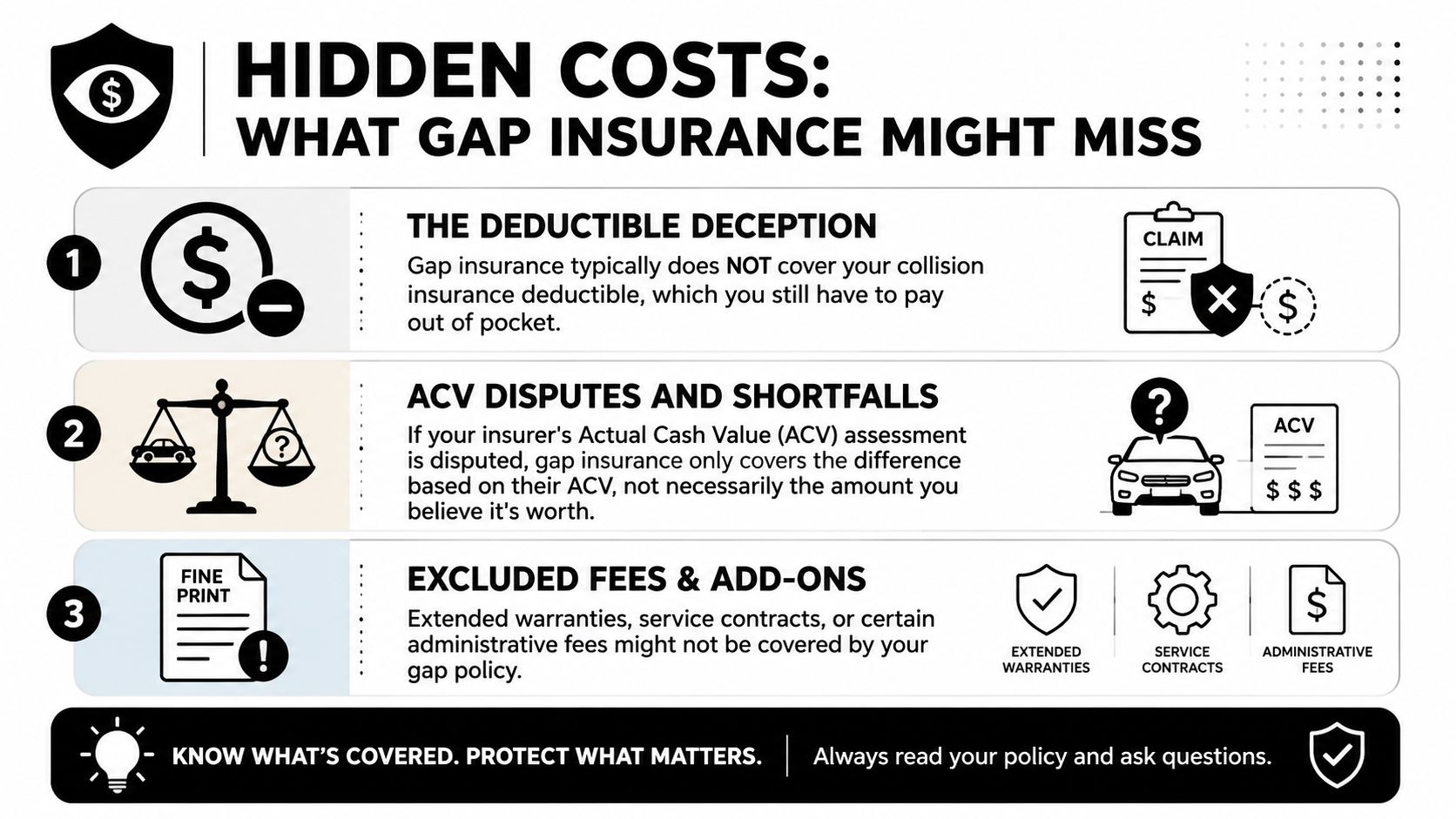
A driver totals a financed car, pays the collision deductible, and expects gap to clean up the rest. Then the settlement arrives. The auto insurer values the car lower than expected, the gap carrier applies its formula, and the deductible reimbursement the driver counted on never materializes.
That outcome is common because deductible language is usually conditional, not automatic.
Some gap contracts reimburse a deductible only when there is a payable gap benefit after the math is done. If the payoff shortfall is too small, excluded, or reduced to zero under the contract, the deductible piece often disappears too. The result is frustratingly simple. A driver can carry collision, pay for gap coverage, suffer a total loss, and still owe the deductible out of pocket.
Why deductible promises fall apart
State Farm's consumer overview makes the key point clearly. Deductible treatment depends on the terms of the gap product, and reimbursement is not guaranteed in every total loss. See State Farm's explanation of gap insurance and deductible limits.
The practical takeaway is straightforward. Drivers should stop treating deductible reimbursement as built-in coverage and start reading it as a limited benefit that may vanish if the underlying gap calculation does not produce a payable amount.
The bigger dispute is usually the ACV
From an appraiser's standpoint, the deductible fight is often the smaller problem. The larger one is the actual cash value set by the primary insurer.
Gap does not decide what your vehicle was worth on the open market. It uses the total loss settlement as a starting point. If that ACV comes in low, every number that follows is affected. The loan payoff does not shrink. The settlement does. Then the gap carrier reviews the remaining deficiency through its own exclusions and caps.
That sequence is where drivers lose money.
- Low ACV offer: The primary insurer pays less than the vehicle may have been worth in the local market.
- Gap applies contract limits: The carrier reviews the shortfall after the valuation is already set.
- Out-of-pocket loss remains: The driver may still absorb part of the deficiency, including the deductible.
I see this regularly in Oregon and Washington claims. People focus on whether gap denied part of the bill, but the defect started earlier with a weak valuation report, poor comparable selection, missed options, or condition adjustments that do not hold up.
If the ACV is wrong, gap insurance does not correct that error. It only reacts to it.
That is why a total loss actual cash value dispute often does more to improve the final outcome than arguing over a small deductible provision. Raise the ACV to a supportable market figure and the whole file changes. The primary settlement improves. The shortfall can narrow. In some cases, the gap claim becomes smaller or unnecessary.
Clients are often surprised by that trade-off. They spend days arguing over a deductible worth a few hundred dollars while ignoring a valuation issue worth thousands. The better claim strategy is to audit the foundation first, then review the gap contract against the corrected numbers.
Your Rights in Oregon and Washington
Drivers in Oregon and Washington have a practical tool that many people never use. It sits in the auto policy itself. It's the Appraisal Clause.
When the dispute is about value, not coverage, the Appraisal Clause can let the policyholder hire an independent appraiser to challenge the insurer's ACV. That matters because total loss valuations often come from systems and comparable selections the driver had no hand in choosing. If those inputs are weak, stale, or poorly matched to your vehicle, the settlement can come in low.
What the Appraisal Clause does
In plain terms, the clause creates a structured valuation dispute process. The insurer has its appraiser. You hire yours. If needed, an umpire resolves remaining differences.
That process changes the conversation. Instead of arguing with a call center representative about why your car “should be worth more,” you move into a contractual mechanism built to address value disagreements with evidence.
Why this matters more than most gap arguments
Gap insurance is reactive. It comes in after the primary settlement and only within its own limitations.
An appraisal challenge works earlier and strikes at the foundation of the claim. If the ACV rises to a fair market level, several good things can happen at once:
- The primary settlement improves: You recover more from the insurer that owed for the vehicle itself.
- The payoff shortfall narrows: A higher ACV can reduce the amount left for gap to evaluate.
- Some gap disputes become less important: If the numbers improve enough, exclusions that once looked devastating may matter less.
That's why, in Oregon and Washington, independent appraisal is often the most practical answer to a bad total loss outcome. It doesn't rewrite the gap contract. It addresses the valuation problem that created the pressure.
What drivers should gather before invoking it
When a settlement feels off, the strongest files usually include documentation that supports the vehicle's real market position:
- Vehicle specifics: Trim, options, mileage, condition, service history, and recent improvements.
- Loss documents: The valuation report, total loss letter, and the insurer's comparable vehicles.
- Ownership papers: Purchase documents, payoff information, and records for financed add-ons.
The best appraisal disputes are built on vehicle-specific facts, not general frustration with a low offer.
For Oregon and Washington drivers, the key insight is this: if gap won't cover part of the balance, that doesn't mean you're out of options. You may still be able to improve the claim where it started, with the ACV itself.
Next Steps When Your Settlement Falls Short
When you're dealing with a total loss, speed matters. So does order. The wrong move is to bounce between the lender, the auto carrier, and the gap provider without first understanding which number is driving the problem.
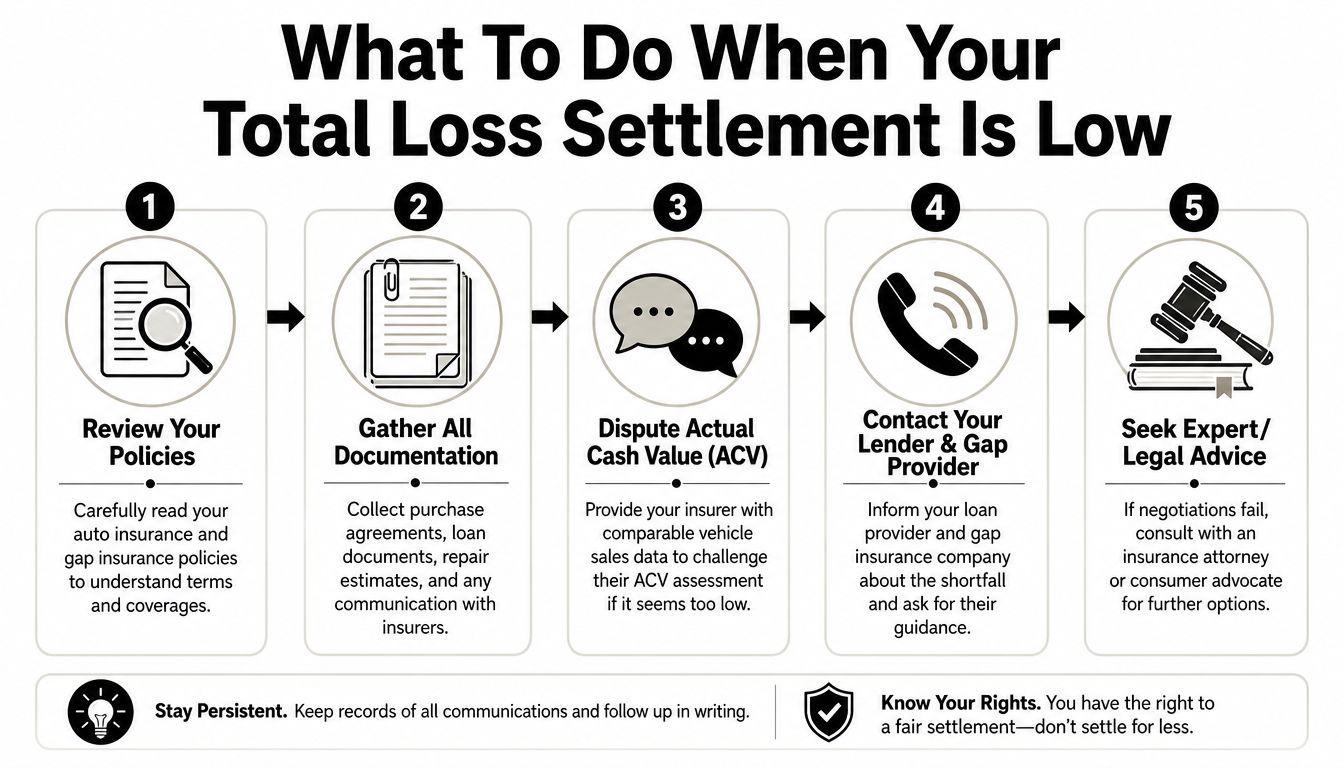
Start by grounding yourself in the documents. Most settlement problems become clearer once the valuation report, finance contract, and gap policy are side by side. You're looking for the source of the shortfall, not just the size of it.
A quick visual overview can help before you make calls or sign releases.
A practical sequence that works
Read the valuation report carefully
Check the insurer's ACV report for wrong trim, missing options, condition errors, mileage issues, or weak comparable vehicles. A small valuation mistake can have a large effect on the final settlement.Read the gap contract like a loan document
Don't skim the exclusions. Look specifically for language about deductibles, rolled-over balances, overdue payments, policy caps, financed products, and any requirement that the primary carrier pay first.Separate vehicle value from loan baggage
If part of the balance came from old negative equity, service contracts, or other financed items, identify that now. It helps explain why the payoff and the vehicle's market value may not line up.
When to escalate
If the ACV still looks low after your review, move quickly toward an independent appraisal. In Oregon and Washington, that can be the difference between accepting the insurer's number and forcing a real valuation process under the Appraisal Clause.
If your insurer won't engage fairly, drivers can also explore a formal complaint path through the state regulator. This guide to filing an insurance commissioner complaint explains that option when communication stalls or the claim process goes off track.
Keep your lender and gap provider informed
Don't let silence create additional account trouble.
- Call the lender early: Confirm the payoff amount and ask how they handle pending total loss claims.
- Notify the gap administrator: Ask what documents they require and whether they need the primary settlement finalized first.
- Track every communication: Save emails, letters, valuation reports, and claim notes in one place.
If the vehicle wasn't totaled and was instead repaired, a different issue may apply. In that situation, some drivers may have a diminished value claim rather than a gap claim. That's a separate lane, and it needs its own evaluation.
The broad takeaway is simple. If your settlement falls short, don't start by arguing emotionally about fairness. Start by identifying whether the shortfall came from a low ACV, an excluded part of the loan, or both. Then act on the part you can challenge.
If your total loss settlement is too low in Oregon or Washington, Total Loss Northwest helps drivers challenge ACV valuations through certified independent appraisal and the Appraisal Clause. If the insurer's number doesn't reflect the actual market for your vehicle, they can build the report and push the dispute where it belongs, at the valuation level instead of leaving you stuck arguing with gap exclusions after the fact.