You open the claim email, scan the number, and your stomach drops. The insurer says your car was worth less than you know it was. Or they say the repaired vehicle didn't lose much value after the crash, even though any serious buyer would hesitate the second they see accident history.
That offer isn't sacred. It's an opinion.
Professional appraisers don't rely on one idea of value. They use recognized valuation approaches to test whether a number makes sense. For cars, insurers usually lean hard on sales comparisons. That method matters, but it's not the whole story. If the comparable vehicles are weak, outdated, poorly adjusted, or not similar enough, you need a stronger framework than “I disagree.”
That's where income approach valuation becomes useful. Not because your daily driver is a rental apartment, but because this method forces a simple question: what economic benefit did this vehicle provide, and what did you lose when the insurer undervalued it? Once you understand that logic, you can challenge a low offer with far more precision.
Your Insurer's Offer Is Low Now What
A low total-loss offer usually arrives with a polished report and an implied message: this is the number, take it or leave it. Most drivers accept it because the paperwork looks technical. That's a mistake.
The insurer's report is only as good as the valuation method behind it. In appraisal work, three broad approaches show up again and again: cost, sales comparison, and income. Car insurers almost always default to sales comparison. They look for vehicles they claim are similar to yours, make adjustments, and call it fair market value. Sometimes that works. Often it doesn't.
Why the first number is often weak
The problems are predictable:
- Bad comparables. The report may use vehicles with different trim, condition, mileage, options, prior damage history, or geographic relevance.
- Thin adjustments. The insurer may acknowledge differences but barely adjust for them.
- Missing utility. The report often ignores how your specific vehicle served your life or business in a way a generic substitute doesn't.
If your car was especially clean, well-maintained, upgraded, rare in your local market, or used in a way that made reliability critical, a shallow comparison set can understate value fast.
Practical rule: Never argue with an insurer using only frustration. Argue with method.
That's also why people who care about avoiding unexpected car repair bills tend to think more clearly about vehicle value in the first place. They understand a car isn't just a metal box with wheels. It's a machine that protects your budget from disruption.
Shift from reaction to analysis
You don't need to become an appraiser overnight. You do need to stop treating the insurer's figure as the starting truth. Treat it as one conclusion that needs to be tested.
A smarter response starts with two moves:
- Read the valuation report closely. Don't skim it.
- Learn how appraisers think about value beyond sales comps.
If you want a direct breakdown of what to do when the number feels wrong, this guide on a lowball insurance settlement offer is a useful companion to the strategy in this article.
The income approach won't replace market evidence for most ordinary vehicles. But it will give you a sharper way to expose where the insurer's logic is too thin. That matters, especially when standard comparisons fail.
Understanding the Income Approach to Valuation
The income approach centers on one question: what is this asset worth based on the economic benefit it can produce over time?
That isn't vague theory. It's a standard valuation principle. The method is grounded in Value = Benefit / Required Rate of Return, where the benefit is usually cash flow or net income, and the required rate of return is a capitalization rate or discount rate that reflects risk, as explained in CRI's overview of the income approach valuation formula.
Think like a buyer, not a spreadsheet
Say you're buying a vending machine. You don't care only what another vending machine sold for last month. You care what this one is likely to earn, how steady those earnings are, and how risky the location is.
A rental property works the same way. A buyer looks at the income stream. If the rent is stable and the risks are understood, value becomes a function of expected benefit and the return the buyer requires for taking that risk.
That's the heart of income approach valuation. Buyers pay for future economic benefit, not just past transaction history.
Two methods matter most
Some assets produce stable income. Others produce uneven income that changes over time. That's why appraisers use two main versions of the income approach.
| Method | Best For | Key Idea |
|---|---|---|
| Direct Capitalization | Stable income-producing assets | Convert one level of ongoing income into value using a capitalization rate |
| Discounted Cash Flow | Assets with changing or uneven future benefits | Project future cash flows over time, then discount them back to present value |
Direct capitalization in plain English
Direct capitalization is the cleaner version. If an asset produces a reasonably stable annual benefit, an appraiser can convert that benefit into value using a rate that reflects risk and market expectations.
You don't need advanced finance jargon to understand the logic. Stable benefit plus lower risk usually supports stronger value. Less stable benefit or higher risk pushes value down.
Discounted cash flow when the future changes
Discounted cash flow, or DCF, is what appraisers use when income won't be flat. Maybe the asset needs time to mature. Maybe the benefits arrive later. Maybe the risks shift over time.
That logic is especially useful whenever value depends on timing, not just amount. A dollar of benefit received sooner is more valuable than the same benefit received later, because uncertainty grows with time.
A valuation method becomes persuasive when it matches how a real buyer would think.
If you want a practical consumer-level explanation of how insurers usually price vehicles, review how an insurance company values a car. Then compare that market-heavy process to the income logic here.
For drivers considering long-run ownership economics, this article on understanding TCO for electric vehicles is also worth reading. Total cost of ownership isn't identical to valuation, but it trains you to think in economic benefit over time instead of sticker price alone.
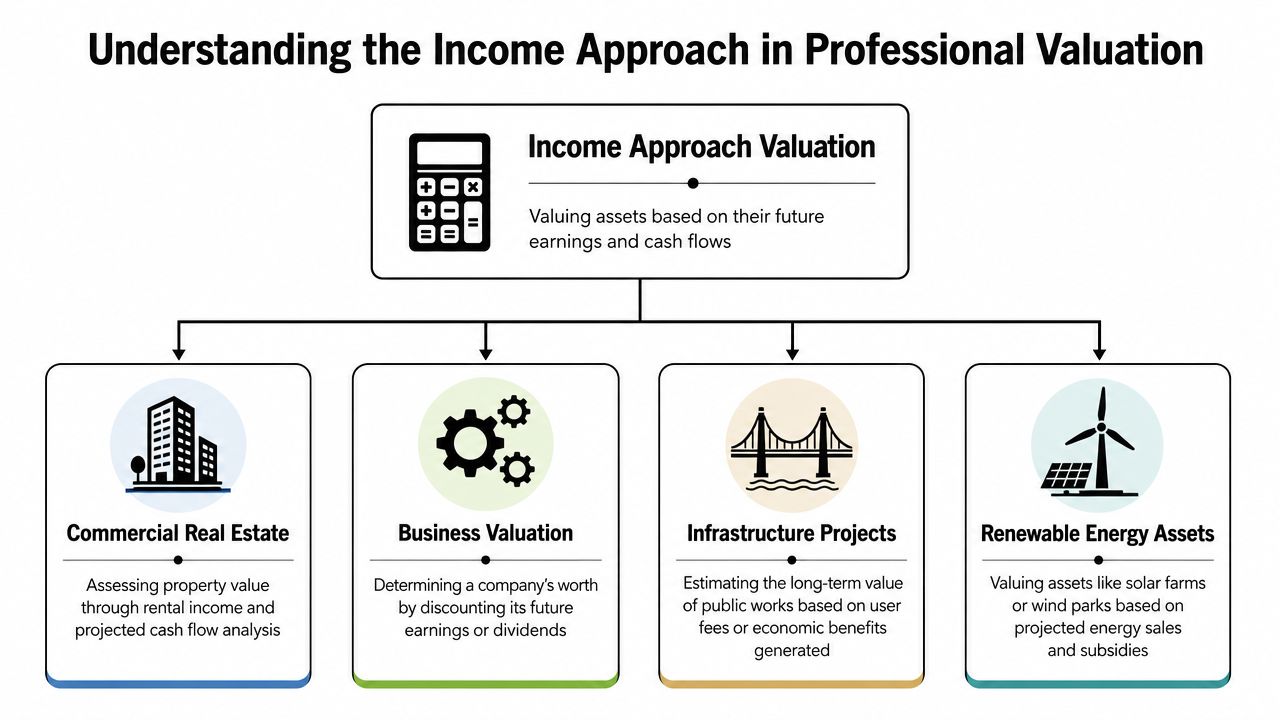
How Professionals Use the Income Approach
Professional appraisers use the income approach because buyers pay for expected economic benefit, not just for a physical object sitting in front of them.
Commercial real estate uses it every day
Real estate appraisers apply this method constantly. They estimate Net Operating Income and convert that income stream into value using a capitalization rate. Wall Street Prep gives a clear income approach real estate example showing how a higher cap rate produces a lower value because the market sees more risk.
That point matters in an auto claim. Valuation is highly sensitive to assumptions. Change the risk, change the expected benefit, or change the quality of the comparables, and value shifts fast. Insurers know this. You should know it too.
Business valuation follows the same rule
Business appraisers do not stop at desks, inventory, or equipment. They examine what the business is expected to produce. The same logic applies to income-producing equipment, infrastructure, and other assets with a measurable future benefit.
That is the part many vehicle owners miss. The income approach is not some niche finance theory. It is standard appraisal thinking. If you want a clearer baseline on the market side before making an income-based argument, review this guide on how to calculate fair market value for a total-loss vehicle.
What that means in an insurance dispute
Your goal is simple. Show that a serious valuation does not stop at a thin list of sales comps when those comps fail to capture how the vehicle served its owner.
That argument gets stronger in cases like these:
- Commercial-use vehicles that generate revenue or prevent business interruption
- Specialized vehicles with modifications, equipment, or use cases that generic comps miss
- Personal vehicles with unusually high utility because replacement on paper does not restore the same real-world function
- Diminished value claims where the vehicle still runs but market appeal and owner confidence have been reduced
A valuation that ignores real economic utility is only part of the job.
That is the practical lesson from professional appraisal work. Value comes from expected benefit. In auto total-loss and diminished value claims, that principle gives you a stronger way to question an offer that relies too heavily on database pricing and not enough on how the vehicle performed in your life.
Applying Income Principles to Your Vehicle's Value
Your insurer declares your car a total loss, pulls a few comps from a database, and hands you a number that would not replace the vehicle you owned. That is where income principles become useful. They let you explain the vehicle's real economic service instead of accepting a paper value that ignores how the car functioned in your life.
Your car produces usable economic value
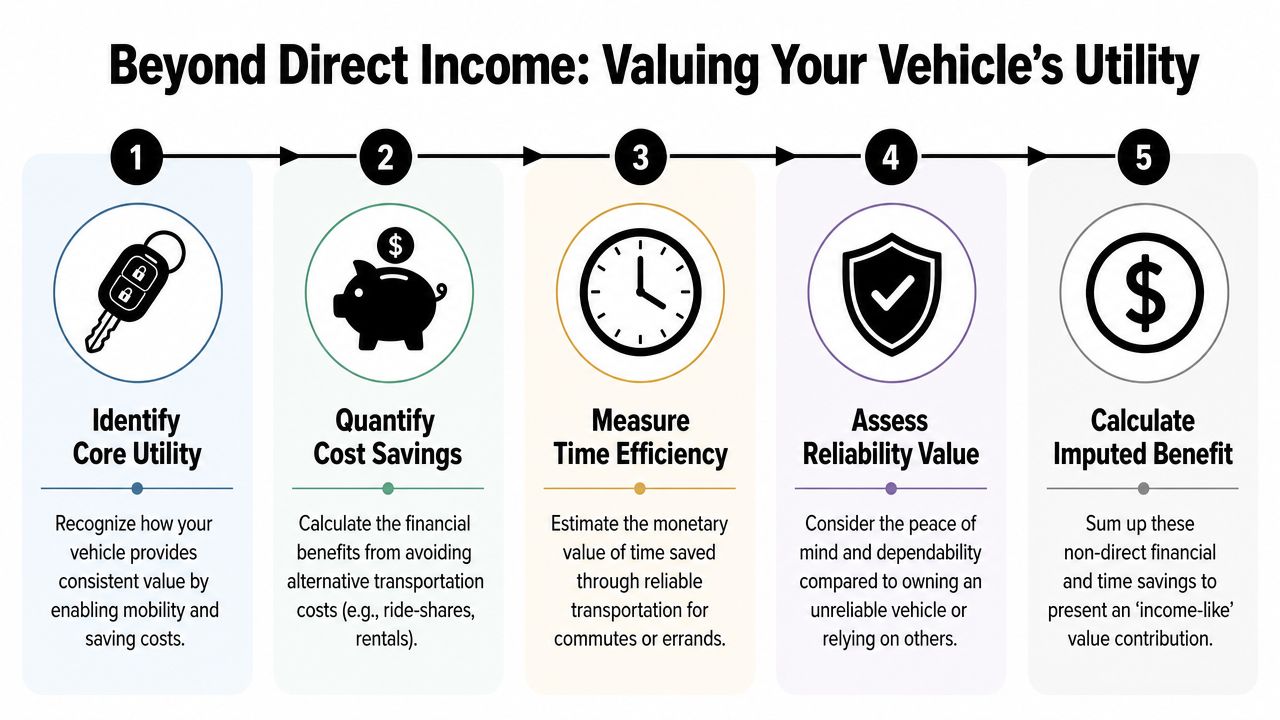
A personal vehicle usually does not generate direct revenue. It still produces measurable value every day by delivering transportation you would otherwise have to buy, replace, or do without.
That service matters. It gets you to work on time, keeps family schedules intact, handles errands, supports caregiving, and covers trips that public transit, ride-share, or a cheap substitute may not handle well. In valuation terms, that is economic benefit.
For a vehicle owner in a total-loss or diminished value dispute, this is the missing link. The income approach is not limited to office buildings and businesses. The same principle applies here. Value comes from expected future benefit, and a vehicle's benefit is the transportation service and utility it reliably provides.
Frame the dispute around replacement utility
A weak insurer valuation asks, “What did similar cars sell for?” A stronger owner response asks, “What will it take to replace the same level of transportation function?”
That shift matters because generic comps often miss the practical differences between vehicles that look similar on paper.
Document the utility your vehicle provided:
- Substitute transportation costs such as rentals, ride-share, taxis, or extra mileage on another household vehicle
- Reliability history if your prior vehicle had known maintenance records and the proposed replacement carries more risk
- Time value if the vehicle supported work travel, school runs, medical appointments, or caregiving without delays
- Functional equipment such as towing capability, cargo space, racks, accessibility features, or installed business tools
This argument works best when it is specific. “I liked my car” carries no weight. “The insurer's substitute does not match the towing setup, service history, and daily work route demands of the lost vehicle” is a valuation point.
Diminished value follows the same logic
The same principle applies after repairs. A damaged-and-repaired vehicle may still operate, but it often delivers less future benefit because buyers assign more risk to it. That lowers confidence, weakens resale appeal, and reduces what the owner retains after the loss.
You do not need to force a full corporate discounted cash flow model onto a car claim. Use the logic instead. When future usefulness becomes less certain, present value falls. That is exactly why accident history, structural concerns, paint mismatch, and stigma affect diminished value even when the vehicle is back on the road.
Use income logic to support, not replace, your market evidence
Start with market proof. Then strengthen it with utility proof.
Use this sequence:
- Build a fair market value baseline with accurate comparables. If you need that groundwork, review this guide on how to calculate fair market value for a total-loss vehicle.
- Identify what the insurer's comps miss, including condition, equipment, local availability, and service history.
- Explain the lost economic benefit in plain language, tied to actual use.
- Show the practical replacement gap between the insurer's number and the vehicle function you lost.
The strongest challenge to a low offer combines market comps with a disciplined explanation of lost utility.
That is how you turn the income approach from abstract finance into a practical tool for an auto claim. It gives you a credible way to challenge a lowball offer without overstating your case.
Knowing the Limits and When to Argue
The income approach is useful. It is not magic.
For ordinary passenger vehicles, the sales comparison approach remains the primary valuation method. That's because most cars trade in active retail and private markets, and buyers usually anchor their decisions to comparable vehicles. If you ignore that reality, you'll weaken your position.

Where income logic helps most
Income principles work best as a supporting argument when the standard market approach is too crude. That happens more often than insurers admit.
Strong use cases include:
- Commercial-use vehicles where replacement delays disrupt revenue-producing activity
- Modified or specialty vehicles that generic comps don't capture well
- High-demand local market mismatches where the insurer's comparables come from weaker markets
- Diminished value disputes where post-repair utility and buyer confidence are clearly reduced
In those situations, the income approach gives you a disciplined way to explain why the insurer's paper comps don't restore the actual benefit you lost.
Don't oversimplify unstable benefit
Many people commonly make a mistake. They grab a rough avoided-cost idea and treat it like fixed annual income. That can produce nonsense.
A.CRE points out a common valuation gap with non-stabilized assets: standard methods often fail to properly adjust for risk premiums or growth expectations, which can lead to misvaluation if direct capitalization is used without yield adjustments, as discussed in its analysis of cap rate selection for uncertain income.
That principle translates cleanly to vehicle claims. If your vehicle's future utility was uncertain, seasonal, highly situation-specific, or dependent on business conditions, you shouldn't present the benefit as if it were perfectly stable. Be honest about uncertainty. Then explain why uncertainty still doesn't justify the insurer's weak valuation.
The smart position
Use income reasoning when it adds logic, not when it replaces evidence.
A solid argument sounds like this: the insurer's comparables are flawed, the adjustments are inadequate, and the resulting number fails to account for the vehicle's real utility and replacement function. That is a serious appraisal argument.
A weak argument sounds like this: my car was important to me, so it must be worth more. Insurers dismiss that instantly, and they should.
How to Fight a Lowball Offer The Right Way
You need a process. Not anger, not a rant, not a long email full of adjectives.
Start with the evidence, then build the argument, then force the insurer to answer the actual valuation problem.
Follow a disciplined dispute process
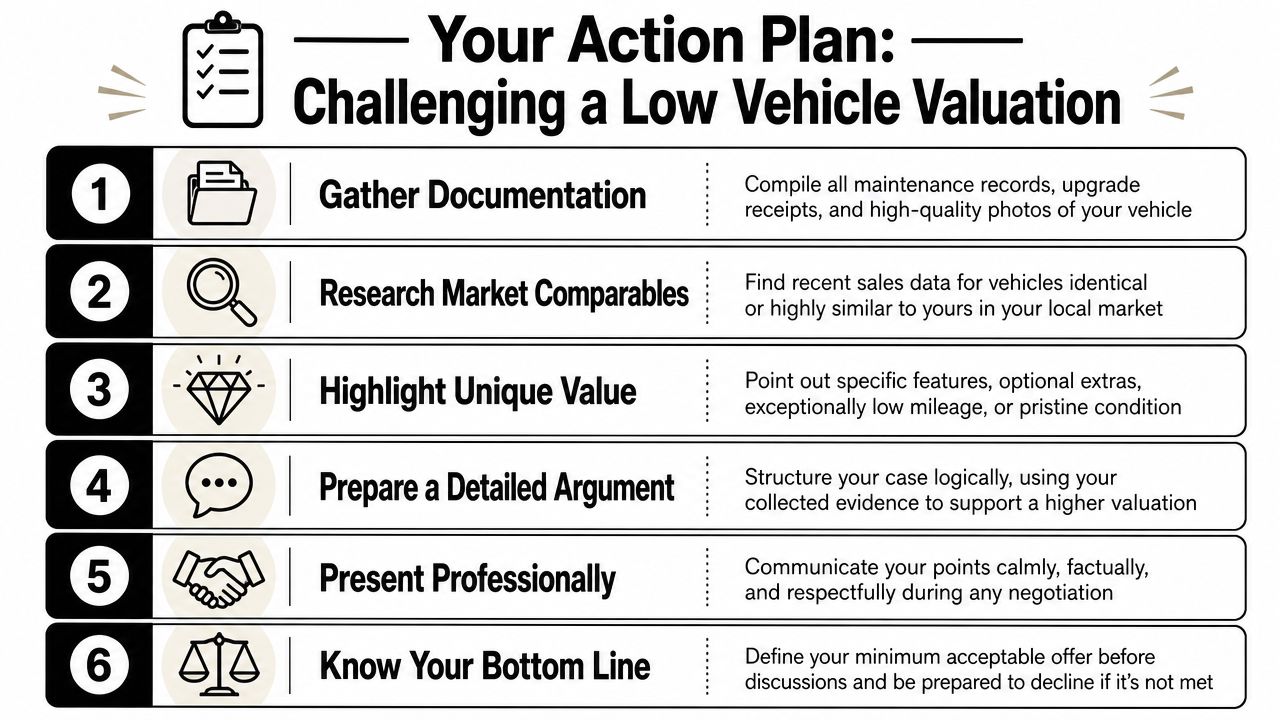
Get the full valuation report
Ask for every comparable, every adjustment, the condition rating, the mileage logic, and any source data used to build the offer.Audit the comparables yourself
Look for trim mismatches, omitted options, bad condition assumptions, prior damage history, remote geography, and unrealistic dealer adjustments.Build your own market file
Collect cleaner comparables. Focus on vehicles that resemble yours in configuration, condition, and local availability.Add the lost-utility argument
Explain how the insurer's number fails to reflect the transportation service your vehicle provided. If the car served business, family logistics, or specialized needs, say so clearly and factually.Write a concise counterpackage
Don't bury your point. Lead with the insurer's errors, then your comparables, then your utility-based support.Use the appraisal clause if the policy allows it
This is often the point where the dispute stops being casual and starts becoming serious.
Present it like an appraiser would
Keep the tone controlled. You are not asking for a favor. You are challenging a valuation conclusion.
A short structure works best:
- State the disputed offer
- Identify the valuation defects
- Provide superior comparables
- Explain why replacement utility is understated
- Request a revised valuation or formal appraisal process
To help you sharpen your thinking before you send anything, watch this overview:
A good dispute package makes it harder for the insurer to hide behind software.
If the insurer still refuses to move, stop debating in circles. Bring in an independent appraiser who understands total-loss and diminished value methodology, knows how to document market defects, and can invoke the appraisal clause when appropriate.
If you're dealing with a low total-loss offer or a diminished value claim, Total Loss Northwest can step in with a certified independent appraisal built for negotiation, not guesswork. They specialize in auto total-loss and diminished value appraisals, invoke the appraisal clause on your behalf, and produce detailed reports that challenge insurer software with real market analysis. If you want a defensible number instead of a take-it-or-leave-it offer, they're the right next call.