You pick up your car from the body shop. The paint matches. The panels line up. It drives straight. On paper, the repair is done.
Then you try to trade it in, sell it privately, or even just check what similar cars are bringing. That's when the second hit lands. Your vehicle now carries an accident history, and buyers discount that history even when the repairs are excellent. That loss is the part many drivers miss after a crash.
In Ohio, that loss may support a diminished value claim Ohio drivers can pursue against the at-fault driver's insurer in the right situation. The hard part isn't understanding that your car is worth less. The hard part is proving it in a way an adjuster can't brush aside.
The Hidden Cost of an Accident You Did Not Cause
A lot of drivers learn about diminished value the same way. They don't hear it from the insurer. They hear it from a dealer, a buyer, or a finance manager who says some version of, “Nice car, but it's been in an accident.”
That's inherent diminished value. The vehicle lost market value because the accident is now part of its history. The repairs may be perfect. The stigma remains.

Why repaired does not mean restored in value
Buyers don't shop for repaired vehicles the same way they shop for clean-history vehicles. They worry about prior structural work, future reliability, and what the next buyer will think. Dealers do the same thing when they write trade numbers.
That concern gets even sharper if the repair file shows frame work, major panel replacement, or any repair that will make a history report harder to explain later. If you've ever wondered why title history matters so much in resale, this overview of salvage titles in Ohio helps show how strongly the market reacts to anything that signals prior damage.
The loss is real, even if the car looks great
Drivers understandably get frustrated. You didn't ask for the crash. You cooperated with the repair process. You got the car fixed. Yet the financial loss remains.
A vehicle can be fully repaired and still be worth less in the marketplace. Those are two different questions.
If you've looked at guidance from other states, some of the same practical issues show up there too. This Tampa diminished value claim guide is useful because it frames the core problem clearly. Insurance focuses on repair cost. The market focuses on accident history.
Ohio drivers need more than that general idea, though. They need the Ohio-specific rules that decide whether a claim exists, how fault changes recovery, and what evidence moves money.
Confirming Your Right to Claim Diminished Value in Ohio
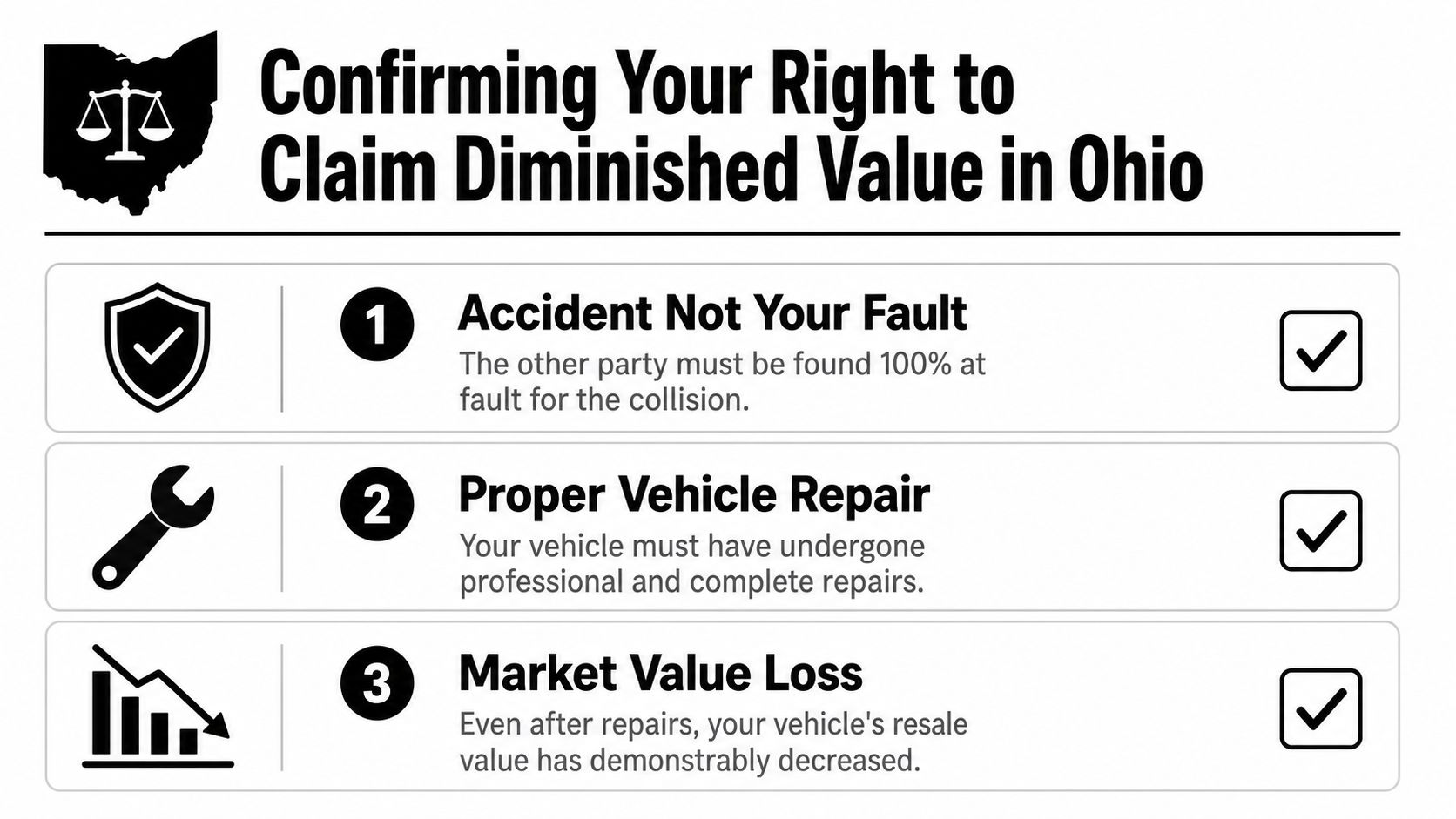
You pick up your car from the body shop, the repair looks clean, and the other driver's insurer acts like the claim is over. It usually is not. In Ohio, the right to pursue diminished value turns on three legal questions: whose policy should pay, whether you are still within the filing deadline, and how fault is divided.
Start with the claim type
In Ohio, diminished value is usually a third-party property damage claim. You are seeking payment from the at-fault driver's liability carrier. Drivers often assume their own collision coverage should also pay for the loss in resale value, but that is usually not how these claims are handled.
For a broader legal framework, see this guide on understanding diminished value laws. The short version is simple. Repairs address the physical damage. Diminished value addresses the market penalty that remains after the repairs are done.
The filing deadline and fault rule decide many Ohio claims
Ohio law gives you a limited window to bring a property damage claim, including a diminished value claim. Under Ohio Revised Code § 2305.10, that deadline is generally two years.
Fault matters just as much. Ohio follows a modified comparative negligence rule. That is the point many articles miss. You can still recover diminished value if you were partly at fault, as long as your share of fault does not exceed Ohio's legal cutoff. If you are found more than 50% at fault, recovery is barred. If you are 50% or less at fault, you may still collect, but your recovery is reduced by your percentage of fault.
In Ohio, partial fault does not automatically kill a diminished value claim. It changes the amount you can recover.
That distinction matters in real claims. I see it often in left-turn crashes, merge collisions, and parking lot impacts where both drivers blame each other. An insurer may try to treat any shared fault as a reason to deny the claim outright. Ohio law does not work that way.
Shared fault changes the math, not just the argument
Here is the practical effect. If your vehicle's proven diminished value is $4,000 and you are found 25% at fault, the legal issue is not whether the loss exists. The issue is how much of that loss remains collectible after the fault reduction. In that example, the claim value would be reduced to $3,000.
That is why drivers should not accept a quick denial based on vague language like “comparative negligence applies.” Comparative negligence is not the end of the analysis. It is the start of the valuation math.
A quick screen before you invest time in the claim
Use these questions to judge whether the claim is worth pursuing:
| Question | Why it matters |
|---|---|
| Was another driver at least partly responsible for the crash? | Ohio diminished value claims are usually made against the other driver's liability insurer. |
| Are you still within the two-year filing period? | Missing the deadline can end the claim regardless of how strong the loss is. |
| Is your fault at 50% or less? | Ohio allows recovery up to that threshold, with the payment reduced by your share of fault. |
| Does the vehicle have enough market value and accident-related stigma to show a measurable resale loss? | Some repaired vehicles support a strong claim. Others do not justify the cost and effort. |
| Can you prove the car's pre-accident condition and the extent of the repairs? | Insurers challenge diminished value claims when the file is thin or the vehicle had prior damage issues. |
A valid Ohio claim starts with legal eligibility. Then it rises or falls on proof.
Building an Unbreakable Case with the Right Evidence
Adjusters don't pay diminished value claims because a driver feels shortchanged. They pay when the file makes the loss hard to deny.
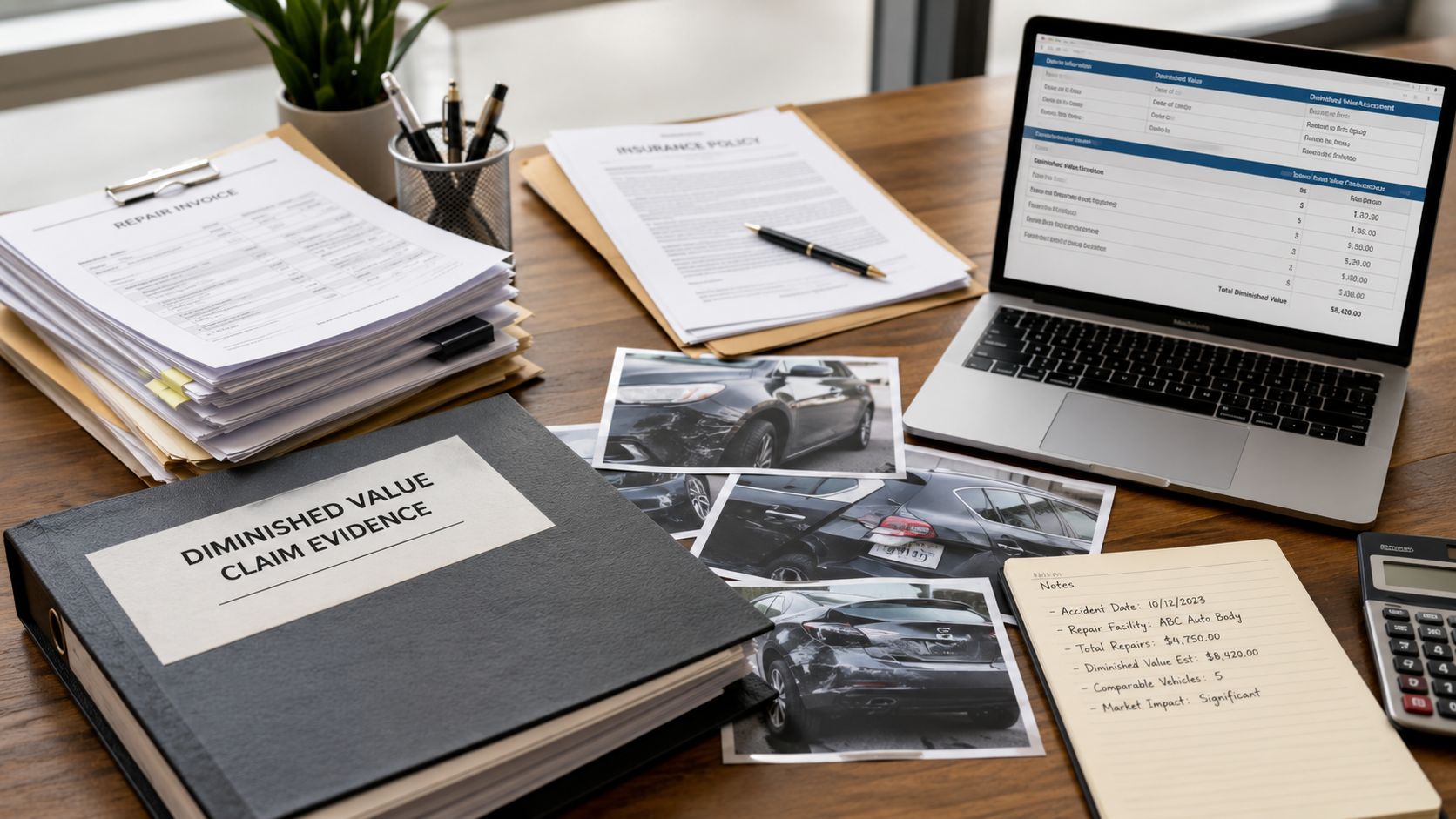
That file starts with basic documents and then gets stronger when you add an independent, market-based appraisal.
The foundation documents every strong claim needs
The first layer is straightforward, but drivers often leave gaps:
- Police report that helps establish liability. If fault is contested, diminished value negotiations usually stall.
- Pre-repair and post-repair photos showing the scope of damage and the condition after repairs.
- Itemized repair invoice listing what was repaired or replaced, especially if there was structural or frame-related work.
- Vehicle history and ownership records that support pre-accident condition and help rebut claims of prior unresolved damage.
These aren't glamorous documents, but they give the appraiser and the adjuster a common factual record.
Ohio requires proof at three stages
In Ohio, a strong diminished value case must establish fair market value at three distinct stages: immediately before the collision, immediately after the accident in the damaged state, and again after repairs are completed. That three-part valuation approach is tied to Ohio appellate guidance discussed in this explanation of Ohio diminished value evidence requirements.
That requirement changes how you build the file. A simple “my car is worth less now” argument isn't enough. You need an evidentiary chain.
Here's the practical version:
Before the crash
What was the vehicle's fair market value with its actual mileage, condition, trim, and options?Damaged state
What was it worth immediately after the collision, before repairs?After repairs
What is it worth now that the work is complete, with an accident history attached?
Miss one of those stages and the insurer has room to attack the claim.
The independent appraisal is the centerpiece
This is the document that separates a serious claim from a weak one. A USPAP-compliant diminished value appraisal from an independent appraiser gives the insurer a valuation grounded in market evidence, not guesswork.
A good report should do more than announce a number. It should show how the number was reached by analyzing comparable vehicle sales, accident-history impacts, repair severity, and the market reaction to similar units.
If you're not sure what that report should include, this page on a diminished value claim appraisal is a good benchmark.
Practical rule: If the adjuster can say, “There's no support for this amount,” your file isn't ready yet.
A weak appraisal also creates problems. I've seen reports that rely too heavily on generic calculators, broad national assumptions, or unsupported condition adjustments. Those reports don't hold up well in negotiation because the insurer can dismiss them as theoretical.
This video offers a useful primer on how appraisals and valuation disputes tend to unfold:
What insurers usually exploit
Insurers look for missing links. Common weak points include:
- No damaged-state value. Ohio's three-stage framework makes this a real problem.
- Thin repair documentation. If the file doesn't clearly show the severity of repairs, the insurer can minimize the market effect.
- No independent appraisal. Without one, the claim often turns into your opinion versus their software.
- Prior condition issues left unaddressed. If the vehicle had earlier damage, repaint work, or title problems, the appraisal must separate those issues from the current loss.
Build the file like you may need to defend it later
Organize the claim packet in a simple order: crash documents, photos, repair records, appraisal, then your written demand. Don't scatter evidence across email threads and text messages.
The strongest diminished value files are easy to follow. When the adjuster opens the packet, the story should be obvious. Clean car. Documented crash. Complete repairs. Remaining market stigma. Supported dollar loss.
How to Calculate and Demand Your Full Compensation
You pick up your repaired car, it looks fine, and then the adjuster offers a number based on a formula you have never heard of. That is where many Ohio drivers get shorted.
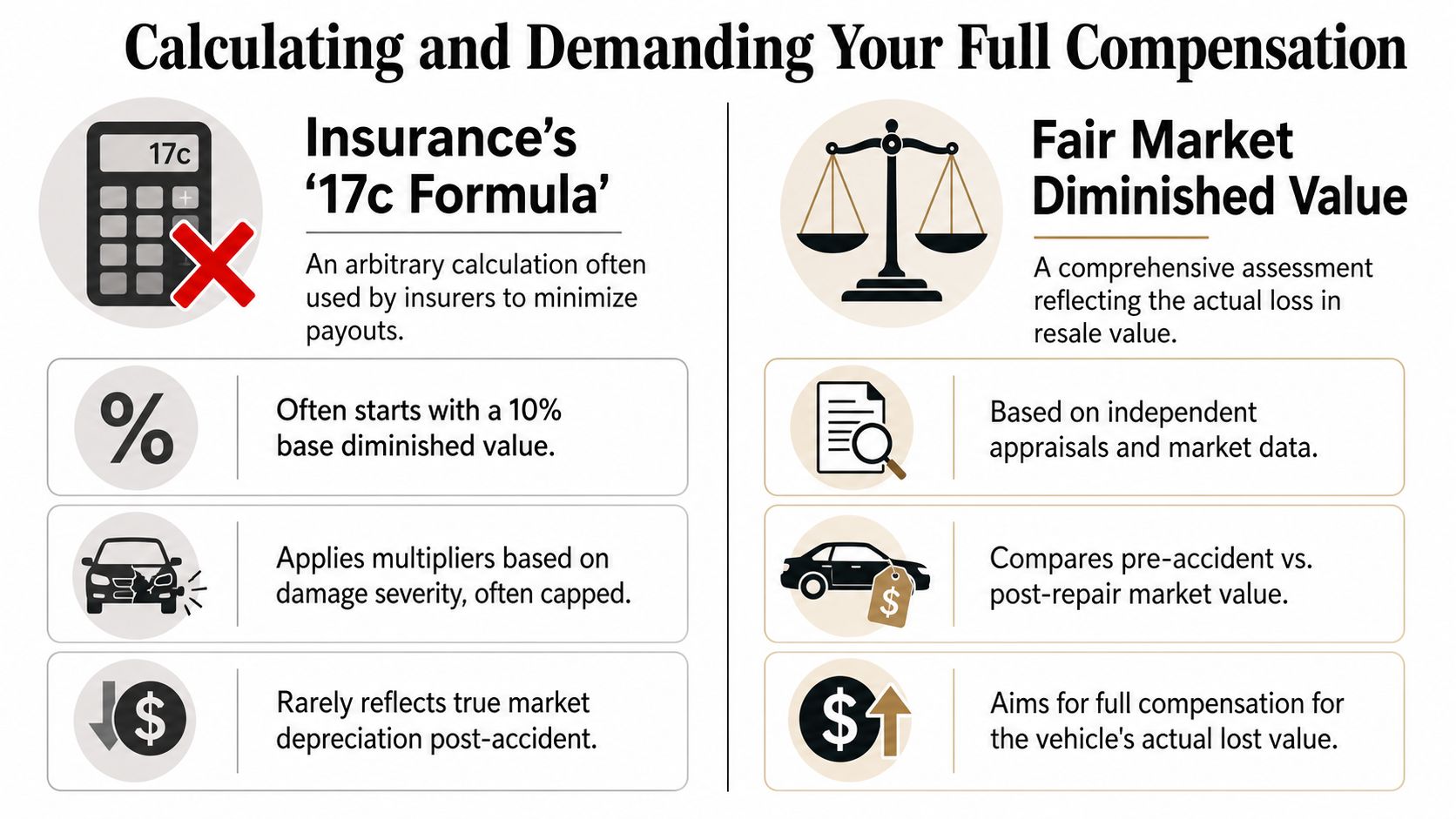
The usual shortcut is the 17c formula. Adjusters like it because it is fast and predictable. It is also a poor fit for many real-world diminished value claims, especially on newer vehicles, higher-trim models, and vehicles with documented structural or panel replacement history. Ohio does not require you to accept a canned formula if the market evidence shows a larger loss.
Why the 17c formula usually comes in low
The 17c method starts with an artificial cap tied to a percentage of pre-accident value, then reduces the claim again with damage and mileage modifiers. That may be convenient for the insurer, but buyers in the Ohio market do not price vehicles that way. They react to accident history, repair type, vehicle age, brand reputation, and whether the Carfax or AutoCheck report shows moderate or severe damage.
A market-based appraisal tracks how buyers and dealers discount a repaired vehicle. That approach gives you something you can defend. It also puts pressure on the adjuster to respond to evidence instead of repeating a formula.
Ohio fault rules matter here too. If the insurer argues you were partly responsible for the crash, the diminished value analysis still starts with the full loss in market value. Then the claim may be reduced by your share of fault. Under Ohio's modified comparative negligence rule, a driver who is 50% or less at fault can still recover a reduced amount. If fault is 51% or more, recovery is barred. Many claimants miss this and assume partial fault kills the claim. It does not, unless you cross that line.
Calculate the claim the way an appraiser would
A sound diminished value number usually comes from three steps:
- Establish pre-loss value. Use the vehicle's actual condition, options, mileage, and local market position before the accident.
- Measure post-repair market value. Look at how the accident and repairs affect what informed buyers will pay now.
- Calculate the difference. That gap is the diminished value.
The method sounds simple because it is. The hard part is doing each step with support the insurer cannot pick apart.
Here is what usually changes the number most:
| Factor | Why it changes value |
|---|---|
| Structural damage or replacement | Buyers and dealers discount these vehicles more heavily |
| Airbag deployment | Signals a more serious loss history |
| Quarter panel, roof, or unibody repairs | Carries more stigma than minor bolt-on part replacement |
| Vehicle age and mileage | Newer, lower-mile vehicles often show a clearer market penalty |
| Brand and trim level | Some vehicles are more sensitive to accident history in resale |
| Prior damage history | The current loss must be separated from earlier issues |
Build the demand around the strongest number you can prove
Your demand amount should come from the appraisal, not from frustration over the accident and not from a random online calculator.
A good demand letter does five jobs quickly:
- Identifies the claim with the date of loss, claim number, vehicle details, and parties involved
- States the liability position and, if needed, notes any agreed percentage of comparative fault
- Summarizes the repairs in plain language, with the repair invoice attached
- States the diminished value amount supported by the appraisal
- Requests payment by a clear deadline and asks for the insurer's position in writing if they disagree
If comparative fault is in play, show the math. For example, if the appraisal supports $4,000 in diminished value and you are 20% at fault, the demand should explain that the net claim is $3,200. That keeps the discussion focused and prevents the adjuster from acting as if partial fault wipes out the claim.
Keep the letter plain and hard to misread
Use a business tone. Short paragraphs work well. One page is often enough if the attachments are organized.
This structure works:
- Identify the vehicle and loss date.
- State that the other driver was at fault, or state the agreed fault allocation.
- Confirm the vehicle was repaired and attach the repair records.
- State that the vehicle still suffers measurable post-repair diminished value.
- Attach the appraisal and demand that amount, adjusted for any comparative fault if applicable.
- Ask for a written response by a specific date.
Do not fill the letter with legal threats. Do not argue every emotion tied to the accident. Insurers pay attention when the file is organized, the number is supported, and the math is clear.
Navigating Negotiations and Escalation Tactics
The first offer is often the easiest one for the insurer to justify internally. It is not usually the best one for you.
If the adjuster comes back with a low number, don't react emotionally. Treat it like a negotiation over evidence, because that's what it is.
How to answer a low offer
Start by asking the adjuster to identify the basis for the offer in writing. If they used a formula, ask what market data supports it. If they reject your appraisal, ask which assumptions, comparables, or condition judgments they dispute.
Short responses work best:
- “Please identify the valuation method used to reach your offer.”
- “Please specify which part of the appraisal you contend is unsupported.”
- “Please provide any comparable sales or internal valuation material you relied upon.”
That shifts the pressure back where it belongs. If they're discounting your evidence, they should explain why.
Use your appraisal as the anchor
Your independent report should remain the center of every response. Don't let the discussion drift into broad statements like “we don't usually pay that much” or “the repairs made the vehicle whole.”
A better reply is direct: the repairs addressed physical damage, but the appraisal documents the remaining loss in market value after repair. That is the issue under review.
A calm, evidence-based counter usually gets more traction than a heated complaint call.
When the adjuster won't move
At some point, negotiation stops being productive. When that happens, escalation becomes a practical decision.
Three paths usually come up:
Supervisor review
Ask for a management review if the adjuster won't explain the valuation gap. Sometimes a fresh set of eyes helps.Appraisal clause review
In some insurance disputes, the Appraisal Clause can move valuation out of the adjuster's hands and into a neutral process. Whether that path is available depends on the policy language and the posture of the claim. It's worth examining carefully before you assume you're stuck.Court or counsel
If the amount at stake justifies it and the insurer remains unreasonable, you may consider small claims court or hiring an attorney. The right choice depends on the claim size, the clarity of liability, and how strong your documentation is.
Decide based on leverage, not frustration
Not every denied or underpaid claim belongs in court. Some do. The smart question is whether your evidence is strong enough to make escalation cost-effective.
If your file is thin, escalation rarely fixes that. If your file is solid and the insurer is still digging in, pressure often changes the outcome.
Ohio Diminished Value Claim FAQs
Is a diminished value claim worth it on an older car
Sometimes, yes.
A key question is whether the likely recovery justifies the time and appraisal cost. Older vehicles with high mileage, prior cosmetic wear, or a low pre-loss value often show a smaller measurable hit in the resale market after repairs. In those cases, a full diminished value fight may not make financial sense.
But I have seen older vehicles support good claims when they were unusually clean, well-kept, hard to replace, or repaired after damage that will follow the VIN history. Age alone does not decide the case. Market reaction does.
What about a collector, specialty, or high-value vehicle
These vehicles need a different level of analysis.
A standard insurer worksheet often misses how buyers in a specialty market react to prior damage. Collector cars, performance models, rare trims, and high-end vehicles can lose value in ways a generic passenger-car formula does not capture. The buyer pool is smaller, expectations are stricter, and documented damage history can affect sale price far more than it would on a typical commuter car.
That is why these claims should be handled by someone who knows the segment, not just the repair bill.
Can I still pursue a claim if I already took an insurance check
Maybe. It depends on what the payment covered and what you signed.
A check for repairs does not always waive a separate diminished value claim. A signed release can. If you are not sure where you stand, this explanation about an accepted an insurance check claim is a useful starting point.
Read the settlement language closely. If the insurer paid for repair costs only, you may still have room to pursue the vehicle's post-repair loss in market value. If you released all property damage claims, the path gets much harder.
What if I was partly at fault for the crash
Ohio's modified comparative negligence rule matters here, and many drivers miss it.
If you were partly at fault, you may still recover diminished value as long as your share of fault does not exceed 50 percent. Your recovery is reduced by your percentage of fault. If you were 20 percent responsible, your recoverable diminished value is reduced by 20 percent. If you are 51 percent or more at fault, recovery is typically barred.
This comes up often in lane-change crashes, intersection collisions, and other cases where liability is shared. Do not walk away from a valid claim just because the insurer says fault is mixed. In Ohio, partial fault does not automatically end the case.
What if the at-fault driver was uninsured or underinsured
That depends on your policy.
Ohio diminished value claims are usually made against the at-fault driver's property damage coverage. If that driver has no insurance or not enough insurance, the answer may turn on whether your own policy includes uninsured or underinsured property damage language that could apply. Some drivers assume there is no path once the other side lacks coverage. That is not always correct.
Pull the policy and read the property damage and UM/UIM sections carefully. If the language is unclear, have a lawyer or qualified claims professional review it before you give up on the claim.
What is a common mistake drivers make
A common mistake is waiting too long to document the loss, then trying to prove diminished value with a guess or an online number that cannot be defended.
Another is accepting the insurer's valuation method without asking what sales data, market comparisons, or condition adjustments support it. A diminished value claim in Ohio gets stronger when liability is clear, the repair file is complete, and the value loss is tied to actual market evidence.