You picked up your car from the body shop. The paint matches. The panels line up. The repair invoice says everything was done correctly.
And yet you already know the problem.
If you trade that car in, list it for sale, or let a dealer appraise it, the accident history follows the VIN. Buyers will see it. Dealers will price for it. Insurance companies know this, but many still act as if a clean repair erased the loss.
It didn't. That loss is called auto diminished value. If you weren't at fault, you should treat it as a real claim, not an afterthought.
Your Car Is Repaired So Why Is It Worth Less
A repaired car and a clean-history car are not the same asset. That's the issue.
The body shop restores function and appearance. It doesn't restore market perception. Once the accident hits a vehicle history report, the car stops competing against clean-history vehicles on equal footing. Buyers compare listings, spot the damage record, and either walk away or lower their offer.
That's why people feel blindsided after a claim closes. They think the insurance company paid for repairs, so the financial harm must be over. It isn't. The unseen loss often starts when the repair is finished.
The record matters more than the repair
A vehicle history report changes the conversation before a buyer ever drives the car. A listing with a reported accident gets filtered differently. A dealer looking at trade-in exposure prices in extra risk. A private buyer starts wondering what they can't see.
If you want to understand how that reporting affects resale, this overview of an insurance loss reported on vehicle history is worth reading. It helps explain why a clean-looking car can still carry a market penalty.
A flawless repair can fix the car. It can't erase the disclosure history attached to it.
What owners get wrong
Most owners assume diminished value only applies if the repair was poor. That's not true. Poor repairs can cause their own loss, but even excellent repairs can leave you with a car that sells for less.
Start from this rule: if the accident changed how the market sees the vehicle, you likely have an auto diminished value issue. That's especially important if your car is newer, higher trim, luxury, electric, custom, or expensive enough that buyers become selective.
What Exactly Is Inherent Diminished Value
There are a few categories people lump together under diminished value, but one matters most in real claims: inherent diminished value.
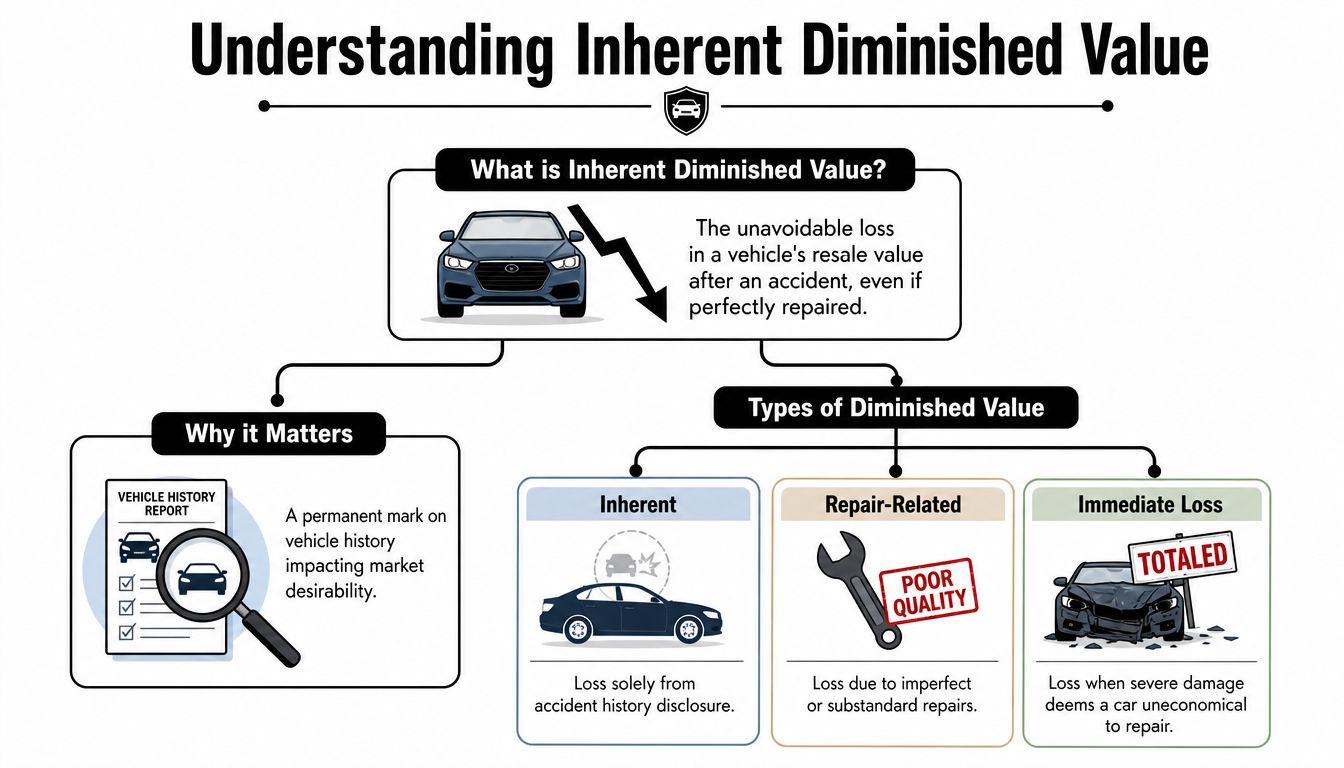
That's the automatic loss in resale value caused by the fact that the vehicle now has an accident history. Not bad repairs. Not unrepaired damage. Just the stigma and pricing penalty that comes from disclosure.
Inherent diminished value is the loss that remains after proper repairs because the market values an accident-history vehicle less than a comparable clean-history vehicle.
The three types you should separate
People use the term loosely, so separate it properly:
- Inherent diminished value is the market loss from accident history alone.
- Repair-related diminished value comes from poor workmanship, non-matching paint, improper fitment, or other repair defects.
- Immediate diminished value refers to the drop in value right after the accident before repairs are completed.
For most drivers pursuing a claim after repairs, the primary battle is over inherent diminished value.
Why the market discounts repaired cars
Think of two identical collector sneakers. One pair is original. The other was professionally restored after damage. The restored pair may look excellent, but collectors still discount it because originality matters and the history changed.
Cars work the same way.
The market doesn't ask only, “Does it drive right?” Buyers ask whether the car had structural damage, whether air bags deployed, whether OEM parts were used, whether hidden issues may surface later, and whether they'll face the same resale penalty when they sell it next. That suspicion reduces value even when the repair shop did everything right.
The documented market effect is substantial. According to the Wikipedia overview of diminished value, a repaired vehicle's market value can remain 10% to 33% lower than a clean-history equivalent due to buyer stigma, and severe structural failures can push losses even higher.
Who gets hit hardest
Not every vehicle takes the same hit. Buyers of premium vehicles tend to be stricter. They expect clean histories, original structural integrity, and a tighter standard for what counts as acceptable prior damage.
That's why owners of newer luxury cars, EVs, collector vehicles, and high-spec trims usually need to take this issue seriously. Their buyer pool is narrower, more informed, and less forgiving.
How Vehicle Type and Damage History Impact Value
Insurance companies like broad formulas because broad formulas are easy to defend in a file. The market doesn't work that way.
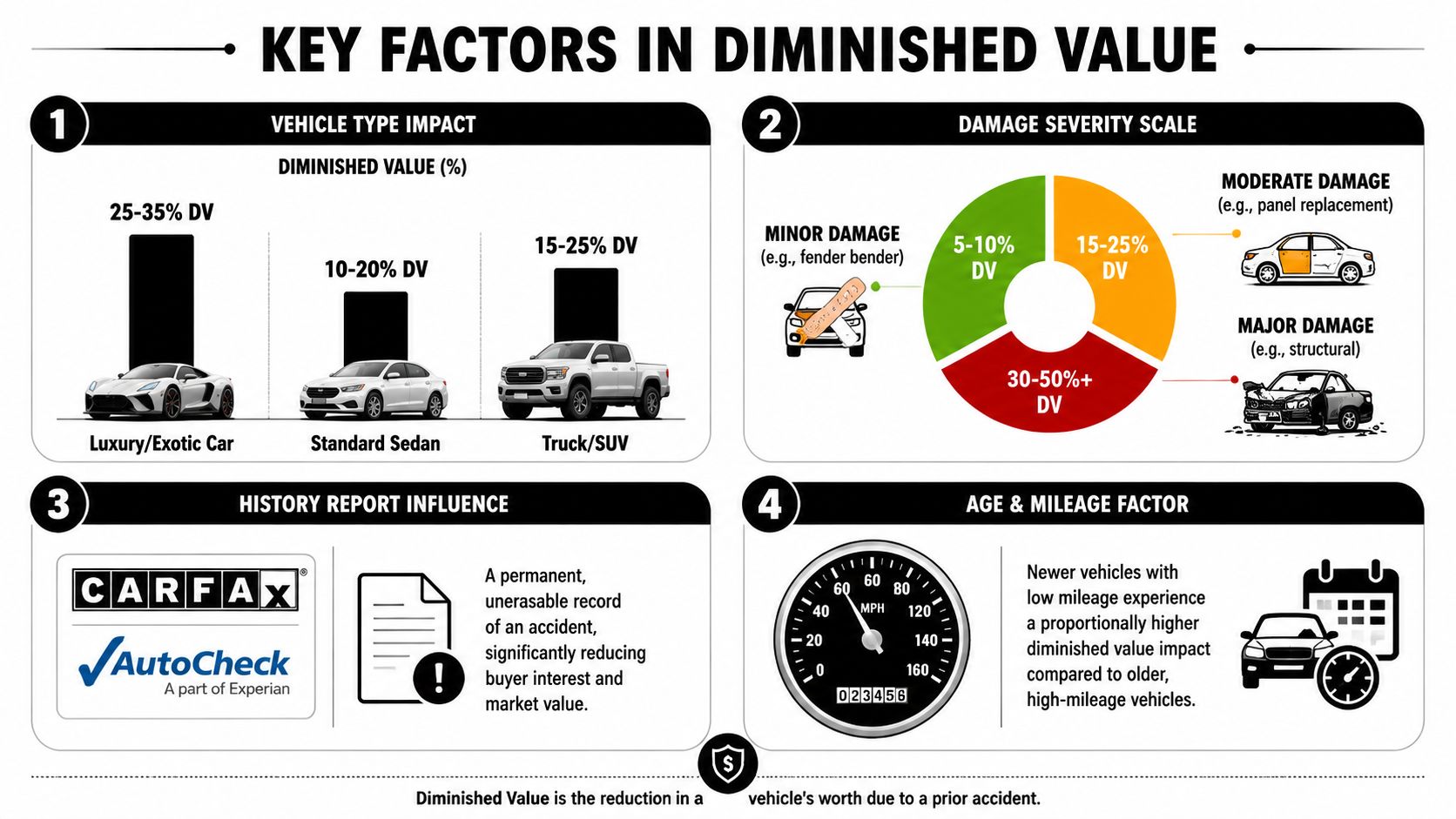
Auto diminished value changes based on what you drive, how severe the damage was, and what the history report now says about the car. A compact commuter with cosmetic damage doesn't get judged the same way as a luxury sedan, premium SUV, or EV with a branded accident record.
Some vehicles lose far more than others
The strongest example is segment sensitivity. According to vehicle segment diminished value ranges, EVs see the highest impact at 18% to 30% of pre-accident market value, while compact economy cars see the lowest at 6% to 10%. The same source states that luxury sedans lose 15% to 25% and premium SUVs lose 12% to 22%.
That tracks with real buyer behavior. EV shoppers worry about hidden battery-area damage, calibration issues, and future resale. Luxury buyers pay for condition and pedigree, not just transportation. Once the car has a reportable accident, the discount becomes sharper.
Damage history isn't just a note on paper
A CARFAX or AutoCheck entry changes pricing because it changes buyer confidence. The market doesn't treat “prior accident” as neutral information.
Here's what usually drives the discount:
- Structural concern: Even if repaired, structural damage raises questions that never fully disappear.
- Disclosure friction: Every future sale starts with an explanation.
- Dealer risk: Dealers know they may need to sell the vehicle at a discount later.
- Selective buyer pool: Higher-end buyers have more alternatives and less tolerance.
Repair quality still matters, just not in the way owners think
Good repairs matter because they reduce repair-related loss. They do not eliminate inherent loss.
That's where parts quality enters the conversation. If your shop used aftermarket replacement parts, learn the benefits of CAPA certified components. CAPA certification doesn't erase accident history, but it can strengthen the repair side of the file by showing the parts met a recognized standard instead of the cheapest available option.
Why broad formulas miss the real number
A formula can't capture segment sensitivity very well. It won't reflect that one buyer category shrugs at an accident while another walks immediately. It won't reflect that some vehicles rely heavily on originality, brand perception, or clean-history resale confidence.
Use the formula if you want a low starting point. Use market comparisons if you want a number grounded in how buyers price damaged history.
The Insurance Company Formula Designed to Undervalue Your Car
Your insurer approves the repairs, the body shop does solid work, and then the diminished value offer shows up far below what you know buyers will discount for an accident history. That gap usually starts with one tool: the 17c formula.
Insurers like 17c because it produces a controlled number. It starts by capping diminished value at 10% of the vehicle's pre-accident value, then cuts that figure again with damage and mileage modifiers. The worksheet looks orderly. The result is often far below the loss the market assigns to an accident record.
Why 17c fails as a valuation method
The first problem is the cap itself.
A formula that limits the claim before it examines the actual market loss is built to suppress the outcome. If your vehicle lost more in resale value than that preset ceiling allows, 17c never had a chance of reaching the right number. Then the insurer applies more reductions on top of that ceiling.
That is why these offers feel detached from reality. They are detached from reality. The method was designed for administrative consistency, not for measuring what a buyer, dealer, or appraiser would do with your car in the market.
Use this rule: Treat a 17c offer as a low opening position, not a reliable measure of diminished value.
It does not reflect how vehicles are bought, traded, or appraised
No informed buyer walks onto a lot and says, “Let's start with 17c.” Dealers do not price trade-ins that way either. They look at accident history, vehicle segment, prior listings, local demand, condition, mileage, trim, and how much resistance that history will create at resale.
A proper diminished value analysis asks one question: what is the market difference between this vehicle with a clean history and the same vehicle with a reported accident?
That is the standard that matters. If you want broader context on insurer valuation methods, this guide on how an insurance company values a car gives useful background. The same pattern shows up here. The carrier relies on a formula. You need market proof.
How to respond to a low formula offer
Stay disciplined. Keep the discussion on method and evidence.
- Ask the adjuster to identify the valuation method. Get confirmation that they used 17c or a similar in-house formula.
- Request every input used in the calculation. That includes pre-accident value, mileage adjustment, damage severity adjustment, and any condition assumptions.
- Attack the foundation. If the method ignores the market, the number it produces is weak from the start.
- Answer with a market-based appraisal. A documented appraisal gives you a position tied to comparable sales and actual buyer behavior, not an internal claims worksheet.
That is how you shift the claim. You stop reacting to a small number and start forcing the insurer to defend a flawed method.
A Step by Step Guide to Filing Your Diminished Value Claim
Your car is back from the shop. It looks right, drives right, and the insurer acts like the file should be closed. Then you try to sell it, trade it, or get dealer bids, and the accident history follows the car everywhere.
That is the moment to file a diminished value claim. Do it in the right order, and you control the record instead of reacting to an adjuster's number.
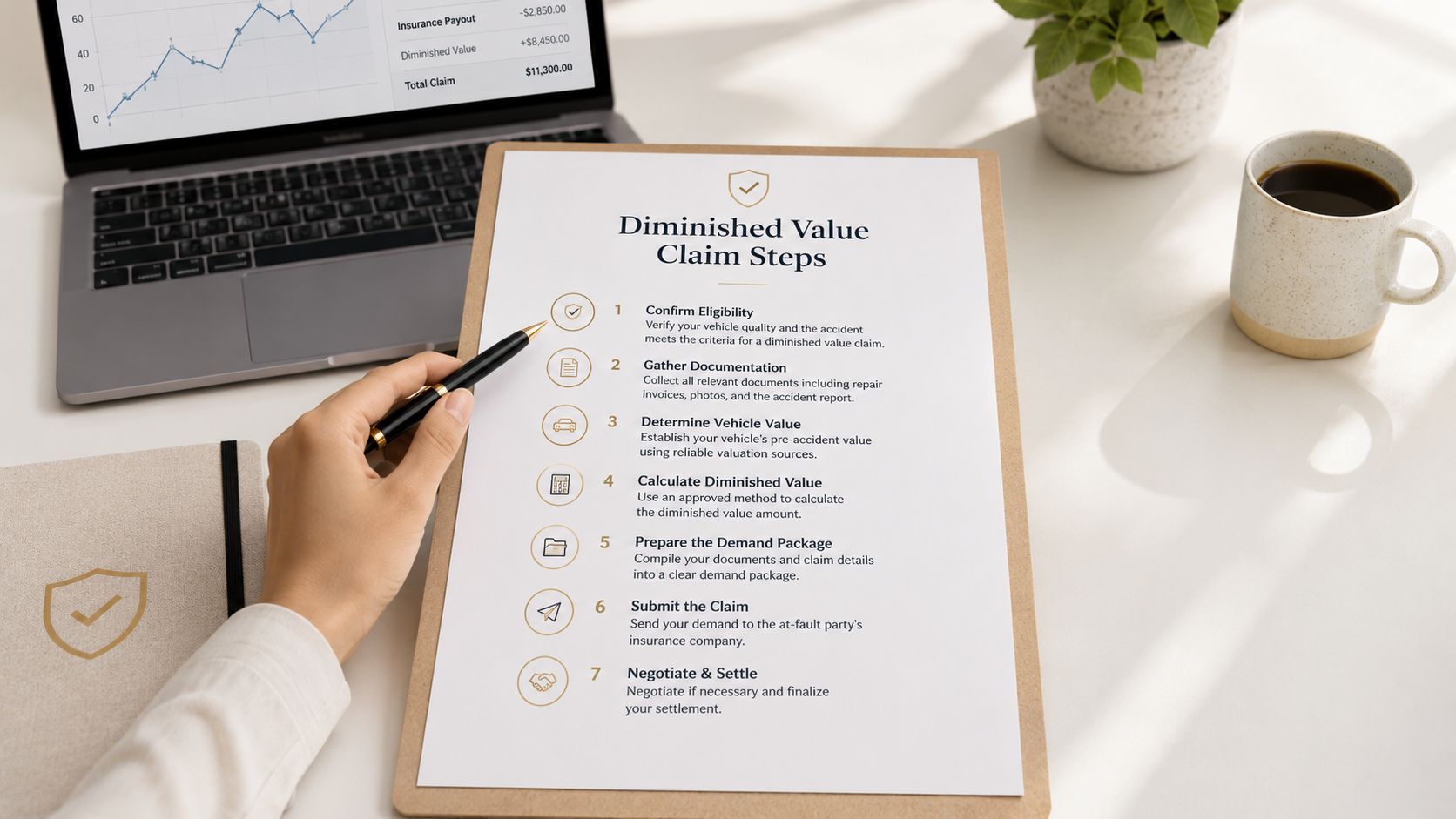
Confirm you have a viable claim
Start with liability. Diminished value claims are usually strongest when the other driver caused the crash and their insurer is paying for the damage.
Then check the deadline in your state. These claims exist in many states, but the filing window depends on local law. Do not wait. Delay makes records harder to gather, gives the carrier room to question the claim, and weakens your position for no reason.
Build the file before the argument starts
Adjusters pay more attention to a clean, documented file than a long chain of emotional emails. Your goal is simple. Make the loss easy to see and hard to dismiss.
Gather these items first:
- Crash records: Police report, claim number, and any written fault decision or admission
- Repair paperwork: Final invoice, parts replaced, paint and refinish details, and supplements
- Photos: Damage before repair, repair progress if you have it, and final post-repair condition
- Vehicle information: VIN, mileage at the time of loss, trim, packages, and ownership details
- History reporting: Proof the accident now appears on the vehicle history record, if available
Control the first conversation with the insurer
Do not ask the adjuster what they think your car lost. Ask what method they used.
That distinction matters. If you let the discussion start with their number, you are already on defense. If you start with method, support, and assumptions, you force the carrier to explain how it reached the number. That is exactly where weak formula-based valuations start to crack.
If they make a quick offer, respond in writing. State that you are requesting the valuation basis, all calculation inputs, and the documents used to support the diminished value figure. Keep it professional and short.
Get an appraisal before the carrier anchors the claim too low
A newer vehicle, a premium model, an EV, a performance car, or a vehicle with structural or substantial panel damage should not be argued from guesswork. Get an appraisal tied to the market.
A qualified independent car appraiser for diminished value can document what buyers, dealers, and comparable sales indicate your vehicle lost after the accident hit its history. That gives you a real number to present, not a figure built from an internal worksheet.
The insurer has a process. You need evidence.
Send a written demand package
Once your repairs are complete and your support is assembled, send a formal demand. Do not scatter documents across multiple emails. Send one organized package.
Include:
- Your claim number and vehicle identification details
- A short statement confirming you were not at fault
- The repair summary and completion date
- Your supporting diminished value evidence, including the appraisal if obtained
- The amount you are demanding
- A clear deadline for response
Write like a professional, not like someone asking for a favor. You are presenting a property damage claim with support.
After you understand the process, this walkthrough can help reinforce the sequence:
Escalate if the adjuster stalls or repeats a formula number
Some adjusters delay. Others recycle the same low number and hope you get tired. Neither response changes the value your car lost.
Ask for a supervisor review in writing. Ask the carrier to address your evidence directly, point by point. If the claim runs through your own policy and your contract includes an Appraisal Clause, invoke it if the dispute is really about value. That can move the case out of the ordinary claims routine and into a process focused on competing valuations.
Keep every communication disciplined
Use email whenever possible. Confirm phone calls in a short follow-up message. Save every estimate, invoice, photo, and letter.
Strong diminished value claims usually come down to one thing. The owner stayed organized and made the insurer respond to evidence instead of letting the carrier hide behind a formula.
How Independent Appraisals Maximize Your Settlement
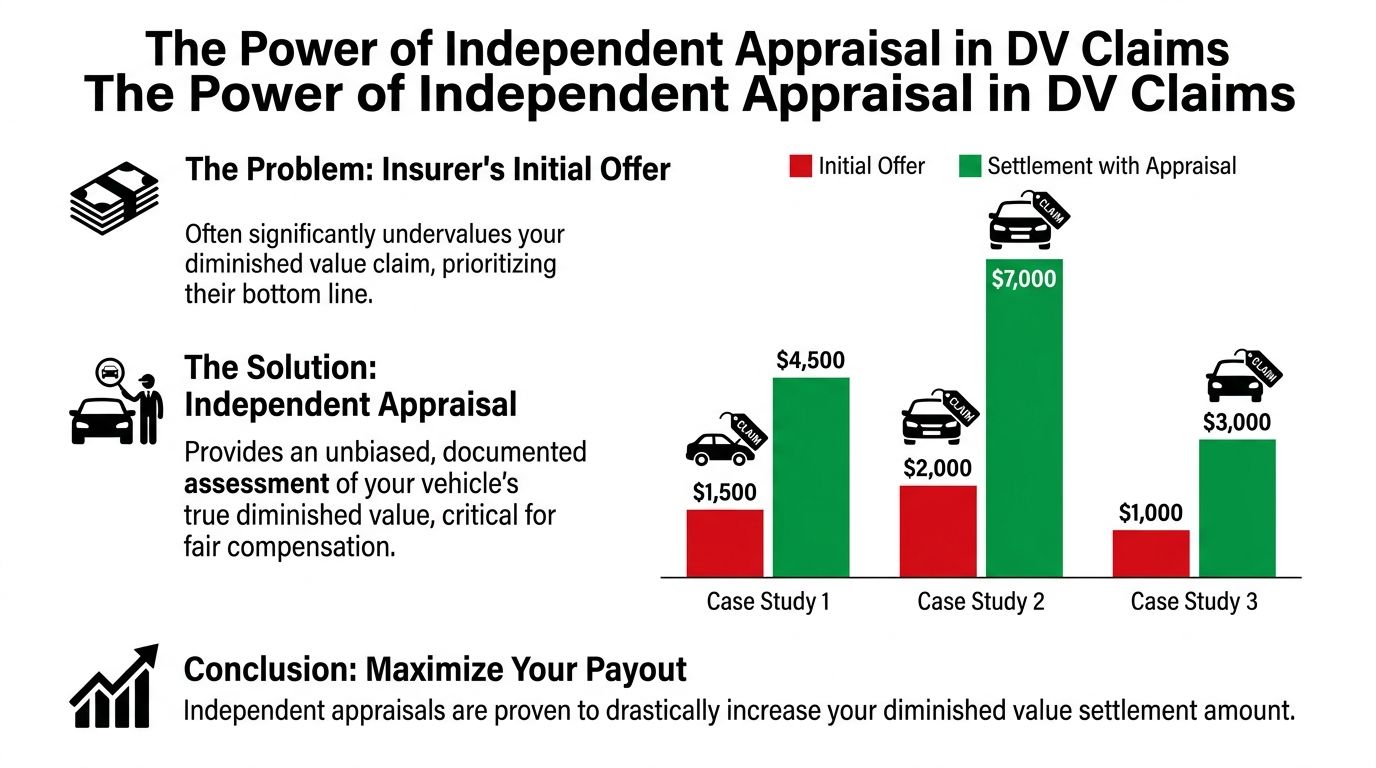
An independent appraisal is the single most important tool in a serious auto diminished value claim. Without it, you're usually arguing with an adjuster who has a formula and no incentive to leave it.
With it, the discussion changes. You're no longer debating whether your car lost value in some abstract sense. You're presenting a documented market-loss conclusion backed by comparable sales, dealer input, and accident-history pricing evidence.
A real appraisal doesn't rely on a canned multiplier sheet
According to Kelley Blue Book's discussion of diminished value estimations after an accident, expert appraisers often reject formula-only valuations because courts can dismiss them. The same source explains that professional appraisals reconcile dealer quotes with actual auction results and comparable sales of accident-history vehicles to establish a court-defensible fair market value under USPAP standards.
That's the standard you want.
What a strong appraisal should include
A credible report usually does more than produce a final number. It should show how the appraiser got there.
Look for work that includes:
- Comparable vehicle analysis: Clean-history versus accident-history market comparisons.
- Vehicle-specific review: Trim, mileage, condition, options, and repair severity.
- Market support: Dealer quotes, listings, auction data, and other sales indicators.
- Method explanation: Clear reasoning, not just a conclusion.
Why this changes negotiations
Adjusters are used to unsupported demands. They get less comfortable when the owner submits a structured report prepared by someone who understands valuation standards.
That's why using a qualified independent car appraiser matters. The report gives the claim a backbone. If the insurer disagrees, they now have to confront your evidence rather than hide behind a shortcut.
A weak claim asks for money. A strong appraisal proves lost value.
When the appraisal is especially important
You should take this step seriously if any of these apply:
| Situation | Why appraisal matters |
|---|---|
| Newer vehicle | Buyers expect cleaner histories and discount accident records more aggressively |
| Luxury or premium brand | Brand-sensitive buyers scrutinize prior damage closely |
| EV or advanced-tech vehicle | Market concerns can increase after reported collision damage |
| Structural or major repair | The resale penalty is harder to ignore and harder to estimate casually |
If your loss is meaningful, the appraisal isn't an optional extra. It's the foundation of the claim.
Your Auto Diminished Value Questions Answered
Can I file if I wasn't at fault
Usually, yes. That's the cleanest setup for a diminished value claim. The other party caused damage to your vehicle, and the repair bill doesn't make you whole if the market still discounts the car afterward.
If you were at fault, recovery gets more complicated and depends on policy language and state-specific rules. Check your policy before assuming anything.
Is the insurer's 10 percent cap a legal limit
No. The key problem with the insurer approach is that many drivers assume the formula's cap is binding. It isn't.
The NAIC-linked discussion of the insurance industry's rigid 17c approach notes that drivers often accept low offers because they don't realize the 10% cap is an arbitrary ceiling, not a legal limit.
How long do I have to file
The filing window depends on state law. The timeline can be short, so act early, preserve records, and don't wait until you're ready to sell the car.
If the accident was recent, build your file now. Delay helps the insurer, not you.
What if the repairs were excellent
That doesn't eliminate your claim. Excellent repairs can fix the vehicle physically while leaving a resale penalty in place because the accident remains part of the vehicle's history.
That's the core of inherent diminished value. Buyers price the record, not just the workmanship.
Is this the same as a total loss claim
No. A total loss claim asks whether the car should be declared uneconomical to repair. A diminished value claim applies when the car was repaired, returned to you, and is still worth less because of its accident history.
The two issues are related because both involve valuation, but they are not the same claim.
Is an appraisal worth paying for
If the loss is minor, maybe not. If the vehicle is newer, higher value, or took notable damage, an appraisal is often the smartest money you can spend because it gives you negotiating power and documentation.
Don't think of it as buying a number. Think of it as buying a defensible argument.
What should I do next
Get your repair file together. Confirm fault. Ask the insurer what valuation method they used. If they used a capped formula, don't treat that as the final word.
Handle your auto diminished value claim like a valuation dispute, because that's exactly what it is. The insurer already has a method designed to minimize payment. You need one designed to measure the actual loss.
If your vehicle lost value after an accident and the insurer is leaning on a formula instead of market evidence, Total Loss Northwest can help you document the loss with a certified diminished value or total loss appraisal. They work with drivers in Washington and Oregon and provide diminished value support in all 50 states, using market-based reports built for negotiation and appraisal-clause disputes.