You answer the call, and the adjuster says the words nobody wants to hear. Your car is a total loss.
The full impact of a total loss often manifests simultaneously. The crash. The towing yard. The rental clock ticking. The sinking feeling that the check won't buy back what you lost. If you're in that spot right now, the most important thing to understand is this. A total loss declaration is not the end of the conversation. It's the start of a valuation fight.
A lot of owners make the same mistake. They assume the insurer's number is based on some fixed truth. It usually isn't. It's based on a report, a set of comparable vehicles, and adjustments that can be wrong, incomplete, or unfair. If your car had exceptional condition, rare trim, recent major maintenance, or custom parts, those details often get flattened into a generic pricing model.
This process has become far more common. In 2025, total loss frequency reached a record 23.1% of all auto insurance claims in the United States, meaning nearly 1 in 4 crashed vehicles was declared a total loss rather than repaired, according to the 2026 Crash Course reporting summarized here.
That matters because more people are being pushed into a settlement process they don't understand. The good news is that you can challenge the value, force a better review, and in many cases improve the outcome if you act early and document well.
The Phone Call Nobody Wants to Get
The call usually comes when you're already overloaded.
You may still be trying to figure out where the car is, how long the rental lasts, and whether your neck is going to stop hurting. Then the adjuster tells you the vehicle is totaled. Not damaged. Not under review. Totaled.

What most owners hear is, “It's over.” What the insurer means is, “We've decided this file now moves to valuation.”
That difference matters. A car declared a total loss is no longer mainly a body shop problem. It becomes a numbers problem. The insurer will build a value report, make adjustments for mileage and condition, and issue an offer. If you don't examine that report, you're accepting their version of your car's market value.
Practical rule: Don't argue emotion. Argue evidence. Photos, service records, option lists, and better comparables move the number. Frustration doesn't.
I've seen owners hurt their own position by focusing on what they paid, how much they loved the car, or how recently they installed parts they can't prove. None of that means much unless it can be tied to market value. The stronger move is to slow the process down, request every valuation document, and treat the first offer as negotiable unless it's unusually well supported.
A total loss decision also doesn't mean your vehicle was necessarily destroyed beyond repair. It often means the insurer believes repairing it no longer makes financial sense under the rules that apply in your state.
That's why the right mindset is so important. If you're dealing with a car a total loss claim, you're not just waiting for a payout. You're stepping into a business negotiation with a company that handles these claims every day.
What Declaring a Car a Total Loss Means
“Total loss” sounds like a mechanical verdict. It usually isn't.
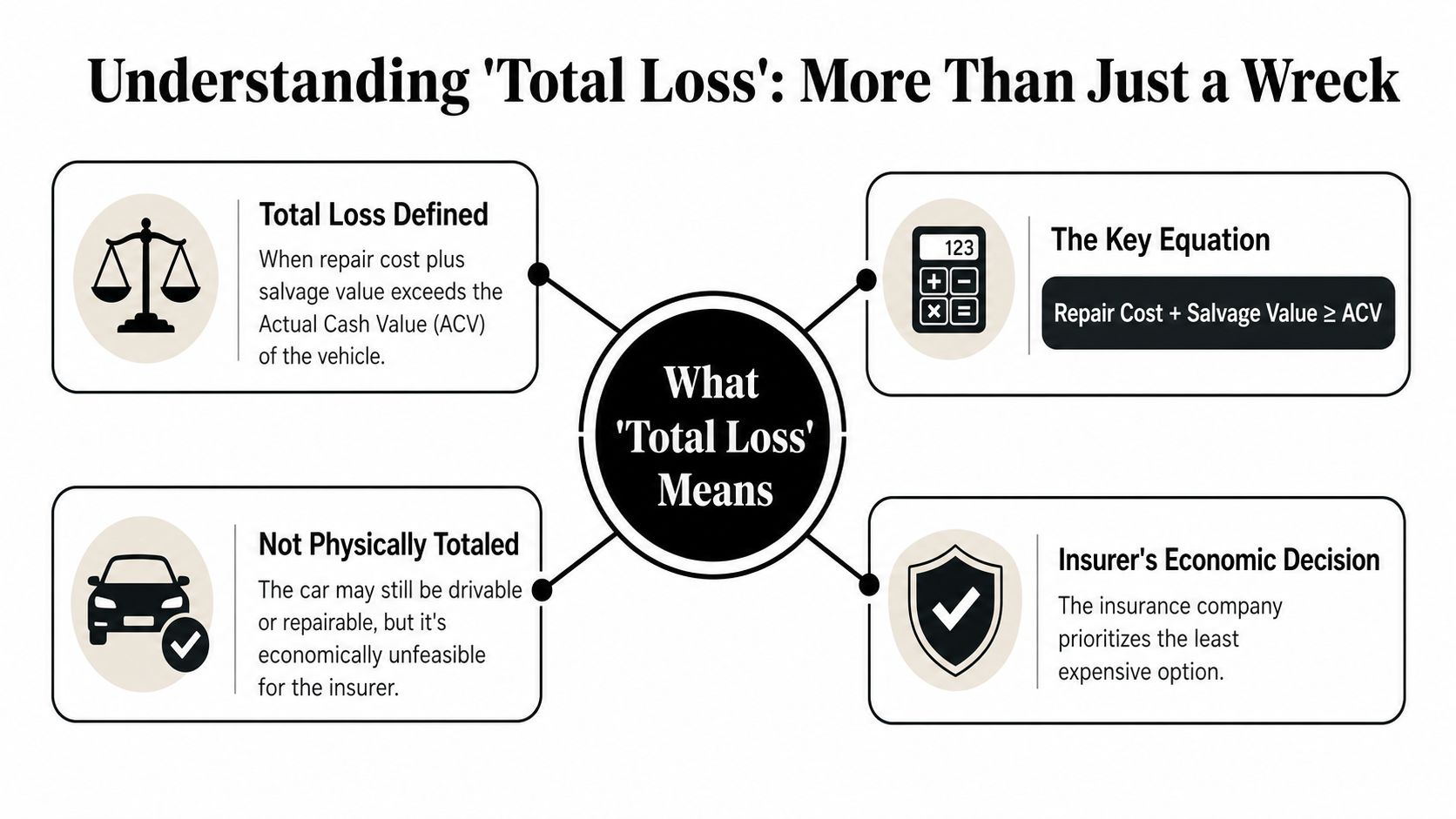
In insurance practice, it's mostly an economic determination. The key issue is whether the cost to repair the vehicle, sometimes combined with salvage value depending on the rule used, crosses the point where the insurer decides paying the vehicle's pre-loss value is cheaper than fixing it.
Why a repairable car can still be totaled
A vehicle can still run, drive, or look fixable and still be declared a total loss. That surprises people, but it's normal. Modern repairs can get expensive fast, especially once body damage involves sensors, wiring, calibration work, or structural components.
The number the insurer cares about is the vehicle's Actual Cash Value, usually called ACV. That is the vehicle's market value immediately before the loss. It is not your loan balance, not your original purchase price, and not the amount you need to buy something newer.
A total loss label doesn't tell you whether the car could be repaired. It tells you the insurer believes repairing it is not economically justified under the claim rules.
This happens often. Roughly 1% of all insured vehicles in the United States, or about 2 million cars annually, are declared total losses due to accidents, theft, or natural disasters. Of those, about 70% come from collisions and about 25% come from incidents such as theft, vandalism, weather events, and animal strikes, according to WalletHub's total loss threshold guide.
What owners often misunderstand
A few points clear up most confusion:
- It's not always crash damage alone: Theft recoveries and storm losses can also become total loss claims.
- The insurer is making a cost decision: They compare value against repair economics, not sentimental value.
- Your documentation still matters: If the ACV is wrong, the entire settlement starts from the wrong number.
If your claim arose from theft risk or attempted theft, practical prevention steps matter before the next vehicle goes on the road. This guide on Quick Keys locksmith options is a useful starting point for reducing exposure to common theft scenarios.
For a closer look at the core factors insurers weigh when they decide what makes a car a total loss, it helps to review the issue the same way an appraiser would. Once you understand that the term is financial, not emotional, the settlement process becomes easier to challenge.
How Insurance Companies Calculate a Total Loss
Insurers don't use one national rule. They use the rule allowed in the state where the claim is being handled. That rule can materially change the outcome.
The two systems you'll see most often are the Total Loss Threshold and the Total Loss Formula. They sound similar, but they work differently enough that owners should know which one applies before arguing the file.
The two methods that matter
Under a Total Loss Threshold, the insurer compares repair cost to the vehicle's ACV. If the repair cost reaches the state's threshold, the car qualifies as a total loss.
Under a Total Loss Formula, the insurer adds repair cost + salvage value and compares that total to ACV. If that combined amount meets or exceeds ACV, the vehicle is totaled.
According to the National Collision Authority overview of total loss determinations, thresholds vary by jurisdiction from 60% to 100% of ACV. Texas uses a 100% threshold, while states without a fixed percentage use the formula approach where Repair Cost + Salvage Value ≥ Actual Cash Value.
Why state rules change real outcomes
Here's the practical takeaway. The same damaged vehicle can be repairable under one state rule and a total loss under another.
| State | Method Used | Threshold / Formula |
|---|---|---|
| Texas | Total Loss Threshold | 100% of ACV |
| States using fixed thresholds | Total Loss Threshold | State-set percentage of ACV |
| States using formula method | Total Loss Formula | Repair Cost + Salvage Value ≥ ACV |
Owners frequently become confused. They hear a friend in another state say, "My car had worse damage and they fixed it." That may be true. It may also be irrelevant. Different states give insurers different legal triggers.
What to look for in the file
When I review a total loss decision, I want to see three things before I accept the classification:
The ACV support
If the starting value is too low, the total loss math becomes easier for the insurer.The repair estimate quality
A thin estimate can grow. A bloated estimate can push the vehicle over the line too early.The salvage figure
In formula states, salvage value matters. If that number is aggressive, it can change the result.
For owners in formula states, the details matter enough that it helps to understand the total loss formula before you respond to the adjuster. Once you know which method applies, you can challenge the right piece of the calculation instead of arguing in general terms.
Decoding Your Settlement Offer and ACV
The settlement offer lives or dies on one number. Actual Cash Value.
If ACV is low, everything downstream is low. That's why owners should spend less time arguing over the word “totaled” and more time dissecting the valuation report line by line.
What ACV actually means
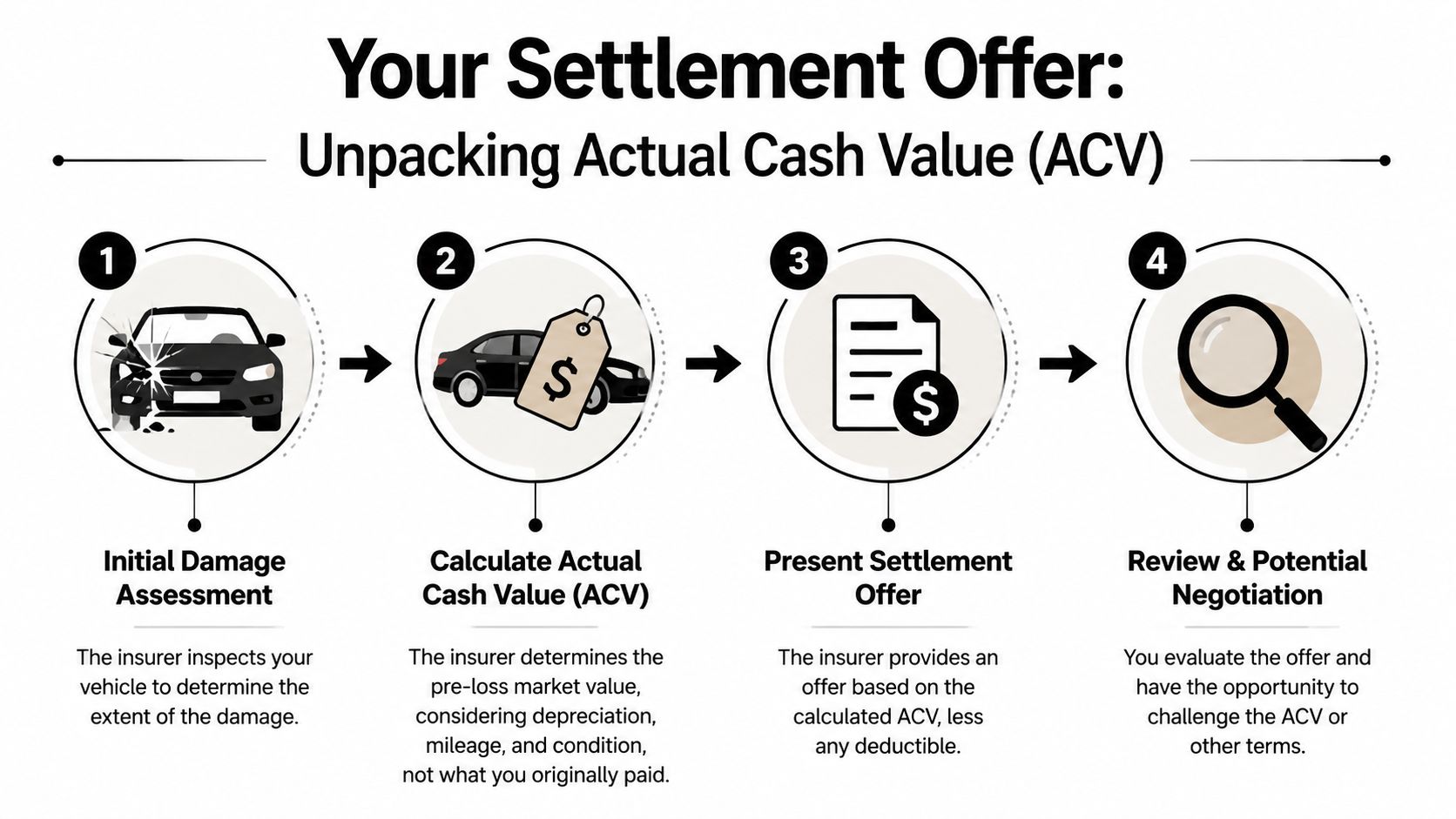
ACV is the vehicle's pre-loss market value. Think of it as the amount a comparable vehicle would reasonably bring in the market right before the crash. It is not replacement cost for a brand-new version, and it is not tied to what you still owe.
One useful way to think about the payout is this. The standard formula is Insurance Payout = Replacement Value – Salvage Value. In an economic total loss, the insurer pays the difference between the vehicle's pre-loss value and what it expects to recover from the salvage sale, as explained in this overview of total loss payout calculation.
Where lowball offers usually hide
Owners often look only at the final amount. Appraisers look at the inputs.
Check the report for these common problem areas:
- Comparable vehicles that aren't appropriately comparable: Wrong trim, wrong drivetrain, wrong equipment, or vehicles located in weak markets far from where you'd replace yours.
- Condition deductions: Insurers may reduce value for prior wear, interior condition, paint issues, or tire condition. If those deductions don't match the actual pre-loss condition, challenge them with photos and records.
- Missing feature omissions: Sunroof, premium audio, tow package, advanced safety options, factory appearance packages, and wheel upgrades are often missed or mis-coded.
- Mileage adjustments that look one-sided: High mileage usually gets noticed. Favorable condition often doesn't get equal credit.
If the valuation report lists your car as “base” when you owned a better-equipped trim, you're not arguing opinion. You're correcting a factual error.
There's also a specific blind spot many owners never catch. Comparable Vehicle Reports can include deductions for “conditioning” or omit features entirely, and most consumer guides don't show people how to audit those deductions with pre-loss photos, service history, window stickers, or receipts. That gap is one of the biggest reasons low offers stick.
If the at-fault claim also raises questions about value loss outside the total loss settlement itself, this guide on how to claim diminished value in NY gives a useful example of how valuation disputes can extend beyond the insurer's first number.
Your Options After a Total Loss Declaration
Once the insurer declares your vehicle a total loss, you usually have three practical paths. None is automatically right. The best choice depends on the car, the valuation, your cash position, and whether the insurer's number is defensible.
Accept the offer and move on
This is the cleanest path if the valuation report is accurate and the offer reflects your vehicle's actual market value.
The upside is speed. You can close the file, deal with the lienholder if there is one, and focus on replacing the vehicle. The downside is obvious. If the report is wrong and you sign off too quickly, you may leave money unclaimed.
This path makes sense when the comparables are solid, the options list is complete, and the condition adjustments are fair.
Keep the vehicle and take a reduced settlement
Some owners want the car back. That's more common with collector vehicles, older paid-off cars, trucks with utility value, or vehicles the owner can repair personally.
In that setup, the insurer usually deducts the salvage value from the settlement and the vehicle will typically move into salvage-title territory, depending on state procedure. The upside is control. The downside is that you now own a damaged vehicle with title and insurability complications.
This option works best when you understand repair costs, parts availability, and post-repair title consequences.
Reject the value and dispute the settlement
If the insurer undervalued the ACV, this is the path that deserves serious attention.
A dispute can begin informally with a written counter supported by documents. If that stalls, many policies allow a formal valuation mechanism through the appraisal clause. That route becomes especially important when standard market databases fail to capture the actual value of the car.
Don't choose your path based on stress alone. Choose it based on whether the insurer's number would let you replace what you actually lost.
For many owners dealing with a car a total loss claim, the biggest mistake is deciding too early. Review the report first. Then decide whether surrender, retention, or dispute gives you the strongest financial result.
How to Maximize Your Total Loss Payout
A better total loss payout usually comes from one thing. Proving the insurer valued the wrong vehicle, or valued your vehicle with the wrong facts.
That means treating the claim like an audit, not an argument. The owners who improve settlements usually do three things well. They find factual errors, document the car's real pre-loss condition and equipment, and know when to push the dispute into appraisal instead of staying stuck in back-and-forth emails.
Build your counter the way an appraiser would
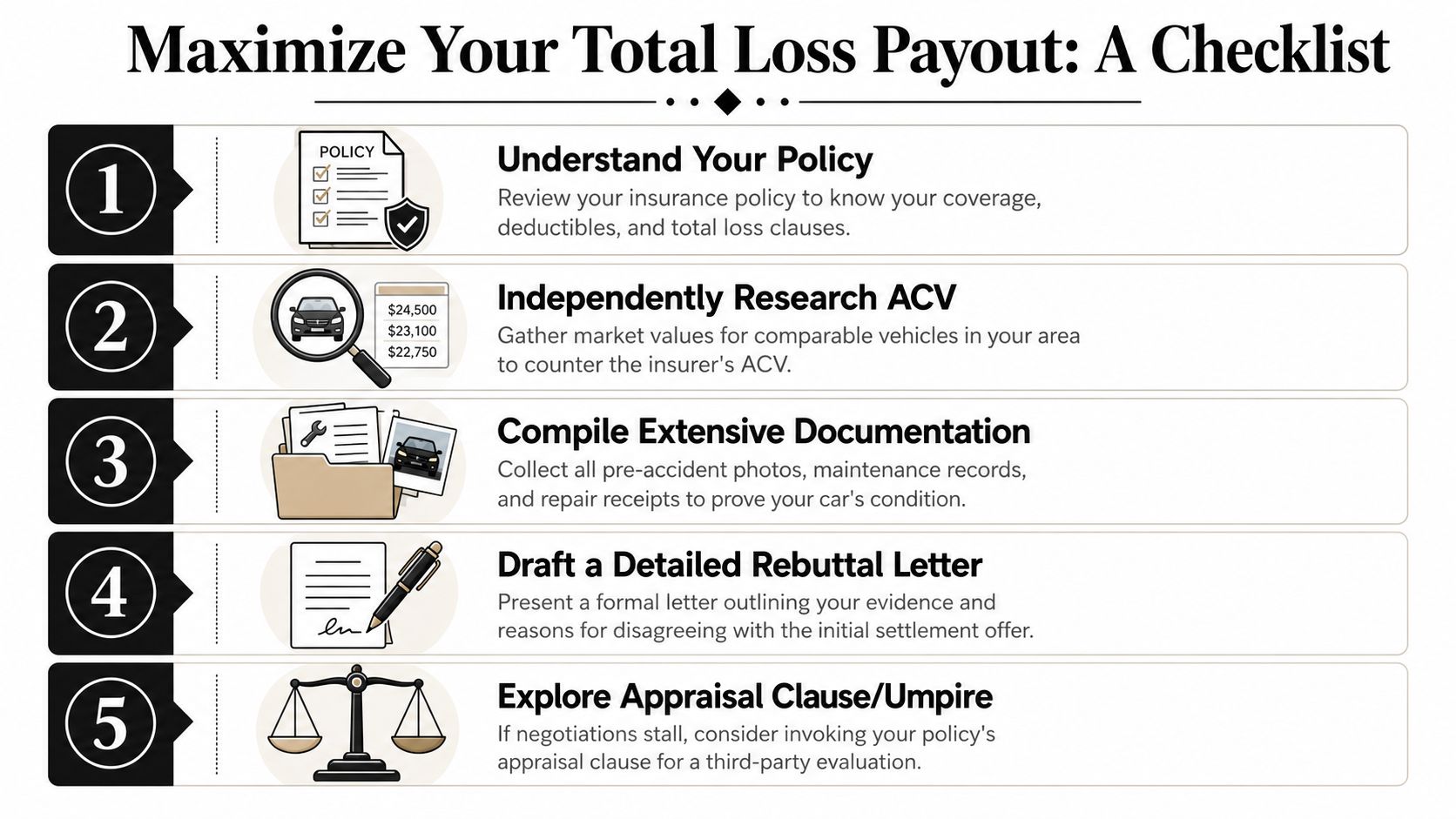
Start with the valuation report, then verify every line against the specific car you owned.
Pull together pre-loss photos, service records, the window sticker if you have it, purchase documents, major repair invoices, tire receipts, and any records that show trim, factory options, upgrades, mileage, and condition. Then compare that file to the insurer's report line by line. Small mistakes add up fast in a total loss valuation.
Focus your rebuttal on errors you can prove:
Wrong trim or package
A base model value does not belong on a premium trim car. List the missing packages and factory equipment specifically.Missed aftermarket or custom equipment
Modified trucks, performance cars, overland builds, audio systems, wheels, and specialty accessories are often ignored or undervalued in standard software.Poor comparable choices
Use retail listings for similar vehicles, with close matches on year, trim, drivetrain, mileage, and major options. If the insurer used distant, stripped-down, or stale comps, say so plainly.Condition deductions that do not match the evidence
If the report marks the car below average, answer with dated photos, maintenance records, and receipts showing the vehicle was cleaner or better maintained than the report suggests.
Keep the written response tight. A short, well-supported package usually carries more weight than a long complaint.
Know when to invoke the appraisal clause
If the adjuster will not correct obvious value problems, stop repeating the same argument and read the policy.
Many policies include an appraisal clause. It usually lets you hire your own appraiser while the insurer hires one too. If those two appraisers cannot agree, they select an umpire to help resolve the value dispute. That changes the process in a meaningful way. Instead of asking the carrier to reconsider its own number again, you move the disagreement into a formal valuation procedure written into the policy.
That option matters most for vehicles that do not fit neatly into database pricing. Custom cars, collector cars, rare trims, heavily optioned vehicles, and unusually clean examples often get flattened into average-market numbers. As Car and Driver's discussion of fighting a total loss valuation explains, standard valuation methods can miss the actual market for upgraded or unusual vehicles.
If you want a practical primer before sending the demand, read this guide on negotiating a total loss settlement.
When outside help makes sense
Some owners can handle a routine dispute on their own. Some should not.
If the gap is small and the errors are obvious, a direct written challenge may be enough. If the car is custom, collector-grade, high-value, unusually clean, or loaded with options, independent appraisal support often makes sense. In those claims, the dispute centers not on whether the car was totaled, but on whether the carrier's comps, condition calls, and option adjustments reflect the actual market.
I tell owners to ask a simple question: if this number will not buy a comparable replacement, what evidence would prove that? Start there.
The strongest position in a total loss dispute is usually the same. Show that the vehicle in the report is not the vehicle you lost.
Frequently Asked Questions About Total Loss Claims
What if I still owe money on the loan
The total loss settlement is based on ACV, not what's left on your loan. If your lender is owed more than the insurer pays, the shortfall usually remains your responsibility unless you have GAP coverage or another contract that covers it.
The practical move is to ask for the lender payoff in writing and compare it to the insurer's valuation. If the ACV looks low, challenge that first. A stronger ACV can reduce the gap.
How long does the total loss process take
There isn't one universal timeline.
Simple claims move faster when liability is clear, the vehicle is accessible, and the valuation report is accurate. Disputed claims take longer, especially if you're correcting comparables, documenting upgrades, or invoking the appraisal clause. Delays also happen when the title is missing, the lienholder is slow to respond, or the vehicle is stuck in storage limbo.
If time matters, keep the claim moving by responding in writing, requesting the valuation report early, and sending supporting documents in one organized package rather than piecemeal.
Will insurance keep paying for my rental car
Rental coverage depends on the policy and the claim setup.
In many total loss claims, rental benefits don't continue indefinitely while you negotiate. They may stop shortly after the insurer makes an offer or declares the vehicle a total loss. That means even a justified dispute can put pressure on you if you wait too long to make transportation plans.
Call the adjuster and ask one direct question. “On what date does rental coverage end under this claim?” Get that answer in writing if possible.
Can I remove my custom stereo, wheels, or other upgrades
Maybe, but don't assume you can just show up and pull parts off the car.
If the claim is still open, the insurer may treat the vehicle as part of the settlement process, especially once it has moved to a salvage facility. Some aftermarket parts can be removed if you replace them with functional equivalents and coordinate with the adjuster first. Others become part of the valuation fight because they affect ACV.
The cleanest approach is this:
- Document the parts first: Photos, receipts, install records, and brand details.
- Ask for written permission: Don't rely on a phone conversation alone.
- Decide whether the part is better removed or valued: Some items are easier to prove through receipts than through physical removal.
- Move quickly: Storage lots and salvage yards don't wait for owners to get organized.
If the custom equipment is significant, treat it as part of the appraisal issue from the start. That's often more effective than trying to sort it out after the vehicle has already been released.
If you're stuck with a low total loss offer and need an independent valuation, Total Loss Northwest is one option to consider. They handle total loss and diminished value appraisals, with a focus on Oregon and Washington, and can help owners use the appraisal clause when an insurer's valuation doesn't reflect the fair market value of the vehicle.