You pick up your car from the body shop, walk around it twice, and the repair looks clean. The paint matches. The panel gaps look right. The warning lights are off. Then the uneasy thought hits you: if you tried to trade it in tomorrow, would a buyer pay the same as before the crash?
They won't.
That lost resale value is called diminished value, and it's real even when the repairs are excellent. Vehicles with a reported accident history lose 10% to 25% of their pre-accident market value, which means a $30,000 vehicle commonly loses $3,000 to $7,500 after repair, according to the NAIC research on accident-related value loss. If you're dealing with that gap right now, this guide on car accident value loss will help you understand what you're looking at and how to pursue it.
Insurance companies know this issue exists. What they usually don't do is volunteer a fair number. That's where a proper auto diminished value appraisal matters. It gives you something stronger than a complaint. It gives you evidence.
Your Repaired Car Is Worth Less And Heres Why
You can spend weeks getting a vehicle repaired correctly and still lose money the day you try to sell it.
That is the part insurance carriers rarely explain clearly. Repairing the car addresses the physical damage. It does not erase the accident record, and the market prices that history fast.
A dealer sees prior damage on the history report and builds in risk. A private buyer sees the same report and starts asking harder questions. Was the frame touched? Were airbags deployed? Are there hidden issues that show up later? Even if the answers are favorable, the car is no longer competing with clean-history vehicles on equal footing.
The market discounts repaired vehicles for a reason
In my work, I see this play out the same way over and over. Two vehicles can look equally clean in person, but the one with an accident record usually draws lower offers, more hesitation, and more negotiation. Buyers are not paying only for paint and parts. They are paying for confidence.
That discount is diminished value.
The financial effect can be substantial. Vehicles with a reported accident history often lose 10% to 25% of their pre-accident market value, according to the NAIC analysis of post-accident market loss.
Repair quality matters, but history still follows the car
Good repairs matter. They protect safety, drivability, and resale. Poor repairs can reduce value even more.
But even excellent repairs have a ceiling. They can restore the vehicle to proper condition. They cannot restore a clean history. That is why a body shop invoice and a diminished value appraisal serve different purposes. One shows what it cost to fix the damage. The other addresses what the market took away afterward.
Here is the practical breakdown:
- Repairs restore the vehicle itself: damaged parts, paint, and systems are corrected.
- Vehicle history reports preserve the loss event: Carfax, AutoCheck, dealer tools, and claim databases continue to show prior damage.
- The next buyer prices in uncertainty: that usually means a lower trade offer or a lower private-party sale price.
Insurance companies often treat the repair bill as the finish line. However, in the market, it is only part of the claim. If you want a clearer picture of that loss before you argue numbers with an adjuster, this guide to car accident value loss after repairs lays out what to look for. An independent appraisal matters because it measures the gap the repair shop could never fix.
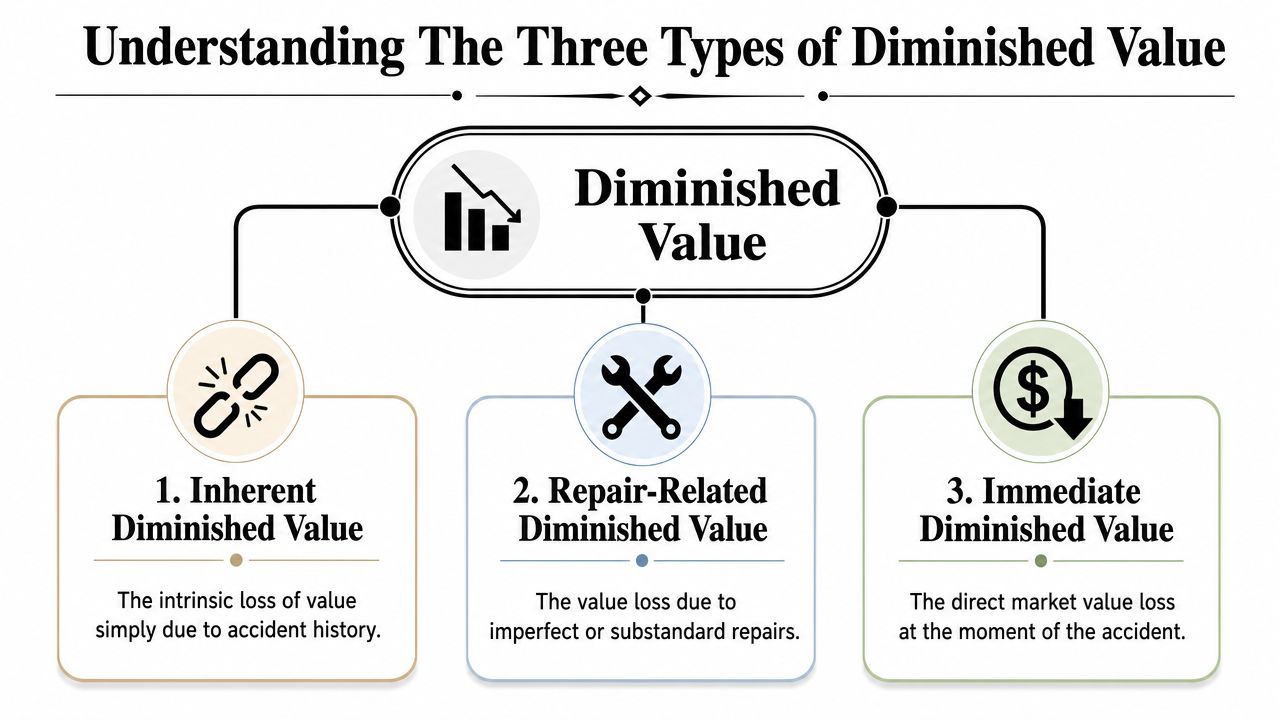
Understanding The Three Types of Diminished Value
Not all diminished value comes from the same source. If you want to make sense of your claim, you need to separate the categories.
A useful background read is this explanation of what diminished value means after an accident.
Inherent diminished value
This is the type that individuals are commonly pursuing.
Inherent diminished value is the loss that remains because the vehicle now has an accident history. Even if the repairs are proper, documented, and visually excellent, the market still treats the car differently.
Think of two houses on the same street. Both look freshly restored. One had a prior fire that was fully repaired and disclosed. Buyers still tend to hesitate, ask more questions, and negotiate harder on that house. The same logic applies to a car with prior collision damage.
Repair-related diminished value
This category comes from the quality of the repair itself.
If the shop leaves paint mismatch, poor panel alignment, overspray, aftermarket parts that hurt fit and finish, or unresolved mechanical issues, the vehicle may lose additional value beyond the stigma of the accident record. This isn't just history-based. It's condition-based.
A repair-related issue can make your claim stronger, but it can also complicate it. Sometimes the proper path is not only a diminished value claim, but also a supplement, a reinspection, or a direct complaint about incomplete work.
Immediate diminished value
This refers to the drop in value right after the accident occurs, before repair.
For most consumers, this category is more theoretical than practical because claims are usually argued after repairs are completed and the market can evaluate the vehicle as repaired. Still, it helps explain the timeline. The vehicle loses value the moment serious damage occurs. Repairs may recover some utility and appearance, but not the full pre-loss market position.
Which type matters most in the real world
In day-to-day claims, the focus is usually this:
| Type | What causes it | Why it matters |
|---|---|---|
| Inherent | Accident history itself | Most common basis for a diminished value claim |
| Repair-related | Poor or incomplete repairs | Can increase loss or create a separate dispute |
| Immediate | Value drop at the time of impact | Helps explain why repair alone doesn't erase loss |
Practical rule: Most successful claims are built around inherent diminished value, then strengthened with repair documentation and market feedback if the repair history raises additional concerns.
How Insurance Companies Calculate Your Loss
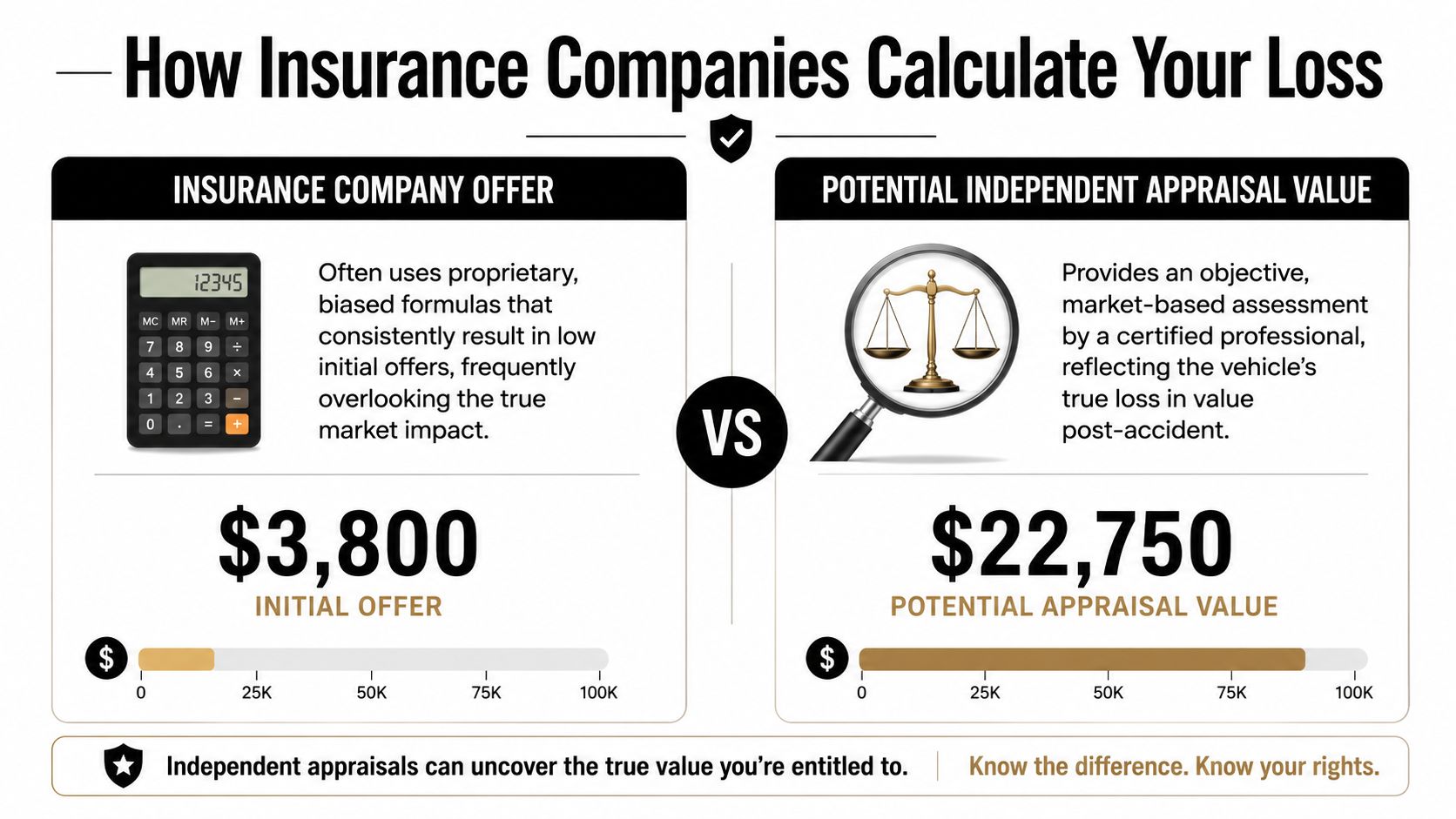
You send the carrier your repaired vehicle information, expect a market-based review, and get back a number that feels disconnected from what any dealer would deduct. That usually happens because the insurer is not starting with your local market. It is starting with an internal method designed to keep payouts predictable.
The method many carriers and adjusters fall back on is 17c. As noted earlier in the article, that formula begins with a capped percentage of the vehicle's pre-accident value, then reduces it again based on damage severity and mileage.
Why carriers prefer formulas
Formulas are efficient.
An adjuster can apply the same framework across a large volume of claims, document the file quickly, and defend the result as consistent with company practice. From the insurer's side, that makes the claim easier to process. From the owner's side, it often means the vehicle gets treated like a generic unit instead of a specific car with a specific repair history, trim level, buyer audience, and resale problem.
That distinction matters. A late-model luxury SUV with structural repairs and a clean pre-loss history does not react in the market the same way as an older commuter sedan with cosmetic damage. A formula tends to flatten those differences.
How the number gets pushed down
The first reduction usually happens at the starting point. The carrier sets a ceiling before anyone asks what dealers or buyers in your area would really do with that accident history.
Then the claim is narrowed again:
- Damage coding affects the result: If the insurer classifies the damage in a less serious category, the calculated loss drops.
- Mileage is used as another discount: Higher mileage often gives the carrier one more reason to trim the figure.
- Vehicle-specific market factors may be ignored: Prior frame work, replaced quarter panels, airbag deployment, or stigma in a brand-sensitive market may never be fully reflected.
By the end, the offer can look neat on paper and still miss the full loss.
Why formula-first offers are often low
A formula works like pricing a repaired house by square footage while ignoring the fact that buyers know it had fire damage. The structure may be restored, but the market still reacts to the history.
That is the problem with many diminished value offers. The insurer is often measuring what its system allows rather than what your vehicle lost in resale position. I see this regularly. The first number is often an administrative number, not a true market opinion.
Here is the practical difference:
| Approach | What it relies on | Main weakness |
|---|---|---|
| Formula valuation | Caps, modifiers, insurer rules | Misses how local buyers and dealers react to your specific repair history |
| Market valuation | Comparable vehicles, dealer input, repair documentation | Takes more evidence and usually more pushback to get considered |
If the offer feels low, the method is usually the reason.
That is why owners in Oregon and Washington often get better traction when they answer a formula with evidence. A qualified independent car appraiser can document the actual market impact, challenge the carrier's assumptions, and, when the policy allows, put the Appraisal Clause on the table instead of arguing in circles over a canned worksheet.
The Power of an Independent Appraisal
A proper auto diminished value appraisal changes the conversation. It moves the claim away from canned software output and toward evidence tied to your actual vehicle.

Most online advice gets stuck on the 17c formula. That's the wrong center of gravity. As noted in this discussion about bypassing formula-based diminished value estimates with dealer-backed market data, independent appraisers can build stronger market-based valuations by gathering real-world input from dealership managers rather than relying on a rigid formula.
What an independent appraiser actually does
A serious appraisal is not just someone picking a number that sounds better.
The work usually includes reviewing the repair invoice, identifying the damaged areas, evaluating whether structural or major panel repairs affect desirability, studying comparable vehicles, and checking how the accident history changes market reaction. Good appraisers also test the carrier's position for weak assumptions.
That's the part many claimants miss. You are not trying to be louder than the insurer. You are trying to be more credible.
For people looking into this route, an independent car appraiser service can provide the report needed to support negotiation, appraisal clause demands, or further escalation.
Why dealer input matters
Dealers buy and price cars on the market every day. They know what buyers ask the moment an accident appears on a history report. They know which repairs trigger hesitation and which models get discounted harder once damage is disclosed.
That market feedback matters because it answers the only question that counts: what will the next buyer pay now?
Here's what tends to work better than arguing with an adjuster by email:
- Full repair documentation: The appraiser needs the final invoice, not a rough summary.
- Clear accident disclosure: The valuation has to reflect the vehicle as the market sees it, not as you wish it looked on paper.
- Comparable market behavior: Dealer quotes and comparable listings can show the practical resale penalty.
- A report built for scrutiny: If the file reaches appraisal, arbitration, or court, loose opinions don't help much.
A strong report doesn't just say your car lost value. It shows why another buyer would pay less for it today.
What doesn't work
A few approaches usually fail or underperform:
- Using an online calculator alone: That may be useful for curiosity, but it won't carry much weight in a dispute.
- Sending a short demand with no evidence: Adjusters can dismiss unsupported numbers quickly.
- Arguing fairness instead of value: Insurance claims turn on proof, not frustration.
A Step by Step Guide to Your Diminished Value Claim
You pick up your car after repairs, the panels line up, the paint matches, and it drives straight. Then the insurer offers little or nothing for diminished value because the vehicle is "fixed." That is the point where claim handling and market reality split apart. Buyers care about the accident history, even when the repair work is proper.
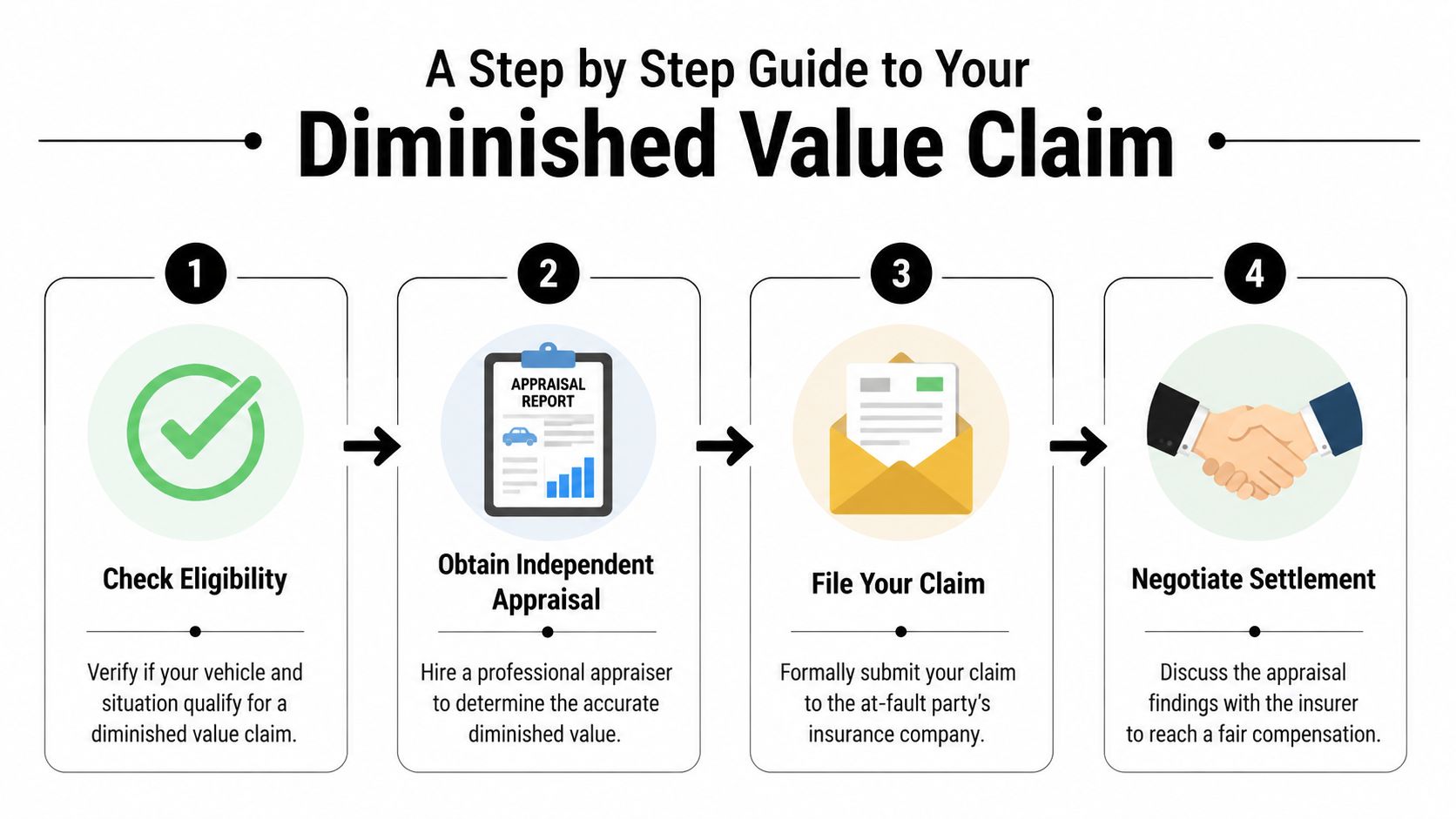
Confirm the claim is worth pursuing
Start with the practical question. Is there enough real market loss to justify the time and expense?
Diminished value claims are usually stronger when another driver caused the accident and their insurer owes for property damage. The vehicle also needs to be one the market tends to discount after an accident. A late-model luxury car, performance vehicle, or clean one-owner truck often gets judged harder than an older commuter car with prior cosmetic history.
Deadlines matter too. Do not wait until repairs are old news and the file has gone cold. Check the time limit that applies in your state and claim posture early.
Organize the file before you make the demand
Adjusters respond to files, not frustration.
Gather the final repair invoice, photos, the estimate, the police report if there was one, proof of ownership, and any emails or letters where the insurer addressed diminished value. If the repairs involved frame work, welded panels, airbag deployment, suspension damage, or replacement of major components, make that easy to spot. Those details often affect resale more than a generic line saying "repairs completed."
One clean package does more work than ten scattered follow-up emails.
Get the appraisal before you debate the number
Do not start by arguing over the insurer's formula. Get an independent appraisal that explains the loss in market terms.
In my experience, paying for an appraisal makes the most sense when the vehicle is newer, higher value, harder to replace, or repaired for damage that shows up badly on a history report. The report should explain what was damaged, how the market reacts to that type of history, and the amount of value lost after proper repair. If the insurer has been hiding behind a canned formula or a flat internal cap, an independent report changes the discussion from opinion to evidence.
Here's a practical video overview of the process and claim posture:
Send a written demand that is built to be reviewed
Once the repairs are complete and the appraisal is in hand, send a formal demand to the at-fault carrier. Keep the tone professional and the package easy to review.
Include:
- Claim identifiers: Claim number, date of loss, vehicle year, make, model, VIN, and your contact information.
- A direct statement of the claim: Explain that you are seeking payment for diminished value after completed repairs.
- Supporting proof: Attach the appraisal, final repair invoice, photos, and any relevant history or disclosure material.
- A deadline for response: Ask for a written decision within a reasonable time and keep copies of everything sent.
This part matters. A short demand with no appraisal invites a short denial.
Push past the low offer the right way
Many insurers respond with a small offer based on an internal formula, or they reject the claim without engaging the actual repair history. That does not end the matter. It tells you how they intend to value the file.
If their response ignores your evidence, ask them to explain their valuation method in writing. Then compare that method to your appraisal. The gap is usually where the main disagreement lies. One side is using a generic worksheet. The other is looking at how this specific vehicle will be treated by dealers and buyers.
Use the Appraisal Clause if the policy allows it
The Appraisal Clause is one of the few tools that can force a value dispute out of the insurer's internal system and into a structured process. It is underused, especially in diminished value claims.
When the dispute is about the amount of loss rather than coverage, the clause may let each side choose an appraiser. If those appraisers cannot agree, an umpire is selected. That process does not promise a win, and it is not available in every situation. But it can stop the endless cycle of "our evaluation says otherwise" and put the number in front of people whose job is valuation.
The simplest way to look at it is this. Negotiation is asking the insurer to reconsider. Appraisal is using a contract process that requires the value dispute to be decided.
Client advice: If the carrier keeps repeating its internal number and will not address the evidence in your report, stop arguing in circles. Review the policy language and decide whether it is time to invoke appraisal.
State Specific Guidance for Oregon and Washington
Drivers in Oregon and Washington should not rely on generic national advice. State practice matters, and the way you present the claim should match the local legal environment.
Oregon
Oregon drivers generally have a workable path for diminished value claims, especially in third-party situations where another driver caused the damage. In practice, the strongest Oregon files are the ones that treat diminished value as a property damage issue backed by documentation, not as a side complaint added at the end of a repair claim.
What usually helps in Oregon:
- Make the demand after repairs are complete: The market loss is easier to document once the final repair history is known.
- Use a market-based report: A formula-only submission gives the insurer room to minimize the claim.
- Keep your paperwork organized: Oregon claims respond better when the file is clean, chronological, and supported.
If you're in Oregon, don't assume the adjuster will explain your options. They usually won't. You need to ask directly whether the carrier will consider a diminished value claim and what documentation they require.
Washington
Washington drivers are often in a similar position. The core issue is still proof. If the accident was not your fault, and your repaired vehicle carries a real resale penalty because of its history, the claim can be presented as part of property damage.
Washington claimants should be ready for two realities. First, the carrier may act as if diminished value is unusual. Second, that doesn't mean the claim is invalid. It often means the insurer is waiting to see whether you have real evidence behind it.
A practical approach in Washington is to keep the claim focused on market loss, avoid emotional arguments, and be prepared to escalate to appraisal when the dispute is about value and the insurer won't move.
What local drivers should do first
| State | Best first move | Common mistake |
|---|---|---|
| Oregon | Finish repairs and build a documented claim file | Demanding payment before the vehicle can be evaluated as repaired |
| Washington | Present a valuation-backed property damage claim | Treating the claim like a casual request instead of a documented demand |
Local claims often turn less on slogans and more on the quality of the paperwork.
Frequently Asked Questions About Diminished Value
Can I file a claim if I was at fault
Usually, diminished value claims are strongest against the at-fault driver's insurance in a third-party property damage claim. If you caused the accident, recovery becomes much harder and depends on your policy language and state-specific rules. Review the policy and don't assume coverage exists just because the car was repaired.
Does it matter if my car is leased or financed
You can still have a diminished value issue with a leased or financed vehicle. The lender or leasing company has an interest in the vehicle, but the market stigma attached to the accident history doesn't disappear. The paperwork can get more technical, so keep the ownership and payoff documents handy.
Is there a minimum amount of damage needed to make a claim worthwhile
There isn't a universal minimum that fits every vehicle. What matters is whether the accident history causes a meaningful resale penalty. Newer vehicles, desirable trims, luxury vehicles, and cars with repairs buyers tend to scrutinize often justify a closer look. Minor cosmetic incidents may not.
How long does the whole process usually take
It varies by insurer, repair timeline, and how quickly you assemble the file. A clean claim with a strong appraisal can move faster than a disorganized one. A disputed claim that goes into appraisal will take longer, but it may produce a more grounded result than endless back-and-forth with an adjuster.
Do I need to accept the first insurance offer
No. You can review it, compare it against your documentation, and challenge it if it doesn't reflect the actual market loss. Many drivers make the mistake of treating the first offer as an objective value. It usually isn't. It's an opening position.
What if the insurer says the repairs restored the car to pre-accident condition
That statement addresses condition, not marketability. A repaired car can be safe and properly restored while still selling for less because buyers discount accident history. That difference is the heart of diminished value.
If you need a documented diminished value opinion, Total Loss Northwest provides independent appraisals for Oregon and Washington vehicle owners and can help invoke the Appraisal Clause when the dispute is about value, not just repair cost.