You got hit on Loop 410, the shop already fixed the body damage, and now the insurer is acting like the story is over. It isn't. If the car's history is going to follow it into the resale market, you may be holding a real diminished value loss, even when the paint matches and the bumper looks clean.
A diminished value appraisal San Antonio claim lives in that gap between “repaired” and “worth the same as before.” In Bexar County, that gap matters because local appraisal cycles can move differently from individual vehicle values, and property assessments already show how broad totals and single-asset value can diverge, with the most recent county cycle showing a flat-to-slightly softer residential market, single-family home values down 0.11% year over year, and the average residential appraisal at about $330,454 while total taxable value still rose 2.5% from new construction (San Antonio Report). Different asset, same lesson, the broad number is not the number that settles your claim.
Practical rule: if the car was worth more before the crash than it will bring after a repaired accident history, you have a value problem, not just a repair problem.
A San Antonio driver on a busy corridor doesn't need a lecture on theory. They need to know whether to press a diminished value claim, whether the loss has become a total-loss dispute, and whether the insurer's first number is worth another minute of attention. For broader accident help, including related collision issues, legal help for rideshare crashes can be useful context when the wreck involved a driver working for a platform.
| San Antonio Diminished Value at a Glance | ||
|---|---|---|
| Vehicle Profile | Typical Value Loss | Best Case for a Claim |
| Newer daily driver with clean history | Often meaningful after documented damage | Strong repair records and no prior accident history |
| Higher-end or luxury vehicle | More resale-sensitive than average | Clean pre-accident records and visible market comparables |
| Structural or body-panel damage | Higher chance of market penalty | Independent appraisal with repair documentation |
| Older vehicle with prior damage | Usually weaker claim | Rarely worth the cost unless the loss is unusual |
For a plain-language primer that stays out of the weeds, see what diminished value means in general terms. In practice, the claim is strongest when you can show the vehicle was worth more before the crash and the market now treats it like a repaired car with baggage.
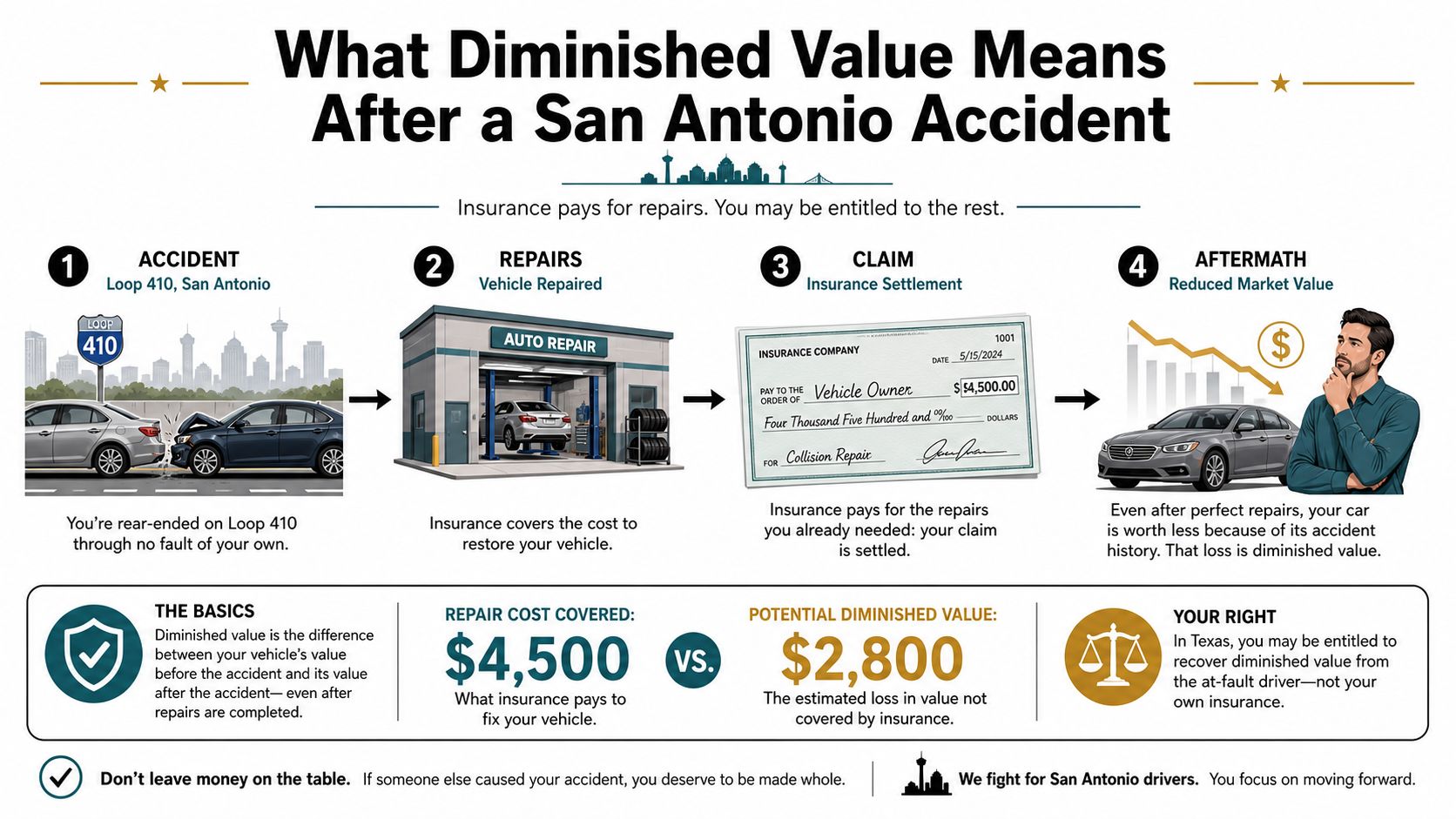
What Diminished Value Means After a San Antonio Accident
A driver gets rear-ended, drops the car at a body shop, and gets the call everyone wants. The repair estimate is approved, the panel gaps line up, and the insurer seems satisfied. Then the owner asks the question that matters most, “If I sell this car next month, will I get the same money I would have gotten before the wreck?”
That question is the whole point of diminished value. It is the loss in market value that remains after repairs because the accident history changes what buyers will pay. The post-crash penalty is often described in the 10% to 30% range, and a vehicle worth $40,000 before the wreck can lose $4,000 to $12,000 depending on severity, history, and how the market reacts (Texas vehicle diminished value appraisals).
The three kinds of value loss that actually matter
Inherent diminished value is the market penalty tied to the accident record itself, even when the repairs are excellent. Repair-related diminished value is the added loss caused by imperfect work, mismatched paint, non-OEM parts, or panel issues. Consequential diminished value shows up when the crash creates other costs or spillover losses, but for most San Antonio non-fault drivers, the cleanest claim is the inherent loss tied to resale.
The practical test is simple. If the vehicle was worth more before the crash, and the market now treats it like a repaired car with history, there is a real value loss to measure. For a plain-language primer on the concept, see what diminished value means in general terms.
San Antonio drivers run into this more often than they expect because the collision corridors are crowded, fast, and unforgiving. I-10, I-35, and US-281 create the kind of stop-and-go traffic and speed differences that turn a minor impact into a resale problem. A car can be fully drivable and still be worth less.
The mistake I see over and over is simple. People assume a repair check ends the matter. It does not. A repaired vehicle with an accident record can still be a weaker asset, and that weak point is what a proper diminished value appraisal is supposed to measure.
A clean repair does not erase a bad history in the market's eyes.
If you are comparing this to a truck or SUV that has already taken a hit, the prior accident record can shrink the remaining claim. If the vehicle was newer, cleaner, and more desirable before the wreck, the claim usually carries more weight. That is the basic financial reality behind the whole thing.
A non-fault driver in San Antonio also needs to keep the third-party side straight. If the other driver caused the wreck, the claim belongs against that driver's carrier, and legal help for rideshare crashes can be useful context when the wreck involved a driver working for a platform.
Texas Law and Your Right to Claim Diminished Value
Texas does give a path to pursue diminished value, but the right move depends on what kind of loss you are dealing with. If another driver caused the crash, the cleanest route is usually a third-party claim against that driver's liability carrier. That is the claim that matters in most San Antonio cases, because you are asking the at-fault side to cover the lost market value, not just the repair bill.
The deadline matters too. Texas law puts a 2-year statute of limitations on this type of claim, so waiting is a waste of time if you want a real recovery. Once that window starts closing, insurers have less reason to deal fairly, and your paperwork gets harder to assemble in a way that still carries weight.
File against the right policy
If you were not at fault, start with the at-fault driver's insurer. That is the practical lane for diminished value in Texas. First-party coverage is a different fight, because many policies limit or exclude this loss, and that is where people burn time arguing with the wrong adjuster.
Read the coverage language before you send anything. A local overview of Texas diminished value rights is useful here because the policy language and the claim theory have to line up. If the vehicle is repairable yet still worth less, diminished value is the right theory. If the pre-loss value itself is disputed and the carrier is pushing the car toward a total-loss value dispute, then you are not really arguing post-repair loss anymore.
That difference matters in Bexar County claims. A repaired vehicle with a clean-looking invoice can still have a weaker resale position, and that is exactly the loss a proper appraisal should measure. A vehicle that is being treated as a total loss needs a different valuation fight altogether, and mixing the two only gives the insurer room to stall.
A San Antonio driver should also pay attention to the policy's appraisal clause instead of guessing. That clause matters in Texas property-damage disputes, and a local guide on the subject explains why it has become a more important tool in claims handling (Northside Collision SA on diminished value appraisals).
Bottom line: file against the correct carrier, under the correct theory, and before the deadline runs out.
One more practical point. If the claim is still stuck between repairable damage and total loss, a sloppy demand slows everything down. A clear valuation position gets attention. A vague complaint gets parked.
How the 17c Formula Compares to a Real Market Appraisal
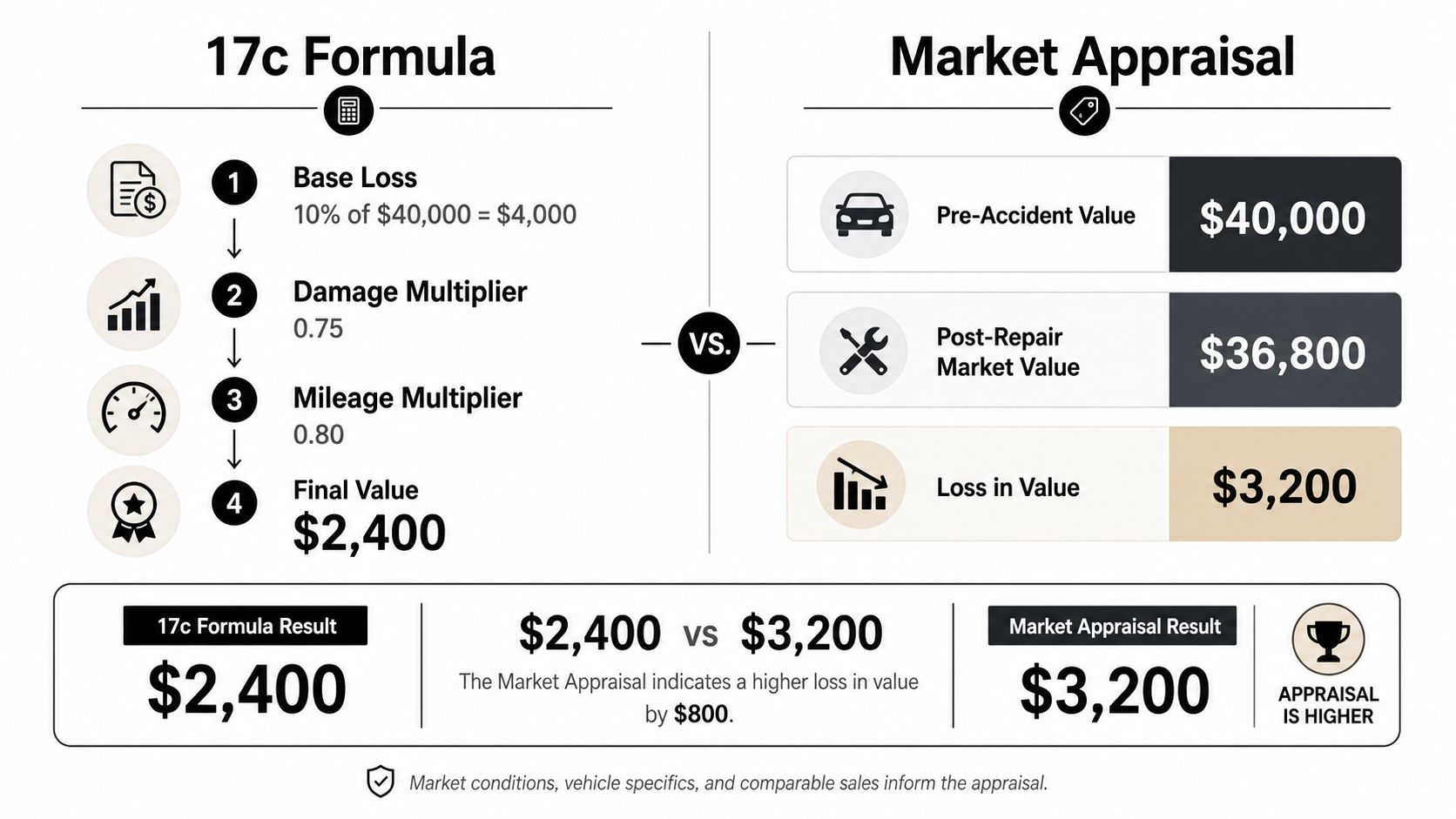
Carriers love the 17c formula because it gives them a neat-looking number that sounds objective. It starts with a 10% base loss cap, then applies a damage multiplier and a mileage multiplier. In Texas-focused commentary, that's often treated as a ceiling check, not the definitive answer (Texas diminished value calculation guide).
Take the example vehicle worth $40,000 before the crash. Under the formula, the base loss starts at $4,000. If the damage multiplier is 0.75 and the mileage multiplier is 0.80, the result is $2,400. That number may be fine as a rough screening tool, but it's not the same thing as what the market does.
Why the formula breaks down
A real appraisal starts with pre-accident fair market value from multiple sources, then checks that against the post-repair market. One expert methodology specifically uses NADA, KBB, Black Book, comparable retail listings, recent auction results, paint-thickness readings on every panel, and at least 3 dealer quotes with full accident disclosure (Certified Auto Appraisers diminished value appraisal service). That's a market-based report, not a generic percentage table.
A market-supported appraisal is stronger because it ties the loss to how buyers behave. Newer cars, higher-end cars, and vehicles with structural or body-panel damage are the ones most likely to show a bigger clean-title versus accident-history gap. That's where the 17c shortcut usually understates the loss.
Here's the rule I use in practice. Use 17c as a rough sanity check if you want to see whether the carrier's opening number is absurd. Don't use it as your main proof. If your car has strong resale sensitivity, the formula is too blunt to carry the claim on its own.
If the report doesn't show actual market evidence, it's just a negotiation prop.
The stronger the vehicle, the weaker the formula. That's the simplest way to say it. If the car is newer, desirable, and well documented, a market appraisal usually does the heavy lifting.
Hiring the Right Independent Appraiser in San Antonio
A good appraiser doesn't sell confidence, they show work. If you're screening someone for a diminished value appraisal San Antonio claim, the first question is simple, do they build the report from market evidence, or do they just punch numbers into a template? Anything that smells like a shortcut is a problem.

The best credential set is not flashy. It's USPAP compliance, proper certification, and experience writing reports that can survive a dispute. A person who can only explain marketing language is not the person you want when the insurer starts pushing back.
What to ask before you hire
Ask whether the appraiser uses pre-accident market data, not a single formula. Ask whether they inspect the vehicle or require repair records and photos. Ask whether they've handled expert-witness work, because a report written for a casual consumer and a report written for a contested claim are not the same thing.
A defensible report should contain the basics already mentioned, multiple value sources, repair invoices, paint-thickness readings, and dealer quotes with accident disclosure. If the appraiser can't explain how those pieces connect, keep looking. A polished website doesn't fix a weak methodology.
For San Antonio drivers searching beyond the city, diminished value appraisals near me is the sort of practical search that makes sense when you need someone who serves Texas broadly, not just one ZIP code. Good appraisers often work remotely, but the report still has to reflect the local market.
The process itself should be straightforward. You send the repair documents, photos, and title history. The appraiser reviews the market, inspects the condition if needed, and returns a report that tells you what the vehicle lost and why. If the turnaround drags and nobody can explain the methodology, that's a red flag.
A quick caution on price. If a quote is so cheap it barely covers the time to review the file, expect a thin report. If a quote is unusually high, make sure the extra cost is tied to deeper inspection or expert support, not just branding. You're buying evidence, not a logo.
Building Your Documentation and Sending the Demand
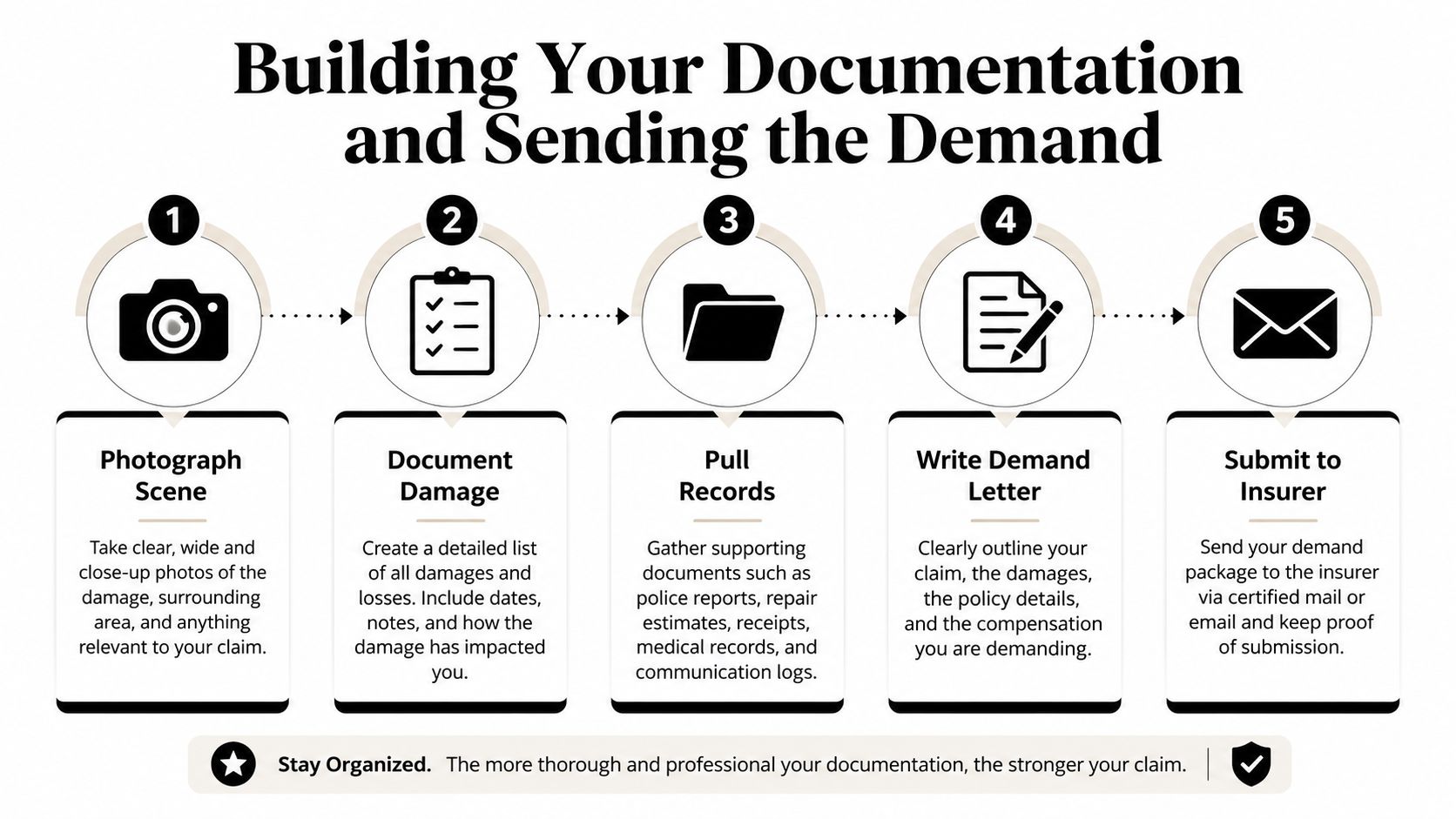
Start documenting before the tow truck leaves. The claim gets stronger when you control the paper trail from the first hour, not when you try to reconstruct everything after the body shop closes the file. That means photos, records, and a clean timeline.
What to collect first
Take photos of the scene, the damaged panels, the license plates, and any visible impact points. Save the repair estimate, the final invoice, and every supplement. Ask for the police report, and keep any records that show the vehicle's condition before the crash if you have them.
If the vehicle is specialized, like a motorhome or another large recreational unit, repair documentation matters even more because the value story can get complicated fast. For those cases, collision restoration for motorhomes is a relevant reference point when you're comparing how repair quality and value loss interact.
Send the demand like you mean it
Your demand letter should be plain, firm, and documented. Address it to the correct claims adjuster, attach the appraisal, the repair invoices, the police report, and anything that shows prior condition. Don't write a rambling story. State the loss, state the amount, and tell them what evidence supports it.
A strong demand sounds like this in substance, not in legal theater, “The vehicle was worth more before the loss, the repair history reduced market value, and the enclosed appraisal supports the amount demanded.” That's the level of clarity adjusters understand.
If you wait too long, the insurer gets comfortable. If you send a thin demand, they treat it like a bluff. The first 30 days after the crash are where the file gets built. The final letter just packages the work.
Photograph the damage early, document the repair honestly, and make the demand from evidence, not frustration.
Negotiation Strength, Fees, and the Appraisal Clause
People either get paid or get stalled. If the insurer's number is too low, the key question is whether the file is strong enough to make the carrier move, or whether it is time to invoke the Appraisal Clause and push the valuation dispute into a formal process.
Fees matter, but do not get lost in them. Appraisal fees for standard passenger vehicles are commonly discussed in the $350 to $600 range, and higher-priced vehicles can cost more, but that is still a fair trade if a proper report gets the claim out of the insurer's canned number. The cost is annoying, and so is leaving money on the table because you hesitated.
Decide whether you are still negotiating or already in a valuation fight
The first decision point is simple. If the vehicle is repairable and still carries a market hit after the crash, diminished value is the issue. If the insurer is really disputing what the car was worth before the loss, keep the fight focused on total-loss valuation instead of mixing the two.
That distinction matters because negotiation has limits. A demand letter gets attention. A formal appraisal process changes the pressure. Texas's appraisal-clause framework gives you a clean way to break a deadlock when the carrier keeps hiding behind a formula instead of addressing the actual market.
For a useful comparison, private investigator prices show the same logic you see in claim work, the fee is not the point by itself, the point is whether the work buys you an advantage and usable evidence.
When to stop arguing and move the file
Stop trading emails when the insurer will not engage with market evidence. Stop sending the same repair photos if the carrier is ignoring the valuation gap. Stop pretending a generic formula will beat a report built on real comparable sales.
That is also where a service like Total Loss Northwest fits naturally, since it handles certified independent auto appraisals and appraisal-clause disputes for auto claims. Use that kind of support when the carrier is treating your loss like a software exercise instead of a market question.
The practical move is straightforward. If the insurer has a defensible counter, answer it. If the insurer has only a low number and a canned formula, invoke the clause and force the valuation issue into a process that tests the numbers.
Your Next Steps and When to Involve an Attorney
Do the first things first. Right after the crash, get the report, the photos, and the repair records. In the first 30 days, get the independent appraisal and decide whether the car is a diminished value claim or a total-loss fight. At the demand stage, send the file cleanly and don't waste words.
If the insurer denies the claim or lowballs it, you've got two realistic paths. One is to keep pressing with better evidence and the appraisal process. The other is to bring in a Texas lawyer who handles property damage disputes instead of treating them like an afterthought.
Bexar County small-claims court can be a sensible option when the dispute is within the Texas $20,000 limit noted in the local coverage, especially if the paperwork is solid and the insurer is being stubborn (Ryan Orsatti Law). If the claim is larger, more technical, or tied to a complicated valuation fight, counsel can make sense fast.
Rule of thumb: if the insurer is arguing about market value, you need market evidence. If the insurer is ignoring market evidence, you need leverage.
A successful outcome doesn't always mean a dramatic settlement. It means the insurer pays based on a documented loss instead of a convenient guess. That can happen through negotiation, the appraisal clause, small claims, or an attorney-led demand.
If you're standing at that fork now, stop guessing and get the valuation right. Review the repair file, order the appraisal, and push the claim from evidence, not hope. If you want a team that focuses on independent valuation and appraisal-clause disputes, visit Total Loss Northwest and compare your file against a real market-supported approach.