You got your car back from the body shop, the paint matches, the panel gaps look fine, and the insurer has already marked the claim paid. Then you try to sell it, or even just talk trade-in, and the number lands lower than it should. That gap is where diminution of value insurance matters, because a repaired vehicle can still carry a permanent market penalty after the metal is straight and the lights all work.
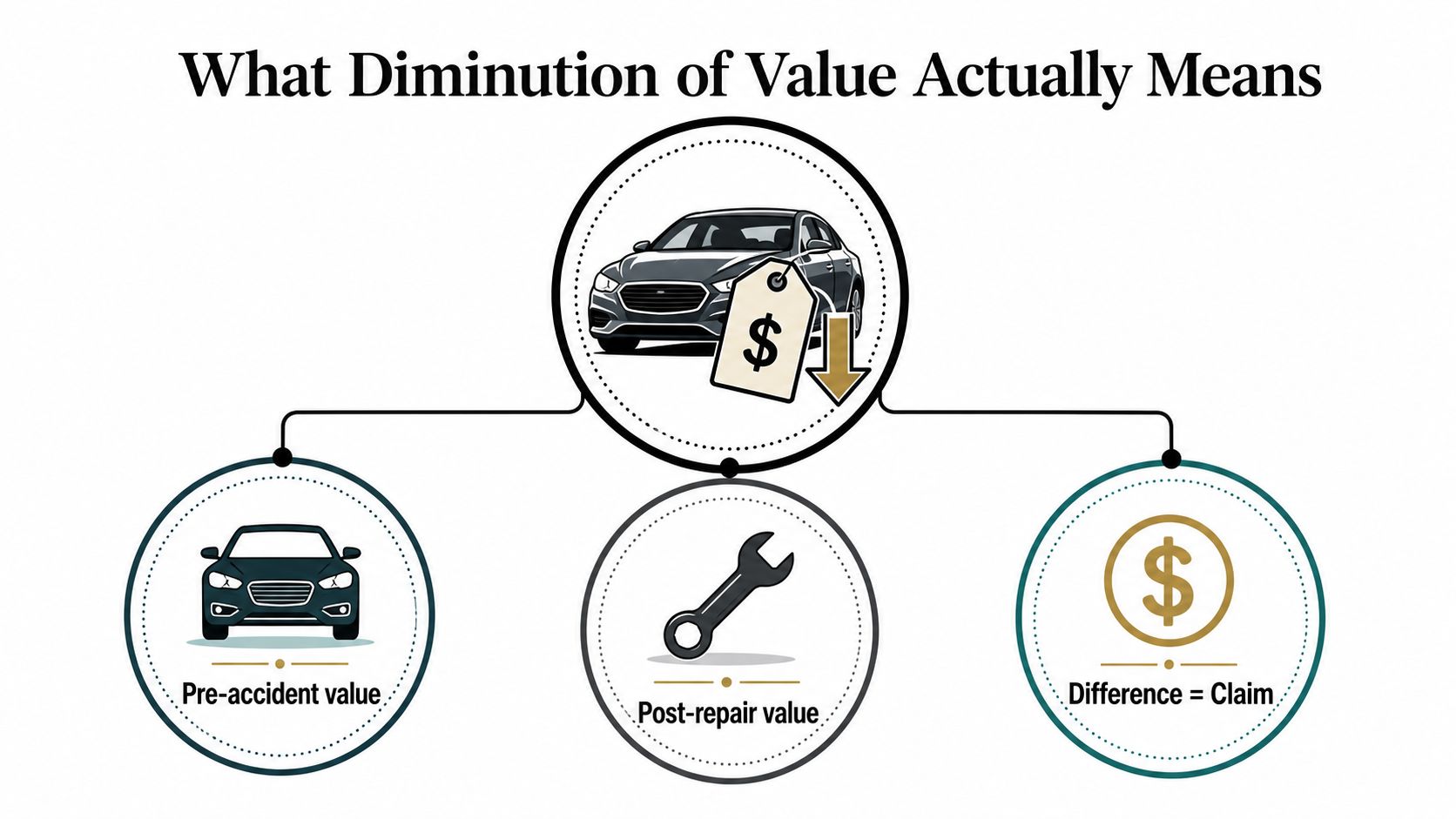
Diminution of value is the loss between a vehicle's pre-accident market value and its post-repair market value. KBB puts the issue plainly, a crash can leave a lasting value hit even after competent repairs because buyers and dealers still discount the accident history rather than paying for repair quality alone, especially on newer, higher-value vehicles (KBB). A coin with a scuff illustrates this. The coin still spends, but it no longer looks untouched, and the market treats that imperfection as a reason to pay less.
Carfax's consumer guidance says the average retail-price hit after an accident is about $500, and severe damage can push that loss to $2,100 (Carfax). The exact number depends on the car, the damage, and the market, but the principle doesn't change. A repaired car is not automatically a fully restored asset.
Practical rule: if the accident is on the record, assume the market will punish the vehicle unless you prove otherwise.
The core question is recovery. Sometimes the loss is collectible, sometimes it isn't, and the answer depends on state law and policy language, not wishful thinking.
What Diminution of Value Means
A repaired car can look fine and still be worth less. Insurers avoid that point because the paint booth is not the same thing as the marketplace. Diminution of value insurance is the claim process used to recover that lost market value after a crash, not just the repair bill.
The market sees history, not just workmanship
The basic test is simple. Compare the vehicle's worth before the accident with its worth after the repairs, then measure the gap. That gap is the market discount that survives the repair, even when the body shop did acceptable work.
A buyer, a dealer, or a leasing company can still see the accident history and lower the offer. The vehicle may run straight and pass inspection, but the resale conversation changes the moment the history report shows a collision. A clean cosmetic finish does not erase the record.
Why some cars take a harder hit
Newer vehicles usually have more value at risk because there is more to lose, and buyers are less willing to pay full price after a repair. High-end vehicles and cleaner examples get hit harder for the same reason. The market expects less compromise, so a repaired car rarely gets treated the same as an identical car with no accident history.
A vehicle does not need visible defects to lose value. It only needs a repair history that makes a buyer hesitate.
A vehicle doesn't need visible defects to lose value. It only needs a repair history that makes a buyer hesitate.
That is the heart of the claim. Diminution is not about whether the shop did decent work. It is about whether the market still pays full price after the crash.
Inherent versus repair-related loss
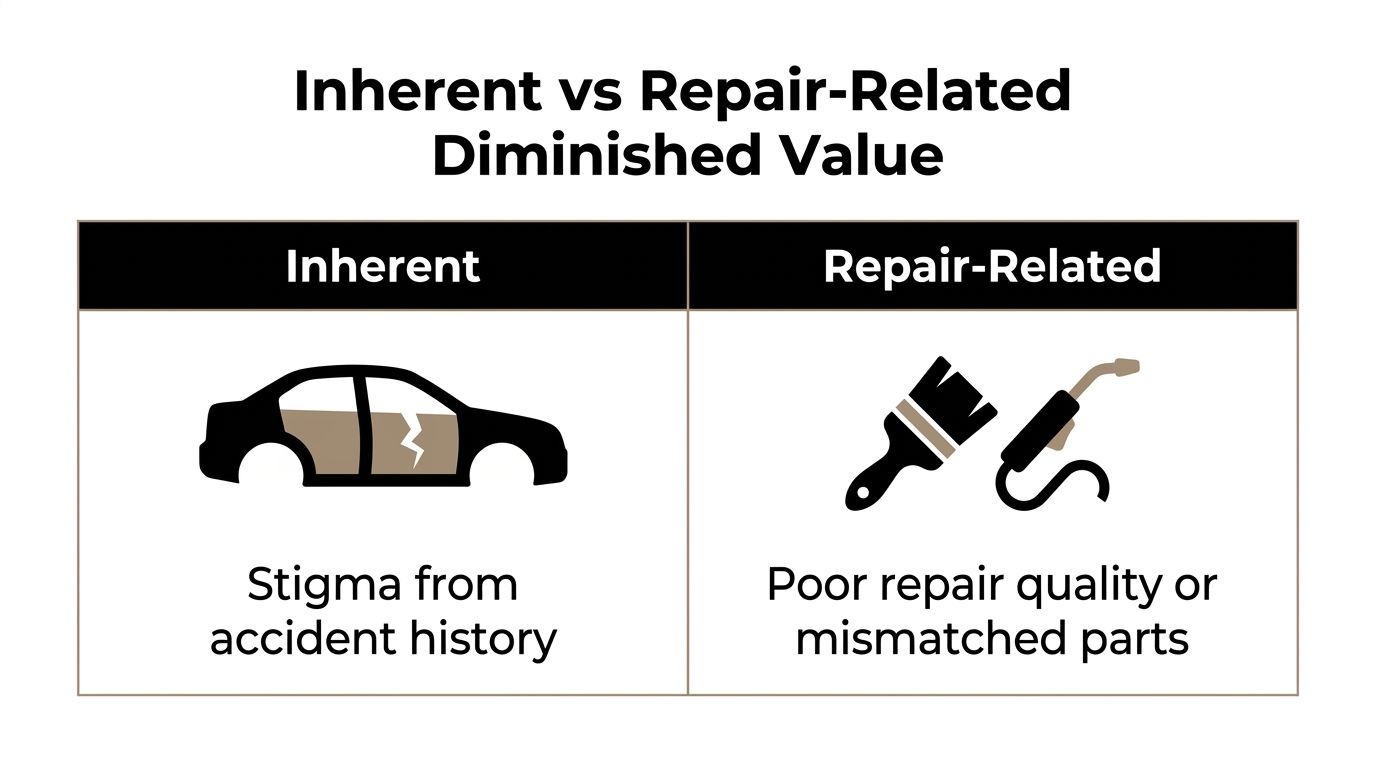
Inherent diminished value is the loss that remains even when the repair work is good. It is the stigma attached to the accident record itself. If two identical SUVs sit on a lot, the one with a collision history usually sells for less because buyers do not pay full retail for a damaged-and-repaired unit.
Repair-related diminished value is different. That loss comes from bad repairs, mismatched parts, calibration problems, crooked panels, or unfinished work. It is easier to document because you can point to the defect rather than the history. Most everyday drivers are chasing inherent diminished value, not a shop-quality dispute.
What goes in the demand
The dollar figure in your demand letter should match the kind of loss you are proving. If the car was repaired properly, the claim centers on stigma and market discount. If the car still has repair defects, the claim gets stronger when you document those defects with photos, measurements, and repair records.
The point is not to blur the two. Insurers do that on purpose because it gives them room to offer the cheaper number and call it fair.
State Law and Where Diminished Value Claims Are Allowed
A good diminished value claim starts with the law, not the repair estimate. If you file in the wrong bucket, the carrier will point to policy language or state rules and cut the claim down fast. Recovery depends on state law and on whether the claim is against the other driver or your own insurer.
Third-party and first-party are not the same fight
A third-party claim goes against the at-fault driver's liability carrier. That route is cleaner in many states because the loss is tied to what the other driver caused. A first-party claim goes against your own insurer, and that usually turns on policy language. Many policies carve out diminished value from collision and full-coverage, so your premium payment does not automatically create coverage.
That distinction matters because insurers use it to change the whole argument. A liability carrier is defending the value loss caused by its insured's negligence. Your own carrier is reading a contract, and the contract is where exclusions do the heavy lifting.
Know your state before you assume recovery
Recoverability changes by state and by policy terms. Some states are friendlier to third-party diminished value claims, some are tighter, and some first-party claims fail unless optional coverage exists.
Start with the law that governs your claim, then match it to the policy in front of you. A practical starting point is the state-by-state diminished value law guide, because it shows why one state may allow recovery while another shuts the door on first-party value loss.
Decision rule: if you are making a third-party claim, start with state tort law. If you are making a first-party claim, start with the policy language.
That sounds basic because it is. Insurers win a lot of weak claims by forcing the wrong theory onto the wrong file. If the law or the contract does not support the loss, the carrier has no reason to pay it. If you are unsure, an independent appraiser or attorney will usually tell you more than a scripted adjuster response.
How Insurance Companies Calculate Diminished Value
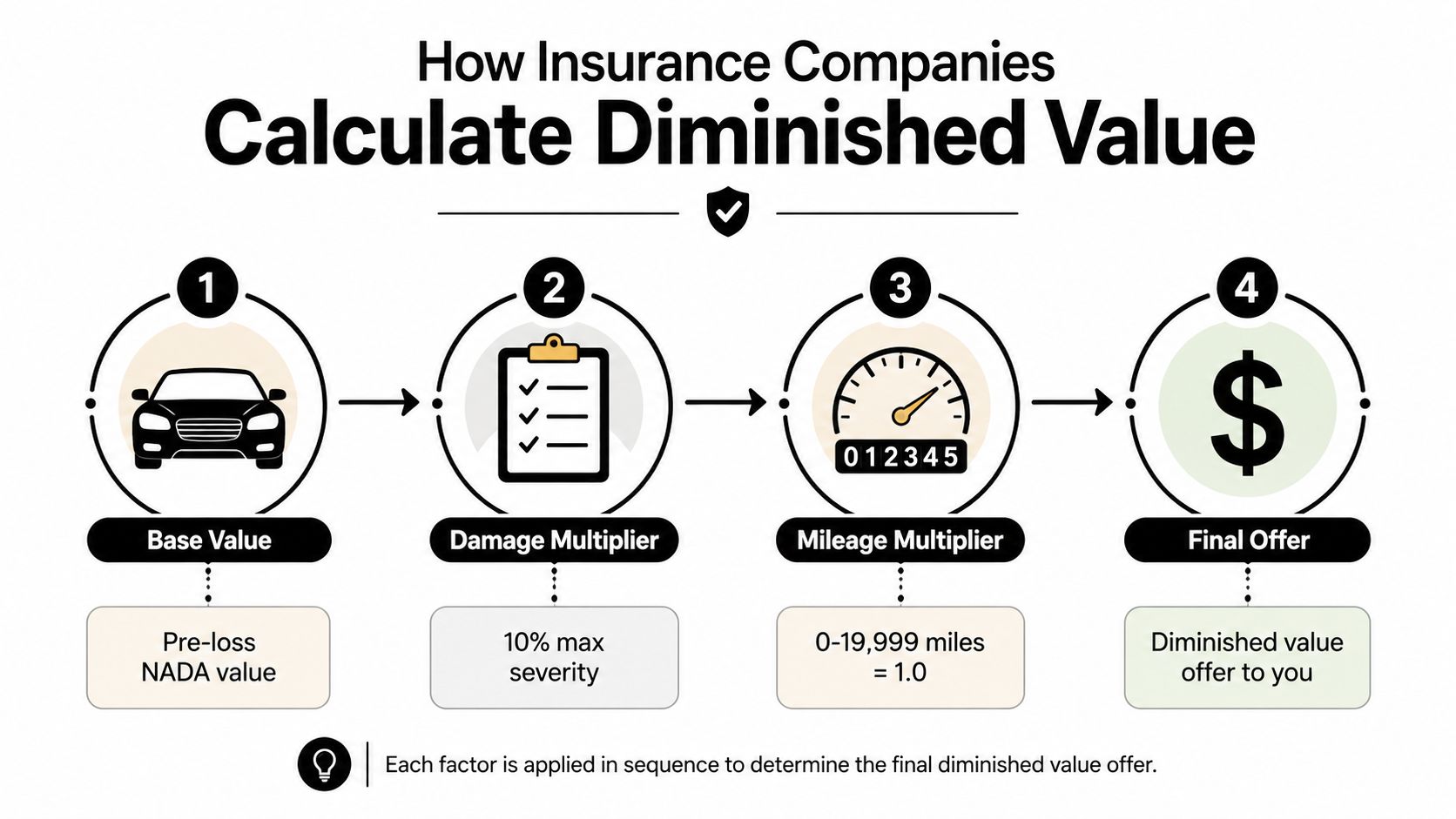
Carriers do not start with the market. They start with formulas, and that is why the first offer so often misses the actual loss. The usual playbook is the 17(c) formula, a historically used method that caps the base loss at 10% of NADA retail value before damage and mileage modifiers are applied.
The 17(c) shortcut
Take a $25,000 vehicle. Under a 10% cap, the base diminished value figure starts at $2,500. Then the carrier cuts that number again with multipliers tied to damage severity and mileage. The result usually falls fast, because the formula is designed to shrink the claim before anyone compares actual local market data.
That is the insurer-friendly part. It creates a tidy worksheet, but it does not prove market truth.
Why the formula keeps underpaying
The problem is not math. The problem is that the math is generic. A formula cannot see how a specific trim level, repair history, color, market, or buyer preference changes resale. It only spits out a standardized number, which is exactly why carriers like it.
Market-supported diminished value works differently. It uses comparable sales, local demand, and actual price behavior for similarly damaged and repaired vehicles. That takes more work, and it usually produces a more credible result for the owner. The software wants speed. The market wants evidence.
The software names you keep hearing
CCC, Mitchell, and similar valuation tools are what adjusters lean on because those systems make offers fast and defensible enough for the carrier. They are not neutral in the way most drivers assume. They are built to support a claim file, not to maximize your recovery.
If the first offer looks like a worksheet, it probably is a worksheet.
That is where an independent appraisal earns its keep. The carrier's formula gives you a starting point. It does not end the dispute unless you let it.
If you want to see how the claims side thinks, this walkthrough is useful context.
Filing a Diminished Value Claim Step by Step
Start with a short demand letter to the at-fault carrier. Keep it direct. Identify the loss, identify the vehicle, and request payment for the post-repair market reduction caused by the collision. A clean version reads like this, “I'm claiming diminished value for the repaired vehicle because the accident history has reduced its market value despite proper repairs.”
Build the file before you argue
Your packet should include the items the insurer cannot shrug off.
- Pre-accident listings: show what the vehicle was worth before the crash.
- Comparable sales: document similar vehicles with and without accident histories in your market.
- Repair invoices: prove what was repaired and what parts were used.
- Vehicle history reports: include accident records from Carfax or similar services showing the accident entry.
- Photos of repair quality issues: document mismatched panels, overspray, alignment concerns, or calibration problems.
The point is simple. Make the carrier look at the market instead of a shortcut worksheet. If they refuse to consider comparable sales, the file is being handled on autopilot.
Push back when the first number is low
If the offer is too low, counter with your evidence and ask for a written explanation of the valuation method. If the claim sits under your own policy and your state allows it, invoke the appraisal clause. Once that happens, the insurer's software does not get the last word by itself.
For drivers who want a process map before they start, appraisal clause and umpire guidance explains how a valuation dispute turns into a formal appraisal track instead of a loop of recycled adjuster emails.
If you are already navigating the claims process in Phoenix, the same discipline applies here. Get the demand in writing, keep the repair file tight, and force the carrier to answer the market evidence instead of the worksheet.
Don't wait until the file goes stale
Deadlines matter. Statutes of limitation and policy notice requirements can cut off a valid claim if you sit on it. Open the demand while the repair file, invoices, and history reports are fresh. Move the file forward before the insurer locks you into a low internal number.
If the carrier still refuses to move on real market evidence, the next step is a certified independent appraisal.
Why a Certified Independent Appraiser Changes the Math
Carrier valuation software gives the insurer speed and consistency. It does not give you a market test. That's why an independent appraiser matters, especially when the file is being driven by CCC, Mitchell, or another carrier-friendly platform.
What the report needs to do
A real appraisal should show the pre-loss market value, the post-repair market value, the difference, and the methodology used to reach it. It should also explain why the subject vehicle's damage history affects the number, not just why the repairs were expensive. That's the part adjusters have to answer, because it's tied to actual market behavior.
Total Loss Northwest offers independent diminished value appraisal services and can be found through independent car appraisers. The value of that kind of report is not marketing fluff, it's that it replaces the insurer's worksheet with a certified opinion built from the vehicle's condition, comparable market evidence, and the damage profile.
Software versus appraiser
| Dimension | Carrier Valuation Software | Certified Independent Appraiser |
|---|---|---|
| Starting point | Internal valuation inputs | Vehicle-specific market evidence |
| Damage analysis | Standardized formulas and modifiers | Condition, repairs, and history reviewed directly |
| Output | Settlement-oriented number | Documented market opinion |
| Negotiation value | Easy for the carrier to defend | Forces a real response to evidence |
The appraisal clause is the lever. Once it's invoked, the fight stops being software versus frustration and becomes a formal valuation dispute that the carrier has to engage with. That changes the tone immediately, because now there's a certified human opinion on the file, not just an internal estimate.
Bottom line: if the carrier's number came from a model, your counter should come from a market.
That's where independent appraisal wins. It doesn't guarantee the carrier will fold, but it does force them to deal with something better than a canned output.
Negotiation Tactics and the Appraisal Clause Play
Lead with evidence, not frustration. Send the insurer the independent report, the repair file, and the comparable sales, then give them one clear chance to correct the number. If they stall, invoke the appraisal clause in writing and state plainly that you are electing the contractual valuation process.
Keep the file disciplined
- Do document comparable sales in your own market.
- Don't accept the first 17(c)-style figure without a written rebuttal.
- Do keep repair invoices and vehicle history printouts in one packet.
- Don't sign a release that waives future diminished value recovery.
That packet matters because insurers lean on whatever is easiest to defend. A clean file forces them to answer market evidence instead of hiding behind a software output.
If the carrier still digs in, push the claim through the insurer's internal complaint process, then the state department of insurance if needed. On a well-supported third-party claim, a stubborn refusal to address market evidence can create bad-faith pressure. That only works if your file is organized and the valuation is credible.
For drivers who need a practical reference on how appraisal disputes get pushed into a formal process, the explanation at appraisal clause and umpire guidance is the right next read. It shows how to stop negotiating against software and start forcing a certified opinion onto the file.
If you're in Oregon or Washington, or anywhere else in the country, do not let a low formula number end the claim. Get the market evidence, invoke the clause when the carrier will not move, and use a certified independent appraisal to reset the conversation.