You might think your auto policy is “good enough” because the premium feels manageable and the declarations page looks official. Then a crash happens, the other driver's insurer calls the vehicle a total loss, and the offer lands short because the coverage layer you assumed would pay isn't there. That gap is where insurance policy limits stop being paperwork and start becoming your problem.
The hard truth is simple, the limit is the insurer's ceiling, not a promise that every loss will be made whole. California's consumer examples show how sharply limits can vary, from 30,000/60,000 bodily injury and $15,000 property damage to 100,000/300,000 bodily injury and $50,000 property damage under a higher example, and those numbers matter because anything above the limit becomes your exposure California Department of Insurance. If you want a plain-English primer on fleet-style liability concepts, fleet legal liability explained is a useful way to see how limits function in a broader insurance context.
Why Insurance Policy Limits Matter More Than You Think
You're not thinking about policy limits when you're buying groceries, commuting, or parking at the curb. You think about them after a crash, when the adjuster's math starts cutting through your assumptions and your repair bill, medical bill, or diminished-value claim doesn't fit neatly inside the available coverage.
The ceiling is real, and it's painful when you hit it
A driver can do everything right and still get trapped by someone else's too-small policy. If the at-fault party's liability limit runs out before the claim is fully paid, the insurer stops there, not because the loss is gone, but because the contract says that's where payment ends. That's why policy limits are not abstract numbers, they're the line between being paid and eating the rest yourself.
Practical rule: If the loss is bigger than the limit, the unpaid part doesn't vanish. It gets pushed to the injured party, the vehicle owner, or a different layer of coverage.
Many people get blindsided in total-loss and diminished-value claims. The at-fault carrier may owe less than your actual loss, and unless another coverage layer is available, you're left chasing the gap. For commercial fleets, the same ceiling problem shows up in a different wrapper, which is why resources like fleet legal liability explained are worth reading even if you're only shopping personal auto coverage.
High-value vehicles feel the gap faster
Owners of newer, classic, custom, or high-end vehicles get hurt fastest by low limits. The more your car costs to repair or replace, the more likely it is that a modest property-damage limit won't cover the whole story. That's not a rare edge case, it's a normal outcome when the policy was written for minimum compliance instead of real-world protection.
You should think about limits before a claim, not after. Once the wreck happens, you don't negotiate from strength, you negotiate from the contract already in force. That's why serious drivers review limits as a financial control, not as a box to check once and forget.
Decoding the Numbers on Your Declarations Page
Most auto policies bury the most important number in plain sight. You'll see something like 100/300/100, and if you don't know what each digit means, you're guessing about the amount of protection you bought.
Split limits are the standard many drivers read past
In a three-number liability format, the first number is the per-person bodily injury limit, the second is the per-accident bodily injury limit, and the third is the property damage limit. So 100/300/100 means $100,000 per injured person, $300,000 total bodily injury per accident, and $100,000 property damage coverage California Department of Insurance.
A split-limit policy can work fine if the numbers are high enough for your risk. But the structure matters, because one serious crash with multiple injured people can burn through the per-accident number much faster than most drivers expect. The same is true when a wreck involves a newer vehicle and expensive repair parts, the property-damage slice can be exhausted long before the injured person's claim is resolved.
Combined single limit gives more flexibility
A combined single limit, or CSL, collapses bodily injury and property damage into one pool. That can give the insurer more flexibility in how it pays a claim, because the money isn't boxed into separate buckets. It often costs more, but the tradeoff is cleaner protection in messy accidents where the damages don't fall neatly into one category.
Here's the practical difference:
| Common Auto Insurance Limit Structures | Limit Type | Format | Per-Person BI | Per-Accident BI | Property Damage |
|---|---|---|---|---|---|
| Split limit, lower example | 30/60/15 | 30/60/15 | $30,000 | $60,000 | $15,000 |
| Split limit, higher example | 100/300/50 | 100/300/50 | $100,000 | $300,000 | $50,000 |
| Combined single limit | CSL | One total pool | N/A | N/A | N/A |
That table is the quickest way to read your declarations page with a skeptical eye. If your policy is split limit, ask yourself whether the separate bins are large enough for a multi-party crash. If your policy is CSL, you still need to know the total pool and whether any sub-limits are hiding elsewhere.
Bottom line: Don't just ask, “What's my limit?” Ask, “How is the limit divided, and what happens when more than one person or one vehicle is involved?”
How UM/UIM Coverage and Sub-Limits Change the Picture
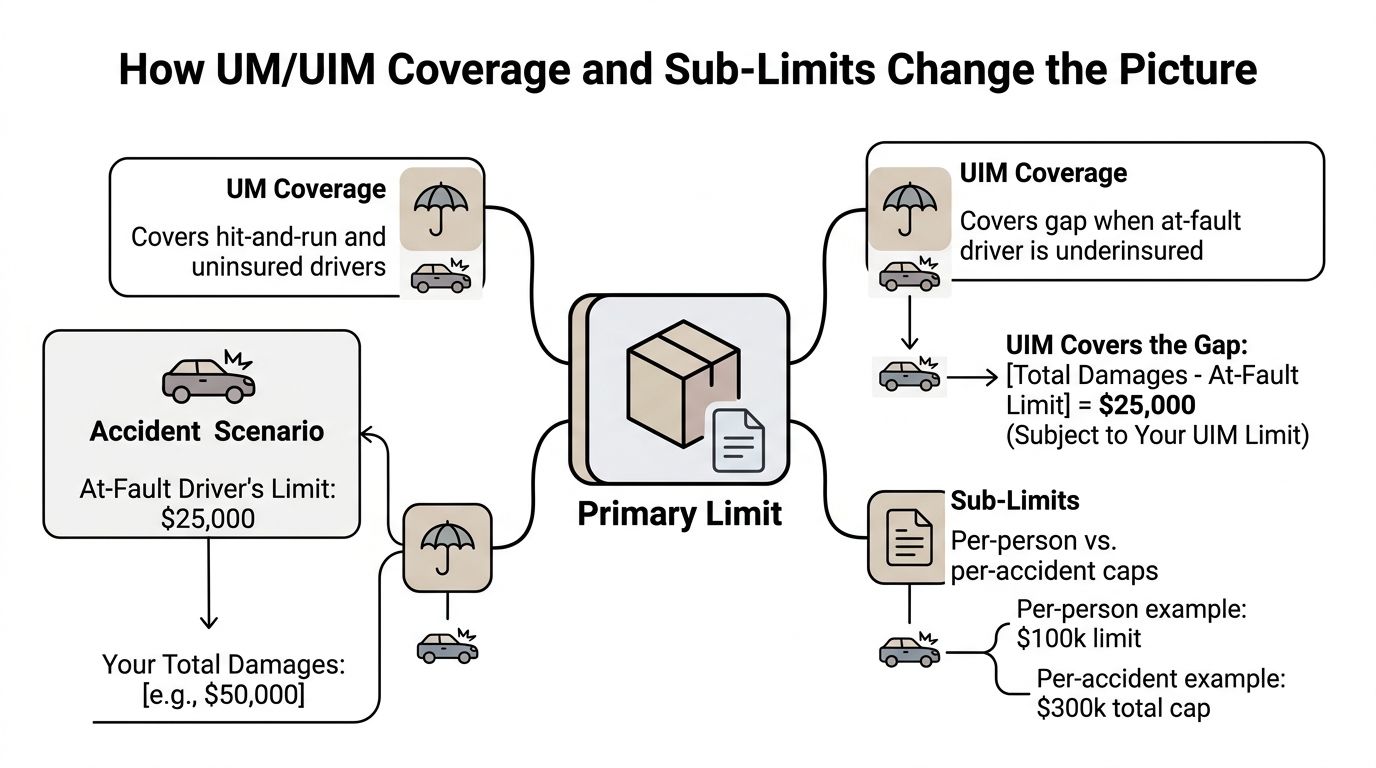
The most expensive mistake drivers make is assuming the at-fault policy is the whole story. It usually isn't. Once that first layer is exhausted, uninsured motorist, or UM, coverage and underinsured motorist, or UIM, coverage can become the difference between recovery and personal loss, especially in a crash with a low-liability driver or a hit-and-run.
The order of payment matters
The question isn't just whether coverage exists, it's which layer pays first. In a typical underinsured claim, the at-fault driver's liability policy pays up to its limit, then your UIM coverage may step in for the remaining uncovered loss, subject to state rules and policy terms. That sequencing is exactly why policy-limit disputes get messy, because the claim can trigger more than one contract and the timing of exhaustion matters Denomillikan on injury-cases policy limits.
If the at-fault driver only carries a small limit, your recovery can run into a wall fast. A common example is a driver with a $25,000 limit, where that first layer gets used up and then the claimant looks to UM or UIM coverage for the remaining loss. Whether that second layer is available depends on your own policy language and your state's rules, which is why you should never assume you're protected just because another driver had insurance.
Sub-limits can shrink a policy that looks generous
Sub-limits are the hidden caps that apply to specific categories of loss. They're not extra money on top of the headline limit, they're carved out inside the policy and can restrict payment for things like medical payments, rental reimbursement, custom equipment, or other narrowly defined losses Property Insurance Coverage Law on sub-limits.
That's where a policy can look strong on the front page and still underperform in the claim file. A driver may think they have plenty of protection, then discover a separate cap applies to the exact loss they're trying to recover. In total-loss and diminished-value disputes, those carve-outs matter because they can wipe out the room you thought you had.
Stacking changes the math
Some policies and states allow stacking, which means you can layer coverage in a way that increases available benefits. That can be a lifesaver in a serious crash, but the details are state-specific and policy-specific, so you need to read the wording instead of guessing. A plain explanation of the protection itself is available in what is underinsured motorist protection, and the key point is simple, stacking can raise the ceiling, but only if the policy and the law allow it.
Sample Calculations for Total Loss and Diminished Value Claims
Numbers make the problem obvious. A policy limit only feels large until you put a real claim against it, then you see how fast the math turns against the claimant.
Total loss means the limit can end the conversation
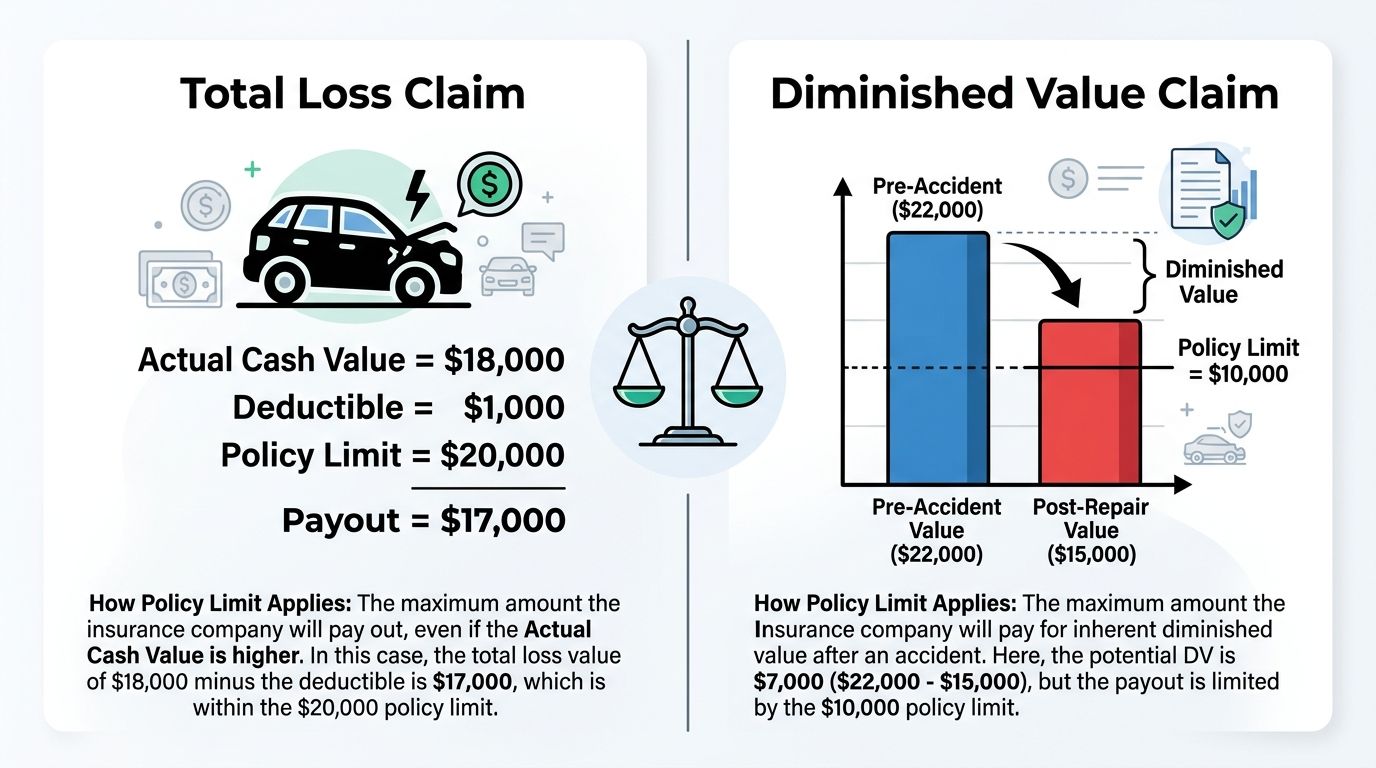
Say a vehicle has an actual cash value above the at-fault property-damage limit. If the insurer's liability cap is lower than the car's value, the carrier pays only up to the cap, and the remaining loss is still there. That's why total-loss claims often become fights about valuation, not just about fault.
The same problem shows up when multiple damaged vehicles are involved. If a split-limit policy has a modest property-damage bucket, one expensive replacement can drain it before everyone else is paid. The policy doesn't stretch just because the claim is larger than expected.
A clean way to think about it is this. The insurer pays the lesser of the covered loss and the policy cap, then the claimant either absorbs the remainder or looks to another coverage source. That's the whole game.
Diminished value is where sub-limits quietly hurt
Diminished value is different. The car may be repaired, but the market still treats it as less valuable because it now has an accident history. If the policy has a carve-out, a restrictive endorsement, or a separate cap that doesn't clearly cover diminished-value loss, the claim can come back at zero or close to it.
That's where adjusters lean on software and generic valuation logic to narrow the payout. Independent appraisal work matters because it forces the dispute back to market reality instead of an insurer model that was built to limit exposure. If you want a deeper look at settlement behavior when caps are in play, policy limits settlement is the right companion read.
Claim reality: A repair receipt doesn't prove the car kept its value. If the policy doesn't clearly cover the loss, the insurer will use that silence against you.
Reading Your Policy for Hidden Coverage Gaps
Most drivers only read the declarations page. That's a mistake. The traps usually live in the endorsements, exclusions, and separate coverage sections where the policy narrows what looked broad on the front page.
Start with the declarations page, then keep going
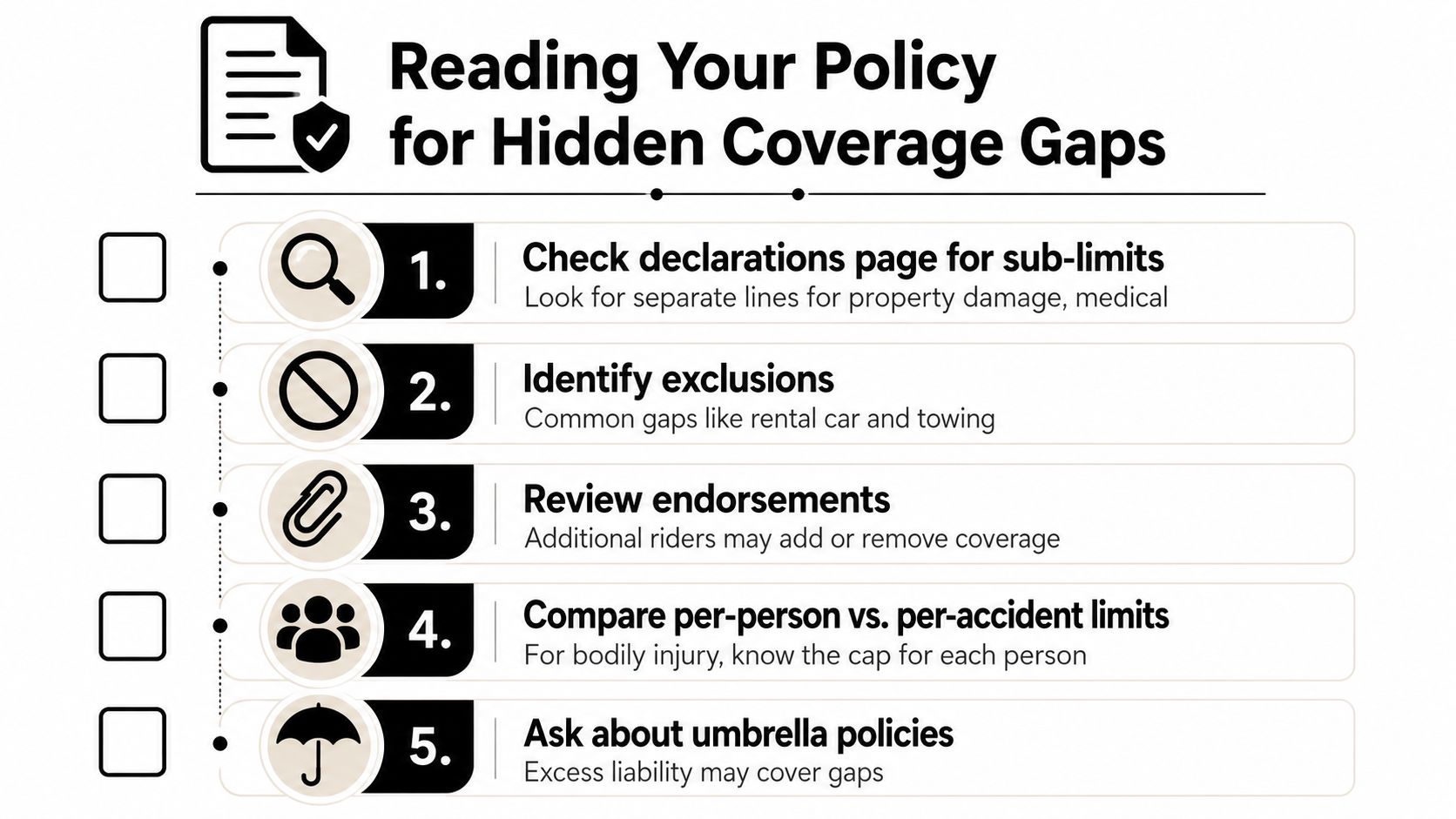
The declarations page tells you the headline limits, but it won't always tell you what's carved out underneath them. Look for separate lines for medical payments, property damage, rental reimbursement, and any mention of custom parts or equipment. If a limit appears as its own line item, treat it as a real cap, not as a bonus.
Then move to the endorsements. That's where carriers add, remove, or narrow coverage without making the policy easier to understand. If you own a custom, collector, or heavily modified vehicle, the fine print can swallow the value you thought you had insured.
Use a five-step audit
- Check for sub-limits: Look for separate caps that sit inside the main policy and apply to specific losses.
- Read exclusions closely: If a loss category is excluded, the headline limit won't save you.
- Review endorsements: These pages often rewrite the claim rules in the carrier's favor.
- Compare per-person and per-accident numbers: A policy can look generous and still fail fast in a multi-injury crash.
- Ask about umbrella coverage: Extra liability above the primary policy can close a gap that standard limits leave open.
That kind of review should happen every year, not after a claim. Vehicles change, repair costs change, and your risk changes with them. A policy that worked when you bought it can be thin by the time you need it.
If you don't understand a clause, ask the agent to translate it into plain English. If they can't explain where the cap sits, assume it matters.
What to Do When Your Limits Are Too Low
Low limits put you in one of two bad positions. Either you're the at-fault driver staring at personal exposure, or you're the claimant trying to recover from a driver who didn't buy enough protection. Both situations demand a direct response, not wishful thinking.
On the at-fault side, buy more protection before you need it
Umbrella policies and excess liability coverage exist for exactly this reason. They sit above the primary policy and can add another layer when the first one is exhausted. If you have assets to protect, or just don't want one bad crash to become a personal balance-sheet problem, this is the cleanest fix.
That advice is more practical than emotional. Higher limits usually cost more, but the point of insurance is not to buy the cheapest possible card in your wallet. The point is to avoid exposing your savings, wages, or property to a claim that should have been covered.
On the claimant side, force the claim to the right layer
If the at-fault driver is underinsured, don't let the insurer stall while the gap grows. Request limits disclosure early, push the claim through the available liability layer, and then evaluate whether your own UM or UIM coverage can take over the remaining loss. If the vehicle is a total loss, challenge the valuation before you accept the first number, because once you sign, the fight gets harder.
An independent appraisal is the cleanest way to push back on a lowball total-loss offer. It pulls the argument away from insurer software and back to actual market value. That's especially useful when the policy is tight and every dollar matters, which is the exact setting where adjusters try to close fast.
If the carrier won't clearly explain what was paid, what remains, and which limit controls next, the file isn't ready for settlement.
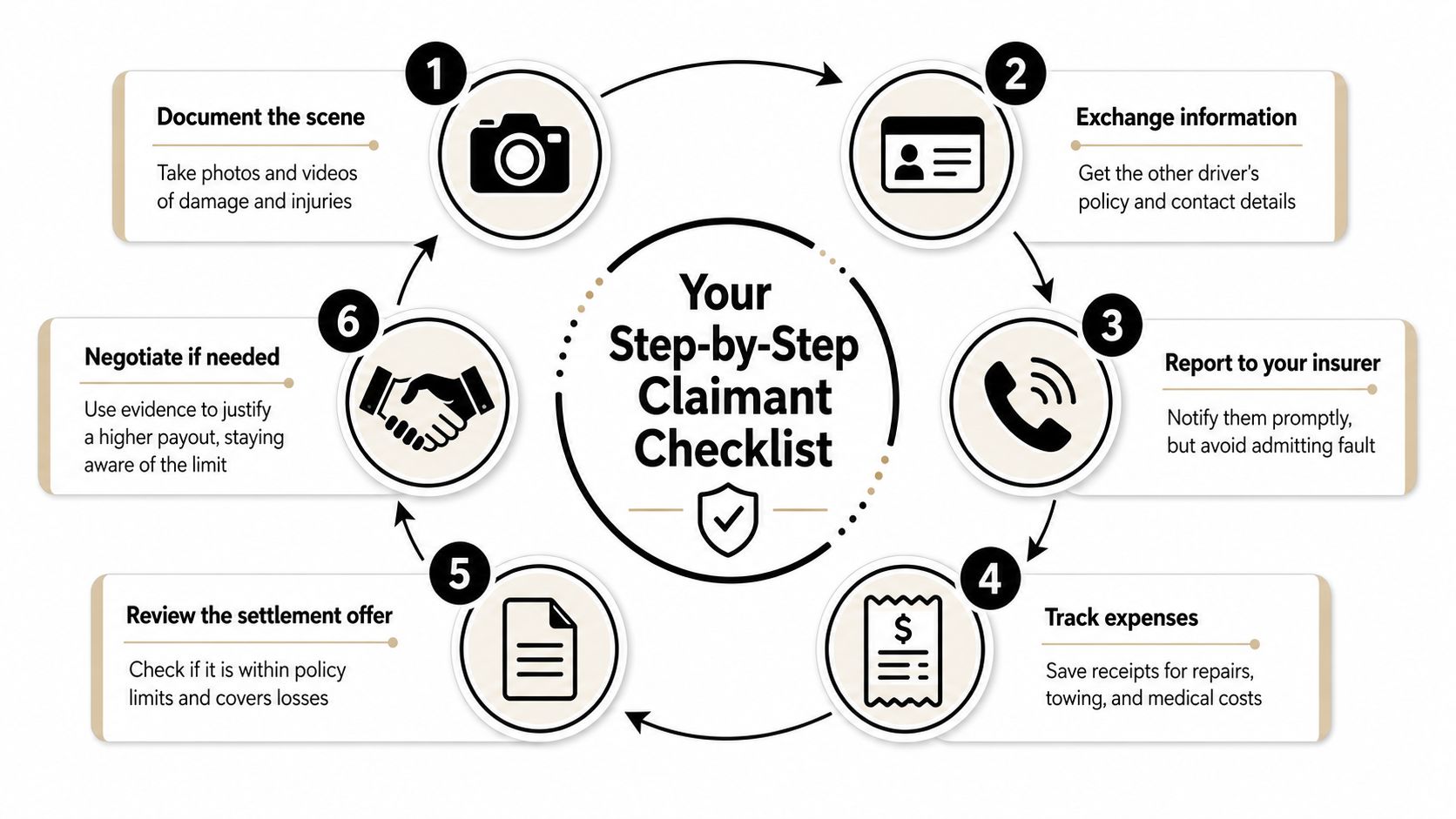
Your Step-by-Step Claimant Checklist
A strong claim starts at the scene, not at the settlement offer. The more complete your documentation, the harder it is for an insurer to hide behind a low valuation, a hidden cap, or a rushed release.
Follow the file, not the adjuster's mood
- Document the scene. Take photos and videos of the vehicles, the roadway, and visible damage before anything gets moved.
- Exchange information. Get the other driver's policy details and contact information, then confirm which insurer is handling the claim.
- Report the crash promptly. Notify your insurer, but don't guess about fault or downplay injuries.
- Track every expense. Save repair invoices, towing receipts, rental bills, and medical records.
- Review the first settlement offer carefully. Check whether it stays within the available limits and whether it covers the loss.
- Negotiate with evidence. If the offer is thin, answer with photos, valuations, repair documentation, and an independent appraisal.
Use direct language with the adjuster. Say, “I need a written explanation of the coverage available and how you calculated the offer.” If the response doesn't line up with your damages, that's your warning sign.
Total Loss Northwest helps drivers who are stuck with low offers, confusing limits, or disputed valuations after a crash. If your vehicle lost value or the settlement doesn't match the actual loss, visit Total Loss Northwest and get help pressing the claim the way it should've been handled from the start.