You open the claim email, see the number, and your stomach drops. You know what your car was worth before the wreck. You know what similar vehicles are selling for in your area. Then Allstate sends an offer that feels detached from reality.
That reaction is usually justified.
A low first offer on a total loss or diminished value claim isn't some rare clerical glitch. It's often the starting point. The insurer has its number. You need yours. If you don't challenge the valuation, their number becomes the file.
That Sinking Feeling When the Settlement Offer Is Too Low
The usual pattern looks like this. Your vehicle gets hit. You weren't at fault. You expect the claim process to be annoying, but manageable. Then the settlement arrives and the valuation report uses vehicles that don't look like yours, don't have your options, or don't reflect your car's condition before the crash.
That's when a lot of drivers start searching for All State appraisal and get buried in confusion.
Some people mean Allstate's valuation process. Others mean a company with a similar name. And that confusion matters, because people frequently ask whether "All State Appraisal" can handle auto diminished value or total loss claims across all states, while existing information often mixes up real estate appraisal firms with auto appraisal services. That confusion is made worse by Allstate Appraisal, L.P., a national real estate appraisal provider with no public indication that it offers auto diminished value services, according to this company profile for Allstate Appraisal, L.P..
If you're dealing with a car claim, don't assume a similar-sounding appraisal company handles auto loss disputes. Real estate appraisal and auto appraisal are different lanes.
What drivers usually get wrong first
The first mistake is treating the offer like a final ruling.
It isn't. It's a negotiable insurance valuation. If the number is wrong, the file needs better evidence.
The second mistake is blending together Allstate, all state appraisal, and independent appraisal as if they're the same thing. They aren't. Allstate is the insurer. Their valuation is their position. An independent appraiser works for the valuation itself, not for the carrier.
You don't need to prove the insurer acted maliciously. You need to prove the number is wrong.
That same mindset shows up in bodily injury claims too. If you're also dealing with a physical injury claim, this guide on getting a fair injury settlement is worth reading because the basic principle is the same: the first offer is often designed to close the claim, not maximize your recovery.
What to do before you argue with the adjuster
Start by slowing down and getting organized. A rushed response usually helps the insurer, not you.
- Save every document: Keep the offer letter, valuation report, photos, repair estimate, and adjuster emails.
- Compare the details: Check trim level, mileage, options, condition, title history, and pre-loss upgrades.
- Read a practical breakdown: If you want a plain-English explanation of what a low offer usually looks like, review this guide to a lowball insurance settlement offer.
If the offer feels low, you're probably not imagining it. The next step is understanding how the number was built, because you can't tear apart a bad valuation until you see the parts they used.
How Allstate Calculates Your Vehicle's Value
Most drivers think the insurer looks up the car, checks a few listings, and lands on a fair number. That's not how it usually feels in practice. The valuation is often built through software-driven reports, condition adjustments, comparable vehicle selection, and internal review.
That matters because every one of those inputs can be wrong.
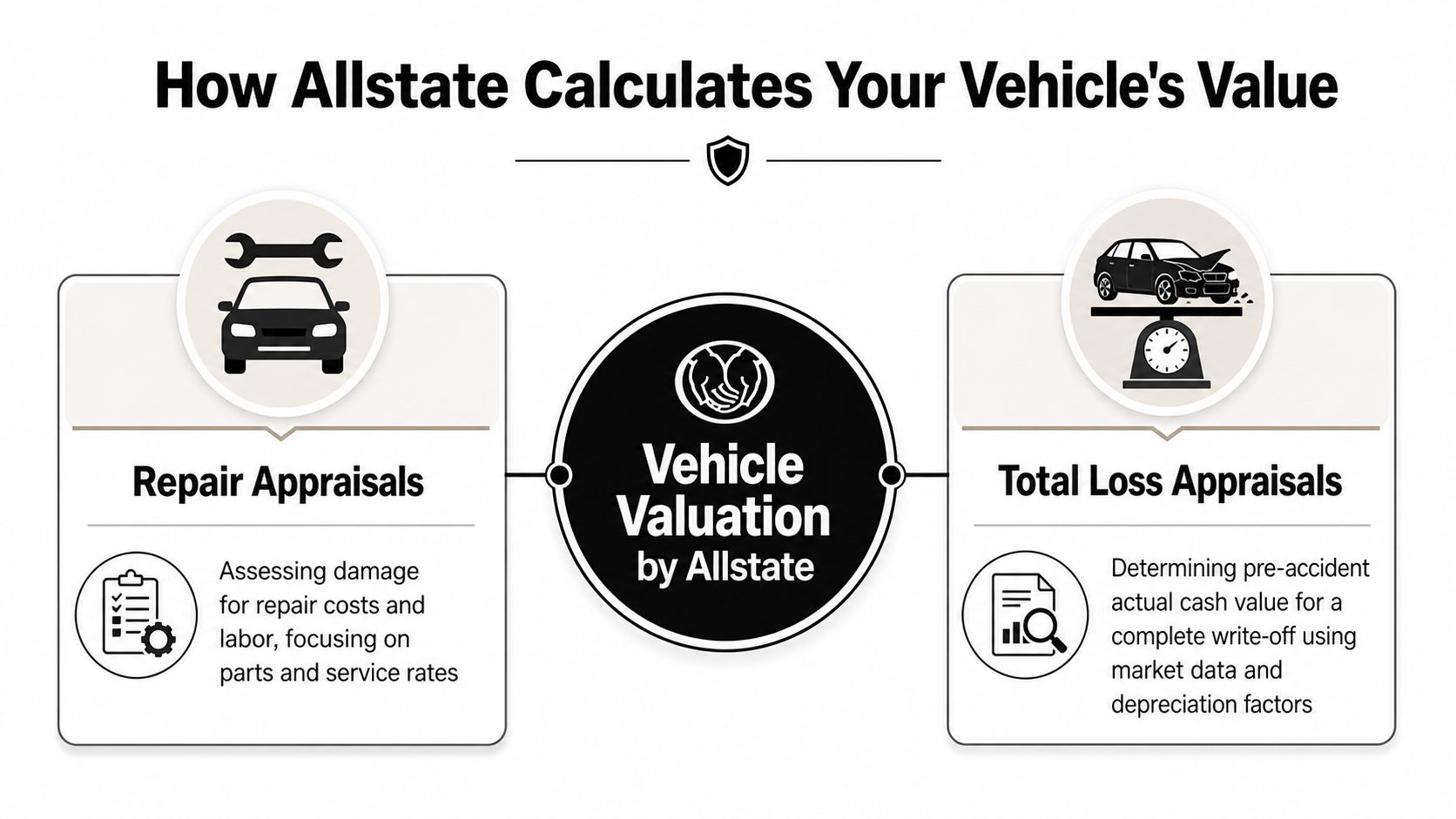
Repair appraisal versus total loss appraisal
A repair appraisal asks one question: what should it cost to fix the damage?
A total loss appraisal asks a different question: what was the vehicle's Actual Cash Value, or ACV, immediately before the loss?
Those are not interchangeable. Repair cost is about parts, labor, paint, procedures, and whether the vehicle should be fixed. ACV is about pre-loss market value. When drivers mix those up, they argue the wrong point and waste time.
A simple way to think about ACV is this: if your car had been sitting for sale on the local market right before the crash, what would a real buyer have paid for that specific vehicle, with its mileage, equipment, and condition?
Where low valuations usually go sideways
The report might look clean. The errors are often buried in the details.
Here are the most common weak spots:
- Bad comparables: The insurer may use vehicles with fewer options, different trims, or worse local relevance.
- Condition downgrades: If they mark your interior, paint, or tires more harshly than the evidence supports, value drops.
- Mileage and equipment mistakes: One missing package can move the number in the wrong direction.
- Unsupported adjustments: Small deductions add up fast when nobody challenges them.
A lot of drivers also forget that presentation affects value. Clean photos, service history, and proof of prior condition can support your position. If you're trying to document your car well before a dispute escalates, this piece on Seattle auto detailing for resale is useful because it shows the kind of visible-condition issues buyers notice and insurers often undervalue.
For a deeper look at the mechanics, this explanation of how insurance companies value a car gives you the framework to read your report critically.
Why state law changes the math
Not every state uses the same standard for declaring a vehicle a total loss. In Tennessee, a vehicle is legally a total loss when repair costs equal or exceed 75% of its pre-loss ACV under state law, while Florida uses an 80% threshold under its own statute, as explained in this overview of Tennessee and Florida total loss thresholds.
That difference matters because insurers don't operate in a legal vacuum. The same damaged vehicle can be treated differently depending on the state rules that control the claim.
Practical rule: Don't argue value in general terms. Argue the specific trim, condition, options, and local market facts the report got wrong.
Your Secret Weapon The Appraisal Clause
If your policy includes an Appraisal Clause, that's your recourse. Use it.
Most drivers never do, because the insurer doesn't exactly lead with, "Here's the contract provision you can use to challenge our number." But when value is disputed, the Appraisal Clause can move the fight out of the insurer's software-driven framework and into a formal valuation process.
How it works in plain English
You hire your appraiser. The insurer hires theirs. If those two appraisers can't agree, they bring in a neutral umpire. The final value decision comes from that process, not from one adjuster repeating the original offer.
That's why this matters. You're no longer asking the insurer to please reconsider. You're forcing a valuation dispute into the mechanism the policy already provides.
If you've never looked at that language before, read this breakdown of the insurance appraisal clause. Then pull your own policy and find the exact wording.
Why it changes the balance
The Appraisal Clause doesn't magically guarantee your number. It does something more important. It makes evidence matter.
A weak insurer valuation can survive casual complaints. It doesn't hold up as well when an independent appraiser starts pointing out the wrong trim, the missing options, the poor comparable choices, and the unsupported deductions.
Once appraisal is invoked, the conversation shifts from opinion to proof.
That shift is where many drivers finally get traction. Not because the insurer suddenly becomes generous, but because the process gets more disciplined.
When to invoke it
If the gap is meaningful and the valuation report has obvious flaws, don't spend weeks going in circles. Push the dispute into appraisal before the file hardens around the insurer's number.
Use the clause when:
- The comparables are wrong: Different trims, bad condition matches, or distant market examples.
- The report omits features: Options, packages, upgrades, or documented condition.
- The adjuster keeps repeating the same number: That's usually your sign that informal discussion has run its course.
This is a contract right. Treat it like one.
A Step-by-Step Guide to Challenging Allstate's Offer
If Allstate sent a number that doesn't reflect your vehicle, stop reacting emotionally and start building a file. A strong challenge is organized, specific, and documented.
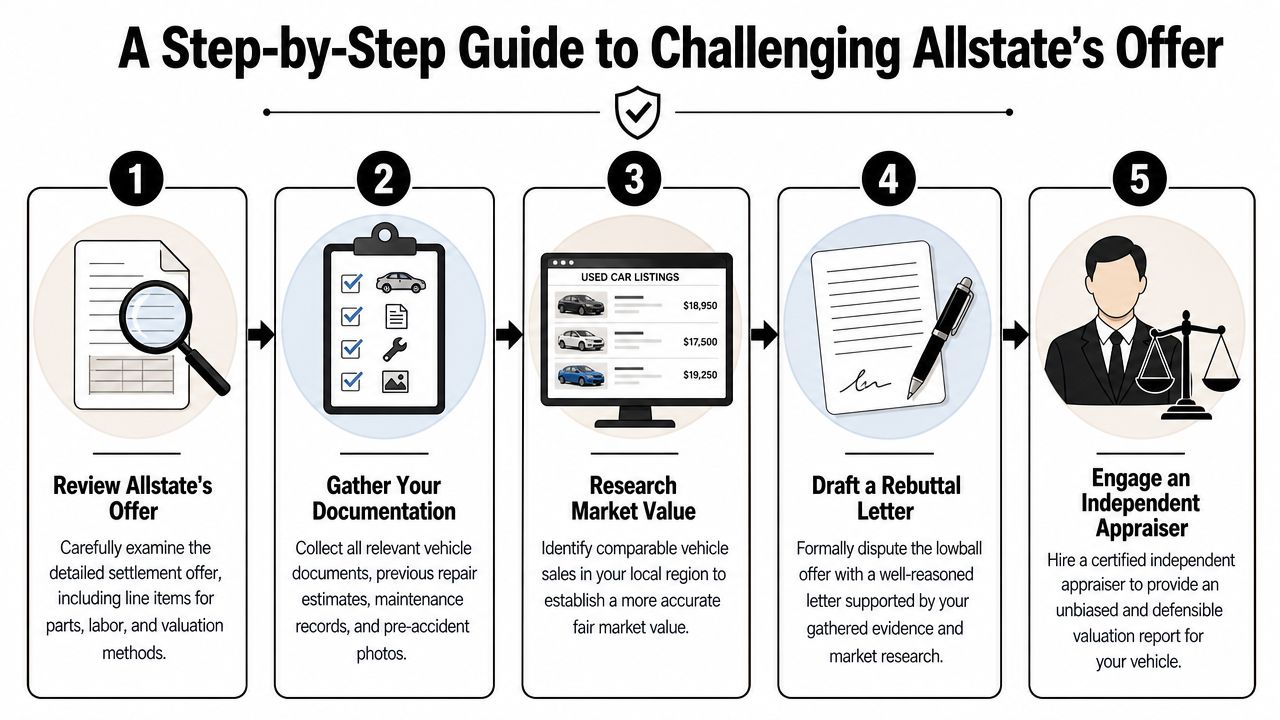
Step 1 through Step 3
Don't rush to accept
Don't sign releases you haven't reviewed carefully. Don't treat pressure from the adjuster as a deadline that controls you. If they've made an offer, you have a valuation dispute, and valuation disputes can be challenged.
Demand the full valuation report
Ask for every page. You want the comparable vehicles, condition ratings, adjustments, and any notes used to support the offer. If they only send a summary, ask again.
Audit the report line by line
Most lowball offers crack at this point. Compare their report against your actual vehicle.
- Check the basics: VIN pattern, trim, drivetrain, mileage, factory options, aftermarket additions.
- Check condition calls: Seats, paint, glass, wheels, tires, prior repairs, service history.
- Check the comparables: Are they comparable, or just convenient?
Step 4 and Step 5
Build your own evidence packet
Gather maintenance records, purchase documents, photos from before the loss, receipts for major work, and anything showing pre-accident condition. If your car had unusually clean history or uncommon options, document it.
Formally dispute the valuation
Keep it short and firm. You don't need a dramatic letter. You need a clean record.
You can say something like this:
I dispute Allstate's valuation of my vehicle. The report contains factual errors and uses non-comparable vehicles. Please preserve my right to contest value, and advise whether Allstate will revise the offer or proceed under the policy's appraisal provision.
If the claim also includes injury issues or broader settlement questions, these ProPlaintiff.ai settlement resources can help you think more clearly about negotiation posture and documentation.
What an independent review does differently
| Factor | Allstate's Method | Independent Appraiser's Method |
|---|---|---|
| Vehicle data | Uses insurer file inputs and valuation report details | Verifies trim, options, mileage, and condition against actual evidence |
| Comparable selection | May include vehicles you wouldn't reasonably shop against | Filters for genuinely similar vehicles and local market relevance |
| Condition analysis | Applies report-based adjustments | Reviews photos, records, and specific pre-loss condition proof |
| Dispute process | Adjuster controls the file unless challenged | Creates a formal rebuttal or appraisal-ready valuation position |
| Goal | Settle the claim from the insurer's side | Establish a supportable market value from the owner's side |
What not to do
Drivers hurt their own cases in predictable ways.
- Don't argue with no documents: A strong opinion without evidence won't move the number.
- Don't focus on what you owe on the loan: Loan balance and market value are separate issues.
- Don't ramble: Long emotional emails are less effective than short factual objections.
A low offer isn't beaten with outrage. It's beaten with better valuation work.
Special Considerations for Oregon and Washington Drivers
If you're in Oregon or Washington, you are in a better position than many drivers realize. These two states give you concrete legal angles to challenge weak total loss valuations. Use them.
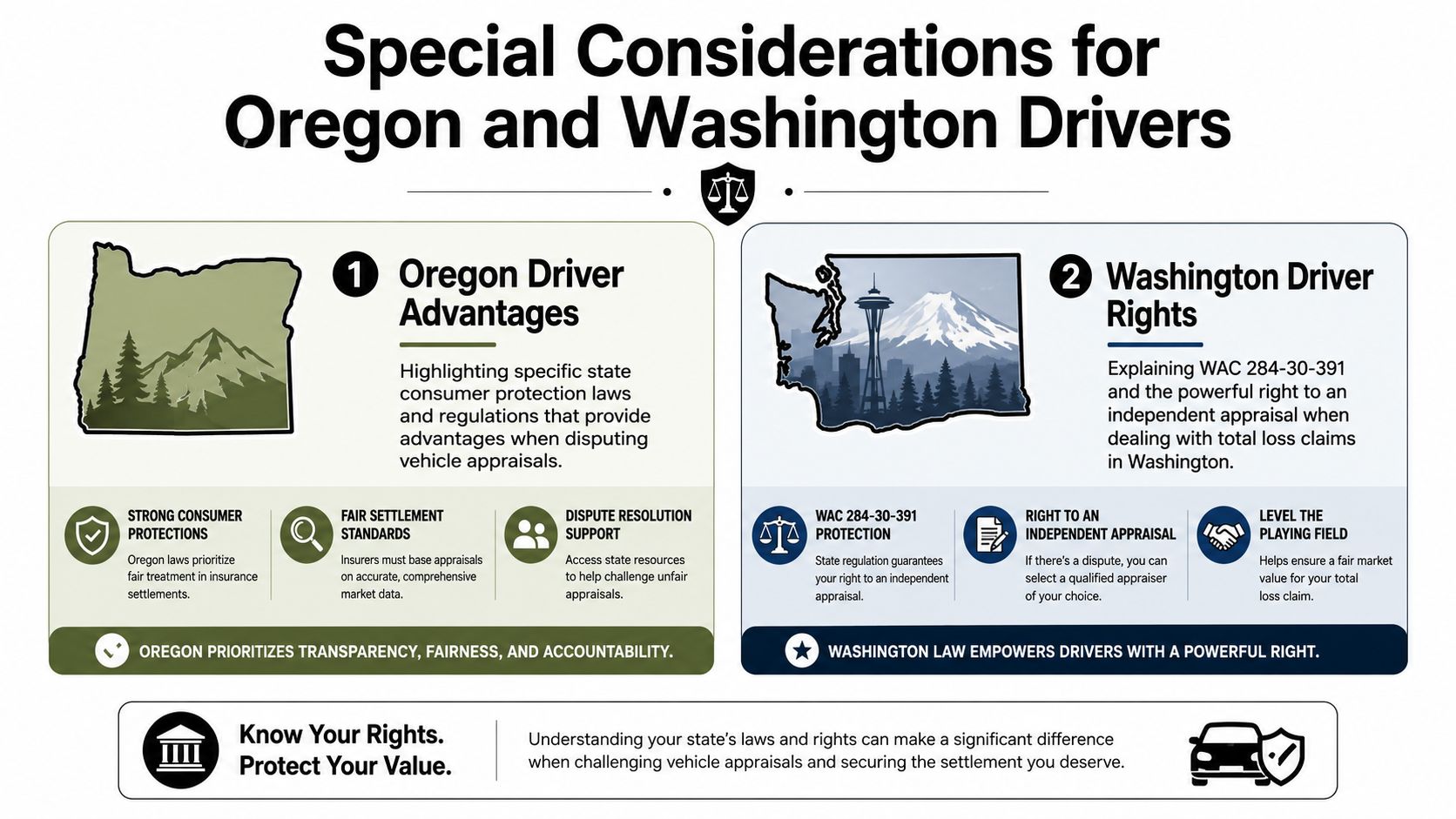
Washington drivers can force the market issue
Washington's rule is unusually practical. Under WAC 284-30-391, when there's a dispute over ACV, the settlement must be resolved by locating a comparable motor vehicle currently available for the agreed settlement amount, or by purchasing it for the claimant. This means the number can't just live inside a database. It has to connect to a real, available replacement vehicle in the market, as described in Washington's WAC 284-30-391.
That gives you a direct challenge when the insurer's number looks theoretical.
If they say your car is worth a certain amount, ask the obvious follow-up: where is the comparable vehicle currently available for that amount? Not a stale idea. Not an abstract average. An actual vehicle.
Oregon drivers should attack weak data sources
Oregon gives drivers a different but equally useful angle. Under OAR 836-080-0240, total loss valuation databases must produce statistically valid values for at least 85% of all makes and models for the last 15 model years, and they must rely on vehicles available within the last 90 days of the loss date. For vehicles five model years old or less, values must come primarily from verifiable data or inventory from licensed dealers, not just advertised prices, under Oregon's total loss valuation rule.
That matters because Oregon doesn't let insurers lean casually on flimsy listings or weak inventory data for recent-model vehicles.
If the insurer's valuation depends on old, unverifiable, or poorly matched listings, Oregon gives you a direct way to attack the foundation of the report.
What this means in practice
For Oregon and Washington drivers, the dispute isn't just "I think my car is worth more." The dispute becomes legal and factual.
- Washington owners: Push the carrier to identify a real replacement vehicle available at the settlement number.
- Oregon owners: Scrutinize whether the database inputs and dealer-based evidence satisfy the rule.
- Both states: Use local market evidence, not generic national assumptions.
In this scenario, local knowledge is essential. A driver who knows these rules can challenge the offer with precision instead of frustration.
How an Independent Appraiser Gets You Paid Fairly
An independent appraiser gives you something the insurer's valuation does not. A documented number you can defend.

What you're actually hiring
You are hiring evidence.
A good appraiser reviews your vehicle's trim, options, mileage, condition, prior repairs, service history, and local market support. Then they audit the insurer's report line by line. They catch missing equipment, bad condition adjustments, weak comparable choices, and valuation shortcuts that drag the number down. If the dispute goes to appraisal, that report gives your side structure and credibility.
That matters because complaints alone do not change claim values. Documentation does.
Why this matters with Allstate, and with "all state" searches
A lot of drivers search "all state appraisal" when they really mean Allstate. That confusion causes problems. You end up reading generic insurance advice when what you need is a direct challenge to one carrier's valuation methods and a plan that fits your state.
An independent appraiser closes that gap. They do not just say your car is worth more. They show why the insurer's number is wrong, using support that holds up in Oregon or Washington when the carrier pushes back.
Total Loss Northwest is one example of a firm drivers use for independent total loss and diminished value appraisals in Oregon and Washington.
A real valuation dispute is won with a written report, not frustration.
That changes the tone of the claim. The adjuster is no longer dealing with a caller who says the offer feels low. They are dealing with a documented market value conclusion backed by a person whose job is to measure vehicle loss, not contain claim payouts.
Taking Control of Your Insurance Claim
If Allstate's offer is low, treat it as the opening move. Not the answer.
You don't need to be a valuation expert to fight back effectively. You need a copy of the report, a willingness to check it carefully, and enough discipline to stop arguing in circles. When the insurer's number is built on bad comparables, missing options, weak condition calls, or shaky market support, that can be challenged.
The biggest mistake is passivity. Drivers assume the insurer's process must be right because it looks official. That's the trap. Official-looking paperwork can still be wrong.
Your advantage comes from facts and procedure. Check the valuation. Document your vehicle. Use the Appraisal Clause when the dispute is real. If you're in Oregon or Washington, use the state-specific rules that give you more ground to stand on.
This process isn't about being difficult. It's about refusing to let a bad number become permanent because you were tired, busy, or intimidated.
If you want a professional review of your lowball total loss or diminished value offer, talk to Total Loss Northwest. They handle independent auto appraisals for Oregon and Washington drivers and can help you challenge the insurer's valuation with a documented, appraisal-ready report.