An accident is chaotic enough, but your auto claim documentation is the one thing you can completely control. I've seen it time and again: this isn't just about collecting paperwork. It's about building the single most powerful tool you have to prove your vehicle's true value and the full extent of your loss. A meticulously prepared file is your best defense against the lowball offers that are all too common.
Why Your Documentation Is the Key to Your Claim
After a crash, the last thing you want is another layer of stress from the insurance company. But what if you could shift the power dynamic in your favor right from the start? That's what organized documentation does. It cuts through the noise and helps you build a case that gets you paid fairly and without unnecessary delays.

When you treat your documentation like the foundation of your claim, you transform from a passive participant into an active, informed negotiator armed with undeniable proof. With a solid file in hand, you can:
- Stop Lowball Offers: A detailed record makes it incredibly difficult for an adjuster to justify an unfairly low settlement.
- Speed Up the Process: When everything is in order, your claim moves faster. This prevents the frustrating back-and-forth that holds up your money and repairs.
- Prove Your Vehicle's Real Worth: This is where you get to show the true pre-accident condition and value of your car, which is especially critical for custom, classic, or exceptionally well-maintained vehicles.
The Financial Impact of Good Records
The difference between a complete file and a sloppy one can be thousands of dollars. In 2026, U.S. auto insurers are projected to report nearly $170 billion in losses, with the bulk split between liability and physical damage claims. From my experience, a claim with complete documentation is often resolved in around 30 days. But if you're missing information, that timeline can easily stretch beyond 90 days, stalling your payout and complicating repairs.
Your goal is simple: create a clear, evidence-based narrative that leaves no room for an insurer to undervalue your loss. You'll be negotiating from a position of strength, not desperation.
Getting familiar with common terminology is also a huge advantage. You’ll frequently see the acronym "MVA" (Motor Vehicle Accident) on police reports and medical forms. Understanding what this and other terms mean is helpful; the MedAmerica Rehab MVA guide offers a great explanation. Ultimately, strong documentation ensures you’re prepared and confident throughout the entire claim process.
Your Essential Post-Accident Evidence Checklist
In the chaotic minutes after a car accident, your first instinct is probably not to start documenting everything. Adrenaline is pumping, and it’s easy to get overwhelmed. But this is precisely when the foundation for your auto claim documentation is built. Taking a few strategic actions right away can mean the difference between a straightforward claim and a frustrating, drawn-out dispute with the insurance company.
Think of yourself as a detective building a case. Every piece of information you gather helps tell the complete story of what happened, leaving very little room for the insurer to argue the facts or undervalue your claim. This isn't just about collecting paperwork; it's about constructing an undeniable record of events.
Mastering On-Scene Evidence Collection
The most compelling evidence is what you collect right there at the scene. It’s fresh, objective, and incredibly difficult for an insurance adjuster to contest weeks later. Your smartphone is your single most important tool in these moments.
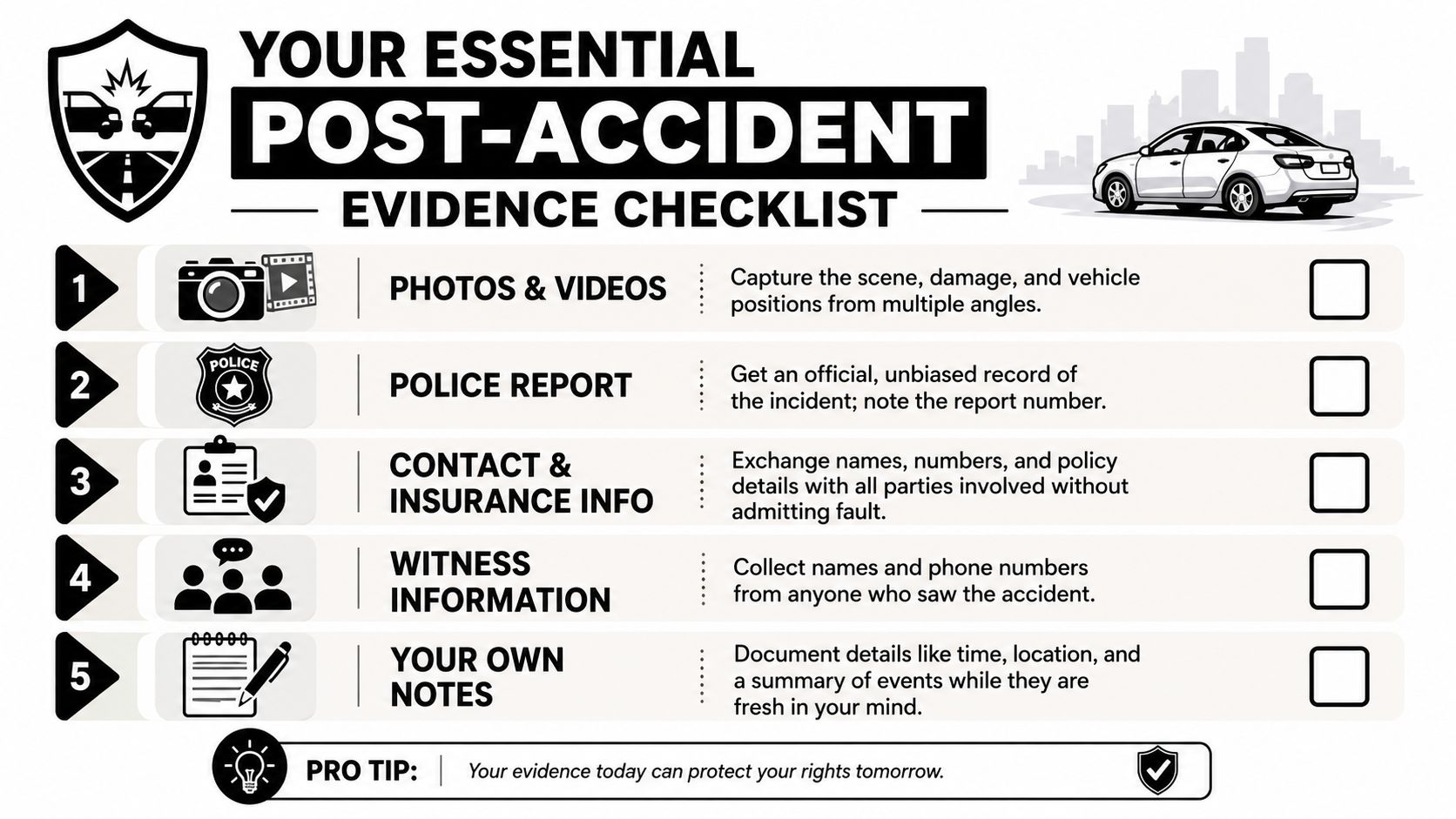
Photos and Videos: Go beyond a quick snapshot of the dent in your door. You need to capture the whole picture. Take wide-angle shots of the entire scene to show how the vehicles are positioned, any relevant traffic signs or signals, and even skid marks on the road. Then, get detailed close-ups of all damage to every vehicle involved, shooting from multiple angles. A slow video walk-around is fantastic for providing context and showing the full scope of the damage.
The Police Report: If the police respond to the accident, they will create an official report. This document is a cornerstone of any claim because it’s an unbiased, third-party account. Before you leave the scene, make absolutely sure you have the officer’s name, badge number, and the official police report number.
Information Exchange: Swap the essentials with the other driver: names, addresses, phone numbers, and their insurance company and policy number. Stay calm and stick to the facts. The one thing you must never do is admit fault—not even a simple "I'm so sorry." An apology can be misinterpreted as an admission of guilt later. Just exchange information.
Capturing evidence isn't about being confrontational; it's about being responsible. The photos you take in the first 15 minutes are often more valuable than any document you can track down a week later.
Expanding Your Evidence File
Your documentation efforts don't end when you drive away from the scene. The next phase is about gathering the records that support the initial evidence you've collected. If there were any witnesses, their contact information is gold. Ask anyone who saw what happened for their name and number.
For a more detailed breakdown of what to do, you can learn more about the immediate steps after a car accident in our comprehensive guide. I highly recommend creating a dedicated folder—either a physical one or a digital one on your computer—to keep all your auto claim documentation organized. This will make it easy to access everything when your adjuster calls.
When it comes to building a strong claim, organization is key. Having a clear checklist ensures you don't miss a single piece of crucial evidence. The table below outlines the essential documents you'll need and why they are so important.
Auto Claim Documentation Checklist
| Document Type | Why It's Critical | Where to Get It |
|---|---|---|
| Police Report | Provides an official, unbiased account of the accident, often including a preliminary determination of fault. | The responding police or sheriff's department. |
| Photos & Videos | Creates a visual record of the accident scene, vehicle damage, and injuries that's hard to dispute. | Your own smartphone at the accident scene. |
| Repair Estimates | Establishes the cost to fix your vehicle. Get at least two or three from reputable body shops. | Certified auto body and collision repair shops. |
| Medical Records | Documents any injuries sustained, treatments received, and associated costs, proving the need for compensation. | Hospitals, doctor's offices, and physical therapists. |
| Proof of Lost Wages | If you missed work due to your injuries, this proves your financial loss. | A letter or pay stubs from your employer. |
| Title & Registration | Confirms your ownership of the vehicle. This is essential for a total loss claim. | Your personal files or your state's DMV. |
| Maintenance Records | Shows you properly maintained your vehicle, which can help its pre-accident value assessment. | Your mechanic or your own personal records. |
Having these documents ready will make your interactions with the insurance company significantly smoother. It shows you're organized, serious, and prepared to advocate for a fair settlement.
Proving Your Vehicle’s Pre-Accident Worth
An insurance adjuster’s first offer on your car is rarely their best one. Think of it as an opening bid based on a generic algorithm that knows your car's make, model, and year but has no idea about its actual condition or history. This initial valuation is often low, and it's your job to prove your car was worth more. If you own a classic car, a modified vehicle, or just one you’ve kept in mint condition, this step is absolutely critical.
You need to build a "value file" that tells your car's complete story. This documentation is the foundation for a successful diminished value claim or the key to negotiating a fair settlement if your car is declared a total loss.
Building Your Value File
It's time to become a detective and gather every scrap of paper that proves your car's history and condition. We're not just talking about major engine work; we're building a case for consistent, quality ownership and investment.
- Maintenance Records: Pull together every receipt for oil changes, tire rotations, brake jobs, and any other scheduled service. A thick stack of these is powerful proof of a well-cared-for vehicle.
- Recent Upgrades: Did you invest in a new set of Michelin tires six months ago? Or maybe you upgraded the sound system? Every receipt for recent improvements adds real, tangible value back to your car.
- Cosmetic and Mechanical Repairs: Invoices for things like dent removal, a new water pump, or transmission service all show you kept the car in excellent shape.
- Pre-Accident Photos: Dig through your phone or social media. Photos of your car looking clean and pristine before the accident can be surprisingly effective at showing the adjuster what was lost.
To make sure your evidence lands with maximum impact, it helps to understand what makes an agreement legal and how to present official records properly. This gives you a stronger footing when you submit your value file. The checklist below gives you a quick visual reminder of what to grab right after a collision.
Every piece of paper, from the police report to your repair receipts, contributes to your auto claim documentation. When you combine this with a well-organized value file, you're giving a certified appraiser the ammunition they need to fight for your car's true pre-accident worth. Getting familiar with how to calculate fair market value ahead of time will also put you in a much better position to have these conversations.
Here’s the thing about the first offer an insurance adjuster gives you: it's almost always just a starting point. Think of it as their opening bid in a negotiation. To protect yourself from a lowball settlement, you need to understand exactly how they came up with that number.
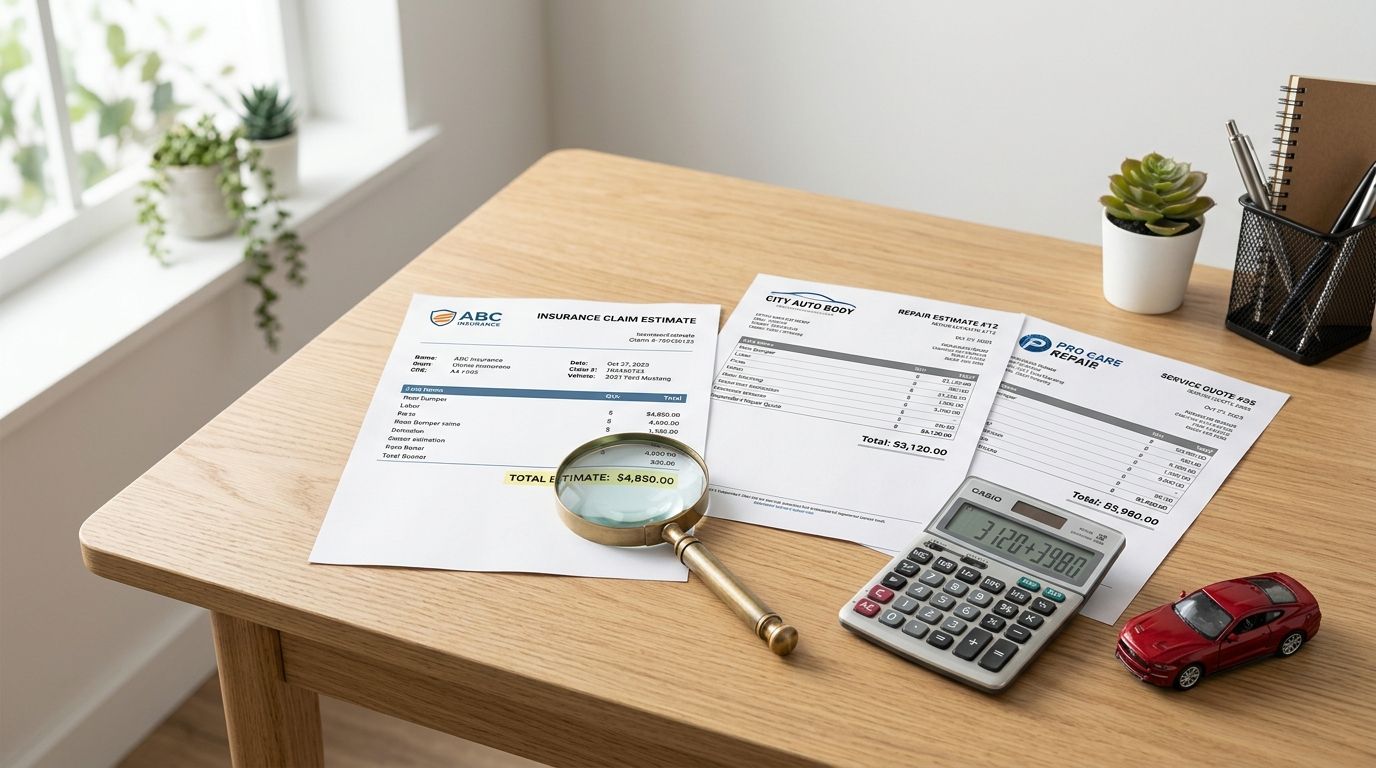
For repair estimates, adjusters lean on specialized software that pulls from huge databases of part prices and labor rates. The catch? It often defaults to cheaper aftermarket or reconditioned parts. You absolutely have the right to get your own independent quotes, and frankly, you always should.
My advice is to find a trusted, independent body shop—one that works for you, not for the insurance company. A shop that isn't on an insurer's "preferred" list has zero incentive to cut corners just to keep an adjuster happy. Their estimate, especially if it’s based on using Original Equipment Manufacturer (OEM) parts, becomes a crucial piece of auto claim documentation for your counteroffer.
What to Do When Your Car Is a Total Loss
The game changes completely if your vehicle is declared a total loss. Now, the insurance company will calculate your vehicle’s Actual Cash Value (ACV), which is what it was worth the moment before the crash. They'll often use third-party valuation services that scan local market data, but these reports are far from perfect.
I’ve seen countless reports where adjusters use sneaky tactics to drive down the ACV. They might apply incorrect condition adjustments for minor wear-and-tear or compare a fully-loaded model to a base model with way more miles. This is exactly why building your own value file is so important.
This is where all your hard work pays off. Your detailed maintenance logs, receipts for new tires or a recent brake job, and even just photos showing how well you cared for your car become the evidence you need to dismantle their low offer. When you present a counter-argument built on your car’s real-world history and condition, you force them to deal with facts, not just a flawed algorithm.
For a deeper dive into this process, we have a complete guide on navigating a total loss estimate on our site.
Using the Appraisal Clause to Get a Fair Payout
So you’ve done everything right. You sent in all your auto claim documentation, built a solid case file, and even made a reasonable counteroffer, but the insurance company’s settlement offer is still way off the mark. It’s a frustrating situation, and frankly, it’s the point where most people throw in the towel.
But don’t give up just yet. Buried in your policy is a powerful tool designed for this exact stalemate: the Appraisal Clause.
Invoking this clause is a game-changer. It essentially takes the negotiation completely out of the hands of the claims adjuster. Instead of arguing back and forth, you’re triggering a formal dispute resolution process that is written right into your contract.
How It Works in the Real World
Picture this: your meticulously maintained truck is declared a total loss. The insurer’s first offer is $22,000, but all your market research and the value file you’ve carefully assembled show it’s actually worth around $28,000. After weeks of calls and emails, the adjuster simply won't budge from their number.
This is the perfect moment to play your trump card. You’ll need to formally notify your insurer in writing that you are invoking the Appraisal Clause. What happens next is a defined process. You hire a certified, independent appraiser, and the insurance company hires one of their own.
These two experts then review the evidence and try to agree on your vehicle's actual cash value. If they can't come to an agreement, they select a neutral third-party "umpire" who will cast the deciding vote. The value determined by this panel is binding for both you and the insurer.
The Appraisal Clause is your ultimate leverage. It takes the power away from the biased software and puts it into the hands of certified experts whose entire job is to determine fair market value based on evidence—evidence you have already gathered.
All that documentation you gathered—your maintenance logs, receipts for new tires, detailed photos showing the vehicle's condition—becomes the foundation of your appraiser's case. They’ll use it to build an undeniable argument for your vehicle's true worth.
And this strategy gets results. A 2024 auto trends report from LexisNexis Risk Solutions found that 51% of claimants who brought in professional help, like an appraiser or an attorney, secured a higher settlement.
The numbers are pretty telling. The average payout for claimants with representation and thorough documentation was approximately $12,500, a huge jump from the $8,200 average for those who went it alone.
Answering Your Top Claim Documentation Questions
Once the dust settles after an accident, the questions start flooding in. It’s a stressful time, and the last thing you need is more uncertainty about the claims process. Let's tackle some of the most common questions I hear from drivers, so you can move forward with a clear plan.
How Long Do I Have to File a Claim?
This is a tricky one because the answer varies everywhere. Each state sets its own deadline, called the statute of limitations, which can be two to three years for property damage. But honestly, you should never, ever wait that long.
Your top priority is to report the accident to your insurer and start the claims process right away. The longer you wait, the more you risk an insurance company arguing that your delay hurt their investigation. Don't give them that excuse. Check your policy and your state’s department of insurance website for the hard deadlines, but act as if the deadline is now.
Should I Hire a Professional Appraiser?
At the beginning, no. You’re the one on the scene, and you’re perfectly capable of gathering the initial, crucial evidence—photos, the police report, and witness contacts. That’s your first and most important job.
However, the game changes if the insurance company’s offer feels like a lowball, especially for a total loss. If they’re undervaluing your vehicle or flat-out denying your diminished value claim, that’s your cue to bring in a professional.
An independent appraiser’s report gives you serious leverage in negotiations. This expert valuation is built on the evidence you collected and is a must-have if you're thinking about invoking your policy’s Appraisal Clause to challenge the insurer.
What if the At-Fault Driver Is Uninsured?
This is exactly why you pay for Uninsured/Underinsured Motorist (UM/UIM) coverage. If you have it, your claim simply moves over to your own insurance company. All that detailed auto claim documentation you’ve been gathering is just as critical here.
In this situation, your insurer basically steps into the shoes of the other driver’s carrier. You still have to prove your case and justify the full value of your loss to your own company to get a fair settlement. If you don't have UM/UIM coverage, your only other option might be suing the driver directly—a process where your documentation file will be the foundation of your entire case.
Can I Use Digital Photos and Videos?
Yes, and you absolutely should. Digital proof is the gold standard today. Your smartphone is your best tool right after an accident, so use it to capture everything with high-resolution photos and videos. Make sure the files are time-stamped.
Be thorough with what you document:
- Wide shots to show the whole scene and how the vehicles ended up.
- Close-ups of the damage on every car involved, taken from several angles.
- The surrounding area, including road conditions, skid marks, traffic signs, and signals.
As soon as you can, back up every single file to a cloud service like Google Drive or Dropbox. This is a non-negotiable step. It keeps your evidence safe from being lost or deleted and makes it easy to share with your insurer or appraiser when the time comes.