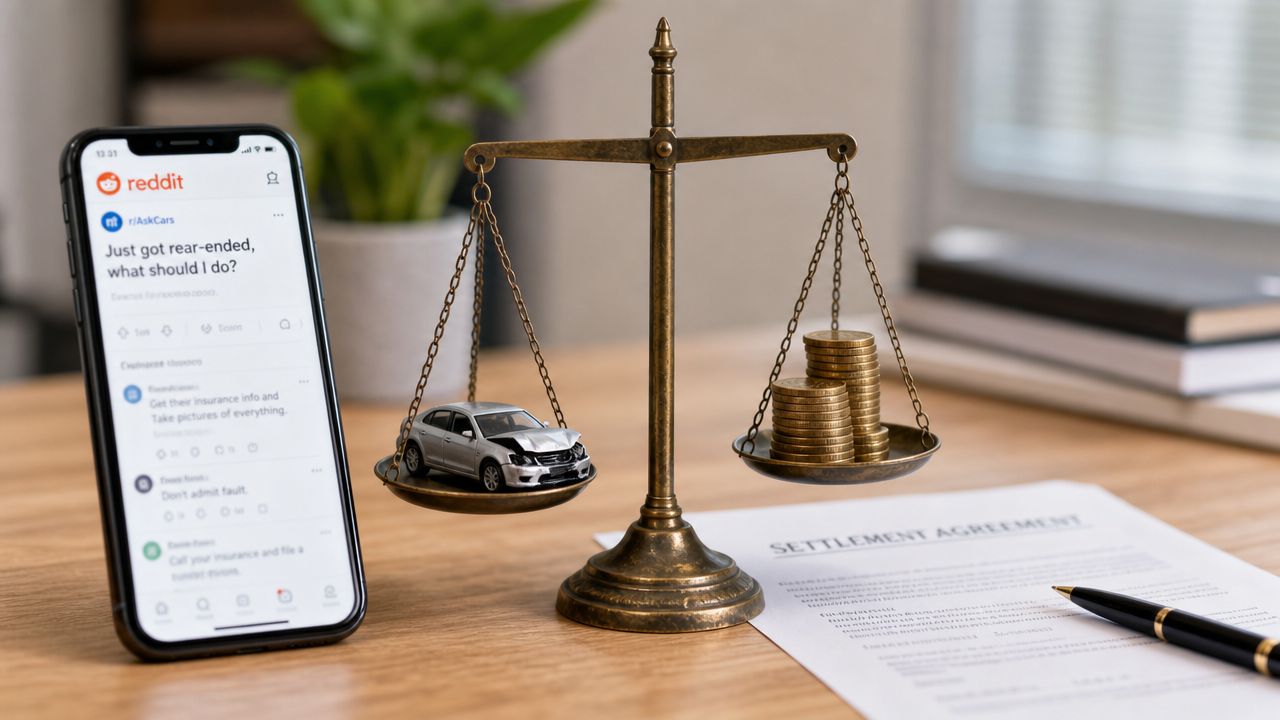
You've got the claim number. The adjuster has called. Your car may be in a body shop lot or already labeled a total loss. Meanwhile, you're scrolling Reddit at midnight, reading one post that says never accept the first offer, another that says lawyers take too much, and a third claiming someone got a huge payout for what sounds like a smaller crash than yours.
That spiral is common. Reddit is useful for spotting patterns, learning insurer tactics, and seeing what can go wrong. It's not a valuation method. It doesn't know your policy limits, your repair quality, your local market, your injury records, or whether your vehicle lost resale value even after “perfect” repairs.
The biggest problem with most car accident settlement Reddit threads is that they flatten very different claims into one number. They talk about “my settlement” as if every case is mostly about pain and suffering. In practice, fair compensation often depends on two parts drivers miss completely: diminished value on the vehicle side and underinsured motorist coverage on the injury side. If you don't look for those, you can leave real money behind even when liability is clear.
The Post-Accident Reddit Deep Dive
A typical driver starts with a simple question. “Is this offer fair?” Then the search widens. “How much should I ask for?” “Do I need a lawyer?” “How long does this take?” Within a few minutes, that search becomes a pile of conflicting stories.
One person says the insurer paid fast. Another says the company dragged things out. A third says never speak to the adjuster. A fourth says they handled everything alone. None of those stories are automatically wrong. They're incomplete.
That's why people get stuck. They're trying to build a real-world claim strategy from fragments. Reddit gives community. It rarely gives clean claim structure.
Practical rule: Use Reddit to spot issues you may need to investigate. Don't use it to price your own case.
The most reliable way to calm the noise is to sort your claim into buckets. What happened to the vehicle? What happened to your body? What coverage is available? What evidence supports each part? Once you do that, the settlement stops feeling like a mystery number.
What forum threads usually get right
Reddit users are often good at warning each other about lowball offers, rushed releases, and adjusters who sound helpful while trying to close the file quickly. That crowd-sourced caution has value.
They're also right that documentation matters. Photos, repair records, medical records, receipts, missed work, and policy language usually matter more than outrage.
What forum threads usually miss
They skip over valuation mechanics. A repaired car can still be worth less on the open market. A minimum-limits driver can injure someone whose losses exceed that policy. Those aren't edge issues. They're common pressure points in claims.
The drivers who recover more usually aren't the loudest online. They're the ones who document the loss properly, understand the policy, and challenge weak valuations with evidence.
Decoding Your Car Accident Settlement
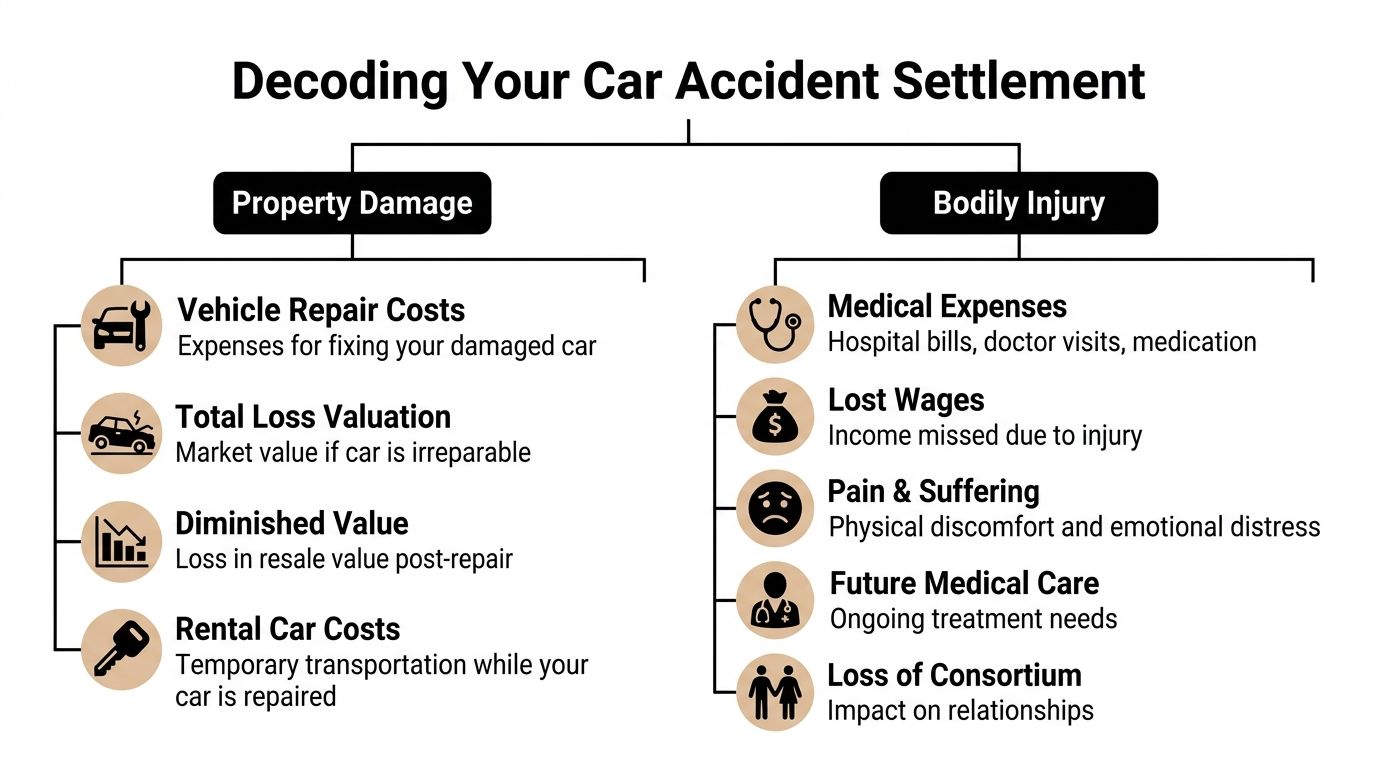
A settlement is easier to understand when you stop treating it like one lump sum. Think of it as two separate tracks that may run at the same time: property damage and bodily injury. Each track has its own documents, adjusters, deadlines, and negotiation points.
Property damage
This is the vehicle side of the claim. It usually includes repair costs, total loss valuation, towing and storage when applicable, and rental reimbursement if that coverage applies.
The part many drivers miss is diminished value. Even if a body shop repairs the vehicle well, buyers often pay less for a car with an accident history. That market loss is separate from the repair bill. Insurance carriers often focus on restoring function. They don't volunteer the resale stigma.
If your own policy language is confusing, it helps to find individual auto coverage and review what protections you carry before the next accident. Good coverage choices made before a crash can change what options you have after one.
Bodily injury
This is the injury side. It can include medical bills, lost income, future care, and pain and suffering. Reddit threads tend to obsess over that last category because it feels the most negotiable.
In reality, bodily injury value still rises or falls on records. Diagnosis, treatment consistency, imaging, work restrictions, and provider notes all matter. Settlement timing matters too. Car accident settlements in major U.S. markets typically take 6 to 36 months, and that timeline is driven by finishing treatment, gathering evidence, and negotiating with insurers. The same source notes that soft-tissue injuries often bring $1,200 to $1,500 in pain-and-suffering compensation beyond medical bills, while total compensation commonly falls in the $25,000 to $75,000 range depending on injury severity and treatment duration, according to this Reddit-sourced discussion of car accident timelines and values.
A cleaner way to evaluate your claim
Use this checklist instead of chasing one headline number:
| Claim part | What to verify |
|---|---|
| Repairs or total loss | Was the vehicle valued against real local comparables or generic software output? |
| Diminished value | Did anyone assess post-repair market stigma, especially for newer, luxury, custom, or collector vehicles? |
| Medical expenses | Are all treatment records, bills, and provider notes complete? |
| Lost wages | Can your employer confirm missed time and reduced earning ability if applicable? |
| Future impact | Is there credible support for ongoing treatment or permanent limitations? |
A fair settlement usually comes from building each block correctly. It doesn't come from picking the Reddit comment you like most.
Why Reddit Settlement Stories Can Be Misleading
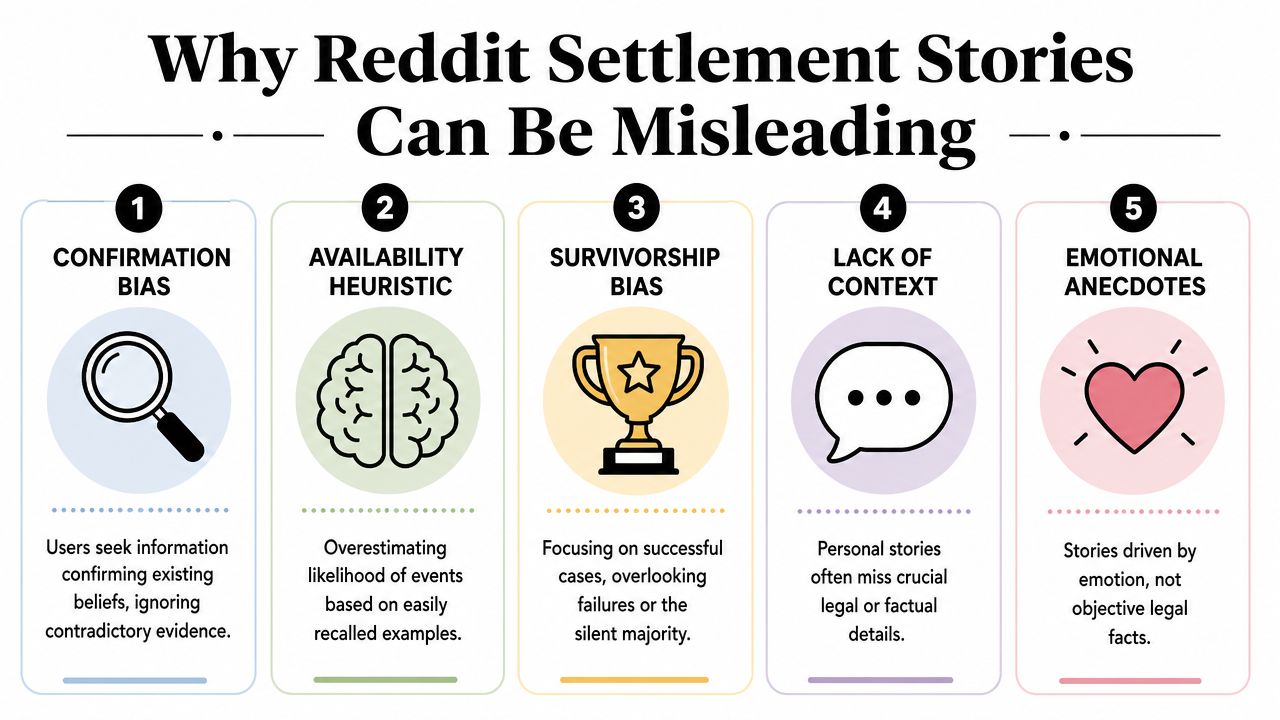
Reddit doesn't reward ordinary outcomes. It rewards emotional, unusual, and extreme ones. That skews expectations fast.
A driver who got an average result after a routine rear-end crash usually won't write a long post about it. A driver who feels cheated, or one who landed an unusually large settlement, probably will. That creates a false center.
The six-figure trap
A lot of car accident settlement Reddit posts revolve around six-figure claims. Those cases exist. They just aren't the norm.
Based on California bodily injury data, just over 2.3% of bodily injury claims resulted in payouts above $100,000, and if every bodily injury claim also involved a property damage claim, roughly 0.5% of all car accidents resulting in claims involved a bodily injury settlement above $100,000, according to this discussion of California claim payout data. That should reset expectations immediately.
Most claims don't fail because the driver was too patient. They fail because the driver anchored to someone else's number.
Five filters to apply before you trust a Reddit post
- Missing policy limits. A big sounding injury story means little if the at-fault driver had low limits.
- Missing liability facts. Clear rear-end liability is different from a disputed intersection crash.
- Missing treatment history. Two “whiplash” cases can have very different medical records.
- Missing vehicle details. A repaired late-model luxury vehicle and an older commuter car won't have the same value issues.
- Missing state-specific rules. Timing, valuation standards, and claim handling practices vary.
Use Reddit as a warning system, not a price sheet
The smart way to read settlement threads is to ask, “What problem should I check for in my own file?” not “Why isn't my number the same?” If a thread mentions lowballing, review valuation. If it mentions delays, review documentation. If it mentions hidden coverage, read your declarations page.
That mindset keeps you grounded. It also makes you harder to push around.
Common Reddit Scenarios and What They Overlook
The same claim patterns show up over and over. The wording changes, but the blind spots don't.
“My car was totaled. Is their offer fair?”
The usual Reddit advice is to ask for comparables, argue condition, and push back if the insurer's numbers look too low. That's good as far as it goes.
What gets missed is whether the insurer's valuation method reflects your actual vehicle and local market. Trim package, prior condition, recent maintenance, factory options, aftermarket additions, and regional demand all matter. A spreadsheet output can look official and still be weak.
If the offer feels light, don't argue in generalities. Challenge the inputs.
“The body shop fixed it. Can I ask for more?”
Reddit often treats the repair check as the end of the property claim. For many vehicles, it isn't.
A repaired vehicle can still carry accident history that reduces resale or trade-in value. That's the heart of diminished value. It's especially important for newer vehicles, luxury models, collector cars, custom builds, and anything with a buyer base that scrutinizes history reports closely.
A major gap in Reddit discussions is diminished value. Over 60% of drivers are unaware they can claim diminished value, and that loss can exceed $5,000 to $15,000 on high-value vehicles. The same source notes increasing denials in Oregon and Washington and weak practical guidance on invoking the appraisal clause or getting independent appraisals, according to this discussion of diminished value claim blind spots.
“The other driver only has minimum coverage. Am I stuck?”
Forum replies often jump straight to “sue them personally.” Sometimes that's part of the picture. Often it isn't the first place to look.
The better question is whether your own policy includes underinsured motorist coverage. Many drivers have it and never use it. Others don't know how to trigger it or what proof their own carrier will require.
If the at-fault policy is thin, your next move shouldn't be panic. It should be a coverage review.
What works better than generic forum advice
Three things consistently move these claims forward:
- A coverage-first review. Before arguing value, confirm what policies can pay.
- An evidence-first challenge. Push back with records, comparables, and appraisals, not frustration.
- A separate look at hidden losses. Diminished value and coverage gaps often matter more than one extra round of back-and-forth with an adjuster.
Your Step-by-Step Post-Accident Action Plan
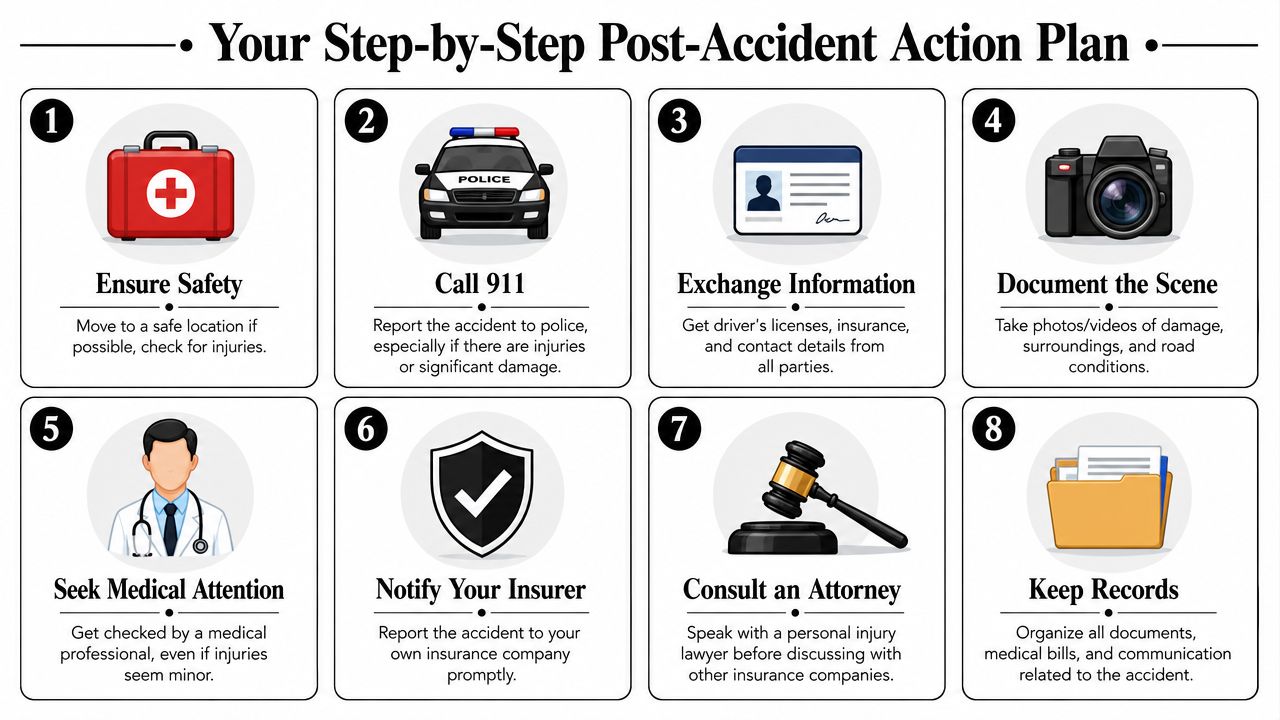
The hours and weeks after a crash shape the settlement more than most drivers realize. A good claim file starts early.
What to do first
- Get safe. Move out of traffic if you can do so safely.
- Call law enforcement if needed. Especially if there are injuries or significant damage.
- Exchange information. Get names, insurance details, plate numbers, and contact information.
- Photograph everything. Vehicle positions, impact points, debris, road signs, weather, skid marks, and injuries.
Don't rely on memory. Claims drift. Photos don't.
What to do in the next few days
Medical care comes before strategy. If you're hurt, get evaluated and follow through. Gaps in treatment create problems later because insurers argue that the injuries weren't serious or weren't caused by the crash.
Then build a file. Keep tow invoices, repair estimates, rental receipts, medical bills, wage loss proof, adjuster emails, and every piece of policy paperwork. If you need help organizing the injury side, this guide on a car accident settlement demand letter gives a useful picture of the documentation that tends to matter.
What to say and not say to adjusters
A short, accurate report is fine. Speculation is not. Don't guess about speed, impact force, injury duration, or future recovery.
Use simple facts. Date, time, location, parties involved, and what happened as you know it. If you don't know something, say you don't know.
Claim habit that saves money: Don't rush to describe yourself as “fine” if you're still being evaluated or symptoms are changing.
Timing and cost trade-offs
Some claims move quickly. In personal injury cases with clear liability and no surgery, settlements typically resolve within 4 to 8 months, according to this discussion of personal injury claim timelines and attorney fees. More contested or medically complex cases often take longer.
There's also a net-versus-gross issue people miss online. The same source says attorney fees commonly run 25% to 40%, and a $75,000 injury claim could leave roughly $50,000 to $56,000 after fees. That doesn't mean you should avoid a lawyer. It means you should understand the economics before making the call.
Securing Fair Value for Total Loss and Diminished Value
The insurance company's number is an opening position. Drivers often treat it like a final judgment because it arrives in formal paperwork. It isn't.
When a total loss offer needs a challenge
If your vehicle is declared a total loss, inspect the valuation report line by line. Check trim, mileage, condition, options, prior damage adjustments, and comparable vehicles. Carriers often rely on software-driven reports that look polished but may not reflect the strongest market evidence.
A weak total loss valuation usually shows its flaws in the details. Wrong package. Poor comparable choices. Unsupported condition deductions. Omitted upgrades.
Why diminished value needs its own proof
Post-repair diminished value isn't self-proving. The insurer may admit the car was damaged and repaired, yet still resist paying for the market stigma that remains.
That's where an independent appraisal matters. A proper diminished value file needs a reasoned market opinion tied to the specific vehicle, the severity and location of damage, the repair history, and the way buyers react to branded accident history. If you want a practical overview of that process, this guide to winning a car diminished value claim lays out the key issues.
The appraisal clause is more powerful than most drivers think
Many policies contain an appraisal clause for disputes over vehicle value. Drivers on Reddit mention it, but usually without explaining how useful it can be. The clause can move the valuation fight away from pure adjuster discretion and into a more structured process.
That matters in two situations:
- Total loss disputes, when the carrier's actual cash value looks low
- Diminished value disputes, when the carrier minimizes or denies post-repair market loss
An independent appraiser changes the conversation from “I think your offer is unfair” to “Here is the valuation evidence and methodology.”
A quick explainer on the process helps:
Don't ignore your own underinsured motorist coverage
This is the other big blind spot. A frequent and poorly answered Reddit question is what to do when the at-fault driver carries minimum coverage. Seventy percent of victims with underinsured motorist coverage fail to activate it, and in Oregon and Washington UIM denials have risen 35%, according to this discussion of underinsured motorist claim failures.
If your medical losses outrun the other driver's policy, review your own declarations page immediately. UIM coverage may provide another path to compensation, but your own insurer can still demand proof. That's where organized medical records, wage documentation, and in some cases independent appraisals tied to future needs become valuable.
Taking Control of Your Settlement Narrative
The smartest takeaway from car accident settlement Reddit threads is not the number someone else got. It's the reminder that insurance claims are negotiated, documented, and often mishandled when drivers don't know what to ask for.
Use Reddit for pattern recognition. Watch for signs of lowballing, rushed releases, weak total loss valuations, ignored diminished value, and missed UIM claims. Then leave the anecdote behind and work your own file.
A fair claim usually comes down to a few disciplined moves. Separate property damage from bodily injury. Read the policy. Keep records that make your loss easy to prove. Don't let “repaired” end the discussion if your vehicle still lost market value. Don't assume the at-fault driver's limits are the only money available if you carry UIM.
If you're trying to improve the outcome instead of just reacting to the first offer, this guide on how to maximize your car accident settlement is a useful next step.
Drivers lose their advantage when they argue from emotion. They gain an advantage when they argue from evidence. That shift is what turns a confusing claim into a controlled one.
If your insurer is undervaluing a total loss or ignoring diminished value after a crash, Total Loss Northwest helps drivers challenge those numbers with independent appraisals. They specialize in total loss and diminished value claims, including appraisal clause disputes, so you can push back with market-based evidence instead of guesswork.