The moments after a car accident are chaotic and stressful. But long after the dust settles, a hidden financial blow often lands when you realize your perfectly repaired car is now worth thousands less.
This drop in market value has a name: diminished value. It's the very real, tangible difference between your car's value right before the crash and its new, lower value after being in a collision—even if the repairs are flawless.
What Exactly Is Diminished Value After an Accident?
Let's paint a picture. Say your beautiful, one-year-old SUV gets rear-ended. The body shop does an incredible job; it looks and drives like it just rolled off the lot. A year later, you decide to sell it. A serious buyer pulls a vehicle history report, and there it is, in black and white: "Accident Reported."
Suddenly, their offer is thousands less than what an identical SUV with a clean history is commanding. That’s the sting of diminished value.
It has nothing to do with the quality of the repair work. It's all about market perception. A vehicle with an accident history is simply less desirable, and buyers won't pay top dollar for it. The scale of this is huge; road crashes in the U.S. led to 40,901 fatalities in 2023 alone, with the property damage contributing to staggering economic costs every year. You can see the yearly breakdown on the IIHS website.
Breaking Down the Three Types of Diminished Value
To build a strong claim, you first need to understand which type of value loss applies to your situation. Each one represents a different aspect of the post-accident financial impact.
The table below breaks down the three main categories you'll encounter.
The Three Types of Diminished Value
| Type of Value Loss | What It Means for You | When It Typically Applies |
|---|---|---|
| Immediate Diminished Value | The instant drop in value right after the accident, before any repairs have been made. | This is a temporary state, as most people will repair their vehicle. It's a baseline calculation. |
| Repair-Related Diminished Value | This is a loss caused by poor-quality repairs. Think mismatched paint, cheap aftermarket parts, or lingering mechanical issues. | This applies when the body shop's work is subpar, further damaging your car's value beyond just the accident history. |
| Inherent Diminished Value | The loss in value that remains after your car has been expertly repaired. This is the big one. | This is the most common type of claim. It's about the permanent stigma attached to your car's VIN. |
Most of the time, your focus will be on inherent diminished value. This is the core of what you're trying to recover.
Key Takeaway: Inherent diminished value is the compensation you are owed for the permanent financial scar the accident leaves on your vehicle's record. It’s a loss that is recognized by law in most states, giving you the right to pursue a claim. You can explore more about your rights by reading our guide to diminished value laws.
How to Calculate Your Vehicle's Value Loss
So, how do you actually figure out how much value your car has lost? You can bet the insurance company has its own way of doing it, and their formula is almost never designed to give you the highest number. To get what you're rightfully owed, you need to come to the table with your own calculation—one that’s backed by solid evidence of your car's true market value before the crash.
This isn’t about just pulling a number out of thin air. It starts with establishing your car's fair market value the moment before the accident happened.
Start With a Strong Pre-Accident Value
Your first job is to pin down what a buyer would have realistically paid for your car right before it was damaged. This sets the baseline for your entire claim.
Start with trusted industry resources like Kelley Blue Book (KBB) or the NADA Guides. Look up the "private party" or "retail" value for your car's exact year, make, model, and trim level. But don't stop there. That number is just an average. You need to adjust it to reflect your specific vehicle.
Think about what made your car stand out:
- Low Mileage: Was your car well below the average mileage for its age? That’s a major selling point and adds significant value.
- Pristine Condition: If you have photos showing your car was immaculate—no dings, scratches, or interior wear—that's powerful proof.
- Meticulous Maintenance: A thick folder of service records shows you took exceptional care of the vehicle, which justifies a higher price tag.
Each of these factors helps you build a case for a higher pre-accident value, which is crucial for maximizing your claim. After all, a car that’s been in an accident takes a permanent hit to its resale value, a reality that even the best repairs can't erase.
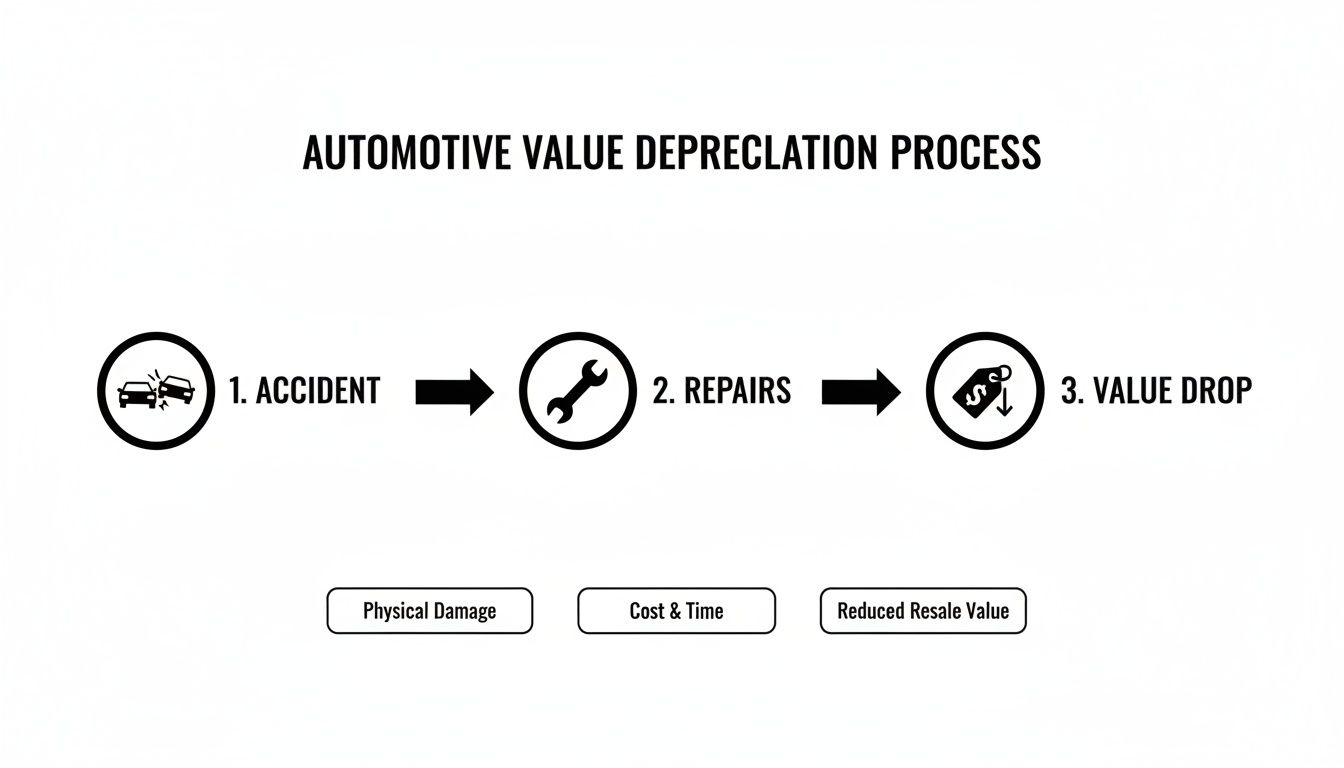
As you can see, the accident itself creates a permanent stigma that directly impacts what someone will pay for it down the road.
Don't Let the Insurance Company Dictate the Math
Once you have your pre-accident value, it's time to calculate the loss. Insurers often lean on a formula called "Rule 17c." Frankly, it’s notorious for producing insultingly low offers. This method typically caps the maximum value loss at 10% of the car's pre-accident value and then chips away at it with various "modifiers" for things like mileage or prior damage.
A Word From Experience: The 17c formula is a tool for the insurance company, not a law. It's often challenged and beaten because it completely ignores how real buyers think. A savvy car shopper will always choose the vehicle without an accident history, and if they do consider one that's been wrecked, they expect a steep discount.
The best way to fight back is with a professional, independent appraisal. A certified appraiser understands the local market. They will research comparable vehicles for sale—both with and without accident histories—and create a detailed report that’s hard for an adjuster to ignore. This report is the bedrock of a strong claim.
If you're not ready for an appraisal just yet, you can get a ballpark idea of your loss online. A good diminished value claim calculator can give you a preliminary estimate to see what's potentially at stake.
Presenting Your Final Calculation
When you submit your claim, your goal is to present a clear, logical argument. You're not just asking for money; you're proving a financial loss.
Lay it out simply: Start with the pre-accident value you established, complete with printouts from KBB or NADA. Then, subtract the car's current, post-repair market value, which should be clearly stated in your independent appraiser's report.
The difference between those two numbers is your inherent diminished value. That's the money you're owed. This approach takes the power away from the insurance company's flawed formula and puts the focus where it belongs: on the real-world financial damage you've suffered.
Building an Undeniable Diminished Value Claim
A successful diminished value claim isn't built on what you think your car has lost in value. It’s built on cold, hard proof. To get an insurance adjuster to take your claim seriously, you have to present them with an organized, compelling case file that proves your financial loss is real and quantifiable.
Think of it like you're a detective building a case. Every document, every photo, and every receipt is a piece of evidence. Your goal is to assemble a file so thorough and well-supported that it leaves no room for the adjuster to argue.
Assembling Your Core Documentation
First things first, get organized. Grab a folder—or create a digital one—and start gathering the foundational paperwork. This is the stuff that establishes the basic facts of the accident and the extent of the damage your vehicle suffered.
Your initial evidence checklist needs to include:
- The Official Police Report: This is your unbiased, official account of the accident. Crucially, it often indicates who was at fault.
- Accident Scene Photos: Hopefully, you snapped plenty of pictures. Photos of the damage to all cars, the road conditions, and any relevant signs or skid marks are incredibly helpful.
- The Final Itemized Repair Bill: This is a big one. It's a detailed breakdown of every single part that was replaced and every hour of labor, proving just how significant the repairs were.
These documents are the bedrock of your claim. They prove the accident happened and that it wasn't just a minor fender-bender.
The Professional Appraisal: Your Secret Weapon
While all that paperwork is essential, the single most powerful tool you have is a professional, independent auto appraisal. Seriously, this isn't just a recommendation—it's the game-changer. An insurer's in-house valuation is meant to protect their bottom line, not yours. An independent appraisal flips the script.
An expert appraisal report is your ultimate leverage. A credible, certified appraiser will analyze your specific local market, find comparable vehicles with both clean and damaged histories, and produce a detailed, data-driven report that an adjuster can't easily dismiss.
This turns your claim from a simple request into a formal, evidence-backed demand.
It’s worth fighting for. The economic fallout from vehicle accidents is staggering, with one study showing the comprehensive cost of U.S. crashes equaling nearly 6% of the Gross Domestic Product. Getting a fair settlement is how you recover your piece of that financial damage.
Finalizing and Submitting Your Claim Package
With your core documents and professional appraisal in hand, it's time to put it all together into a clean, professional package. Start with a simple cover letter that introduces your claim, lists the documents you've included, and clearly states the diminished value amount you are claiming.
Before you send anything, double-check the deadline. Every state has a legal time limit, known as the statute of limitations for car accident claims, for filing. If you miss that window, your claim could be dead in the water, no matter how strong your evidence is.
Once your undeniable package is ready, you’re prepared to submit it and start the negotiation from a position of real strength.
Time to Negotiate Your Claim with the Insurance Company
You’ve done the hard work of building your case and submitting your claim. That’s a huge step, but now the real back-and-forth begins. This is where you take all that evidence and turn it into a check that fairly compensates you for your car's lost value. You're shifting from a fact-finder to an advocate.
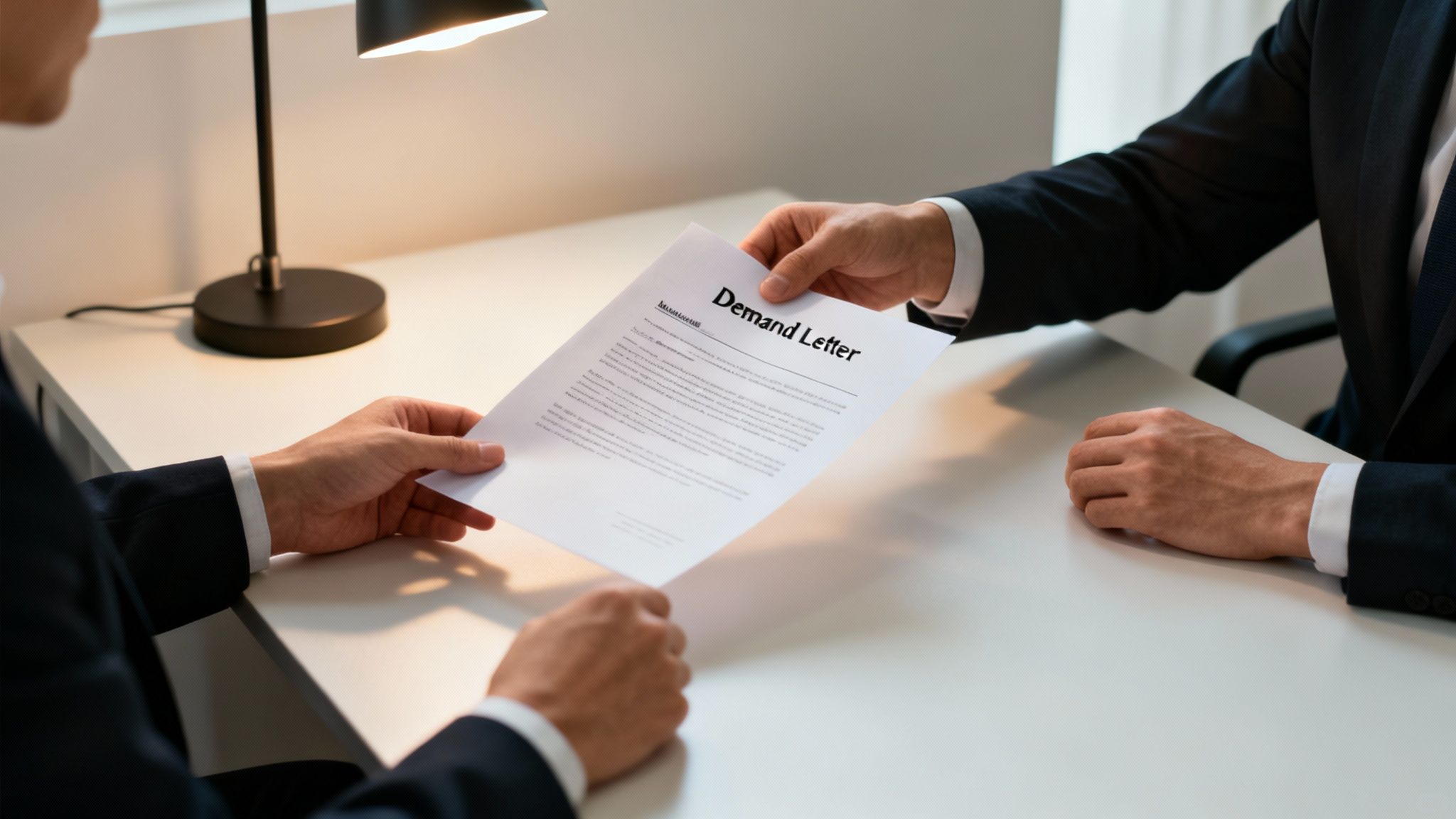
The first shot you fire is your demand letter. Think of this as your formal opening argument sent directly to the at-fault driver's insurance company. You want it to be professional and firm, clearly summarizing your position without unnecessary fluff.
Your letter should lay out the core facts of the accident, reference the key evidence you’ve gathered (like the police report and your professional appraisal), and state the exact dollar amount you are demanding for your vehicle's diminished value.
Dealing with the Insurance Adjuster
Once your demand lands on their desk, you'll hear from an insurance adjuster. It's crucial to go into this conversation with your eyes wide open. Their job isn't to be your friend; it's to protect their company's bottom line by paying out as little as possible. They are professional negotiators, and they have a playbook.
No matter what, keep your cool. Stay polite, professional, and stick to the facts. Losing your temper won't get you a bigger check—it just gives them a reason to label you as "difficult" and dig in their heels.
A Quick Word of Advice: If an adjuster asks for a recorded statement, politely decline. You can simply say, "All the necessary information has been provided in my written claim." You are not required to give them a recording they can pick apart later to find inconsistencies and use against you.
Don't be surprised if their first move is a quick, lowball offer. It’s a classic tactic designed to see if you'll take a few hundred bucks and disappear. Politely but firmly reject it. Your response should always pivot back to your evidence: "Thank you for the offer, but my $5,000 claim is based on a professional appraisal using real-world market data, not an internal formula."
When you're on the phone, what you say—and how you say it—matters. Here are a few pointers to keep in mind.
Insurance Negotiation Do's and Don'ts
| Do | Don't |
|---|---|
| Stay calm, polite, and professional. | Get emotional, angry, or make threats. |
| Stick to the documented facts of your claim. | Speculate or offer opinions on things you're not sure about. |
| Refer back to your professional appraisal report. | Accept the first offer, especially if it's low. |
| Keep a log of all communications (dates, times, names). | Give a recorded statement without legal advice. |
| Be prepared to justify your numbers with evidence. | Feel pressured to make an immediate decision on the phone. |
Remember, your goal is to show them you've done your homework and won't be easily dismissed.
Your Secret Weapon: The Appraisal Clause
What happens if the adjuster just won't budge? If they stonewall you or continue to push an absurdly low number, you have a powerful tool in your back pocket: the Appraisal Clause. This is a provision tucked away in most standard auto insurance policies that outlines a formal process for settling valuation disputes.
Invoking it usually follows a clear path:
- Put it in writing: You formally notify the insurance company that you are exercising your right under the policy's appraisal clause.
- Each side gets an appraiser: You've already got yours. The insurance company will now have to hire its own independent appraiser.
- The appraisers talk: The two experts will then review the evidence and try to come to an agreement on the amount of diminished value.
- A neutral umpire steps in: If the two appraisers can't agree, they will select a neutral third-party "umpire" whose decision is typically binding.
This move effectively takes the negotiation away from the adjuster—who is paid to save the company money—and puts it in the hands of certified professionals who deal in facts and figures. It forces the insurer to argue against the data, not just their own internal software. For a deeper dive into these negotiation tactics, our complete guide on how to negotiate a diminished value claim provides even more strategies.
What to Do When the Insurer Denies Your Claim
It’s a frustrating moment, but one you should almost expect. You've done your homework and submitted a solid diminished value claim, only for the insurance company to come back with a hard "no" or a ridiculously low offer.
This isn't the final word; it's the start of a negotiation. How you respond next is what really counts in recovering the car accident value loss you’re entitled to. Don't take their initial rejection at face value.
Your first move? Escalate the conversation, but keep it professional. Ask to speak with a claims supervisor or manager. Front-line adjusters are often given a script and have very little authority to deviate from it. A senior employee has more power to make a real decision, especially when they see you've come prepared with evidence.
Taking Your Claim to the Next Level
If a supervisor still won't budge, it’s time to get more formal with your dispute. You have two powerful options that insurance companies can't easily dismiss.
Here’s where you can apply real pressure:
- File a State Insurance Complaint: Every state has a Department of Insurance that regulates these companies. Filing a complaint is free and immediately gets your case in front of a government watchdog. Insurers hate this kind of attention and often become much more reasonable once the state is looking over their shoulder.
- Invoke the Appraisal Clause: This is your ace in the hole. Remember that clause in the auto policy we talked about? Invoking it takes the decision away from the adjuster and puts it into the hands of certified, independent experts. It’s a formal dispute process they are contractually obligated to follow.
To get ahead of their tactics, it’s a good idea to review common insurance claim denial reasons. Knowing their typical arguments helps you build a stronger counter-argument from the start.
The Power of an Independent Appraiser
Once you invoke the appraisal clause, your appraiser officially represents you. They aren't just sending another email; they are presenting your detailed valuation directly to the appraiser hired by the insurance company.
Suddenly, the dynamic shifts. It’s no longer just you against a giant corporation; it’s a professional negotiation between two experts who speak the same language.
Key Insight: The appraisal clause forces the insurer to justify their low offer with hard market data, not just some internal, proprietary formula. When their number can’t hold up under professional scrutiny, they’re often forced to come to the table with a much more realistic settlement.
This process ensures your claim is evaluated based on its actual merits and real-world evidence. It gives you the leverage you need to hold your ground and fight for the full compensation you deserve.
Got Questions About Diminished Value? We Have Answers.
Going after a diminished value claim can feel a bit overwhelming, especially when you're just trying to get back on your feet after an accident. It's completely normal to have questions. Let's tackle some of the most common ones that come up so you can move forward with confidence.
Knowing the answers to these questions will help you sidestep common pitfalls and put you in a much stronger negotiating position from day one.
"Can I Still File if the Accident Was My Fault?"
This is a big one, and the answer is almost always no. You typically cannot file a diminished value claim with your own insurance company if you were the one who caused the accident.
Your own collision coverage is there to pay for the repairs to your car, not to compensate you for the hit its market value takes. The claim needs to be filed against the at-fault driver's liability insurance. After all, they caused the financial loss.
The main exception? If you're hit by an uninsured or underinsured driver. If you carry Uninsured/Underinsured Motorist (UIM) coverage, some states will allow you to file the diminished value claim under that portion of your policy.
The bottom line is that the person responsible for the accident is also responsible for all the financial damage that comes with it, including the permanent black mark on your vehicle's history report.
"Is There a Deadline to File a Diminished Value Claim?"
Yes, and this is a hard deadline you absolutely cannot miss. Every state has a statute of limitations for filing property damage claims, and diminished value falls squarely into this category.
How long do you have? It varies by state, but you’re usually looking at a window of two to four years from the date of the accident. Don't wait. The sooner you start the process after your repairs are done, the easier it is to prove your case. If you let the clock run out, you lose your right to claim anything at all.
"What Does a Professional Diminished Value Appraisal Cost?"
Hiring a professional appraiser is probably the single best move you can make. You can expect to pay somewhere between $300 and $700 for a thorough, well-documented report. The exact cost often depends on your car's value, how complex the damage was, and the appraiser's qualifications.
Think of this as an investment, not just a cost. A powerful report from a certified expert is your number one tool for proving your car accident value loss. It can be the difference-maker that adds thousands of dollars to your final settlement, making that initial appraisal fee well worth it. It gives you the evidence you need to break down the insurance company's inevitable lowball offer.
Don't let the insurance company dictate what your vehicle is worth. At Total Loss Northwest, our certified independent appraisers fight to get you a fair and accurate settlement backed by real market data. If you’re ready to recover the money you’re owed, visit us at https://totallossnw.com to get started.