You walk out to your car, hit the handle, and nothing happens. Maybe the keys are sitting in plain view on the passenger seat. Maybe the fob is in your bag, but the car acts dead. Maybe one door won't open, the trunk won't release, and now you're standing in a parking lot wondering if this is a simple lockout or the start of an expensive problem.
That stress is real. A car door locked situation can feel minor for the first few seconds, then turn chaotic fast when you're late, it's dark, your phone battery is low, or the car is still running.
Most lockouts are manageable. The trick is not to make them worse. On older vehicles, people got away with coat hangers, wedges, and fishing rods through the window gap. On many late-model cars, those same moves can bend trim, tear weather stripping, hit side-curtain airbag areas, or damage the lock linkage without ever opening the door.
The calmer approach is to slow down for one minute, figure out which kind of lockout you're dealing with, and then choose the least destructive fix. That's what matters most. Get back in safely, protect the vehicle, and if anything does get damaged during entry, document it so you don't create headaches for a later repair, insurance, or diminished value discussion.
That Sinking Feeling When Your Car Door Is Locked
It usually starts with a tiny sound. The click of the locks engaging right before you realize your key fob is on the console. Or the moment you press the button that grants entry and get no response because the fob battery has gone flat at the worst possible time.
I've seen drivers go straight from annoyance to panic in under a minute. They pull on the same handle three times, check one door instead of all of them, then start looking around for anything thin enough to pry the door open. That's how a basic lockout turns into scratched paint, a bent window frame, and a door that whistles on the highway afterward.
Modern vehicles complicate the old advice. Recessed lock buttons, electronic actuators, smart proximity systems, and tighter trim designs mean the old roadside tricks often don't translate cleanly anymore. What worked on a sedan with exposed linkages can fail completely on a newer crossover with shielded internals.
Practical rule: The first job isn't getting in fast. It's figuring out whether this is a simple key-inside mistake, an electronic access failure, or a mechanical fault.
There's also a second layer people miss. If a bad DIY attempt leaves pry marks, torn seals, or latch issues, those details matter later. They can affect repair estimates, insurance conversations, and the vehicle's condition record. That's one reason experienced roadside techs tend to be conservative. A lockout is temporary. Door damage can stick around.
If your car door is locked right now, take a breath. You're not the first person this has happened to, and you're usually not stuck for long. The next steps are about diagnosis before action.
First Steps Assess Your Lockout Situation
Start with triage, not tools. The wrong fix wastes time. On newer vehicles, it can also create damage before you've even confirmed what the actual problem is.

Check the urgent safety issues first
If a child, pet, elderly passenger, or anyone vulnerable is inside, stop reading and move to emergency action. That is not a normal lockout.
If you're alone, look at your surroundings next.
- Check your location: If you're on a shoulder, in a dark lot, near moving traffic, or in an area that doesn't feel safe, move yourself to a safer spot nearby if you can.
- Look at the vehicle status: Is the engine running? Are the lights on? Do you hear any electrical activity when you touch the handle or press the fob?
- Confirm all entry points: Check every door, the hatch, and the trunk. People are often sure the whole car is sealed when one rear door is still open.
Figure out what kind of lockout this is
This part matters more than most drivers realize. Ask these questions in order:
Are the keys visibly inside the cabin?
If yes, this is likely a straightforward key-inside lockout.Is the key fob with you, but not working?
That points more toward a dead fob battery, disabled keyless entry, or a communication issue.Does the car seem electrically dead?
If the vehicle won't respond at all, a dead 12V battery may be part of the problem.Is one lock or handle acting different from the others?
That suggests a jammed latch, failed actuator, or physical lock problem rather than a simple lockout.
Don't start prying on a late-model door until you've ruled out a dead battery or a fob issue. Many modern lockouts are electronic, not mechanical.
Gather what you'll need before you call anyone
Have the basics ready so you don't fumble through them later.
| What to confirm | Why it matters |
|---|---|
| Vehicle make, model, and year | Helps determine the lock system and entry method |
| Your exact location | Speeds up dispatch |
| Whether the keys are inside or missing | Changes the service approach |
| Whether the engine is running | Raises urgency |
| Whether the car may have damage already | Helps document condition before entry |
If this lockout happened after a collision, or if a door isn't operating normally after impact, keep notes and photos. A lock problem can overlap with accident damage, latch alignment issues, or door shell distortion. If you're already sorting out post-crash vehicle issues, this guide on steps after a car accident is a useful companion.
Solutions for Common Lockout Scenarios
The right move depends on what failed. A key left inside the cabin needs a different response than a dead smart fob or a car with no 12V power.
Keys locked inside the car
If you can see the key on the seat, in the cupholder, or in the ignition, the temptation is to grab the nearest improvised tool and start fishing. That's where damage usually starts.
Older methods like coat hangers, wedges, and slim-jim style tools depend on exposed manual linkages and simpler lock layouts. For late-model cars, that advice is often outdated. As noted in this modern lockout overview, many newer lockout problems are electronic, including dead 12V batteries, disabled keyless systems, or jammed smart locks. Traditional tools don't respond reliably or safely to those setups.
Use this rule of thumb:
- Older vehicle with visible manual lock posts: DIY entry may be possible, but it still carries risk.
- Late-model vehicle with flush handles, smart access, or hidden linkages: Skip improvised entry unless you already know the exact access point and tool path for that model.
What you can try safely first:
- Recheck every door and hatch: One may not have latched fully.
- Use the manufacturer's app if your vehicle supports it: Some cars allow remote entry through the app.
- Ask for the spare key early: If someone can bring it within a reasonable time, that's often the cleanest fix.
Key fob with no response
A dead fob battery can mimic a lockout even when the key is in your hand. If the fob won't open the vehicle, don't assume the whole system has failed.
Try these steps:
- Use the physical emergency key blade: Many fobs have a hidden mechanical key.
- Check the driver's door handle or lock cap: Some vehicles hide the mechanical cylinder behind a trim cap.
- Try the backup start or recognition position once inside reach is available: Some vehicles can still detect a low-battery fob when held in a specific spot.
If the hidden key won't turn, don't force it. Mechanical cylinders that haven't been used in years can feel stuck, and forcing them can create a second problem.
Here's a visual walkthrough that may help you think through the next move before you start forcing anything:
Car won't unlock because the 12V battery is dead
This is one of the most confusing modern lockouts. The fob may be fine. The car may have no electrical power to actuate the locks.
Signs this might be your issue:
- No lights, no chirp, no mirror fold, no handle response
- The vehicle was sitting for a long period
- You already had weak battery symptoms recently
Some vehicles still allow entry through a concealed mechanical key cylinder. Others may require a model-specific manual release method for the frunk, hood, or door system before power can be restored. Because procedures vary sharply by make and model, random internet advice gets dangerous.
If the car seems fully dead, treat it like an access-and-power problem, not a simple locked-keys-inside problem.
At that point, professional help is usually the safer choice.
Jammed lock, damaged handle, or latch problem
If one door won't open from inside or outside, or the lock cycles but the latch doesn't release, you're no longer dealing with an ordinary lockout. You may have a failed actuator, striker alignment issue, latch fault, or collision-related misalignment.
Federal safety standards also matter here. Door-lock and retention hardware are part of the occupant-retention system, not just theft prevention. The technical checks include verifying latch engagement, striker alignment, first-stage and second-stage retention, and lock actuator operation, as described in FMVSS No. 206 materials and related safety discussion.
That means if a door has been hard to shut, pops on the first latch only, or feels different after someone pried on it, don't keep using brute force. A lock issue can overlap with a safety issue.
Emergency Lockouts When a Child or Pet Is Inside
If a child or pet is locked in the vehicle, call 911 immediately.
Don't start by calling a locksmith. Don't spend time comparing tools. Don't worry about whether a window might get broken. Time matters more than glass, trim, or inconvenience.
Heat, cold, panic, and limited airflow can turn a lockout into a medical emergency fast. Emergency responders can reach the scene, assess conditions, and force entry if needed. That's the priority.
Stay with the vehicle and keep eyes on the person or animal inside. If the engine is running or climate control is active, that does not make the situation safe enough to delay the call.
For pet owners, prevention matters before the emergency happens. If you travel with your dog often, it helps to choose the right dog travel crate so your pet rides more securely and you're less likely to open and close doors in a rushed, disorganized way during stops.
Call 911 first. Everything else can wait.
If dispatch gives instructions, follow them exactly. If conditions are visibly deteriorating, tell them. Stay on the line if asked.
Calling for Help Your Professional Options
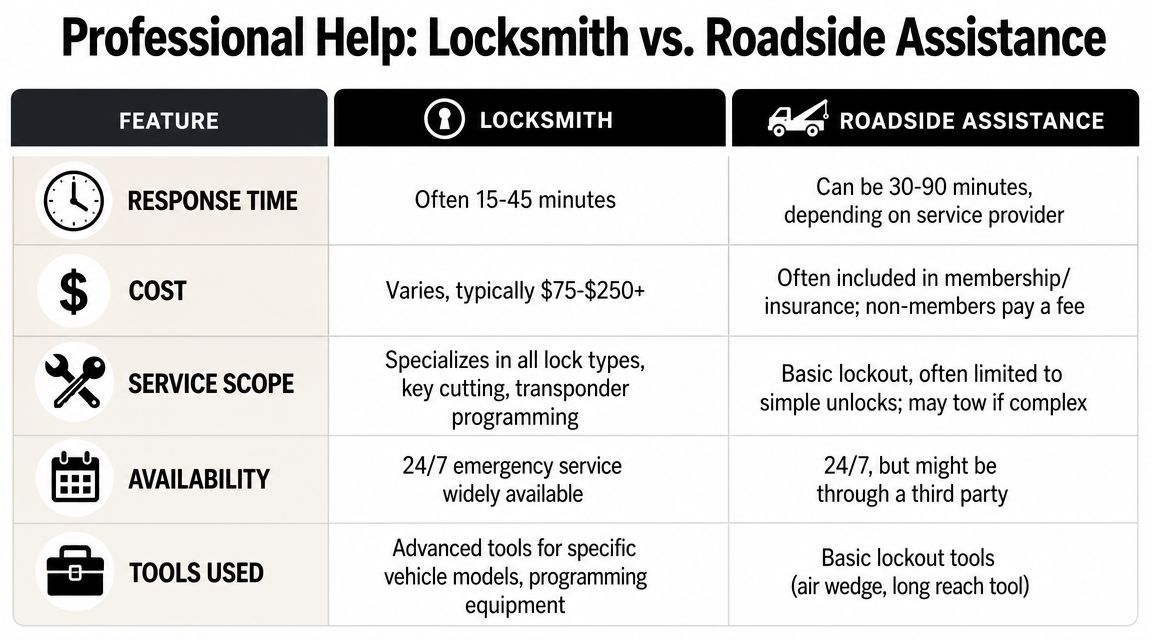
When DIY isn't smart, you usually have two realistic paths. Call roadside assistance or call an automotive locksmith. Both can work. They just solve different versions of the problem better.
What a locksmith does better
A fully equipped professional locksmith can often open a car door within five minutes or less, according to this locksmith timing overview. The advantage isn't just speed. It's model-specific tooling and technique.
That matters because improvised methods can damage weather stripping, bend linkage rods, interfere with side-curtain airbag areas, or scar the lock itself. A dedicated automotive locksmith is usually the better choice when the car is newer, the system is unusual, or the problem may involve the fob, cylinder, or programming rather than a plain opening.
What roadside assistance does better
Roadside assistance makes sense when you already have access through your insurer, auto club, or a vehicle service plan. It can be the easiest first call if you're not in immediate danger and you want to know whether lockout service is already included.
If the lockout turns out to be more complex than a simple opening, roadside may still help by dispatching a contractor or arranging a tow. If you're not sure what your policy covers beyond the lockout itself, it's worth reviewing what comprehensive insurance coverage includes.
Side by side comparison
| Factor | Roadside Assistance (e.g., AAA) | Automotive Locksmith |
|---|---|---|
| Best for | Basic lockouts and member convenience | Complex lockouts, newer vehicles, lock and key issues |
| Tools | Often basic air wedge and long-reach tools | Model-specific entry tools and lock equipment |
| Lock/fob expertise | Usually limited | Usually stronger on lock cylinders, fobs, and smart access issues |
| Good choice when | You already have service included | You need precision and less trial-and-error |
Before you call, have this ready:
- Vehicle details: Make, model, year, and color
- Your exact spot: Parking lot row, street address, landmark, or garage level
- Problem type: Keys inside, fob dead, car battery dead, handle jammed, or possible damage
- Proof of ownership: ID and registration if available
The clearer your first call is, the fewer delays you'll deal with on scene.
If entry causes damage, document it before and after. For claim-related valuation issues after accident damage or repair disputes, Total Loss Northwest handles diminished value and total loss appraisal work. That's separate from lockout service, but it can become relevant if a damaged door, frame, or prior repair history affects what the vehicle is worth.
Prevention and Documentation for Future Peace of Mind
The easiest lockout to solve is the one you never create. Build a repeatable habit instead of relying on memory when you're distracted, carrying groceries, or juggling kids and bags.
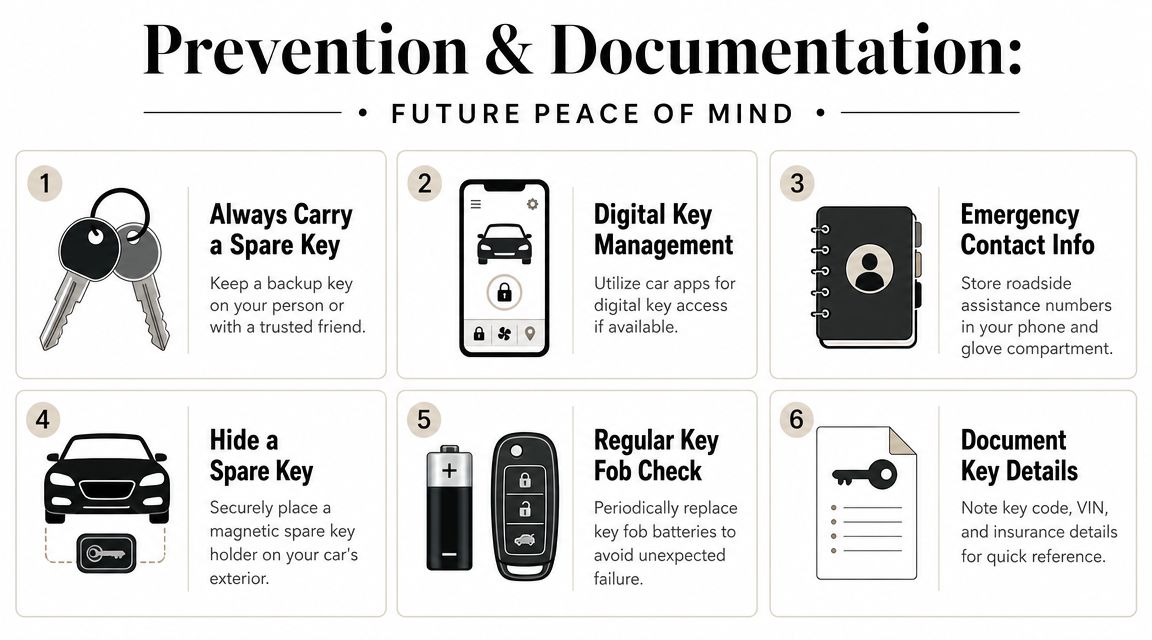
A few prevention moves work well because they're simple:
- Keep a real spare plan: A trusted person with a spare key beats hiding your only backup in a risky place.
- Replace weak fob batteries early: Don't wait for the day the range gets erratic in a bad parking lot.
- Pause before shutting the door: Hand on keys, then close door. It sounds basic because it works.
- Use digital access if your vehicle supports it: App-based entry can save the day when the fob fails.
Locking the car consistently matters too. One industry analysis reports that 50% of car thefts are from vehicles left unsecured, and figures cited there also note 47% of thefts from vehicles happened when the vehicles were left unsecured, which reinforces that a locked door is one of the simplest theft barriers you control (driving theft analysis and cited figures).
Documentation is the part often skipped. If you or a helper used wedges, long-reach tools, or force on the handle, take photos afterward. Capture weather stripping, window trim, paint edges, door-frame alignment, and the latch area if visible. Save receipts, technician notes, and screenshots from any roadside app.
That record helps if you later need repair support, insurer documentation, or vehicle value resources like the material collected in Total Loss Northwest's resource library.
If a lockout, accident, or repair issue leaves you with questions about what your vehicle is actually worth, Total Loss Northwest provides independent appraisals for diminished value and total loss claims so you have documentation to support a fair settlement.