Your car is sitting in a body shop lot, or worse, the insurer already called it a total loss. Meanwhile, your life didn't pause. You still have to get to work, pick up groceries, get kids to school, make appointments, and handle everything else that depends on having reliable transportation.
That gap between “your car is unavailable” and “the insurer finally pays fairly” is where a lot of people get burned.
Car insurance loss of use is supposed to compensate you for that gap. In practice, insurers often treat it like an afterthought. They'll pay repair costs or discuss the total loss value, then try to slide past the fact that losing your vehicle had its own cost. If you don't raise it, document it, and push for it, you may get little or nothing.
This isn't a favor from the insurance company. It's a damage claim. And if you handle it like a side issue, the adjuster will too.
Your Car Is Gone But The Bills Are Not
Monday morning, your car is in the body shop. By Friday, you are already paying for the accident in ways the insurer does not volunteer to cover. Ride shares, borrowed cars, missed time, extra hassle, delayed plans. If the vehicle is a total loss, the clock usually runs even longer while the carrier drags through valuation, title paperwork, and payment.

Insurance companies know exactly what happens during that gap. They also know many claimants stay focused on repair costs or the total loss check and never press the separate issue of being without a vehicle. That silence saves the insurer money.
What this disruption is worth
Loss of use puts a value on the time you were deprived of your car. For a daily driver, that means the transportation you rely on to keep work, family, and basic errands on track. For a luxury, specialty, or high-value vehicle, the fight gets sharper because insurers often lowball the comparable rental rate or cut the number of payable days.
The usual measuring stick is straightforward. Start with the reasonable daily rental value for a comparable vehicle. Then multiply it by the number of days your car was unavailable. That sounds simple, though adjusters often trim the claim. They use a cheaper vehicle class, shave days off the timeline, or act like delays in inspection, parts, or total loss processing do not count.
Do not treat loss of use like a courtesy item on the estimate. Treat it like a damage claim that has to be proven and negotiated.
Claimants usually make two bad moves. They never ask for it, or they accept the first number without checking the vehicle class, the daily rate, or the date range. Insurers count on both.
If your car was out of service, put loss of use on the table early and keep it there until the numbers make sense.
Understanding Your Right to Compensation
Your car can be in the body shop, at a salvage yard, or waiting on a total loss decision. Your transportation problem still exists. Loss of use compensation addresses that problem.
Treat it as its own damage claim from day one.
Insurers like to keep this part blurry. They talk about the repair estimate, the total loss number, the deductible, and the rental in one breath because confused claimants ask for less. Do not let them package everything together. Loss of use is a separate category of damage from the cost to repair the vehicle and from the amount paid for the vehicle itself after a total loss.
That distinction matters most in bigger claims. If you drive a high-value SUV, a specialty vehicle, or a car that plainly does not match the insurer's cheapest rental category, the carrier has every incentive to downgrade your claim. They will call a midsize sedan “comparable.” They will shorten the time period. They will act like administrative delay is your problem. It is not.
You can have a claim even if you never rented a car
A lot of adjusters count on this misunderstanding.
Loss of use often turns on the value of being deprived of your vehicle, not on whether you paid out of pocket for a rental. If you borrowed a family member's car, used rideshares, rearranged work, or went without transportation, you may still have a valid claim. The usual measuring tool is the reasonable rental value of a comparable vehicle for the period your car was unavailable.
That gives you an advantage. You do not need to apologize for not renting. You need to prove what a comparable replacement would have cost and why the insurer's substitute is too low.
State law and claim type change the rules
The broad principle is straightforward. The details are not universal.
Some states allow recovery based on reasonable rental value even without an actual rental. Some limit how this works. Some handle total loss downtime differently from repair downtime. The path also changes depending on whether you are using optional coverage under your own policy or making a demand against the at-fault driver's insurer. If you need a refresher on those coverage buckets, read this guide on what liability insurance covers and how it differs from your own optional auto coverage.
Get specific fast. Ask the adjuster to identify, in writing, the policy provision or legal basis they are using to limit your loss of use claim. If they cannot point to language or authority, treat the denial or reduction as a negotiation position, not a final answer.
Being made whole includes the time your vehicle was out of service. Do not let the carrier reduce that part of the claim to an afterthought.
Who Pays Your Claim Rental Reimbursement vs Tort
The first question isn't “Do I have a loss of use claim?” It's “Whose insurance should pay it?”
That answer changes the strategy.
According to Alfa Insurance's explanation of loss of use coverage, eligibility depends on whether your own policy includes optional rental reimbursement coverage, state-specific rules, and whether you're claiming against your own insurer or the at-fault driver's liability carrier. That same source also notes that if the insurer provides you with a rental vehicle, you generally can't also collect a separate cash payment for the same loss of use period.
First-party claim through your own policy
This is the easier route administratively. You open a claim with your own insurer and use the rental reimbursement or loss of use coverage you already bought, if you bought it.
The problem is that this coverage is often limited by policy language. It's an add-on, not standard coverage. It's convenient, but convenience isn't the same as full compensation.
If you're trying to understand what liability insurance generally covers versus what your own optional coverages do, this breakdown of what liability insurance covers helps separate those buckets.
Third-party claim against the at-fault driver
Many not-at-fault drivers should focus on this aspect, especially when the insurer's rental authorization doesn't reflect the actual market for a comparable vehicle or the true amount of downtime.
The KGG Law overview of loss of use claims explains the split clearly. In tort states like Texas, a not-at-fault driver can pursue loss of use against the at-fault party based on the reasonable rental value of a comparable substitute vehicle for the repair period. The same source also notes that loss of use coverage isn't standard in basic liability policies and is typically an optional add-on on your own policy.
Side-by-side comparison
| Claim Type | Who You Claim Against | Coverage Requirement | Typical Limitation | Key Advantage |
|---|---|---|---|---|
| First-Party | Your own insurer | You usually need optional rental reimbursement or similar coverage on your policy | Policy terms often restrict what's payable and for how long | Faster access and less dispute over fault |
| Third-Party | At-fault driver's insurer | Depends on liability and state law rather than your optional add-on | More negotiation and more pushback from the adjuster | Better path when the insurer's internal rental allowance is too low |
Don't let the adjuster pick your path for you. Their preferred route is usually the one that controls your claim most tightly.
The practical rule is simple. If your own policy gives you quick transportation, use it if needed. But if another driver caused the loss, don't assume that your insurer's rental benefit defines the full value of your claim.
The Formula Insurers Use to Value Your Time
Your car goes into the shop on Monday. By Friday, the adjuster talks as if you only lost it for a few workdays. That is how claims get cut down. Insurers reduce the timeline first, then they reduce the vehicle class, then they call the result reasonable.
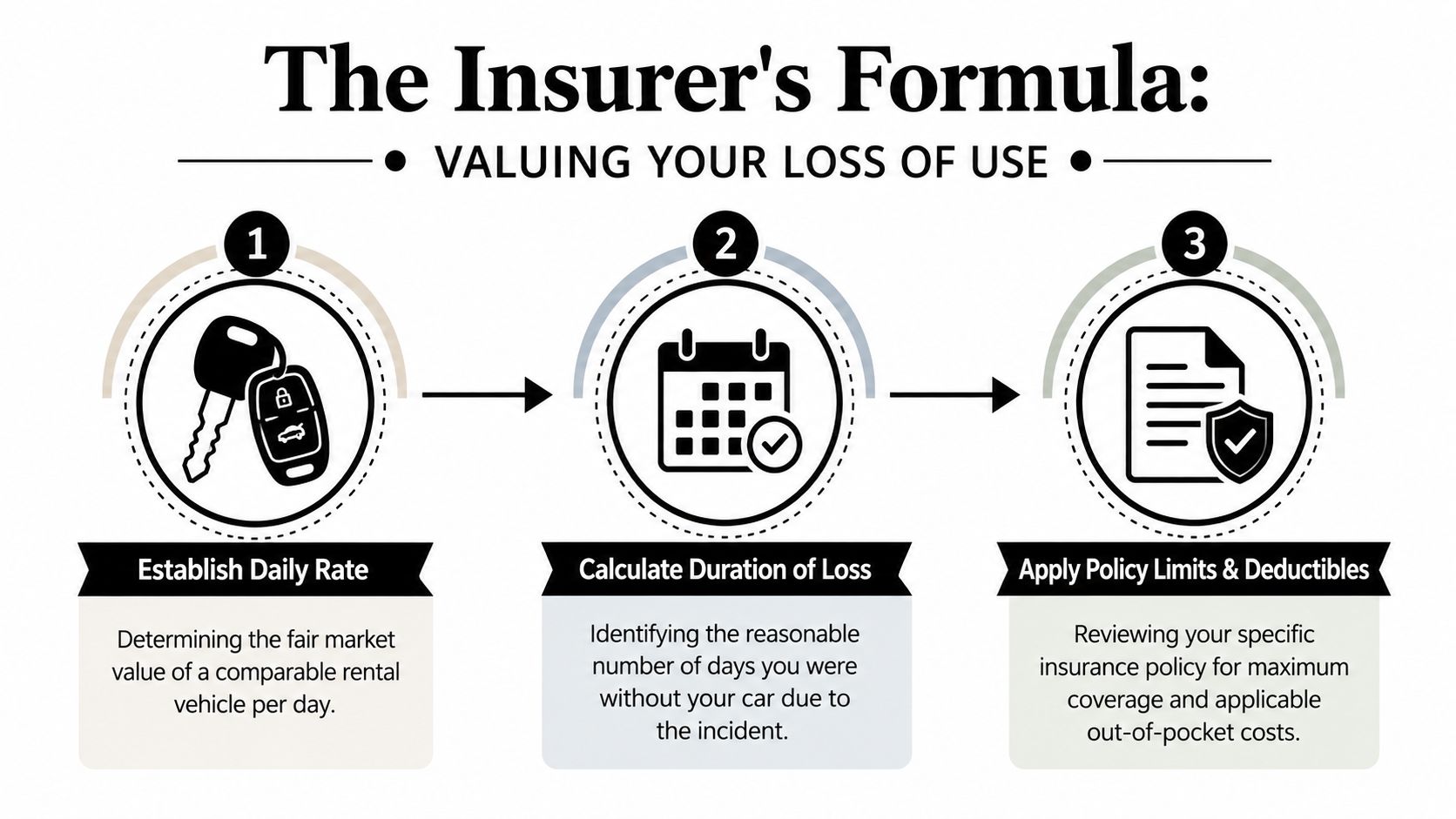
The formula is simple on paper. Comparable rental rate x compensable days out of service. The fight is over both parts.
If you drove a basic commuter car, expect the carrier to price your claim off a basic rental. If you drove a luxury SUV, heavy-duty truck, performance car, or specialty vehicle, push back hard when they price it like an economy sedan. Insurers save money by downgrading comparability and shrinking the number of payable days. That is not a neutral estimate. It is a negotiation position.
How repair days get converted into payable days
Adjusters do not just count the dates your car sat at the shop. They usually break the repair period into labor time, ordinary delay, and claim handling time. Then they decide which parts they will recognize and which parts they will ignore.
That is where owners lose money.
A common insurer approach includes three moving parts:
- Labor conversion: repair hours are converted into repair days
- Weekend time: non-business days may be added to reflect the actual repair cycle
- Administrative time: extra days may be added for estimate approval, transport, teardown, supplements, or pickup logistics
The point is not to memorize one carrier's internal worksheet. The point is to make them show you theirs. Ask for the exact start date, end date, labor assumption, and every excluded day. If they refuse to put it in writing, treat the offer as unsupported.
A simple example
Say the estimate supports about five repair days. The carrier may still owe more than five calendar days of loss of use because repairs do not happen in a vacuum. Shops wait on approvals. Parts get ordered. Weekends interrupt the process. Administrative handling adds time.
Insurers know this. They still present the shortest version first.
If the math in the offer feels thin, answer it with your own timeline. A clear written demand does more damage than a phone complaint. If you need a model, use this insurance demand letter for a loss of use dispute and force the adjuster to respond to dates, rates, and comparability instead of vague excuses.
The total loss problem
Total loss claims are where adjusters get the most aggressive. Once they label the car a total loss, they try to cut off loss of use as early as possible and shift the conversation to the vehicle value only.
Do not let them collapse those issues into one.
You lost the use of the vehicle until a reasonable end point. In many claims, that means the period runs until the settlement is made available, not until the insurer internally decided the car should be totaled. For high-value, rare, or difficult-to-replace vehicles, this dispute gets sharper because the replacement process is slower and the insurer knows it.
Ask one question every time: What date are you using to stop loss of use, and why is that date reasonable for this vehicle?
Make them defend the timeline, the rental class, and every skipped day. That is how you turn a weak offer into a claim they have to justify.
How to Document and Prove Your Loss of Use Claim
Your car is out of service, the adjuster is already looking for a shortcut, and every undocumented day makes your claim cheaper in their file.
Build the record before they build the story.

The documents that actually move money
Adjusters do not pay extra because you explain the inconvenience well. They pay when your file pins down two things: the correct vehicle class and the full period you were deprived of it.
Start there.
- Comparable rental quotes: Get written quotes from at least two or three reputable rental companies for a vehicle that matches yours as closely as possible. If you drove a luxury SUV, do not submit quotes for an economy sedan and expect a fair result.
- A dated claim timeline: Gather every document that shows when the car became unavailable and when it should reasonably have become available again. Include tow records, shop intake, teardown dates, supplement requests, parts notices, total loss notice, and the date payment was offered.
- Written claim communications: Save emails, letters, portal messages, and text messages with the carrier, shop, and rental company. Verbal conversations disappear. Written contradictions do not.
- Proof of liability: Keep the crash report, scene photos, witness information, and any written acceptance of fault.
- Your actual transportation costs: Save rental agreements, rideshare receipts, transit records, and notes showing any days you had to borrow a car or go without one.
If your vehicle was unusual, modified, commercial, or high-value, add proof of that now. Window sticker, prior appraisal, service records, listing examples, and photos all help establish what a true substitute looks like.
Put the timeline in writing before the adjuster shrinks it
Do not hand over a pile of papers and expect the insurer to assemble your case fairly. They will assemble it cheaply.
Write out the timeline yourself:
- Date the vehicle became unusable
- Date the claim was reported
- Date the insurer or shop inspected it
- Date repair approval was issued or total loss was declared
- Dates of any supplements, delays, or reinspection
- Date repairs finished or funds were made available
- Date you reasonably regained use or could replace the vehicle
That last point gets missed all the time. In a total loss claim, the insurer may try to stop the clock long before you could realistically replace the car. For a specialty vehicle, collector car, or high-end model, your replacement search is not the same as finding the cheapest car on a dealer lot.
If you want a clean format, use this loss of use demand letter guide and force the adjuster to answer dates, rates, and comparability in writing.
A short visual explanation can help if you're sorting this out while dealing with the claim:
Keep a contact log
Do this from day one.
Use a notes app, spreadsheet, or legal pad. Log the date, time, name, company, phone number, and what was said on every call. If the adjuster promises approval by Friday, write it down. If the reason for delay changes a week later, write that down too.
A clean contact log turns a vague dispute into a credibility problem for the insurer.
For a practical outside perspective on dealing with adjusters after a crash, review Haddad & Associates P.A. insurance advice.
A strong loss of use claim reads like a file prepared for litigation, not a customer service complaint.
That is the standard to aim for. Organize the proof, label the dates, show the market rate, and make the insurer explain every cut instead of making you guess why they made one.
Challenging a Low Offer and Knowing When to Get Help
Here's the part insurers hope you never figure out. They often treat loss of use as a throw-in item they can minimize, waive, or bury inside the larger settlement conversation.
The CLM article on overlooked loss of use claims makes that problem plain. It notes that legal precedent shows loss of use damages can exceed $120,000, yet adjusters often treat these claims as “small bargaining chips” and systematically undervalue or waive them during settlement.
That attitude tells you exactly how to respond. Don't argue emotionally. Attack the weak points in their evaluation.

Signs the offer is too low
Low offers usually follow a pattern:
- The daily rate is too low: The adjuster uses a preferred vendor rate that doesn't reflect the market for your comparable vehicle.
- The time period is cut short: They ignore administrative delay, parts delay, or replacement search time in a total loss.
- Comparability is manipulated: They price a lower-class substitute than what you owned.
- The claim is bundled: They push a lump sum settlement without clearly showing what was allocated to loss of use.
- They rush you: Quick money is the point. Transparency usually isn't.
If the adjuster won't show the calculation, that's a warning sign by itself.
When an appraiser matters
An independent appraiser becomes important when the dispute is really about value, comparability, or the insurer's timeline assumptions. That's especially true for:
- high-value vehicles
- collector cars
- custom vehicles
- disputed total loss valuations
- claims where the insurer's “comparable rental” theory doesn't match the actual world
A good appraiser doesn't just write a number on a page. They document market support, challenge bad comparables, and force the carrier off canned valuation software and onto defensible evidence.
If you're still handling the adjuster directly, study a practical negotiation framework before you respond. This guide on how to negotiate with an insurance adjuster is worth reading before you send your next email.
When an attorney should step in
Not every loss of use dispute needs a lawyer. Some need one immediately.
Talk to an attorney when the insurer denies a valid claim outright, ties the property damage dispute into an injury settlement, accuses you of failing to mitigate without basis, or drags the process out in a way that looks like bad faith. If the claim involves broader accident issues, Haddad & Associates P.A. insurance advice is a useful outside resource on dealing with insurers after an accident.
Ask for the denial or reduction basis in writing. Carriers get more careful when they have to commit their position to paper.
The main point is this. You do not have to accept the carrier's framing of the claim. Loss of use isn't minor because the adjuster says it is. It's only minor if you let them value it that way.
Your Next Steps for a Fair Settlement
Start with the basics. Loss of use is not a courtesy. It's part of the damage claim. Treat it that way from the first call.
Then get strategic. Figure out whether you're using your own optional coverage, pursuing the at-fault driver's insurer, or both in sequence depending on how the claim develops. Don't assume the quickest route is the fairest one.
Keep your file tight:
- Get market rental quotes
- Lock down the timeline in writing
- Save every communication
- Demand the insurer's calculation, not just the result
- Challenge any daily rate or time period that doesn't match the evidence
If the vehicle is totaled, uncommon, high-value, or customized, be even more careful. Those are the claims where insurers most often hide behind weak comparables and compressed timelines.
There's a broader lesson here too. Insurance disputes often turn on whether the policyholder knows how to appeal, document, and push back. Even outside auto claims, that same principle shows up in guides like this explanation of how to appeal health insurance denial. Different coverage, same reality. The first answer from an insurer isn't always the right one.
You don't need to be aggressive for the sake of it. You need to be organized, specific, and unwilling to accept unsupported numbers.
If you're dealing with a low total loss offer, a disputed loss of use claim, or a vehicle that deserves better than the insurer's software-driven valuation, Total Loss Northwest can help you fight for a fair settlement with independent appraisals backed by real market evidence.