It's the phone call no one wants to get. An insurance adjuster is on the line, and they've just told you, "Your car is a total loss."
In plain English, this means your insurance company has decided that fixing your car would cost more than what it was worth right before the crash. This value is called the Actual Cash Value (ACV), and that single term kicks off a claims process that can leave you feeling completely overwhelmed.
Your Car Is Totaled What Really Happens Next

Hearing your car is "totaled" is a jarring moment. It’s often the final, frustrating chapter of an already deeply stressful event. But what does it really mean for you and your wallet?
Think about it like this: imagine your high-end smartphone takes a bad tumble, shattering the screen and getting serious water damage. If the repair quote is higher than the price of a similar used phone, your provider would just pay you the phone's current value. It’s the exact same principle with your car. The insurance company isn’t paying to buy you a brand-new car; they’re paying to replace the one you just lost.
The Foundation of Your Settlement Offer
The entire settlement process comes down to one critical number: the Actual Cash Value (ACV). This figure is meant to represent the fair market value of your vehicle the instant before the accident happened. It’s the starting point for everything that follows, and getting a handle on it is your first step toward securing a fair payout.
The insurer will make you an initial offer based on their calculation of this ACV. But it's vital to remember that their first number is exactly that—an offer. It is not the final word, and you absolutely have the right to question it, especially if it seems too low.
A total loss declaration isn't an endpoint; it's the beginning of a negotiation. Your goal is to ensure the insurer's ACV calculation accurately reflects your vehicle's true pre-accident worth, including its condition, features, and local market demand.
Why Total Loss Claims Are More Common Now
If it seems like you’re hearing about more cars being totaled these days, you’re not imagining things. The trend is real, and it’s being driven by a perfect storm of skyrocketing repair costs, skilled labor shortages, and increasingly complex vehicle technology.
Consider this: back in 2019, there was a 58% chance a non-fault claim would result in a total loss. Fast forward to mid-2025, and that figure is projected to hit 66%, thanks in large part to a staggering 24.7% increase in average repair costs. Insurers are simply finding it cheaper to write a check than to pay a body shop.
Don’t forget the emotional side of this. A serious accident and the loss of your vehicle can take a real toll. For residents in British Columbia, it's important to know what support is available. You can learn more in A Guide to ICBC Counselling After an Accident. In this climate, preparing yourself to stand up for a fair settlement is your best defense.
Decoding Actual Cash Value: The Heart of Your Settlement

When your car is declared a total loss, everything boils down to one critical term that dictates your payout: Actual Cash Value (ACV). Getting a firm grip on what this means is the single most important step you can take toward getting a fair settlement.
It’s a common—and costly—misconception to think ACV is based on what you paid for the car or what you still owe on the loan. It’s neither.
Think of ACV as a snapshot in time. It's what your specific vehicle was worth in its exact pre-accident condition, in your local market, the moment before the crash happened. Essentially, it's the price a reasonable buyer would have paid for it on that day. This is a crucial distinction because it separates your car's real-world value from your personal finances.
How Insurers Calculate ACV
Insurance companies don't just pull a number from a hat. They have a formula, and understanding the ingredients they use is your best defense against a lowball offer.
Here’s what they look at:
- The Basics: Make, model, and year set the foundation.
- Mileage: This is a big one. Fewer miles generally means higher value.
- Trim & Options: A fully-loaded EX-L model is worth a lot more than a base LX trim.
- Pre-Accident Condition: This is where things get subjective. It covers everything from the shine on the paint and the cleanliness of the interior to the wear on your tires.
- Local Market Comps: They look at what similar cars are actually selling for in your area.
To see how these factors create a huge difference in the car insurance total loss value, let's look at a real-world example.
A Tale of Two Cars
Picture two identical 2018 Honda Accords. On the surface, they're the same car. But their individual stories paint two very different value pictures.
Car A: The Meticulously Maintained Commuter
This Accord was always garage-kept and has 50,000 miles on the odometer. The owner has a stack of service receipts, including one for premium tires installed just last month. The inside is spotless, the paint is pristine.
Car B: The Hard-Working Daily Driver
This one lived on the street. It has 110,000 miles and the typical battle scars to prove it—minor door dings, faded paint on the roof, and a spotty service history.
Even though they're the same year and model, Car A's ACV could easily be $4,000 to $5,000 higher than Car B's. This is precisely why your records, receipts, and photos are so vital—they are the proof of your car’s true value. If you want to dive deeper into this topic, you can learn more about what Actual Cash Value of a car means in our detailed guide.
The Problem With Valuation Software
To streamline the process, most insurance carriers lean on third-party valuation software. One of the industry giants is CCC Intelligent Solutions (formerly CCC ONE). This software scours databases for "comparable" vehicles to generate a valuation report that becomes the basis for your settlement offer.
The problem is, these automated systems often prioritize speed over accuracy. They are notorious for producing lowball offers by using flawed or mismatched data—like comparing your pristine, top-trim vehicle to a beat-up base model with a salvage title located 300 miles away.
This is where the real fight for a fair settlement often begins. The insurer’s report isn't the final word; it’s just their opening argument, and it's often built on shaky data. They might miss recent upgrades, overlook a rare factory option, or fail to account for the exceptional condition you kept it in.
Your job is to find those inaccuracies and challenge them with your own evidence. This is how you can claw back the thousands of dollars you're rightfully owed.
So, the insurance adjuster has called with a settlement offer for your totaled car. After all the stress, it's tempting to just take the number and move on. But you need to pump the brakes.
That first offer is almost never their best one. Think of it as an opening bid, not a final verdict on what your car was worth.
Insurance companies are businesses, after all. Their goal is to manage payouts and stay profitable, which means there's a built-in incentive to keep claim settlements, including yours, as low as possible. Accepting that initial number without a second thought could mean walking away from thousands of dollars you're entitled to.
The Valuation Report is Often Flawed
The adjuster’s offer isn't just a number they pulled out of thin air. It's based on a valuation report, usually from a third-party company. These reports look official and are packed with data, but they’re often full of mistakes that just so happen to favor the insurance company.
It's your job to put on your detective hat and dig into the details.
Imagine trying to sell your beautifully renovated home, but the real estate agent only compares it to foreclosure properties in the next state over. It sounds crazy, but that’s essentially what can happen with these car valuation reports. They often use "comparable" vehicles that aren't comparable at all.
- Mismatched Trim Levels: Your car might be the top-of-the-line model with every available option, but the report could be comparing it to the most basic, entry-level version. This alone can slash the perceived value.
- Wrong Neighborhood: The report might pull comps from a dealership a hundred miles away where cars are cheaper. What matters is what your car was worth in your local market, right before the accident.
- Questionable History: Some of the "comps" used might have accident histories or even salvage titles, which torpedoes their value and unfairly drags down your car’s worth in the report.
Automated Systems Don't See the Whole Picture
Beyond just picking the wrong comps, the software itself is the problem. These automated systems are built for speed and volume, not for capturing the unique qualities that made your car valuable.
They have a nasty habit of missing or undervaluing key details:
- Recent Upgrades: Did you just put $1,200 worth of new high-performance tires on your car a month before the crash? How about that new stereo or a recent brake job? Your receipts are proof of added value that the software completely ignores.
- Pristine Maintenance: If you have a binder full of service records showing you babied your car, it was objectively worth more than an identical one that was neglected. A clean history is a high-value feature.
- Special-Case Cars: For classic cars, rare models, or heavily customized vehicles, these automated systems are completely useless. They simply can't grasp the value of something that doesn't fit neatly into their database.
And this problem is only getting bigger. We're seeing a huge shift in the auto insurance industry where total loss claims now make up over 22% of all physical damage claims. With more than 70% of these vehicles being seven years or older, it's often cheaper for insurers to total a car than to fix it. This trend puts even more pressure on them to control payout costs, which often leads to lowball offers for people who don't know how to fight back. You can explore the trends reshaping the auto insurance market to see just how much the landscape is changing.
The insurer's first offer is a business calculation designed to settle the claim for the lowest reasonable amount. It's not a reflection of what you're truly owed, but rather their opening position in a negotiation.
At the end of the day, nobody knows your car better than you do. By understanding why that first offer is probably too low and exactly where to look for errors, you can confidently push back and get the fair settlement you actually deserve.
How to Dispute a Low Total Loss Settlement
Getting a lowball settlement offer for your totaled car can feel like the final punch after an already draining ordeal. It's easy to feel stuck, but this is exactly when you need to switch from accident victim to your own best advocate. You absolutely have the right to challenge the insurance company's valuation. With the right approach, you can successfully fight for the fair car insurance total loss value you're truly owed.
This isn’t about picking a fight; it’s about being armed with the facts. The whole process kicks off with a firm, simple request and a healthy dose of skepticism about their initial offer.
Your First Moves in the Dispute Process
Before you can pick apart the insurer's math, you need to see their homework. The very first thing you should do is request a complete copy of their valuation report. This document, usually spit out by third-party software like CCC ONE, is the basis for their offer—and it’s probably riddled with errors you can use to your advantage.
Once that report is in your hands, zero in on the "comparable" vehicles they used. This is where most low offers are born. You're looking for obvious mismatches, such as:
- Trim Level and Options: Is your fully-loaded, top-of-the-line model being compared to a stripped-down base version? That’s a common tactic.
- Geographic Location: Are the "comps" from a cheaper market a few hundred miles away? The only value that matters is what your car was worth in your local market right before the crash.
- Condition and History: Look closely to see if their comparable vehicles have salvage titles or a history of previous accidents. Those factors tank a car's value and will drag your offer down with them.
This flowchart breaks down the simple choice you face when you get that initial offer.
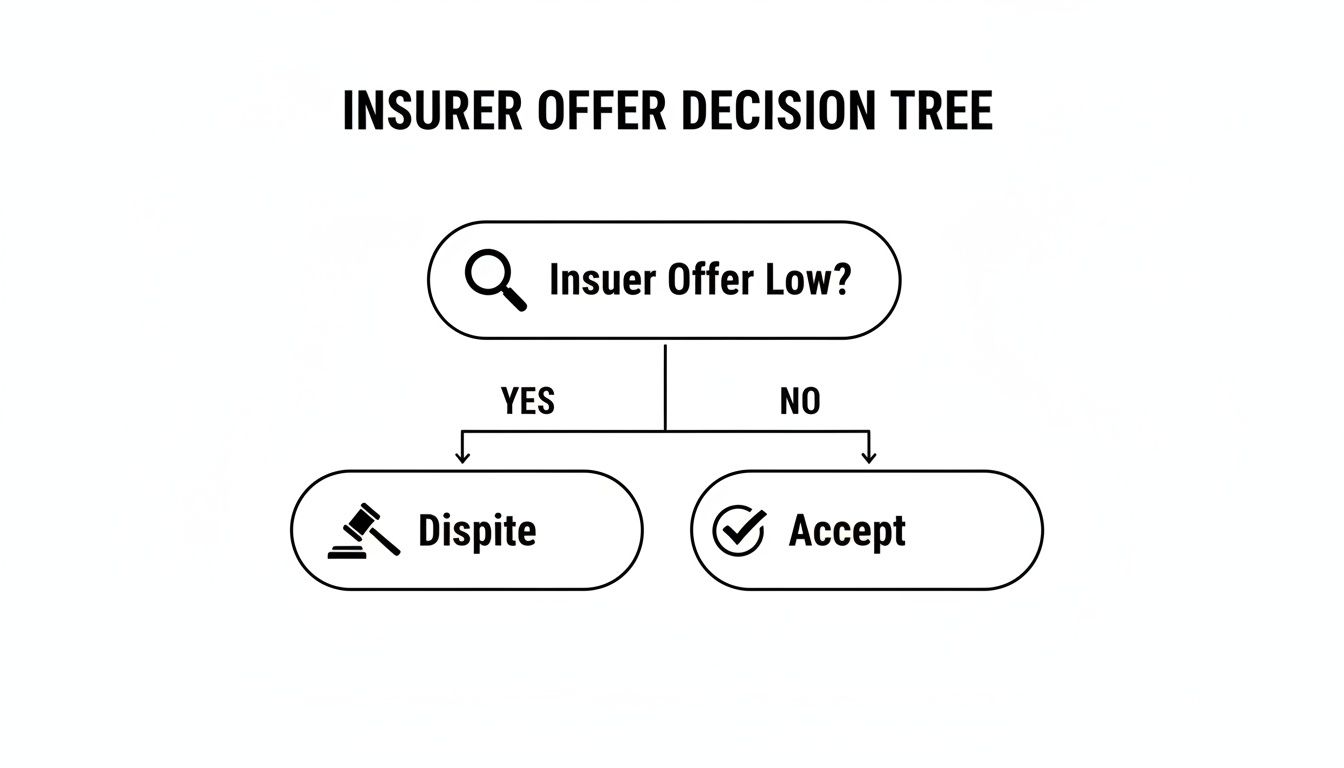
As you can see, an offer that doesn't feel right should be the starting point for a dispute, not a reluctant acceptance.
Building Your Counter-Offensive with Solid Evidence
Your opinion won't win this argument, but solid evidence will. The insurance company is leaning on their (likely flawed) report, so your job is to build an airtight case that proves your vehicle was worth more. Your goal is to present them with so many facts they simply can't ignore them.
Start gathering every piece of paper you can find. This is your arsenal.
- Maintenance Records: A full service history proves your car was well-cared-for, and well-maintained vehicles are worth more. It's that simple.
- Receipts for Recent Upgrades: Did you put on a new set of tires for $1,000 last month? Replace the brakes? Add a new stereo? Those receipts are hard proof of added value.
- Pre-Accident Photos: Clear, dated pictures showing your car in pristine condition are the perfect counter to an adjuster's attempt to rate its condition as just "average."
- Your Own Market Research: Get online and find listings for cars that are truly comparable to yours—same year, make, model, trim, and similar mileage—being sold by dealers in your immediate area. These listings show real-world asking prices in your market.
The insurer’s valuation is just their opening argument. Your documented evidence—from oil change receipts to listings for similar local cars—is your powerful rebuttal that demonstrates the real-world value they chose to ignore.
For some more in-depth tactics, you can read our guide on how to negotiate a total loss settlement to get even more prepared.
Invoking the Appraisal Clause: Your Ultimate Power Play
What if you present all your evidence and the adjuster still won't budge? You have one last, powerful tool in your back pocket: the Appraisal Clause. It’s buried in the fine print of most auto insurance policies, and it gives you a contractual right to an impartial resolution process.
Invoking this clause changes the game completely. It forces the insurance company to take your dispute seriously by leveling the playing field. Here’s how it generally works:
- You hire your own certified, independent appraiser.
- The insurance company hires its own appraiser.
- These two experts review all the evidence and negotiate to agree on a fair value.
- If they can't reach an agreement, they bring in a neutral, third-party "umpire" who makes the final, binding decision.
This process pulls the valuation out of the hands of the insurer's biased software and their internal adjusters. Instead, it puts the decision in the hands of qualified professionals whose only job is to determine an accurate, market-based value. For a relatively small investment in an appraiser, you can often add thousands more to your final settlement.
Maximizing Your Claim With an Independent Appraiser
So, you've presented all your evidence, argued your case, and the insurance adjuster still won't budge on their lowball offer. It can feel like you’ve hit a brick wall. This is precisely the moment to bring in the most powerful tool in your arsenal: a certified independent appraiser.
Hiring an appraiser isn't just another negotiation tactic. It’s a formal process that can completely change the game and is often your best bet for a fair outcome.
Think of an independent appraiser as a neutral, third-party expert. Their only job is to determine the true, unbiased car insurance total loss value of your vehicle. They don't work for you, and they certainly don't work for the insurance company. Their loyalty is to the facts, which makes their valuation incredibly difficult for an insurer to simply dismiss.
What a Professional Appraiser Actually Does
An independent appraiser does a lot more than just a quick online search. They perform a deep, forensic-level analysis of your vehicle and the local market, creating a comprehensive report that's built to withstand serious scrutiny.
Their process is methodical and detailed, digging into all the areas where an insurer’s automated software often gets it wrong.
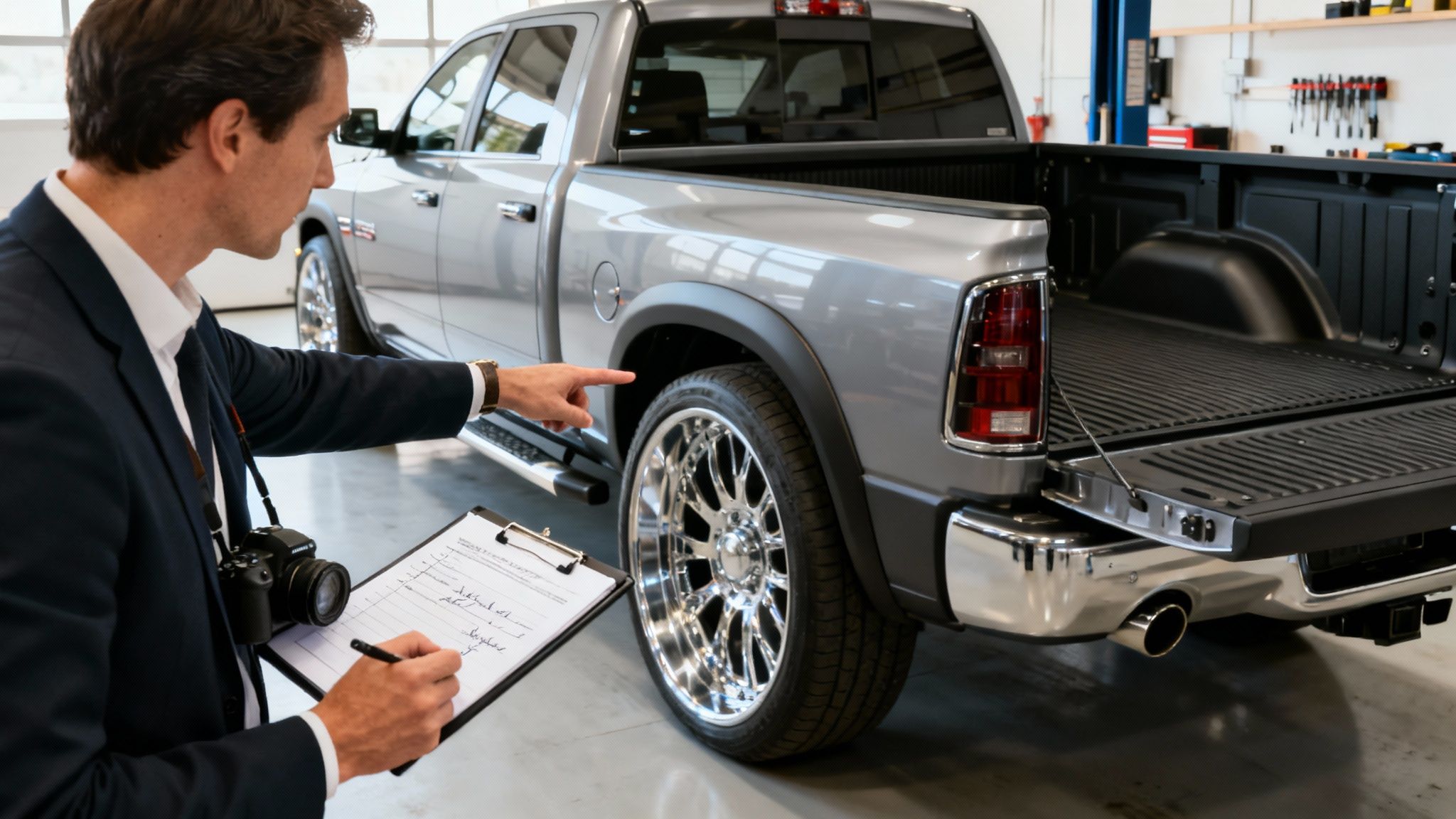
- A Hands-On Inspection: They'll physically inspect the vehicle (or use detailed, high-resolution photos) to document its exact pre-accident condition—from the quality of the paint down to the wear on the seats.
- Finding True Comparables: They dig deep to find vehicles that are genuinely comparable to yours that have recently sold in your specific local market. This means matching the exact trim, options, and condition, not just the make and model.
- Documenting Upgrades and Maintenance: All those receipts for new tires, a recent brake job, or that premium sound system you installed are carefully documented and factored into the final value.
- Making Professional Adjustments: Using industry-standard methods, they make transparent adjustments for mileage, condition, and optional features, creating a final value that is clear and defensible.
The report they produce becomes your ultimate piece of counter-evidence to the insurer's low offer. It's a professional opinion that carries real weight, often forcing the insurance company to re-evaluate their position based on solid, market-driven data instead of their own flawed algorithm.
An independent appraiser replaces the insurer's biased, automated valuation with a detailed, evidence-based report from a certified professional. This levels the playing field and forces the negotiation to be about your car's true market value, not the insurer's lowest possible payout.
The Decisive Advantage for Unique Vehicles
While hiring an appraiser is a smart move for almost any disputed claim, it becomes absolutely essential if you own a classic, custom, or rare vehicle. The valuation software used by insurance companies is notoriously bad at assessing these types of cars because they simply don't fit into standard data sets.
These automated systems will completely miss the value of a meticulous restoration, rare factory options, or tasteful modifications. A professional appraiser, on the other hand, specializes in understanding these nuances. They can accurately document what makes your vehicle special, ensuring you get paid for its true, unique worth. If you're looking for a trusted expert, you can learn more about finding an independent auto appraiser near you to get started.
Case Study: A $6,000 Difference
Let's look at a real-world example. A driver owned a meticulously maintained pickup truck with some high-quality off-road upgrades. After an accident, his insurance company offered a settlement of $25,000, based on a report that compared his truck to basic, high-mileage work trucks.
Feeling cheated, he hired an independent appraiser. The appraiser got to work, documenting the truck's pristine condition, its low mileage, and the real-world value of its high-end suspension, wheels, and tires. He built a detailed report proving the truck's actual cash value was much higher.
Armed with this expert report, the driver's final settlement was $31,000—a $6,000 increase. Even after paying the appraiser's fee, he walked away with thousands more than he would have otherwise. This is the kind of powerful return on investment an expert appraisal can deliver.
Your Game Plan for a Total Loss Claim
It’s easy to feel overwhelmed when your insurance company declares your car a total loss, but you're not powerless. Think of this as your personal game plan, a step-by-step guide to make sure you get the fair car insurance total loss value you deserve.
From the first phone call to the final check, being prepared is your best asset. Following these steps helps you stay in control of the process and confidently push back against a lowball offer.
The Fair Settlement Checklist
Here’s exactly what you need to do to protect your interests:
- Don't Take the First Offer: It's almost never their best one. See that initial number for what it is—a starting point for a negotiation, not the final say.
- Get the Valuation Report: Immediately ask the adjuster for a complete copy of their valuation report. This is the document they used to come up with their offer, and you need to review it for any mistakes or missing information.
- Compile Your Evidence: This is where you build your case. Dig up all your service records, receipts for recent upgrades like new tires or a stereo, and any photos you have that show the car in great shape before the accident.
- Know Your Local Market: Become the expert on your car's value. Search local dealer websites for vehicles that are a true match to yours—same year, make, model, trim, and similar mileage. This is what your car was worth right before the crash.
- Use Your Appraisal Clause: If the insurance company won't budge, it's time to play your trump card. Formally invoke the Appraisal Clause in your policy. This is your contractual right to an independent review.
- Bring in a Professional: The single best way to counter the insurer's low offer is to hire your own independent appraiser. Their detailed, evidence-backed report is the most powerful tool you have to get the settlement you're truly owed.
The claims process can feel like a battle of attrition, but remember this: you are in the driver's seat. By arming yourself with documentation, market data, and expert help, you can turn the tables and ensure the final payout is a fair one.
Frequently Asked Questions
When your car is declared a total loss, a million questions probably pop into your head. It's a confusing process, but we've got you covered. Here are some straightforward answers to the questions we hear most often.
What if I Owe More on My Car Loan Than the Settlement?
This is a tough spot to be in, and it's surprisingly common. It’s called being "upside down" on your loan, and it happens when your loan balance is higher than your car's Actual Cash Value (ACV). Because the insurance company only pays you the ACV, you're on the hook for the rest of the loan.
This is precisely why Guaranteed Asset Protection (GAP) insurance exists. If you have it, GAP coverage steps in to pay that remaining balance to your lender. Without it, you'll be stuck making payments on a car you can't even drive anymore.
Can I Keep My Car if It Is a Total Loss?
Believe it or not, yes. In most states, you can choose to keep the vehicle, a process known as "owner retention." If you go this route, the insurer pays you the car's ACV minus its salvage value (what they’d get for it at a scrap auction).
Just be aware of the trade-off. Your car will be given a permanent "salvage title." This brand makes the car incredibly difficult to sell or insure later on. To get it back on the road legally, you'll have to make significant repairs and pass a stringent state inspection to get a "rebuilt" title. It’s a big commitment.
How Long Does a Total Loss Claim Take to Settle?
The timeline really depends on the complexity of your claim. If you accept the insurance company’s first offer without any pushback, things can wrap up in just a few weeks.
However, if you challenge their valuation and use your policy's Appraisal Clause, you need to be more patient. A disputed claim typically takes 30 to 60 days, sometimes longer. This gives your independent appraiser time to do their research, build a solid report, and negotiate a fair number. It takes longer, but that extra time can easily translate into thousands more in your pocket.
A quick settlement is often an undervalued one. Taking the necessary time to dispute and properly document your vehicle's worth is the key to securing the full amount you are rightfully owed.
Do I Need a Lawyer for a Value Dispute?
Probably not. If your only issue is the settlement amount, a lawyer usually isn't necessary. Your policy’s Appraisal Clause is a contract-based process designed specifically for value disagreements, and an independent appraiser is the expert you need. They provide a much more direct and cost-effective way to prove your car's true value.
You should only consider bringing in a lawyer if the insurance company is acting in bad faith—like intentionally dragging out the claim for no good reason or denying it on flimsy grounds.
When an insurance company's offer feels like a lowball, you need a heavy hitter in your corner. Total Loss Northwest specializes in independent appraisals that force insurers to the negotiating table. We fight to make sure you get the settlement you deserve. Learn more about how we can maximize your total loss claim.