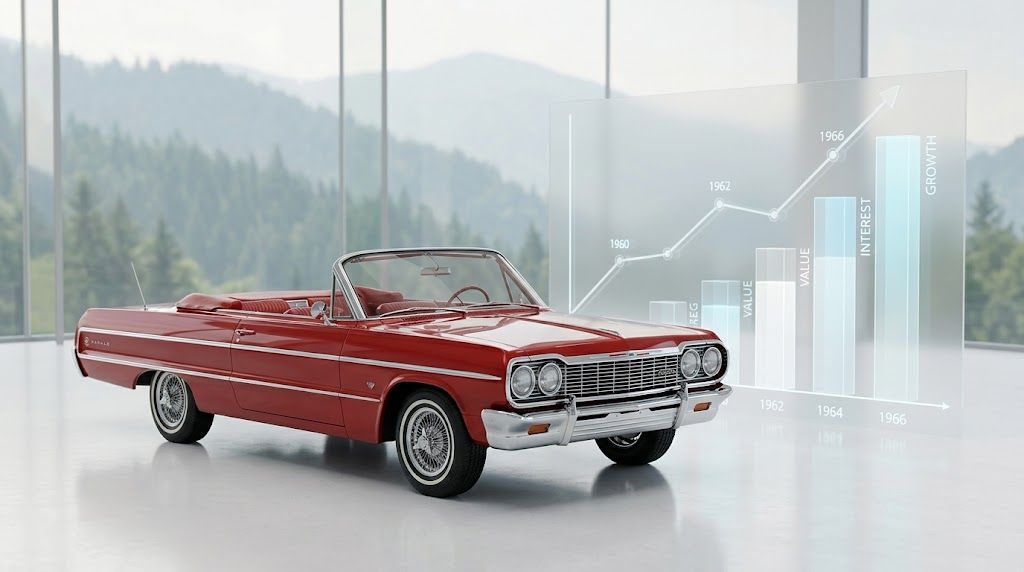
The tow truck has already left. Your stomach drops when you see the first insurance number. They priced your classic like an old commuter car with a fancy paint job, not a documented collector vehicle you've maintained for years.
That reaction is justified. Most low offers on classic car claims don't start with malice. They start with bad inputs. The adjuster leans on generic valuation software, broad market averages, and weak comparables. Your job, and your appraiser's job, is to replace those shortcuts with market evidence that fits your exact car.
If you're in Oregon or Washington, this matters even more. The Pacific Northwest has a deep enthusiast market, strong niche demand, and plenty of cars that don't fit neatly into insurer databases. Classic car value trends aren't abstract market talk. They're ammunition when you're arguing diminished value or fighting a total loss number.
Your Classic Was Wrecked Now What
You walk into the storage yard and see the car before the adjuster does. Maybe it's a chrome bumper folded where it should never fold. Maybe it's quarter panel damage on a car with impossible trim. Maybe it's a “repairable” hit that instantly changed the car from documented survivor to repaired example.
Then the carrier sends its valuation.
It's based on age, mileage, and a few broad comps that don't match your trim, your originality, your restoration quality, or your paperwork. If you own a classic, that's the moment to stop treating the claim like a normal auto claim. It isn't one.
What owners get wrong in the first week
The biggest mistake is arguing from emotion alone. I understand the emotional side. You know what the car means. You know what you spent. You know how hard it was to find. The insurer doesn't pay based on that. They pay based on what you can prove.
The second mistake is accepting the insurer's frame. If they call it “just an older vehicle,” and you respond inside that frame, you've already lost ground. A classic car claim has to be built around collector market behavior, not used-car depreciation logic.
Your car didn't become ordinary because it got hit.
Before you do anything else, gather every record you have. Photos before the loss. Restoration invoices. Ownership history. Awards. Build sheets. Spare parts. Prior appraisals. If you're not sure what coverage and policy language may shape the fight, review classic car insurance requirements and check whether your policy includes an appraisal process.
Shift from frustration to evidence
You need a clean argument:
- What the car was before the crash. Condition, originality, rarity, documentation.
- What changed because of the crash. Structural damage, paintwork, replacement panels, loss of originality, stigma.
- What the market says now. Real comparables and segment-specific trends.
- Why the insurer's number fails. Wrong segment, weak comps, no condition adjustment, no provenance adjustment.
That's how you move from “I know my car is worth more” to “Here is why your valuation is wrong.”
The Billion-Dollar Market Behind Your Car
Most adjusters still think about old cars the wrong way. They see age first. The market sees category, era, collector demand, rarity, and liquidity.
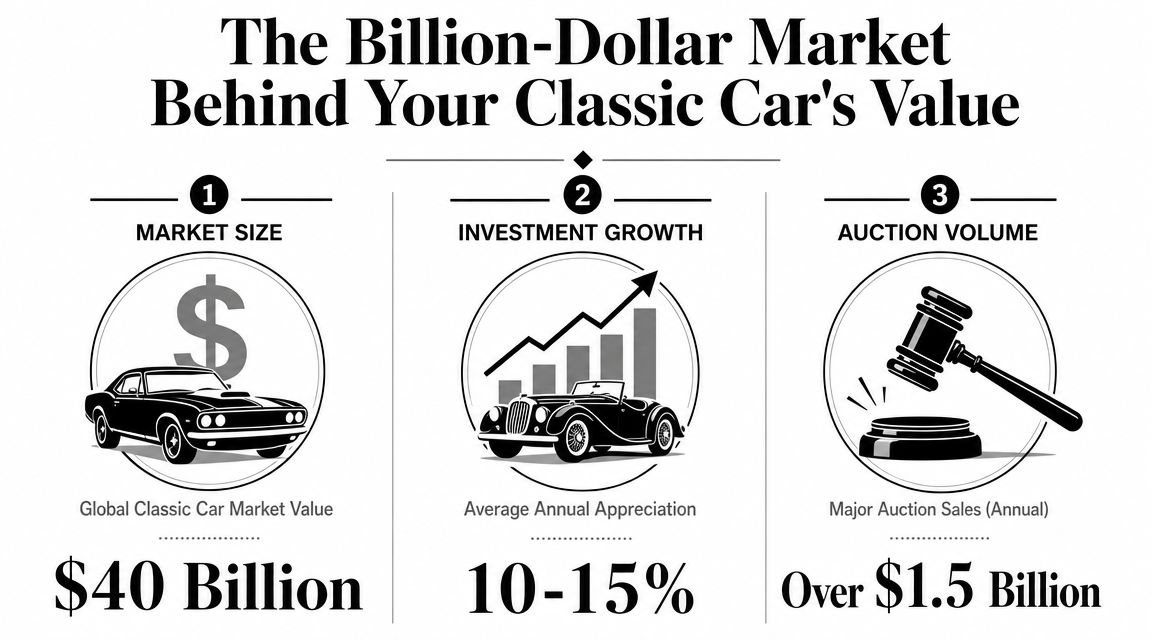
That difference is why classic car value trends matter so much in a claim. Your vehicle exists inside a large global collector market, not a shrinking used-car pool. One industry estimate valued the global Vintage Car Market at USD 47.4 billion in 2024, projected USD 49.7 billion in 2025, and forecast USD 80 billion by 2035 at a projected 4.8% CAGR over 2025 to 2035, according to this vintage car market estimate. Other market studies in the verified data also place the market in the high tens of billions, which tells you the same thing qualitatively. This is a serious asset class.
This is not a niche side market
McKinsey reported that the global value of the existing stock of collectible cars reached around €800 billion in 2024, with about 5% of cars changing hands annually, creating roughly €45 billion in annual trade volume, as described in McKinsey's analysis of collectible cars. That matters in a claim because active trade volume gives appraisers and owners a real market to study.
A market with that much turnover cannot be reduced to a generic book figure.
It also tells you something else. Collector cars are no longer just owned by retirees protecting garage queens. McKinsey noted that collectible cars from the 1980s, 1990s, and 2000s have been the main value and liquidity growth driver for the past decade, reflecting millennial demand and nostalgia effects. That's exactly why insurer software often lags actual buyer behavior. The software tends to flatten nuance. The market rewards it.
What that means after a loss
If your car was damaged, you need to position it as part of this collector market. Not as transportation. Not as an “older unit.” As a tradable, documented asset with segment-specific demand.
Use this framework when you speak with the carrier:
| What insurers often use | What your claim should use |
|---|---|
| Broad age-based depreciation logic | Collector market evidence |
| Generic regional database comps | Like-for-like enthusiast comps |
| Minimal condition adjustment | Detailed condition and originality analysis |
| Limited attention to provenance | Full documentation and ownership history |
Practical rule: If the valuation reads like it could apply to any old car, it's almost certainly wrong for a classic.
This is also why transport and storage details can matter. Owners moving collector vehicles for repair, events, or preservation often rely on specialized options such as enclosed car trailers in Savannah because collectible vehicles need handling that matches their market status. Insurance negotiations should reflect that same level of seriousness.
How Appraisers Determine Your Car's True Value
A proper appraisal doesn't start with a spreadsheet. It starts with the car itself.
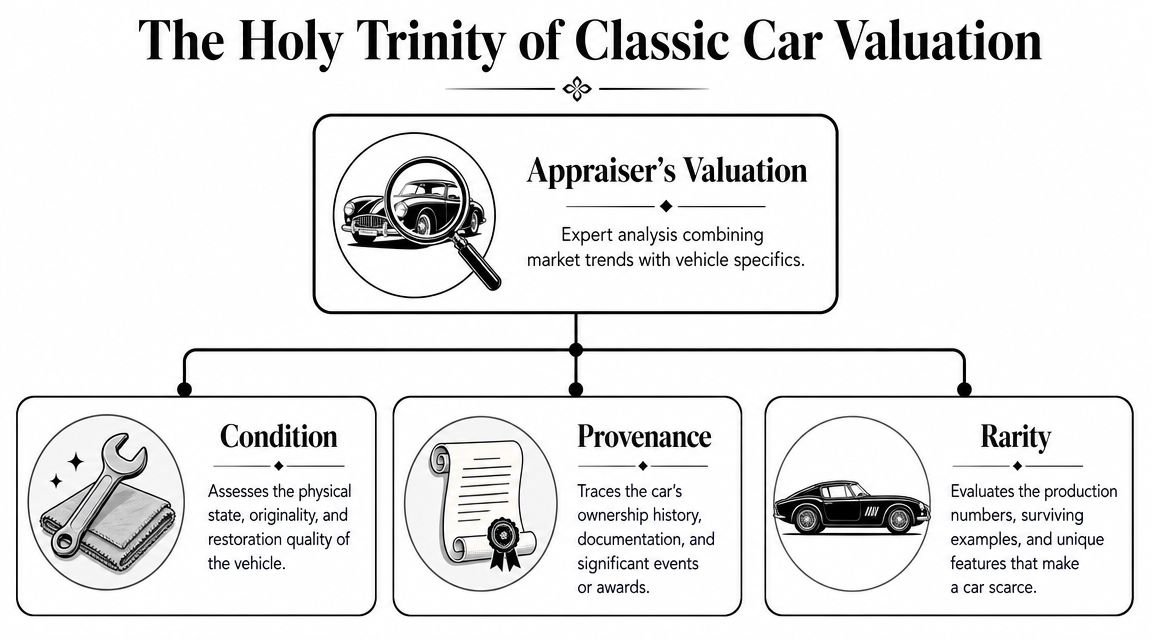
I look at three things first. Condition. Provenance. Rarity. If an insurer ignores any one of those, the result skews low. If they ignore all three, the result is useless.
Condition is more than paint and mileage
Condition means body integrity, panel fit, rust status, interior preservation, drivability, mechanical health, restoration quality, and originality. On a classic, the difference between honest preservation and cosmetic masking is massive.
A clean repaint doesn't automatically help. A poor repaint can hurt. Replacement panels can matter. Incorrect trim can matter. Non-original finishes can matter. Fresh work without documentation can raise questions instead of value.
If you want a stronger grasp of how professionals break this down, read how to value a classic car. The key point is simple. Two cars with the same year, make, and model can carry very different numbers once you inspect the details.
Provenance changes the conversation
Documentation is value. Service records, ownership chain, restoration photos, certificates, period literature, awards, and factory paperwork all help establish what the car is and how the market should treat it.
If your car has known history, respected restoration work, or long-term ownership records, that's not trivia. That's evidence. It helps justify why your car should not be compared to the cheapest example floating around a search result.
Here's the hard truth. An undocumented car always gives the insurer more room to argue down.
Rarity isn't just production numbers
Owners hear “rare” and think low production. That's only part of it. In appraisal practice, rarity also includes surviving examples, factory options, unusual driveline combinations, market desirability, and how often comparable cars trade hands.
A car can be old and scarce but still weak in the market. Another can be newer, easier to live with, and far more liquid. That's why broad market averages can mislead.
One 2025 market review reported global values down 10% year over year, but classics defined as 30+ years old fell less sharply at 7.7%, showing that different segments are moving differently, according to this 2025 collector market review. For appraisal work, that means condition-adjusted, like-for-like comparisons matter more than sweeping “classic car” averages.
A market dip does not erase the premium for the right car. It widens the gap between average examples and exceptional ones.
Finding Real Data to Fight Insurance Software
The insurer's software usually has one advantage. It's fast. That's also its weakness.
Fast systems flatten the details that drive collector value. They don't handle modifications well. They miss trim-level nuance. They often treat poor comps as good enough because the database wants closure, not precision.

What makes a useful comp
A defensible comparable sale should match your car in the ways that matter most:
- Era and generation. Don't mix early and late production versions if the market treats them differently.
- Trim and drivetrain. Engine, transmission, package, and factory options change liquidity.
- Condition tier. A tired driver is not a comp for a sorted, documented example.
- Originality or modification profile. Tasteful period-correct upgrades may help one market niche and hurt another.
- Timing. Older sales from hotter market moments can distort present value.
- Geography. Regional demand can affect asking prices and buyer competition.
Where owners should look
You don't need dozens of weak comps. You need a handful of strong ones.
Start with auction archives, enthusiast dealer listings, and marque-specific communities that keep sale histories. Then compare those against local and regional listings. If the insurer used a valuation platform such as CCC, learn how those systems can miss collector nuance by reviewing how CCC auto valuation works.
Use asking-price evidence carefully. Asking prices are not sale prices, but they still help show market positioning, especially when the listings are model-specific, well-documented, and consistent with known enthusiast demand.
A clean evidence pack usually includes:
- Recent sold examples that mirror your car closely.
- Current listings showing replacement cost in the live market.
- Vehicle-specific records proving why your car belongs at the stronger end of the range.
- A written critique of the insurer's weak comps.
If the carrier's comps ignore your car's documentation, rarity, or restoration quality, challenge the comps before you argue the final number.
Software loves convenience. Claims are won with specificity.
Why the Pacific Northwest Market Is Different
A national average is lazy math. It often misses what buyers in Oregon and Washington will pay.
The Pacific Northwest has a long-standing enthusiast culture built around European cars, Japanese performance cars, vintage 4x4s, air-cooled and water-cooled German cars, Swedish wagons, and well-kept survivors that escaped harsher conditions common in other regions. That doesn't mean every PNW classic is worth more. It means the local market can behave differently enough that national software averages become weak evidence.
Local demand changes value
In Portland and Seattle metro areas, buyers often pay attention to details national databases miss. Service history from respected local shops. Clean underside condition. Original interior preservation. Desirable color combinations. Regionally popular brands and chassis.
That matters in negotiations because insurer software tends to lean on broad geographic buckets. A software-generated “comparable” from a different regional culture may be technically similar on paper and still be a bad comp in practice.
For a Pacific Northwest owner, these arguments are often persuasive:
- Local enthusiast demand can support stronger values for specific marques and eras.
- Well-preserved examples may carry a premium when rust and deferred maintenance are less common than in harsher climates.
- Imported or niche vehicles can have stronger regional followings than a national average suggests.
- Repair stigma may hit harder in tight enthusiast circles where buyers scrutinize history closely.
PNW claims need local logic
If your car lived in the inland Northwest, was garaged, maintained, and documented, don't let the insurer compare it to rougher examples from generic data pools. If your model has a following in the region, bring that into the claim narrative through actual market evidence and local comp selection.
This is especially important for diminished value. A repaired classic in a market full of informed buyers can lose appeal fast, even if the repair invoice looks thorough. Enthusiast buyers ask better questions than average used-car buyers. They notice paint meter readings, panel replacement, weld quality, and deviations from factory presentation.
The right comp is often closer to home
I've seen claims drift low because the carrier treated the car as interchangeable with examples from outside the owner's actual buyer pool. That approach collapses when you show what comparable vehicles in the owner's likely market look like, how they're presented, and why buyers in that region sort good cars from average ones.
Your classic car value trends argument should never be generic if your market isn't generic.
How to Win Your Total Loss or Diminished Value Claim
At this point, the strategy should be clear. Don't argue louder. Argue better.
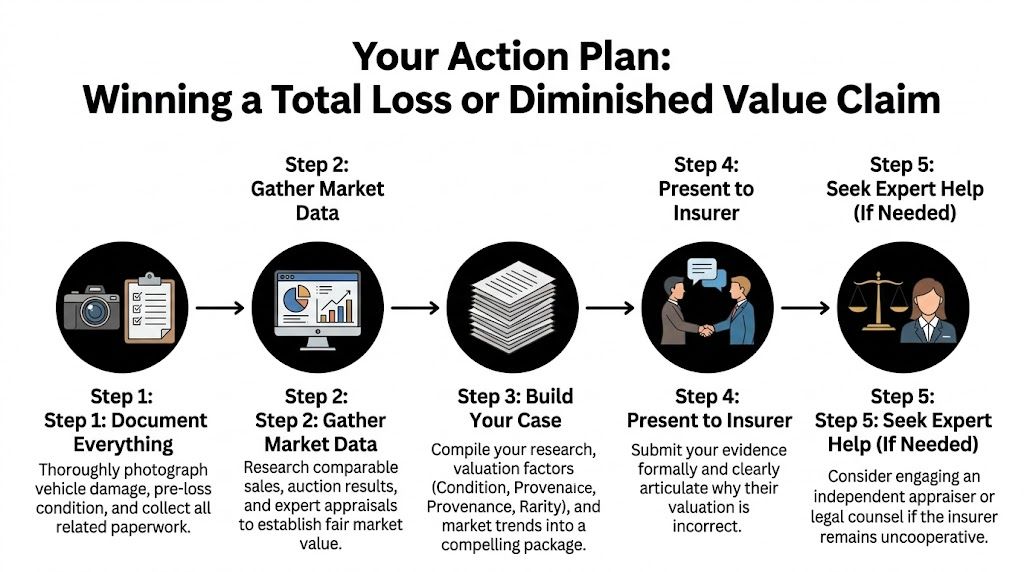
You win these claims by packaging the right evidence in the right order, then forcing the insurer to address it. That means your file needs structure, not a stack of random screenshots.
Build a file that an adjuster can't shrug off
Start with the basics. Pre-loss photos. Damage photos. Ownership records. Service and restoration invoices. Prior appraisals. Any evidence of awards, provenance, rarity, or original equipment. Then add your market section with carefully chosen comps and a written explanation of why they fit.
For diminished value, explain the loss in market appeal after repairs. For a total loss, explain why the settlement number fails to reflect what a buyer would have paid for your exact car before the crash.
A strong package usually contains:
- A vehicle profile with year, model, trim, options, modifications, and condition notes
- A documentation set that proves history and quality
- A comp analysis with comments on similarities and differences
- A rebuttal to the insurer's valuation logic
- A demand number supported by evidence, not guesswork
Don't let age be the insurer's shortcut
This matters even more for modern classics. Hagerty reported that the strongest price gains have been in 2000s-era vehicles, and the average age of seven-figure cars sold has moved nearly 12 years younger over the last five years, according to Hagerty's data-driven market analysis. Age alone is a poor value indicator.
If you own a 2000s performance car, limited-production sport coupe, special-edition German car, or enthusiast-favorite analog model, don't let the insurer lump it into “used car” logic. Those claims need trim-level and market-segment benchmarking. The wrong generation, wrong transmission, wrong package, or wrong condition tier can blow up a valuation.
Here's a practical walkthrough that helps explain the process:
Use the appraisal clause when the carrier won't move
If the insurer sticks to a bad number, stop expecting the same process to fix itself. Check your policy for the Appraisal Clause.
That clause usually gives you the right to hire an independent appraiser to challenge the carrier's valuation. That changes the fight. You're no longer begging the insurer to reconsider its own software. You're moving the dispute into a formal valuation process.
For Oregon and Washington owners, that can be the difference between going in circles and getting movement.
One option is hiring a certified independent appraiser such as Total Loss Northwest, which handles diminished value and total loss appraisals and can invoke the Appraisal Clause on the owner's behalf. That approach replaces generic software logic with a market-based report built for negotiation.
The claim gets stronger the moment the discussion shifts from opinion to appraisal methodology.
What to do this week
If your classic was just damaged, act in this order:
- Secure the records. Don't assume the shop or storage yard will preserve your paper trail.
- Photograph everything. Include pre-loss photos if you have them.
- Request the insurer's valuation report. You need to see the comps and adjustments.
- Audit every comp. Trim, condition, geography, originality, and timing.
- Commission an independent appraisal if the carrier is anchored to a weak number.
That's how classic car value trends become useful. Not as cocktail-party market talk. As a strategic tool.
If your insurer is treating your collector vehicle like a generic old car, get a market-based appraisal before you accept the offer. Total Loss Northwest works with owners in Oregon and Washington on diminished value and total loss disputes, using independent appraisals and the Appraisal Clause process to challenge low valuations.