The call usually goes the same way. The adjuster says your car is a total loss, gives you settlement numbers, and then asks the question that changes everything. Are you keeping the vehicle, or are you signing it over?
At that point, most Connecticut owners aren't thinking about title branding, parts receipts, or resale stigma. They're thinking about whether the damage really justifies totaling the car, whether they can afford another vehicle, and whether keeping this one might save money. That's exactly where a ct salvage title becomes more than DMV paperwork. It becomes a financial decision with long consequences.
A salvage title can still lead to a road-legal car. It can also trap owners in a project that costs more than expected and sells for less than hoped. The difference usually comes down to when you evaluate the numbers, how cleanly you document the repairs, and whether you understand what the title brand does to future value before you commit.
Your Car Was Totaled What Does a CT Salvage Title Mean
When an insurer tells you the vehicle is totaled, it feels final. In practice, it's a fork in the road.
One path is simple. You accept the settlement, let the insurer take the vehicle, and move on. The other path is more complicated. You keep the car, deal with a ct salvage title, fund repairs, and try to bring it back as a legal and usable vehicle with a rebuilt brand.
That second option isn't automatically a bad one. Sometimes it makes sense for an older paid-off vehicle, a specialty car, or a vehicle where the owner knows the maintenance history and trusts the underlying condition. But owners get into trouble when they treat "salvage" like a temporary inconvenience instead of what it really is: a legal status that changes use, value, and bargaining power.
Here's the practical point. The title brand changes the conversation with the insurer and with yourself. If you're considering keeping the vehicle, you need to compare three things before agreeing to anything:
- Settlement reality: What is the insurer paying, and does that number fairly reflect the vehicle before the loss?
- Repair reality: What will it take to make the car inspectable, not just drivable?
- Exit reality: If you rebuild it, what will buyers and insurers think of it later?
If you want a broad write-off primer from outside the U.S. system, AutoProv's guide for motor traders on write-offs is useful for understanding how title history affects downstream resale and buyer trust. For the total-loss side of the claim itself, this overview of what happens when your vehicle is totaled gives a solid foundation before you decide whether to retain the car.
A salvage title isn't the end of the car. It's the end of the car as a normal, clean-title asset.
That distinction matters more than most owners realize during the first few days after the accident.
How Connecticut Law Defines and Brands a Salvage Vehicle
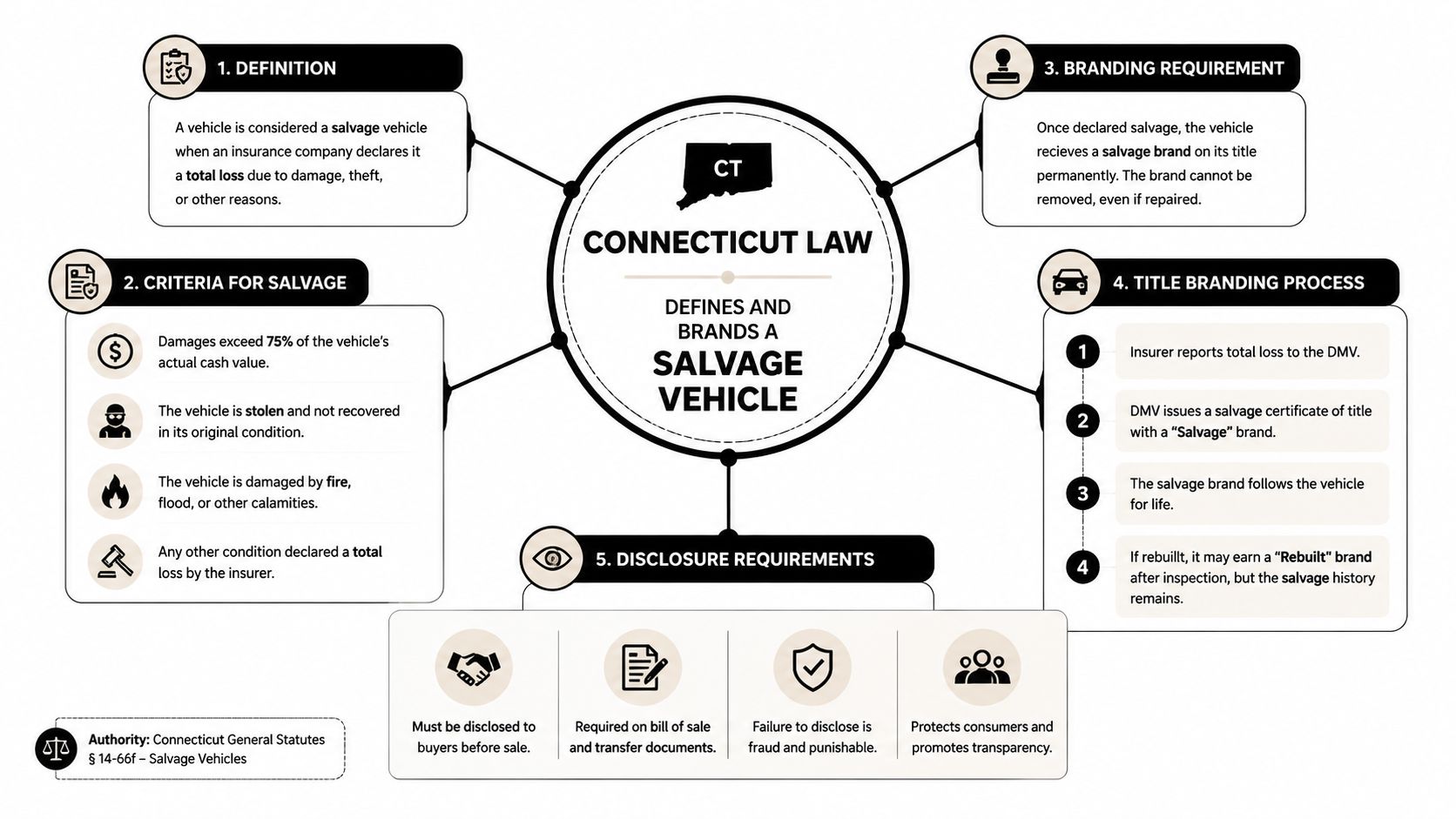
Connecticut doesn't treat salvage as an informal label. It treats it as a controlled legal status with immediate consequences.
If an insurer declares a vehicle a total loss and stamps the title “Salvage,” the vehicle becomes illegal to operate on Connecticut roads until it's rebuilt and passes a state salvage inspection, according to Connecticut DMV guidance on salvaged and totaled vehicles. The DMV also cancels the registration, requires the plates to be removed, and allows those plates to be transferred to another vehicle rather than left on the salvage unit.
What the title brand really changes
Owners often think the title brand just warns future buyers. In Connecticut, it does much more than that.
It controls whether the car can legally re-enter the road market at all. That means the title brand directly affects:
- Use: You can't legally keep driving the vehicle as if nothing happened.
- Repair economics: A repair that looks worthwhile on paper can fail if the paperwork or inspection side falls apart.
- Bargaining power for settlement: If the car's future status is restricted, the value of keeping it may be lower than expected.
If you're still sorting out the terminology, this salvage title explainer is a helpful companion because it frames the branding issue in plain language.
Not every salvage-branded vehicle is rebuildable
Many owners tend to make expensive assumptions.
Connecticut also uses brands such as “Salvage Parts Only,” “Salvage Unrebuildable,” and “Salvage Unrepairable.” Those vehicles cannot be registered or re-titled under any circumstances under the same DMV guidance already cited above. In appraisal terms, that changes the asset from a possible rebuild candidate into something closer to a parts inventory or disposal problem.
Practical rule: Before you price repairs, confirm what brand the vehicle can actually carry. A non-rebuildable unit isn't a rebuild project. It's a different category of asset.
That legal line matters because owners often focus on whether a shop can repair the damage. Connecticut's rules force the more important question. Even if a shop can repair it, can the vehicle ever come back as a road-legal car?
If the answer is no, the math changes fast.
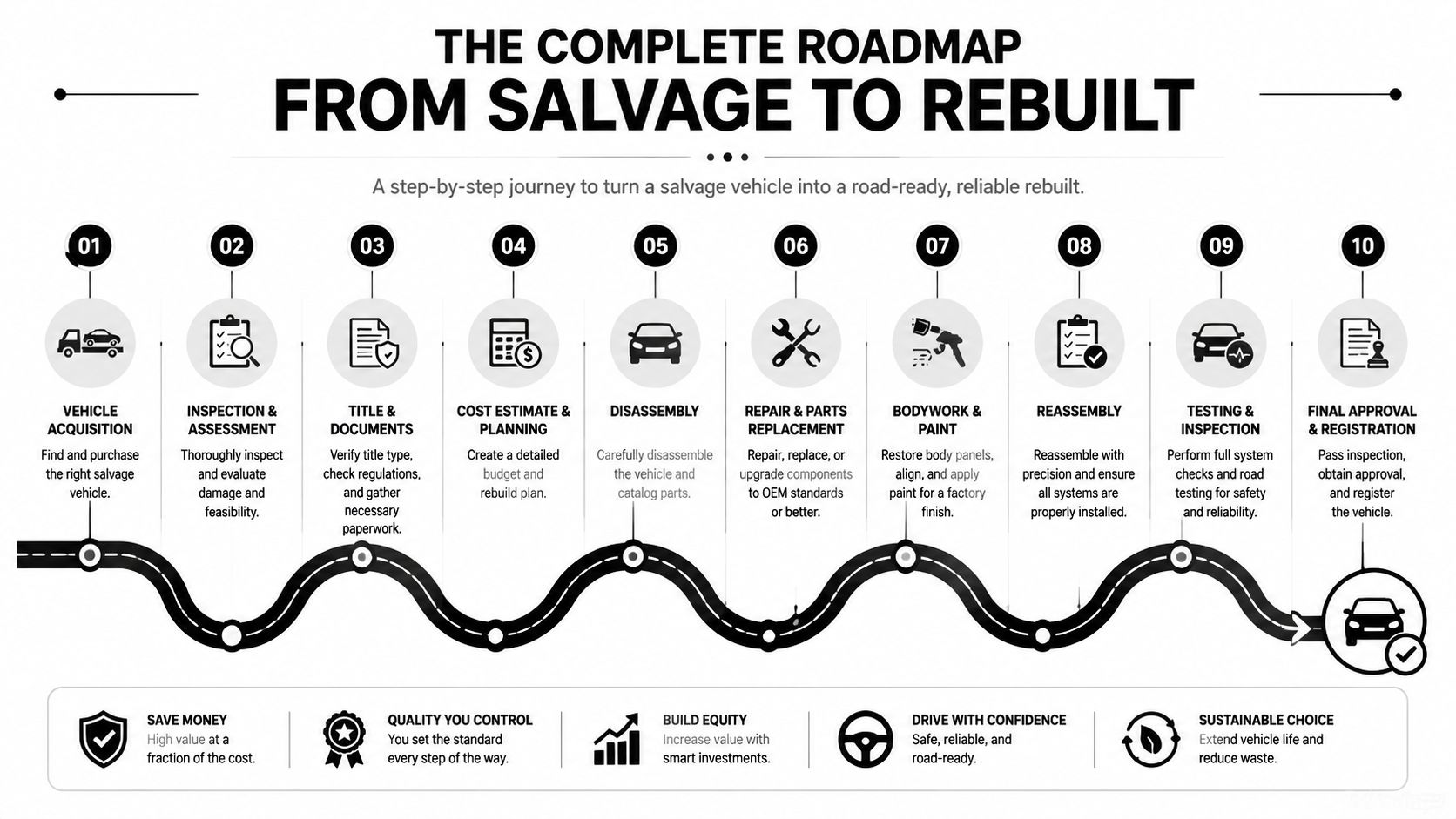
The Complete Roadmap from Salvage to Rebuilt Title
Most owners do better when they view the process as a chain. If one link fails, the rest of the investment gets harder to recover.
Under CGS § 14-16c, if an insurance company or self-insurer takes possession of a vehicle declared a total loss, the title must be stamped “salvage,” and the vehicle can't be legally operated on Connecticut roads until it goes through a salvage inspection. Connecticut's guidance also states that the inspection fee is $88 for a regular salvage inspection, with an additional $10 administrative fee if the vehicle has never been registered in Connecticut or is 10 years old or older, and after passing inspection the vehicle may be re-registered and retitled with a new title marked “Rebuilt” through the state summary of CGS § 14-16c and salvage inspection rules.
The roadmap in plain English
The sequence usually looks like this:
Settle the total-loss claim
Decide whether you're retaining the vehicle or letting it go. This is the valuation decision point. If the insurer's number is low, that problem should be addressed before you commit to a retention path built on a weak settlement.
Repair the vehicle
The goal isn't cosmetic improvement. The goal is a repair file and physical vehicle that can survive state review.
Collect the paper trail
Connecticut cares about evidence. Missing receipts and missing forms can turn a finished repair into a failed inspection.
Pass the salvage inspection
This is the gateway back to legal registration eligibility.
Receive a rebuilt title
You do not get a clean slate. You get a vehicle that can return to the road with a permanent history that buyers, dealers, insurers, and appraisers will consider.
The financial point owners miss
A rebuilt title restores utility, not original market standing.
That matters because owners often compare repair cost to pre-loss value and stop there. The better comparison is broader:
- What did the insurer pay?
- What did you spend to make the vehicle inspectable?
- What will the rebuilt title do to future sale options?
- Will full coverage be easy, limited, or expensive?
If those answers aren't clear at the beginning, the salvage route tends to feel cheaper than it really is.
Passing the CT Salvage Inspection Your First Time
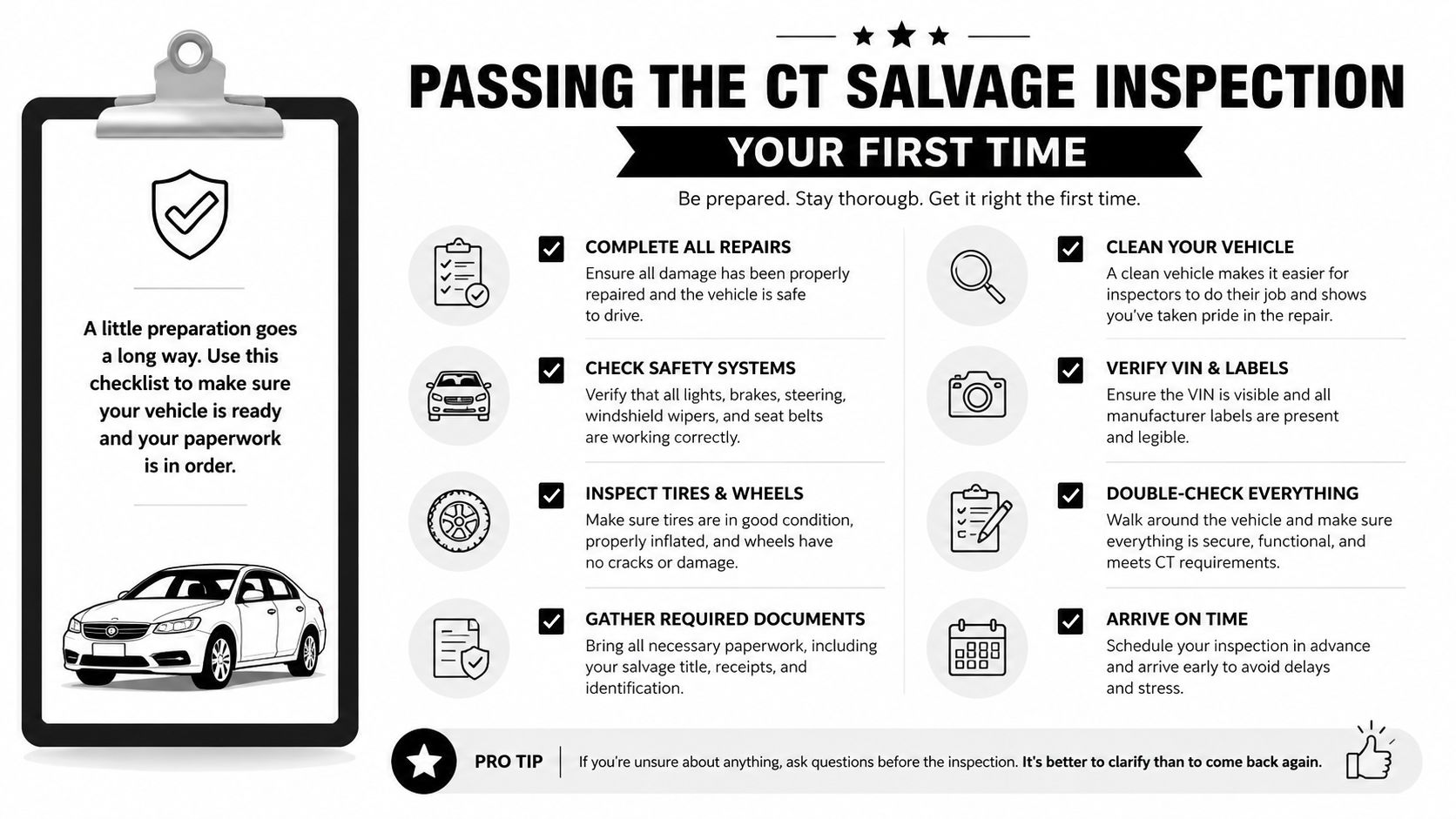
The inspection is where many rebuild plans either become legitimate or come apart. Connecticut's process is document-heavy for a reason. The state wants to know what was repaired, where key parts came from, and whether the vehicle's identity-critical components were lawfully sourced.
Connecticut's rebuilt-title pathway requires the owner to submit documentation including the insurance adjuster's report, the completed salvage vehicle repair report Form K-186, receipts for major component parts, and an air-bag certification statement Form B-303 whenever the vehicle is equipped with airbags, even if they did not deploy, as summarized in this Connecticut-focused salvage inspection and parts-traceability guide.
Why Connecticut asks for so much paperwork
This isn't paperwork for paperwork's sake.
Connecticut treats major component parts as regulated, identity-critical parts. In practical terms, that means the state wants continuity. If a front clip, engine, transmission, airbag component, or other major part enters the repair, the file has to show lawful sourcing and a clean chain from seller to vehicle. That reduces fraud risk and helps screen out stolen or improperly documented parts.
Owners who fail inspection usually don't fail because the bumper gap is imperfect. They fail because the paper trail is incomplete, inconsistent, or impossible to reconcile.
Bring your file as if someone who has never seen the car must understand every major repair decision from the documents alone.
Here's a useful walk-through to watch before your appointment:
What to organize before the appointment
Don't arrive with a stack of loose invoices and hope for the best. Build a clean packet.
| Item | Purpose | Notes |
|---|---|---|
| Insurance adjuster's report | Shows the loss context and damage basis | Match it to the repaired areas |
| Form K-186 | Documents the salvage vehicle repair | Complete it carefully and consistently |
| Receipts for major component parts | Proves lawful sourcing and traceability | Keep seller information legible |
| Form B-303 | Certifies air-bag compliance | Required when the vehicle is equipped with airbags, even if they didn't deploy |
| Vehicle title and ownership records | Supports title processing | Make sure names and VIN details align |
| Repair invoices | Connect labor and parts to the finished vehicle | Separate estimates from final paid invoices |
What actually helps on inspection day
A few habits make a major difference:
- Sort receipts by repair area: Put front-end parts together, restraint-system records together, and structural items together.
- Match every major part to the VIN file: If a part matters to identity or structure, make it easy to trace.
- Clean up the vehicle: Not for appearance alone, but so inspectors can see labels, weld areas, fasteners, and installed components clearly.
- Check the airbag paperwork twice: Owners miss this often because they assume no deployment means no form. Connecticut still requires the certification when the car is equipped with airbags.
What doesn't work
These shortcuts almost always create trouble:
- Using undocumented parts
- Submitting estimates instead of paid receipts
- Letting the shop keep the only copies
- Assuming a mechanically drivable car is inspection-ready
The inspection rewards owners who think like auditors, not just drivers.
Insurance Resale Value and Safety After Rebuilding
A rebuilt car can return to the road. It doesn't return to the same market position it had before the loss.
That distinction matters when owners decide whether keeping the vehicle will save money. In many cases, the answer depends less on whether the car can be fixed and more on what the rebuilt title will do to future insurability, resale appeal, and buyer confidence.
Insurance after a rebuilt title
Some owners assume that once the state allows registration again, insurance becomes routine. It often doesn't.
Carriers may be cautious with rebuilt-title vehicles because prior severe damage changes how they view future risk, repair severity, and valuation disputes. Some owners can find only liability coverage easily. Others can get broader coverage, but only after inspections, photos, or tighter underwriting review. The issue isn't just premium. It's whether the coverage you want is realistically available.
Before you spend money on the rebuild path, ask prospective carriers practical questions:
- Will you write other than collision and collision on a rebuilt-title vehicle?
- Do you require photos or a separate inspection first?
- How do you handle a later total-loss valuation on a rebuilt title?
Those answers matter because a rebuilt-title car that can't get the coverage you want may not fit your household's needs, even if the repair itself is sound.
Resale value is where owners feel the title brand most
A rebuilt brand stays with the vehicle's market story. Buyers, dealers, lenders, and appraisers all account for it.
Owners often confuse utility with value. You may end up with a dependable car for your own use, but that doesn't mean the retail market will treat it like a comparable clean-title vehicle. Buyer hesitation is common. Trade-in offers are often softer. Private-party buyers ask harder questions and want stronger documentation.
If you're trying to evaluate the pre-loss side of the claim before making the keep-or-release decision, this fair market value guide is a useful way to think about actual market support rather than insurer assumptions.
A rebuilt title can be a workable ownership decision and still be a weak resale decision. Those are not contradictions.
Safety is more than passing inspection
Passing inspection means the state accepted the vehicle for the rebuilt-title pathway. It doesn't mean the vehicle is restored to factory-new condition in every respect.
That's especially important with structural repairs, restraint systems, and damage patterns that can affect alignment, crash behavior, or long-term durability. A high-quality shop and a complete repair file reduce those risks. Cheap parts, vague invoices, and rushed work increase them.
Owners usually make the best salvage decisions when they separate these three questions:
- Can it be made road-legal?
- Can it be insured the way I need?
- Will I be comfortable owning or selling it later?
If the answer to only the first question is yes, the salvage path may still be a poor financial choice.
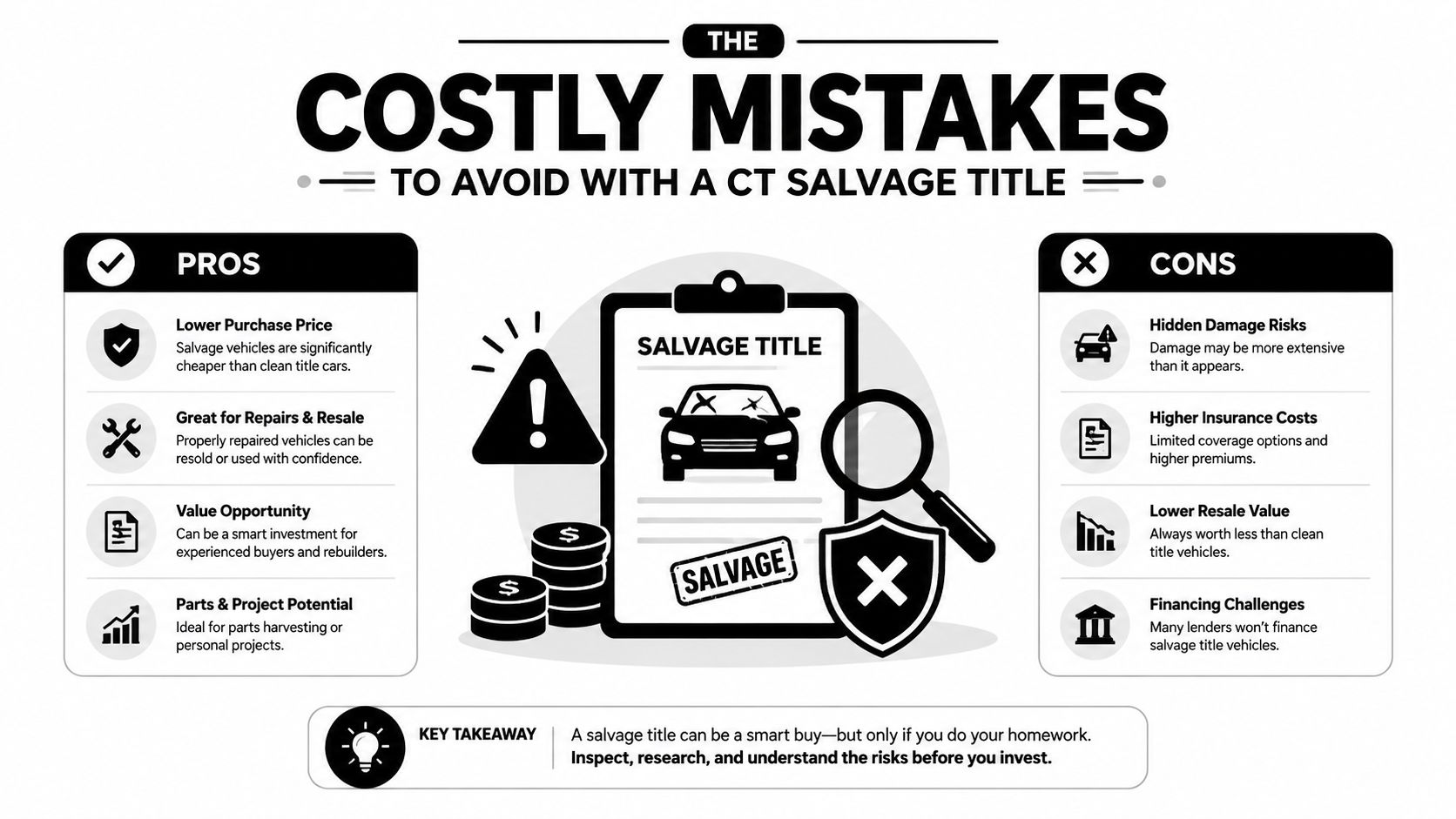
Costly Mistakes to Avoid with a CT Salvage Title
The biggest mistakes happen before the wrenching starts. Owners assume the title issue is just a formality, accept the insurer's first numbers, or buy a damaged vehicle without understanding which brands can never come back to the road.
Connecticut DMV guidance distinguishes “Salvage Parts Only,” “Salvage Unrebuildable,” and “Salvage Unrepairable” from rebuildable salvage vehicles, and those brands cannot be registered or retitled under any circumstances according to the DMV form guidance on salvage title distinctions and transfer rules.
The dead-end title mistake
This is the costliest misunderstanding.
Some shoppers hear "salvage" and assume all damaged vehicles are rebuild projects. They aren't. In Connecticut, certain brands mean the vehicle is effectively finished as a road-use asset. If you buy one expecting a rebuilt-title outcome, you've bought the wrong category of vehicle.
The ownership transfer trap
Another common mistake shows up when an owner tries to sell the vehicle too quickly.
The DMV guidance notes that the owner of a vehicle declared salvage can't directly transfer ownership on a duplicate-title application and must first obtain the duplicate title with the salvage legend before assigning it to a buyer. That sounds technical, but the financial consequence is straightforward. A sloppy title transfer can delay the sale, complicate payment, and create avoidable disputes.
Other mistakes that drain money fast
These don't always look dramatic, but they add up:
- Accepting a weak total-loss valuation too early: Once you build your plan around a low settlement, every later decision gets tighter.
- Budgeting only for visible repairs: Inspection readiness and documentation often cost more time and money than owners expect.
- Using a shop that doesn't document parts well: The car may be repaired competently and still fail the state process.
- Assuming future buyers won't care: They will, especially if your paperwork is thin.
The cheapest-looking salvage deal is often the one with the weakest exit options.
When the numbers are close, owners should slow down and test the decision from the back end. If I had to sell this rebuilt vehicle later, insure it again after another loss, or defend its repair history to a skeptical buyer, would the file hold up? If the answer is shaky, the project usually is too.
Next Steps and Your CT Salvage Title Questions Answered
Most owners don't need more theory at this point. They need a decision framework.
If you're early in the claim, focus on the valuation first. If you're already committed to keeping the vehicle, focus on documentation and title eligibility before spending heavily on repairs. If you're shopping for a damaged car, verify the exact brand before you think about rebuild potential.
Can I dispute the insurer's total-loss valuation
Yes. If the insurer's number doesn't reflect the vehicle's actual pre-loss condition, options, market position, or comparable sales reality, you can challenge it. The strongest disputes are evidence-based. They use market support, condition analysis, and a clear explanation of why the carrier's valuation misses the mark.
One practical route is an independent appraiser. Firms such as Total Loss Northwest handle total-loss and diminished-value appraisal work and can invoke the Appraisal Clause where the policy allows, which changes the conversation from adjuster opinion to documented valuation analysis.
How much value does a rebuilt title lose
There isn't one universal formula. The impact depends on vehicle type, damage history, repair quality, buyer pool, and documentation. What can be said with confidence is that the rebuilt brand changes how the market views the vehicle, even after legal road use is restored.
Is it ever smart to buy or keep a salvage vehicle
Sometimes, yes. It can make sense if you understand the title brand, can document the repairs, plan to keep the vehicle for a while, and aren't relying on strong resale later. It usually makes less sense when the project only works if everything goes perfectly.
If your accident involved injury issues as well as vehicle damage, broader legal and financial context can matter too. CasePulse has a helpful overview of 2026 car accident settlement insights that can help you think through the bigger claim picture while keeping the property-damage side separate.
The best salvage decisions are made before emotion and sunk costs take over. Once you've accepted a low settlement, bought parts, and committed to repairs, it's much harder to reverse a bad strategy.
If you're dealing with a total-loss offer and need a defensible value before deciding whether to keep the vehicle, Total Loss Northwest provides independent total-loss and diminished-value appraisals. That can be useful when the insurer's number feels low and the salvage decision depends on getting the valuation right first.