You did the hard part already. You filed the claim, got the car repaired, maybe even paid out of pocket for a few extras the shop said were necessary. Then you try to sell or trade it, and the number comes back lower than it should. That gap is the problem, and in Georgia it's exactly where a strong diminished value appraisal Georgia claim can put real money back in your pocket.
The mistake most drivers make is treating a repaired car like a fully restored car. The market doesn't. A vehicle with an accident history carries stigma, even when the repair work is solid, and buyers price that risk into every offer. Georgia recognizes that loss as recoverable against the at-fault party, but only if you prove the market took a hit, not just that the body shop did its job.
Why Your Repaired Car Is Worth Less Than You Think
A car can come back from the body shop looking clean and still bring a lower number in the market. Buyers do not forget accident history just because the paint matches. Once a wreck is on the vehicle history report, dealers and wholesale buyers use it to cut their offer.
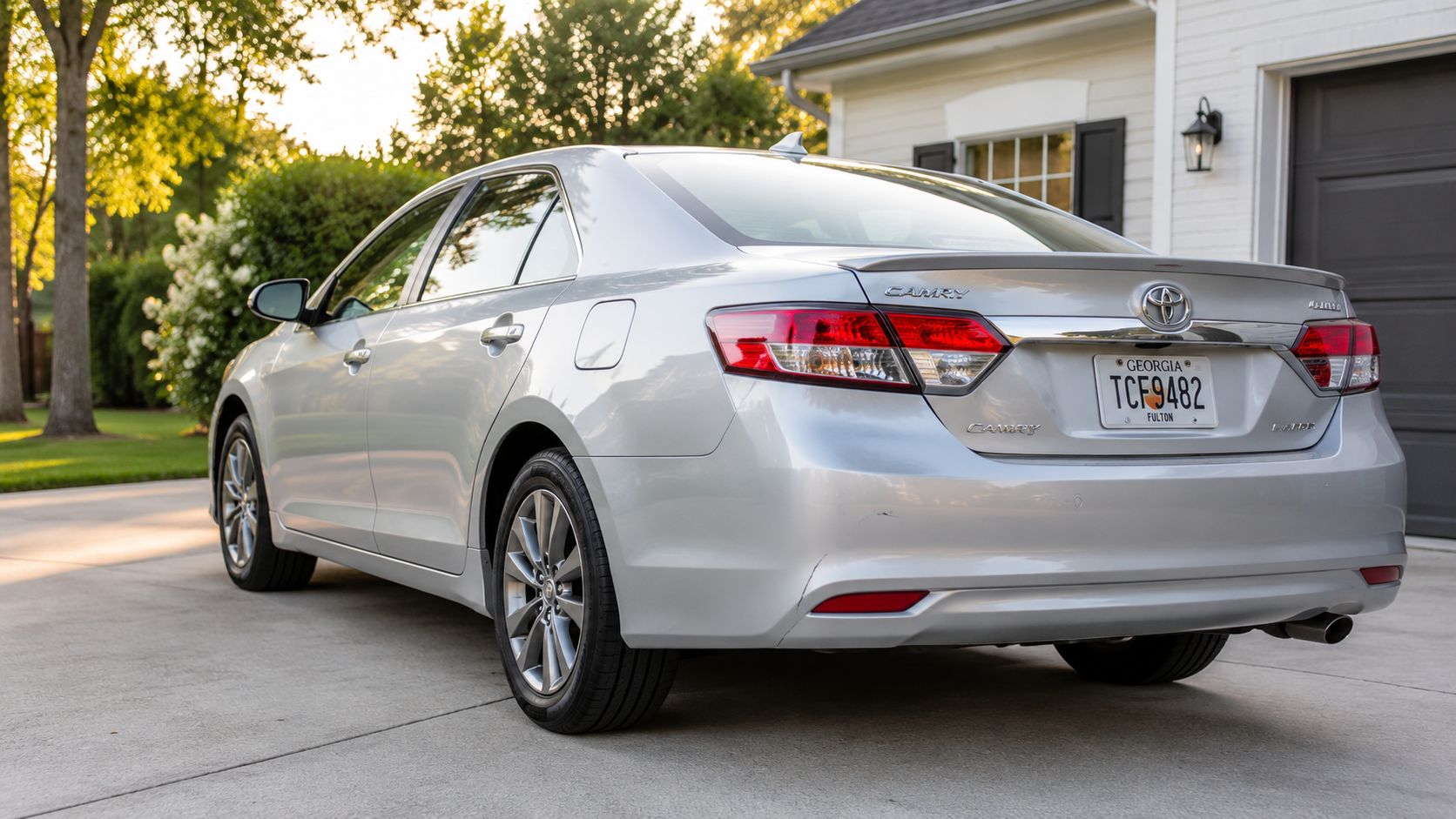
A repaired bumper is not the point. A repaired structural hit, a panel replacement, or even a careful cosmetic repair can still leave the car with market stigma. Georgia diminished value appraisal Georgia claims live or die on pre-crash market value versus post-repair market value, not on the repair bill by itself, and the strongest files prove both values with local comparable sales, repair documentation, and condition evidence (Georgia diminished value claim guidance).
The insurer's question is rarely, “Was it repaired?” The more important question is, “What does the market now pay for it?”
That is the question that decides payout quality. If you talk only about repair quality, the carrier drags the claim into a body-shop debate. If you tie the loss to the specific damage type, the repair work, and how buyers in your area react to that history, you are arguing the actual loss, which is diminished market value.
Clean, late-model, and higher-end vehicles usually get hit the hardest. A dealer may say the car looks great, then still reduce the offer because the history report changed how they can resell it. High-value, collector, and custom vehicles take the worst beating from formula-based estimates, because buyers in those segments pay closer attention to prior damage, originality, and matching parts. A strong file has to show what the market would pay for that exact car, not what a generic calculator thinks a repaired sedan should be worth. If you want a quick benchmark before you start that fight, use this Georgia diminished value calculator as a starting point, then build from there with real market evidence.
How Georgia Insurers Calculate Diminished Value and Why It Falls Short
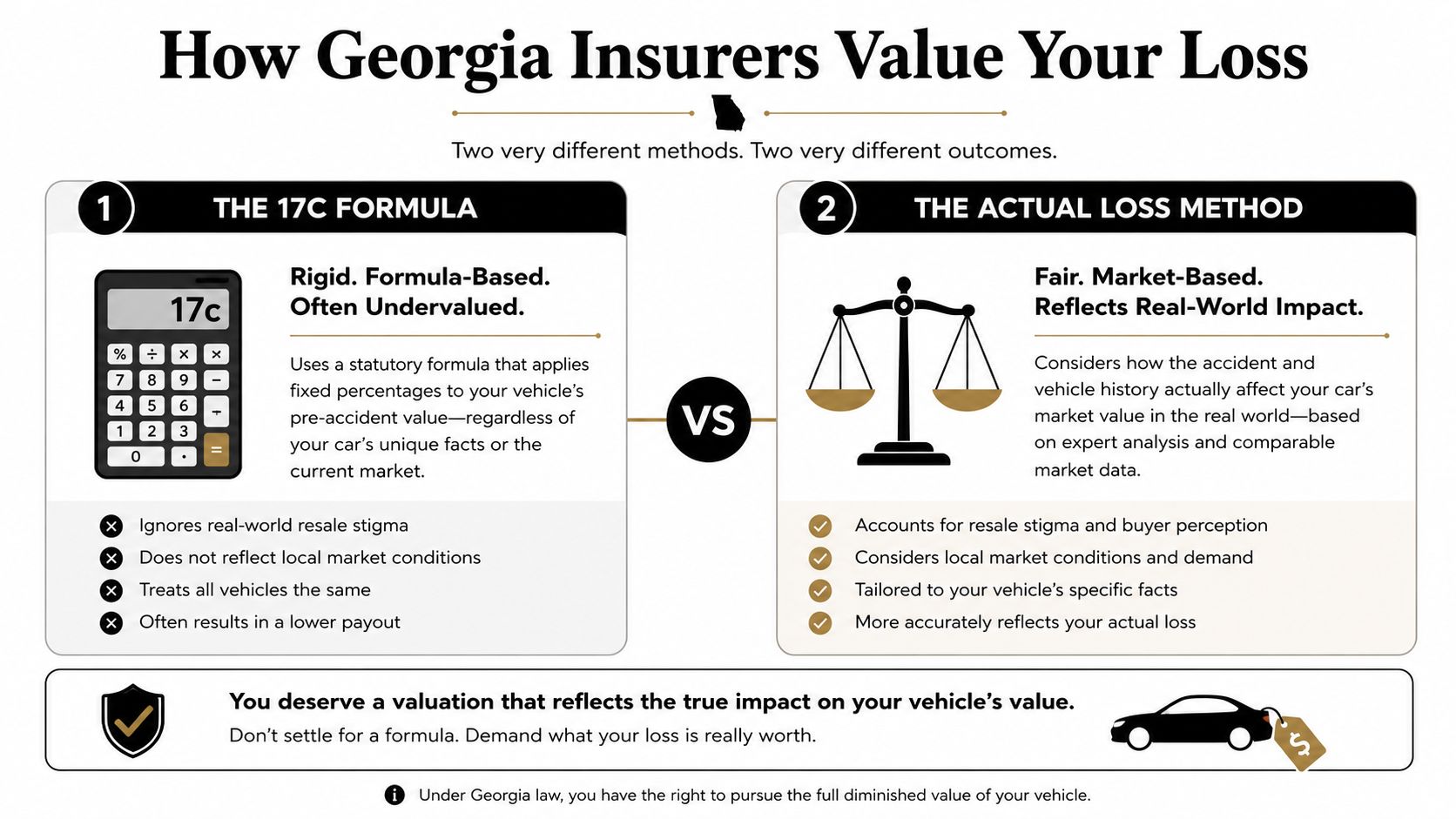
A Georgia adjuster usually opens with the 17c method. It is a formula, not a market analysis. The carrier starts with the vehicle's pre-accident retail value, caps the starting loss at 10%, then applies severity and mileage multipliers to estimate diminished value (17c method overview). That process keeps the insurer's number controlled before any real negotiation begins.
Why the formula underpays
The flaw is simple. A formula cannot see what a buyer sees. High-mileage cars take a harder hit under the mileage multiplier, while structurally damaged vehicles can still end up with a number that fails to capture how much the market distrusts repaired sheet metal, frame work, or airbag deployment.
The formula becomes a ceiling in disguise. It treats every car as if the same math should control the outcome, even when the market behaves differently for luxury, rare, or specialty vehicles. In those segments, buyers react more sharply to accident history, so the loss can be more significant than the insurer's calculator suggests.
The better method is market comparison
A defensible appraisal does the opposite. It compares real vehicles in the local market, supports pre-loss value with comparable sales, then measures the post-repair value against the same market behavior. Independent appraisals are strongest when they tie the loss to repair documentation, condition evidence, and the exact damage pattern on your vehicle.
That matters even more for high-value, collector, and custom vehicles. Generic formulas flatten out the details that drive price, such as originality, rarity, matching parts, and how a buyer will judge the history report. If you want a practical benchmark before you argue with the carrier, use this Georgia diminished value calculator to test whether the first offer is even in the right range.
Here's the core difference: The insurer wants a formula that compresses the claim. You want an appraisal that shows how buyers price the car. That gap is where payout quality gets decided.
Watch this comparison carefully, because it shows why the carrier's first number is usually a starting point, not a fair valuation.
Building an Evidence Package That Insurers Cannot Easily Dismiss
An adjuster will not pay top dollar for a thin file. Send in a demand package with no market support, and the insurer will default to the 17c formula and treat your claim like a negotiation over scraps.
What the file needs
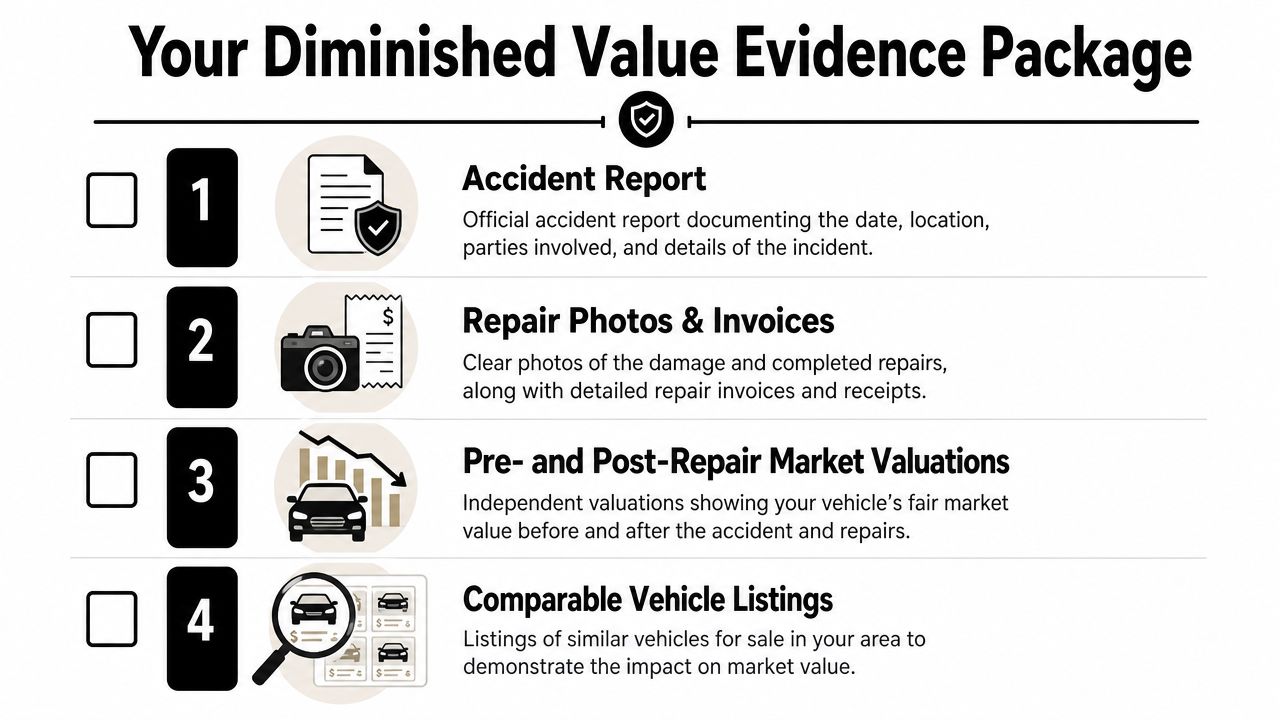
Start with the accident paperwork, then build the file around it. Include the repair invoices, photos, the shop's work order, and the vehicle history report that shows the recorded loss. Add valuation support that speaks to the market, not a tidy online estimate that falls apart when challenged.
Practical rule: If the adjuster can attack one missing document and collapse the claim, the package is not ready.
The strongest independent appraisals do more than name a number. They explain why the number makes sense. That means local comparable sales, a clear before-and-after condition narrative, and documentation of the specific damage and repair quality. Those pieces make the claim harder to dismiss because they tie the loss to real buyer behavior, not abstract math. For a practical visual reference, use this A checklist for a diminished value evidence package containing an accident report, repair invoices, market valuations, and comparable listings.
What insurers usually challenge
Insurers usually go straight after prior damage, mileage, age, and whether the repairs were complete. They also try to shrink the whole claim into repair cost, which is the wrong lens. If they do not see a market-based explanation for the loss, they will label your demand as inflated.
That is why the report has to read like something a buyer, dealer, or opposing appraiser could verify. Keep it specific, grounded in the local market, and tied to the exact vehicle, not a generic template.
What Actually Determines Your Payout in Georgia
Most guides talk about forms and demand letters. That's not what determines the check. The payout quality comes down to how the car looked before the crash, what kind of damage it took, how well it was repaired, and how the market judges that history.
The factors that move the number
Georgia guidance repeatedly points to vehicle age, mileage, accident severity, prior damage history, repair quality, and vehicle segment as key decision drivers. The common 10-25% rule of thumb floats around online, but it isn't tied to actual settlement data and can overstate expectations for older, higher-mileage, or heavily repaired vehicles (Georgia claim outcome gap and rule-of-thumb caution).
That matters a lot if you own a high-value, collector, or custom vehicle. Those cars can be hit harder by buyer sensitivity, but they also demand a cleaner, more detailed appraisal file. The market reacts differently to a standard commuter car than to a rare trim, a modified build, or a specialty model with limited supply.
Here's the blunt version. If your vehicle already had wear, prior repairs, or high mileage, the carrier will lean on those facts to push the number down. If the damage was structural, the carrier knows the stigma is stronger, but it still may not volunteer a fair number without a real market comparison.
| Factor | Impact on Payout | Why It Matters |
|---|---|---|
| Vehicle age | Usually lowers leverage on the claim | Older vehicles often face tougher resale resistance and weaker appraisal support |
| Mileage | Can reduce the insurer's number sharply | High-mileage cars are easier for carriers to discount under formula methods |
| Accident severity | Can increase the claim value when damage was serious | Buyers care more when the damage pattern suggests structural or major repair work |
| Prior damage history | Often cuts payout quality | Earlier damage gives the carrier another reason to argue the loss is overstated |
| Repair quality | Can either support or weaken the claim | Clean repairs help, but poor repairs can create additional value loss |
| Vehicle segment | Can raise buyer sensitivity in certain cases | Luxury, collector, and specialty buyers react more strongly to accident history |
The lesson is straightforward. Stop arguing from a rule of thumb and start arguing from the car's actual market position.
When to Invoke the Appraisal Clause Instead of Negotiating
Some claims die in endless back-and-forth because the carrier keeps repeating its first number. That's usually the point where the appraisal clause becomes the better weapon. It forces the dispute into a process that's built around valuation, not adjuster preference.
Why it works better than more emails
A demand letter is only as useful as the carrier's willingness to engage. If they respond with the 17c formula and ignore your comparables, you're not negotiating on equal ground. The appraisal clause removes that dynamic and pushes the file toward an independent valuation process instead of another round of lowball correspondence (appraisal clause overview).
That's especially useful when the insurer is treating the claim like an internal pricing exercise. In practice, drivers often get steered into valuation disputes instead of a real market review, which is exactly why an independent appraisal can change the balance of power.
Where edge cases matter
The hard questions are the ones people ask after the repair check clears. Does diminished value survive if the vehicle is close to total loss, or totaled? How does uninsured or underinsured motorist coverage affect recovery? When is appraisal better than litigation?
Those questions matter because the recovery path can change depending on the claim posture and coverage layer (Georgia recovery edge cases and claim posture). If the vehicle is borderline total loss, you need to think about valuation first. If the claim is already stuck on value and the insurer refuses to engage with market evidence, appraisal usually beats waiting on a lawsuit.
If the carrier won't discuss comparable sales, the appraisal clause is often the cleanest way to force a real valuation fight.
Use the clause when the insurer won't leave the formula behind. Use it when delay is the tactic. Use it when your file is strong enough that a neutral valuation process gives you a better shot than another round of arguing with the adjuster.
Your Step-by-Step Negotiation and Escalation Playbook
Start with a demand that sounds like a market file, not a plea. State the pre-crash value, the post-repair value, and the basis for the loss. The point is to make the carrier answer your evidence instead of your emotion.
The sequence that works
Send the demand with market support. Anchor it to comparable vehicles, repair documentation, and the recorded accident history. If you want a useful benchmark for your own review, the Georgia diminished value claim guide is a solid reference point for structuring the file.
Force a response to the comparables. If the adjuster only cites the 17c formula, push back. Ask them to explain why their number better reflects the local market than your appraisal.
Escalate when they avoid the evidence. If they dispute your appraisal without producing their own market-supported analysis, that's not a real rebuttal. It's a delay tactic.
Invoke appraisal when the file stalls. Use it when the carrier's offer is fixed, the numbers don't track the market, or the claim has gone nowhere for too long.
Reserve litigation for stubborn cases. Lawsuit is the last lever, not the first. It's slower and heavier, so use it when the carrier refuses to move even after the appraisal process or a strong documented demand.
A direct demand line helps. Use wording like this, and keep it factual, not dramatic: “I am submitting a diminished value claim based on the difference between the vehicle's pre-loss market value and its post-repair market value, supported by local comparable sales and the attached independent appraisal.”
That sentence does the job because it frames the dispute around market evidence. It also tells the insurer you're not accepting a repair-cost shortcut.
Answers to the Questions Georgia Drivers Actually Ask
If you were partially at fault, you may still have a claim, but your recovery can be reduced under Georgia's comparative negligence rules. If you're close to a total-loss situation, the valuation fight gets more important, not less. The claim posture changes, but the market loss issue doesn't disappear.
Georgia property damage claims generally have a four-year statute of limitations, which gives you time, but not a reason to wait. Evidence gets weaker as time passes, especially photos, repair notes, and comparable listings. The cleanest file is usually the one built soon after repairs are done.
A diminished value claim can affect your premiums differently depending on whose policy you're using and how the claim is handled, but the key point is simple. A third-party diminished value claim is about recovering loss from the at-fault driver, not filing a self-inflicted complaint against your own car. If the at-fault carrier has low limits, the issue becomes coverage pressure, not whether the loss exists.
If the vehicle is leased, ownership matters. The party with the ownership interest is the one who can usually pursue the value loss. If the insurer tries to wave you off because the car was repaired well, that's not a valid answer. Repaired and restored are not the same thing in the used-car market.
If you're staring at a low offer and you know the car is worth more than the insurer says, get the claim documented the right way. Total Loss Northwest helps vehicle owners challenge biased valuation methods with independent appraisal work that focuses on real market value, not insurer shortcuts. Reach out if you want a sharper read on your numbers and a stronger path to the settlement you are owed.