Ever been in an accident that wasn't your fault? You get your car fixed, it looks great, but you’re left with a nagging feeling. You’re right to feel that way. A diminished value auto claim is how you recover the financial hit your car takes after a crash, even if the repairs are perfect. It’s the gap between what your car was worth moments before the accident and its new, lower value now that it has a collision on its record.
What Is Diminished Value and Why Does It Matter?
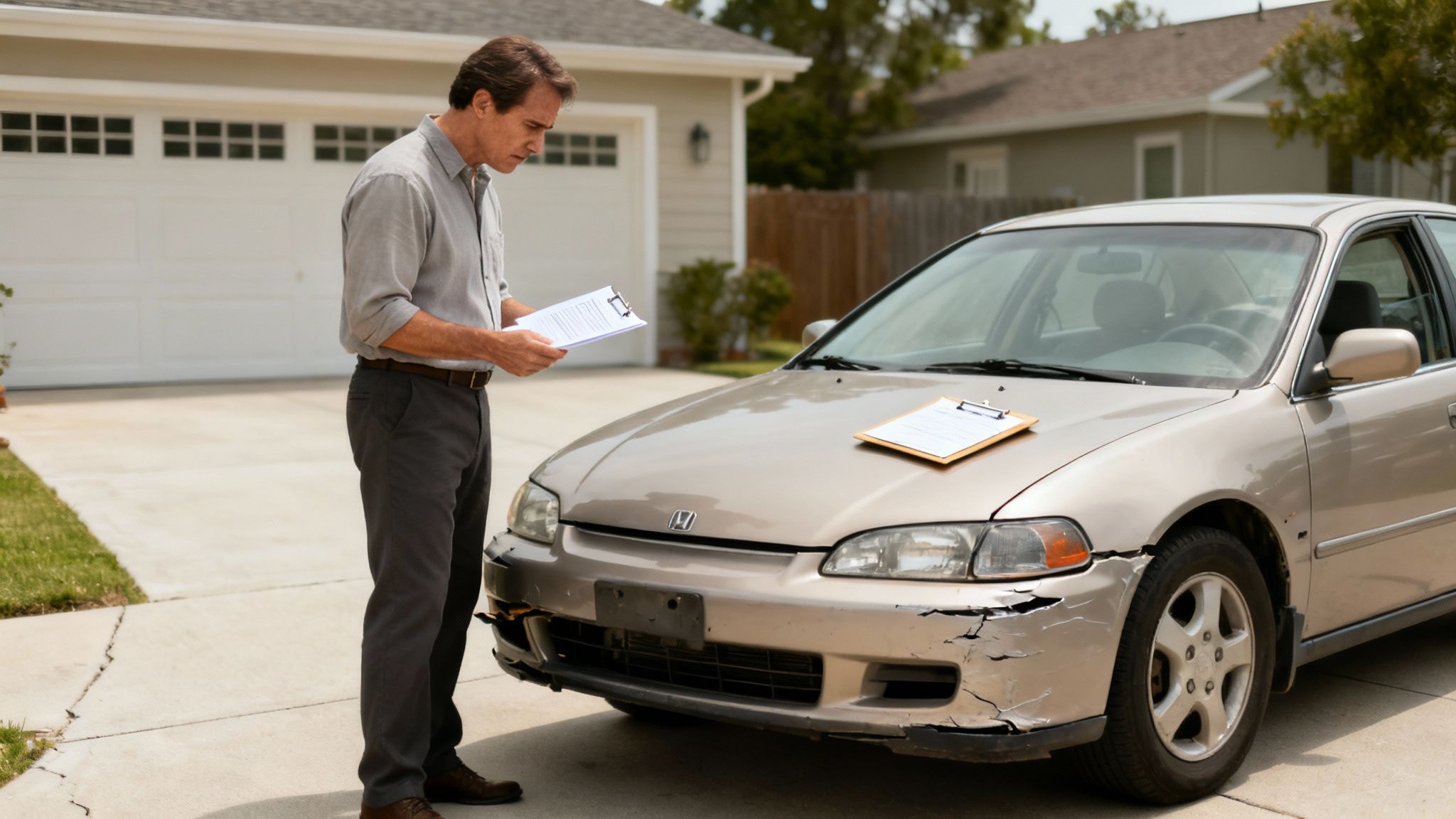
Think of it like this: Imagine you're selling two identical used cars. One has a clean history, and the other was in an accident but has been beautifully repaired. Which one do you think a buyer would pay more for? The one with no accident history, of course. That difference in price is its diminished value.
Once an accident is reported, it leaves a permanent mark on your vehicle's history report. Even the best body shop in the world can't erase that history. Down the road, when you go to sell or trade in your car, that accident record will cause buyers and dealers to lowball their offers. This isn't just a possibility; it's a certainty. The good news is, if another driver was at fault, you are legally entitled to be compensated for this very real, measurable loss.
The Three Faces of Value Loss
To really get a handle on this, it helps to see that "diminished value" isn't just one thing. It actually comes in three distinct forms, though only one is typically recoverable in a standard claim.
I've put together a quick table to break down these concepts. It's a simple way to see the differences at a glance.
The Three Types of Diminished Value at a Glance
| Type of Diminished Value | What It Means | When It Occurs |
|---|---|---|
| Immediate | The instant drop in value before any repairs are done. | Immediately after the accident. |
| Repair-Related | The loss in value due to shoddy or incomplete repair work. | After repairs, if they are of poor quality. |
| Inherent | The automatic loss in value simply because the car now has an accident history, even with perfect repairs. | After high-quality repairs are complete. |
The key takeaway here is that Inherent Diminished Value is the one that sticks around no matter what. It's the focus of nearly every claim because it's the damage that can't be fixed with a wrench or a paint gun.
Key Takeaway: Inherent Diminished Value is the financial "stigma" that attaches to a vehicle after an accident. It's the market's reaction to an accident history, and it's the loss you have the right to recover from the at-fault party's insurance.
The Real-World Financial Impact
So, what does this look like in dollars and cents? It's a bigger deal than most people think.
Let's say your perfectly repaired Honda Civic is ready to be traded in. The dealer pulls the Carfax report, sees the rear-end collision, and immediately knocks 30% off the trade-in offer. This happens every single day. According to industry experts like Kelley Blue Book, a reported accident can slash a vehicle's value by 10-30% on average, and in severe cases, that loss can shoot up to 50%.
This is why fighting for what you're owed is so critical. The at-fault driver's insurance company is legally obligated to make you "whole" again. That doesn't just mean paying the body shop; it means compensating you for the permanent drop in your car's market value. If you don't file a claim, you're essentially letting someone else’s mistake cost you thousands of dollars out of your own pocket. For more details on your local rights, check out our guide on diminished value laws in Oregon and Washington.
Why Certain Cars Lose More Value Than Others
It’s a hard truth: not every car takes the same financial hit after a wreck. The amount of value your vehicle loses is a unique recipe of different factors. You could have two cars in nearly identical accidents, yet the drop in their resale value could be thousands of dollars apart.
Getting a handle on these key ingredients is the first real step in figuring out what your diminished value auto claim could be worth. It’s not just about the crash itself. It’s about your car’s reputation and place in the market long before the accident ever happened.
Brand Reputation and Vehicle Type
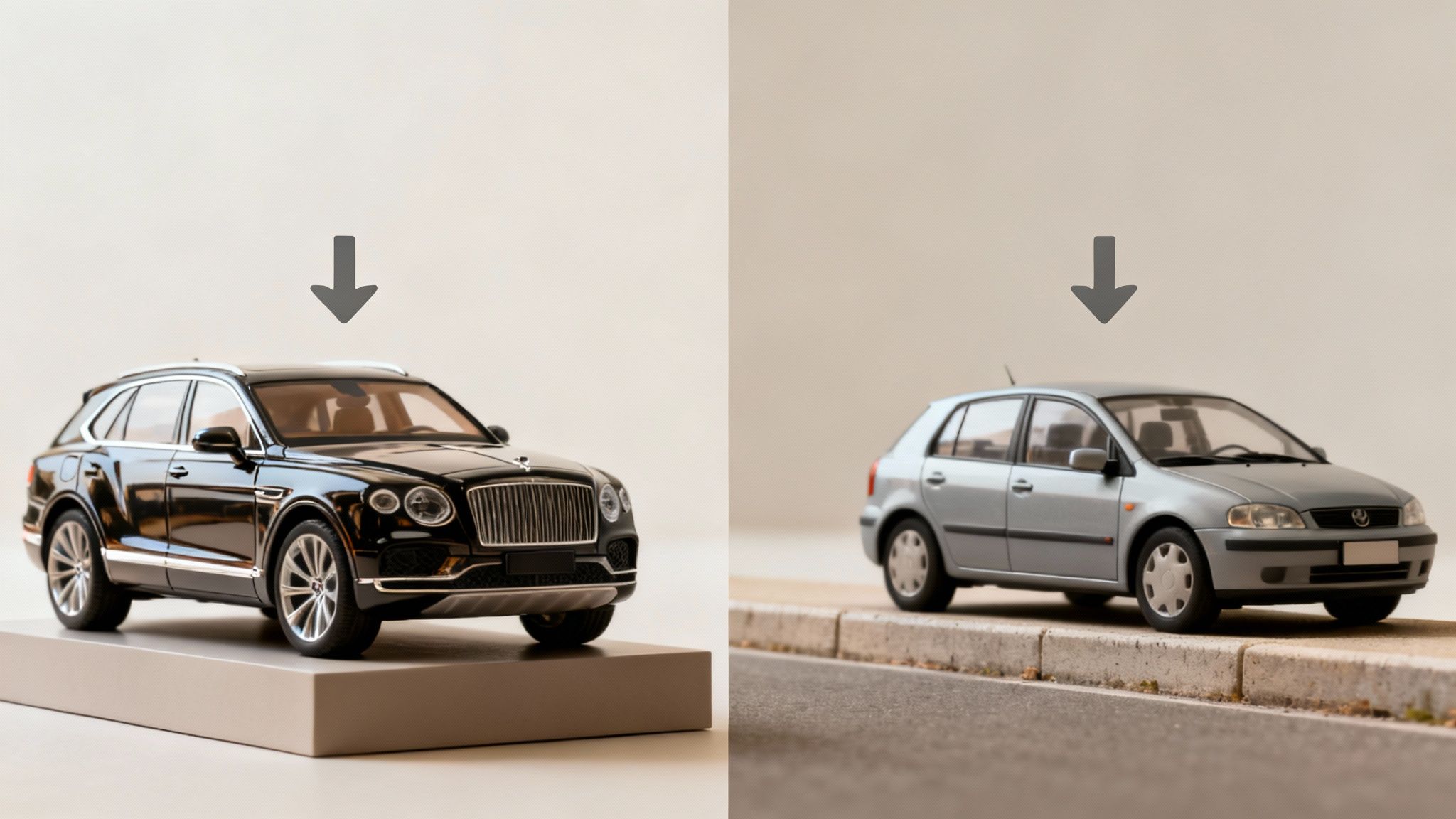
More often than not, the biggest factor is the badge on the grille. Luxury and high-performance cars are bought for their prestige, their precision engineering, and their flawless condition. An accident completely shatters that perfect image, causing a much steeper nosedive in value than you'd see with a standard daily driver.
Think about the difference between a high-end SUV and a simple economy sedan. A luxury car buyer is paying a premium for a clean history. They're far less likely to touch a vehicle with a collision record, forcing the seller to slash the price. A common commuter car, on the other hand, is valued more for its utility. It will lose value, sure, but not nearly as much.
A real-world example paints a clear picture. Say you’re driving your immaculate BMW 5 Series, worth a solid $35,000, when a not-at-fault collision damages the front end. Industry data shows BMW owners can expect a 25-35% diminished value hit from a minor accident. For a major one? A staggering 40-50%. A reliable Toyota in the same scenario might only lose 10-15%.
For drivers here in Oregon and Washington, this can be a tough pill to swallow. If your $40,000 Mercedes suffers a 50-55% loss after major repairs, you’re looking at a $20,000+ hole in your pocket. In fact, a 2023 analysis showed luxury brands depreciated 2-3 times faster than economy models after an accident. You can find more details about how specific brands are affected on AppraisalEngine.com.
Pre-Accident Condition and Mileage
Your car’s story before the crash plays a massive role. A vehicle with low mileage, a stack of service records, and a perfect exterior has so much more value to lose. Its pristine pre-accident condition sets a very high bar, making the post-accident drop that much more dramatic.
The condition and upkeep of a vehicle directly influence its market value. Things like Paint Protection Film vs Ceramic Coating are good examples of how owners invest in maintaining that value. Conversely, a car with high mileage and a few dings and scratches already has a lower starting value, so the diminished value impact won't be as severe.
Key Insight: The better a car’s condition was before the accident, the more significant its diminished value will be. A pristine vehicle has a reputation to lose, and that reputation has a high price tag.
The Severity and Nature of the Damage
Finally, the damage itself is a critical piece of the puzzle. The car-buying public reacts very differently to certain types of repairs, and that perception is what drives your car’s new, lower value.
There's a world of difference between a cosmetic touch-up and a structural repair. A potential buyer might not bat an eye at a replaced bumper cover, but they'll get very nervous when they learn the vehicle’s frame had to be straightened on a machine.
Here’s a quick breakdown of how damage severity impacts your claim:
- Cosmetic Damage: This includes scratches, minor dents, and bumper scuffs. These issues result in the lowest amount of diminished value because they're seen as superficial.
- Panel Replacement: When you have to replace entire doors, fenders, or hoods, you’re looking at a moderate loss in value. This tells buyers the impact was more significant, raising red flags about paint matching and panel gaps.
- Structural or Frame Damage: This is the big one. Any damage to the vehicle's underlying frame or unibody structure is the kiss of death for resale value, causing the highest diminished value. It creates a permanent stigma that scares away buyers and brings perceived safety into question.
Understanding these variables is everything. Your claim isn't just some random number an adjuster comes up with. It's a direct reflection of how the market will judge your specific car, with its unique history and the specific damage it now carries.
How Insurance Companies Calculate Diminished Value
So, you've filed a diminished value claim. What happens next? The insurance adjuster doesn't just pick a number out of a hat. They turn to a very specific, in-house calculation called Formula 17c.
While it might sound official, you need to know this formula was created by the insurance industry for the insurance industry. Its primary purpose is to produce the lowest possible payout, not to fairly compensate you for your car's actual loss in value. Think of it as their opening offer in a negotiation—and a lowball one at that.
Breaking Down the Formula 17c Calculation
On the surface, Formula 17c looks simple. It’s a three-step process designed to systematically shrink your payout.
It all starts with your car's value and then gets whittled down by a couple of arbitrary multipliers.
- Start with a 10% Cap: The formula immediately caps the potential diminished value at 10% of your car's pre-accident value. Right off the bat, if your car was worth $40,000, their calculation starts at just $4,000, no matter how bad the damage was.
- Apply a "Damage Multiplier": Next, they apply a subjective multiplier based on the severity of the damage. This is a judgment call that almost always works in their favor.
- Apply a "Mileage Multiplier": Finally, they hit the number with another multiplier for your car's mileage, reducing the payout even further.
The problem is this rigid, cookie-cutter approach. It treats every car as just a number, completely ignoring what makes your vehicle unique and what it’s actually worth in the real world.
The Problem with a One-Size-Fits-All Formula
Formula 17c is completely disconnected from market reality. It fails to answer the single most important question: "What would a real buyer in Oregon or Washington pay for this exact car now that it has a wreck on its record?"
Instead, it just plugs numbers into a self-serving equation. Here’s what this flawed formula misses:
- Local Market Conditions: The market for a Subaru in Portland is very different from the market for a pickup truck in Eastern Washington. Formula 17c doesn't know or care about these local dynamics.
- Unique Vehicle Features: Did you have a rare trim package, sought-after color, or tasteful modifications? The formula completely ignores these value-adding features.
- True Market Stigma: A number on a worksheet can’t capture the real-world stigma of structural or frame damage. That kind of history can make a vehicle incredibly difficult to sell to an informed buyer for a fair price.
Key Insight: Formula 17c is an internal insurance tool built to minimize claims. It is not a true or fair measure of your vehicle’s lost market value. You should always view it as just the starting point for negotiations.
A Real-World Example of Formula 17c in Action
Let's put this into perspective. As explained on sites like KBB.com, the formula uses damage multipliers ranging from 0.00 (cosmetic) to 1.00 (severe structural) and mileage factors that penalize you for every mile on the odometer.
Imagine your car was worth $30,000 before the accident.
- The 10% cap immediately reduces the starting point to $3,000.
- The adjuster applies a 0.50 "moderate damage" multiplier: $3,000 x 0.50 = $1,500.
- Then they apply a 0.80 mileage multiplier: $1,500 x 0.80 = $1,200.
Suddenly, your car's significant loss in value is reduced to a meager $1,200 offer. It's no surprise that not-at-fault drivers leave billions on the table every year by accepting these initial offers without question.
This is precisely why a professional, independent appraisal is your best tool. It throws out their self-serving formula and replaces it with a detailed, evidence-backed report that reflects your vehicle's genuine loss in your specific market.
The table below highlights just how different these two approaches are.
Formula 17c vs. Independent Appraisal
| Valuation Factor | Formula 17c Approach | Independent Appraisal Approach |
|---|---|---|
| Starting Point | Arbitrary 10% cap on pre-accident value. | The vehicle's full, pre-accident fair market value. |
| Damage Severity | Subjective multiplier (0.00-1.00) set by the insurer. | Detailed analysis of repair quality, parts used, and type of damage (e.g., structural vs. cosmetic). |
| Mileage | A generic, punitive multiplier that reduces value. | Considered as one factor among many, including condition and maintenance history. |
| Market Factors | Completely ignored. | In-depth analysis of local market demand, comparable sales, and buyer perception in your area. |
| Vehicle Uniqueness | Ignored. Trim, color, and options don't matter. | Specific features, packages, and condition are key components of the final valuation. |
| Final Output | A low, formula-driven number. | A comprehensive, evidence-based report reflecting true market loss. |
As you can see, one method is designed to protect the insurer's bottom line, while the other is designed to determine the facts.
You can get a rough idea of what a market-based calculation looks like by using our free diminished value claim calculator. It's a great first step toward understanding what your claim is really worth.
A Step-By-Step Guide to Filing Your Claim
Knowing your car has lost value is one thing, but actually getting that money back from the insurance company is a whole different ballgame. It can feel intimidating, for sure. But when you break it down into a few clear steps, it’s a process you can absolutely handle.
Think of it like you're building a small case. You’re the one who has suffered a loss, the other driver's insurance company is on the other side, and the quality of your evidence will determine whether you win. Trying to rush this is the quickest way to get your claim denied or be handed a ridiculously low offer.
Step 1: Confirm You Have a Case and Gather Your Paperwork
First things first, let's make sure you're eligible. In states like Oregon and Washington, the rule is simple: the accident can't be your fault. A diminished value claim is what’s called a third-party claim, meaning you’re going after the insurance company of the driver who hit you.
Once you know you have a valid claim, it's time to switch into document-gathering mode. The more proof you have, the stronger your argument becomes.
Start pulling these items together:
- The Police Report: This is your official proof of who was at fault. It’s non-negotiable.
- Repair Invoices: I mean everything from the body shop. Get the first estimate and the final, itemized bill showing every part and every hour of labor.
- Proof of Pre-Accident Value: This could be the bill of sale from when you bought the car, a full stack of maintenance records, or even a pre-accident appraisal if you happen to have one.
- Photos and Videos: Dig up every photo you took at the scene and get some good shots of the finished repairs.
This stack of paperwork is the foundation of your entire claim. Without it, you’re just asking for money. With it, you’re presenting a fact-based case they can't easily ignore.
Step 2: Get an Independent Appraisal
This is, without a doubt, the most critical step you will take. Letting the insurance company tell you what your car's value has dropped is like letting a fox count the chickens. You absolutely need an unbiased, expert opinion from a certified appraiser who is working for you.
A true professional doesn't just plug numbers into a generic formula. They do a deep dive, looking at:
- Your car’s specific make, model, year, and trim level.
- Its condition, mileage, and options before the crash.
- The seriousness of the damage and what kind of repairs were done.
- Real, up-to-the-minute market data from your specific area, whether that's Portland, Seattle, or somewhere in between.
What you get back is a detailed, comprehensive report that gives a credible, defensible dollar amount for your car's lost value. This report is your silver bullet—it becomes the centerpiece of your demand. If you're wondering where to find a pro, you can learn more about finding a diminished value appraisal near you right here.
Step 3: Send a Formal Demand Letter
Now that you're armed with your appraisal report, it’s time to make your official move. You’ll send a formal demand letter to the insurance adjuster handling the claim for the at-fault driver. This isn't just a quick email; it's a professional document that lays out your case.
Your letter needs to include:
- Your name, contact info, and the claim number.
- A clear statement that you are making a claim for your vehicle's inherent diminished value.
- A quick recap of the accident that confirms their driver was at fault.
- The specific amount of money you are demanding, which should be the exact figure from your appraisal report.
- Attach a full copy of the appraisal and all the supporting documents you gathered back in Step 1.
Pro Tip: Keep the tone of your letter firm but professional. State the facts, show your evidence, and make your demand crystal clear. This isn't the time for emotion—stick to the financial loss.
Step 4: Negotiate and Use the Appraisal Clause
Don't be surprised or discouraged when the insurance adjuster comes back with a lowball offer, or just pushes back on your demand. This is completely normal. It's just page one of their negotiation playbook. Your job is to stand your ground, using your independent appraisal as your shield and sword.
If the adjuster refuses to be reasonable or flat-out rejects your appraisal, you have a powerful tool in your back pocket: the Appraisal Clause. This is a section written into most auto insurance policies that creates a process for settling disagreements over value.
The infographic below shows the kind of oversimplified formula insurers love to use—starting with a base value and just chipping away at it.
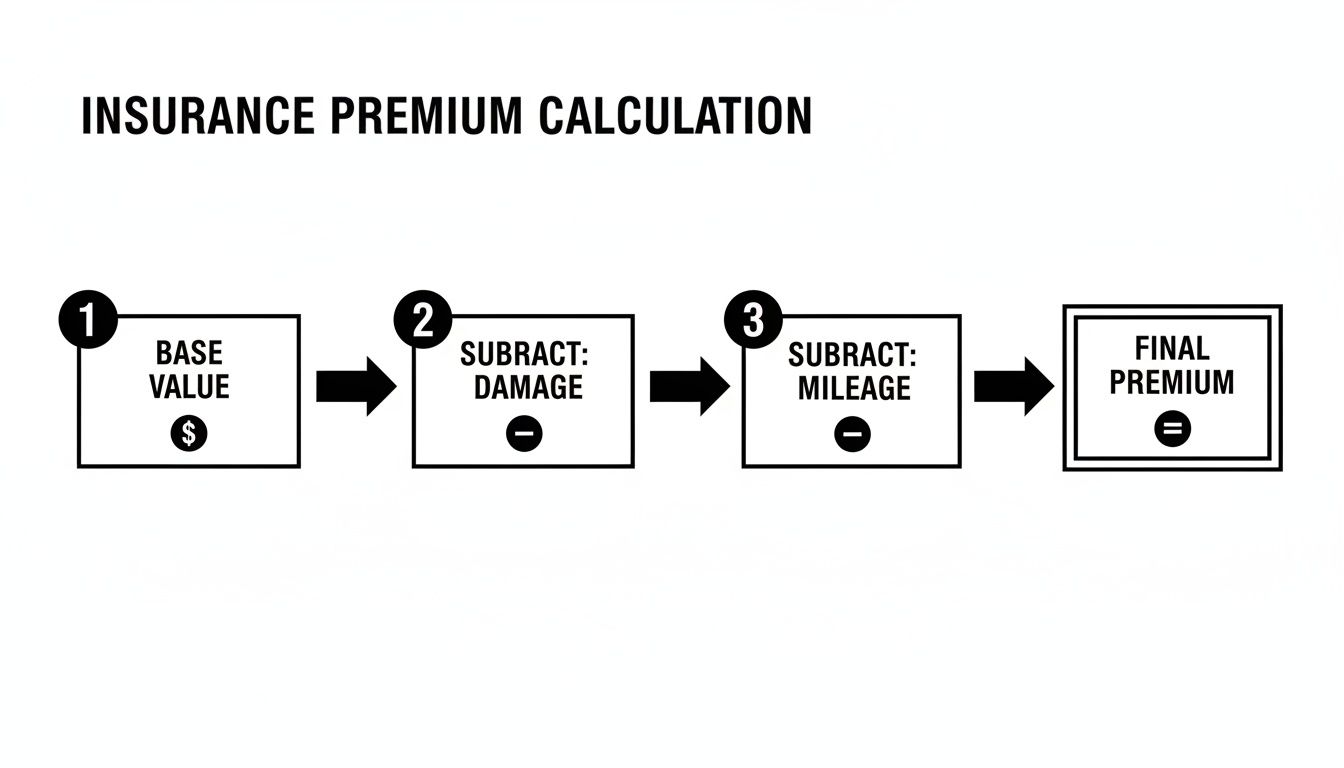
This kind of simplistic math is exactly what the Appraisal Clause is designed to fight.
Here’s the breakdown: You hire your appraiser, the insurance company hires theirs, and those two appraisers have to agree on a neutral third appraiser to act as an "umpire." A final value agreed upon by any two of those three people becomes legally binding. It’s a brilliant way to take the insurer's biased methods out of the picture and force a fair outcome based on the real market.
Common Mistakes That Can Sink Your Claim
Knowing what to do in a diminished value claim is only half the battle. Just as important is knowing what not to do. I’ve seen countless drivers with strong, valid claims walk away with pennies on the dollar—or nothing at all—because of a few common but devastating missteps.
Think of it this way: insurance companies have a playbook designed to trip you up. They know these common mistakes and count on you making them. Being aware of these traps is your best defense. Let’s walk through the biggest claim-killers so you can steer clear of them.
Cashing That Check Too Quickly
This is one of the most final and heartbreaking mistakes you can make. The insurance company sends you a check for your vehicle's repairs, and you cash it, relieved to be moving on. The problem? Buried in the fine print on the check or in the letter that came with it is a sneaky little clause.
That clause often states that by cashing the check, you agree it's a "full and final settlement" of all claims from the accident. That includes your diminished value auto claim. Once that check is deposited, you've legally slammed the door shut on any future compensation. The insurer will simply say, "You already agreed our payment was enough. Case closed."
Crucial Warning: Before you even think about cashing a property damage check from the other driver's insurance, get it in writing that doing so does not waive your right to a future diminished value claim. Always, always read the fine print.
Accepting the Insurer's First Offer
Let's be clear: an insurance adjuster's first offer is almost never their best one. Their job is to settle claims for the lowest amount possible, so they start with a lowball figure to see if you'll take the bait and go away quietly.
They’ll often present a number—usually cooked up with a flawed method like Formula 17c—and act like it’s a final, take-it-or-leave-it deal. It isn't. An insurer might offer $1,500 on a vehicle that an independent appraisal shows has lost $6,000 in value. If you don't challenge their figure, you're leaving thousands on the table.
Missing Your State's Deadline
Every state gives you a limited window of time to file a lawsuit for property damage, known as the statute of limitations. If you miss this deadline, your claim is dead on arrival. It doesn't matter how much evidence you have; the court will refuse to hear your case.
- In Oregon: The clock is ticking for six years from the date of the accident.
- In Washington: You have a much shorter window—just three years from the date of the accident.
While that might seem like a lot of time, life gets busy. Waiting until the last minute not only risks missing the deadline entirely but also weakens your negotiating power and makes it tougher to collect all the proof you need.
Relying on the Insurer's Appraiser
This is a classic "fox guarding the henhouse" scenario. Trusting the insurance company's hand-picked appraiser to calculate your loss is a huge mistake. That appraiser is paid by the insurance company, and you can bet their assessment is going to protect their employer's bottom line. It’s a massive conflict of interest.
Without your own independent appraisal from a certified expert who works for you, you have no counter-argument. You're stuck in a debate where the other side gets to define all the terms. A professional, unbiased report grounded in real-world market data is the only tool that levels the playing field and forces the insurer to negotiate based on facts, not fiction.
Your Diminished Value Questions, Answered
Even with a roadmap in hand, it’s normal to have some questions pop up. The whole world of diminished value auto claims can feel a bit murky at first, but once you grasp the core ideas, it all starts to click. This section is all about giving you quick, straight-to-the-point answers to the questions we hear every single day from drivers in Oregon and Washington.
Think of this as your final gut check before you decide to move forward. We’ll cover the big ones: are you even eligible, what’s this going to cost, and what happens when the insurance company inevitably tries to shut you down?
Do I Have a Valid Claim in Oregon or Washington?
In a word: yes. As long as you weren't the one who caused the accident, you absolutely have the right to pursue a diminished value claim. Both Oregon and Washington operate under third-party liability laws, which is just a formal way of saying you can legally go after the at-fault driver's insurance company to make you whole again. That includes recovering the money your car lost in value.
Of course, a successful claim needs a solid foundation. It really boils down to two things:
- Proving Fault: It must be crystal clear that the other driver was to blame. This is exactly why a police report is your best friend.
- Proving the Loss: You have to prove that your vehicle is now worth less specifically because it has an accident on its record, even if the repairs were perfect.
Just remember, you generally can't file a diminished value claim against your own policy if you were the one at fault. This is strictly for not-at-fault drivers.
How Much Does a Professional Appraisal Cost?
It’s best to think of a professional appraisal as an investment in your claim, not just another bill to pay. It’s the expert evidence you need to go toe-to-toe with the insurance company and their predictable lowball offer. Without a certified report from an independent expert, you’re basically walking into a negotiation armed with nothing but your own opinion.
A high-quality appraisal is packed with detailed market analysis, data on what similar cars are selling for, and an undeniable valuation that stands up to scrutiny. While it does have an upfront cost, the return is often thousands of dollars more in your pocket—making it one of the smartest financial moves you can make after a crash.
Getting an appraisal sends a clear message to the insurer: you're serious, you've done your homework, and you have the proof to back up every dollar you’re asking for.
What if the Insurance Company Rejects My Report?
First off, don't panic. An initial rejection is one of the oldest tricks in the insurance adjuster’s playbook. They do this all the time. It’s a calculated move to make you feel defeated and hope you’ll just give up and go away. I can’t stress this enough: this is not the end of the road.
When the insurer disputes your independent appraisal, you have a secret weapon built right into their own contract: the "Appraisal Clause." This clause is a mandatory dispute resolution process.
Invoking it means you and the insurance company each hire an independent appraiser. Those two appraisers then agree on a third, neutral appraiser (called an umpire) to act as a tie-breaker. A final value agreed upon by any two of those three people becomes legally binding. This completely takes the insurance company’s biased formulas out of the picture and forces an outcome based on the real-world market.
Is It Worth Filing a Claim for an Older Car?
That’s a great question, and the honest answer is, "it depends." It’s true that the biggest diminished value checks are usually cut for newer, low-mileage, or high-end vehicles. But that doesn’t mean an older car can’t have a very real, and very worthwhile, claim—especially if the damage was pretty bad.
The deciding factor isn't just the car's age; it's whether a potential buyer would now pay a lot less for it simply because it has a documented accident history.
Here’s a simple way to look at it:
- A few minor scratches on an older car with a ton of miles? The drop in value might be too small to make a claim practical.
- Major structural work or replacing multiple body panels on that exact same car? You’re almost certainly looking at a measurable loss in value that’s worth recovering.
The only way to know for sure is to talk to an expert. A professional appraiser can dig into your car's pre-accident value, the extent of the damage, and the specific market demand to tell you if a claim makes financial sense. For many well-kept older cars, the answer is a resounding "yes."
At Total Loss Northwest, we provide the certified, independent appraisals you need to fight back against the insurance company's lowball offers. We know their game, and we know how to win. We invoke the Appraisal Clause on your behalf, forcing a settlement based on real market data, not their self-serving formulas. Don't leave your money on the table. Learn more and start your free claim review today.