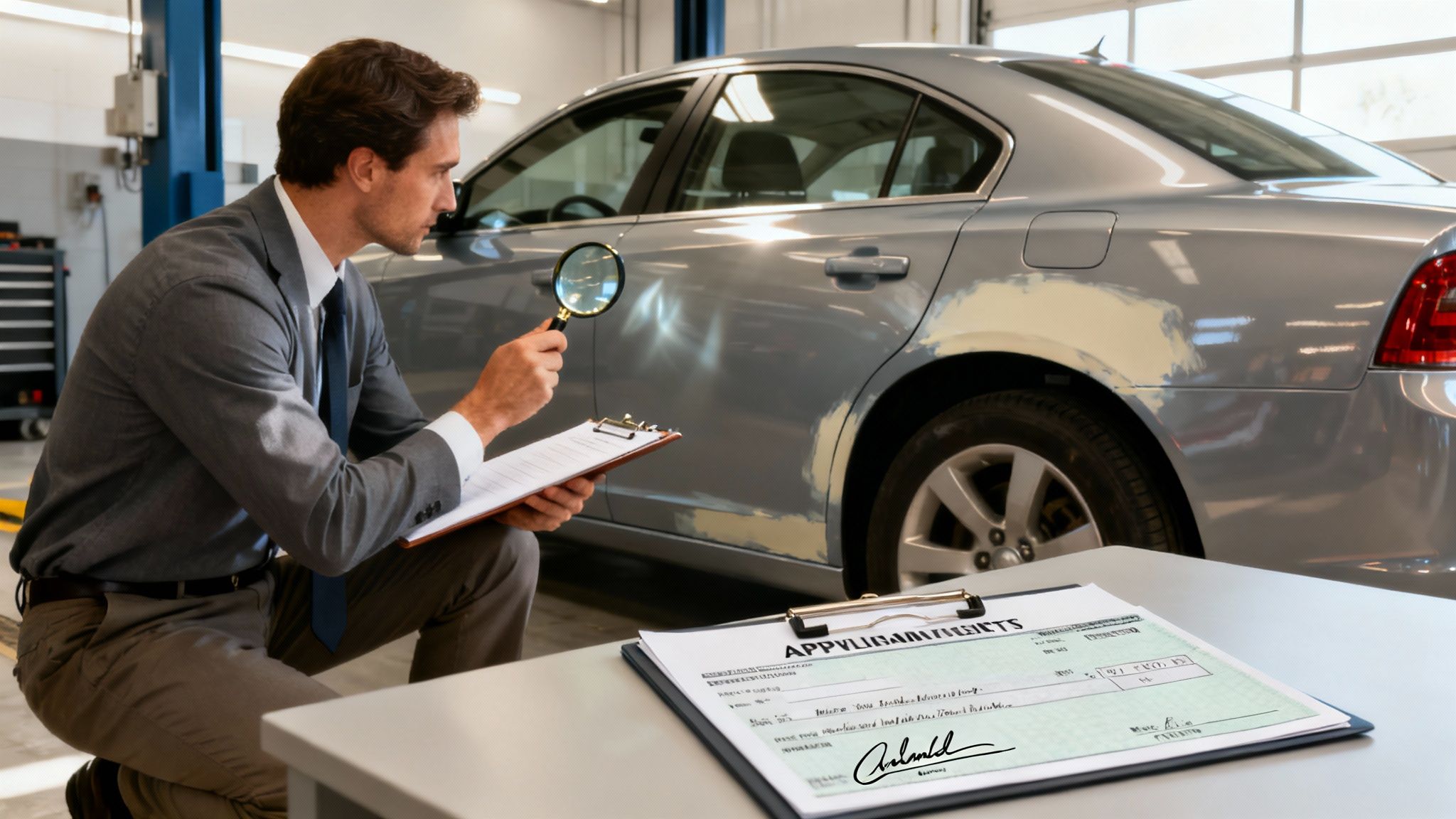
A diminished value appraisal is a professional report that pinpoints the exact dollar amount your car has lost in resale value because of an accident. Think of it as your most crucial piece of evidence. This independent report proves the inherent diminished value—the permanent financial hit your vehicle takes simply for having an accident on its record, no matter how perfect the repairs were.
What Exactly Is a Diminished Value Claim?
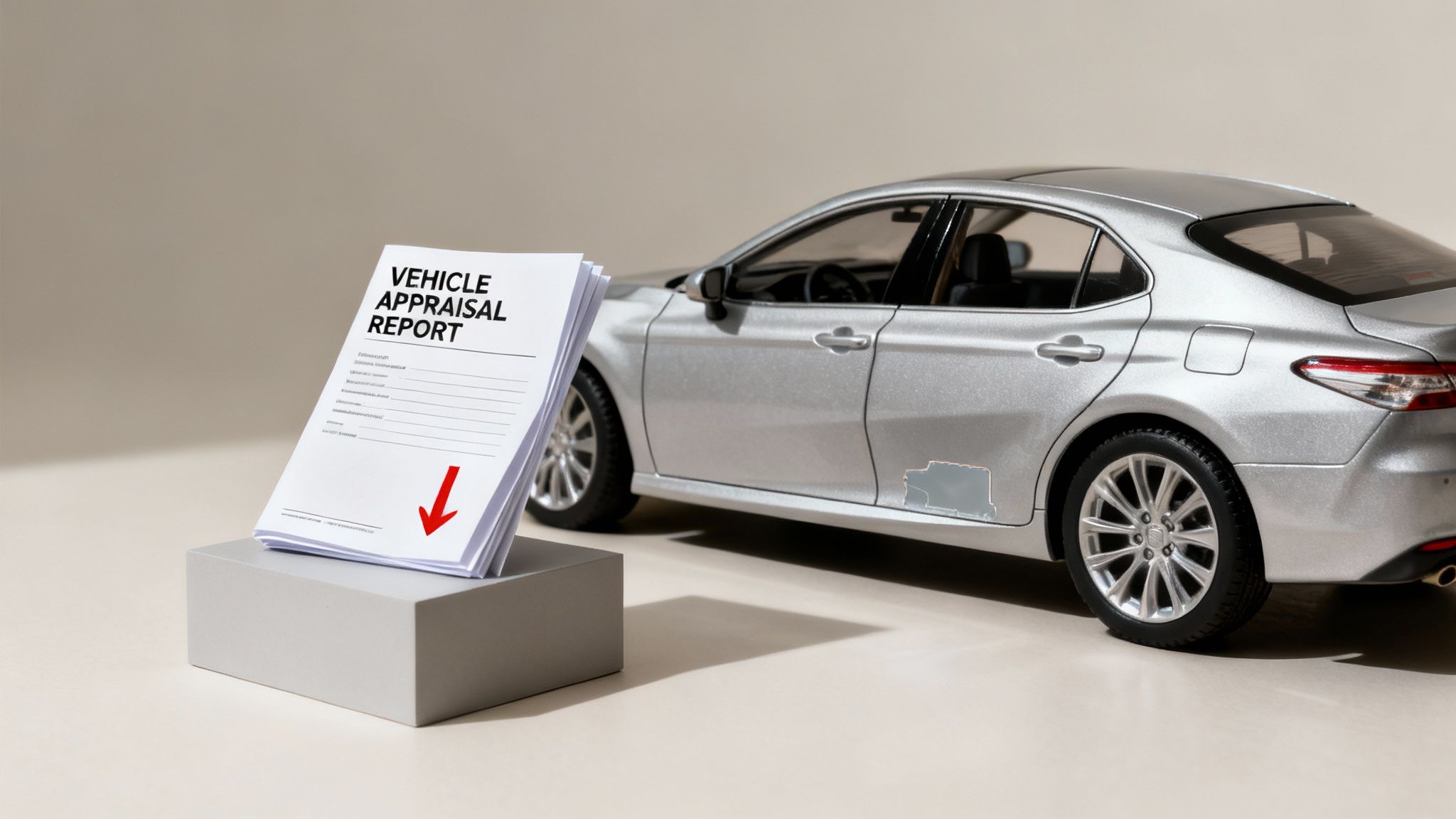
Here's a real-world scenario I see all the time. Picture two identical used cars side-by-side on a lot. One has a squeaky-clean vehicle history report. The other was in a pretty serious wreck but was repaired by a top-notch body shop. Which one are you buying? Even if you can't see a single flaw on the repaired car, any informed buyer will pay significantly less for it once they see the accident history.
That price gap? That's its diminished value.
When another driver caused the accident, the law says you're entitled to be "made whole." This principle goes beyond just fixing the dents and scratches. It means you must be compensated for this very real, very tangible loss in your car's market value. The at-fault driver's insurance company is on the hook for paying you that difference.
Understanding the Types of Diminished Value
It's really important to know the lingo because when you file a claim, you're targeting one specific type of loss. Here's a quick breakdown of what you'll encounter.
| Type of Diminished Value | What It Means | When It Applies |
|---|---|---|
| Inherent Diminished Value | The automatic, unavoidable loss in value simply because the vehicle now has an accident history. | This is the basis for virtually all third-party claims. It assumes repairs are done perfectly. |
| Repair-Related Diminished Value | Extra value loss from shoddy workmanship, like mismatched paint, poor panel gaps, or using cheap aftermarket parts. | This is usually a dispute you'd take up with the body shop that did the work, not the insurance company. |
| Immediate Diminished Value | The value difference right after the crash but before any repairs have been made. | This is a temporary, in-between state and is not what you file a claim for. |
Essentially, the entire focus of your claim will be on that first one: inherent diminished value.
Key Takeaway: Your entire argument boils down to this: even with flawless, factory-quality repairs, the market itself will penalize your vehicle's value because of its newly stained history.
Diminished value claims aren't some obscure legal trick; they're a recognized financial reality for millions of drivers across the country. Legally supported in 49 states, the average claim is around $1,500, but I've seen payouts soar past $15,000 for luxury or high-end vehicles. You can find more data on this from the National Association of Insurance Commissioners.
Unfortunately, you can't expect the insurance company to just hand you a fair check. They often lean on flawed internal formulas—the most infamous being the "17c formula"—to spit out insultingly low offers. This method uses arbitrary caps and weird modifiers that have zero basis in how the real used car market works. It’s a tool built to save them money, not to make you whole.
This is precisely why getting your own professional diminished value claim appraisal is the only way to level the playing field and fight for the compensation you actually deserve.
Why You Need an Independent Appraisal
Let's be blunt: letting the at-fault driver's insurance company calculate your car's diminished value is like asking a fox to guard the henhouse. Their job is to protect their company’s bottom line, which means paying out as little as possible. That’s a massive conflict of interest, and it’s why their first offer will almost certainly be a lowball.
It’s not that insurance adjusters are bad people. They're just players in a game designed to minimize costs. They often lean on internal software or generic, one-size-fits-all formulas to spit out a number. These tools are deliberately simplistic and fail to account for the real-world factors that actually determine your car's value, like your local market and the specific details of your vehicle.
The Problem with Their Math
The insurer's calculation isn't based on what a real person would pay for your car now. It's an internal number-crunching exercise designed to produce the smallest payout. They might use a flawed formula like 17a or apply arbitrary caps and percentages that have nothing to do with how an informed buyer in your area views a car with an accident history.
This completely misses the entire point of diminished value. The whole idea is to figure out how much less a buyer would pay for your car versus an identical one with a clean history. An insurer's cookie-cutter formula simply can't capture that real-world financial hit.
Key Takeaway: An insurance company's diminished value offer isn't a fair assessment of your loss. It's a negotiation tactic, and it's always weighted in their favor.
If you accept their first offer, you're almost guaranteed to be leaving money on the table—often thousands of dollars. They are counting on you to not know any better or to decide it's not worth the fight.
Your Expert on Your Side
This is exactly where a certified, independent appraiser becomes your greatest asset. Unlike the insurance adjuster, an independent auto appraiser near me works for you, and only you. Their sole focus is to determine the true, unbiased drop in your car's market value using hard evidence and professional experience.
A real appraiser throws those generic formulas in the trash. Instead, they dig in and perform a detailed analysis, which typically includes:
- Real-World Comps: They hunt down actual, local examples of cars just like yours—some with clean histories, some without—to establish a clear and undeniable value gap.
- Deep Market Research: They look at auction data, dealer sales trends, and private listings to see exactly how your local market penalizes vehicles with a history of damage.
- Thorough Inspection: They review the quality of the repairs and the severity of the damage, using the final repair invoice as a guide.
All of this gets compiled into a detailed, evidence-backed report. This isn't just a "second opinion"; it's a professional valuation that systematically picks apart the insurer's lowball number with facts.
Suddenly, your claim is no longer your opinion versus theirs. You're now armed with verifiable proof of your financial loss, which completely changes the dynamic and forces the insurance company to take your claim seriously.
Getting and Submitting Your Appraisal
When it comes to a diminished value claim, timing is critical. The sweet spot for taking action is right after your vehicle’s repairs are done but before you accept and cash that final property damage settlement check. Cashing that check is often seen as a final agreement, and it can slam the door shut on getting any more money for your car's lost value.
The first real move is to hire a qualified, independent appraiser who knows this niche inside and out. It’s crucial that you don’t just accept a recommendation from the insurance company—that’s a massive conflict of interest. Your goal is to find a certified professional who specializes in diminished value appraisals and has a proven history of creating reports that stand up to the toughest scrutiny from insurers.
A great appraiser isn't just a "car person"; they're a market data expert.
Finding the Right Professional
When you're interviewing potential appraisers, you need to dig into their process. Ask them directly how they calculate diminished value. Do they use vague formulas, or are they digging into real-world market data and pulling actual comparable sales? A true professional will be completely open about their methods and should have no problem showing you a sample report. Their job is to build a rock-solid, evidence-based case for the financial loss you've suffered.
Once you’ve found your expert, they’ll need a few key documents from you to get started. Having these ready will speed things up considerably.
- The Final Repair Invoice: This is the big one. It spells out exactly what was damaged and how much it cost to fix, serving as the foundation of your claim.
- Pre-Accident Photos: If you have any pictures of your car from before the wreck, they are incredibly helpful for establishing its pristine pre-loss condition.
- Post-Repair Photos: After the body shop is done, take a bunch of clear, well-lit photos. Get shots of the repaired areas from every angle you can think of.
- The Police Report: This provides an unbiased, official account of the accident and helps establish who was at fault.
To make sure you don't miss anything, use this checklist to gather all your materials before moving forward.
Your Diminished Value Claim Checklist
This checklist will help you organize all the necessary documents and actions to ensure your claim is as strong as possible from the very beginning.
| Checklist Item | Purpose | Status |
|---|---|---|
| Obtain Final Repair Invoice | To document the full extent and cost of repairs. | ☐ Complete |
| Gather Pre-Loss Photos | To establish the vehicle's excellent prior condition. | ☐ Complete |
| Take Post-Repair Photos | To show the vehicle's current state post-repair. | ☐ Complete |
| Secure a Copy of the Police Report | To provide an official record of the accident and fault. | ☐ Complete |
| Find a Certified DV Appraiser | To get an expert, evidence-based valuation of your loss. | ☐ Complete |
| Receive Completed Appraisal Report | The core evidence for your demand letter. | ☐ Complete |
Once you've ticked every box, you're ready to make your official demand.
This whole process is about countering the insurance company's lowball offer with undeniable facts.
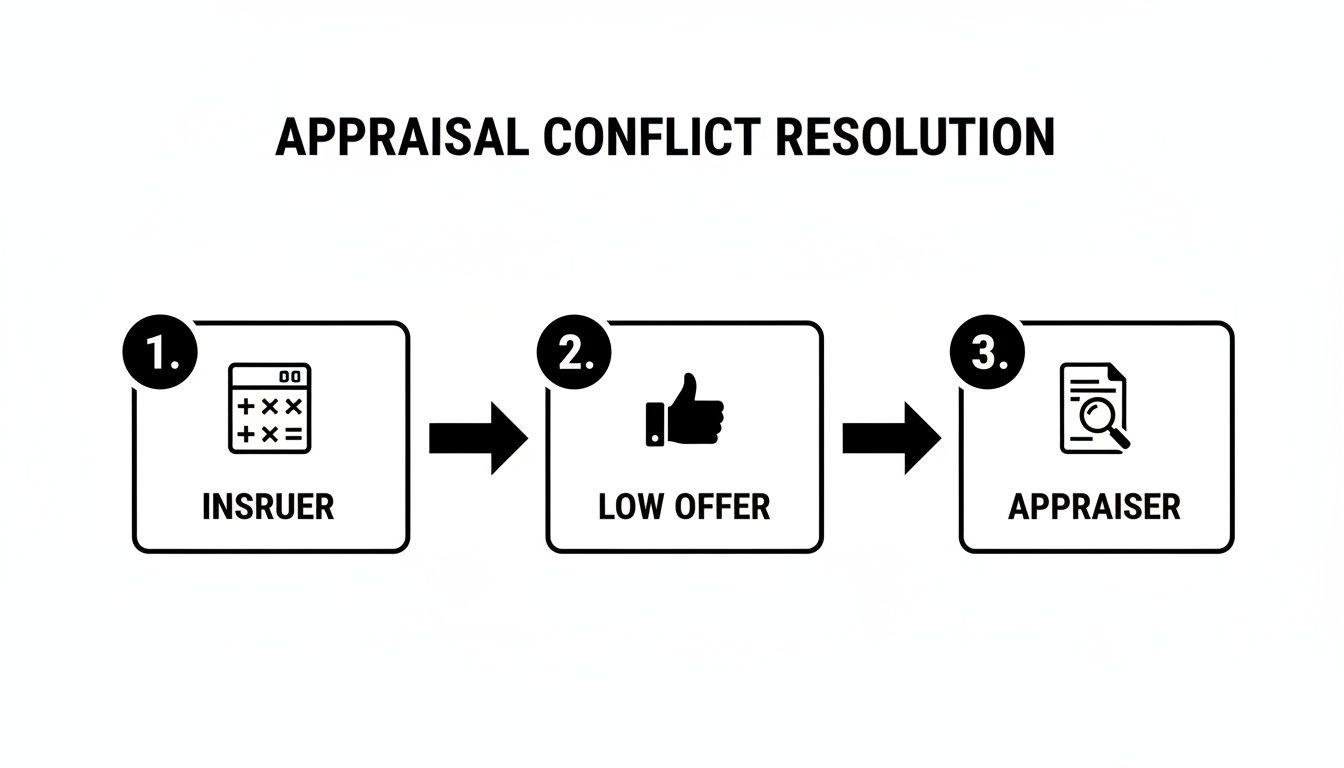
As you can see, the independent appraisal is the pivot point where your claim gains real leverage. It replaces their algorithm with actual market evidence.
Crafting Your Demand Letter
With your completed appraisal report in hand, it’s time to formally submit your claim to the at-fault driver's insurance adjuster. This is done with a professional demand letter. Think of it less like a simple cover note and more like a formal, non-negotiable declaration of what you're owed.
Keep the letter direct and confident. Clearly state the exact amount of diminished value that your appraiser calculated and make it clear this is the compensation you expect to receive. Don’t forget to attach a full copy of the detailed appraisal report, which is the evidence backing up your number.
Pro Tip: Always send your demand letter and the appraisal report via certified mail with a return receipt. This creates a legal paper trail and gives you undeniable proof that the insurance company received your documents. It completely removes the "we never got it" excuse from their playbook.
Now, the real negotiation starts. The adjuster will likely push back, question the report, or throw a low counteroffer your way. This is where you stand your ground. Use the specific facts and data points from your appraisal to defend your position. Keep all communication professional, but firm.
Remember, you aren't asking for a handout. You are demanding fair and just compensation for a very real financial loss you were forced to take on because of their insured's negligence.
Using the Appraisal Clause to Your Advantage
So you've done everything by the book. You secured a professional diminished value appraisal, sent a firm demand letter, and laid out a bulletproof case. And what does the insurance adjuster do? They hit you back with a laughably low offer, or worse, deny the claim entirely.
I see this all the time. It’s a standard play from their book, but it's certainly not the end of the game.
This is precisely when you need to pull out a powerful tool hidden in the fine print of most auto policies: the Appraisal Clause. It’s your trump card, and when you play it, you force the insurance company into a binding resolution that yanks the final decision right out of their adjuster's hands.
So, How Does This Actually Work?
The process itself is surprisingly straightforward, but it completely changes the dynamic. When you invoke the appraisal clause, both you and the insurance company have to hire your own independent, unbiased appraiser. It's their job to assess the evidence and agree on the proper amount of diminished value.
Now, what if they can't agree? That's where the tie-breaker comes in. The two appraisers select a neutral third party, called an umpire. A final, binding decision is reached as soon as any two of them—your appraiser, their appraiser, or the umpire—come to an agreement on the value. That number becomes the final settlement.
The real beauty of this is that the insurance adjuster, who is paid to save the company money, is completely removed from the equation. The outcome is determined by independent experts relying on market data and facts, not an internal script designed to lowball you.
The power shifts back to you almost immediately. For a closer look at the nuts and bolts, our guide on the insurance appraisal clause breaks down exactly how to put this strategy into action.
Why This Is Such a Game-Changer
Invoking the appraisal clause is more than just a negotiation tactic; it’s a proven system for getting to the real, fair value of your claim. The gap between what an insurer first offers and what an appraisal panel awards can be absolutely massive.
Don't just take my word for it. Research on appraisal clause results shows just how far off these initial offers can be. One study found that insurers' pre-appraisal offers lowballed the true claim amount by an average of $5,312.46 per vehicle.
On average, those first offers were off by almost 46%, and the final awards were often more than double what the insurance company wanted to pay. You can see more of the data on these appraisal clause outcomes on Repairer Driven News.
Here’s a real-world example I see happen all the time:
- An insurer offers $1,500 for diminished value on a newer SUV, claiming it’s what their "formula" calculated.
- The owner, holding an independent appraisal for $5,000, rejects the offer and invokes the appraisal clause.
- The two appraisers can't agree, so they bring in an umpire.
- After reviewing all the evidence, the owner's appraiser and the umpire agree the true diminished value is $4,800.
That $4,800 is now legally binding. The insurance company has no choice but to write the check. This process turns a frustrating, one-sided negotiation into a structured, evidence-based resolution where your claim is judged on its actual merit.
Costly Mistakes to Avoid During Your Claim
When you're trying to recover your car's lost value, a few wrong moves can cost you thousands. I've seen it happen time and time again. The single biggest, and most tempting, mistake is cashing that first property damage check the insurance company sends you.
Don't do it. Cashing that check can be legally interpreted as your acceptance of a final settlement. If that happens, the door to your diminished value claim might just slam shut for good.
Another common misstep is giving a recorded statement to the at-fault driver's insurance adjuster without thinking it through. It sounds harmless, but adjusters are skilled at asking questions designed to undermine your claim down the road. You can politely decline until you've spoken with an expert or feel ready to stick to only the basic, undisputed facts of the accident.
Trusting the Wrong People
It's easy to fall into the trap of accepting the insurance company's "helpful" recommendation for an appraiser. This is a massive conflict of interest. The appraisers they use often have deep ties to the insurance industry, and you can bet their assessment won't be in your favor. You need to hire your own independent, certified appraiser who has one priority: you.
Along those same lines, you should never treat the insurer’s initial offer as a fair valuation. Think of it as what it really is: a starting point for negotiations. Their number comes from internal formulas that are all about protecting their profits, not making you whole.
Key Takeaway: The insurance company is not your friend in this process. Their primary goal is to settle your claim for the absolute minimum. You have to build your own case with independent, solid evidence.
Missing Critical Deadlines
Finally, you absolutely must know your state’s statute of limitations for property damage claims. This isn't a soft suggestion; it's a hard legal deadline. Miss it by a single day, and you lose your right to file a claim forever, no matter how strong your case is.
These deadlines vary wildly from one state to another, sometimes giving you just a year or two from the date of the accident. Imagine you're in a state with a two-year limit and you wait 25 months to file. You've just forfeited any chance of compensation.
To protect your claim and avoid these painful errors, keep these rules of thumb front and center:
- Don't cash the first check until you have it in writing that it doesn't settle the entire claim.
- Politely decline recorded statements until you are 100% prepared.
- Always hire your own appraiser for a truly independent and fair valuation.
- Know your state's deadline and get the ball rolling as soon as your car's repairs are finished.
Steering clear of these blunders is every bit as important as building your case with a professional diminished value claim appraisal.
Common Questions About Diminished Value
Even after you've got a roadmap, it's natural to have a few questions about how this all plays out in the real world. Let's walk through some of the most common ones we get from drivers who are right where you are now.
Can I File a Diminished Value Claim if I Was At Fault?
This is a big one. In almost every case, the answer is no. Diminished value is designed as a third-party claim, which means you can only file against the at-fault driver's insurance company.
Your own collision coverage is there to get your car fixed, not to compensate you for the hit to its resale value. The only real exception is Georgia, where state law sometimes allows for a first-party diminished value claim under very specific conditions. For the rest of us, if you caused the accident, you can't claim diminished value.
What Does a Professional Appraisal Actually Cost?
You can expect a certified, high-quality diminished value claim appraisal to run somewhere between $300 and $700. The final price usually depends on your vehicle's make and model, its pre-accident value, and the details of the damage.
I know, it feels like spending more money after you've already been through so much. But think of it as an investment. That expert report is the most powerful piece of leverage you have. It’s what turns the insurer's lowball offer into a fair settlement that’s often thousands of dollars higher.
A good way to look at it: spending a few hundred dollars on an expert report that proves you’re owed $4,000 is a smart, strategic move. The return on that investment is massive.
Is There a Deadline for Filing My Claim?
Yes, absolutely. This is non-negotiable. Every state has a legal deadline called the statute of limitations for filing property damage claims, and that includes diminished value. These deadlines vary wildly by state, from as short as one year to as long as six years from the date of the accident.
If you miss that deadline, you lose your right to collect anything, no matter how solid your claim is. It’s critical to find out your state’s specific time limit and get the ball rolling as soon as your car is out of the shop. To get a better sense of the end goal, it helps in understanding settlement agreements and how they finalize these kinds of disputes.
At Total Loss Northwest, we build the certified, evidence-based appraisals that force insurance companies to take your claim seriously. Don’t let them keep what you're owed. Our experts can document your vehicle's true loss in value and help you secure the settlement you deserve. Get your claim started today by visiting us at https://totallossnw.com.