Your car is back from the shop. The paint looks good, the panels line up, and the repair invoice says the work is complete. But if you tried to trade it in tomorrow, you already know what would happen. The dealer would see the accident history and offer less.
That drop is real. In Ohio, it can also be recoverable.
Most drivers only hear about repair bills. They don't hear much about the resale loss that remains after the repairs are done. A strong diminished value claim in Ohio is how you put that loss back on the at-fault carrier where it belongs. The key is knowing whether you qualify, how to prove the number, and how to push the claim when the adjuster gives you the usual brush-off.
What Is Diminished Value and Why It Matters in Ohio
Diminished value is the loss in market value a vehicle suffers after a crash, even when the repairs are done properly. The most important form for most claims is inherent diminished value. That's the built-in stigma of an accident history.
A buyer compares two similar vehicles. One has a clean history. The other shows prior collision repairs. Even if both drive well, buyers usually treat them differently. That's why a repaired car can still be worth less.
What buyers care about
People shopping used cars don't just look at shine and tire tread. They look at history reports, prior damage, and whether structural work was done. That's especially true when the vehicle is newer, lower mileage, higher trim, or had major repairs.
In practice, the market doesn't pay "clean car" money for an "accident car." That's the entire point of a diminished value claim.
A repair restores function. It doesn't erase market perception.
Why Ohio drivers should take this seriously
Ohio allows recovery for this kind of property damage in the right circumstances. That matters because insurers often act like repair completion ends the conversation. It doesn't.
If your loss is handled correctly, you're not asking for a bonus. You're asking to be made whole for the difference between what the vehicle was worth before the crash and what the market will pay now that the accident is part of its record.
That difference is where good claims are won or lost. Not on emotion. On proof.
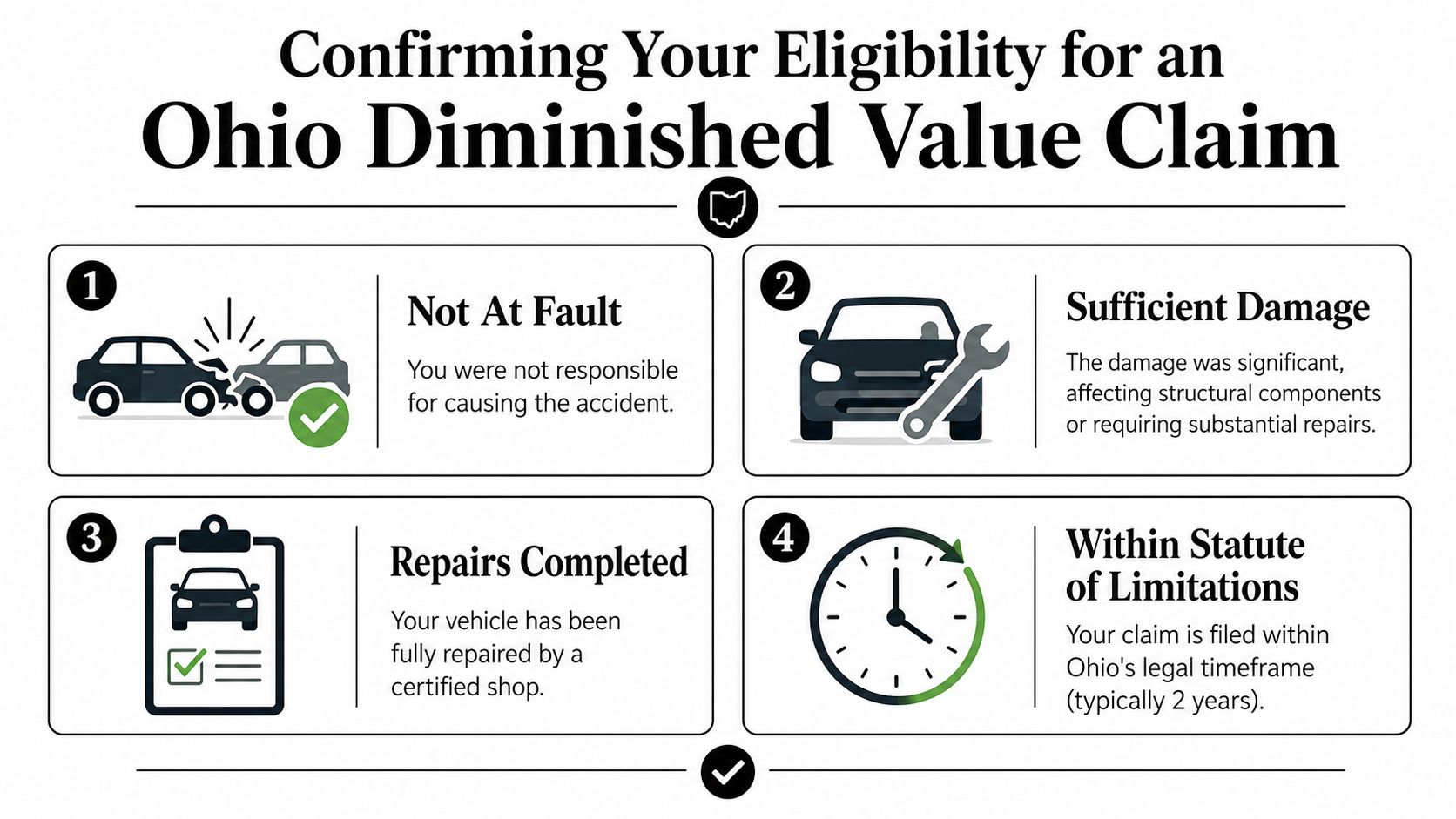
Confirming Your Eligibility for a Claim in Ohio
Start with the part insurers use to stall or shut down the claim. Eligibility. If you confirm the legal and practical basics early, you avoid paying for an appraisal before the carrier is even in a position to evaluate diminished value.
Fault comes first
Ohio follows a modified comparative negligence rule. In plain English, your share of fault matters. If the evidence puts you over the line, the diminished value portion of the property damage claim can fail before anyone debates how much the car lost in the market.
That is why I tell owners to treat liability proof and value proof as two separate jobs. If fault is still disputed, gather the crash report, scene photos, witness information, and repair estimate notes that show point of impact. Adjusters usually will not negotiate diminished value seriously until liability is locked down.
You usually claim against the other driver's insurer
In Ohio, diminished value is usually pursued as a third-party property damage claim against the at-fault driver's carrier. Many policies do not pay first-party diminished value through your own collision coverage. There are occasional exceptions tied to policy language, but they are the exception, not the rule.
This point matters because drivers get bad information all the time. They call their own carrier, hear that collision coverage will pay for repairs but not reduced resale value, and assume the case is over. It often is not. It just means the demand belongs with the liability carrier for the driver who caused the loss.
The filing deadline is real
Ohio Revised Code § 2305.10(A) gives you a two-year window to bring a property damage claim. Diminished value falls into that category. If you let that deadline get close without progress, your negotiating power diminishes quickly.
Do not confuse an open claim number with protection. If negotiations drag on, the calendar still matters. Good practice is simple. Get repairs finished, gather your documents, value the loss, and put the insurer on written notice well before the deadline. If you need a starting point, a diminished value claim calculator can help you estimate whether the claim is large enough to justify a formal appraisal and demand package.
Repairs need to be complete before valuation means much
A credible diminished value opinion depends on the final repair outcome. Before repairs are done, nobody knows the full repair scope, whether structural components were involved, or how the history will read once the work closes out.
I have seen owners rush this step and hurt their own case. They submit a demand based on an early estimate, then the supplement changes the repair total or adds structural work. The adjuster uses the inconsistency to question the whole claim. Wait until the repair file is complete, then build the number once.
A quick screen before you invest more time
Use this checklist:
- Liability supports your position: The evidence shows the other driver caused the crash, or your share of fault stays within Ohio's limit for recovery.
- You are presenting the claim to the right carrier: In most cases, that is the at-fault driver's insurer.
- Repairs are finished: Final invoices, supplements, and parts documentation are available.
- You are still within the statute of limitations: The accident date is comfortably inside Ohio's filing period.
- The vehicle has a plausible market stigma claim: Newer, lower-mileage, premium, or structurally repaired vehicles usually present better than older cars with minor cosmetic work.
Some claims are easier to prove than others
A claim can be valid and still be hard to win. That is an important trade-off. Newer vehicles with clean pre-loss history, lower mileage, and significant repair records usually draw the strongest responses from the market after a crash. Vehicles with frame damage, structural repairs, airbag deployment, or multiple panel replacements also tend to show clearer post-repair stigma.
Older daily drivers can still have diminished value. The difference is proof. On those files, you need tighter comparables, better repair documentation, and a cleaner demand letter because the insurer will argue the loss is minimal or already reflected in age and mileage.
If your file clears these eligibility issues, you are ready to move from "Can I make the claim?" to "How do I prove the number and force a real response?"
How to Calculate Your Vehicle's Lost Value
You pick up your car from the body shop, the paint matches, and it drives straight. Then the insurer offers a token amount for diminished value, or nothing at all, because the vehicle is "fully repaired." That is the point where owners in Ohio lose money unless they can show how the market prices a repaired vehicle with an accident history.
Start with the right question
The question is not, "What formula did the adjuster use?" It is, "What would a willing buyer in Ohio pay for this car now, after this repair history shows up?"
That difference is your target number.
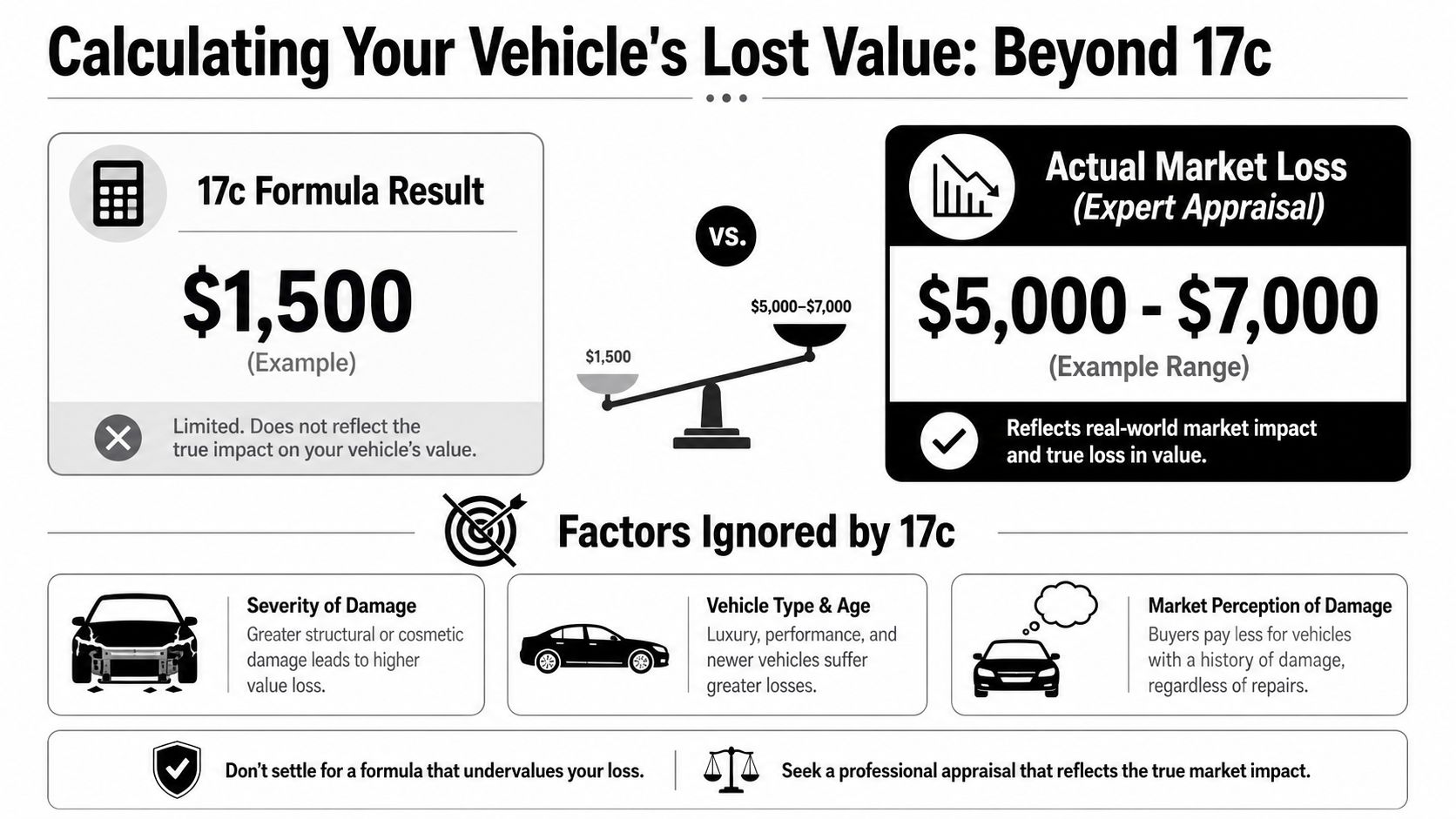
Insurers often start with the 17c formula because it gives them a fast ceiling and a predictable way to reduce the claim. From a carrier's side, that is efficient. From a vehicle owner's side, it often misses the actual market reaction, especially on newer vehicles, luxury models, trucks, and cars with structural repairs or airbag deployment.
Why formula-based numbers come in low
A preset formula does not inspect local buyer behavior. It applies caps and multipliers first, then works backward. In practice, that means the claim can get squeezed before anyone looks at comparable vehicles with similar damage histories.
I see the same problem repeatedly. The adjuster has a number. The file does not have market support.
Here is the practical difference:
| Method | What it uses | Where it falls short |
|---|---|---|
| 17c formula | A capped starting value and damage modifiers | It may ignore what repaired, accident-history vehicles actually sell for in the market |
| Independent appraisal | Comparable sales, vehicle history, repair scope, and condition | It takes more work and better documentation |
How to build a defensible number
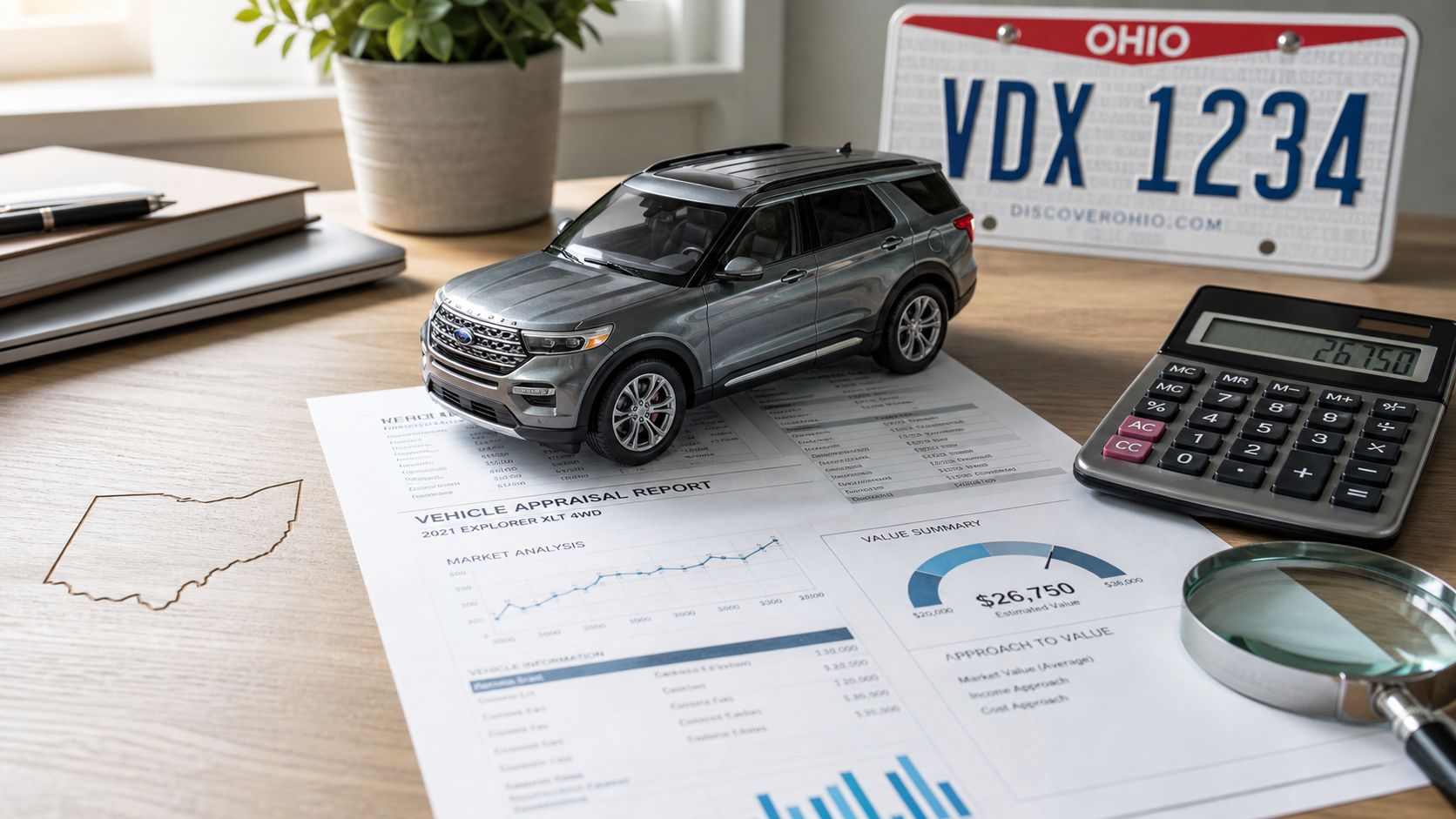
A credible diminished value calculation usually rests on a market comparison. You start with the vehicle's pre-loss market value. Then you compare that clean-history benchmark to the price impact buyers place on the same vehicle after the reported accident and repairs.
A sound appraisal should account for:
- Pre-loss profile: Year, make, model, trim, mileage, options, condition, and prior history
- Repair severity: Cosmetic work versus structural repairs, frame work, restraint system repairs, or major panel replacement
- Parts and methods: OEM versus aftermarket parts, refinishing scope, weld points, calibrations, and supplements
- Post-repair stigma: What buyers and dealers discount once the accident appears on vehicle history reports
- Comparable market data: Similar vehicles with clean histories compared against similar vehicles with disclosed accident histories
If you want a rough range before hiring an appraiser, a diminished value claim calculator can help you estimate the issue. Treat that as a starting point only. It is not proof by itself.
Use the three-value framework
Ohio diminished value claims are strongest when the loss is shown in a clean sequence:
- What the vehicle was worth before the collision
- What happened to it in the crash
- What it is worth now, after proper repairs, with a permanent accident history
That structure matters because it mirrors how these disputes get tested. If your number skips one of those steps, the adjuster has room to say the claim is speculative.
A practical example
Take a late-model SUV with low mileage and a clean history before the crash. The repair bill includes quarter panel replacement, rear body work, and sensor calibration. The insurer may plug it into 17c and call it done.
A better analysis asks harder questions. What were clean-history SUVs of the same trim selling for in the local market? What discount shows up on comparable units with a reported collision and similar repair scope? Did the repairs involve structural areas buyers and dealers care about? Those answers produce a number you can defend in negotiation, in appraisal, or in court if necessary.
One more tactical point. Ask the adjuster to identify the comparable sales or valuation support behind any diminished value offer. If they cannot show their math, you should not treat their number as reliable.
Assembling Evidence and Writing Your Demand Letter
A diminished value claim gets stronger when your paperwork tells one clear story. The accident happened. The repairs were made. The market still discounts the vehicle. Your demand package should make that sequence easy for the adjuster, supervisor, or later, a judge, to follow.
Build the file before you argue
Don't start with a long email about fairness. Start with documents.
Gather these first:
- Claim and crash records: The insurer's claim number, crash report if available, and any liability acceptance letter.
- Repair documentation: Final repair invoice, parts list, and any supplements showing what work was done.
- Vehicle condition proof: Pre-accident photos if you have them, maintenance records, and anything showing the vehicle was in strong condition before the loss.
- Post-repair photos: Clear images of the repaired vehicle from multiple angles.
- Independent appraisal report: This is the core document for the value loss itself.
- History report if available: Useful because it shows what future buyers will likely see.
What adjusters actually read
Adjusters skim first. If your submission is chaotic, they assume the claim is weak. If it's organized, they know pushing you off may take more effort.
Use this structure:
- A short cover letter or email.
- A timeline of the loss and repair.
- The appraisal report.
- Repair records and photos.
- A concise payment demand.
The best demand letters don't sound angry. They sound documented.
Sample demand letter language
You can adapt the following language to your situation. Keep it clean and factual.
Subject line
Diminished Value Demand for [Year Make Model], Claim No. [Claim Number]
Opening paragraph
I am submitting this diminished value claim for my repaired [Year Make Model], which was damaged in the collision involving your insured on [Accident Date]. Although the repairs have been completed, the vehicle has sustained a measurable loss in market value due to its accident history and repair record.
Liability paragraph
Your insured was responsible for the collision, and the property damage claim has proceeded accordingly. I am seeking payment for the post-repair loss in market value that remains after physical repairs.
Vehicle and repair summary
Before the collision, the vehicle was in [excellent/good] condition, with no relevant prior damage affecting market value. The vehicle required repairs documented in the enclosed final invoice, including [brief description of major repair categories]. The repairs may restore function and appearance, but they do not eliminate the market impact of the vehicle's accident history.
Valuation paragraph
I obtained an independent diminished value appraisal, enclosed with this letter. That appraisal concludes that the vehicle suffered a diminished value loss of $[insert amount from appraisal]. This opinion is based on the vehicle's specifications, damage history, repair scope, and market comparison data.
Demand paragraph
Based on the enclosed documentation, I demand payment in the amount of $[insert amount] for the vehicle's diminished value. Please confirm in writing within a reasonable time whether your company will honor this claim.
Closing paragraph
If additional documentation is needed, please identify it specifically in writing. Otherwise, I expect your written response and settlement position after review of the enclosed materials.
If you want a second model for tone and layout, this guide on how to write a demand letter is useful as a drafting reference.
What to leave out
Some things weaken a good claim package:
- Threats too early: If your first letter sounds like a lawsuit, some adjusters stop engaging and kick it to defense mode.
- Round-number guessing: Don't pick a number because it "feels right." Use the appraisal amount.
- Unfocused attachments: Fifty unmarked photos and random receipts bury the useful evidence.
- Repair complaints mixed into value loss: If you also have quality-of-repair issues, separate that dispute from inherent diminished value unless the appraiser specifically addressed both.
A simple package checklist
Before sending, confirm these points:
| Item | Included |
|---|---|
| Liability information | Yes |
| Final repair invoice | Yes |
| Post-repair photos | Yes |
| Independent appraisal | Yes |
| Written demand amount | Yes |
| Contact information | Yes |
Send the package in a way you can track. Save a complete copy. If the file later moves to a supervisor, appraisal dispute, or court, that original submission becomes your baseline record.
Negotiating with the Insurance Adjuster
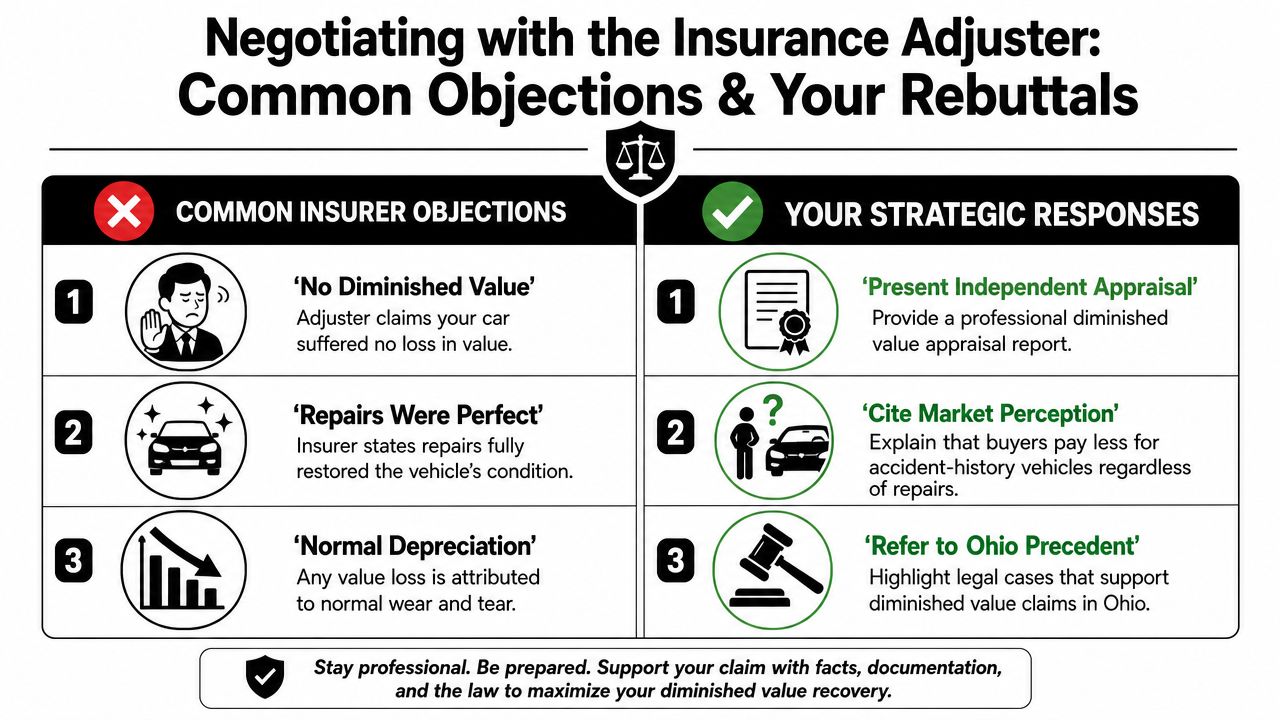
Once your demand lands, the adjuster usually goes one of three directions. They deny diminished value exists, claim the repairs made the car whole, or offer a token amount and hope you take it.
That's normal. It doesn't mean the claim lacks merit.
Common objections and direct responses
Here are responses that keep the discussion where it belongs.
"There is no diminished value."
Answer with market logic, not outrage. The vehicle now carries an accident history, and buyers commonly distinguish between clean-history vehicles and repaired vehicles."The repairs restored it to pre-accident condition."
Repairs restore usability. They don't remove the accident record or buyer stigma."Any loss is just normal depreciation."
Normal depreciation happens whether a car is hit or not. Diminished value is the extra loss tied to the collision and its repair history."Your appraisal is too high."
Ask them to identify the comparable vehicles, adjustments, and valuation method they used instead.
How to control the conversation
Negotiation goes better when you force specificity. Ask short questions. Make the adjuster commit to a position in writing.
Try these:
- Request the basis: Ask what method they used and what sales data supports it.
- Pin down disagreements: If they reject your appraisal, ask what exact assumption they dispute.
- Move up when needed: If the first adjuster is scripted, request a supervisor review.
For a practical primer on negotiating a fair settlement, Bell Law has a useful breakdown of how to keep negotiations grounded in facts instead of pressure tactics. If you want a more claim-specific framework, this guide on how to negotiate with an insurance adjuster can help you tighten your response strategy.
Don't argue every sentence. Force the insurer to explain its valuation method.
The appraisal clause issue
When negotiations stall, many people hear "invoke the appraisal clause" and assume it's a magic phrase. It isn't. It's a contractual valuation mechanism, and whether it applies depends on the policy language and claim posture.
The key strategic point is this. If the dispute is about value, structured appraisal can shift the fight away from an adjuster's unsupported number and toward competing expert opinions. That's often far better than endless back-and-forth emails.
What works is using appraisal when the insurer admits there is a valuation issue but won't pay fairly. What doesn't work is invoking it blindly without checking the policy wording, the type of claim, and whether the carrier is disputing liability instead of amount.
Signs you should stop casual negotiating
Watch for these signals:
- They repeat the same denial language
- They won't identify supporting data
- They ignore your appraisal report
- They offer a small amount without analysis
At that point, polite repetition won't move the file. Escalation usually will.
Your Escalation Playbook When Negotiations Fail
When the insurer won't make a reasonable move, pick the next step based on the kind of dispute you have. Don't escalate emotionally. Escalate with purpose.
Option one is formal appraisal
If the fight is over the amount of loss, formal appraisal is often the cleanest next move. Each side presents an appraiser, and the dispute moves out of routine adjuster handling into a more structured valuation process.
This route usually makes the most sense when liability is already resolved and the file has strong documentation. It tends to be less personal than litigation and more focused on numbers, comparables, and methodology.
Option two is small claims court
Small claims can be a practical choice when the amount at stake fits the court and the facts are straightforward. It's often best for clean liability cases where the insurer refused to deal fairly with a documented loss.
You'll need an organized file. Bring the repair invoice, appraisal, photos, claim correspondence, and your demand letter. The strength of your presentation matters more than indignation.
Option three is hiring a lawyer
An attorney makes the most sense when the claim is more complicated than a simple value dispute. That can include contested fault, a high-value vehicle, unusual repair history, or an insurer that keeps changing its reason for nonpayment.
A lawyer also helps when the diminished value issue sits inside a larger accident claim. In those cases, coordination matters.
A quick decision guide
| Situation | Best next step |
|---|---|
| Liability is accepted, amount is disputed | Formal appraisal |
| The claim is straightforward and document-heavy | Small claims court |
| Fault is disputed or the case is more complex | Attorney review |
Pick the lane that matches the problem. If the dispute is really about valuation, keep it a valuation dispute. If it has turned into a legal fight, treat it that way and get proper help.
If you need independent support on a diminished value or total loss dispute, Total Loss Northwest provides certified appraisals and appraisal clause help for vehicle owners, including diminished value support in all 50 states. When an insurer leans on biased valuation software or a weak internal number, a market-based appraisal can give you the evidence you need to push back with confidence.