You pick up your car from the body shop. The paint matches. The panels line up. The repair invoice says everything was done right.
Then you check what the car is worth now, and the number drops.
That drop is real. Buyers pay less for a vehicle with an accident history, even when the repairs are flawless. Dealers know it. Appraisers know it. Insurers know it too. The reason people keep asking does insurance pay for car depreciation after accident is simple. Insurance companies usually won't volunteer that money. You have to claim it, document it, and push for it.
Your Repaired Car Is Worth Less And You Can Prove It
A lot of drivers get stuck on the same point. They assume that once the car is fixed, the claim is over. It isn't.
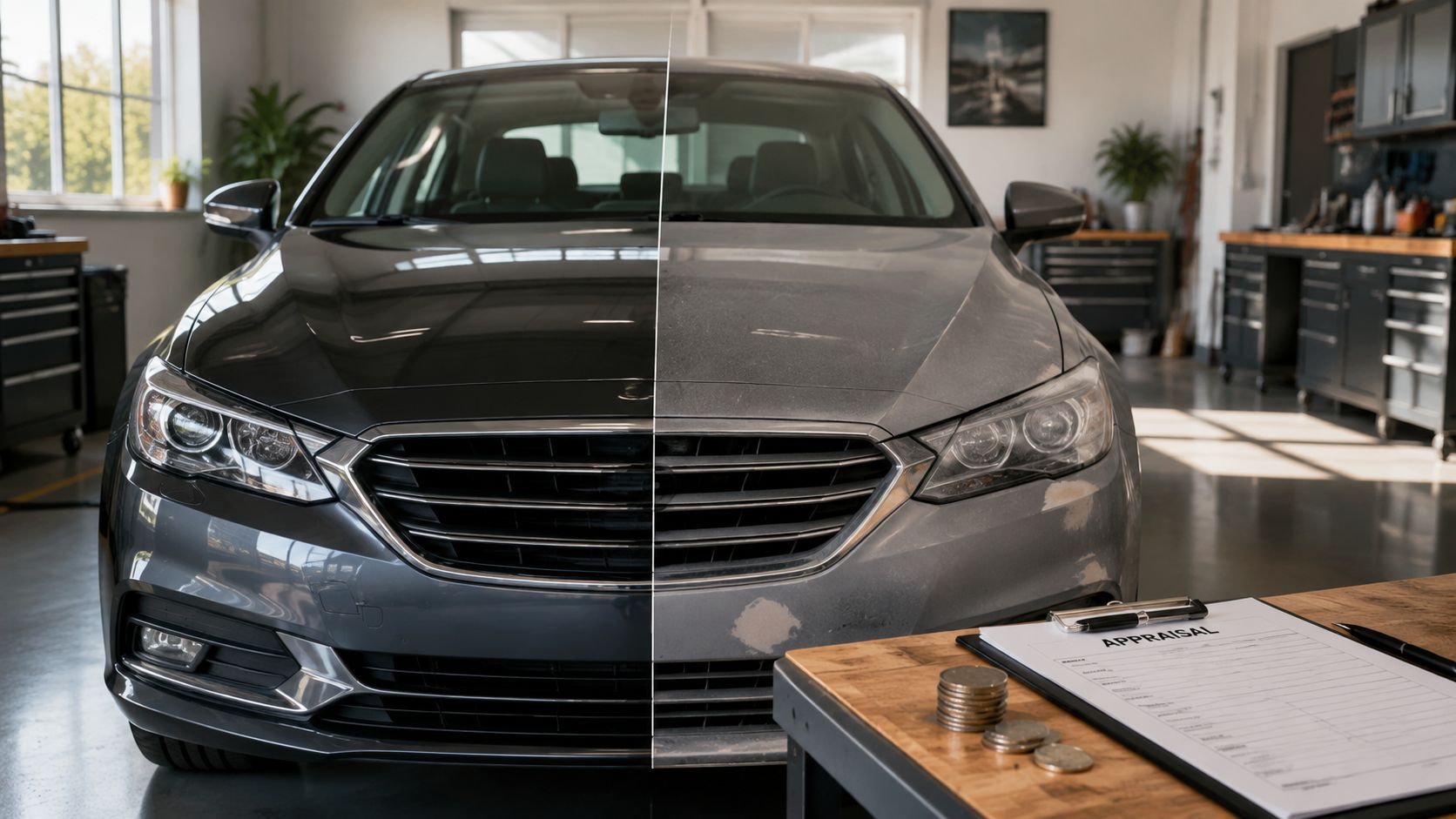
If your vehicle now carries an accident record, the market treats it differently. A clean-history car and an accident-history car are not worth the same thing, even if they look identical in your driveway. That lost resale or trade-in value is called diminished value.
What this looks like in real life
You had a clean vehicle. Someone hit you. The insurer paid for repairs. Weeks later, you try to trade it in or check dealer offers, and suddenly the car isn't worth what it was before the crash.
That's not routine wear. That's not age. That's accident stigma.
If you want to preserve every bit of value you still can, appearance still matters. Clean presentation won't erase an accident history, but it can strengthen your resale position. This breakdown of professional car detailing benefits is worth reading for that reason.
Buyers don't pay top dollar for a car with a crash on its record just because the bumper looks good again.
What you need to understand immediately
Insurers often act like repair payment solved the whole problem. It didn't. Repairs address physical damage. They don't automatically pay for the market value your car lost because the accident is now part of its history.
That's why drivers need to understand how car value drops after a crash. If you don't recognize the loss for what it is, the adjuster keeps the advantage.
The good news is that this loss can be proven. Market comparisons, repair records, vehicle history reports, and independent appraisal evidence all help show that your car came back repaired, but not restored to its prior market value.
Understanding Diminished Value vs Normal Depreciation
Insurers blur these terms on purpose because confusion saves them money.
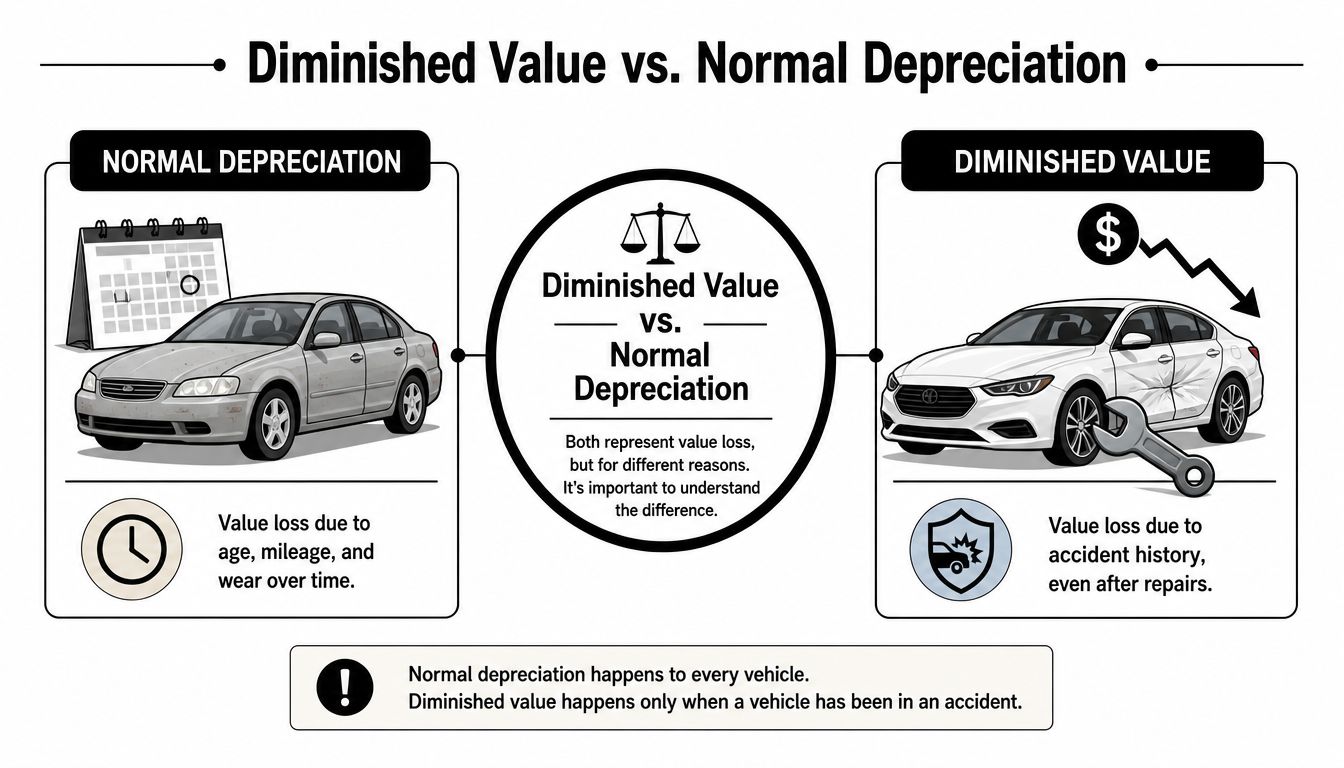
Normal depreciation is the routine drop in value from age, mileage, wear, prior owners, and market conditions. Every vehicle has it. It is built into the price of a used car, and it is not an accident claim.
Diminished value is the extra loss tied to the crash history itself. The car was worth one number before the wreck and a lower number after repairs because buyers, dealers, and appraisers treat an accident-reported vehicle differently.
A clean-history car and a repaired accident-history car can look identical on the lot. They do not sell the same. Dealers know it. Buyers know it. Adjusters know it too, even when they try to call the difference “normal depreciation.”
That distinction matters because your claim lives or dies on cause. If the loss came from age and mileage, insurance owes nothing. If the loss came from the collision and the stigma attached to that collision, you are dealing with diminished value.
The three types of diminished value
Adjusters often lump everything together. Don't let them. The category affects how the loss is argued and how it is proven.
| Type | What it means | Why it matters |
|---|---|---|
| Immediate diminished value | The drop in value right after the crash, before repairs | Useful in valuation disputes and total loss discussions |
| Repair-related diminished value | Loss caused by poor repairs, visible flaws, or inferior parts | Stronger when workmanship or parts quality hurt resale value |
| Inherent diminished value | Loss that remains after proper repairs because the accident stays on the vehicle history | This is the form most drivers pursue in a third-party claim |
If you want a practical outside explanation of diminished value after an accident, that overview does a solid job showing why repaired does not mean fully restored in the market.
What drivers get wrong
A lot of vehicle owners assume depreciation and diminished value are just two words for the same loss. They are not. Depreciation was already happening before the crash. Diminished value starts because of the crash.
That is why an insurer's favorite line, “your car was already depreciating,” misses the point. Of course it was. The real question is how much additional value disappeared because the accident is now part of the car's record.
Practical rule: If the vehicle history report changed because of the collision, treat any new market discount as a separate accident loss and make the insurer address it directly.
When And How Insurance Actually Covers Diminished Value
The short answer to does insurance pay for car depreciation after accident is yes, but usually only in the right claim setup.
The strongest path is a third-party claim. That means you're making the claim against the at-fault driver's insurer, not your own carrier. That's where diminished value claims usually live.
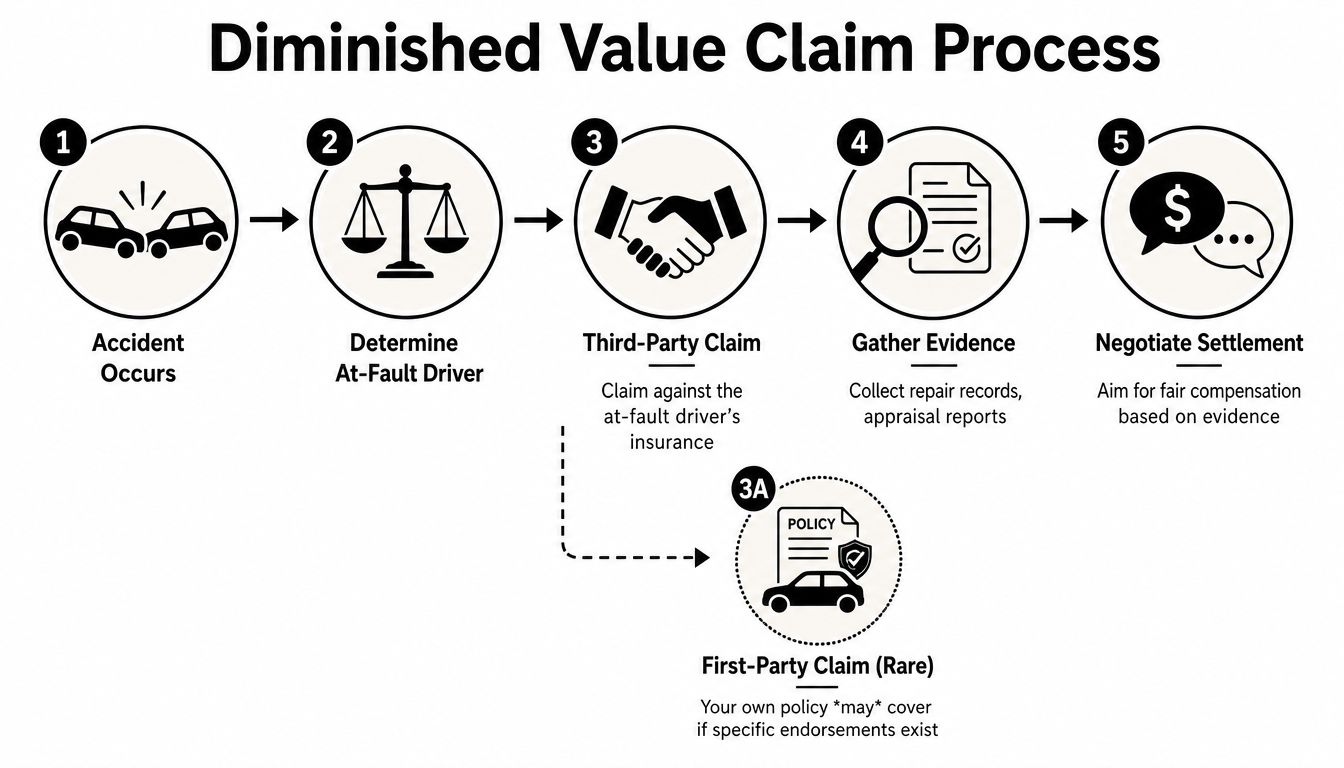
The claim path that usually works
If someone else hit you and their liability insurer accepted fault, you may be able to recover:
- Repair costs for the physical damage
- Diminished value for the accident-related loss in market price after repairs
That second piece is where many drivers leave money on the table. The insurer won't frame it for you. You have to raise it and support it.
If you want a practical outside perspective on diminished value after an accident, that resource gives a useful overview of why repaired doesn't mean fully restored in the market.
The claim path that usually doesn't
A first-party claim is a claim under your own policy. Standard collision coverage generally pays for repair costs or actual cash value if the vehicle is a total loss. It usually does not pay diminished value unless your policy language or state-specific rules create an exception.
That's why drivers get frustrated. They assume “full coverage” means every financial consequence of a crash is covered. It doesn't.
Here's the blunt version:
- Not at fault: pursue diminished value against the other driver's insurer.
- At fault: don't expect a normal diminished value payout under your own collision coverage.
- Disputed fault: resolve liability first, because diminished value becomes harder to collect while fault is unsettled.
What insurers want you to do
They want you to focus only on repairs, close the file, and move on.
Don't.
Keep your paperwork. Keep the final repair invoice. Keep photos. Keep the valuation evidence. If the crash wasn't your fault, your job is to treat diminished value as a separate damage component, not an afterthought.
The Insurers Playbook The Flawed 17c Formula
Your car comes back from the body shop looking clean. Then the adjuster sends a diminished value offer that feels absurdly small. That usually means they ran your claim through the 17c formula, a carrier-friendly shortcut built to shrink payouts.
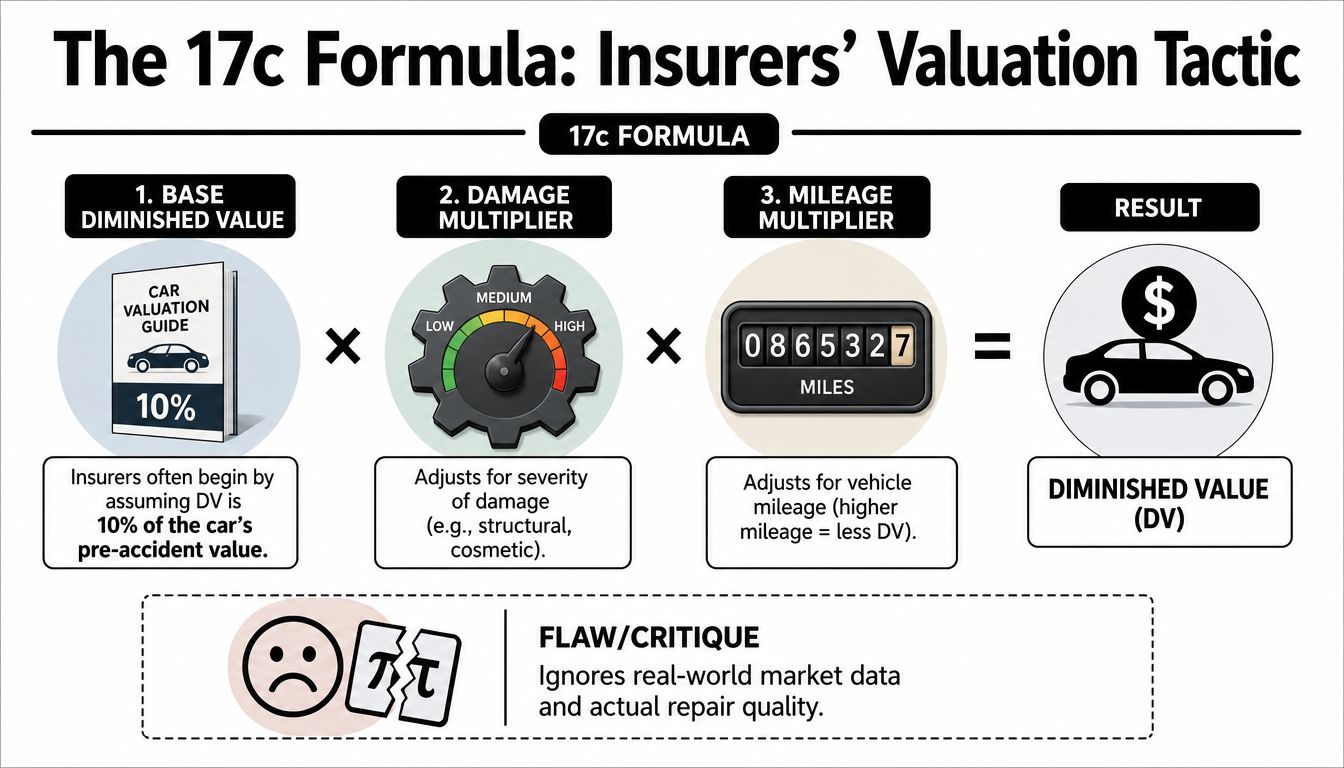
How the 17c formula works
The method is simple, and that is exactly the problem. It starts with your vehicle's pre-accident market value, caps possible diminished value at 10% of that number, then cuts it again with a damage multiplier and a mileage multiplier.
Here is the usual sequence:
- Start with the pre-accident value
- Apply a 10% ceiling
- Apply a damage severity multiplier
- Apply a mileage multiplier
By the end, the number often has little connection to what a real buyer, dealer, or appraiser would say your repaired car lost in the open market.
If you want to see how insurers and claimants typically frame the process before you dispute their number, review this guide on how to file a diminished value claim.
Why insurers like it
17c gives adjusters a fast, standardized number they can defend internally. It helps them close files cheaply. It does not measure real-world buyer resistance to an accident history report.
That distinction matters.
A repaired vehicle with structural history, airbag deployment, frame work, multiple panel replacements, or luxury-brand stigma can lose far more market value than a canned formula suggests. Buyers do not shop with insurer multipliers in hand. They shop with caution, and they discount repaired cars accordingly.
Why I don't treat 17c as credible valuation evidence
Insurers often present 17c as if it is the accepted way to value every diminished value claim. It is not. It came out of litigation, not from a neutral market-based valuation standard, and carriers kept using it because it favors the carrier.
The formula ignores the details that move resale price:
- Local market reaction to accident history
- Structural versus cosmetic repairs
- Vehicle desirability and trim level
- Brand stigma in the resale market
- How severe damage appears on history reports
- Whether the repair record scares off dealers and private buyers
That is why experienced appraisers do not stop at 17c. A real diminished value opinion looks at comparable sales, dealer behavior, damage severity, repair quality, and how the market treats that exact vehicle after a reported accident.
A capped formula that gets reduced again and again is a cost-control tool. It is not a fair measure of market loss.
What to do if the adjuster uses 17c
Treat it as the insurer's opening position. Nothing more.
Push back with evidence that speaks the market's language:
- An independent diminished value appraisal
- Repair documents that show the full scope of damage
- Photos from before and after repairs
- Vehicle history reporting that shows the accident record
- Dealer trade-in quotes or market comparisons
- A written challenge to the carrier's method
If the insurer hides behind 17c, that usually tells you something important. They are relying on a formula because a real market analysis would cost them more money.
How To Build And File A Winning Diminished Value Claim
Your car is repaired, looks fine, and the adjuster acts like the claim is over. Then you try to trade it in and the accident history knocks money off the offer. That lost value is the claim, and you win it by proving market loss better than the insurer can deny it.
Start with a clean file.
A diminished value claim gets paid when the paperwork shows three things clearly. The other driver caused the damage. The vehicle was repaired. The accident history still hurts resale value. If any one of those points is muddy, the insurer will use it to stall, discount, or deny.
Confirm the claim is worth pursuing
Focus on claims where the resale hit is real and visible to buyers.
- You were not at fault: These claims usually go against the at-fault driver's insurer.
- Repairs are complete: Carriers usually want the final repair record before they evaluate loss in value.
- The vehicle still has market appeal: Newer, cleaner, higher-value vehicles usually show the strongest diminished value case.
- The damage was significant enough to matter: Structural damage, airbag deployment, major panel replacement, and heavy repair totals usually get more market resistance than minor cosmetic work.
Build the file adjusters hate to see
Insurers pay weak claims cheaply because the owner sends a few photos and a complaint. Do the opposite. Build a file that reads like a valuation package.
Gather:
- Crash report, if one exists
- Photos of the vehicle before repairs
- Repair estimate and final paid invoice
- Parts list and repair line items
- Vehicle history report showing the accident entry
- Trade-in quotes, buyer feedback, or market comps
- All emails and letters with the insurer
As noted earlier, the burden is on you to prove the loss. If your file does not show the damage, the repair, and the market reaction, the carrier will fill in the gaps with its own low number.
Get an independent diminished value appraisal
This is the pivot point.
The insurer already has a process built to contain payouts. You need your own market-based valuation from an independent appraiser who knows how accident history affects sale price in practice, not just on an internal worksheet. A good report should address pre-loss condition, damage severity, repair quality, comparable vehicles, and the stigma attached to an accident on the history report.
If you want a practical walkthrough, this guide on how to file a diminished value claim gives the step-by-step process.
Expert advice: If the carrier has a formula and you have opinions, you lose. If the carrier has a formula and you have an appraisal backed by market evidence, the fight changes.
Send a formal demand package
Do not call in casually and ask what they think the loss might be. Put the demand in writing and make them answer the evidence.
Your demand should include:
- Liability summary showing their insured caused the accident
- Vehicle summary with year, make, model, trim, mileage, and pre-loss condition
- Repair summary explaining what was damaged and what was replaced or repaired
- Evidence package with photos, invoices, history report, and supporting market material
- Independent appraisal report with your diminished value amount
- A firm dollar demand and a reasonable response deadline
Keep the tone professional and tight. Strong claims read like organized proof, not frustration.
Force the adjuster to show their math
If the insurer lowballs or denies the claim, answer in writing. Ask for the exact valuation method used, the documents reviewed, and the basis for any reduction. Make them explain whether they relied on a canned formula, internal software, or a real market analysis.
That question matters because many carriers still hide behind insurer-friendly shortcuts instead of pricing the loss the way actual buyers and dealers do. Once you force the file into the open, weak reasoning gets easier to attack.
A winning claim is not about sounding angry. It is about making the cheap offer look unsupported.
The Appraisal Clause Your Most Powerful Negotiation Tool
When negotiations stall, most drivers think they have only two choices. Accept the low offer or sue.
That's not always true.
Many policies contain an Appraisal Clause. This clause can force a structured value dispute process when you and the insurer disagree on what the vehicle is worth. It matters in total loss fights, and it can be a strong countermeasure when valuation software or adjuster shortcuts distort the number.
A quick visual helps show why this tool matters.
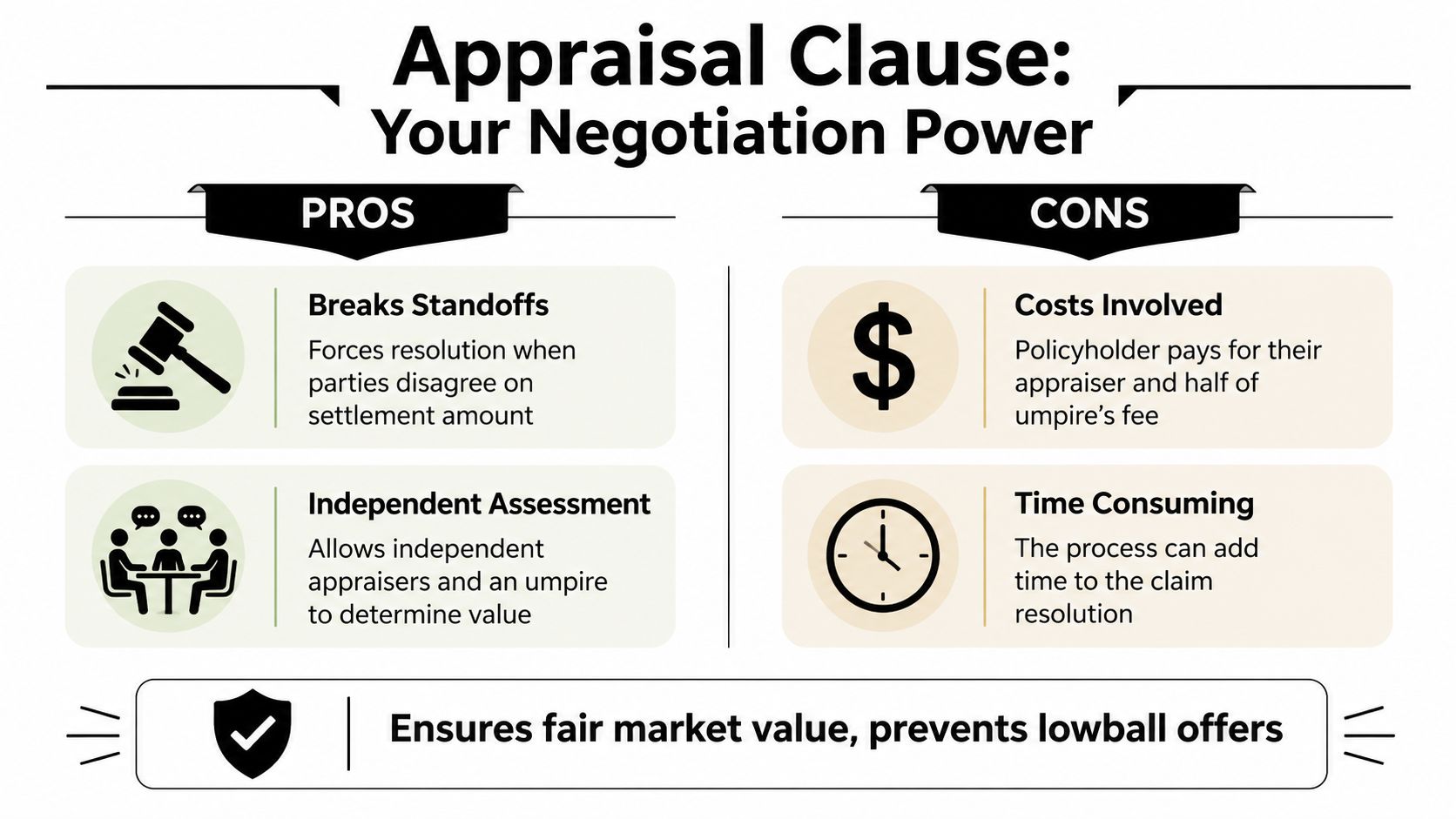
Why this clause changes the power balance
When the insurer controls valuation internally, you're often arguing with their process, their software, and their adjuster at the same time.
The Appraisal Clause breaks that setup.
It usually puts each side in position to choose an appraiser, with a neutral umpire available if needed. That moves the dispute away from one adjuster's spreadsheet and toward a real valuation process.
A useful breakdown of the insurance appraisal clause process can help you understand how it works in practice.
Later in a claim, seeing the process discussed visually can help too.
When I'd seriously consider invoking it
This tool becomes especially important when the vehicle isn't ordinary.
A source discussing diminished car value notes that insurers increasingly rely on proprietary valuation software that can discount total loss offers, and that invoking the Appraisal Clause is critical for high-end, custom, or classic vehicles whose value gets missed by standard formulas in this discussion of biased valuation software and appraisal rights.
That same logic applies whenever the insurer's offer clearly ignores the market.
Use the clause when:
- The offer depends on opaque software
- The vehicle has unique value characteristics
- The insurer refuses to explain its valuation
- Negotiation has turned into repetition instead of analysis
The clause won't make every fight easy. It can cost money and add time. But it often gives you the only serious advantage short of litigation.
Frequently Asked Questions About Diminished Value
Can I claim diminished value if I caused the accident
Usually, no.
In most cases, diminished value gets paid by the at-fault driver's insurer because their insured caused the loss in market value. Your own collision coverage usually pays to repair the car, not to make up for the resale hit that follows an accident history. Some policies and some states handle this differently, so read the policy language instead of taking the adjuster's first answer as final.
How long do I have to file
State law controls the deadline, and the clock matters more than drivers realize. Wait too long and you give the insurer exactly what it wants: a stale claim, weaker evidence, and another reason to say no.
Do not guess. Check your state's property damage deadline and your policy's notice requirements right away. As noted earlier, deadlines vary by state, and delay only helps the carrier.
Is it worth filing on an older vehicle
Sometimes, yes. Age alone does not kill a diminished value claim.
What matters is market reaction. A clean, well-kept older vehicle with strong resale demand can lose real value after an accident, especially if buyers in that segment care about history reports. Enthusiast cars, limited trims, trucks in exceptional condition, and collector vehicles often deserve a closer look than insurers want to admit.
What if the at-fault driver was uninsured
You may still have options under your own policy, but you need to read the contract carefully. Look for uninsured motorist property damage coverage, collision coverage, and any appraisal or dispute language that could help if the carrier lowballs the loss.
Ask direct questions. Does the policy cover loss in value, or only repairs? If they refuse to answer clearly, that tells you a lot.
What if the insurer says my repairs were enough
That answer dodges the core issue.
A body shop fixes physical damage. It does not erase the accident record, buyer hesitation, or dealer trade-in discount tied to that history. A properly repaired car can still be worth less the day it comes out of the shop. That is the whole basis of a diminished value claim.
Should I accept the insurer's first diminished value offer
No, not until you see how they calculated it.
Insurers often present a small number as if it came from some neutral standard. It usually did not. It often came from an internal formula, a software tool, or the same insurer-first logic discussed earlier with the 17c method. Treat the first offer as a starting position built to save them money, not as proof of fair value.
If the offer is thin, unsupported, or copied from a canned worksheet, push back with market evidence. If they still stonewall, use the Appraisal Clause if your policy allows it.
If you're in Oregon or Washington and the insurer is lowballing your diminished value or total loss settlement, Total Loss Northwest gives drivers a serious way to fight back. They specialize in independent diminished value and total loss appraisals, and they invoke the Appraisal Clause to get biased insurer software out of the valuation process. If you want a market-based number backed by a detailed report, they're the kind of shop to call before you sign away money you can't recover later.