You're standing at the worst part of an accident claim, the insurer has sent a low number, the vehicle may be a total loss, and now you're wondering whether hiring an independent appraiser is worth it or just another cost that eats into the settlement. That's the question behind fair fee. It's not “what's the cheapest quote,” it's “what pricing model makes sense for the work, the claim, and the money you can recover.”
A fair fee after an accident is a process standard, not a magic dollar amount. The best benchmark is whether the charge is adequate, easy to administer, transparent, and fair in how it treats different claimants, because fairness is bigger than the final invoice. The TIAA Institute's fee-fairness framework is useful here because it turns a fuzzy pricing question into something you can test against an appraisal quote, a report, and a negotiation strategy TIAA Institute fee fairness framework.
What a Fair Fee Actually Means After an Accident
The first mistake drivers make is treating the fee like a sticker on a shelf. That's backwards. After a not-at-fault crash, you're not buying a product, you're paying for a dispute process that has to survive insurer scrutiny, document the value loss, and sometimes push the claim through the Appraisal Clause.
Start with the claim, not the price tag
If your total-loss offer looks low or your diminished-value claim gets brushed off, the question isn't whether an appraiser is cheap. The question is whether the appraiser's work is strong enough to change the outcome. A low fee that produces a weak report is expensive, because it can leave the insurer's number untouched.
That's why fair fee should be judged against the work being done. A simple case with a common daily driver shouldn't be priced like a heavily modified truck with a messy repair history, and a high-value claim shouldn't be treated like a routine file. In plain English, the fee has to match the job.
Practical rule: If the quote doesn't tell you what the appraiser is actually doing for the money, it's not a fair fee. It's just a number.
Why the settlement itself matters
Total loss and diminished value claims are different from ordinary consumer purchases because the fee can be part of the recovery strategy. If the report helps move the settlement, the fee may recover through the claim itself or through the appraisal process, depending on the policy path and dispute structure. That changes the math completely.
Drivers usually don't need a philosophical answer. They need a decision rule. If the fee is understandable, tied to the scope, and likely to produce a report that the insurer can't dismiss casually, it's moving toward fair. If the price is vague, the scope is vague, and the logic is vague, walk away.
The Four Conditions That Make a Fee Fair
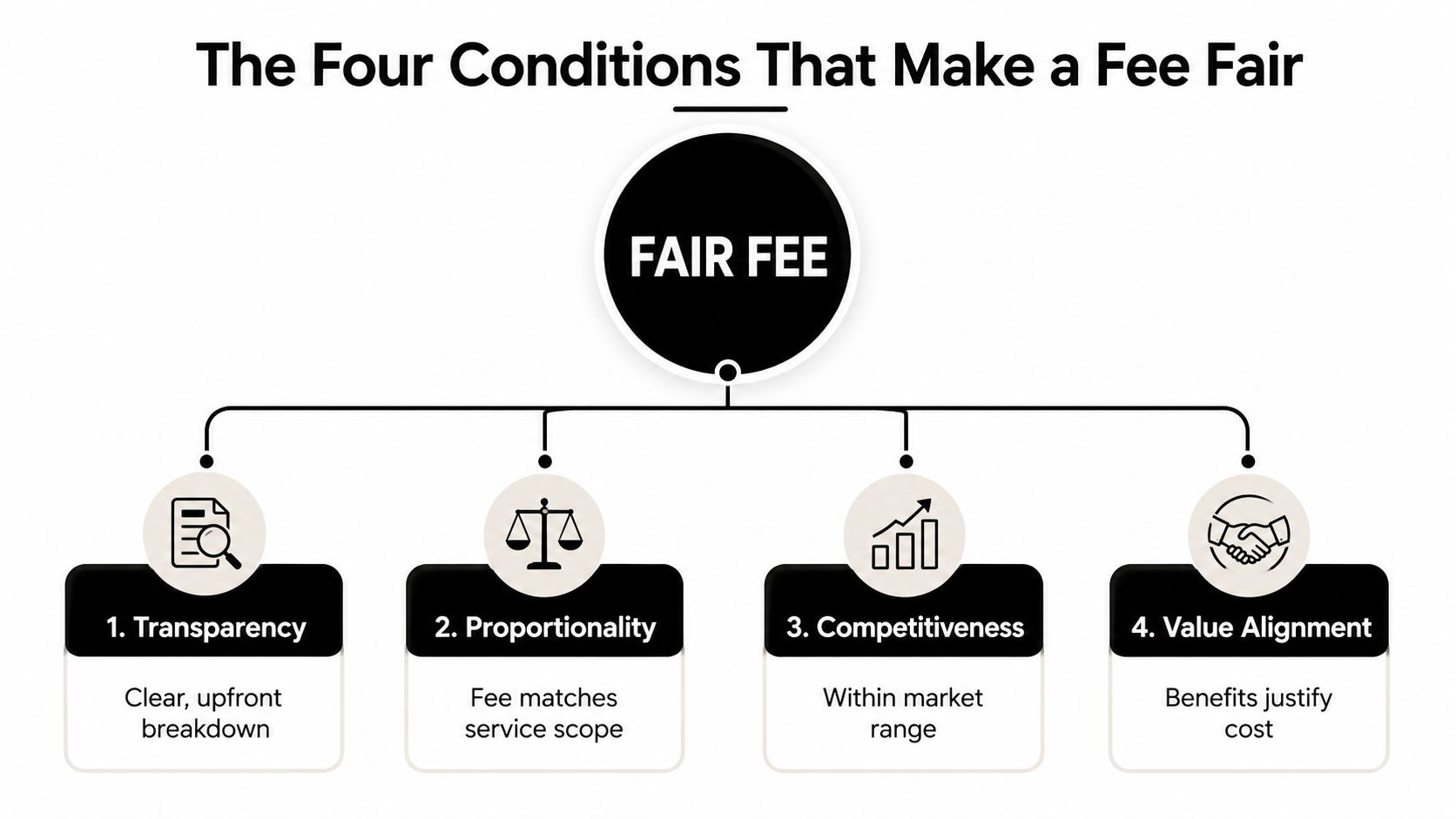
A fair fee starts with the job, not the sticker price. After a crash, you are not buying a generic service. You are paying for work that has to stand up in a dispute, support the settlement, and give the carrier a reason to move off its first number. That is the correct lens for appraisal pricing.
Adequacy means the fee has to buy real work
Adequacy asks a blunt question: does the fee fund the work the claim requires? In an accident claim, that means searching for comparables, checking market data, reviewing repair records, and writing a report that can hold up when the insurer pushes back. If the quote is so low that the appraiser cannot do that work properly, the fee is not fair. It is too thin to support the result you need.
Administrative ease means the pricing should be understandable
A claimant should not need to decode a billing puzzle. A fair appraisal fee is easy to read, easy to connect to the claim, and easy to explain if the insurer asks why the number is what it is. If the appraiser cannot state the charge in plain language, the pricing is hiding something. That usually means the fee structure is weak.
Transparency means you can see the method
A transparent fee tells you what is included, what is excluded, and how the work connects to the report. It should also make it obvious that the appraisal is not just a casual opinion with a label on it. The FTC fee rule FAQ makes the same point in consumer pricing, total price and mandatory charges have to be disclosed upfront because hidden fees distort decision-making FTC fee rule FAQ.
Fairness means similar claims should not be priced wildly apart
This is the equity test. Two comparable claims should not come back with wildly different fees unless there is a real reason the scope changed. A higher-value vehicle, a more complex claim, or a faster turnaround can justify a higher charge, but the logic has to be visible. That is how you tell a fair fee from a random one.
The same framework shows up in professional valuation work outside auto claims too. If you want a useful comparison point, the fee discussion in Corinthian Surveyors London LTD RICS fees shows the same basic rule, price follows scope, not just the label on the service.
A good fee also has to make sense in relation to the way Total Loss Northwest structures its appraisal work. Their diminished value appraisal cost has to be judged by what it is set up to recover through the settlement process, not by whether it looks cheap in isolation. That is how drivers should read it, as a framework question, not a bargain hunt.
Typical Appraisal Fee Ranges and What Drives the Price
There isn't one honest number that works for every claim. A daily driver with a straightforward total-loss dispute is a different animal from a collector car, a custom build, or a diminished-value case with missing records. Fee fairness lives in the scope, not the label.
Why one quote can be fair and another can be nonsense
A fee can rise for good reasons. Higher-value vehicles usually need stronger comparable-sales support, more documentation, and more time defending the conclusion. A combined claim can also take more work than a single-purpose report because the appraiser has to address more than one dispute point.
Travel matters too. An in-person inspection costs more than a desktop review when the appraiser has to get eyes on the vehicle, photograph damage, or verify details that photos won't capture. Turnaround also matters. If someone wants the report fast, they're asking the appraiser to rearrange the queue, and that usually changes the price.
For a useful comparison point on valuation pricing structure in another professional field, the fee discussion in Corinthian Surveyors London LTD RICS fees is worth reading because it shows the same basic principle, scope drives price, not just the word “valuation.”
A simple way to size up a quote
Use the quote as a scope check, not a verdict. Ask whether the appraiser is pricing the work you need or just tossing out a flat number. If the claim is small and clean, a lower fee can be reasonable. If the claim is complex, the fee should rise with the work.
| Claim Type | Typical Scope | Fee Band | Complexity Driver |
|---|---|---|---|
| Straight total loss | Comparable-sales review, market support, settlement challenge | Lower to moderate | Standard vehicle, straightforward damage file |
| Diminished value | Post-repair loss analysis, market impact review | Moderate | Documentation quality, repair history, insurer pushback |
| Combined dispute | Total loss plus diminished value, negotiation support | Higher | Multiple issues, more research, longer report |
If you want a practical internal reference on claim pricing, the cost page at diminished value appraisal cost is a useful complement because it helps you separate price from scope without pretending every file should cost the same.
State Rules and Insurance Carrier Fee Recovery
The recoverability question changes everything. If the carrier has to pay part of the process, the fee isn't just a personal expense, it becomes a negotiation choice. If you're in a state that recognizes the Appraisal Clause, the insurer and claimant don't necessarily split costs the same way in every situation, so you need to know who pays what before you hire anyone.
The Appraisal Clause changes the fee decision
When the Appraisal Clause is invoked properly, the dispute can move into a structured appraisal process with an umpire. In that setup, the insurer typically pays its own appraiser and the umpire's fee, while the claimant pays the independent appraiser they chose. That's why the selection step matters so much, because a weak appraiser can cost you money with no meaningful recourse.
For a plain-language breakdown of how this works in practice, insurance Appraisal Clause is the right place to start. It helps you see the cost side before you commit to the process.
Diminished value often works differently
Outside a total-loss appraisal, diminished-value claims usually don't come with automatic carrier fee reimbursement. In those cases, the claimant often pays out of pocket first and then tries to recover value through settlement. That makes fair fee even more important, because you're deciding whether the report has enough upside to justify the spend.
Federal procurement gives a useful outside benchmark. Under the FAR, a fair and reasonable price is judged through cost elements, profit or fee, market competition, and cost realism, which shows that fairness isn't a vibe, it's an evidence standard FAR 15.404-1. That's how you should think about appraisal pricing too.
A fee is only “too much” if the work can't justify it. The reverse is also true, a cheap fee can be expensive if it can't move the claim.
Net Recovery and the Cost-Benefit Math
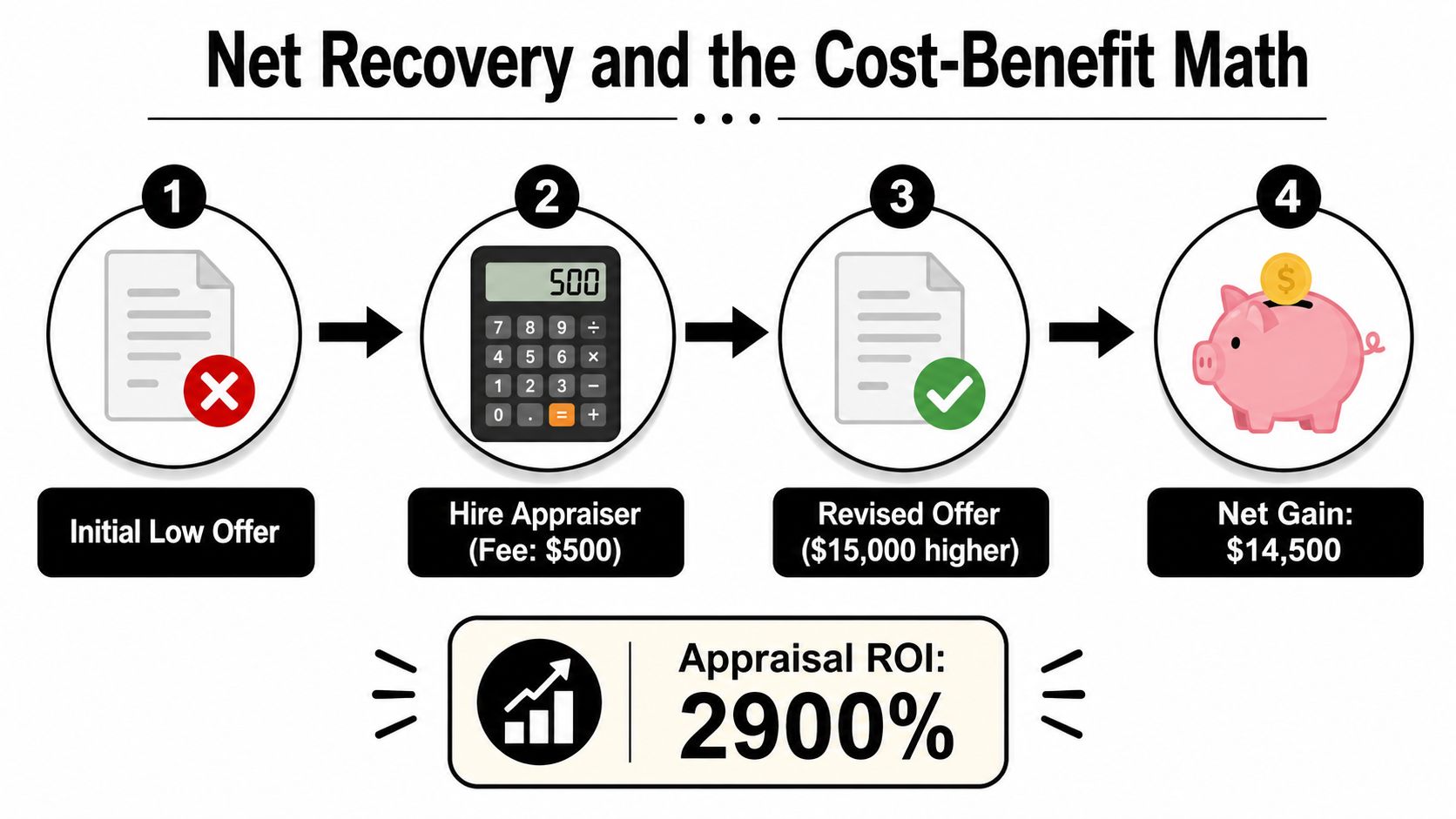
The only math that matters is net recovery. If the appraisal fee helps you recover more than you would have gotten otherwise, the fee can be worth it even when it feels uncomfortable upfront. If it doesn't improve the settlement enough, don't force the hire.
Total loss math should be plain and ruthless
If an insurer offers a low payout and an independent report pushes the settlement higher, subtract the fee from the increase. That's the gain. A driver doesn't need a complicated formula, just a clean comparison between the old number, the new number, and the cost of getting there.
A strong settlement increase can make a fee look small. A weak increase makes the same fee look foolish. That's why a fair fee is tied to expected recovery, not just the invoice.
Diminished value math has the same logic
If the at-fault carrier starts at zero and the claim later resolves with meaningful value, the fee can produce a clear positive outcome. But if the appraisal barely changes the offer, the fee may not be justified. That's the part many overlook when they chase the cheapest quote, focusing only on the spend and ignoring the return.
For a broader business lens on weighing cost against payoff, the cost-benefit analysis for UK dealers is a solid reminder that a purchase only makes sense when the return survives the math. Different market, same logic.
Don't hire on hope
A fair fee should make sense before the report is written. If you can't explain how the appraisal could pay for itself, pause. Good claims work isn't gambling, it's controlled spending on evidence.
Red Flags That Signal an Unfair or Inflated Fee
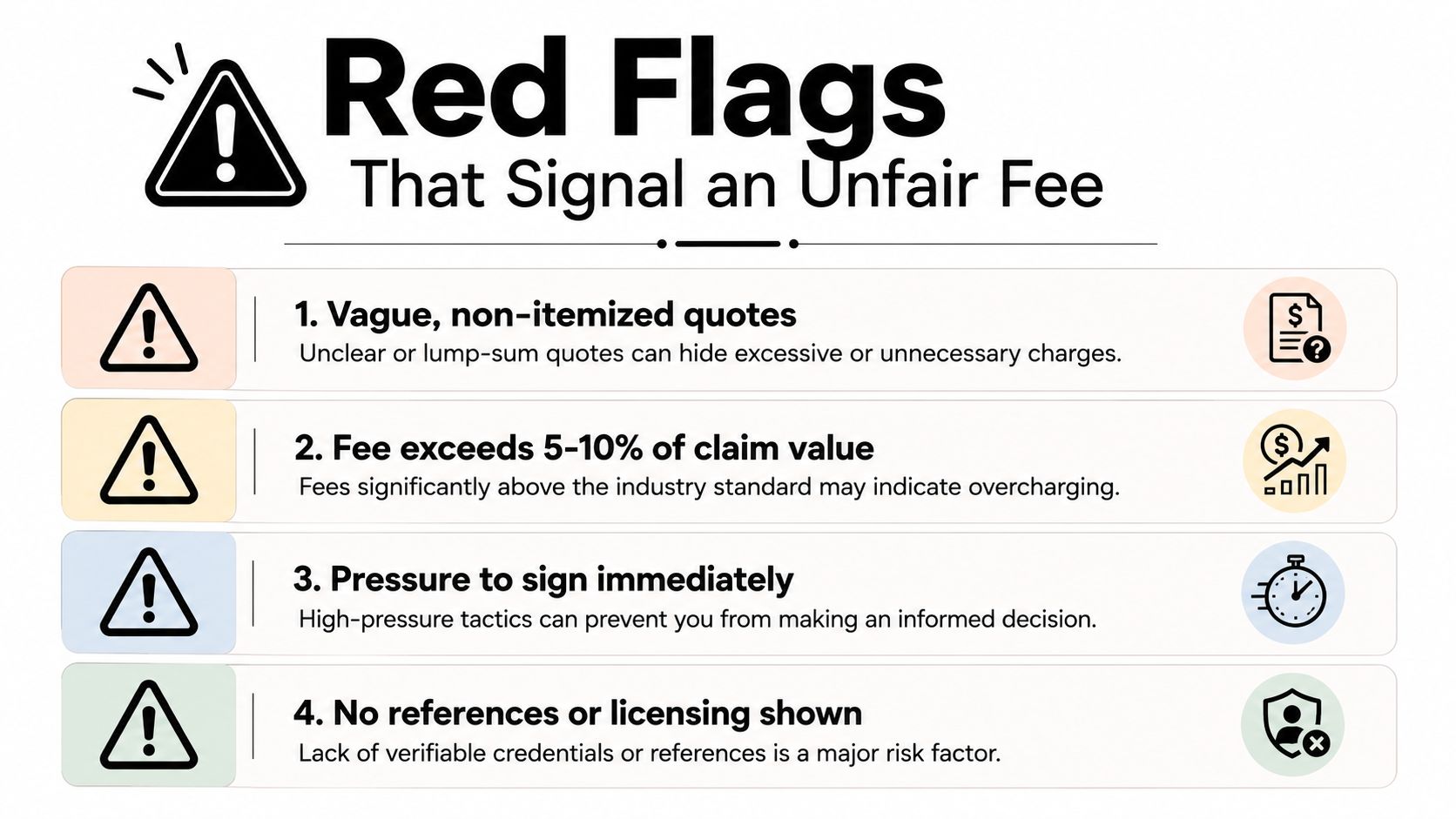
Unfair pricing usually looks polished at first glance. The quote sounds confident, the turnaround sounds fast, and the appraiser sounds busy. That doesn't make the fee fair. It just means you haven't asked the right questions yet.
Watch for the obvious problems
- Vague, non-itemized quotes: If the appraiser won't say what's included, you can't judge whether the fee matches the work.
- Pressure to sign immediately: Urgency is often a substitute for clarity.
- No references or licensing shown: If the appraiser won't show a track record, you're paying blind.
- A report that looks thin before it's even started: Sparse methodology usually means the fee is funding an opinion, not an appraisal.
The hidden problem is scope drift
A quote can be unfair even if it isn't expensive. If the fee is flat but the claim is complex, the appraiser may cut corners. That's the opposite of adequacy and transparency. A report like that can be easy for an insurer to ignore, which means the fee failed at the only job that matters.
The best warning sign is a mismatch between the promise and the process. If the appraiser talks about “getting you more” but won't explain the work, the fair fee framework already tells you what's wrong.
If you suspect the claim handling itself is being distorted, the overview on bad faith insurance practices helps you separate a pricing issue from a carrier conduct issue. Those are different problems, and you shouldn't confuse them.
How Total Loss Northwest Structures and Justifies Its Fees
Total Loss Northwest prices appraisals the way a fair-fee framework demands, by tying the charge to claim type, vehicle class, and report scope instead of pretending every file is the same. That's the right model for total loss and diminished value work because the value of the report depends on whether it can survive insurer pushback. If the fee reflects the actual burden of the claim, it's easier to defend than a one-size-fits-all quote.
What matters in the pricing logic
The firm's approach lines up with the four fairness conditions. The pricing is supposed to be transparent through a published fee schedule and scope definitions, adequate enough to support the research and documentation a disputed claim needs, and fair in how it treats higher-value or more complex cases. Where the Appraisal Clause applies, the fee recovery strategy can run through the settlement process rather than leaving the claimant to absorb every dollar alone.
That matters in Oregon and Washington, where drivers often want an appraisal that's built for negotiation, not just for a file folder. It also matters for diminished value work in all 50 states, because those claims often live or die on documentation quality and the appraiser's ability to defend the number.
The real trade-off
You can pay less for a report that looks tidy and collapses under pressure, or pay for an appraisal that's built to hold up when the insurer pushes back. Those are not the same product. The right choice depends on whether you need cheap paperwork or a defensible claim position.

If your claim is simple and the insurer is already close, you may not need this level of support. If the offer is low, the vehicle is unique, or the carrier is stonewalling, a stronger appraisal can be the smarter spend.
If your settlement is still being dragged down by a low total-loss number or a dismissed diminished-value claim, talk to Total Loss Northwest and ask how their appraisal process fits your vehicle, your state, and your claim posture before you sign anything.