You fill up with E85 because the price on the pump looks good, the badge on the tailgate says Flex Fuel, and the owner's manual says the vehicle can use it. A day later the idle turns uneven, throttle response feels lazy, or the check engine light comes on. That's the moment most owners realize flex-fuel capability and trouble-free operation aren't the same thing.
I look at vehicles through the lens of condition, repair history, market value, and claim support. From that angle, flex fuel engines problems matter for more than drivability. They can weaken trade-in offers, complicate total loss valuations, and give an insurer room to argue that some of your vehicle's issues existed before the crash. If you've already had an accident, understanding that difference becomes financially important.
An Introduction to Flex Fuel Vehicle Challenges
A flex-fuel vehicle, or FFV, is built to run on gasoline or high-ethanol blends such as E85. On paper, that sounds simple. In real ownership, it often isn't. The first problem is efficiency. The U.S. Department of Energy notes that FFVs can run on gasoline or blends up to E83, but higher-ethanol blends require ethanol-compatible parts and ECM calibration, and E85 usually delivers fewer miles per gallon because ethanol contains less energy per gallon than gasoline. The same DOE material also highlights the supply gap. A vehicle-history summary citing federal data notes that only about 2% of U.S. motor fuel stations offered E85 by March 2014, and by November 2015 there were 3,218 public E85 stations compared with roughly 156,000 retail fuel outlets that did not offer any ethanol blend. That helps explain why many drivers can use flex fuel in theory, but not consistently in daily life, especially away from major ethanol markets (U.S. Department of Energy guidance on FFVs and E85 availability).

That supply problem has a practical side owners often miss. If your engine runs best when you can switch fuels based on weather, local pump quality, or a developing drivability issue, sparse E85 access limits your options. You may end up topping off with whatever is nearby rather than what makes the most mechanical sense.
Why owners get caught off guard
It is often assumed that the flex-fuel badge means equal results on either fuel. It doesn't. An FFV can be compatible with more than one fuel and still show clear trade-offs in mileage, cold starts, and long-term wear.
Practical rule: If your vehicle suddenly starts acting up after a switch to E85, don't dismiss it as coincidence just because the vehicle is labeled flex fuel.
The financial angle starts early. If poor fuel economy, repeated warning lights, or hard-start complaints show up in service records, buyers notice. So do adjusters reviewing pre-loss condition. If you ever need to challenge a value dispute, it helps to understand how insurers think about operating condition. My Safety Manager's insurance guide is commercial in focus, but it's still useful for seeing how insurers frame risk, documentation, and compliance. The same logic shows up in private auto claims.
If you're already dealing with a valuation dispute, it also helps to know how insurers define price versus market evidence. This overview of fair market value after a loss gives a good baseline for that conversation.
Understanding How E85 Interacts with Your Engine
E85 isn't just “gas with something added.” It behaves differently inside the fuel system. That difference is where many flex fuel engines problems begin.
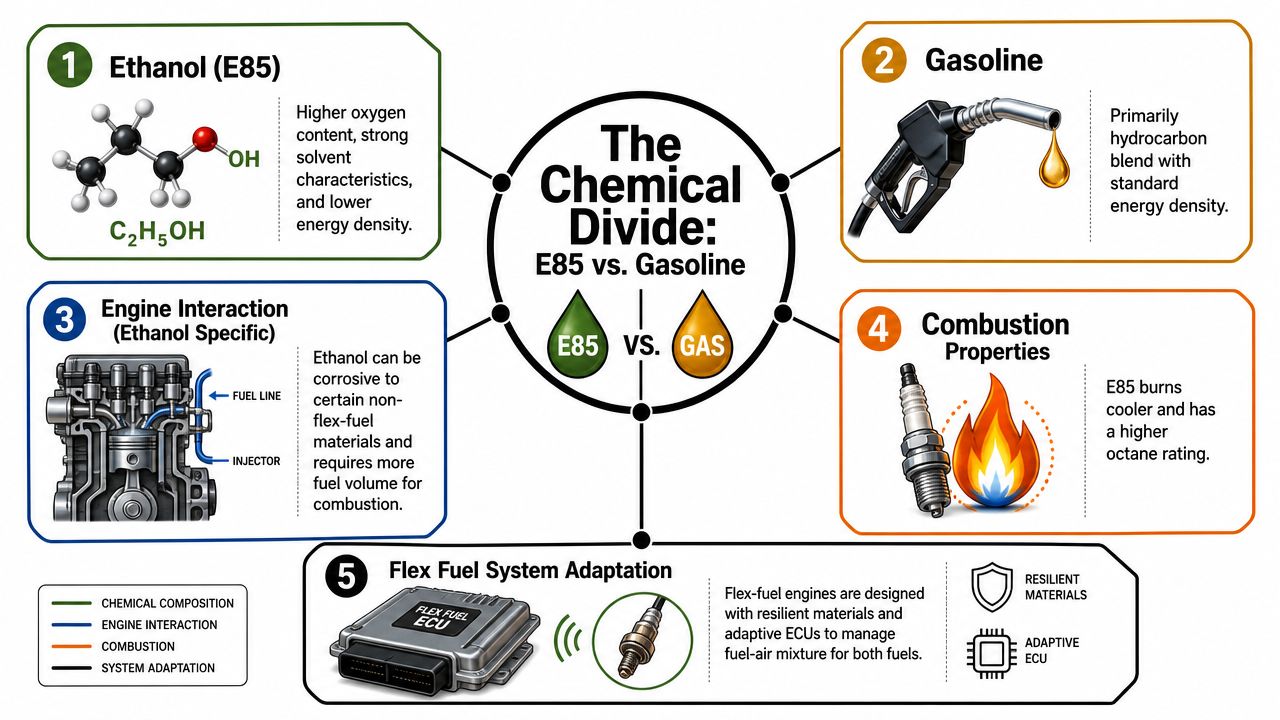
Ethanol acts more like a strong cleaner
A good working analogy is this: gasoline is familiar shop soap, while high-ethanol fuel behaves more like a stronger solvent. That stronger action can help clean old deposits, but it can also expose weaknesses. Seals, fuel lines, and internal components that are already aged or marginal don't always react well.
A key drawback is fuel-system durability risk. One automotive explainer notes that high ethanol content can accelerate wear on fuel lines, O-rings, and pumps, and that ethanol can carry more dirt and debris into the engine than gasoline, increasing the chance of corrosion, deposits, and long-term component damage, especially in older or high-mileage FFVs (CarBuzz on flex-fuel durability concerns).
That point matters in appraisal work. A vehicle can still run and drive while accumulating condition issues without obvious signs that lower confidence in the car. Fuel trim problems, injector balance issues, and pump wear may not show up in a quick test drive, but they often surface in records, inspections, and owner complaints.
Why FFVs need different hardware
A proper flex-fuel system needs parts that can tolerate ethanol's chemistry. In practical terms, that means components such as:
- Fuel-system materials that resist ethanol exposure: seals, hoses, and lines must hold up where standard materials may swell, harden, or deteriorate sooner.
- Sensors that help the engine adapt: the control system has to recognize changing fuel content and adjust the fuel-air mixture accordingly.
- Calibration that matches both fuels: the ECM has to account for the different combustion needs of gasoline and ethanol blends.
Older vehicles, neglected vehicles, and high-mileage FFVs are where trouble often shows first. Ethanol may loosen old contamination in the tank or lines. Once that material moves downstream, injectors and pumps take the hit.
An FFV isn't just a gasoline vehicle with permission to run E85. It's a system that depends on compatible materials, good maintenance, and accurate fuel management.
Where owners feel it first
Most drivers don't notice chemistry. They notice behavior:
- Hard starts
- Rough idle
- Hesitation on acceleration
- Reduced range between fill-ups
- Intermittent check engine lights
Those symptoms don't prove E85 caused the issue. They do justify a closer look at fuel-system condition before the problem gets written off as “just bad gas.”
Common Flex Fuel Engine Problems and Symptoms
The most expensive flex fuel engines problems usually don't begin as catastrophic failures. They begin as intermittent drivability complaints. The engine stumbles once. The vehicle feels weak under load. It starts fine warm but struggles cold. Owners keep driving because the problem comes and goes.
Fuel pump and delivery issues
One of the sharper warnings in this area came from litigation involving GM. A proposed class action alleged the company had known since at least 2016, through technical service bulletins, that “excessive use of E85” could cause an internal fuel pump plunger to stick, leading to sudden loss of power and expensive repairs. The filing also alleged that owner materials warned about lower mileage and cold-temperature incompatibility, but did not clearly explain that owners might need to alternate E85 with gasoline to avoid damage (class action summary involving GM flex-fuel allegations).
From a practical standpoint, pump-related complaints often show up as:
- Long crank before start
- Power loss during acceleration
- Surging or stumbling under load
- No-start condition after repeated warning signs
- Intermittent lean codes
If the pump weakens, the vehicle may still run well enough to avoid immediate repair. That's exactly the kind of issue that can hurt resale value later because the next buyer, dealer, or appraiser sees a pattern.
Sensor and mixture problems
FFVs rely on accurate fuel management. If the system misreads the fuel blend or struggles to adjust fuel delivery, the engine can run lean or erratic. Owners often describe this as “it runs different every tank” or “it's fine on regular gas but not on E85.”
Common symptoms include:
- Check engine light soon after refueling
- Rough idle that improves after driving
- Poor throttle response
- Noticeable drop in power
- Inconsistent cold-start behavior
These complaints don't always point to one failed part. Sometimes the issue is a sensor. Sometimes it's contamination. Sometimes it's a pump that can't keep up.
Corrosion and material degradation
Long-term ethanol exposure can create slower, less obvious trouble. Lines, seals, and pump internals may wear down over time. Deposits can form. Corrosion can begin where moisture and contamination sit in the system. Older and high-mileage FFVs deserve extra caution here.
If a vehicle has repeated fuel-system repairs on its history report, buyers usually assume the problem wasn't isolated. They assume it may come back.
Flex Fuel Problem Diagnosis Cheat Sheet
| Problem | Common Symptoms | Possible OBD-II Codes | Estimated Repair Cost (USD) |
|---|---|---|---|
| Weak or sticking fuel pump | Hard starting, sudden loss of power, hesitation, no-start | P0171, P0174 | Moderate to high, depends on vehicle and access |
| Fuel composition sensor issue | Check engine light after refueling, inconsistent running on different fuels | P0178, P0179 | Low to moderate, if limited to sensor and calibration |
| Clogged or dirty injectors | Rough idle, stumble on acceleration, misfire feel | P0171, P0174, misfire-related codes | Low to moderate for cleaning, higher if replacement is needed |
| Deteriorated fuel lines or seals | Fuel odor, drivability changes, recurring lean condition | P0171, P0174 | Moderate, varies by parts access and material replacement |
| Contaminated fuel system | Rough running, poor performance, hard starts after fueling | P0171, P0174, P0178, P0179 | Variable, can range from basic service to major fuel-system work |
I'm keeping the cost ranges qualitative for a reason. They vary heavily by make, engine layout, parts pricing, and whether the repair stays local to one component or spreads into the wider fuel system.
Diagnosing Issues with OBD Codes
When the check engine light comes on, your first useful move is to pull the code before anyone starts guessing. A simple OBD-II scanner is enough for that. You don't need dealership equipment to see the starting point.
The codes that matter most
For flex-fuel complaints, these codes are common places to start:
- P0171 usually means the system is running too lean on one bank.
- P0174 points to a lean condition on the other bank, if the engine has two banks.
- P0178 often relates to the fuel composition sensor circuit.
- P0179 also points toward fuel composition sensor circuit issues, often intermittent or out-of-range behavior.
A lean code doesn't automatically mean “bad E85.” It can also mean weak fuel delivery, vacuum leaks, contamination, or injectors that aren't flowing correctly. Fuel composition sensor codes narrow the focus more directly toward the FFV side of the system.
A safe troubleshooting sequence
Before approving expensive work, do the basics in order.
Read and save the codes
Take a photo or note the code numbers exactly. If the light clears later, you still need that record.Check the fuel you just used
If the problem began right after an E85 fill-up, note the station, fuel type, and timing.Inspect the gas cap and obvious issues
A loose cap won't explain every flex-fuel complaint, but it's easy to rule out.Switch back to gasoline for a tankful if the vehicle allows it
If symptoms improve, that's useful diagnostic information. It doesn't prove the ethanol blend caused the issue, but it gives the shop direction.Pay attention to cold-start behavior
If the vehicle is worse in cold conditions, note that specifically. It helps separate random drivability issues from fuel-related patterns.
Bring the scanner data, fuel receipts, and your symptom timeline to the repair shop. Good diagnostics start with a clean history.
Why this matters beyond repair
Documentation strengthens your position later. If the car ends up in a diminished value or total loss dispute, a clear timeline helps distinguish pre-existing fuel-system issues from collision-related damage. Without that record, an insurer may lump everything together and reduce what they think the vehicle was worth before the accident.
Estimating Repair Costs and Finding Professional Help
Once you know the likely problem area, the question becomes simple: is this a manageable repair, or is this the beginning of an expensive fuel-system chain reaction?
When DIY makes sense
A few steps are reasonable for an owner:
- Scanning and recording OBD-II codes
- Checking whether symptoms began after a specific fill-up
- Switching fuels to see whether drivability changes
- Looking for obvious fuel odor or visible line deterioration where safely accessible
That's where most owner-level work should stop. Modern fuel systems run under pressure. A bad decision around a hot engine, a pressurized rail, or an open ignition source can turn a minor diagnosis into a safety problem.
When to hand it to a pro
Professional diagnosis is the right move when you have:
- Persistent lean codes
- Loss of power under load
- Repeat check engine lights after clearing
- A no-start or near-stall complaint
- Any suspicion of pump failure or sensor circuit fault
Ask the shop one direct question: Are you installing ethanol-compatible replacement parts where required? If the answer is vague, keep asking. A cheap part that doesn't tolerate ethanol well can bring the vehicle right back with the same complaint.
If you want a better sense of how repair shops build and present estimates, RedAppy auto repair software guide is a helpful look at how estimates are structured, documented, and revised. That matters because estimate wording can later affect claim negotiations.
The appraisal decision point
There's a line where repairing the car is only part of the issue. If the vehicle has prior accident damage, high market value, collector interest, or a serious claim pending, you also need to think about independent valuation support. That's especially true if a carrier starts blending collision loss with unrelated mechanical wear.
If you're at that point, it helps to understand what an independent auto appraiser near you does and how that differs from an insurer's internal valuation process.
Prevention and Smart Maintenance Tips
Preventing flex fuel engines problems is cheaper than chasing them after the warning light comes on. The key is to treat E85 as a fuel choice with conditions, not as an automatic upgrade.
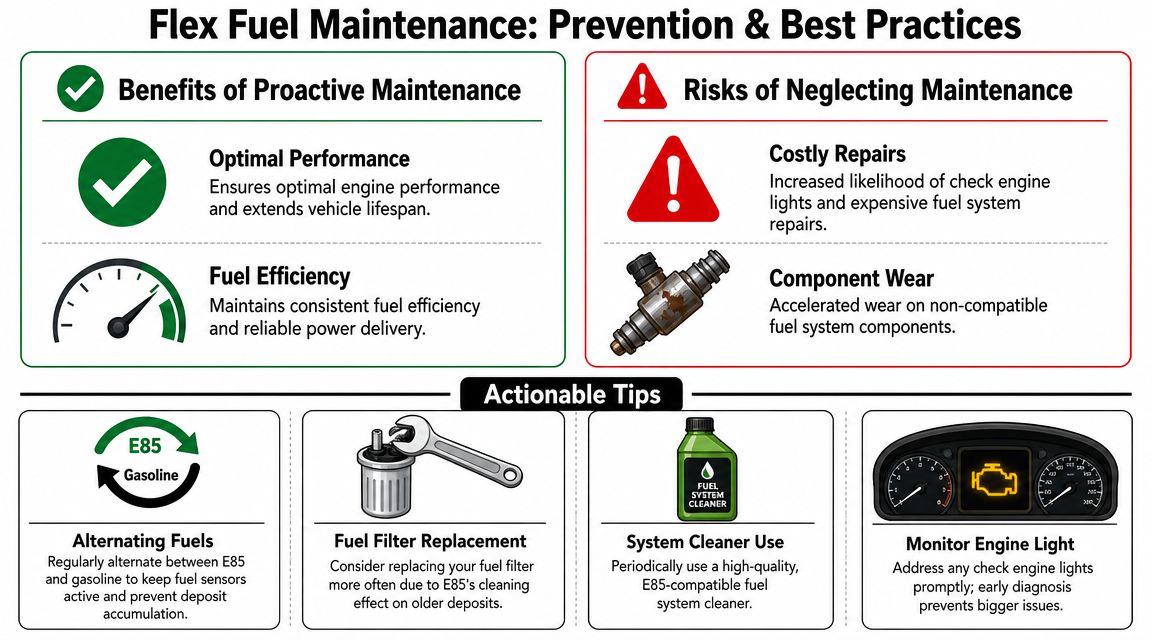
Habits that help
Some practical habits reduce risk:
- Alternate fuels when needed: If your owner information or service experience suggests the vehicle behaves better with periodic gasoline use, listen to that pattern.
- Stay ahead on fuel filter service: Ethanol's cleaning effect can move old contamination through the system.
- Address warning lights early: Waiting usually turns a drivability issue into a parts issue.
- Use only products labeled for ethanol-compatible fuel systems: That applies to replacement parts and any additive you choose.
This is also a good point to watch a basic visual explainer on flex fuel maintenance and E85 use:
Is E85 actually worth it
Owners often make an incomplete calculation. They compare only pump price. That's incomplete. A local report notes that E85 has about 27% less energy and that maintenance costs can also increase, which changes the actual economics. The better question is not whether E85 works, but when it is financially rational for your vehicle, your driving habits, and your local fuel access (ABC30 report on E85 economics and maintenance trade-offs).
A better break-even mindset
Use this simple framework:
- Start with range loss: If you're filling up more often, the pump discount may not be enough.
- Add inconvenience: If E85 stations aren't on your normal route, your time has a cost.
- Factor in maintenance risk: If the vehicle already shows fuel-system sensitivity, savings at the pump may disappear later at the shop.
- Judge by your own vehicle's behavior: Some FFVs tolerate E85 well. Others signal quickly that they prefer limited use.
A fuel is only cheaper if the total cost per mile stays lower after you account for mileage, maintenance, and availability.
Owners who do this math often decide to use E85 selectively rather than constantly. That tends to be the smarter approach.
How Flex Fuel Problems Affect Vehicle Value and Insurance Claims
This is the part most mechanical articles skip. Flex-fuel trouble doesn't stop at the repair order. It affects what your vehicle is worth and how strong your insurance claim looks.
Why value drops faster than owners expect
Repeated fuel-system complaints leave a paper trail. Service invoices for lean codes, pump replacement, injector cleaning, hard-start complaints, or rough idle concerns can make the next buyer cautious. Dealers do the same thing. They don't need proof that the issue is chronic. They only need enough history to discount the car.
If the vehicle is later totaled, that history can also show up in the insurer's assessment of pre-loss condition. The carrier may argue that the car already had drivability or mechanical concerns unrelated to the accident. That can push the valuation down.
How claim disputes happen
A common dispute looks like this:
- You know the crash damaged the vehicle and reduced its value.
- The insurer reviews prior records and spots fuel-system complaints.
- The insurer argues that some condition issues were pre-existing wear, not accident-related loss.
- Your settlement offer comes in lower than expected.
That's why fair market value matters so much in claim handling. If you want a plain-language explanation of how insurers and policyholders think about that baseline, how to determine fair market value is a useful reference.
Diminished value and pre-existing condition arguments
If your vehicle wasn't at fault in an accident, you may also be dealing with post-repair value loss. That's where pre-existing mechanical history becomes a pressure point. The insurer may try to use prior flex-fuel complaints to weaken a diminished value claim even if the collision damage is separate.
Understanding diminished value after an accident helps you see why documentation matters so much. Maintenance records, diagnostic reports, and a clear before-and-after condition story can make the difference between a supported claim and a weak one.
A well-documented file doesn't erase prior issues. It separates them. That separation is what protects your settlement.
If an insurer is undervaluing your total loss or using pre-existing mechanical issues to undercut your claim, Total Loss Northwest can help you challenge that number with an independent appraisal. They specialize in diminished value and total loss appraisals, and their reports are built to support real negotiations, not just software-generated estimates.