You picked up your car from the body shop, the panels line up, the paint looks clean, and the insurer acts like the problem is over. It isn't. The car now carries an accident history tied to its VIN, and buyers, dealers, and appraisers treat that history as a value hit even when the repairs were done correctly.
That's why people search for a GA diminished value calculator right after repairs are finished. They want a fast number. That makes sense. The mistake is thinking that number is what the insurance company will fairly pay.
In practice, a free calculator is only useful if you understand what it's built to do, what it leaves out, and how insurers use the same logic to shrink your claim. If you want a better outcome, you need more than a formula. You need a valuation strategy.
Your Repaired Car Is Worth Less and Here Is Why
A repaired car can still be worth less for one simple reason. Accident history follows the vehicle. Once that history shows up on reports like Carfax or AutoCheck, many buyers treat the car differently. They negotiate harder, trade-in offers drop, and some shoppers walk away entirely.
That loss is what diminished value is about. It is the difference between what the vehicle was worth before the wreck and what it is worth after proper repairs because the market now sees it as an accident vehicle. A useful overview of that claim concept is available in this guide to vehicle diminished value.
What owners usually notice first
Most drivers don't discover diminished value in a legal document. They discover it when:
- A dealer softens the trade offer: The car looks fine, but the history report changes the offer.
- A private buyer hesitates: The first serious question is no longer mileage or maintenance. It's whether the car was wrecked.
- The insurer says repairs made you whole: That sounds neat on paper, but it doesn't match how the resale market works.
A body shop repairs the car. It does not erase the accident.
There's another practical issue. Repair quality matters, and so does proof of repair quality. If you're trying to document prior work or evaluate refinish work, tools used for measuring car paint depth can help identify repainted panels and support a closer look at what was repaired.
What a calculator can and cannot tell you
A Georgia diminished value calculator can give you a rough starting estimate. That's useful if you need a quick baseline before calling the insurer. It is not the same thing as a market-backed valuation.
The hard truth is that the insurer already has its own preferred method, and that method is designed to control payouts. If you walk into the claim with only a free online estimate, you're usually bringing a flashlight to a floodlight fight.
How Insurers Actually Calculate Diminished Value in Georgia
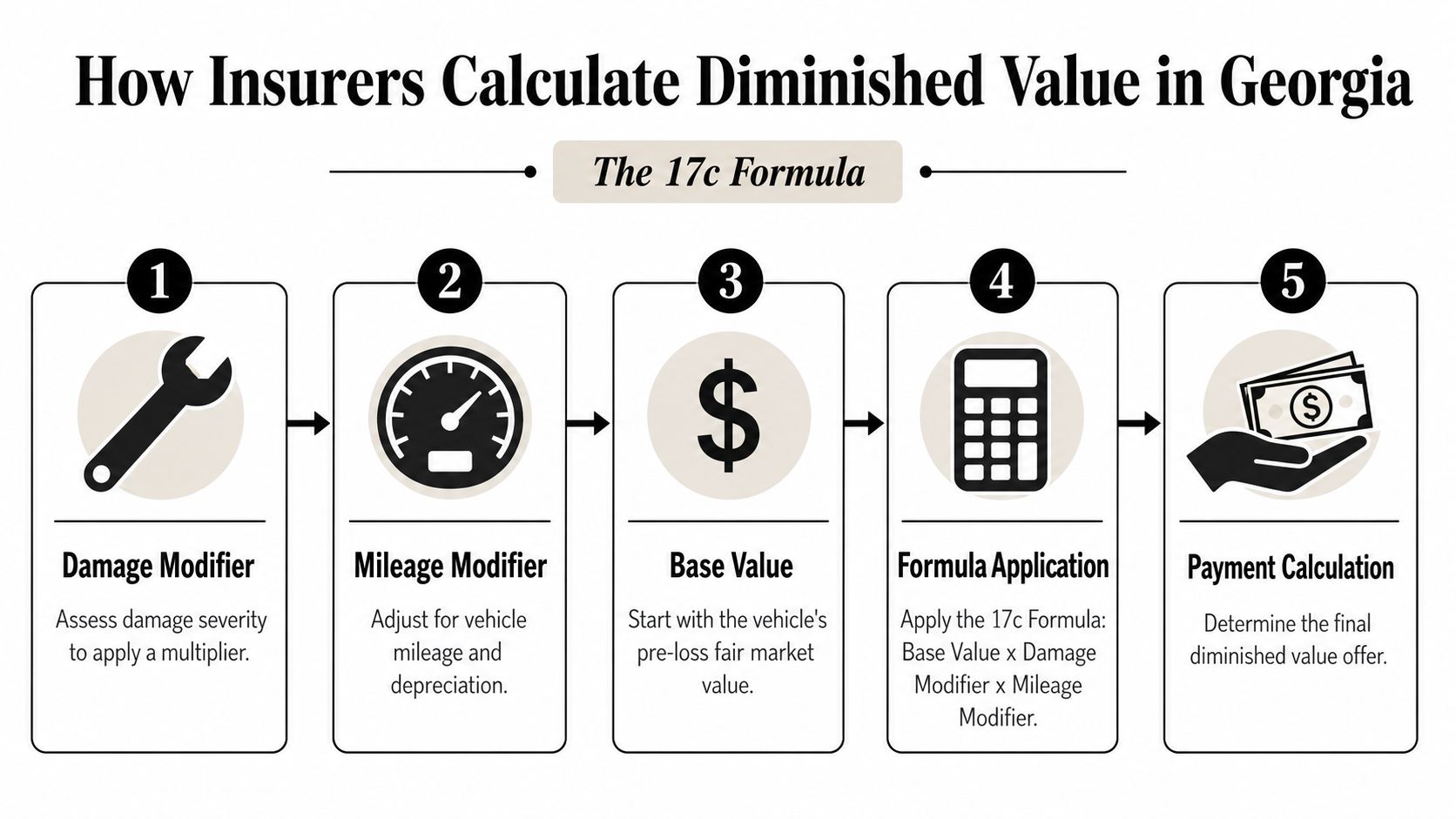
Insurance companies in Georgia usually don't start with the actual resale market. They start with the 17c Formula, a method widely used by insurers that caps the maximum diminished value recovery at 10% of the vehicle's pre-accident market value, then reduces that amount further with damage and mileage multipliers, as explained in this breakdown of the 17c Formula and insurer calculations.
If you're dealing with a Georgia claim, it helps to review a more detailed discussion of the diminished value claim process in Georgia alongside the formula itself. The formula sounds objective. The payout usually isn't.
The cap comes first
The first reduction happens immediately. The formula does not begin by asking what the market took away from your car. It begins by imposing a ceiling.
Under 17c, the maximum possible diminished value is capped at 10% of the pre-accident market value in the insurer-standard calculation described at National Workers Comp Authority. On a $25,000 vehicle, that cap is $2,500 in that same explanation.
That means the formula has already limited the discussion before anyone talks about the actual stigma attached to the vehicle.
Then the damage multiplier cuts it again
After the cap, insurers apply a damage multiplier. The scale commonly used in the 17c method is:
| Damage level | Multiplier |
|---|---|
| Severe structural damage | 1.00 |
| Major damage to structure and panels | 0.75 |
| Moderate damage | 0.50 |
| Minor damage | 0.25 |
| No structural damage or replaced panels | 0.00 |
Those multiplier levels are part of the insurer-standard framework summarized at National Workers Comp Authority.
Many owners get trapped. They know the repair was expensive, but the adjuster places the damage in a lower category than expected. Once that lower multiplier is applied, the claim shrinks fast.
Practical rule: If you don't know whether the repairs involved structural components, subframe work, or panel replacement, don't guess. Read the estimate line by line.
Mileage reduces the number one more time
The final step is the mileage multiplier. The higher the mileage, the lower the insurer's number tends to go. That makes the formula especially tough on older daily drivers, even when they had strong market demand before the loss.
A common result looks like this:
- Start with pre-accident value: say the vehicle was worth $25,000.
- Apply the cap: the formula sets the maximum at $2,500.
- Apply damage severity: if the insurer uses 0.50 for moderate damage, the number drops.
- Apply mileage: the number drops again.
- Issue the offer: the final offer often has little resemblance to real-world resale loss.
That's why adjuster offers often feel disconnected from what you know the car lost in the market. The formula isn't built to measure the market first. It's built to narrow the claim.
Using an Online GA Diminished Value Calculator Correctly
A calculator is still useful if you use it for what it is. It's a baseline tool. Nothing more. If you feed it bad inputs, you'll get a weak number and a weaker negotiation position.
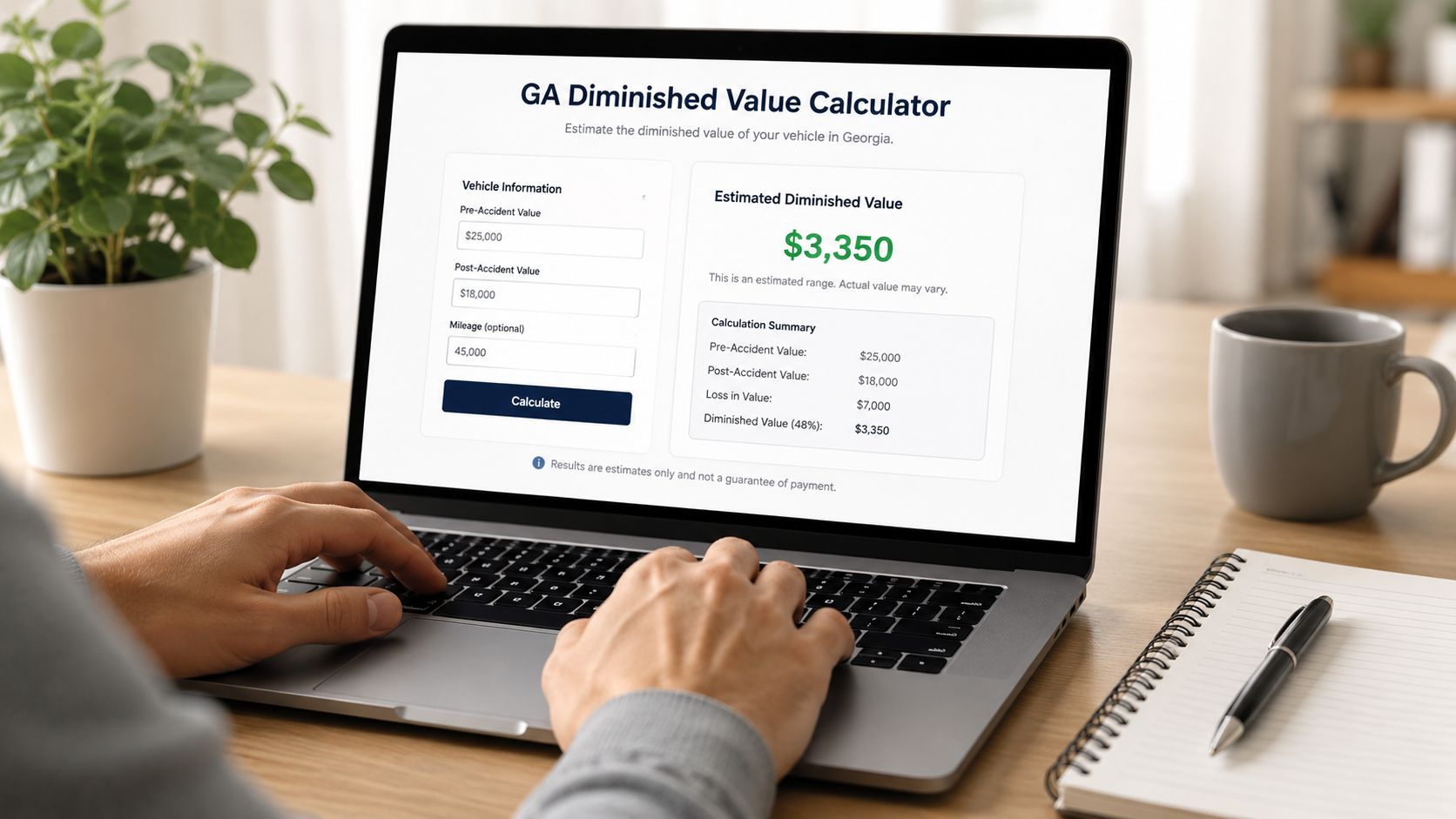
If you want a simple place to start, use a diminished value claim calculator only after you've gathered the underlying records. Don't start with the calculator. Start with the file.
Gather the right inputs first
Before entering anything, collect these items:
- Pre-accident value support: Use a KBB or NADA reference that reflects the vehicle's condition, trim, and equipment before the crash.
- Mileage at the time of loss: Don't use today's odometer if the accident happened months ago.
- Final repair estimate and invoice: You need the actual repair scope, not a vague summary.
- Photos before and after repairs: These help clarify whether damage was cosmetic, panel-related, or structural.
- VIN and exact configuration: Trim level matters. Options matter. Drivetrain matters.
Be careful with the damage category
Most online tools ask you to choose a damage level. That single selection can swing the result. Owners often overstate or understate it because the labels are broad and the repair paperwork is technical.
Use the body shop estimate to answer questions like:
- Were panels replaced or repaired?
- Was there structural work?
- Was there suspension-related impact?
- Did the repair include weld points, pulls, or frame measurements?
If the estimate is hard to read, ask the shop manager to explain the repair path in plain English before you choose a category.
Treat the output like a draft number
When the calculator gives you a result, save it. Screenshot it. Keep it in your file. Then label it correctly in your own mind: starting estimate.
It's good for orientation. It's not good enough to stand alone if the insurer pushes back, says the repairs restored value, or sends a low offer built on its own internal assumptions.
Why Your Calculator Result Is Just a Starting Point
Most Georgia diminished value calculators use the 17C formula, which caps loss at 10% of retail value, while professional appraisers often rely on the Market Comparison Method to compare identical accident-free vehicles with similar vehicles that carry accident history and reveal a larger real-world price gap, as described in this analysis of Georgia diminished value methods.
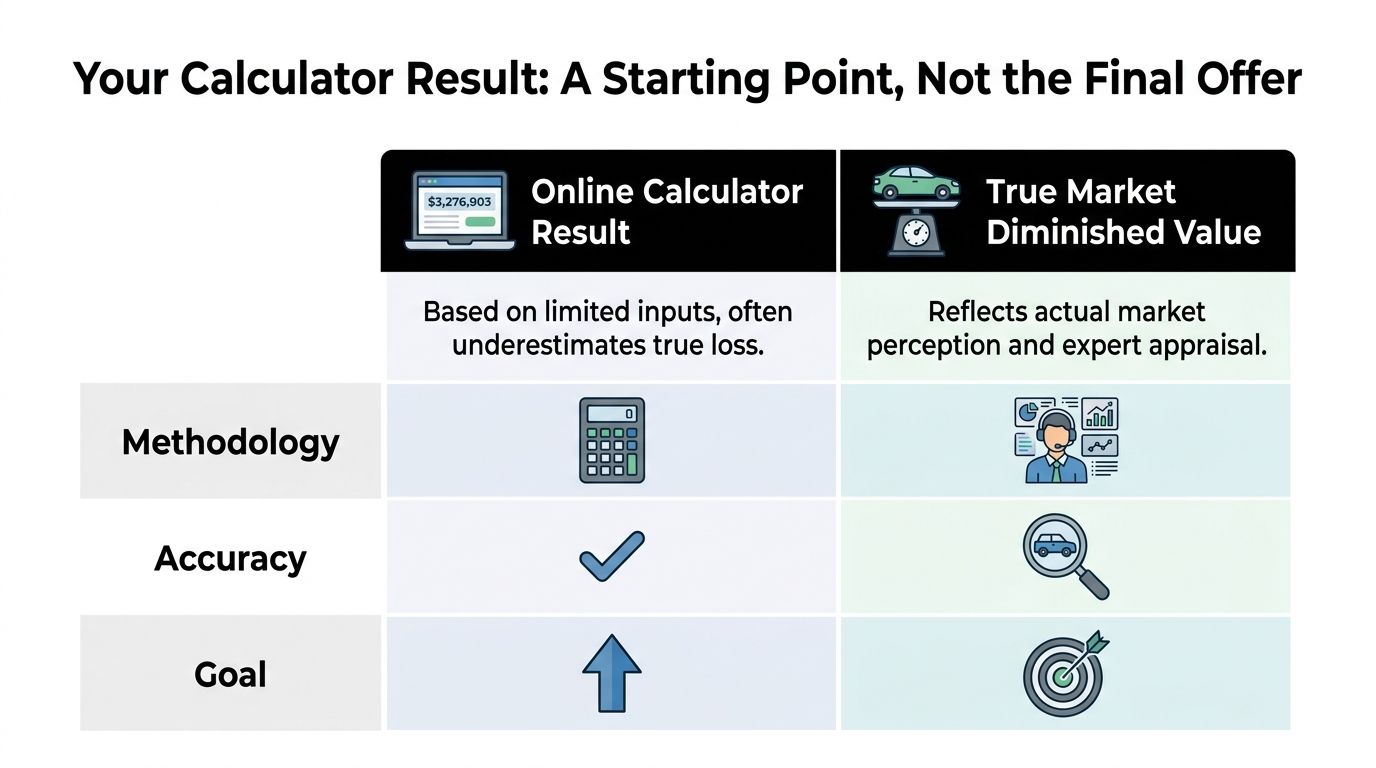
That difference matters because calculators are usually built to mimic the insurer's preferred shortcut. The market comparison approach asks a different question. What are buyers and dealers doing in the actual market with vehicles like yours?
Formula logic versus market evidence
The 17c approach is tidy. It uses a cap, a damage multiplier, and a mileage adjustment. That makes it easy to process claims at scale. It also makes it easy to ignore what your exact vehicle, trim, and accident history would do to resale value in the market you sell in.
The market comparison method is more work. It requires reviewing comparable listings and valuations for similar vehicles, then separating accident-free units from history-flagged units. That takes time, but it tracks the issue that matters most: buyer behavior.
Here's the cleanest way to understand this:
| Approach | What it relies on | What it often misses |
|---|---|---|
| Online calculator | Formula inputs | Real buyer resistance to accident history |
| Insurer offer | Internal valuation rules | Trim-specific and market-specific resale loss |
| Independent appraisal | Comparable market evidence | Less likely to ignore vehicle-specific facts |
Why insurers like calculator-style numbers
Insurers prefer methods they can apply consistently across a large volume of claims. A standardized formula gives them speed and predictability. It also keeps discussions centered on their model instead of the resale market.
That's why many owners get stuck arguing over categories and multipliers instead of proving the actual post-repair value loss. The conversation starts inside the insurer's box. Once that happens, the ceiling is already low.
Your job isn't to admire the formula. Your job is to prove the loss.
What works better in a dispute
If the insurer's number feels disconnected from the car's real stigma in the market, the stronger move is to build a valuation based on comparable vehicles with and without accident history. That approach tends to be more persuasive because it ties the claim to actual buying conditions instead of a preset cap.
This is the turning point in most claims. Stop asking, “What does the calculator say?” Start asking, “What evidence shows what my vehicle would bring in the market today?”
Building Your Claim and Negotiating with Insurers
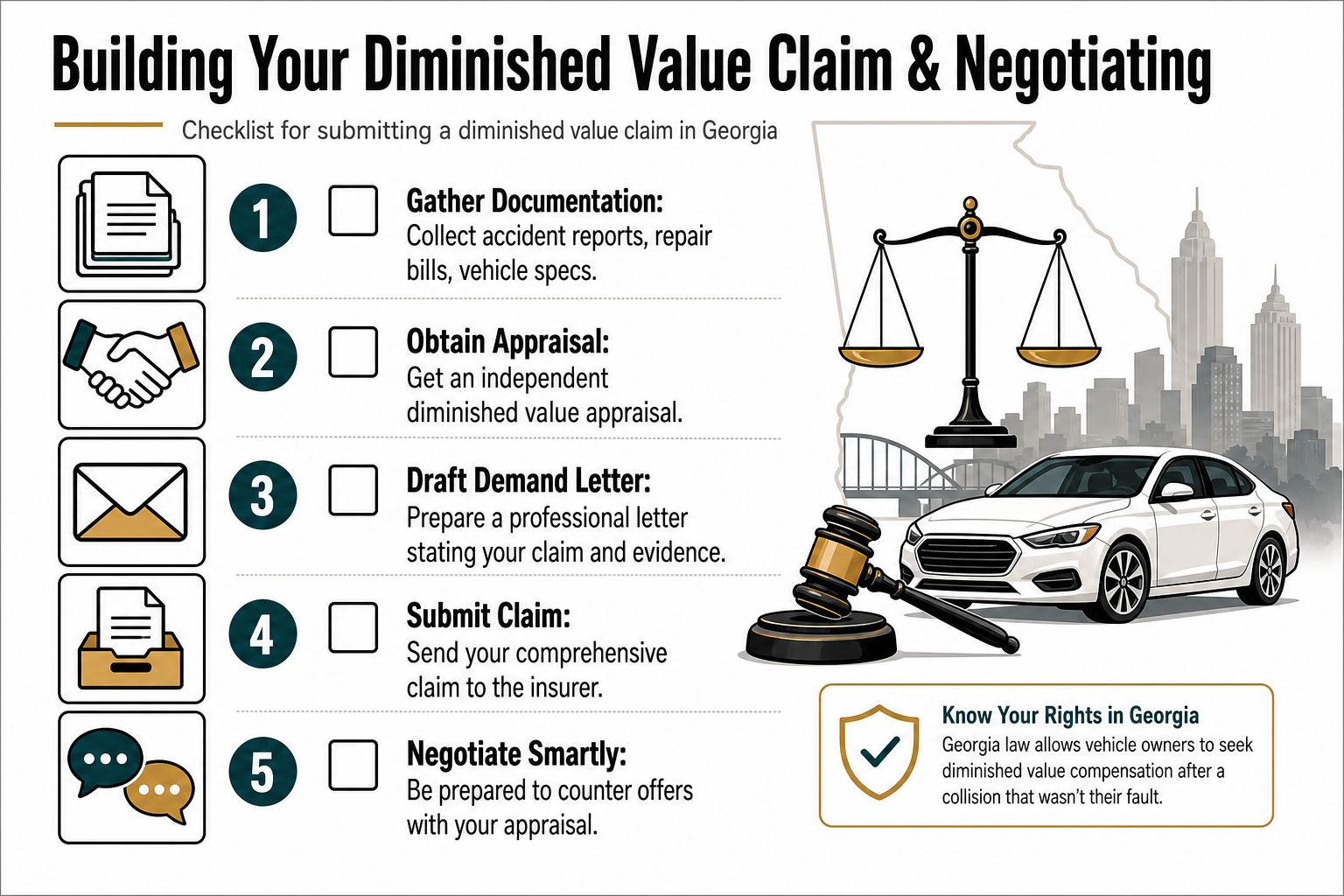
Drivers often recover between 10% to 20% of their vehicle's fair market value where diminished value claims are legally permitted, while insurer formulas like 17c often keep offers at the lower 10% cap, and if the offer is too low, the Appraisal Clause can be used to force an independent valuation, as explained in this guide on how much diminished value you may have.
Start with a complete claim package, not a phone call and a complaint. Adjusters respond better to organized evidence than frustration.
The file you want on your desk
Build your claim with documents that answer the adjuster's next question before they ask it:
- Accident and ownership records: Police report, claim number, registration, and proof that you owned the vehicle at the time of loss.
- Repair documentation: Final invoice, estimate, supplement sheets, and any frame or structural measurement paperwork.
- Photos and history records: Damage photos, post-repair photos, and the vehicle history entry once it appears.
- Pre-loss value support: KBB or NADA materials that show the vehicle's baseline value before the accident.
- Market evidence: Comparable listings, trade indications, or an appraisal report that addresses accident stigma directly.
What insurers usually say
Adjusters tend to use a few familiar positions.
One is that the repairs restored the vehicle, so there's no further loss. Another is a small initial offer meant to test whether you'll accept a quick close. A third is delay. More paperwork requests. More review. More waiting.
You don't need to match that with emotion. You need to answer it with structure.
Negotiation note: A low first offer doesn't tell you what the claim is worth. It tells you how the insurer wants the negotiation to start.
How to respond effectively
Use a short, professional demand letter that does three things:
- States the claim clearly: The vehicle suffered post-repair market stigma due to accident history.
- Summarizes the evidence: Reference your repair records, pre-loss value support, and market comparison material.
- Asks for review of the valuation: Don't just reject the number. Show why it fails to reflect the vehicle's actual market loss.
If the claim involves broader property damage or injury issues at the same time, it helps to understand how attorneys frame settlement pressure points. This guide on how to maximize your car accident settlement is useful for understanding the bigger negotiation picture.
Later in the process, this video gives a practical overview of the claim dynamic:
When to bring up the appraisal clause
If the insurer won't move off a formula-driven number and your evidence supports a larger loss, the appraisal clause becomes important. That's the point where the discussion shifts away from the insurer's software and toward an independent valuation process.
Don't threaten it casually. Raise it when you're prepared. By then, your file should be complete, your position should be documented, and your demand should be specific.
When to Hire a Certified Appraiser for Your GA Claim
Some claims can be handled with a calculator, a repair file, and persistent follow-up. Some can't. The line becomes clear when the value issue is technical enough that the insurer can hide behind its own process unless someone qualified pins the loss to real market evidence.
In Georgia, diminished value claims generally require the vehicle to be repairable and repaired, and a vehicle declared a total loss typically falls outside a traditional diminished value claim and becomes a dispute over the total loss settlement instead, as outlined in this explanation of how to file a diminished value claim in Georgia.
Cases where DIY often falls short
A certified appraiser becomes much more important when:
- The vehicle is high-value or specialized: Luxury trims, collector vehicles, and custom builds don't fit neatly into generic calculator logic.
- The repairs involved structural damage: Once the repair path gets technical, the insurer has more room to minimize severity.
- The insurer has stopped negotiating in good faith: If every response circles back to an internal formula, you need stronger valuation support.
- The resale stigma is obvious but hard to quantify: Some vehicles are hit harder in the market after an accident, especially when buyers in that segment are selective.
What the appraiser adds
A credible appraiser doesn't just give you a number. The appraiser builds the logic behind the number. That usually means reviewing repair records, confirming vehicle configuration, analyzing market comparables, and producing a report that can survive scrutiny.
That's the key difference. A calculator gives you an output. An appraiser gives you an argument.
If the dispute is significant, the report matters as much as the conclusion.
Don't confuse diminished value with a total loss fight
This is one of the most common points of confusion. If the insurer declared the vehicle a total loss and bought it out, you're usually not in a diminished value claim anymore. You're in a total loss valuation dispute.
That distinction matters because the strategy changes. A diminished value calculator won't solve a bad total loss offer. In that situation, the valuation fight centers on what the vehicle was worth before the buyout, not what it was worth after repair.
If you're dealing with a low diminished value offer or a total loss valuation that doesn't reflect the actual market, Total Loss Northwest can help you challenge the insurer with an independent appraisal. They specialize in diminished value and total loss auto appraisals, invoke the appraisal clause when needed, and provide market-based reports that give drivers a stronger position in negotiations.