Most advice about how to get a salvage title in ohio starts at the title office. That's backwards.
Your first problem usually isn't the Clerk of Courts. It's the insurance valuation. If you accept a weak total loss offer too fast, you can lock in a bad financial outcome before the paperwork even starts. Once the vehicle gets branded, your negotiating position changes, your resale options narrow, and the math often gets worse.
I look at this the same way I look at any disputed total loss file. First, protect value. Then deal with title status. If the salvage title is unavoidable, handle it cleanly and keep a perfect paper trail. Ohio's process isn't impossible, but it punishes sloppy documentation and rushed decisions.
Your First Move After a Total Loss Declaration
If the insurer says your car is a total loss, don't treat that as the final word.
Treat it as an opening position. Insurers rely on valuation systems that don't always capture upgrades, rarity, condition, service history, or local market reality. That matters for ordinary daily drivers, and it matters even more for collector, specialty, and well-kept vehicles.
Don't surrender the title too early
A lot of owners make the same mistake. They hear "totaled," sign paperwork, hand over the title, and start asking how to get a salvage title in ohio. That's often too soon.
Before you surrender anything, review:
- The valuation report: Check comparable vehicles, trim level, mileage, condition adjustments, and options.
- Your policy language: Look specifically for the Appraisal Clause.
- Your repair-versus-value position: Sometimes the insurer's number is the primary problem, not the vehicle.
If you need a plain-English primer on the broader insurance side, this guide on what to do when your car is a total loss is a useful starting point.
Use the Appraisal Clause when the offer is wrong
The Appraisal Clause is one of the most overlooked tools in this whole process. It lets you bring in an independent appraiser to challenge the carrier's number. That's not a loophole. That's a contractual right when your policy includes it.
Practical rule: If the insurer's value feels light and you haven't transferred title yet, stop and verify the number before you accept the salvage path.
An independent appraiser can change the outcome. If you're dealing with a disputed total loss valuation, this resource on what to do with a totalled car lays out the options before you commit to the title process.
The right question isn't "Can I get a salvage title"
The right question is whether you should accept the insurer's valuation first.
If the appraised market value comes in higher than the carrier's offer, that may improve your settlement enough to change your decision on keeping or releasing the vehicle. Even if the car still ends up branded, you don't want to walk into that outcome after taking a discounted payout.
My advice is simple:
- Get the insurer's valuation report.
- Audit every comparable vehicle.
- Check your policy for an Appraisal Clause.
- Decide the title path only after the value fight is handled.
Owners lose money when they reverse that order.
Understanding When a Salvage Title Becomes Mandatory
In Ohio, a salvage title isn't just an insurance label. It's a legal title status, and once the trigger is met, the state wants the branding handled correctly.

What usually triggers the salvage requirement
Ohio issues a salvage title when a vehicle is declared totaled by insurance, typically when repair costs exceed its actual cash value under Ohio law. That's the practical point where title branding becomes part of the process, not a side issue.
The key distinction is this:
| Issue | What it means |
|---|---|
| Insurance company total loss decision | The carrier decides the vehicle is uneconomical to repair under its claim handling process |
| Ohio salvage branding requirement | The title must be surrendered and branded when the vehicle meets the legal standard for salvage treatment |
That gap matters. Insurers use their own valuation methods and internal thresholds. Ohio cares about title status and record integrity.
If you want to understand how total loss standards differ by state before you make a keep-or-release decision, review this breakdown of total loss threshold by state.
The NMVTIS issue catches owners off guard
One of the biggest traps in Ohio is historical branding.
Since Ohio's BMV integrated with NMVTIS data, clean titles can be retroactively branded as salvage without physical inspection if a prior history report flags a total loss event, hail damage, or auction sale, which creates major problems for owners and dealers (Ohio title office guidance).
That means a vehicle can look clean on paper until a title transaction exposes an old event in the background record. Then the state can force the salvage brand even if the car currently looks fine and has been on the road for years.
If the record says the vehicle was previously reported as a total loss, arguing that it "looks repaired" won't fix the paperwork problem.
When the salvage title becomes unavoidable
At that point, arguing with the clerk won't help. The title office isn't re-litigating the accident or your insurer's valuation. It's processing the title status reflected by Ohio law and the data tied to the VIN.
Expect the salvage title path to become mandatory when:
- Insurance has declared the vehicle a total loss and the title must be surrendered for branding.
- Historical NMVTIS data surfaces during a title transaction.
- You retained the vehicle after settlement and need to put the title in the correct branded status.
What owners get wrong
I see three recurring mistakes.
- They confuse a claim dispute with a title dispute. Those are separate fights.
- They assume a clean paper title means a clean title history. In Ohio, that can fall apart during processing.
- They wait too long to organize records. If the title later needs to move from salvage to rebuilt, missing ownership proof becomes a real problem.
My recommendation
Run your strategy in this order:
- Challenge the insurer's number if it's low.
- Confirm whether the vehicle's record already carries a prior loss history.
- If salvage branding is required, accept that reality early and document everything from day one.
The people who get burned are usually the ones who assume title branding is optional until the state tells them otherwise.
How to Secure Your Initial Ohio Salvage Certificate
Once the salvage designation is unavoidable, stop overcomplicating it. The first phase is administrative. You're not proving the car is repaired yet. You're getting the vehicle properly branded.

What to bring to the title office
For the initial salvage certificate of title, gather the basics first:
- Your original title
- Valid identification, such as a state-issued ID or passport
- Any required application paperwork the title office asks you to complete
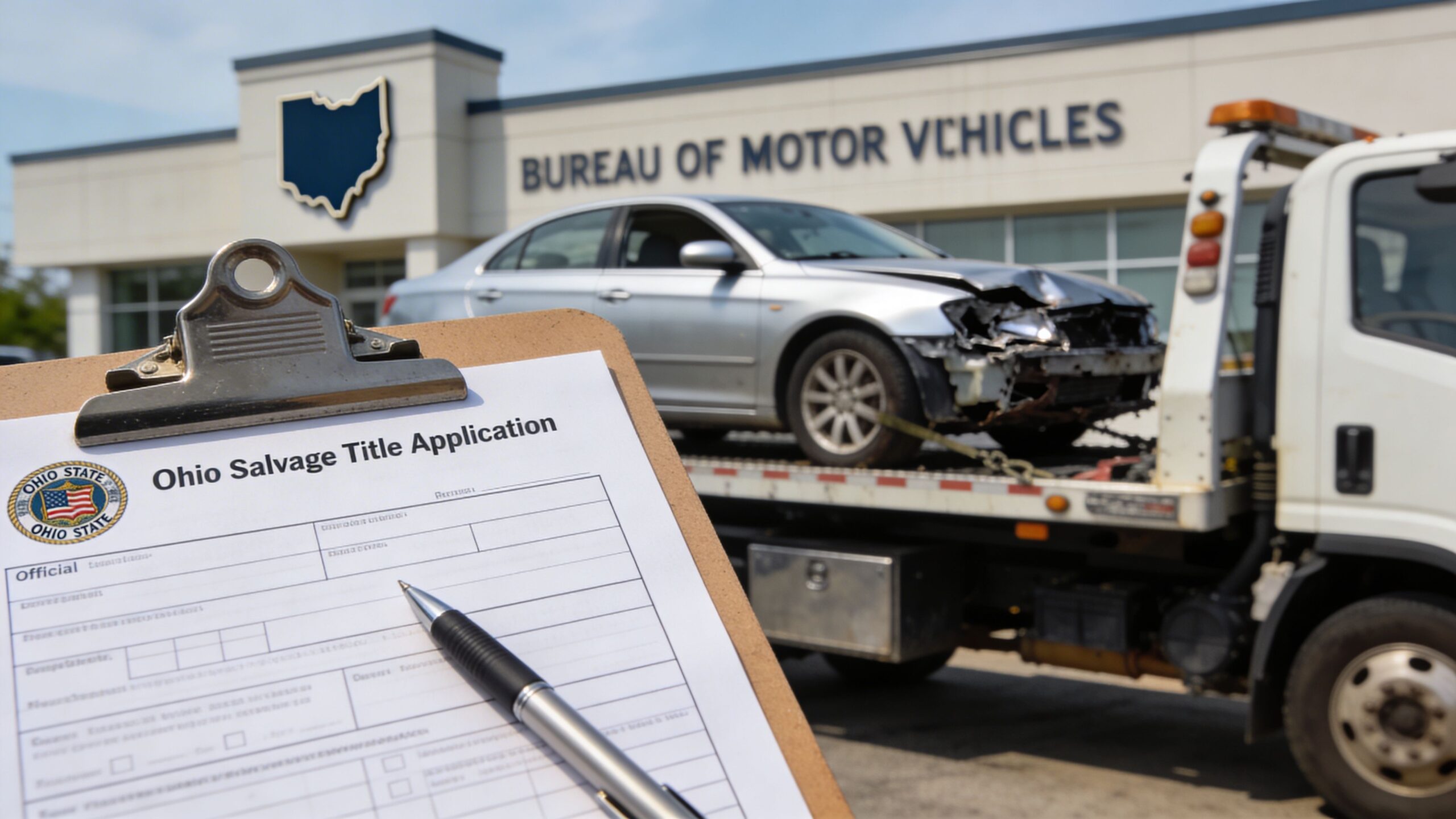
You take those materials to an Ohio Clerk of Courts Title Office and surrender the existing title for salvage branding. For this initial branding step, the process doesn't require a prior inspection.
That's good news, because it means you can handle the title issue before the rebuild phase starts.
What to say at the counter
Keep it simple. Tell the clerk you're applying for a salvage certificate of title for a totaled vehicle.
Don't bury the issue in a long story about the accident, who hit whom, or what the shop said. The title counter is there to process documents, not evaluate your claim.
A clean office visit usually looks like this:
- Present your ID.
- Surrender the original title.
- Complete the application the clerk provides.
- Confirm the vehicle will be titled as salvage.
The major limitation many ignore
Once the salvage certificate is issued, the vehicle is not street-legal.
Under Ohio Revised Code 4505.11(G), license plates can't be transferred to or issued for the vehicle, which means you can't legally drive it on public roads until it passes rebuild inspection and receives a new title.
Don't "just drive it to the shop" after salvage branding. Tow it. That's the compliant move.
What this first title does, and doesn't do
Here's the practical difference:
| Title status | What you can do | What you can't do |
|---|---|---|
| Salvage certificate | Prove ownership of a salvage vehicle and move into the repair and inspection path | Register it, plate it, or drive it on public roads |
| Rebuilt salvage title | Move toward registration and normal road use after approval | Erase the salvage history |
Common mistakes at this stage
This phase is straightforward, but owners still create headaches for themselves.
- Handing in incomplete ownership paperwork: If your title paperwork is messy, fix that first.
- Assuming the salvage certificate is a temporary registration document: It isn't.
- Starting repairs without creating a parts file: The first title step is the best time to set up a receipt folder you'll need later.
My recommendation on recordkeeping
Create one physical folder and one digital backup the same day you get the salvage certificate. Use sections for:
- title documents
- insurer paperwork
- photos of the damage
- receipts for every replacement part
- towing and shop invoices
That sounds basic, but it saves people when the inspection stage gets strict. Ohio doesn't reward memory. It rewards paperwork.
If your goal is to learn how to get a salvage title in ohio, this is the part most guides stop at. That's not enough. The hard part isn't getting branded. The hard part is getting back to road-legal status without failing inspection over missing documentation.
The Path from Salvage to Rebuilt: A Guide
Many owners either get organized or get stuck at this point.
Repairing the vehicle is only half the job. The other half is proving every major component came from a legitimate source and belongs on that car. If your paperwork is weak, the rebuild can be mechanically sound and still fail.

Start with the inspection receipt
Before you schedule the rebuild inspection, you need a $50 prepaid inspection receipt, plus any registrar fees, from a BMV Deputy Registrar. That receipt is the gatekeeper for the inspection process.
Get it early. If your area has scheduling pressure, waiting until the vehicle is fully repaired can cost you more downtime than necessary.
Think like the inspector, not like the owner
Ohio State Highway Patrol isn't just checking whether the car runs. The inspection focuses on documentation, identity of parts, and whether the vehicle appears to have been rebuilt with legally obtained components.
The official rule that trips people most often is simple. To pass the Ohio State Highway Patrol inspection, you must present original receipts for all replaced major components, and for used parts such as an engine or transmission, the receipt must include the VIN of the source vehicle (OSHP salvage inspection requirements).
That single requirement wipes out a lot of casual rebuilds.
What belongs in your rebuild file
Your paperwork package should be obsessive. I mean that as a compliment.
Use this checklist:
- Salvage title in your name: Assigned titles create problems. Get ownership straight first.
- Original receipts for major components: Engines, transmissions, doors, frame sections, airbags, and similar parts need clear documentation.
- VIN-specific receipts for used parts: If a dismantler or yard gives you a vague invoice, fix it before inspection day.
- Manufacturer's certificates for kits or new assemblies: If applicable, don't show up with generic packaging and hope for the best.
- Photo log of repairs: Optional, but useful when an inspector has questions about sequence or replacement work.
- Your ID and towing documents if needed: Keep the transport side clean too.
Buy parts from sellers who document properly. Cheap parts with bad paperwork are expensive parts.
Don't cut corners on parts sourcing
A lot of rebuild failures start at the moment someone buys a used component from a seller who can't or won't document where it came from. That's a paperwork problem now and a theft-risk problem later.
If you're refinishing repaired panels or replacement components, quality materials matter too. Owners and shops comparing coatings can review automotive refinishing products as part of the broader repair planning process, especially when appearance and surface durability matter after structural work is complete.
Get valuation advice before you overspend
This is also the point where owners often make a financial mistake. They spend heavily on repairs without revisiting whether the rebuilt vehicle will justify that investment.
An independent valuation review can help before you sink more money into the job. If you want that kind of analysis, Total Loss Northwest's total loss appraisal page explains how independent appraisals are used when owners need a market-based value assessment outside an insurer's internal system.
My rebuild standard
If I were advising a client face-to-face, I'd give them this rule set:
- Buy documented parts only.
- Keep originals, not screenshots alone.
- Scan every receipt the day you get it.
- Match every major part to a line item in your folder.
- Tow the vehicle until the title status is corrected.
People who treat the rebuild like a paperwork project usually get through. People who treat it like a casual garage job usually learn the hard way that Ohio is focused on documentation first.
Navigating the Ohio State Highway Patrol Inspection
Inspection day shouldn't be dramatic. If it feels dramatic, you're probably underprepared.
The smooth version starts before you leave home. The vehicle is loaded on a trailer or tow truck, your paperwork is sorted in order, and nothing in your file requires explanation because the documents already explain it.

What to bring on the day
Bring the vehicle and your documents as if you're presenting a case file.
Use this packing list:
- The rebuilt vehicle, transported legally, not driven on a salvage title
- Your Ohio salvage title
- Your prepaid inspection receipt
- Original parts receipts and supporting ownership documents
- Manufacturer paperwork for kits or new assemblies, if applicable
- Valid identification
- Any repair photos you kept during the rebuild
Don't hand the inspector a crumpled envelope full of invoices and expect patience.
What the inspector checks
The OSHP inspection isn't a cosmetic judging contest. The inspector is trying to answer two questions:
- Is this vehicle assembled with lawfully obtained parts?
- Does the repair work support safe return to the road?
That means they may check serial numbers, compare receipts to visible components, inspect welds and structural areas, and look closely at safety-related systems. If something doesn't line up, the process stops.
Why so many people fail the first time
The state doesn't publish official pass-rate data, but anecdotal dealer-association evidence suggests a 60 to 70 percent first-pass inspection rate, and nearly 40 percent of failures are tied to incomplete or missing VIN-specific receipts for used parts (OSHP salvage inspection guidance).
Those numbers tell you exactly where to focus. Most failures aren't because the inspector hates the car. They happen because the owner can't document the car.
Organize receipts in the same order the inspector is likely to review the vehicle. That removes friction and shows you're prepared.
What passing looks like
If the inspection goes well, you'll receive Form HP106. That's the paper that proves the rebuilt vehicle cleared the state inspection process.
From there, take:
- Form HP106
- your salvage title
- your identification
- any title-office paperwork they require
to the Clerk of Courts Title Office and apply for the rebuilt title.
Once the title office issues the rebuilt salvage title, you can move into normal registration and plate issuance. That's the moment the car comes back into lawful road use.
A clean inspection-day routine
Here's the version I recommend to clients:
| Stage | Smart move |
|---|---|
| Night before | Put receipts in order by component, then by date |
| Transport | Tow the vehicle and bring duplicate copies for your own reference |
| Check-in | Answer directly. Don't ramble |
| Inspection | Let documents do the work |
| After approval | Go straight to the title office and finish the process |
What not to do
Three habits sink inspections fast:
- Arguing about what "should be enough" when the receipt doesn't identify the donor VIN
- Showing up with copied or partial paperwork instead of originals
- Assuming a good repair excuses a bad paper trail
The inspector isn't there to rescue a disorganized rebuild. They're there to verify it.
If you've handled the title correctly, documented every component, and transported the vehicle legally, inspection day is manageable. If you haven't, Ohio will expose every shortcut.
Financial Realities and Common Rebuilt Title Pitfalls
A rebuilt title gets the car back on the road. It doesn't restore the vehicle to clean-title economics.
That's the part many owners resist. They focus on the win of passing inspection and ignore what happens after. Buyers care about the brand. Insurers care about the brand. Lenders care about the brand.
The value hit is real
According to NADA guides, a rebuilt salvage title can reduce vehicle value by 20 to 40 percent compared with a clean title, and owners should expect insurance premiums to be 50 to 100 percent higher initially, if they can find a carrier willing to write full coverage at all (OSHP salvage inspection guidance).
That means your rebuild decision has to be economic, not emotional.
If the vehicle is inexpensive, common, or hard to insure, the rebuilt route may not make financial sense unless you plan to keep it long term. If it's a specialty vehicle, the math can still work, but only if you controlled the purchase price, repair cost, and documentation from the start.
The pitfall list I see most often
These are the mistakes that cost people money after the title is fixed:
- Buying at auction without checking history carefully: You can inherit title complications and surprise branding issues.
- Over-repairing a low-value vehicle: Owners pour money into a car they could never resell well.
- Failing to digitize records: One lost receipt can become a resale or insurance headache later.
- Assuming full coverage will be easy: Some carriers will hesitate, limit coverage, or price it aggressively.
- Ignoring buyer psychology: Even a proper rebuild narrows your future market.
A blunt decision test
Ask yourself three questions before you continue with a rebuild:
- Do I plan to keep this vehicle long enough to spread out the financial hit?
- Can I document every major component cleanly?
- Am I rebuilding because the numbers work, or because I'm attached to the car?
If the answer to the third question is emotion, slow down and recalculate.
A rebuilt title can be a practical solution. It's rarely the best resale strategy.
My recommendation
Rebuild when one of these is true:
- you know the vehicle well,
- you can control repair quality,
- you have complete records,
- and you're prepared to keep it rather than flip it.
If your goal is maximum resale flexibility, a salvage-to-rebuilt project is usually the wrong vehicle strategy.
Frequently Asked Questions About Ohio Salvage Titles
Some issues don't fit neatly into the normal workflow. These are the questions owners ask when the process gets messy.
Quick answers that matter
| Question | Answer |
|---|---|
| Can I drive a car with a salvage title to the inspection? | No. Once the vehicle is on a salvage title, it isn't road-legal for normal public-road use. Arrange towing or trailer transport. |
| Do I need an inspection before getting the initial salvage certificate? | No for the initial branding step. The inspection comes later when you're trying to move from salvage to rebuilt. |
| What paperwork matters most for the rebuilt inspection? | Original receipts for replaced major components matter most. Used parts need source details that identify where they came from. |
| Can Ohio brand a title based on old history I didn't know about? | Yes. Historical record issues can surface during title processing and create branding problems even when the vehicle was previously used like a normal car. |
| Will a rebuilt title become a clean title later? | No. The rebuilt title allows legal road use after approval, but it doesn't erase the salvage history. |
| Should I accept the insurer's total loss offer before dealing with title issues? | Not automatically. Review the valuation first. If the number is low, challenge it before you lock yourself into a weaker financial outcome. |
| What if I lost a receipt for a used major component? | Try to get a corrected original from the seller before inspection. Missing source documentation is one of the fastest ways to create a failure. |
| Is rebuilding worth it for every totaled car? | No. It depends on value, repair cost, documentation quality, long-term ownership plans, and insurance availability. |
Final practical guidance
If you're dealing with Ohio salvage paperwork, don't rush because the insurer or a shop wants the file off the desk.
Handle the valuation fight first. Then handle the title correctly. Then rebuild only if the numbers still make sense.
That order protects your money better than the usual advice.
If you're being lowballed on a total loss and need an independent valuation before accepting a salvage outcome, Total Loss Northwest handles total loss and diminished value appraisal work and can help you understand whether the insurer's number reflects real market value.