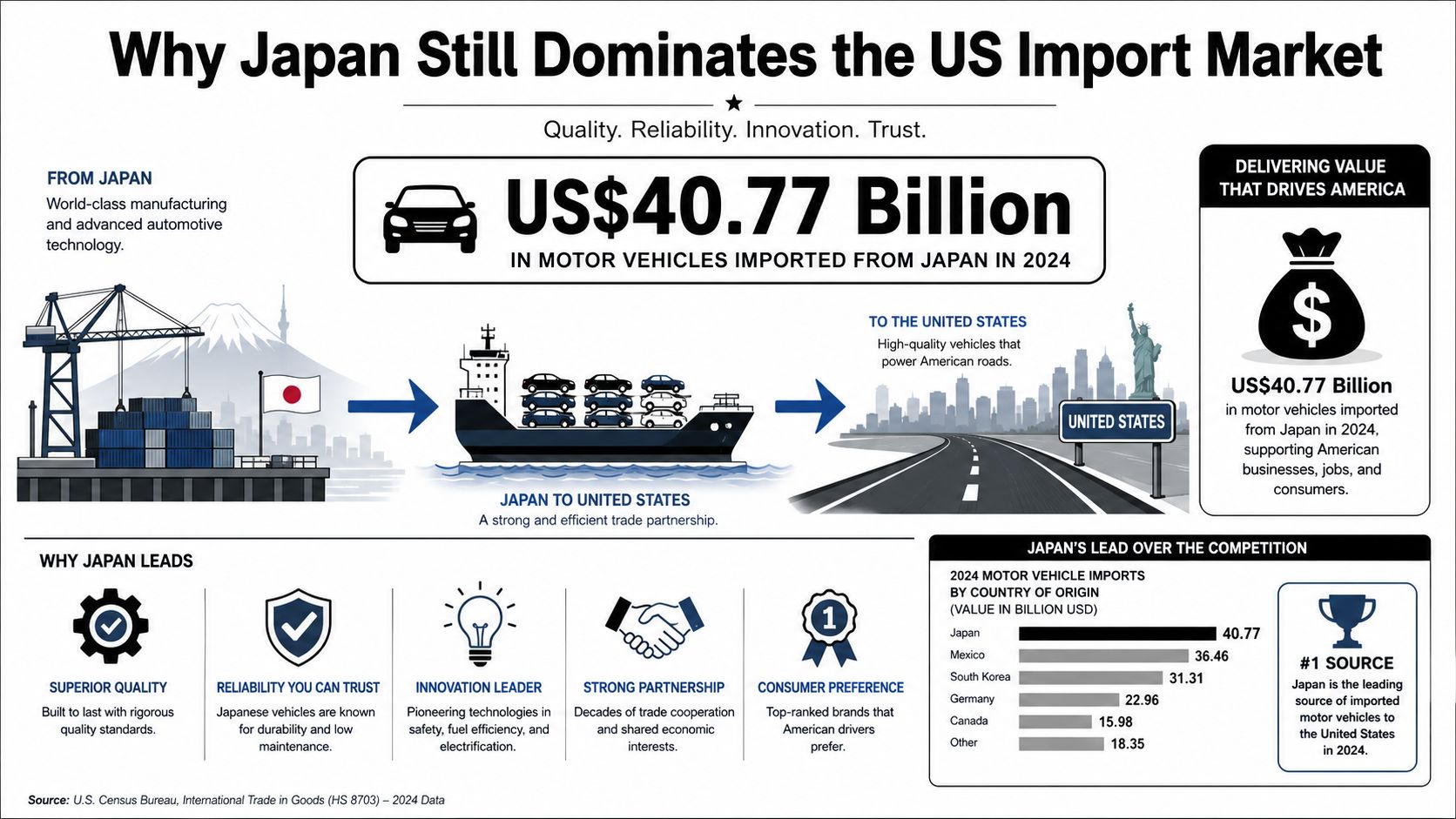
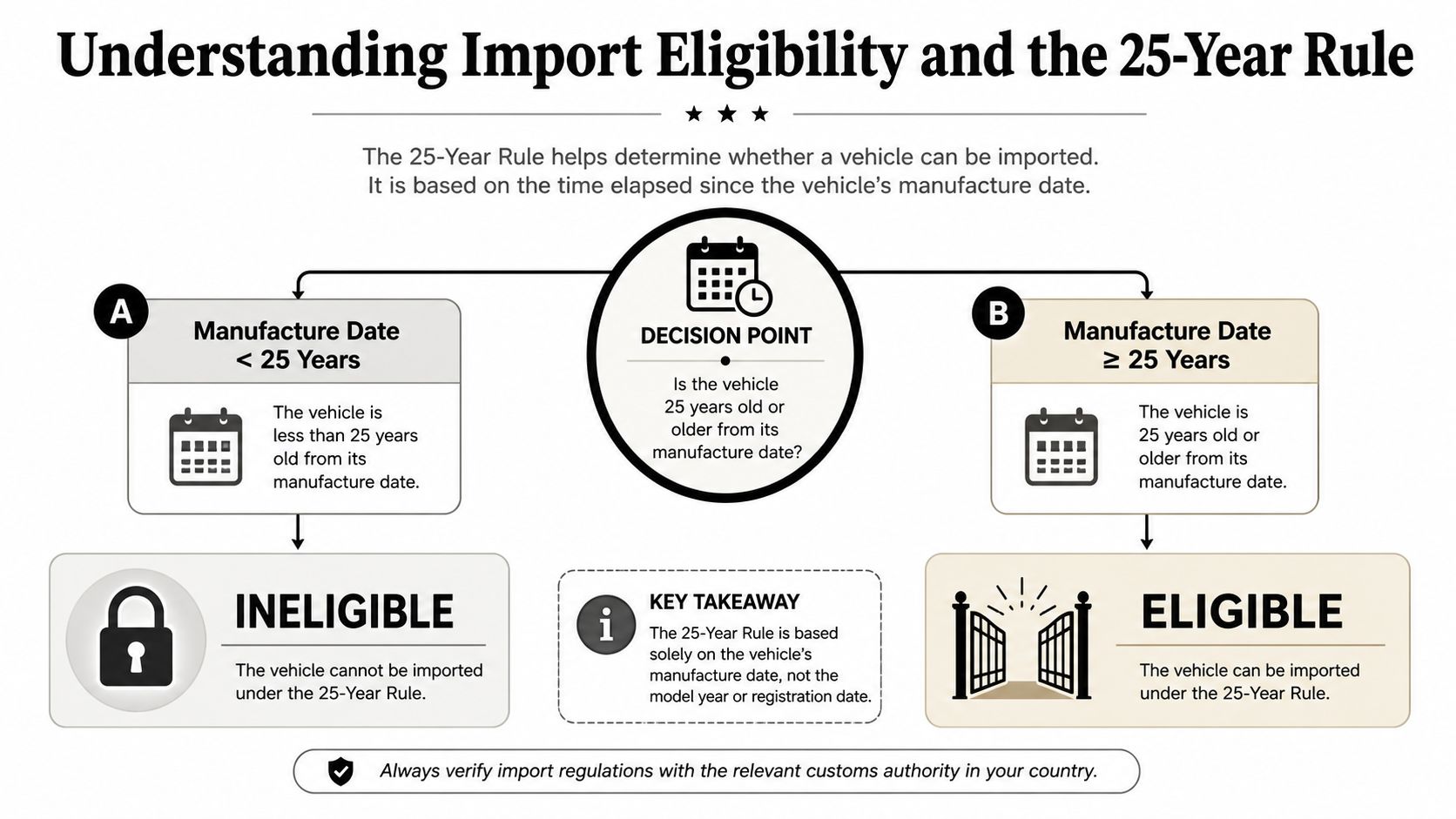
The United States imported US$40.77 billion of motor cars and vehicles for transporting persons from Japan in 2024. For any buyer looking at import cars Japan USA, the first fact that matters is simpler than the auction listing or the badge, a vehicle is only eligible 25 years after its actual month-and-year of manufacture, not its model year.
Japan's hold on the U.S. import-car market isn't a niche story, it's a mature trade lane with deep logistics, repeat buyers, and hard rules that punish sloppy date checks. The people who do this successfully don't start by asking whether the car looks old enough, they start by confirming the build date, then they work backward from there.
Why Japan Still Dominates the US Import Market
Japan's scale in the U.S. market is hard to miss. In 2024, the United States imported US$40.77 billion of motor cars and vehicles for transporting persons from Japan, which puts Japan among the largest suppliers to the American vehicle market. In broader 2025 trade reporting, Japan accounted for about 20.2% of U.S. spending on imported cars, or roughly US$37.1 billion, with only Mexico ahead of it (Trading Economics trade data).
That matters because volume changes the experience for the buyer. Freight lanes are established, brokers know the paperwork, and ports on both sides see enough Japanese vehicles that the process is routine rather than experimental. The market is large enough that failure points are rarely “can it be done,” they're usually date verification, paperwork quality, and the buyer assuming a model year is the same thing as eligibility.
What the long history tells you
Japanese cars didn't become a force in the U.S. by accident. Historical import data shows 1,855,913 Japanese cars in 1981, and they accounted for about 80.0% of imported car sales in the United States at that point. A year later, Japan agreed to a voluntary export restraint limiting passenger-car exports to about 1.68 million units, a reminder that the market became politically significant as soon as it grew large enough to reshape U.S. sales (Congressional Research Service PDF).
That history still shows up in the way buyers shop today. Enthusiasts chase Skylines, RX-7s, and other JDM icons, but the reason Japan dominates is broader than enthusiast demand. It's a reliable source of well-kept vehicles, and the U.S. market keeps absorbing them because the channel works.
Practical rule: if the build date is wrong, the rest of the deal can still fall apart even when the car looks perfect on paper.
For brand context and market familiarity, the imported Japanese lineup that U.S. buyers most often cross-shop is easier to understand when you look at the mainstream brands already on the road, which is why a reference like Japanese car brands in America can help buyers separate badge recognition from import eligibility.
Understanding Import Eligibility and the 25-Year Rule
The first mistake buyers make is treating the model year as if it controls legality. It doesn't. The gatekeeper is the month and year of manufacture, and that means a late-2001 build doesn't become eligible until late-2026, even if the car is sold as a 2002 model. That single detail is the difference between a clean import and a deposit trapped in a dead deal.
The two paths that matter
For most buyers, there are only two real pathways. The first is the 25-year exemption, which removes the need to prove full compliance with FMVSS and EPA rules for older vehicles. The second is the Registered Importer route, which is the expensive, technical path for vehicles under 25 years old and can make the entire project uneconomical.
A lot of people underestimate how punishing the newer-car route can be. Industry guidance notes that sub-25-year compliance work can run roughly $10,000 to $30,000+ depending on the model and modifications required (TokyoCarZ import guide). That's why a clean-looking car can still be a terrible buy if the build date isn't old enough.
A quick eligibility checklist
- Confirm the build date first. Ask for the chassis plate, auction sheet, or export documents that show the exact month and year.
- Separate model year from manufacture date. A car sold as a 2002 can still be ineligible if it rolled off the line too late.
- Check whether the car lands beyond 25 years. Late builds can miss the cutoff by months, not years.
- Assume under-25-year cars need serious money. If the car isn't exempt, the compliance bill can outrun the vehicle's value.
One buyer I've seen get burned thought a 2002 Nissan Skyline GT-R was importable in 2024 because the badge said 2002. The deposit was already paid before the build-date paperwork made it obvious that the car wasn't eligible yet. That's a common failure pattern, and it's avoidable if the first question is always “when was it built, exactly?”
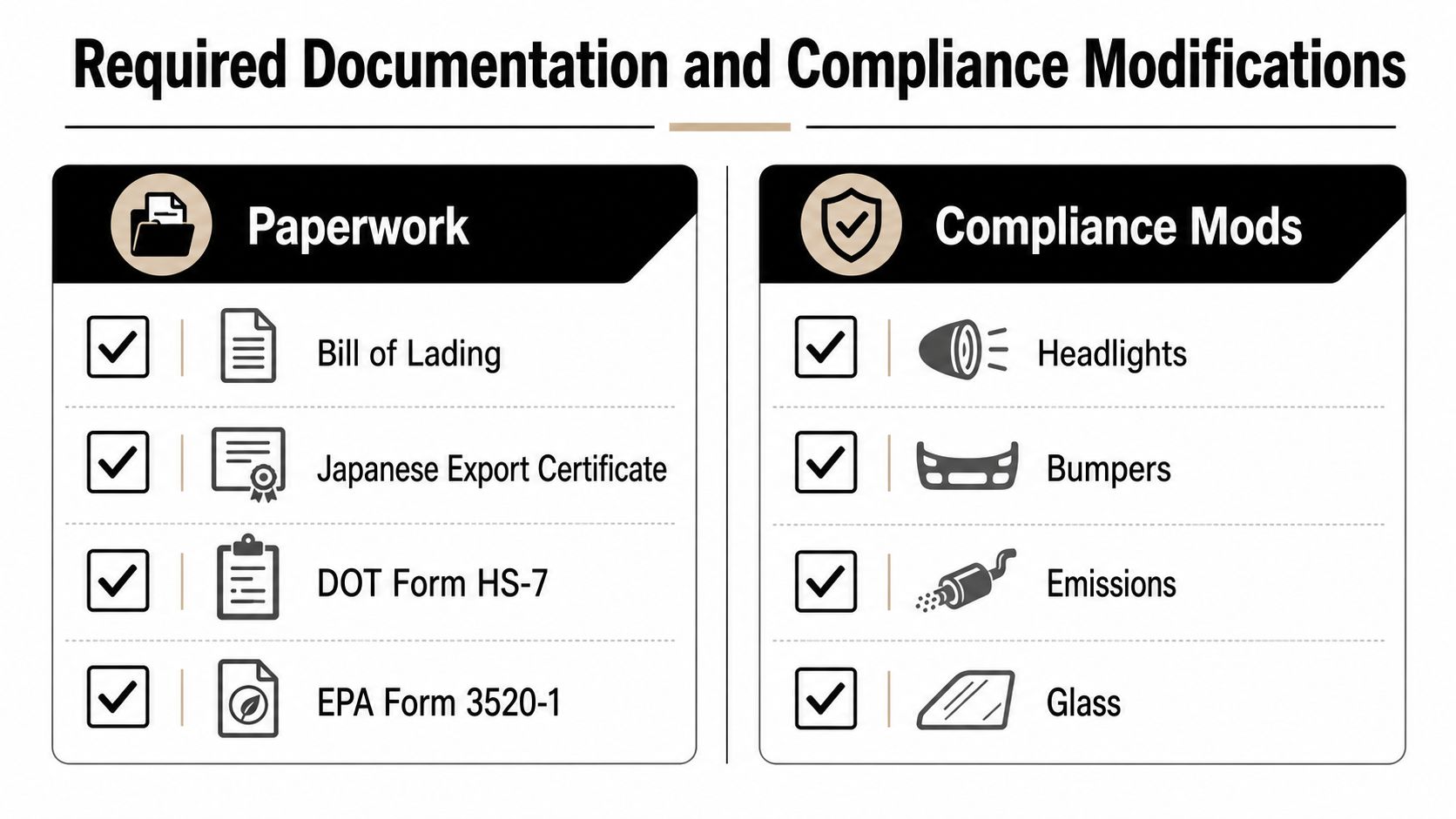
Required Documentation and Compliance Modifications
Eligibility only answers one question, whether the car can enter the U.S. under the rule set. The next problem is making it legal to keep, register, and insure. That's where the paperwork starts stacking up and the hidden condition issues start costing real money.
The documents that actually matter
The Japanese side should be clean before the car ever leaves the port. You want deregistration and export paperwork in hand, plus a shipping file that matches the vehicle identity exactly. On the U.S. side, the car needs the right customs and compliance forms, and those forms have to match the vehicle's age and status.
A car can clear the ocean and still fail at the DMV if one document or one component doesn't line up.
The physical compliance side is where many imports get stuck. NHTSA flags tires, rims, brake hoses, glazing, lamps, and reflective devices as FMVSS-sensitive equipment, so hidden issues in those parts can block registration even after the car is physically in the country (Logi-Net import guide). If you're importing a collectible or high-value JDM car, don't trust photos alone.
What I'd require before paying
- Translated condition sheets. If the seller can't explain the auction grade or inspection notes, pause.
- Detailed photos. Ask for underbody shots, lamps, glass markings, and wheel close-ups.
- Pre-purchase inspection. This is the best defense against a cosmetically clean car with paperwork or mechanical problems.
- Clear export paperwork. If the seller can't prove the car is ready to leave Japan, don't wire money.
That last point saves more imports than any bargain-hunting tactic. A translation of the condition sheet, paired with real photos, is the cheapest insurance you can buy before the car leaves Japan.
A broader reference on valuation and inspection discipline can help when the car's condition affects what you should pay, especially if you're cross-checking desirability against repair risk. That's where JDM vehicle appraisal becomes useful for buyers who need a reality check before they commit.
Shipping Options and Choosing the Right Importer
The shipping decision changes the whole experience. If the car is running and the budget is tight, one route makes sense. If the car is collectible, expensive, or fragile, the cheaper option can become the most expensive mistake in the file.
RO-RO versus container shipping
Roll-on/roll-off, or RO-RO, is usually the cheaper choice for running cars. The vehicle is driven onto the ship, secured, and driven off at arrival. That works fine for budget-minded buyers who care more about getting the car across than about added protection.
Container shipping costs more, but it gives you much better protection against damage and exposure. For high-value or collector vehicles, that extra control is often worth it. The car is boxed in, handled more carefully, and less exposed to the kind of cosmetic surprises that can turn into arguments at delivery.
| Shipping Method | Best For | Estimated Cost Range | Transit Time |
|---|---|---|---|
| RO-RO | Running, budget-conscious daily drivers | Lower than container shipping | Faster on the West Coast |
| Container | Collector cars, non-runners, high-value imports | Higher than RO-RO | Longer on the East Coast |
Why the importer matters
A broker can file forms, but an importer of record is the party that keeps the shipment moving when customs wants a clean answer. For a first-time buyer, a licensed importer of record often saves time because the customs paperwork, port communication, and follow-through don't have to be learned mid-shipment.
The timeline also depends on where the car lands. Realistic guides point to about 4 to 8 weeks on the West Coast and 8 to 14 weeks on the East Coast (Car From Japan import guide). That's not just travel time, it's the whole chain from booking to arrival and release.
If the car is a daily-drivable project and the budget is tight, RO-RO can make sense. If it's a collector piece, a full-service importer and container protection aren't extras, they're the cost of not gambling with a rare car.
Complete Cost Breakdown and Hidden Expenses
Auction price is the number that gets people excited. The total landed cost is the number that decides whether the import still makes sense once the car is in the country, cleared, and ready to register.
The real cost breakdown
The first fee most buyers expect is the 2.5% duty on most passenger cars, but that is only one piece of the bill. Ocean freight, customs processing, importer of record charges, compliance modifications if the car needs them, domestic transport, and state taxes or registration costs all stack on top of the purchase price. The budget is the full chain of costs, not a single line item.
A buyer looking at a $15,000 auction purchase should be prepared for the total to rise well beyond the hammer price once shipping, duty, paperwork, and inland delivery are added. In practical terms, the spread can be large enough to change the decision between importing and buying locally.
The cleanest way to avoid surprises is to price every step before you bid. That includes port charges on both ends, storage if the car sits, broker fees, and any inspection or compliance work that a car needs before it can be legally driven.
How policy can change the math
Trade policy can move faster than a buyer's budget. Recent reporting says U.S. and Japan trade talks would set the U.S. tariff on Japanese cars at 15%, combining a new 12.5% tariff with the prior 2.5% MFN rate (S&P Global Automotive Insights). Buyers should treat that kind of change as a live cost variable, not a footnote.
The other place budgets get distorted is valuation. A car that looks cheap on auction paper can become expensive once customs, freight, and compliance are counted together, which is why an import vehicle valuation check belongs early in the process. If you want a practical overview of the paperwork discipline behind cross-border sourcing, how to import from Japan shows how much the process depends on clean documents even when the destination market is different.
A JDM import only makes sense if the full landed cost still works after all the hidden expenses are added. That includes the appraisal side too, and a focused JDM vehicle appraisal helps keep the purchase price anchored to what the car is worth after it clears, not just what it cost at auction.
Customs Clearance and State Registration Process
The final stretch is where a clean shipment can still stall. Customs doesn't care that the car is popular on forums, and your state DMV won't care how rare the model is if the paperwork is incomplete or the vehicle doesn't meet local rules.
What happens at the port
The vehicle clears through U.S. Customs and Border Protection, and any agriculture inspection has to be handled if it applies. The key forms, including HS-7 and EPA Form 3520-1, need to match the vehicle's age and compliance status, and the customs entry has to line up with the bill of lading and export documents.
If CBP flags the car for additional inspection, the delay can stretch fast. That's why the paperwork set should be complete before the vessel arrives, not assembled after the fact. A car that is physically present but administratively incomplete is just storage and stress.
State rules are where reality gets local
State titling rules vary. Some states want emissions testing, some only verify the VIN, and a few have extra restrictions that can affect right-hand-drive vehicles. This is why a car can be cleared federally and still sit if the local DMV wants a different document set.
A port choice can help. Major West Coast ports like Los Angeles and Long Beach handle a high volume of Japanese imports, so the customs officers and state DMV staff there are generally more familiar with the flow. That doesn't make the process effortless, but it does reduce the odds of explaining the same import basics to multiple people.
Bring the full file before the ship docks, not after it lands.
If you're working through classification questions, the detailed US HTS compliance tips from Logivo are useful because tariff classification errors can complicate the release process just as much as missing forms.
The cleanest handoff is simple. Have the bill of lading, export documents, HS-7, EPA paperwork, and proof of payment ready before the vehicle arrives. If those items are complete, state registration becomes a paperwork exercise instead of a rescue mission.
Common Mistakes and Cost-Saving Strategies
The same mistakes keep showing up because the import process rewards patience and punishes assumptions. Buyers lose money when they treat model year and eligibility as the same thing, skip the pre-purchase inspection, or ignore how much compliance work and transport can add to the final bill. They also overpay when they chase the lowest shipping quote without thinking through what the car can handle.
The mistakes that wreck otherwise good deals
The biggest mistake is buying before verifying the actual build date. That one detail decides whether the car clears the 25-year rule, and it is the fastest way to turn a promising import into a stalled deposit. The next mistake is trusting a glossy auction listing instead of the condition sheet, which is where corrosion, missing parts, and weak documentation usually show up.
Another frequent problem is choosing the cheapest freight option for a car that cannot absorb risk. A rough daily driver can handle more handling and a little more uncertainty than a rare Skyline or RX-7. A collectible car should not be treated like a commodity shipment, because damage, delays, or sloppy transfer points can erase any savings fast.
What saves money
- Buy when auction pressure is softer. Timing matters, and patient buyers often get better inventory selection instead of panic-bidding.
- Demand all-in broker pricing. Clear quotes reduce the surprise fees that appear after the car is already moving.
- Handle customs yourself only if you are comfortable with the forms. If not, pay for help and avoid expensive mistakes.
- Source compliance parts in the U.S. when you can. Domestic suppliers often beat exporter markup on common parts.
- Ask for the translated condition sheet before payment. That check is simple, and it keeps you from paying for a car that looks right but documents poorly.
Small savings matter, but only if they do not create a bigger problem later. A cheaper broker fee means very little if the paperwork slows the release or the vehicle needs extra work just to become registerable.
Budget with policy uncertainty in mind
Tariff policy can shift the final cost picture for future imports, so leave room in the budget instead of assuming today's rate will hold forever. That matters most when you are comparing two cars and one of them leaves no margin for customs, transport, or surprise repairs. A tight budget can turn a fair purchase into a stressful one before the car even leaves the port.
If you are ready to move, start with the actual build date on the exact chassis you want. If the date clears the rule, ask for the translated condition sheet, confirm the export paperwork, and contact a licensed importer of record before money changes hands.