You bought the imported car because it wasn't interchangeable. It had the spec you wanted, the paperwork you chased down, the history you verified, and the market appeal that ordinary valuation tools don't capture. Then an accident happens, the insurer runs its software, and the number on the settlement offer looks like it belongs to a different car.
That disconnect is where most import owners get trapped. They assume the insurer must be using some official, complete measure of value. In reality, insurance companies often use systems built for common domestic vehicles, not niche imported cars with unusual compliance history, scarce comparables, or enthusiast demand. If you own an imported vehicle, you need to understand how value is analyzed, where the insurance process breaks down, and what you can do when the offer is wrong.
Why Your Imported Car's Value Is Misunderstood
A common claim scenario goes like this. Your imported coupe or SUV gets hit. The repair estimate is high, or the insurer declares a total loss. A few days later, you receive a valuation packet full of “comparable vehicles” that aren't really comparable at all. Wrong trim. Wrong market. Wrong history. Sometimes they aren't even legitimate import equivalents.

The first mistake is assuming customs value and insurance market value are the same thing. They aren't. In the United States, the foundational method for determining import vehicle valuation is Transaction Value, which accounts for over 90% of all imported goods valuation cases and is defined as the price paid or payable for merchandise sold for export to the U.S. That customs figure is legally separate from what the vehicle is worth later in the market for an insurance claim, as explained in this customs valuation overview.
Customs value isn't claim value
Customs law asks one question. What was the proper declared import value at entry?
Insurance asks a different question. What was the vehicle worth in its actual market immediately before the loss, or how much market value did it lose after the accident?
Those are not interchangeable analyses. A vehicle can be legally imported at one figure and later command a very different amount because of collector demand, legal compliance status, rarity, provenance, or market scarcity. Insurers blur that distinction all the time, especially when they want a fast file closure.
Practical rule: If the insurer treats your imported car like a standard domestic VIN in a pricing database, the valuation is already suspect.
Standard insurance tools miss what buyers actually pay for
Imported cars don't trade like commuter sedans. Buyers pay for details. They care whether the car was properly federalized, whether the import path was clean, whether the title history is consistent, and whether the car has the right components and records. Generic valuation software usually reduces all of that into a bland year-make-model estimate.
That's why owners feel insulted by the first offer. They should. The insurer may be pricing a category. You own a specific vehicle.
The core problem in import vehicle valuation is simple. Insurance systems are optimized for speed and volume. Imported cars require judgment, documentation, and market-specific research. If your claim involves a rare import, a specialty appraiser sees a real vehicle in a real market. The carrier's software often sees a placeholder.
Five Factors That Determine Your Import's Real Value
The U.S. imported passenger vehicles valued at approximately $192 billion in 2018, and automobiles made up roughly 8.3% of total U.S. imports, according to Statista's vehicle import data. That market is enormous, and it's far too broad for a one-size-fits-all pricing model.
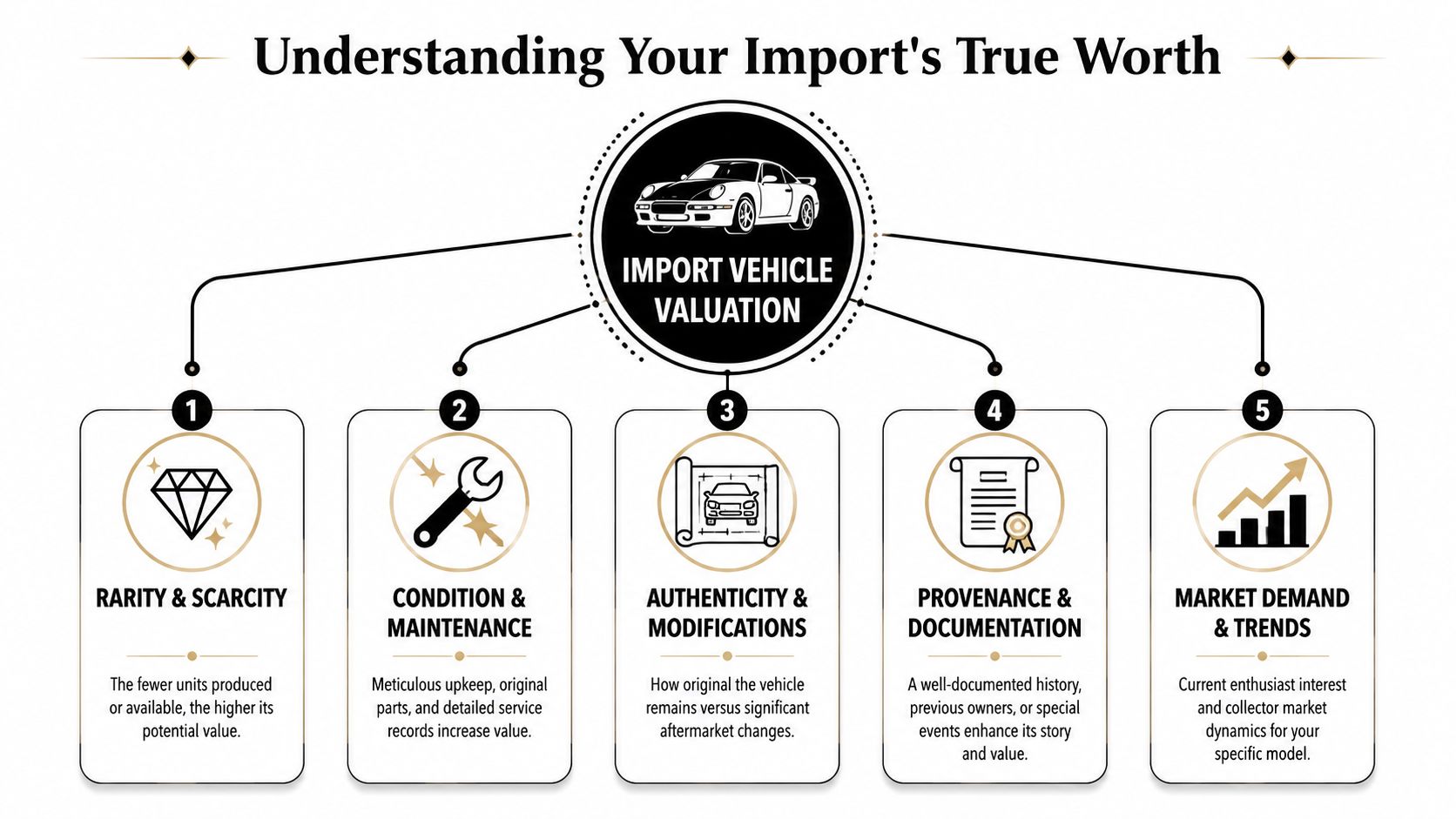
Compliance and legality
An imported vehicle with complete, coherent import documentation is worth more than one with unanswered legal questions. Buyers want confidence. They want to know the car can be titled, registered, insured, and resold without a headache.
Look closely at:
- Import paperwork: Entry records, customs documents, and supporting compliance records matter.
- Title status: A clean, transferable title with no odd gaps carries more weight than a file full of corrections.
- Regulatory path: If the car required federalization or specific conformity work, proof of that work is part of the value story.
Missing paperwork doesn't just create hassle. It narrows the buyer pool.
Rarity and provenance
Not every imported car is valuable because it's imported. Some are scarce, some are famous within enthusiast circles, and some have ordinary specs with no premium market at all. Value comes from the specific vehicle's place in the market.
A strong valuation looks at questions like these:
- Production significance: Was it a limited configuration or an ordinary export-market trim?
- Ownership history: Long-term ownership and traceable records help.
- Documented story: Original sales literature, auction history, service binders, and import records support credibility.
A rare import without proof is just a claim. A rare import with documentation is evidence.
Parts and serviceability
This factor gets ignored until money is on the table. If replacement parts are difficult to source, if body panels are market-specific, or if only a handful of shops will service the vehicle correctly, those realities affect both desirability and claim analysis.
Buyers think about downtime, repair quality, and future ownership burden. Appraisers should too.
Condition and modifications
Condition drives value, but with imports, the wrong modifications can either help or hurt depending on the buyer pool. Some markets reward period-correct upgrades. Others punish non-original changes, especially if the work is undocumented or poorly executed.
Use a hard standard here:
- Mechanical condition: Fresh maintenance with records carries weight.
- Cosmetic quality: Paintwork, interior originality, trim condition, and corrosion matter.
- Modification quality: Professional installation and receipts beat vague seller claims every time.
Market demand for your exact version
Many insurance valuations collapse. They stop at make and model. Real buyers don't. They care about drivetrain, chassis code, import origin, trim, equipment, mileage story, and whether the car checks boxes enthusiasts search for.
A proper import vehicle valuation should identify your car's actual market, not the nearest generic substitute. That might mean specialty dealers, enthusiast marketplaces, marque-specific communities, or private-party sales where informed buyers pay informed prices.
How Vehicles Are Valued and Why Insurers Get It Wrong
Insurance companies talk about value as if there's one accepted formula. There isn't. Different valuation methods answer different questions. The problem starts when the insurer uses the fastest method instead of the right one.
Three methods, three very different results
A competent appraiser usually works from market evidence first. That means actual comparable sales, active listings adjusted with judgment, condition analysis, and documentation review. Insurers often lean on Actual Cash Value, or ACV, generated through software and limited market feeds.
Here's the side-by-side problem.
| Method | Used By | Data Source | Accuracy for Imports |
|---|---|---|---|
| Comparable sales | Independent appraisers | Specialty listings, private sales, dealer inventory, enthusiast market research, vehicle-specific documentation | High when the appraiser understands the niche market |
| Cost to replace | Appraisers handling unique or hard-to-source vehicles | Replacement search, import costs, parts availability, market scarcity, build documentation | Useful when true comparables are thin |
| Actual Cash Value | Insurance carriers | Valuation software, broad databases, dealer and auction feeds, standardized adjustments | Often weak for imported vehicles |
Why ACV falls apart on imported cars
ACV sounds objective. In practice, it can be crude. The software may pull vehicles that are merely similar on paper, then make formula adjustments that flatten the very details driving your car's real market value.
That's how owners end up with bad comparisons such as:
- Domestic substitutes instead of authentic import-market equivalents
- Wrong trim or drivetrain sold into a different buyer base
- Listings without documentation compared against a fully documented example
- Auction-oriented data that reflects distressed transactions, not enthusiast purchases
The result looks official because it arrives in a report. But formatting isn't proof.
What a proper appraisal does differently
A real appraiser starts with the vehicle itself. The file should include photos, condition observations, records, title history, import documentation, and the specific facts that make the car marketable. Then the appraiser finds comparables that share the characteristics actual buyers care about.
That process is slower. It's also more defensible.
If you want a plain-language breakdown of how insurers typically build their numbers, read how insurance companies value a car. It helps you spot where the carrier's report may be substituting convenience for accuracy.
The insurer's valuation packet is not the final word. It's the opening position.
The issue isn't software itself
Software is fine for ordinary vehicles with thick local market data. It fails when the market is thin, specialized, or distorted by factors generic databases don't track well. Imported cars often check all three boxes.
That's why import vehicle valuation requires an appraiser who understands both market behavior and claim strategy. The goal isn't to attack every carrier estimate on principle. The goal is to expose bad comparisons and replace them with credible ones.
The Two Insurance Fights Import Owners Face
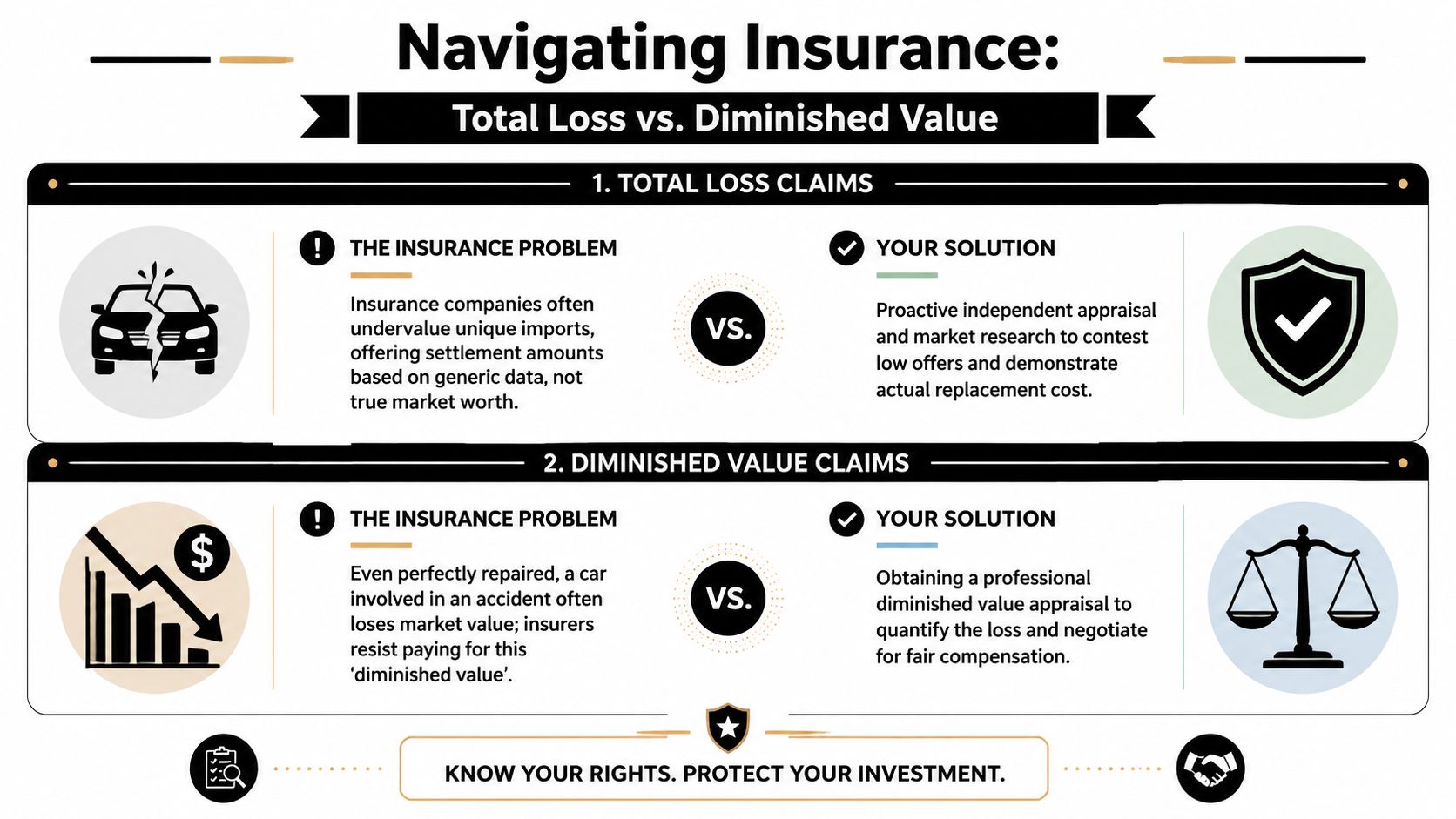
Imported vehicle owners usually face one of two fights after a crash. Either the insurer says the car is a total loss and undervalues it, or the car gets repaired and the insurer pretends the accident didn't permanently hurt resale value. Both positions are common. Both deserve pushback.
Total loss claims
A total loss dispute is brutal for import owners because the wrong number doesn't just reduce a settlement. It can make replacement impossible. If the insurer underprices your car, you may not be able to find a comparable import in the current market for the amount offered.
That problem gets worse in volatile import markets. Recent data indicates imported vehicle prices rose by approximately 19% due to tariffs, while insurer algorithms often rely on older domestic pricing databases that ignore those import premiums, as discussed in Resources for the Future's analysis of import tariffs and the vehicle market. When software ignores scarcity and acquisition realities, owners get lowballed.
The insurer may still act as if its offer is neutral. It isn't. It reflects the limitations of the inputs.
What to challenge in a total loss file
- Bad comparables: Reject vehicles that aren't legitimate equivalents.
- Shallow adjustments: Generic mileage or options tweaks don't fix a wrong market match.
- Missing import premium: If the market pays more for legally imported, documented examples, that needs to be recognized.
- Condition flattening: A clean, well-kept enthusiast vehicle shouldn't be priced like an average used car.
Diminished value claims
Diminished value is the money your car loses because it now carries an accident history, even after proper repairs. Imported cars are especially vulnerable here because buyers in this segment are picky. They pay attention to originality, paintwork, structural history, and disclosed damage.
A repaired imported vehicle may still drive perfectly. That doesn't restore its pre-loss market position.
Insurers resist diminished value because it's harder to automate. There's no easy checkbox for how much an accident changed buyer behavior in a niche market. So they often minimize it, deny it, or offer a token amount that has little connection to real resale damage.
When a buyer can choose between two similar imported cars, the one without accident history usually wins. That difference is value loss.
Why imported cars suffer sharper resale stigma
Not every imported vehicle loses value for the same reason. Some lose value because collectors want originality. Others because replacement parts and repair methods are harder to verify. Some because buyers fear hidden title or parts issues after a collision. The point is the same. The accident changes the market conversation.
That's why a diminished value claim on an imported car shouldn't be handled with generic formulas built around standard daily drivers.
Your right to force a better valuation process
Most owners argue with adjusters too long before using the right tool. If your policy includes an appraisal clause, use it. That clause can shift the dispute out of the insurer's internal valuation loop and into a more balanced process with appraisers. If you're not familiar with how that works, read this explanation of the appraisal clause and how it affects a value dispute.
The appraisal clause matters because it provides an advantage. You stop debating opinions with a desk adjuster and start building an evidence-based valuation with an independent expert. That's the right battlefield for import claims.
How to Get and Defend an Independent Appraisal
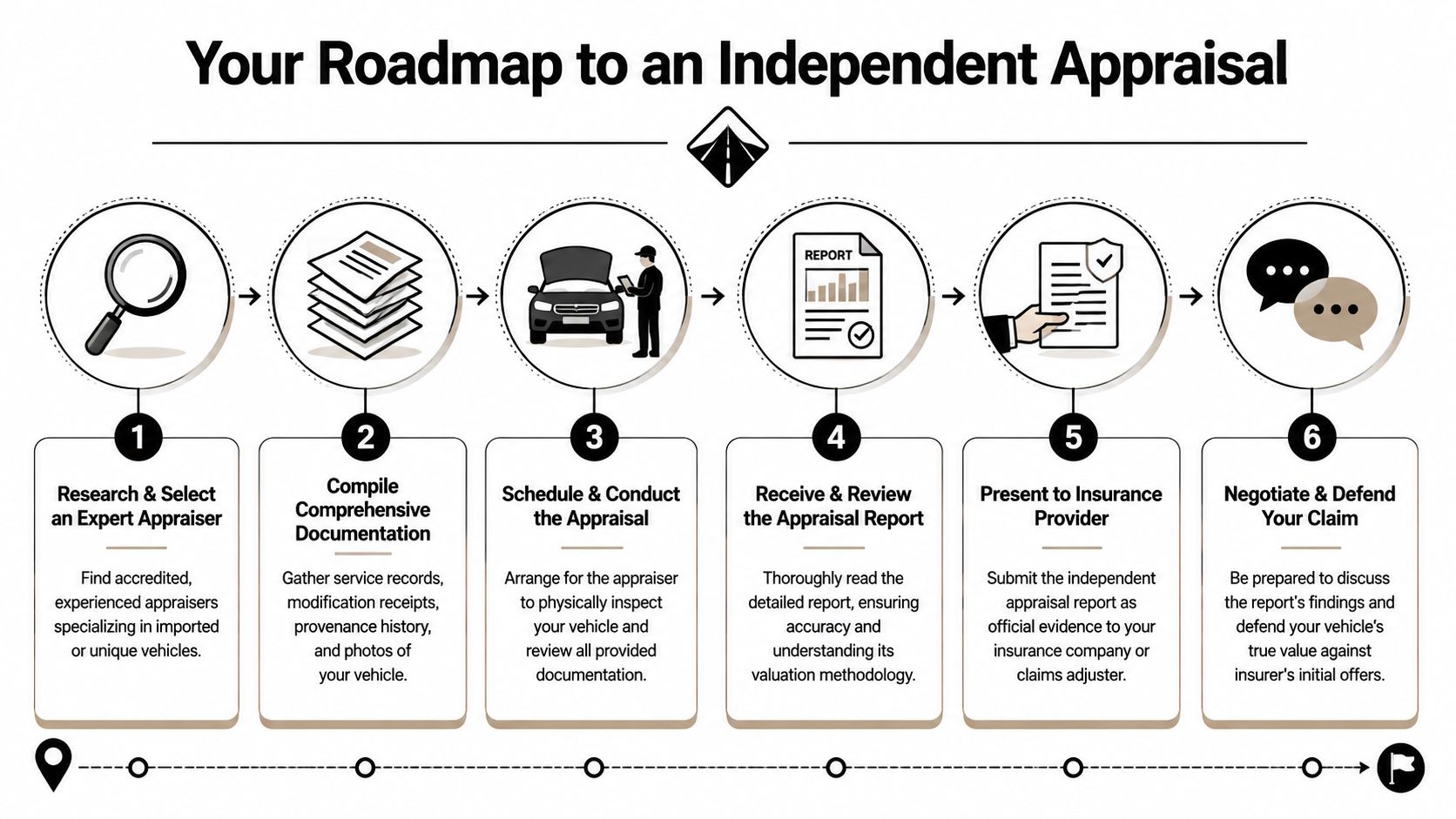
Most owners wait too long to get help. They send screenshots, argue over line items, and hope the adjuster suddenly understands the imported vehicle market. That rarely works. A better move is to build a clean appraisal file early and present it in a way the insurer can't casually dismiss.
Start with the right appraiser
Not every appraiser is qualified to value an imported car. You want someone who understands niche markets, documentation, and claim disputes. General experience alone isn't enough.
Look for:
- Import-specific familiarity: They should know the difference between a generic comp and a real one.
- Claim experience: They need to write reports that stand up in negotiation.
- Clear methodology: If they can't explain how they reached value, don't hire them.
If you need a baseline for what to look for, review this guide to choosing an independent car appraiser.
Build your evidence file before the insurer defines the car for you
Strong appraisals are document-driven. Don't make the appraiser guess.
Gather these items:
- Import records including customs paperwork, entry documents, and compliance records.
- Title and registration history showing the vehicle's legal status and continuity.
- Service and maintenance records that prove condition, not just claims about condition.
- Modification receipts if upgrades are relevant and professionally done.
- Pre-loss photos showing paint, interior, wheels, trim, engine bay, and mileage.
- Post-loss repair records or damage photos depending on whether the claim is total loss or diminished value.
Review the report like it matters, because it does
Don't just forward the appraisal blindly. Read it. Make sure the report identifies the right configuration, options, market, documentation, and condition. If something is incomplete, fix it before the insurer attacks it.
Claim posture: The strongest appraisal is the one that answers objections before the adjuster raises them.
Invoke the appraisal clause properly
If your policy allows it, follow the policy language exactly. Give written notice. Keep copies. Stay organized. Don't rely on phone conversations to preserve your rights.
For owners in Oregon and Washington, the practical rule is simple. Be formal, be timely, and document every exchange. Insurance disputes get easier when your paper trail is cleaner than theirs.
Be ready to defend, not just submit
An appraisal report is evidence, not magic. The insurer may push back on comparables, methodology, or condition adjustments. That's normal. The answer is not anger. The answer is a stronger factual file.
Defend the report with:
- Vehicle-specific records
- Clear import history
- Market-appropriate comparables
- A coherent explanation of why the insurer's data set is wrong
If the process goes to an umpire or a formal appraisal proceeding, organization wins. Owners who keep records, respond promptly, and use qualified experts put themselves in a much stronger position.
Taking Control of Your Vehicle's True Worth
Imported car claims go wrong when owners accept the insurer's first framing of the vehicle. Once the car gets reduced to a generic database entry, everything downstream gets smaller. The settlement shrinks. The repair stigma gets minimized. The actual market for the vehicle disappears from the file.
That's why import vehicle valuation has to be handled differently. The right question isn't what a broad pricing system says. The right question is what your specific imported vehicle was worth in its real market, or how much that market value dropped after the accident. Those are evidence questions, not software questions.
If you want a helpful consumer reference for basic valuation context, SnapClaim's car valuation guide is a useful starting point. For imported vehicles, though, you usually need to go further than broad consumer tools and demand a valuation process built around the actual car.
You don't need to accept weak comparables, shallow reports, or settlement numbers that ignore documentation, scarcity, and buyer behavior. You have the right to challenge the valuation, the right to document the vehicle properly, and in many cases the right to invoke the appraisal clause and force a better process.
Don't treat that as being difficult. Treat it as being accurate.
If you're in Oregon or Washington and an insurer is undervaluing your import, Total Loss Northwest can help you fight the number with a certified independent appraisal. They handle total loss and diminished value disputes, invoke the appraisal clause, and build market-based reports designed to hold up in negotiation.