You've dealt with the crash, the tow, the phone calls, and the headache of being without your car. Then the insurer sends its valuation and your stomach drops. The number doesn't match what your vehicle was worth in your area, it doesn't reflect the condition you kept it in, and it definitely doesn't feel like enough to replace what you lost.
That reaction is usually correct.
When people ask me about the insurance claim value of a car, they're often asking a simpler question: “Why is the insurance company acting like my car was worth less than every similar vehicle I can find for sale?” The answer is that insurers don't start with your lived experience. They start with software, depreciation models, and deductions that tend to cut the number down unless you challenge them.
If you're in Oregon or Washington, don't accept the first figure just because it arrived on official letterhead. A low offer is an opening position. Treat it that way.
The Shock of the First Lowball Offer
A common sequence goes like this. Your car gets hit. The body shop says repairs may be too high. The adjuster sounds calm and efficient on the phone. Then the valuation report lands in your inbox, and the offer is nowhere near what you expected.
You start checking local listings. Vehicles like yours seem to be advertised for more. Your car had newer tires, a clean interior, complete service history, and options that mattered. The insurer's number still looks thin. That isn't paranoia. It's often the first sign that the company's valuation process is built to protect its payout, not your equity.
Repair costs have climbed, and the severity of claims has gone up with them. The Insurance Information Institute states that by 2026, the average collision claim value rose to approximately $6,840, marking an 18% increase from 2023 levels, and for some vehicles with advanced sensors, a single claim can easily exceed $12,000 via the Insurance Information Institute auto insurance facts. As cars get more expensive to repair, insurers lean harder on valuation systems that control the total loss side of the file.
You don't have to prove the insurer is acting maliciously. You only have to prove the number is wrong.
In Oregon and Washington, I see the same mistake over and over. Drivers assume the first offer is based on a neutral market assessment. It usually isn't. It's based on the insurer's selected data, insurer's chosen adjustments, and insurer's interpretation of your vehicle's condition. That's why so many owners end up researching what to do after a lowball insurance settlement offer.
What the low offer usually leaves out
- Your local market reality: Listings and sale activity in your area may support a higher number than the report shows.
- Your vehicle's actual condition: Clean ownership history, maintenance records, and major recent work can matter.
- Trim and equipment differences: A base model comp is not a match for a better-equipped vehicle.
- Negotiation advantage: Many do not realize they can formally dispute the valuation.
The first offer feels final because insurers present it that way. It isn't final unless you accept it.
What Is the Insurance Claim Value of a Car
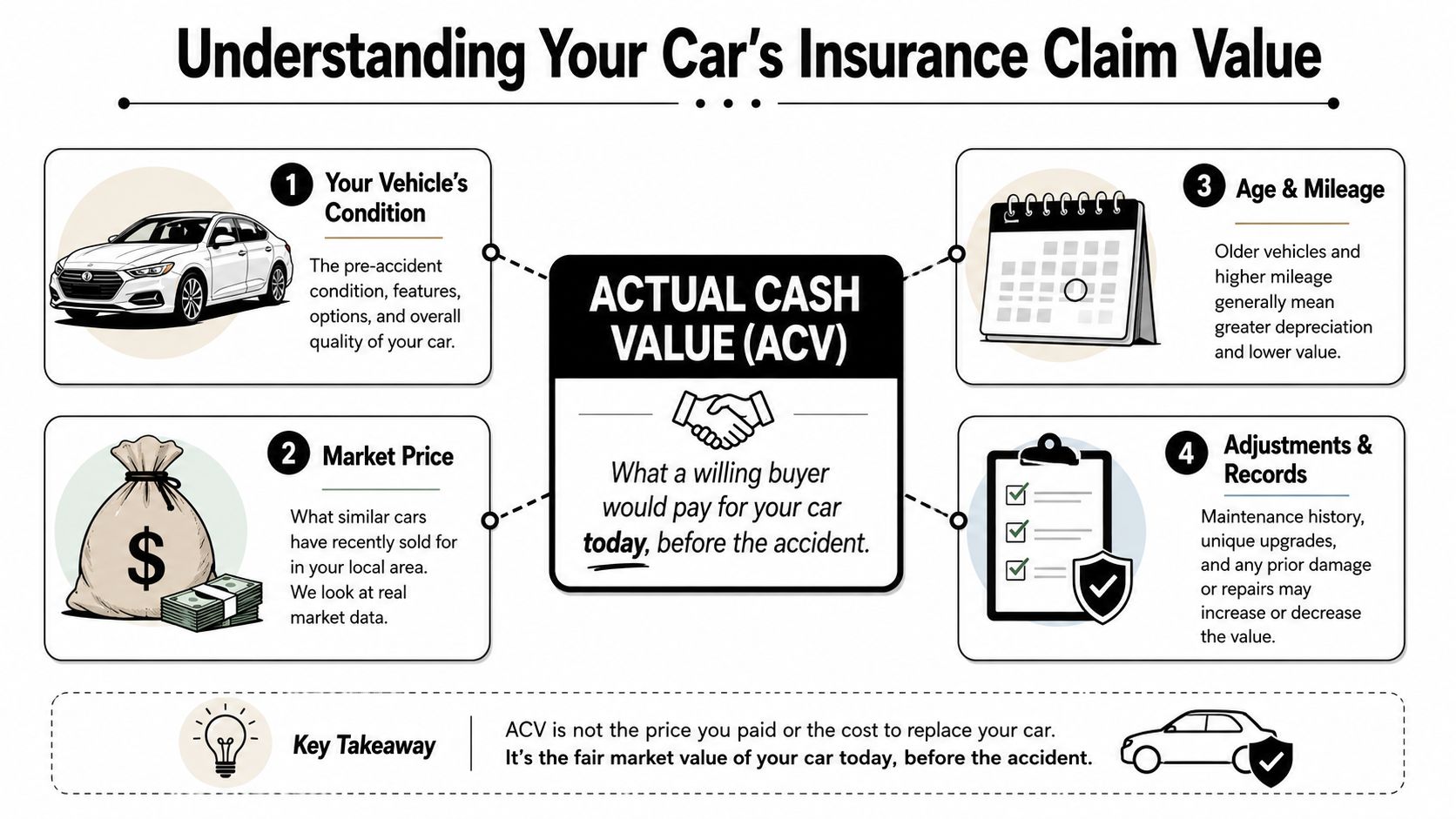
The insurance claim value of a car in a total loss case usually comes down to Actual Cash Value, or ACV. Strip away the jargon and ACV means one thing: what a willing buyer would have paid for your car immediately before the accident in its real-world condition and local market.
That's the number that matters. Not what you paid years ago. Not what you still owe. Not what a brand-new replacement costs.
ACV is not your loan balance
Individuals are often blindsided. If you owe more than the car's market value, the insurer still doesn't care about the loan number for valuation purposes. Investopedia explains that a car is generally declared a total loss when repair costs exceed a percentage of its value, typically 51% to 80% depending on the state, and the payout is based on Actual Cash Value, not what you owe on your loan in its guide to how car insurance companies value cars.
That distinction matters because many owners mentally anchor to one of three wrong numbers:
| Number people focus on | Why it's not the claim value |
|---|---|
| Purchase price | Your car depreciated after you bought it |
| Loan payoff | Debt doesn't determine market value |
| Replacement cost | ACV reflects pre-accident market value, not the price of a new equivalent |
What counts toward ACV
ACV is a market snapshot. A proper valuation should consider factors like:
- Year, make, model, and trim: The trim line matters. So do factory options.
- Mileage and condition: Lower mileage and better condition usually support a stronger value.
- Local comparables: Oregon and Washington pricing can differ from other regions.
- Documented maintenance and upgrades: Records help support condition and marketability.
If you use your vehicle in a way that affects coverage or claim handling, it's worth understanding how insurers classify that use. A practical overview from Copeland Insurance Agency on business use on car insurance is useful if your driving pattern includes work-related use beyond a normal commute.
Why total loss rules feel inconsistent
Owners in Oregon and Washington often assume there's one universal rule for when a car is totaled. There isn't. Thresholds vary, and insurers also apply their own handling practices inside that legal framework. That's why two vehicles with similar damage can end up on different paths.
Practical rule: Don't argue from emotion. Argue from pre-accident market value.
If you remember only one thing, remember this: the insurer is valuing the car you had one minute before the collision. Your job is to prove what that car was worth in your market, with your trim, your condition, and your records.
How Insurers Systematically Undervalue Your Vehicle
Insurers want you to think their valuation is objective because it came from software. Software feels neutral. It isn't neutral when people choose the inputs, the comparables, and the deductions.
Most total loss reports rely on third-party systems and data vendors. Those tools can be useful, but they also create a clean-looking report that hides weak assumptions. A bad valuation doesn't need to look sloppy. It only needs to look official.
The software is only as fair as the inputs
Terms.law notes that valuations rely on third-party data from sources like CCC Intelligent Solutions, and insurers may also deduct a “haggling factor” of 5% to 10% from comparable vehicle prices, a standard practice that can systematically underpay claimants who don't dispute it, as explained in this discussion of auto total loss valuation practices.
That haggling factor is one of the most important things drivers miss.
If a comparable vehicle is listed for sale, the insurer may treat that price as inflated and subtract a negotiation discount before using it. The problem is obvious. The car didn't sell at that reduced number. The deduction is theoretical. Yet it can push your settlement down in a very real way.
The common undervaluation tactics
Here's what I tell clients to look for in every valuation report:
- Weak comparables: The report uses cars from outside your real market area, or from lower-priced areas.
- Trim mismatch: Your better-equipped vehicle gets compared to a base model.
- Mileage distortion: The insurer uses higher-mileage comps that naturally drag value down.
- Condition downgrades: The report applies generic deductions for interior, paint, tires, or prior repairs without strong support.
- Hidden negotiation discount: That haggling factor trims comp prices before they ever help you.
Many owners don't even request the full valuation packet. That's a mistake. You need the actual report, not just the settlement number.
Read the report like an appraiser
When I review a total loss file, I'm not impressed by the report's formatting. I'm looking for errors. You should too.
Use this short audit:
| What to review | What can go wrong |
|---|---|
| Vehicle identification | Wrong trim, options, drivetrain, or package |
| Comparable vehicles | Different body style, condition, mileage, or geography |
| Condition adjustments | Vague deductions with little evidence |
| Pricing adjustments | Hidden reductions, including negotiation assumptions |
A clean PDF can still contain a bad value.
If you want a plain-language breakdown of how carriers build these reports, this overview on how insurance company value a car is worth reading before you respond to the adjuster.
Ask for the valuation report in full. If they won't show you how they got the number, that alone tells you the number needs scrutiny.
Why Oregon and Washington owners need to push back
In both states, drivers often rely on local dealer inventory, private-party listings, and regional demand that don't always line up with insurer-selected comps. The farther the insurer drifts from your real market, the easier it becomes for them to defend a number that doesn't reflect what it would take to buy a comparable vehicle locally.
Don't argue that the offer “feels low.” Point out exactly where the report cuts corners. That shifts the discussion from opinion to evidence, and that's where lowball valuations start to crack.
Understanding Diminished Value The Hidden Loss on Repaired Cars
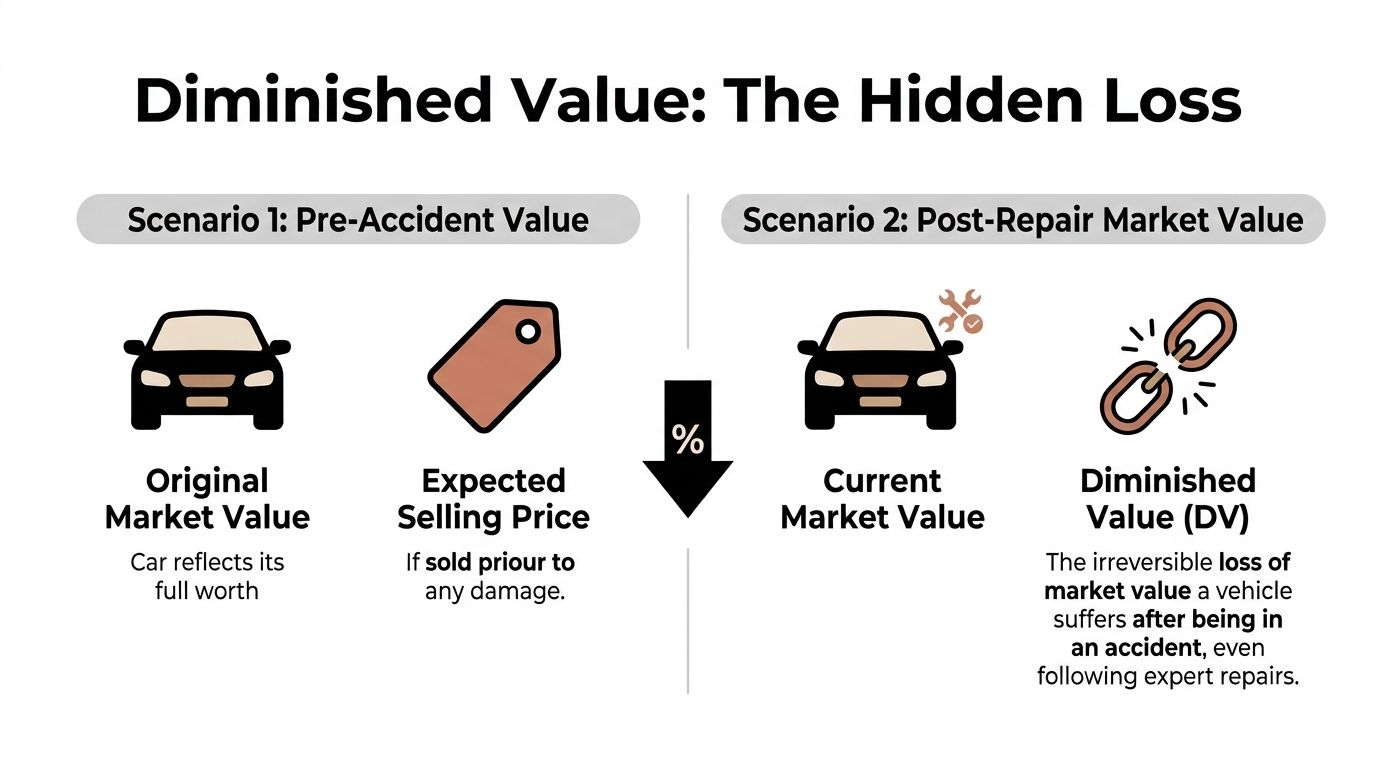
A repaired car can still be worth less. That loss is called Diminished Value, or DV. Buyers pay attention to accident history, structural repairs, and damage records. Even excellent repair work doesn't erase that stigma in the market.
This is the loss insurers hope you ignore.
A repaired vehicle is not the same asset it was before
A lot of people hear the same dismissive line after repairs: “Your car is fixed, so you've been made whole.” That's not how the resale market works. A buyer comparing two identical vehicles will usually prefer the one without an accident history.
That's why DV matters. It addresses the gap between your vehicle's pre-accident fair market value and its post-repair market value.
One of the biggest myths is that DV only applies to nearly new or luxury vehicles. That's too simplistic. The more accurate question is whether the accident created a measurable market loss that can be documented.
A useful explanation for people outside the Pacific Northwest, especially for Texas car accident victims, shows how these claims are framed and why documentation matters. The legal rules differ by state, but the market reality is the same. Accident history can reduce value.
What actually proves diminished value
The common failure point is proof. The insurer denies the claim and says there isn't enough evidence. Many owners stop there. They shouldn't.
The verified guidance you were given is right on this point. A prevalent misconception is that DV claims are only for “newer” cars, and many people abandon valid claims because nobody explains the need for a pre-loss vs. post-repair professional appraisal, as discussed in this video explanation of diminished value claim proof.
A proper DV case usually centers on:
- Pre-accident value: What the vehicle would have sold for before the collision
- Post-repair value: What the same vehicle is worth now, with accident history
- Comparable sales analysis: Market support from similar vehicles
- Repair review: Structural replacements and significant damage matter
If the repair history would make a buyer hesitate, it can affect market value. That's the heart of a DV claim.
Why formula shortcuts often fail
Some insurers lean on rigid formulas because formulas are cheap and easy to defend internally. The market doesn't buy cars with formulas. Buyers look at history reports, structural damage, brand reputation, rarity, and how clean the vehicle is compared with alternatives.
That's why certified documentation carries weight. In a DV claim, independent appraisals compare the pre-accident and post-repair market values using comparable sales data, and a detailed court-ready report typically costs $400 to $1,200, according to this explanation of diminished value appraisal cost and methodology.
A good report doesn't just give a bottom-line number. It shows the logic behind the number. That's what forces a serious response from the insurer.
How to Document and Calculate Your Cars True Value
If the insurer built a number with software, you need to build a better number with evidence. Don't send a vague email saying the offer is unfair. Send a package that makes it hard to ignore you.
Start with records. Then build comparables. Then organize everything so a stranger can understand your position in minutes.
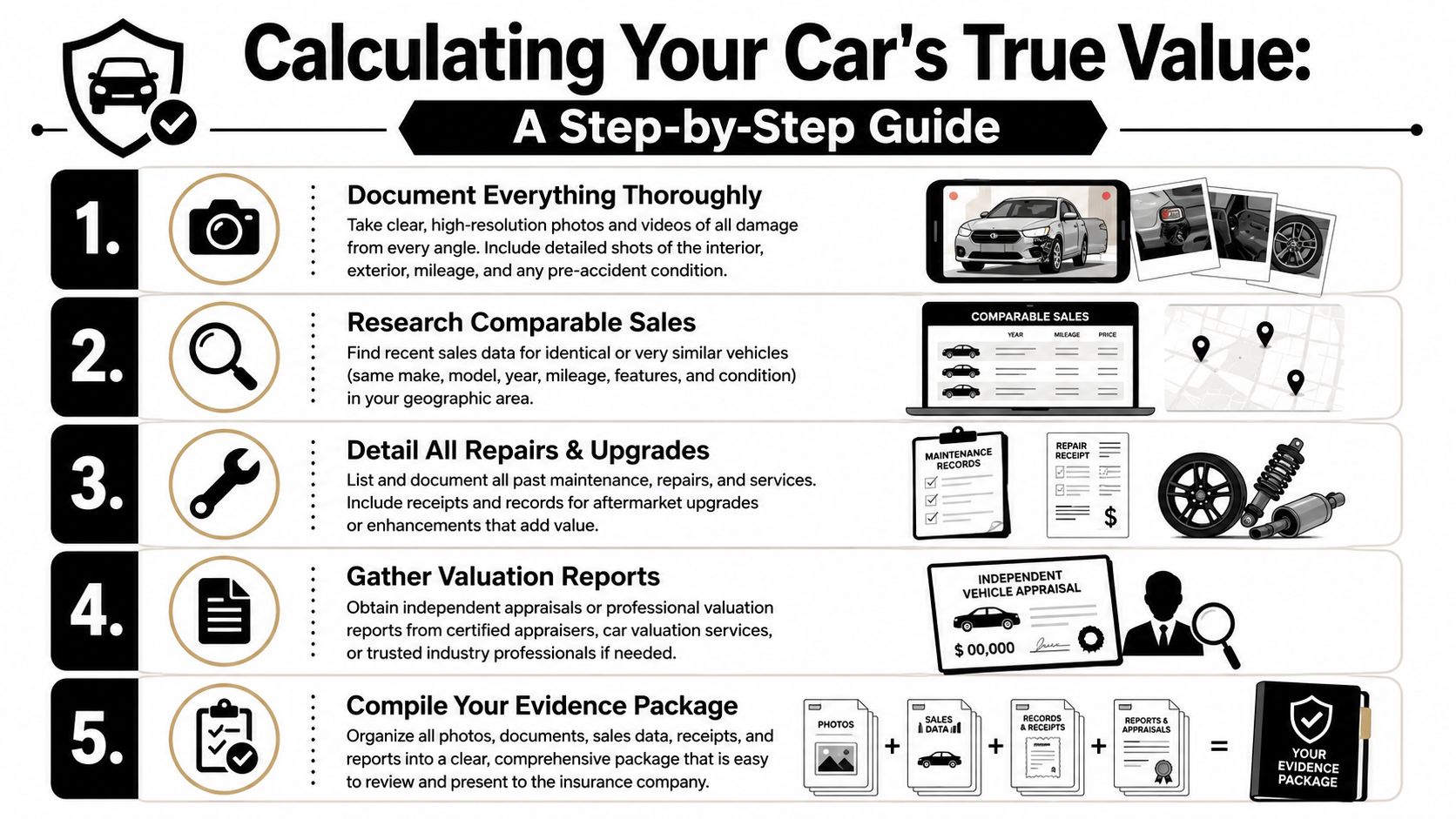
Build your evidence file first
Your file should include anything that supports pre-accident condition and market appeal.
Gather these before you argue value:
- Service records: Oil changes, major maintenance, dealer service, transmission work, brake service
- Repair receipts: Anything recent that improved reliability or condition
- Tire and battery invoices: These are small details until the insurer downgrades your condition
- Photos from before the accident: Especially helpful if they show clean paint, interior, wheels, or accessories
- Window sticker or build sheet: Useful for verifying trim and factory options
If you added premium appearance protection or finish work, document that too. Buyers may not pay full retail for detailing extras, but condition still affects marketability. For owners trying to understand how appearance investments are viewed, this practical guide on Lionheart Detailing ceramic info helps explain what those services do and how they relate to vehicle presentation.
Find the right comparable vehicles
Most owner-prepared disputes falter when they find “similar” vehicles that aren't comparable. You need close matches.
Look for vehicles with the same:
- year
- make
- model
- trim
- drivetrain
- major options
- similar mileage
- same region, if possible
Use listing platforms, dealer inventory, and local marketplaces. Save screenshots immediately. Listings disappear.
A simple way to stay organized:
| Evidence type | What to save |
|---|---|
| Comparable listings | Full screenshot, price, mileage, VIN if visible, date captured |
| Your vehicle records | PDF scans or photos of receipts and service history |
| Vehicle features | Photos or documents showing trim, packages, and options |
| Condition proof | Pre-loss photos of exterior, interior, wheels, and tires |
If you need a framework for the math side of the dispute, this guide on how to calculate fair market value lays out the logic clearly.
Here's a video that helps explain the valuation mindset before you put your packet together.
Adjust for differences instead of pretending they don't exist
Don't damage your credibility by claiming every higher-priced listing proves your case. If another vehicle has lower mileage, a better package, or certified dealer status, acknowledge that difference. Then explain why your vehicle still deserves a stronger value than the insurer offered.
Your goal is not perfection. Your goal is a defensible range.
A strong owner submission usually does three things well:
- It shows the insurer used poor comparables or weak adjustments.
- It presents better local comparables with screenshots and notes.
- It ties your specific vehicle's condition to documentation, not opinion.
Know when an independent appraisal makes sense
If the insurer is entrenched, or the value gap is meaningful, an independent appraisal can change the conversation fast. The verified data already gives the cost range for a DV appraisal report, and the same principle applies more broadly in valuation disputes. A properly supported report overrides unsupported assumptions. It turns “I think my car was worth more” into “Here is the market evidence.”
This is also the one point where using a specialist can be practical. Firms such as Total Loss Northwest prepare total loss and diminished value appraisals for Oregon and Washington owners when a carrier's valuation doesn't match the market. That kind of report is only useful if it's specific, documented, and built for negotiation.
The Negotiation Process Disputing a Low Offer
Once your file is built, stop talking in generalities. Negotiate in writing. Phone calls are fine for scheduling. Value disputes belong on paper or email where the facts stay visible.
The adjuster already has the insurer's report. Your job is to force them to confront your evidence line by line.
Send a focused written dispute
Keep it professional. Keep it concise. Don't rant. Don't threaten. Don't bury the lead.
A good dispute letter usually includes:
- The valuation you reject: Identify the date and amount of the insurer's offer
- The reason you reject it: State that the report does not reflect true pre-accident market value
- The specific errors: Wrong trim, weak comparables, improper condition deductions, poor geographic matches
- Your evidence package: Comparable listings, records, photos, receipts
- Your requested action: Re-review the valuation and issue a revised offer
You don't need legal drama. You need precision.
“I dispute the valuation because the report relies on non-comparable vehicles and unsupported condition adjustments. Attached are local market comparables, vehicle records, and documentation supporting a higher Actual Cash Value.”
That tone works. It signals you're organized and not going away.
Attack vague deductions directly
One of the easiest places to challenge a valuation is the adjustment section. The verified data on ACV disputes notes that tools like Black Book and NADA are used in valuation, and disputes often arise when insurers apply vague deductions, such as $1,200 for “moderate interior wear,” which independent appraisers can counter with specific comparable sales data, as outlined in this discussion of how insurers determine car value and where ACV disputes arise.
That example matters because it exposes the insurer's habit of using broad labels without granular support.
If they deducted for condition, ask:
- What photos support that deduction?
- What specific damage was observed?
- How did they calculate the adjustment amount?
- Did they apply the same standard to every comparable vehicle?
If they can't answer those questions cleanly, the deduction is vulnerable.
Use the appraisal clause if the carrier stalls
This is your strong position. Many policies include an appraisal clause or right to appraisal. It's a contractual process for resolving value disputes.
The process is usually straightforward:
| Step | What happens |
|---|---|
| You invoke appraisal | You notify the insurer that you dispute value and elect appraisal under the policy |
| Each side selects an appraiser | You hire yours, the insurer hires theirs |
| Appraisers try to agree | They review the vehicle and market evidence |
| If they don't agree | A neutral umpire resolves the remaining dispute |
For Oregon and Washington owners, this can be especially effective when the insurer is hiding behind a software report and refusing to engage with stronger local comparables. Appraisal forces a real valuation process instead of a one-sided one.
Don't negotiate against yourself
A lot of owners weaken their own case by saying things like, “I'd probably take a little more” before the insurer has answered the evidence. Stop doing that.
Use this sequence instead:
- Reject the current offer in writing.
- Attach your supporting packet.
- Ask for a revised valuation by a clear deadline.
- If they dodge the evidence, raise appraisal.
You don't need to be aggressive. You need to be disciplined.
When to Hire a Professional Total Loss Appraiser
Some claims are manageable on your own. Some aren't. If the dispute is small and the errors are obvious, you may get movement by sending a solid evidence package and pushing back once or twice.
But there are situations where doing it yourself costs you more than it saves.

Bring in help when the claim gets technical
Hire a professional appraiser when:
- The insurer won't justify the report: If they keep repeating the same number without addressing your evidence, you need a stronger response.
- Your car isn't easy to value: Collector cars, rare trims, modified vehicles, and high-option vehicles often confuse automated systems.
- The condition story matters: If your car was unusually clean, well-maintained, or recently improved, an appraiser can document what the software missed.
- You're pursuing diminished value: DV claims live or die on proof.
- You're preparing for appraisal: The process works better when your side is represented by someone who understands valuation methodology.
The real reason professional appraisals matter
A professional doesn't help because they use fancier language. They help because they know how insurers build numbers, where those numbers break down, and how to replace weak assumptions with market-supported analysis.
If you're in Oregon or Washington and the offer doesn't match reality, treat the insurer's valuation as a draft, not a verdict. The moment you stop assuming the report is correct, you put yourself in a position to recover what the car was worth.
If the insurance company's number doesn't reflect your car's real pre-loss market value, get an independent review before you sign anything. Total Loss Northwest handles total loss and diminished value appraisals for Oregon and Washington owners, including appraisal clause disputes when a carrier relies on biased valuation software and weak deductions.